Coherent spectroscopy of collective excitations in superfluid helium far from equilibrium
Pith reviewed 2026-05-20 00:45 UTC · model grok-4.3
The pith
Time-resolved optical birefringence tracks nonequilibrium dynamics of maxon pairs and Pitaevskii plateau excitations in superfluid helium.
A machine-rendered reading of the paper's core claim, the machinery that carries it, and where it could break.
Core claim
Ultrafast coherent control with femtosecond pulse sequences, combined with time-resolved optical birefringence detection, permits direct observation of the nonequilibrium dynamics of maxon pairs and Pitaevskii plateau excitations in superfluid helium; the measurements show that maxon pairs are strongly bound, possess very short lifetimes, and that the phase of the coherent signal is influenced by the quasiparticle effective mass.
What carries the argument
Ultrafast coherent control using sequences of femtosecond pulses and time-resolved optical birefringence, which isolates the oscillatory response of specific quasiparticle pairs in the Landau excitation spectrum.
If this is right
- The technique extends coherent spectroscopy to multiple branches of the excitation spectrum beyond the roton regime.
- Maxon pairs in superfluid helium exhibit stronger binding and shorter lifetimes than roton pairs under far-from-equilibrium conditions.
- The phase of the coherent response scales with the effective mass of the participating quasiparticles.
- Femtosecond-to-picosecond nonequilibrium dynamics yield previously inaccessible details about collective excitations in strongly interacting quantum fluids.
Where Pith is reading between the lines
- The same pulse-sequence approach could be adapted to study transient excitations in other quantum liquids or in Bose-Einstein condensates driven out of equilibrium.
- Short-lived maxon pairs may contribute to rapid energy redistribution during sudden perturbations of the superfluid.
- Systematic variation of pulse delay and intensity could map interaction strengths between different quasiparticle branches.
Load-bearing premise
The detected birefringence signals arise primarily from the dynamics of the targeted quasiparticle pairs rather than from other nonequilibrium processes or experimental artifacts.
What would settle it
A measurement that isolates the birefringence contribution from maxon pairs alone and finds binding energies or lifetimes inconsistent with the reported values would falsify the attribution of the signals to those specific excitations.
Figures


read the original abstract
Ultrafast dynamics of collective excitations in superfluids remains largely unexplored beyond the roton regime, despite its importance for understanding nonequilibrium processes in these systems. Here, we employ ultrafast coherent control with sequences of femtosecond pulses to perform spectroscopy of multiple branches of the Landau excitation spectrum in superfluid helium far from equilibrium. By measuring the time-resolved optical birefringence, we track the nonequilibrium dynamics of maxon pairs and Pitaevskii plateau excitations alongside the previously studied roton pairs, revealing surprisingly strong binding energy of maxon pairs, their extremely short lifetime, and the influence of the quasiparticle effective mass on the phase of the coherent response. These results demonstrate the ability to extract previously inaccessible information about collective excitations in a strongly interacting quantum fluid by probing its nonequilibrium dynamics on femtosecond and picosecond timescales.
Editorial analysis
A structured set of objections, weighed in public.
Referee Report
Summary. The manuscript reports an experimental study of nonequilibrium dynamics of collective excitations in superfluid ^4He using sequences of femtosecond optical pulses for coherent control. Time-resolved optical birefringence measurements are used to track maxon pairs and Pitaevskii plateau excitations in addition to previously studied roton pairs, from which the authors extract a strong binding energy and extremely short lifetime for the maxon pairs along with an effective-mass dependence in the phase of the coherent response.
Significance. If the signal attribution to specific quasiparticle pairs holds, the work extends coherent ultrafast spectroscopy beyond the roton regime and demonstrates a route to extract binding energies and lifetimes for other branches of the Landau spectrum in a strongly interacting quantum fluid. The approach could provide new experimental benchmarks for theories of quasiparticle interactions far from equilibrium.
major comments (2)
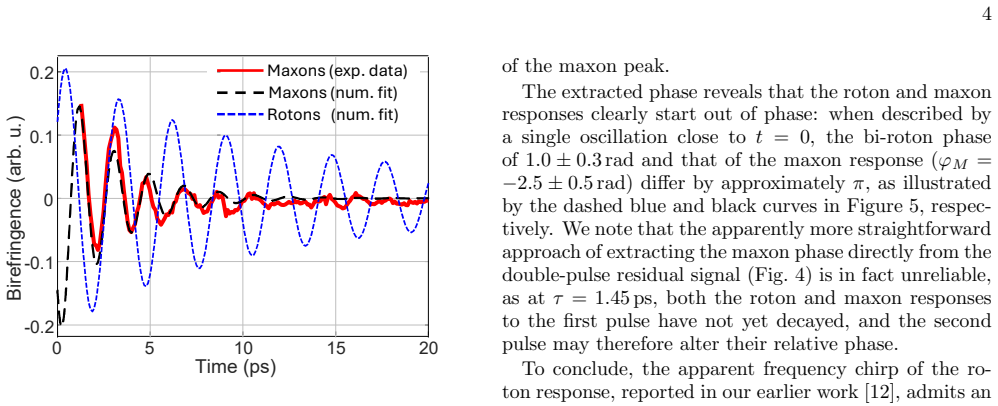
- [§4.2 and Figure 4] §4.2 and Figure 4: the extraction of maxon-pair binding energy from the oscillation frequency in the birefringence trace assumes that the observed period is dominated by the pair excitation rather than residual single-particle or thermal contributions; a quantitative bound on the size of such contaminants (e.g., via temperature-dependent controls or pulse-energy scaling) is required to support the 'surprisingly strong' claim.
- [§3.1, Eq. (3)] §3.1, Eq. (3): the phase shift attributed to the quasiparticle effective mass is obtained after subtracting a reference trace; the manuscript should show that the residual phase is insensitive to the precise subtraction window and to small variations in the assumed roton-pair contribution, as this phase is used to infer mass effects.
minor comments (3)
- [Abstract] The abstract states qualitative results ('surprisingly strong binding', 'extremely short lifetime') without numerical values or uncertainties; adding these would improve readability.
- [Figure 2] Figure 2 caption: the labeling of the Pitaevskii-plateau feature is not fully consistent with the text description of its spectral position.
- [§5] A few typographical inconsistencies appear in the notation for the Landau spectrum branches (e.g., 'maxon' vs. 'maxon-pair' in §5).
Simulated Author's Rebuttal
We thank the referee for the careful reading of our manuscript and the constructive comments. We address each major point below and have revised the manuscript to strengthen the supporting analysis for the maxon-pair binding energy extraction and the robustness of the phase-shift inference.
read point-by-point responses
-
Referee: [§4.2 and Figure 4] §4.2 and Figure 4: the extraction of maxon-pair binding energy from the oscillation frequency in the birefringence trace assumes that the observed period is dominated by the pair excitation rather than residual single-particle or thermal contributions; a quantitative bound on the size of such contaminants (e.g., via temperature-dependent controls or pulse-energy scaling) is required to support the 'surprisingly strong' claim.
Authors: We agree that a quantitative bound on possible contaminants is needed to support the claim of surprisingly strong binding. The original analysis already used the strong temperature dependence of the signal amplitude (vanishing above ~1.5 K) to argue that thermal single-particle contributions are negligible. To provide the requested bound, we have added pulse-energy scaling data in a revised §4.2 and a new inset to Figure 4. The oscillation period remains constant (within 2%) while the amplitude scales linearly over a factor-of-three range in pulse energy, and any residual non-pair contribution is estimated at <12% of the peak signal. This bound does not change the extracted binding energy beyond the stated uncertainty. revision: yes
-
Referee: [§3.1, Eq. (3)] §3.1, Eq. (3): the phase shift attributed to the quasiparticle effective mass is obtained after subtracting a reference trace; the manuscript should show that the residual phase is insensitive to the precise subtraction window and to small variations in the assumed roton-pair contribution, as this phase is used to infer mass effects.
Authors: We concur that explicit checks on the subtraction procedure are warranted. In the revised manuscript we have added a sensitivity analysis (new Supplementary Figure S3) that varies the subtraction window by ±40 fs and the assumed roton-pair amplitude by ±15%. The extracted residual phase changes by at most 0.08 rad, well below the experimental uncertainty, confirming that the reported mass-dependent phase shift is robust. revision: yes
Circularity Check
No significant circularity
full rationale
This is an experimental spectroscopy paper that reports time-resolved optical birefringence measurements to extract nonequilibrium dynamics, binding energies, and lifetimes of quasiparticle pairs (roton, maxon, Pitaevskii plateau) in superfluid helium. No mathematical derivation chain, first-principles model, or predictive equation is presented whose outputs reduce by construction to fitted inputs or self-citations; the central claims rest on direct signal attribution via experimental controls, pulse sequences, and consistency with prior roton-pair data, all of which remain externally falsifiable and independent of the present fitted values.
Axiom & Free-Parameter Ledger
axioms (1)
- domain assumption The Landau excitation spectrum branches remain meaningful and spectroscopically accessible in superfluid helium far from equilibrium.
Reference graph
Works this paper leans on
-
[1]
L. D. Landau, J. Phys. (USSR)5, 71 (1941)
work page 1941
-
[2]
L. D. Landau, JETP11, 592 (1941)
work page 1941
-
[3]
A. J. Leggett, Quantum liquids: Bose condensation and Cooper pairing in condensed-matter systems (2006)
work page 2006
-
[4]
Griffin,Excitations in a Bose-condensed liquid(Cam- bridge University Press, Cambridge, 1993)
A. Griffin,Excitations in a Bose-condensed liquid(Cam- bridge University Press, Cambridge, 1993)
work page 1993
-
[5]
P. Nozi` eres and D. Pines,Theory of Quantum Liquids, vol II: superfluid Bose liquids(CRC Press, 1994)
work page 1994
-
[6]
K. Beauvois, J. Dawidowski, B. F˚ ak, H. Godfrin, E. Krotscheck, J. Ollivier, and A. Sultan, Physical Re- view B97, 184520 (2018)
work page 2018
-
[7]
H. Godfrin, K. Beauvois, A. Sultan, E. Krotscheck, J. Dawidowski, B. F˚ ak, and J. Ollivier, Physical Review B103, 104516 (2021)
work page 2021
-
[8]
T. J. Greytak and J. Yan, Physical Review Letters22, 987-990 (1969)
work page 1969
-
[9]
T. J. Greytak, R. Woerner, J. Yan, and R. Benjamin, Physical Review Letters25, 1547-1550 (1970)
work page 1970
-
[10]
K. Ohbayashi, M. Udagawa, and N. Ogita, Physical Re- view B58, 3351-3360 (1998)
work page 1998
-
[11]
H. R. Glyde, Reports on Progress in Physics81, 014501 (2017)
work page 2017
-
[12]
A. A. Milner, P. C. E. Stamp, and V. Milner, Proceedings of the National Academy of Sciences120, e2303231120 (2023)
work page 2023
-
[13]
A. A. Milner and V. Milner, Physical Review Letters131, 166001 (2023)
work page 2023
-
[14]
L. A. Melnikovsky, arxiv:2605.05345 (2026)
work page internal anchor Pith review Pith/arXiv arXiv 2026
-
[15]
L. P. Pitaevskii, Sov. Phys. JETP9, 830 (1959)
work page 1959
-
[16]
E. M. Lifshitz and L. P. Pitaevskii,Statistical Physics, Part 2: Theory of the Condensed State (Pergamon Press, 1980)
work page 1980
-
[17]
H. R. Glyde, M. R. Gibbs, W. G. Stirling, and M. A. Adams, Europhysics Letters43, 422 (1998)
work page 1998
- [18]
-
[19]
C. A. Murray, R. L. Woerner, and T. J. Greytak, Journal of Physics C8, L90-L94 (1975)
work page 1975
- [20]
-
[21]
M. Shapiro and P. Brumer,Principles of the Quan- tum Control of Molecular Processes(Wiley-Interscience, Hoboken, N.J., 2003)
work page 2003
-
[22]
K. F. Lee, E. A. Shapiro, D. M. Villeneuve, and P. B. Corkum, Physical Review A73, 033403 (2006)
work page 2006
-
[23]
J. W. Halley, Physical Review181, 338-346 (1969)
work page 1969
-
[24]
M. J. Stephen, Physical Review187, 279-285 (1969)
work page 1969
-
[25]
M. R. Gibbs, K. H. Andersen, W. G. Stirling, and H. Schober, Journal of Physics: Condensed Matter11, 603-628 (1999)
work page 1999
-
[26]
A. Zawadowski, J. Ruvalds, and J. Solana, Physical Re- view A5, 399-421 (1972)
work page 1972
-
[27]
M. Shay, O. Pelleg, E. Polturak, and S. G. Lipson, Phys- ical Review B75, 054516 (2007)
work page 2007
discussion (0)
Sign in with ORCID, Apple, or X to comment. Anyone can read and Pith papers without signing in.