Optimizing Appliance Scheduling for Solar Energy Management Using Metaheuristic Algorithms
Pith reviewed 2026-06-27 07:09 UTC · model grok-4.3
The pith
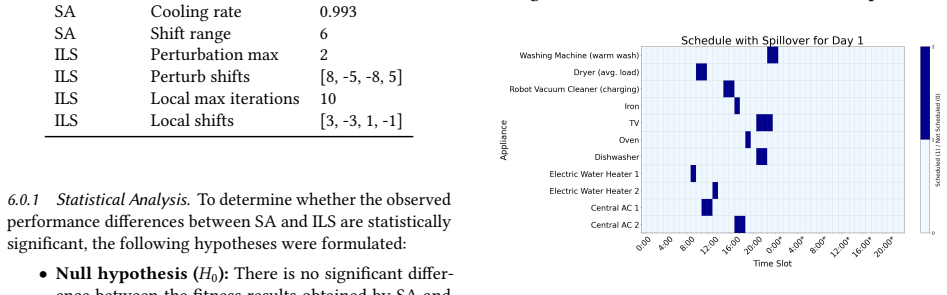
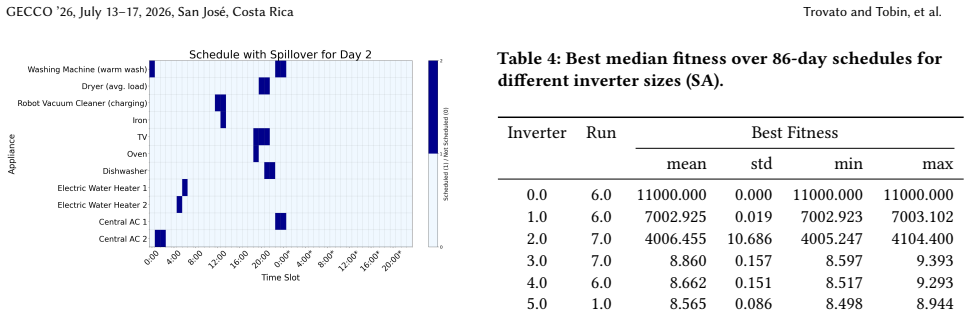
Metaheuristics optimize appliance start times over multiple days to align household use with solar generation under constraints.
A machine-rendered reading of the paper's core claim, the machinery that carries it, and where it could break.
Core claim
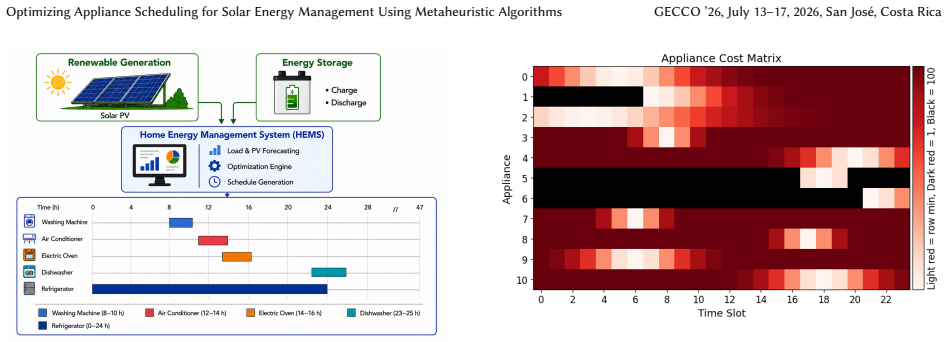
The paper claims that a sequential multi-day scheduling framework using Iterated Local Search and Simulated Annealing effectively manages system constraints while ensuring user convenience under exclusive solar generation by optimizing appliance start times that account for operating durations, power consumption, inverter limit, battery state of charge constraints, and solar generation forecasts, with explicit allowance for spillover of unfinished tasks from prior days.
What carries the argument
Sequential multi-day scheduling framework with Iterated Local Search and Simulated Annealing that optimizes appliance start times while permitting spillover of unfinished tasks across days.
If this is right
- Maximizes renewable energy utilization from solar generation alone.
- Minimizes user inconvenience as part of the objective function.
- Adheres to inverter limit and battery state of charge constraints.
- Enables operational continuity by allowing spillover of tasks across days.
- Creates scope for examining multi-objective trade-offs between equipment sizing, return on investment, and user satisfaction.
Where Pith is reading between the lines
- The framework could be evaluated against real household load traces to quantify actual grid displacement.
- It may connect to battery sizing decisions by revealing how schedule flexibility reduces required storage capacity.
- Forecast error sensitivity could be tested by injecting noise into the solar predictions used by the optimizers.
- The same sequential structure might apply to other time-shifted resources such as electric vehicle charging.
Load-bearing premise
Solar generation forecasts are accurate enough and user inconvenience can be expressed as an objective term that the metaheuristics can meaningfully optimize.
What would settle it
If real-world tests with measured solar data show the generated schedules frequently violate inverter or battery limits or produce high actual inconvenience scores, the claim of effective constraint management would be falsified.
Figures


read the original abstract
Renewable energy is essential for meeting future energy demands; however, solar energy generation, which occurs only during daylight hours often does not align with household consumption patterns. Appliances such as cookers, washing machines, and dryers are typically operated according to user preferred schedules rather than solar energy availability, creating a scheduling optimization problem. The objective is to determine optimal appliance start times to maximize renewable energy utilization while minimizing user inconvenience and adhering to system constraints. This paper presents a metaheuristic approach using Iterated Local Search (ILS) and Simulated Annealing (SA) to optimize appliance start times, while considering appliance operating durations, power consumption, inverter limit, battery state of charge constraints, and solar generation forecasts. Unlike most existing work, the scheduling is extended beyond a single day to accommodate unfinished tasks from previous days (spillover), ensuring operational continuity and enabling sequential operation across multiple days. Experimental results show that the sequential multi-day scheduling framework effectively manages system constraints while ensuring user convenience under exclusive solar generation. These findings also open opportunities for future research on multi-objective trade-offs between investment in equipment of various sizes, return on that investment, and user satisfaction.
Editorial analysis
A structured set of objections, weighed in public.
Referee Report
Summary. The paper proposes using Iterated Local Search (ILS) and Simulated Annealing (SA) metaheuristics to optimize appliance start times in a home energy system powered exclusively by solar generation. The approach extends scheduling to a sequential multi-day framework that handles spillover tasks from prior days, incorporates appliance durations, power ratings, inverter limits, battery state-of-charge constraints, and solar forecasts, and trades off energy utilization against a user-inconvenience term. The central claim is that experimental results demonstrate the framework effectively manages system constraints while ensuring user convenience.
Significance. If the experimental claims hold after proper validation, the multi-day spillover extension would represent a practical advance over single-day scheduling common in the literature, enabling better continuity for tasks that exceed daily solar availability. The work also correctly identifies the need to consider equipment sizing trade-offs in future extensions. However, the absence of any reported quantitative metrics, baselines, or sensitivity analyses in the abstract limits the immediate impact; the contribution remains primarily algorithmic until the results are substantiated.
major comments (2)
- [Abstract] Abstract (paragraph on objective and constraints): The effectiveness claim rests on the assumptions that solar generation forecasts are sufficiently accurate for the optimized schedule to remain feasible and that user inconvenience can be expressed as a quantifiable penalty term that ILS/SA can meaningfully optimize. No error model, forecast accuracy figures, sensitivity study, or validation against actual user tolerance data is supplied; if either assumption fails, the headline conclusion does not follow.
- [Abstract] Abstract (final sentence on experimental results): The manuscript asserts that 'experimental results show that the sequential multi-day scheduling framework effectively manages system constraints' yet supplies no quantitative performance numbers, baseline comparisons (e.g., against greedy or single-day methods), statistical tests, or details on how constraints were enforced during optimization. This absence makes the central claim impossible to evaluate from the provided text.
Simulated Author's Rebuttal
We thank the referee for the constructive feedback on the abstract. We agree that the abstract should more explicitly address modeling assumptions and include quantitative experimental details to strengthen the claims. We will revise the abstract accordingly in the next version.
read point-by-point responses
-
Referee: [Abstract] Abstract (paragraph on objective and constraints): The effectiveness claim rests on the assumptions that solar generation forecasts are sufficiently accurate for the optimized schedule to remain feasible and that user inconvenience can be expressed as a quantifiable penalty term that ILS/SA can meaningfully optimize. No error model, forecast accuracy figures, sensitivity study, or validation against actual user tolerance data is supplied; if either assumption fails, the headline conclusion does not follow.
Authors: The optimization framework takes solar forecasts as a given input and models user inconvenience via a penalty term on deviation from preferred start times, which is a standard formulation in appliance scheduling literature. We acknowledge that the abstract does not discuss forecast error sensitivity or real-user validation data. We will revise the abstract to explicitly state these modeling assumptions and note the absence of sensitivity analysis as a limitation for future work. revision: yes
-
Referee: [Abstract] Abstract (final sentence on experimental results): The manuscript asserts that 'experimental results show that the sequential multi-day scheduling framework effectively manages system constraints' yet supplies no quantitative performance numbers, baseline comparisons (e.g., against greedy or single-day methods), statistical tests, or details on how constraints were enforced during optimization. This absence makes the central claim impossible to evaluate from the provided text.
Authors: The body of the manuscript details the experimental setup, constraint handling within the ILS and SA implementations, and reports performance metrics. However, we agree the abstract is too high-level and lacks specific numbers or baseline comparisons. We will revise the abstract to summarize key quantitative results (e.g., solar utilization rates and constraint violation statistics) and note comparisons to single-day baselines. revision: yes
Circularity Check
No circularity: algorithmic search evaluated on external constraints
full rationale
The paper presents an application of standard metaheuristic algorithms (ILS and SA) to an optimization problem whose objective function, constraints, and evaluation metrics are defined independently of the reported results. No equations, derivations, or parameter-fitting steps are described that reduce the claimed performance to self-referential inputs or prior self-citations. The experimental outcomes are assessed against externally specified solar forecasts, inverter limits, battery state-of-charge, and a user-inconvenience term; these remain falsifiable benchmarks outside the optimization procedure itself. This is the normal case of an applied algorithmic method whose validity rests on empirical testing rather than internal redefinition.
Axiom & Free-Parameter Ledger
Reference graph
Works this paper leans on
-
[1]
Edoardo Bastianetto, Sara Ceschia, and Andrea Schaerf. 2020. Solving a Home Energy Management Problem by Simulated Annealing.Optimization Letters15, 5 (2020), 1553–1564
2020
-
[2]
R. K. Congram, C. N. Potts, and S. van de Velde. 2002. An iterated dy- nasearch algorithm for the single-machine total weighted tardiness sched- uling problem.INFORMS Journal on Computing14, 1 (2002), 52–67
2002
-
[3]
Emden-Weiner and M
T. Emden-Weiner and M. Proksch. 1999. Best practice simulated annealing for the airline crew scheduling problem.Journal of Heuristics5, 4 (1999), 419–436
1999
-
[4]
Dolf Gielen, Francisco Boshell, Deger Saygin, Morgan D Bazilian, Nicholas Wagner, and Ricardo Gorini. 2019. The role of renewable energy in the global energy transformation.Energy Strategy Reviews24 (2019), 38–50
2019
-
[5]
Hanafi and E
R. Hanafi and E. Kozan. 2014. A hybrid constructive heuristic and simulated annealing for railway crew scheduling.Computers & Industrial Engineering 70 (2014), 11–19
2014
-
[6]
Adil Imran, Ghulam Hafeez, Imran Khan, Muhammad Usman, Zeeshan Shafiq, Abdul Baseer Qazi, Azfar Khalid, and Klaus-Dieter Thoben. 2020. Heuristic-based programmable controller for efficient energy management under renewable energy sources and energy storage system in smart grid. IEEE Access8 (2020), 139587–139608
2020
-
[7]
Gholam-Reza Kamyab. 2025. Scheduling of home energy management sys- tems for price-based demand response and end-users discomfort reduction. Serbian Journal of Electrical Engineering22, 1 (2025), 17–34
2025
-
[8]
Daniel Gelatt, and Mario P
Scott Kirkpatrick, C. Daniel Gelatt, and Mario P. Vecchi. 1983. Optimization by simulated annealing.Science220, 4598 (1983), 671–680
1983
-
[9]
Helena R Lourenço, Olivier C Martin, and Thomas Stützle. 2003. Iterated local search. InHandbook of metaheuristics. Springer, 320–353
2003
-
[10]
Matallanas, Manuel Castillo-Cagigal, A
E. Matallanas, Manuel Castillo-Cagigal, A. Gutiérrez, F. Monasterio-Huelin, Estefanía Caamaño-Martín, D. Masa, and J. Jiménez-Leube. 2012. Neural network controller for active demand-side management with PV energy in the residential sector.Applied Energy91, 1 (2012), 90–97
2012
-
[11]
Mert Nakip, Onur Çopur, Emrah Biyik, and Cüneyt Güzelis. 2023. Re- newable energy management in smart home environment via forecast embedded scheduling based on Recurrent Trend Predictive Neural Net- work.Applied Energy340 (2023), 121014
2023
-
[12]
Ahmed, Azah Mohamed, and Eslam Al Has- san
Hussain Shareef, Maytham S. Ahmed, Azah Mohamed, and Eslam Al Has- san. 2018. Review on home energy management system considering demand responses, smart technologies, and intelligent controllers.IEEE Access6 (2018), 24498–24509
2018
-
[13]
1998.Applying iterated local search to the permutation flow shop problem
Thomas Stützle. 1998.Applying iterated local search to the permutation flow shop problem. Technical Report AIDA–98–04. FG Intellektik, TU Darmstadt
1998
-
[14]
Benjohn Koodakatt Varghese, Narottam Das, Biplob Ray, Abdul Md Mazid, Israt Jahan, and Mohamad Nur-E-Alam. 2025. Optimisation algorithms used in home energy management systems: A review.Energy and Buildings (2025), 116338
2025
-
[15]
Diego Branches Vilar and Carolina de Mattos Affonso. 2016. Residential energy management system with photovoltaic generation using simulated annealing. In2016 13th International Conference on the European Energy Market (EEM). IEEE, 1–6
2016
discussion (0)
Sign in with ORCID, Apple, or X to comment. Anyone can read and Pith papers without signing in.