Minor Ions as a Diagnostic of Solar Wind Heating: Inverted Mass-to-Charge Scaling in Imbalanced Turbulence
Pith reviewed 2026-06-27 23:26 UTC · model grok-4.3
The pith
Imbalanced Alfvénic turbulence generates flat proton-cyclotron wave spectra that invert minor-ion heating dependence on mass-to-charge ratio.
A machine-rendered reading of the paper's core claim, the machinery that carries it, and where it could break.
Core claim
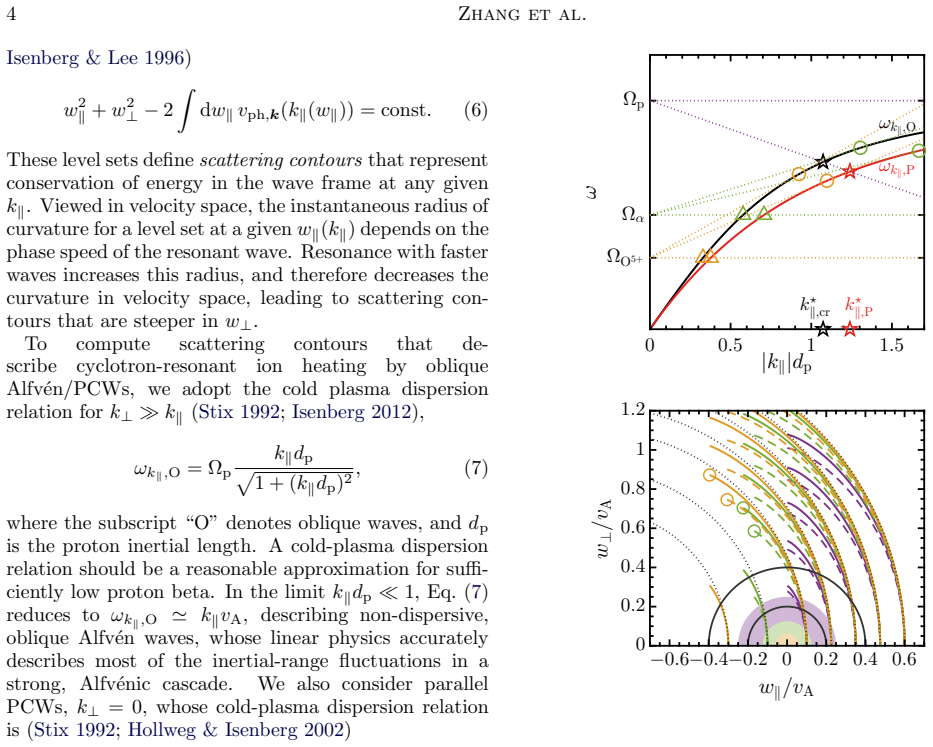
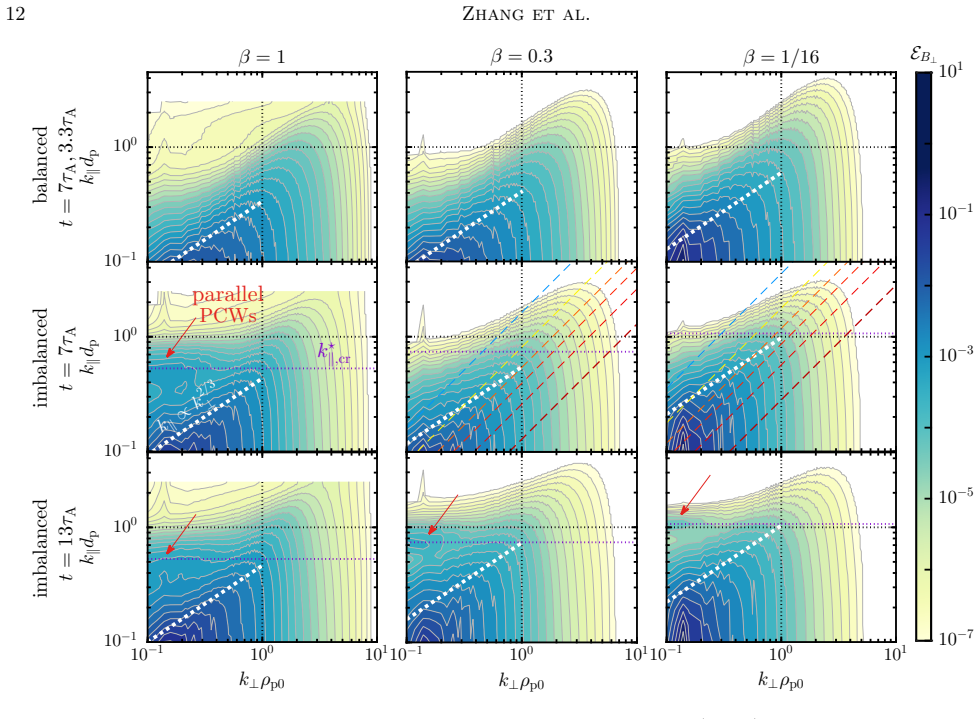
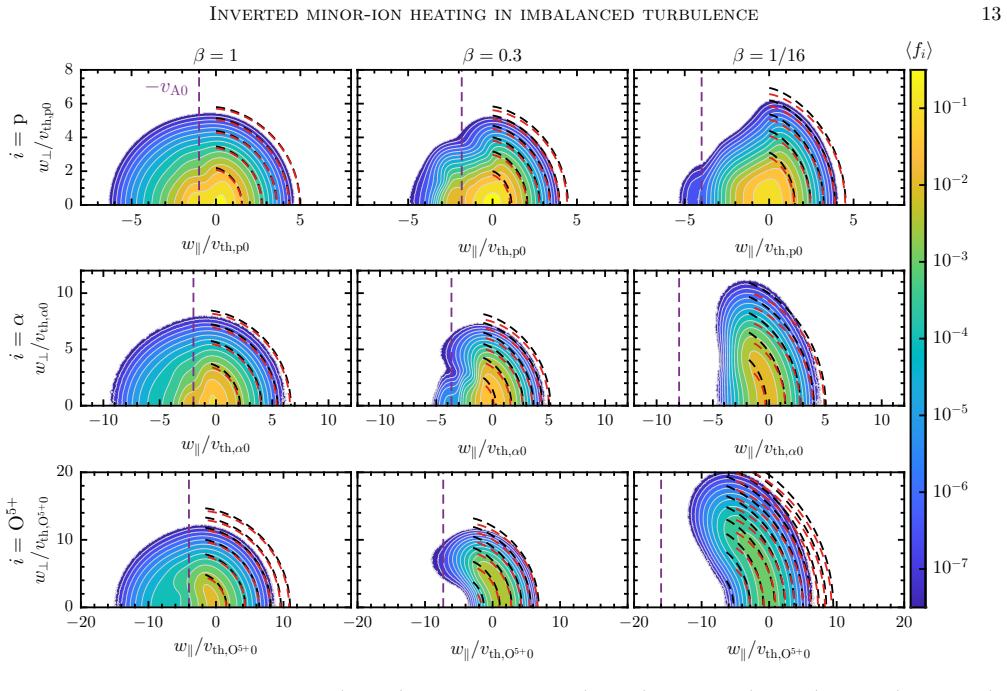
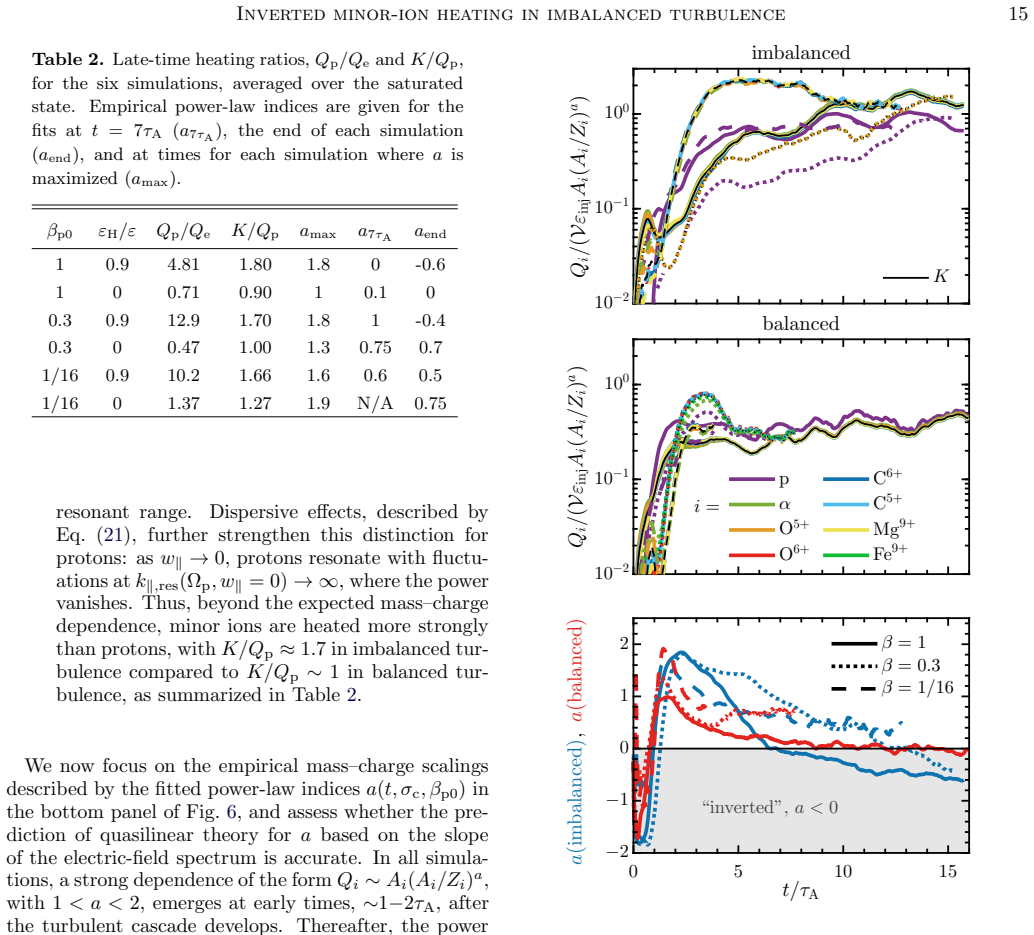
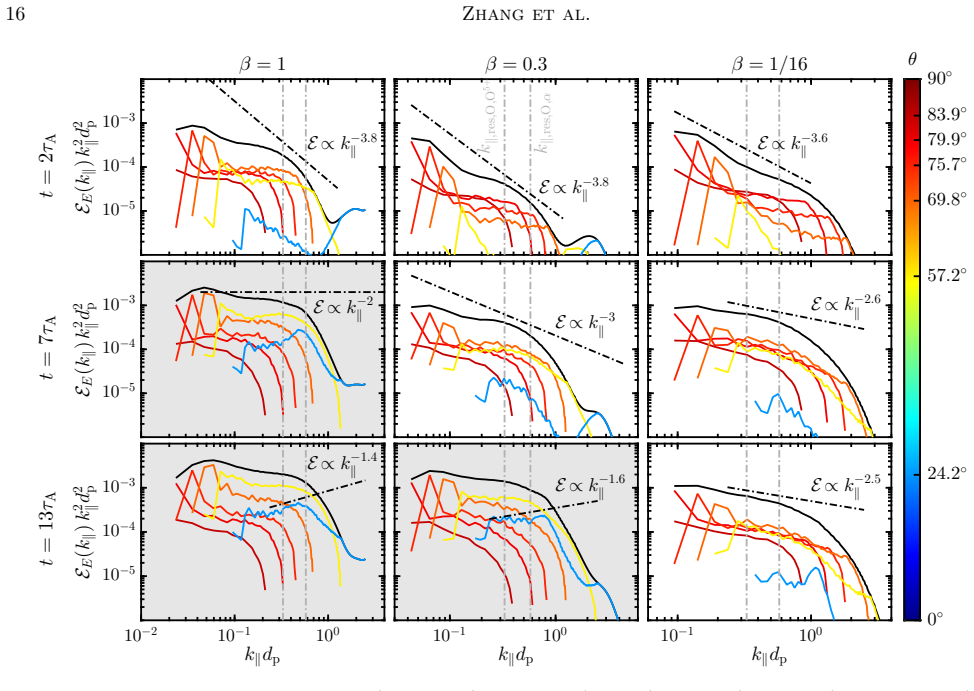
When Alfvénic turbulence is imbalanced, its cascade to ion-Larmor scales is throttled by the helicity barrier. This barrier ultimately leads to high-frequency proton-cyclotron waves, both oblique and parallel, the latter of which produce very flat electric-energy spectra (E_E⊥ ∼ k_∥^{-η} with η<2) over the range of scales that are cyclotron resonant with minor ions. While steeper spectra lead to a positive correlation of heating with A_i/Z_i, the shallower spectra cause the dependence to invert, with Q_i ∝ Q_p A_i (A_i/Z_i)^{η−2}.
What carries the argument
The helicity barrier in imbalanced turbulence, which generates parallel proton-cyclotron waves that produce flat electric-energy spectra controlling resonant minor-ion heating.
If this is right
- Minor-ion heating rates follow (A_i/Z_i)^a in both balanced and imbalanced cases across the simulated betas.
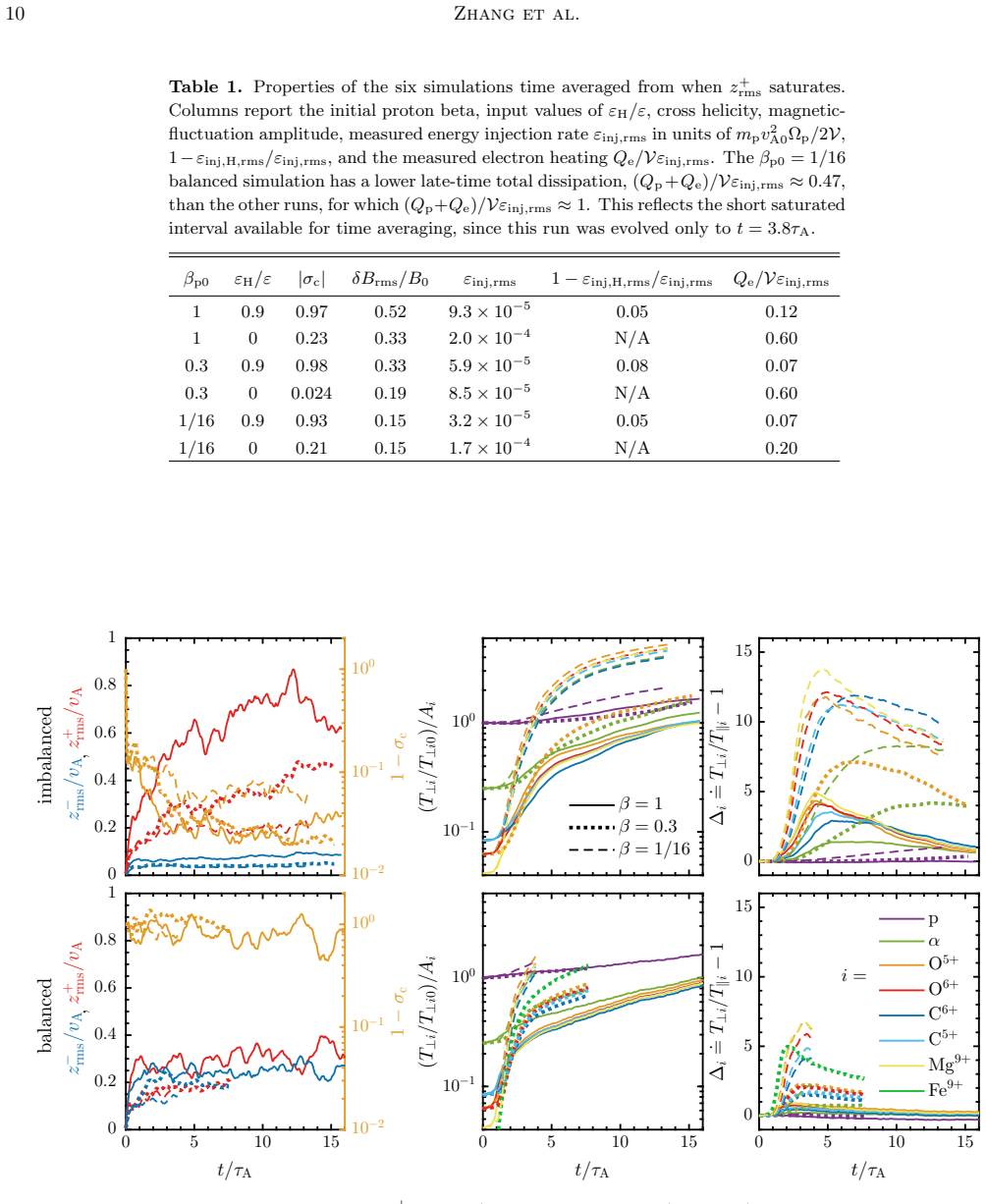
- Heating is strongest and most perpendicular in the lowest-beta imbalanced run, reaching T_perp_O5+/T_perp_p ≈40 and T_perp/T_parallel ≈10.
- Inverted heating trends indicate a history of large cross helicity and steep transition-range spectra.
- Future minor-ion measurements can test the association between inverted trends and parallel proton-cyclotron wave power.
Where Pith is reading between the lines
- Minor-ion temperature trends could serve as a remote diagnostic of turbulence imbalance even when direct cross-helicity measurements are unavailable.
- The same spectral flattening may alter the overall transition-range dissipation rate in imbalanced regimes.
Load-bearing premise
Quasilinear theory remains valid for resonant heating by the parallel proton-cyclotron waves without significant corrections from nonlinear effects, collisions, or solar-wind expansion.
What would settle it
Observations of intervals where minor-ion thermal speeds decrease with increasing mass-to-charge ratio but lack large cross helicity or enhanced parallel proton-cyclotron wave power would falsify the proposed link.
Figures
read the original abstract
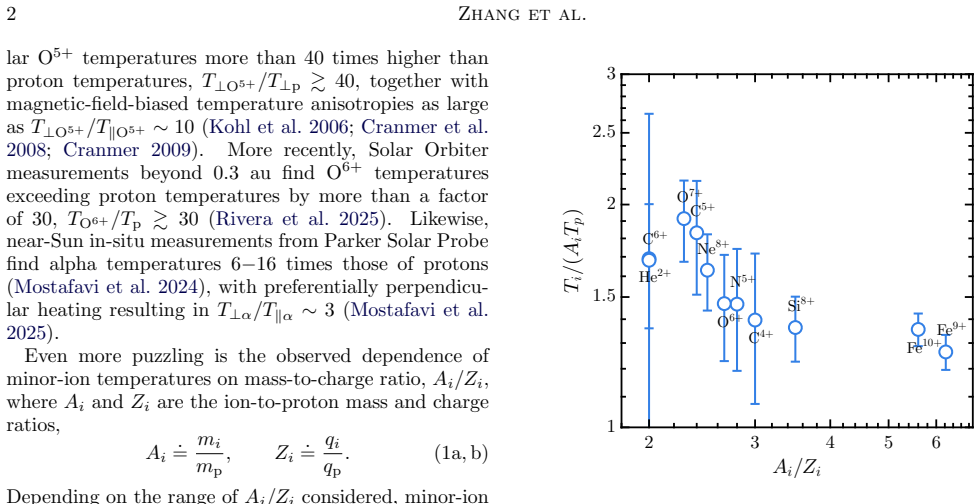
Alfv\'enic turbulence is vital to powering the solar wind and corona, yet eludes a comprehensive understanding of the kinetic processes by which it dissipates. Minor ions are sensitive tracers of these processes, showing extreme perpendicular temperatures and mass-weighted temperature trends that can either correlate or anticorrelate with mass-to-charge ratio, $A_i/Z_i$. We use a combination of quasilinear theory and 3D hybrid-kinetic simulations to explain these features and their correlations with properties of turbulence in the fast solar wind. When Alfv\'enic turbulence is imbalanced, its cascade to ion-Larmor scales is throttled by the helicity barrier. This barrier ultimately leads to high-frequency proton-cyclotron waves (PCWs), both oblique and parallel, the latter of which produce very flat electric-energy spectra ($\mathcal{E}_{E_{\perp}}\sim k_\parallel^{-\eta}$ with $\eta<2$) over the range of scales that are cyclotron resonant with minor ions. While steeper spectra lead to a positive correlation of heating with $A_i/Z_i$, the shallower spectra cause the dependence to invert, with $Q_i\propto Q_{\mathrm{p}}A_i(A_i/Z_i)^{\eta-2}$. Six simulations of balanced and imbalanced turbulence spanning $\beta_{\rm p0}=\{1,0.3,1/16\}$ corroborate this prediction, showing minor-ion heating rates that follow $(A_i/Z_i)^a$. Minor-ion heating is strongest and most perpendicular in our lowest $\beta_{\rm p0}=1/16$ simulation of imbalanced turbulence, reaching $T_{\perp{\rm O}^{5+}}/T_{\perp{\rm p}}\approx40$ and $T_{\perp{\rm O}^{5+}}/T_{\parallel{\rm O}^{5+}}\approx10$, consistent with low-coronal observations. Future minor-ion measurements should test whether intervals in which minor-ion thermal speeds decrease with increasing mass-to-charge ratio are associated with a history of large cross helicity, enhanced power in parallel PCWs, and a steep transition-range spectrum.
Editorial analysis
A structured set of objections, weighed in public.
Referee Report
Summary. The manuscript claims that imbalanced Alfvénic turbulence is throttled at ion-Larmor scales by the helicity barrier, which generates both oblique and parallel high-frequency proton-cyclotron waves. The parallel component produces flat electric-energy spectra (E_{E⊥} ∼ k_∥^{-η} with η < 2) over cyclotron-resonant scales for minor ions. Substituting this spectrum into the quasilinear cyclotron-resonance heating integral yields the inverted scaling Q_i ∝ Q_p A_i (A_i/Z_i)^{η-2}. Six 3D hybrid-kinetic simulations (balanced and imbalanced cases at β_p0 = {1, 0.3, 1/16}) confirm minor-ion heating rates follow (A_i/Z_i)^a, with extreme perpendicular heating (T_⊥O^{5+}/T_⊥p ≈ 40) at the lowest β.
Significance. If the central claim holds, the work supplies an explicit, testable link between turbulence imbalance, the resulting parallel-PCW spectrum, and observed minor-ion temperature trends in the fast solar wind. The derivation of the exponent directly from the spectral index η (rather than a free fit) and its reproduction across multiple β_p0 values in hybrid-kinetic runs constitute a clear strength, offering a falsifiable observational signature for intervals of large cross helicity.
major comments (2)
- [Theory derivation] Quasilinear theory section: the inverted scaling Q_i ∝ Q_p A_i (A_i/Z_i)^{η-2} is obtained by direct substitution of the flat parallel-PCW spectrum into the cyclotron-resonance integral; however, the manuscript does not demonstrate that quasilinear theory remains valid once nonlinear orbit modifications, solar-wind expansion, and collisions (all omitted from the hybrid-kinetic runs) are restored at the resonant k_∥.
- [Numerical results] Simulation results section: the six runs show the (A_i/Z_i)^a trend and flat E_E⊥(k_∥), but the manuscript should report a direct, quantitative comparison between the simulated heating rates and the quasilinear prediction evaluated at the measured η for each species to establish that the spectral shape, rather than other simulation features, is the controlling factor.
minor comments (2)
- [Discussion] The abstract states that future measurements should test the association with steep transition-range spectra, but the manuscript does not define or show how the transition-range spectral index is measured in the simulations.
- [Figures] Figure captions should explicitly state the value of η extracted from each imbalanced run so readers can verify the predicted exponent without consulting the main text.
Simulated Author's Rebuttal
We thank the referee for their constructive comments, which help clarify the scope and limitations of our quasilinear analysis and simulation results. Below we respond to each major comment and indicate the planned revisions.
read point-by-point responses
-
Referee: [Theory derivation] Quasilinear theory section: the inverted scaling Q_i ∝ Q_p A_i (A_i/Z_i)^{η-2} is obtained by direct substitution of the flat parallel-PCW spectrum into the cyclotron-resonance integral; however, the manuscript does not demonstrate that quasilinear theory remains valid once nonlinear orbit modifications, solar-wind expansion, and collisions (all omitted from the hybrid-kinetic runs) are restored at the resonant k_∥.
Authors: Hybrid-kinetic simulations do incorporate nonlinear orbit modifications via the kinetic treatment of particle trajectories in the self-consistent fields. The omitted elements are solar-wind expansion and collisions. We agree that full validation under these conditions lies beyond the present study. We will add a dedicated paragraph in the discussion section acknowledging these limitations and noting that the consistency between QL predictions and simulation trends across β values supports the utility of the approach as an interpretive tool. revision: yes
-
Referee: [Numerical results] Simulation results section: the six runs show the (A_i/Z_i)^a trend and flat E_E⊥(k_∥), but the manuscript should report a direct, quantitative comparison between the simulated heating rates and the quasilinear prediction evaluated at the measured η for each species to establish that the spectral shape, rather than other simulation features, is the controlling factor.
Authors: We concur that such a comparison would strengthen the link to the spectral shape. We will include in the revised manuscript a direct comparison: for each simulation, we will evaluate the QL heating ratio using the measured η and compare it quantitatively to the simulated Q_i/Q_p values for the minor ions. revision: yes
Circularity Check
No significant circularity; analytic scaling tested by independent simulations
full rationale
The paper derives the inverted heating scaling Q_i ∝ Q_p A_i (A_i/Z_i)^{η-2} by substituting the flat parallel-PCW spectrum (η<2) into the standard quasilinear cyclotron-resonance integral; this is a direct mathematical step, not a self-definition or fit. The six hybrid-kinetic simulations independently evolve imbalanced turbulence, measure the emergent spectrum η, and compute minor-ion heating rates, confirming the predicted (A_i/Z_i)^a dependence without using the target scaling as an input. The helicity-barrier premise is likewise tested by the same runs rather than resting solely on prior self-citations. The derivation chain therefore remains self-contained against external simulation benchmarks.
Axiom & Free-Parameter Ledger
free parameters (1)
- β_p0
axioms (2)
- domain assumption Quasilinear theory accurately describes resonant cyclotron heating by the parallel PCWs
- domain assumption The helicity barrier in imbalanced turbulence produces the flat η<2 spectra at ion-cyclotron scales
Reference graph
Works this paper leans on
-
[1]
2025, ApJ, 990, 138, doi: 10.3847/1538-4357/ade9b0
Adkins, T., Meyrand, R., & Squire, J. 2025, ApJ, 990, 138, doi: 10.3847/1538-4357/ade9b0
-
[2]
Schekochihin, A. A. 2023, PhRvX, 13, 021014, doi: 10.1103/PhysRevX.13.021014 20Zhang et al
-
[3]
Bame, S. J., Asbridge, J. R., Feldman, W. C., & Kearney, P. D. 1974, SoPh, 35, 137, doi: 10.1007/BF00156963
-
[4]
2000, RvGeo, 38, 247, doi: 10.1029/1999RG000063 —
Bochsler, P. 2000, RvGeo, 38, 247, doi: 10.1029/1999RG000063 —. 2007, A&ARv, 14, 1, doi: 10.1007/s00159-006-0002-x
-
[5]
1985, JGR, 90, 10779, doi: 10.1029/JA090iA11p10779
Bochsler, P., Geis, J., & Joos, R. 1985, JGR, 90, 10779, doi: 10.1029/JA090iA11p10779
-
[6]
2006, PhRvL, 96, 115002, doi: 10.1103/PhysRevLett.96.115002
Boldyrev, S. 2006, PhRvL, 96, 115002, doi: 10.1103/PhysRevLett.96.115002
-
[7]
Bowen, T. A., Bale, S. D., Chandran, B. D. G., et al. 2024, NatAs, 8, 482, doi: 10.1038/s41550-023-02186-4
-
[8]
Byers, J. A., Cohen, B. I., Condit, W. C., & Hanson, J. D. 1978, JCoPh, 27, 363, doi: 10.1016/0021-9991(78)90016-5
-
[9]
S., Arzamasskiy, L., & Kunz, M
Cerri, S. S., Arzamasskiy, L., & Kunz, M. W. 2021, ApJ, 916, 120, doi: 10.3847/1538-4357/abfbde
-
[10]
Chandran, B. D. G. 2010, ApJ, 720, 548, doi: 10.1088/0004-637X/720/1/548
-
[11]
2010a, ApJ, 720, 503, doi: 10.1088/0004-637X/720/1/503
Germaschewski, K. 2010a, ApJ, 720, 503, doi: 10.1088/0004-637X/720/1/503
-
[12]
Chandran, B. D. G., Pongkitiwanichakul, P., Isenberg, P. A., et al. 2010b, ApJ, 722, 710, doi: 10.1088/0004-637X/722/1/710
-
[13]
Chen, C. H. K. 2016, JPlPh, 82, 535820602, doi: 10.1017/S0022377816001124
-
[14]
Cranmer, S. R. 2002, SSRv, 101, 229, doi: 10.1023/A:1020840004535 —. 2009, LRSP, 6, 3, doi: 10.12942/lrsp-2009-3
-
[15]
Cranmer, S. R., Panasyuk, A. V., & Kohl, J. L. 2008, ApJ, 678, 1480, doi: 10.1086/586890
-
[16]
1968, JATP, 30, 1313, doi: 10.1016/S0021-9169(68)91158-6
Gendrin, R. 1968, JATP, 30, 1313, doi: 10.1016/S0021-9169(68)91158-6
-
[17]
1995, ApJ, 438, 763, doi: 10.1086/175121
Goldreich, P., & Sridhar, S. 1995, ApJ, 438, 763, doi: 10.1086/175121
-
[18]
Halekas, J. S., Bale, S. D., Berthomier, M., et al. 2023, ApJ, 952, 26, doi: 10.3847/1538-4357/acd769
-
[19]
Hewett, D. W., & Nielson, C. W. 1978, JCoPh, 29, 219, doi: 10.1016/0021-9991(78)90153-5
-
[20]
Hollweg, J. V. 1999, JGR, 104, 24781, doi: 10.1029/1999JA900300
-
[21]
Hollweg, J. V., & Isenberg, P. A. 2002, JGRA, 107, 1147, doi: 10.1029/2001JA000270
-
[22]
Horbury, T. S., Forman, M., & Oughton, S. 2008, PhRvL, 101, 175005, doi: 10.1103/PhysRevLett.101.175005
-
[23]
Isenberg, P. A. 1984, JGR, 89, 6613, doi: 10.1029/JA089iA08p06613 —. 2004, JGRA, 109, A03101, doi: 10.1029/2002JA009449 —. 2012, PhPl, 19, 032116, doi: 10.1063/1.3697721
-
[24]
Isenberg, P. A., & Hollweg, J. V. 1983, JGR, 88, 3923, doi: 10.1029/JA088iA05p03923
-
[25]
Isenberg, P. A., & Lee, M. A. 1996, JGR, 101, 11055, doi: 10.1029/96JA00293
-
[26]
Isenberg, P. A., Lee, M. A., & Hollweg, J. V. 2001, JGR, 106, 5649, doi: 10.1029/2000JA000099
-
[27]
Isenberg, P. A., & Vasquez, B. J. 2011, ApJ, 731, 88, doi: 10.1088/0004-637X/731/2/88
-
[28]
Quasi-linear theory of perpendicular ion heating by critically balanced turbulence
Johnston, Z., & Squire, J. 2025, arXiv e-prints, arXiv:2512.03472, doi: 10.48550/arXiv.2512.03472
work page internal anchor Pith review Pith/arXiv arXiv doi:10.48550/arxiv.2512.03472 2025
-
[29]
Kasper, J. C., Lazarus, A. J., & Gary, S. P. 2008, PhRvL, 101, 261103, doi: 10.1103/PhysRevLett.101.261103
-
[30]
Kasper, J. C., Stevens, M. L., Lazarus, A. J., Steinberg, J. T., & Ogilvie, K. W. 2007, ApJ, 660, 901, doi: 10.1086/510842
-
[31]
Kawazura, Y., Barnes, M., & Schekochihin, A. A. 2019, PNAS, 116, 771, doi: 10.1073/pnas.1812491116
-
[32]
Kennel, C. F., & Engelmann, F. 1966, PhFl, 9, 2377, doi: 10.1063/1.1761629
-
[33]
Klein, K. G., & Chandran, B. D. G. 2016, ApJ, 820, 47, doi: 10.3847/0004-637X/820/1/47
-
[34]
1997, SoPh, 171, 345, doi: 10.1023/A:1004943213433
Guhathakurta, M. 1997, SoPh, 171, 345, doi: 10.1023/A:1004943213433
-
[35]
Kohl, J. L., Noci, G., Cranmer, S. R., & Raymond, J. C. 2006, A&ARv, 13, 31, doi: 10.1007/s00159-005-0026-7
-
[36]
Kunz, M. W., Stone, J. M., & Bai, X.-N. 2014, JCoPh, 259, 154, doi: 10.1016/j.jcp.2013.11.035
-
[37]
Landi, E., & Cranmer, S. R. 2009, ApJ, 691, 794, doi: 10.1088/0004-637X/691/1/794
-
[38]
Livi, S., Lepri, S. T., Raines, J. M., et al. 2023, A&A, 676, A36, doi: 10.1051/0004-6361/202346304
-
[39]
Mallet, A., Schekochihin, A. A., & Chandran, B. D. G. 2015, MNRAS, 449, L77, doi: 10.1093/mnrasl/slv021
-
[40]
2012, SSRv, 172, 23, doi: 10.1007/s11214-010-9734-z
Marsch, E. 2012, SSRv, 172, 23, doi: 10.1007/s11214-010-9734-z
-
[41]
Matthaeus, W. H., Goldstein, M. L., & Roberts, D. A. 1990, JGR, 95, 20673, doi: 10.1029/JA095iA12p20673
-
[42]
W., de Pontieu, B., Carlsson, M., et al
McIntosh, S. W., de Pontieu, B., Carlsson, M., et al. 2011, Natur, 475, 477, doi: 10.1038/nature10235
-
[43]
Simon, P. A. 2025, PhRvX, 15, 031008, doi: 10.1103/PhysRevX.15.031008
-
[44]
Meyrand, R., Squire, J., Schekochihin, A. A., & Dorland, W. 2021, JPlPh, 87, 535870301, doi: 10.1017/S0022377821000489
-
[45]
Mostafavi, P., Jagarlamudi, V. K., Raouafi, N. E., et al. 2025, ApJL, 991, L35, doi: 10.3847/2041-8213/ae0732
-
[46]
Mostafavi, P., Allen, R. C., Jagarlamudi, V. K., et al. 2024, A&A, 682, A152, doi: 10.1051/0004-6361/202347134
-
[47]
Panchal, U., Wicks, R. T., & Stawarz, J. E. 2025, ApJ, 983, 160, doi: 10.3847/1538-4357/adbfff Inverted minor-ion heating in imbalanced turbulence21
-
[48]
Rivera, Y. J., Badman, S. T., Stevens, M. L., et al. 2024, Science, 385, 962, doi: 10.1126/science.adk6953
-
[49]
Rivera, Y. J., Klein, K. G., Wang, J. H., et al. 2025, ApJL, 990, L60, doi: 10.3847/2041-8213/adfa97
-
[50]
D., & Shevchenko, V
Rowlands, J., Shapiro, V. D., & Shevchenko, V. I. 1966, JETP, 23, 651
1966
-
[51]
Schekochihin, A. A., Kawazura, Y., & Barnes, M. A. 2019, JPlPh, 85, 905850303, doi: 10.1017/S0022377819000345
-
[52]
Squire, J., Meyrand, R., & Kunz, M. W. 2023, ApJ, 957, L30, doi: 10.3847/2041-8213/ad0779
-
[53]
Squire, J., Meyrand, R., Kunz, M. W., et al. 2022, NatAs, 6, 715, doi: 10.1038/s41550-022-01624-z
-
[54]
Stix, T. H. 1992, Waves in plasmas (American Institute of Physics)
1992
-
[55]
Tracy, P. J., Kasper, J. C., Raines, J. M., et al. 2016, PhRvL, 116, 255101, doi: 10.1103/PhysRevLett.116.255101
-
[56]
Verscharen, D., Klein, K. G., & Maruca, B. A. 2019, LRSP, 16, 5, doi: 10.1007/s41116-019-0021-0 von Steiger, R., Schwadron, N. A., Fisk, L. A., et al. 2000, JGR, 105, 27217, doi: 10.1029/1999JA000358
-
[57]
Wang, J. H., Horbury, T. S., Matteini, L., & Trotta, D. 2025, ApJL, 978, L17, doi: 10.3847/2041-8213/ad9ddd
-
[58]
Yerger, E. L., Chandran, B. D. G., David, V., Bowen, T. A., & Bale, S. D. 2026, JPlPh, in press. https://arxiv.org/abs/2605.25117
Pith/arXiv arXiv 2026
-
[59]
Zhang, M. F., Kunz, M. W., Squire, J., & Klein, K. G. 2025, ApJ, 979, 121, doi: 10.3847/1538-4357/ad95fc
discussion (0)
Sign in with ORCID, Apple, or X to comment. Anyone can read and Pith papers without signing in.