Stain-Aware Wavelet Regularization for Instant Adversarial Purification in Histopathology
Pith reviewed 2026-06-27 18:52 UTC · model grok-4.3
The pith
Stain-Aware Wavelet Regularization disentangles adversarial perturbations from tissue structures in histopathology images using multi-level Haar transforms.
A machine-rendered reading of the paper's core claim, the machinery that carries it, and where it could break.
Core claim
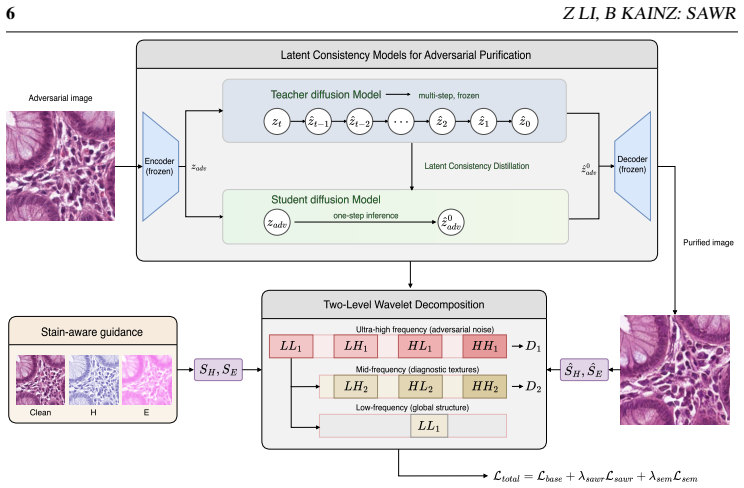
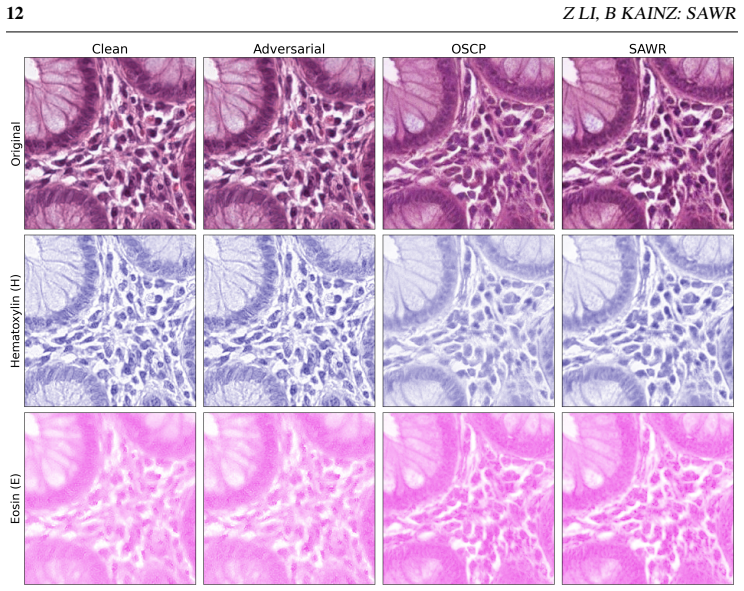
SAWR leverages multi-level wavelet-domain regularization based on Haar transform to hierarchically disentangle adversarial perturbations from diagnostic structural information. This spectral constraint is further extended to individual histological channels, enabling stain-specific frequency regulation consistent with the biological properties of Hematoxylin and Eosin. When integrated into an instant purification framework, SAWR improves adversarial robustness by up to 10.69% over the baseline approach while maintaining texture and spectral fidelity under adversarial perturbations.
What carries the argument
Stain-Aware Wavelet Regularization (SAWR), which applies multi-level Haar wavelet regularization extended to histological channels for hierarchical separation of perturbations from tissue structures.
If this is right
- Adversarial robustness in histopathology classification rises by up to 10.69 percent compared with the baseline.
- Texture and spectral fidelity remain intact after purification of perturbed inputs.
- The framework supports instant, single-pass purification suitable for real-time clinical pipelines.
- Stain-specific channel handling aligns frequency constraints with H&E biological properties.
Where Pith is reading between the lines
- The same wavelet separation might apply to other contrast-based medical images where high-frequency noise overlaps with fine structures.
- Input purification could reduce reliance on retraining models for every new attack type.
- Validation across multiple cancer types and scanners would test whether the stain-aware extension holds beyond the reported settings.
Load-bearing premise
Multi-level Haar wavelet regularization can hierarchically disentangle adversarial perturbations from diagnostically relevant tissue structures and extending the spectral constraint to individual histological channels produces stain-specific frequency regulation.
What would settle it
A direct comparison on adversarial histopathology images showing no gain in robustness or loss of diagnostic accuracy when SAWR is applied versus the baseline purification method.
Figures


read the original abstract
Deep learning has become prevalent in computational pathology pipelines that support tasks such as cancer screening and digital pathology analysis. However, the susceptibility of neural networks to adversarial perturbations raises safety concerns for reliable deployment in clinical practice. In histopathological images, this challenge is exacerbated by the difficulty of distinguishing high-frequency adversarial noise from subtle and diagnostically relevant tissue structures. To address this issue, we propose Stain-Aware Wavelet Regularization (SAWR), an adversarial purification framework that leverages multi-level wavelet-domain regularization based on Haar transform to hierarchically disentangle adversarial perturbations from diagnostic structural information. This spectral constraint is further extended to individual histological channels, enabling stain-specific frequency regulation consistent with the biological properties of Hematoxylin and Eosin. When integrated into an instant purification framework, SAWR improves adversarial robustness by up to 10.69\% over the baseline approach, while maintaining texture and spectral fidelity under adversarial perturbations.
Editorial analysis
A structured set of objections, weighed in public.
Referee Report
Summary. The manuscript proposes Stain-Aware Wavelet Regularization (SAWR), an adversarial purification framework for histopathology images. It applies multi-level Haar wavelet-domain regularization to hierarchically separate adversarial perturbations from diagnostically relevant tissue structures and extends the spectral constraint to individual H&E histological channels for stain-specific frequency regulation. When integrated into an instant purification pipeline, SAWR is reported to improve adversarial robustness by up to 10.69% over a baseline while preserving texture and spectral fidelity.
Significance. If the empirical gains hold under standard evaluation protocols, the work addresses a practically relevant safety issue for deep-learning pipelines in computational pathology. The stain-aware extension of wavelet regularization is a targeted design choice that aligns with the domain; credit is due for the explicit linkage to H&E biological properties and the focus on instant (non-retraining) purification.
minor comments (2)
- [Abstract] Abstract: the quantitative claim of 'up to 10.69%' improvement is stated without naming the baseline method, attack type, dataset, or metric; the main text (likely §4) must supply these details with error bars and statistical tests to make the result verifiable.
- [Abstract / §2] The phrase 'instant purification framework' is introduced without a precise definition or reference; clarify its relation to existing purification pipelines in §2 or §3.
Simulated Author's Rebuttal
We thank the referee for the constructive summary, positive assessment of significance, and recommendation for minor revision. No major comments were listed in the report, so we have no specific points requiring detailed rebuttal. We will incorporate any minor suggestions during revision.
Circularity Check
No significant circularity detected; empirical claim with explicit design assumptions
full rationale
The paper presents SAWR as a proposed framework using multi-level Haar wavelet regularization extended to histological channels for stain-specific frequency regulation. The central claim is an empirical robustness improvement (up to 10.69%) under an instant purification setup. No equations, derivations, fitted parameters renamed as predictions, or self-citation chains reducing the result to its own inputs are visible in the abstract or described method. The design assumptions (hierarchical disentanglement of perturbations from tissue structures) are stated explicitly and remain externally testable via experiments, satisfying the criteria for a self-contained non-circular contribution.
Axiom & Free-Parameter Ledger
Reference graph
Works this paper leans on
-
[1]
A survey on adversarial deep learn- ing robustness in medical image analysis.Electronics, 10(17):2132, 2021
Kyriakos D Apostolidis and George A Papakostas. A survey on adversarial deep learn- ing robustness in medical image analysis.Electronics, 10(17):2132, 2021
2021
-
[2]
Adversarial attack vulnerability of medical image analysis systems: Unexplored factors.Medical Image Analysis, 73:102141, 2021
Gerda Bortsova, Cristina González-Gonzalo, Suzanne C Wetstein, Florian Dubost, Ioannis Katramados, Laurens Hogeweg, Bart Liefers, Bram van Ginneken, Josien PW Pluim, Mitko Veta, et al. Adversarial attack vulnerability of medical image analysis systems: Unexplored factors.Medical Image Analysis, 73:102141, 2021
2021
-
[3]
Reliable evaluation of adversarial robustness with an ensemble of diverse parameter-free attacks
Francesco Croce and Matthias Hein. Reliable evaluation of adversarial robustness with an ensemble of diverse parameter-free attacks. InInternational Conference on Machine Learning, pages 2206–2216. ICML, 2020
2020
-
[4]
SIAM, 1992
Ingrid Daubechies.Ten lectures on wavelets. SIAM, 1992
1992
-
[5]
Survey on adversarial attack and defense for medical image analysis: Methods and challenges
Junhao Dong, Junxi Chen, Xiaohua Xie, Jianhuang Lai, and Hao Chen. Survey on adversarial attack and defense for medical image analysis: Methods and challenges. ACM Computing Surveys, 57(3):1–38, 2024
2024
-
[6]
Adversarial attacks on medical machine learning.Science, 363 (6433):1287–1289, 2019
Samuel G Finlayson, John D Bowers, Joichi Ito, Jonathan L Zittrain, Andrew L Beam, and Isaac S Kohane. Adversarial attacks on medical machine learning.Science, 363 (6433):1287–1289, 2019
2019
-
[7]
Adversarial attacks and adversarial robustness in computational pathol- ogy.Nature communications, 13(1):5711, 2022
Narmin Ghaffari Laleh, Daniel Truhn, Gregory Patrick Veldhuizen, Tianyu Han, Marko van Treeck, Roman D Buelow, Rupert Langer, Bastian Dislich, Peter Boor, V olkmar Schulz, et al. Adversarial attacks and adversarial robustness in computational pathol- ogy.Nature communications, 13(1):5711, 2022
2022
-
[8]
Explaining and harness- ing adversarial examples.The International Conference on Learning Representations (ICLR), 2015
Ian J Goodfellow, Jonathon Shlens, and Christian Szegedy. Explaining and harness- ing adversarial examples.The International Conference on Learning Representations (ICLR), 2015
2015
-
[9]
Improving robustness using generated data.Advances in neural information processing systems, 34:4218–4233, 2021
Sven Gowal, Sylvestre-Alvise Rebuffi, Olivia Wiles, Florian Stimberg, Dan Andrei Calian, and Timothy A Mann. Improving robustness using generated data.Advances in neural information processing systems, 34:4218–4233, 2021
2021
-
[10]
Predicting survival from colorectal cancer histology slides using deep learning: A retrospective multicenter study.PLoS medicine, 16(1):e1002730, 2019
Jakob Nikolas Kather, Johannes Krisam, Pornpimol Charoentong, Tom Luedde, Esther Herpel, Cleo-Aron Weis, Timo Gaiser, Alexander Marx, Nektarios A Valous, Dyke Ferber, et al. Predicting survival from colorectal cancer histology slides using deep learning: A retrospective multicenter study.PLoS medicine, 16(1):e1002730, 2019. 16Z LI, B KAINZ: SAWR
2019
-
[11]
Instant adversarial purification with adversarial consistency distillation
Chun Tong Lei, Hon Ming Yam, Zhongliang Guo, Yifei Qian, and Chun Pong Lau. Instant adversarial purification with adversarial consistency distillation. InProceedings of the Computer Vision and Pattern Recognition Conference (CVPR), pages 24331– 24340, 2025
2025
-
[12]
Multi-level wavelet-CNN for image restoration
Pengju Liu, Hongzhi Zhang, Kai Zhang, Liang Lin, and Wangmeng Zuo. Multi-level wavelet-CNN for image restoration. InIEEE/CVF Conference on Computer Vision and Pattern Recognition Workshops (CVPRW), pages 773–782, 2018
2018
-
[13]
Latent Consistency Models: Synthesizing High-Resolution Images with Few-Step Inference
Simian Luo, Yiqin Tan, Longbo Huang, Jian Li, and Hang Zhao. Latent consistency models: Synthesizing high-resolution images with few-step inference.arXiv preprint arXiv:2310.04378, 2023
work page internal anchor Pith review Pith/arXiv arXiv 2023
-
[14]
Lcm-lora: A universal stable-diffusion ac- celeration module.arXiv preprint arXiv:2311.05556, 2023
Simian Luo, Yiqin Tan, Suraj Patil, Daniel Gu, Patrick von Platen, Apolinario Pasber, Longbo Huang, Jian Li, and Hang Zhao. LCM-LoRA: A universal Stable-Diffusion acceleration module.arXiv preprint arXiv:2311.05556, 2023
-
[15]
Understanding adversarial attacks on deep learning based medical image analysis systems.Pattern Recognition, 110:107332, 2021
Xingjun Ma, Yuhao Niu, Lin Gu, Yisen Wang, Yitian Zhao, James Bailey, and Feng Lu. Understanding adversarial attacks on deep learning based medical image analysis systems.Pattern Recognition, 110:107332, 2021
2021
-
[16]
A method for normalizing histology slides for quantitative analysis
Marc Macenko, Marc Niethammer, James S Marron, David Borland, John T Woosley, Xiaojun Guan, Charles Schmitt, and Nancy E Thomas. A method for normalizing histology slides for quantitative analysis. In2009 IEEE international symposium on biomedical imaging: from nano to macro, pages 1107–1110. IEEE, 2009
2009
-
[17]
Towards deep learning models resistant to adversarial attacks.The International Conference on Learning Representations (ICLR), 2018
Aleksander Madry, Aleksandar Makelov, Ludwig Schmidt, Dimitris Tsipras, and Adrian Vladu. Towards deep learning models resistant to adversarial attacks.The International Conference on Learning Representations (ICLR), 2018
2018
-
[18]
A theory for multiresolution signal decomposition: the wavelet representation.IEEE transactions on pattern analysis and machine intelligence, 11(7): 674–693, 2002
Stephane G Mallat. A theory for multiresolution signal decomposition: the wavelet representation.IEEE transactions on pattern analysis and machine intelligence, 11(7): 674–693, 2002
2002
-
[19]
Deepfool: a simple and accurate method to fool deep neural networks
Seyed-Mohsen Moosavi-Dezfooli, Alhussein Fawzi, and Pascal Frossard. Deepfool: a simple and accurate method to fool deep neural networks. InProceedings of the IEEE conference on computer vision and pattern recognition (CVPR), pages 2574– 2582, 2016
2016
-
[20]
Diffusion models for adversarial purification.arXiv preprint arXiv:2205.07460, 2022
Weili Nie, Brandon Guo, Yujia Huang, Chaowei Xiao, Arash Vahdat, and An- ima Anandkumar. Diffusion models for adversarial purification.arXiv preprint arXiv:2205.07460, 2022
-
[21]
High-resolution image synthesis with latent diffusion models
Robin Rombach, Andreas Blattmann, Dominik Lorenz, Patrick Esser, and Björn Om- mer. High-resolution image synthesis with latent diffusion models. InIEEE/CVF Con- ference on Computer Vision and Pattern Recognition (CVPR), pages 10684–10695, 2022
2022
-
[22]
Defense-GAN: Protecting Classifiers Against Adversarial Attacks Using Generative Models
Pouya Samangouei, Maya Kabkab, and Rama Chellappa. Defense-gan: Protect- ing classifiers against adversarial attacks using generative models.arXiv preprint arXiv:1805.06605, 2018. Z LI, B KAINZ: SAWR17
work page internal anchor Pith review Pith/arXiv arXiv 2018
-
[23]
Towards the first adversarially robust neural network model on MNIST
Lukas Schott, Jonas Rauber, Matthias Bethge, and Wieland Brendel. Towards the first adversarially robust neural network model on MNIST. InInternational Conference on Learning Representations (ICLR), 2019. URLhttps://openreview.net/ forum?id=SJXvE30cKX
2019
-
[24]
Naman Deep Singh, Francesco Croce, and Matthias Hein. Revisiting adversarial train- ing for imagenet: Architectures, training and generalization across threat models.Ad- vances in Neural Information Processing Systems, 36:13931–13955, 2023
2023
-
[25]
SIAM, 1996
Gilbert Strang and Truong Nguyen.Wavelets and filter banks. SIAM, 1996
1996
-
[26]
Nasr, Shirin Nilizadeh, and Jacob M
Poojitha Thota, Jai Prakash Veerla, Partha Sai Guttikonda, Mohammad S. Nasr, Shirin Nilizadeh, and Jacob M. Luber. Demonstration of an adversarial attack against a mul- timodal vision language model for pathology imaging. In2024 IEEE International Symposium on Biomedical Imaging (ISBI), pages 1–5, 2024. doi: 10.1109/ISBI56570. 2024.10635610
-
[27]
Structure-preserving color normalization and sparse stain separation for histo- logical images.IEEE transactions on medical imaging, 35(8):1962–1971, 2016
Abhishek Vahadane, Tingying Peng, Amit Sethi, Shadi Albarqouni, Lichao Wang, Maximilian Baust, Katja Steiger, Anna Melissa Schlitter, Irene Esposito, and Nassir Navab. Structure-preserving color normalization and sparse stain separation for histo- logical images.IEEE transactions on medical imaging, 35(8):1962–1971, 2016
1962
-
[28]
Guided diffusion model for adversarial purification.arXiv preprint arXiv:2205.14969, 2022
Jinyi Wang, Zhaoyang Lyu, Dahua Lin, Bo Dai, and Hongfei Fu. Guided diffusion model for adversarial purification.arXiv preprint arXiv:2205.14969, 2022
-
[29]
Medmnist v2-a large-scale lightweight benchmark for 2d and 3d biomedical image classification.Scientific Data, 10(1):41, 2023
Jiancheng Yang, Rui Shi, Donglai Wei, Zequan Liu, Lin Zhao, Bilian Ke, Hanspeter Pfister, and Bingbing Ni. Medmnist v2-a large-scale lightweight benchmark for 2d and 3d biomedical image classification.Scientific Data, 10(1):41, 2023
2023
discussion (0)
Sign in with ORCID, Apple, or X to comment. Anyone can read and Pith papers without signing in.