DeSQ: Decomposition-based SPARQL Query Generation
Pith reviewed 2026-06-28 22:13 UTC · model grok-4.3
The pith
DeSQ generates SPARQL queries by decomposing natural language questions into atomic constraints that mirror the knowledge base relations.
A machine-rendered reading of the paper's core claim, the machinery that carries it, and where it could break.
Core claim
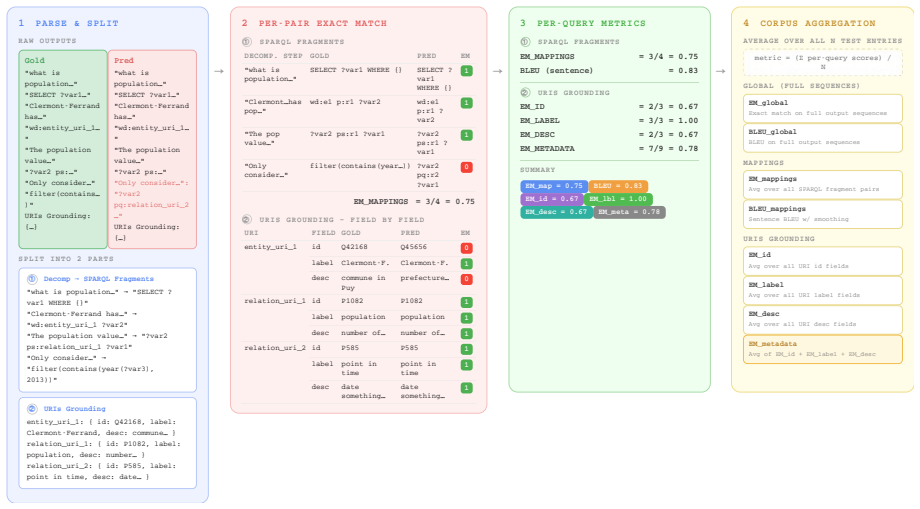
DeSQ is a KB-agnostic framework that decomposes complex questions into Atomic Constraints (ACs) that mirror the relational structure of the underlying KB, generates a two-part structured output consisting of mappings from each AC to its corresponding SPARQL Fragment using standardized variable and URI placeholders together with a URIs Grounding block, and assembles the fragments into a complete SPARQL query.
What carries the argument
Atomic Constraints (ACs) that decompose the question to mirror KB relations, together with the two-part structured output of AC-to-SPARQL-fragment mappings (using placeholders) and a separate URIs Grounding block.
If this is right
- Surpasses state-of-the-art approaches on four out of five major benchmarks.
- Demonstrates superior robustness to lexical variation in the input questions.
- Simplifies evaluation by removing the requirement for a live KB endpoint.
- Produces structured output that supports fine-grained error analysis and targeted improvements.
Where Pith is reading between the lines
- The placeholder-based mapping step may allow the same decomposition logic to be reused across different target query languages.
- Fine-grained error signals from the structured output could be fed back to improve the decomposition stage in future iterations.
- Avoiding direct KB exploration during query construction may reduce latency when answering questions over very large knowledge bases.
Load-bearing premise
Complex questions can be reliably decomposed into Atomic Constraints that accurately mirror the relational structure of the underlying knowledge base, enabling correct mapping to SPARQL fragments.
What would settle it
A collection of complex questions on which the decomposition step produces Atomic Constraints whose relations do not match the gold-standard query structure, causing the assembled SPARQL queries to return incorrect or empty results even after correct URI grounding.
Figures

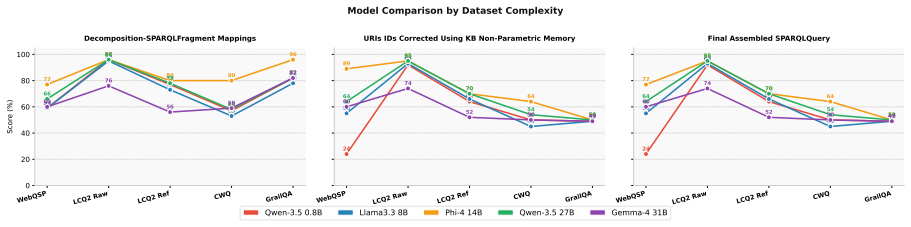
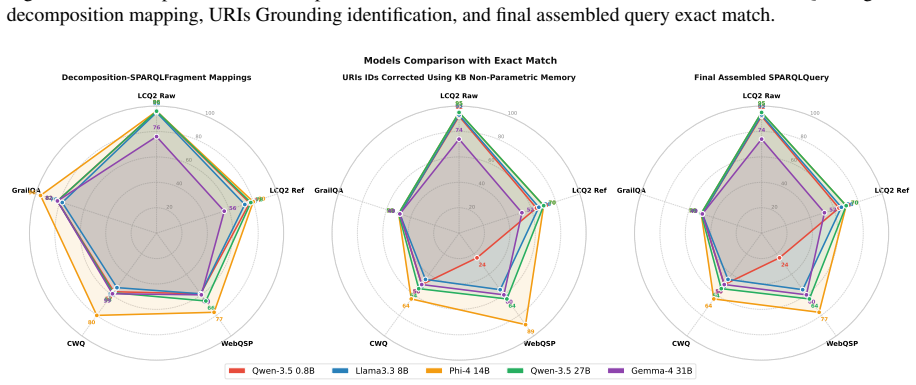
read the original abstract
Dominant approaches to Knowledge Base Question Answering (KBQA) fall into two categories. First is the generation of a formal query that suffers from brittleness and limited explainability, and the second is direct answer retrieval through KB exploration that is computationally costly and prone to hallucination. To combine the strengths of both paradigms while mitigating their respective weaknesses, we introduce DeSQ (Decomposition-based SPARQL Query Generation), a KB-agnostic framework that operates in three stages. First, it decomposes complex questions into Atomic Constraints (ACs) that mirror the relational structure of the underlying KB. Second, it generates a two-part structured output: (a) Mapping of each AC to its corresponding SPARQL Fragment, using standardized variable and URIs placeholders, and (b) URIs Grounding block describing each placeholder. Third, it assembles these fragments into a complete SPARQL query. DeSQ surpasses state-of-the-art approaches on four out of five major benchmarks and demonstrates superior robustness to lexical variation. Beyond performance gains, our framework greatly simplifies evaluation by eliminating the need for a live KB endpoint, and its structured output enables fine-grained error analysis, allowing more targeted interventions for improvement.
Editorial analysis
A structured set of objections, weighed in public.
Referee Report
Summary. The paper introduces DeSQ, a KB-agnostic three-stage framework for SPARQL query generation from natural language questions in Knowledge Base Question Answering (KBQA). Stage 1 decomposes complex questions into Atomic Constraints (ACs) that mirror the relational structure of the underlying KB. Stage 2 produces a structured output consisting of (a) mappings from each AC to SPARQL fragments using standardized variable and URI placeholders and (b) a URIs Grounding block. Stage 3 assembles the fragments into a complete SPARQL query. The authors claim that DeSQ surpasses state-of-the-art methods on four out of five major benchmarks, exhibits superior robustness to lexical variation, eliminates the need for a live KB endpoint during evaluation, and enables fine-grained error analysis via its structured output.
Significance. If the empirical claims hold, DeSQ offers a useful hybrid between formal query generation (which can be brittle) and direct KB exploration (which can hallucinate). The elimination of live KB requirements for evaluation and the provision of structured intermediate output for targeted error analysis are concrete practical strengths that could improve reproducibility and iterative improvement in the KBQA literature. The robustness claim, if substantiated, would address a known practical weakness of many KBQA systems.
major comments (2)
- [Abstract, §3] Abstract and §3 (Method): The framework is described as 'KB-agnostic,' yet ACs are required to 'mirror the relational structure of the underlying KB.' If decomposition occurs from the question text alone (as implied by the pipeline), it is unclear how ACs can systematically capture KB-specific predicates, cardinalities, and entity types without KB access during stage 1. This tension directly affects the reliability of the weakest assumption and the claimed robustness to lexical variation.
- [§4] §4 (Experiments): The central claim that DeSQ surpasses SOTA on four of five benchmarks depends on reliable AC decomposition. No quantitative breakdown is reported that isolates decomposition accuracy (e.g., precision/recall of ACs against gold KB structure) from end-to-end query execution accuracy. Without such a table or subsection, it is impossible to determine whether performance gains stem from the decomposition stage or from later components.
minor comments (2)
- [§2, §3] The introduction of 'Atomic Constraints (ACs)' and 'URIs Grounding block' would benefit from an explicit formal definition or pseudocode example in §2 or §3 to clarify their exact structure and invariants.
- [Figures/Tables in §4] Figure captions and table headers should explicitly state whether results are averaged over multiple runs and whether statistical significance tests were applied, to support the robustness claims.
Simulated Author's Rebuttal
We are grateful to the referee for the constructive feedback. The comments highlight important points regarding the interpretation of 'KB-agnostic' and the need for finer-grained analysis of the decomposition stage. We address each major comment below and indicate the revisions we will make.
read point-by-point responses
-
Referee: [Abstract, §3] Abstract and §3 (Method): The framework is described as 'KB-agnostic,' yet ACs are required to 'mirror the relational structure of the underlying KB.' If decomposition occurs from the question text alone (as implied by the pipeline), it is unclear how ACs can systematically capture KB-specific predicates, cardinalities, and entity types without KB access during stage 1. This tension directly affects the reliability of the weakest assumption and the claimed robustness to lexical variation.
Authors: We thank the referee for this observation. In the manuscript, 'KB-agnostic' specifically denotes that DeSQ requires no live KB endpoint or runtime access to the knowledge base during inference, query generation, or evaluation (in contrast to exploration-based methods). The decomposition into Atomic Constraints is performed by an LLM that has been trained or prompted on question-SPARQL pairs drawn from the target KB; this allows the model to learn and reproduce the relational structure, predicates, cardinalities, and entity types directly from the natural-language input. We will revise the abstract and §3 to explicitly distinguish runtime agnosticism from training-time exposure to KB structure and to elaborate on how this learned mapping underpins the reported robustness to lexical variation. revision: partial
-
Referee: [§4] §4 (Experiments): The central claim that DeSQ surpasses SOTA on four of five benchmarks depends on reliable AC decomposition. No quantitative breakdown is reported that isolates decomposition accuracy (e.g., precision/recall of ACs against gold KB structure) from end-to-end query execution accuracy. Without such a table or subsection, it is impossible to determine whether performance gains stem from the decomposition stage or from later components.
Authors: We agree that an explicit quantitative breakdown of the decomposition stage would strengthen the empirical claims. In the revised manuscript we will add a dedicated subsection (or table) in §4 that reports precision, recall, and F1 of AC decomposition against gold-standard structures derivable from the gold queries on the five benchmarks. We will also include a correlation analysis between per-question decomposition accuracy and end-to-end execution accuracy to clarify the contribution of each stage. revision: yes
Circularity Check
No circularity in empirical framework
full rationale
The paper describes an empirical three-stage framework for KBQA without equations, derivations, or parameter-fitting steps that reduce to their own inputs. Claims rest on benchmark comparisons and robustness tests rather than any self-definitional mapping, fitted-input prediction, or load-bearing self-citation chain. The decomposition into ACs is presented as an input process whose correctness is evaluated externally via end-to-end results, satisfying the criteria for a self-contained empirical contribution with no circularity patterns.
Axiom & Free-Parameter Ledger
axioms (1)
- domain assumption Complex questions can be decomposed into Atomic Constraints (ACs) that mirror the relational structure of the underlying KB.
invented entities (2)
-
Atomic Constraints (ACs)
no independent evidence
-
URIs Grounding block
no independent evidence
Reference graph
Works this paper leans on
-
[1]
Attention is All you Need , url =
Vaswani, Ashish and Shazeer, Noam and Parmar, Niki and Uszkoreit, Jakob and Jones, Llion and Gomez, Aidan N and Kaiser, ukasz and Polosukhin, Illia , booktitle =. Attention is All you Need , url =
-
[2]
gpt-oss-120b & gpt-oss-20b Model Card
gpt-oss-120b & gpt-oss-20b model card , author=. arXiv preprint arXiv:2508.10925 , year=
work page internal anchor Pith review Pith/arXiv arXiv
-
[3]
arXiv preprint arXiv:2305.13269 , year=
Chain-of-knowledge: Grounding large language models via dynamic knowledge adapting over heterogeneous sources , author=. arXiv preprint arXiv:2305.13269 , year=
-
[4]
arXiv preprint arXiv:2305.03268 , year=
Verify-and-edit: A knowledge-enhanced chain-of-thought framework , author=. arXiv preprint arXiv:2305.03268 , year=
-
[5]
Advances in neural information processing systems , volume=
Chain-of-thought prompting elicits reasoning in large language models , author=. Advances in neural information processing systems , volume=
-
[6]
Proceedings of the AAAI conference on artificial intelligence , volume=
Graph-based reasoning over heterogeneous external knowledge for commonsense question answering , author=. Proceedings of the AAAI conference on artificial intelligence , volume=
-
[7]
arXiv preprint arXiv:2307.07697 (2024)
Think-on-graph: Deep and responsible reasoning of large language model on knowledge graph , author=. arXiv preprint arXiv:2307.07697 , year=
-
[8]
International Conference on Knowledge Engineering and Knowledge Management , pages=
UniQ-Gen: Unified Query Generation Across Multiple Knowledge Graphs , author=. International Conference on Knowledge Engineering and Knowledge Management , pages=. 2024 , organization=
2024
-
[9]
arXiv preprint arXiv:2410.06062 , year=
Llm-based sparql query generation from natural language over federated knowledge graphs , author=. arXiv preprint arXiv:2410.06062 , year=
-
[10]
arXiv preprint arXiv:2507.10045 , year=
Automating SPARQL Query Translations between DBpedia and Wikidata , author=. arXiv preprint arXiv:2507.10045 , year=
- [11]
-
[12]
arXiv preprint arXiv:2408.02795 , year=
Entity Retrieval for Answering Entity-Centric Questions , author=. arXiv preprint arXiv:2408.02795 , year=
-
[13]
arXiv preprint arXiv:2305.09645 , year=
Structgpt: A general framework for large language model to reason over structured data , author=. arXiv preprint arXiv:2305.09645 , year=
-
[14]
Proceedings of the 61st annual meeting of the association for computational linguistics (volume 1: long papers) , pages=
Don’t generate, discriminate: A proposal for grounding language models to real-world environments , author=. Proceedings of the 61st annual meeting of the association for computational linguistics (volume 1: long papers) , pages=
-
[15]
arXiv preprint arXiv:2406.14763 , year=
A Learn-Then-Reason Model Towards Generalization in Knowledge Base Question Answering , author=. arXiv preprint arXiv:2406.14763 , year=
-
[16]
Search-on-Graph: Iterative Informed Navigation for Large Language Model Reasoning on Knowledge Graphs , author=. arXiv preprint arXiv:2510.08825 , year=
work page internal anchor Pith review Pith/arXiv arXiv
-
[17]
IEEE Access , volume=
A comprehensive evaluation of neural SPARQL query generation from natural language questions , author=. IEEE Access , volume=. 2024 , publisher=
2024
-
[18]
Proceedings of the 19th Conference of the European Chapter of the Association for Computational Linguistics (Volume 1: Long Papers) , pages=
Out of style: Rag’s fragility to linguistic variation , author=. Proceedings of the 19th Conference of the European Chapter of the Association for Computational Linguistics (Volume 1: Long Papers) , pages=
-
[19]
Proceedings of the 54th Annual Meeting of the Association for Computational Linguistics (Volume 2: Short Papers) , pages=
The value of semantic parse labeling for knowledge base question answering , author=. Proceedings of the 54th Annual Meeting of the Association for Computational Linguistics (Volume 2: Short Papers) , pages=
-
[20]
2019 , publisher=
Dubey, Mohnish and Banerjee, Debayan and Abdelkawi, Abdelrahman and Lehmann, Jens , booktitle=. 2019 , publisher=
2019
-
[21]
Proceedings of the 2018 Conference of the North American Chapter of the Association for Computational Linguistics: Human Language Technologies, Volume 1 (Long Papers) , pages=
The web as a knowledge-base for answering complex questions , author=. Proceedings of the 2018 Conference of the North American Chapter of the Association for Computational Linguistics: Human Language Technologies, Volume 1 (Long Papers) , pages=
2018
-
[22]
Proceedings of the web conference 2021 , pages=
Beyond iid: three levels of generalization for question answering on knowledge bases , author=. Proceedings of the web conference 2021 , pages=
2021
-
[23]
2024 , publisher=
Usbeck, Ricardo and Yan, Xi and Perevalov, Aleksandr and Jiang, Longquan and Schulz, Julius and Kraft, Angelie and Dubey, Mohnish and Napolitano, Giulio and Saxena, Karan and Luo, Yao and others , journal=. 2024 , publisher=
2024
-
[24]
ACM Journal on Computing and Cultural Heritage , volume=
Generating sparql queries over cidoc-crm using a two-stage ontology path patterns method in llm prompts , author=. ACM Journal on Computing and Cultural Heritage , volume=. 2025 , publisher=
2025
-
[25]
International Semantic Web Conference , pages=
Assessing the Generalization Capabilities of Neural Machine Translation Models for SPARQL Query Generation , author=. International Semantic Web Conference , pages=. 2023 , organization=
2023
-
[26]
arXiv preprint arXiv:2502.12210 , year=
Enhancing Frame Detection with Retrieval Augmented Generation , author=. arXiv preprint arXiv:2502.12210 , year=
-
[27]
Applied Sciences , volume=
Enhancing SPARQL Query Generation for Knowledge Base Question Answering Systems by Learning to Correct Triplets , author=. Applied Sciences , volume=. 2024 , publisher=
2024
-
[28]
Proceedings of the 2024 Annual International ACM SIGIR Conference on Research and Development in Information Retrieval in the Asia Pacific Region , pages=
Triple Augmented Generative Language Models for SPARQL Query Generation from Natural Language Questions , author=. Proceedings of the 2024 Annual International ACM SIGIR Conference on Research and Development in Information Retrieval in the Asia Pacific Region , pages=
2024
-
[29]
arXiv preprint arXiv:2407.01626 , year=
SPARKLE: Enhancing SPARQL Generation with Direct KG Integration in Decoding , author=. arXiv preprint arXiv:2407.01626 , year=
-
[30]
arXiv preprint arXiv:2010.00904 , year=
Autoregressive entity retrieval , author=. arXiv preprint arXiv:2010.00904 , year=
-
[31]
2024 , publisher=
Generating sparql from natural language using chain-of-thoughts prompting , author=. 2024 , publisher=
2024
-
[32]
Proceedings of the 45th International ACM SIGIR Conference on Research and Development in Information Retrieval , pages=
Modern baselines for SPARQL semantic parsing , author=. Proceedings of the 45th International ACM SIGIR Conference on Research and Development in Information Retrieval , pages=
-
[33]
arXiv preprint arXiv:2402.05128 , year=
Enhancing textbook question answering task with large language models and retrieval augmented generation , author=. arXiv preprint arXiv:2402.05128 , year=
-
[34]
Proceedings of the 4th International Workshop on Knowledge-Augmented Methods for Natural Language Processing , pages=
Investigating Large Language Models for Text-to-SPARQL Generation , author=. Proceedings of the 4th International Workshop on Knowledge-Augmented Methods for Natural Language Processing , pages=
-
[35]
arXiv preprint arXiv:2305.01750 , year=
Few-shot in-context learning for knowledge base question answering , author=. arXiv preprint arXiv:2305.01750 , year=
-
[36]
International Conference on Applications of Natural Language to Information Systems , pages=
The benefits of query-based KGQA systems for complex and temporal questions in LLM era , author=. International Conference on Applications of Natural Language to Information Systems , pages=. 2025 , organization=
2025
-
[37]
arXiv preprint arXiv:2202.08904 , year=
Sgpt: Gpt sentence embeddings for semantic search , author=. arXiv preprint arXiv:2202.08904 , year=
-
[38]
arXiv preprint arXiv:2407.11417 , year=
Spinach: Sparql-based information navigation for challenging real-world questions , author=. arXiv preprint arXiv:2407.11417 , year=
-
[39]
arXiv preprint arXiv:2310.08975 , year=
ChatKBQA: A Generate-then-Retrieve Framework for Knowledge Base Question Answering with Fine-tuned Large Language Models , author=. arXiv preprint arXiv:2310.08975 , year=
-
[40]
Code Llama: Open Foundation Models for Code
Code llama: Open foundation models for code , author=. arXiv preprint arXiv:2308.12950 , year=
work page internal anchor Pith review Pith/arXiv arXiv
-
[41]
Findings of the Association for Computational Linguistics: EACL 2026 , pages=
LitE-SQL: A Lightweight and Efficient Text-to-SQL Framework with Vector-based Schema Linking and Execution-Guided Self-Correction , author=. Findings of the Association for Computational Linguistics: EACL 2026 , pages=
2026
-
[42]
Autonomous Knowledge Graph Exploration with Adaptive Breadth-Depth Retrieval
Autonomous Knowledge Graph Exploration with Adaptive Breadth-Depth Retrieval , author=. arXiv preprint arXiv:2601.13969 , year=
work page internal anchor Pith review Pith/arXiv arXiv
-
[43]
Proceedings of the ACM on Management of Data , volume=
Codes: Towards building open-source language models for text-to-sql , author=. Proceedings of the ACM on Management of Data , volume=. 2024 , publisher=
2024
-
[44]
IEEE Transactions on Knowledge and Data Engineering , year=
Next-generation database interfaces: A survey of llm-based text-to-sql , author=. IEEE Transactions on Knowledge and Data Engineering , year=
-
[45]
arXiv preprint arXiv:2503.22144 , year=
FRASE: Structured Representations for Generalizable SPARQL Query Generation , author=. arXiv preprint arXiv:2503.22144 , year=
-
[46]
Proceedings of the 61st annual meeting of the association for computational linguistics (volume 1: long papers) , pages=
Interleaving retrieval with chain-of-thought reasoning for knowledge-intensive multi-step questions , author=. Proceedings of the 61st annual meeting of the association for computational linguistics (volume 1: long papers) , pages=
-
[47]
Proceedings of the 2025 Conference on Empirical Methods in Natural Language Processing , pages=
Search-o1: Agentic search-enhanced large reasoning models , author=. Proceedings of the 2025 Conference on Empirical Methods in Natural Language Processing , pages=
2025
-
[48]
ReSearch: Learning to Reason with Search for LLMs via Reinforcement Learning
Learning to reason with search for llms via reinforcement learning , author=. arXiv preprint arXiv:2503.19470 , year=
work page internal anchor Pith review Pith/arXiv arXiv
-
[49]
Kag: Boosting llms in professional domains via knowledge augmented generation, 2024 , author=. URL https://arxiv. org/abs/2409.13731 , year=
-
[50]
Findings of the Association for Computational Linguistics: EACL 2026 , pages=
Reducing hallucinations in language model-based sparql query generation using post-generation memory retrieval , author=. Findings of the Association for Computational Linguistics: EACL 2026 , pages=
2026
-
[51]
The llama 3 herd of models , author=. arXiv preprint arXiv:2407.21783 , year=
work page internal anchor Pith review Pith/arXiv arXiv
-
[52]
Phi-4 technical report , author=. arXiv preprint arXiv:2412.08905 , year=
work page internal anchor Pith review Pith/arXiv arXiv
-
[53]
DeepSeek-R1: Incentivizing Reasoning Capability in LLMs via Reinforcement Learning
Deepseek-r1: Incentivizing reasoning capability in llms via reinforcement learning , author=. arXiv preprint arXiv:2501.12948 , year=
work page internal anchor Pith review Pith/arXiv arXiv
-
[54]
Proceedings of the 2025 Conference on Empirical Methods in Natural Language Processing , pages=
Beyond seen data: Improving kbqa generalization through schema-guided logical form generation , author=. Proceedings of the 2025 Conference on Empirical Methods in Natural Language Processing , pages=
2025
-
[55]
arXiv preprint arXiv:2209.04994 , year=
Knowledge base question answering: A semantic parsing perspective , author=. arXiv preprint arXiv:2209.04994 , year=
-
[56]
IEEE Transactions on Knowledge and Data Engineering , year=
A Survey of Text-to-SQL in the Era of LLMs: Where are we, and where are we going? , author=. IEEE Transactions on Knowledge and Data Engineering , year=
-
[57]
arXiv preprint arXiv:2505.19761 , year=
Divide and conquer: Grounding LLMs as efficient decision-making agents via offline hierarchical reinforcement learning , author=. arXiv preprint arXiv:2505.19761 , year=
-
[58]
Advances in neural information processing systems , volume=
Tree of thoughts: Deliberate problem solving with large language models , author=. Advances in neural information processing systems , volume=
-
[59]
2023 , eprint=
C-Pack: Packaged Resources To Advance General Chinese Embedding , author=. 2023 , eprint=
2023
discussion (0)
Sign in with ORCID, Apple, or X to comment. Anyone can read and Pith papers without signing in.