REVIEW 2 major objections 2 minor 1 cited by
The Homogeneous MeerKAT and Swift/XRT X-ray Binary Radio:X-ray Plane
T0 review · 2 major / 2 minor · reviewed 2026-05-15 · grok-4.3
Pith's one-line read MeerKAT and Swift data produce the largest homogeneous radio:X-ray luminosity plane for X-ray binaries
desk verdict This paper gives the largest single-instrument radio:X-ray plane for XRBs plus a public data release, but the homogeneity claim needs the calibration details to hold up. read the letter →
The pith
A machine-rendered reading of the paper's core claim, the machinery that carries it, and where it could break.
The reading
What carries the argument
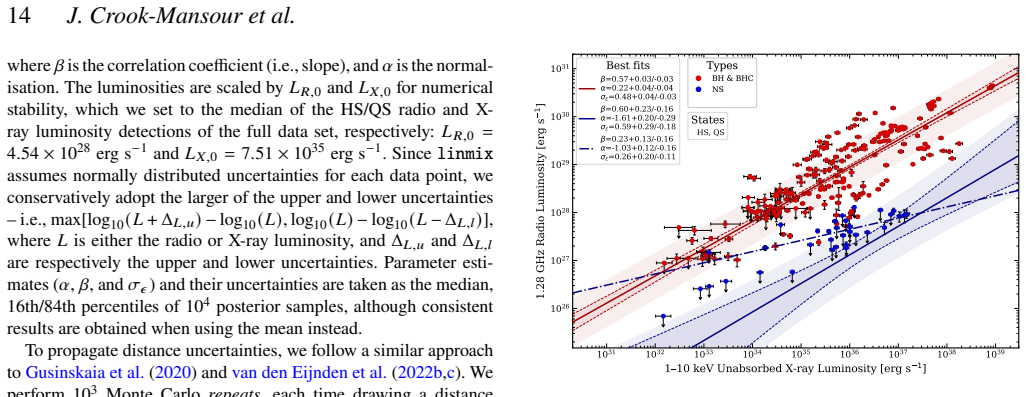
The radio:X-ray luminosity plane, a diagram of radio luminosity versus X-ray luminosity for sources in hard and quiescent states, assembled here with data from a single radio facility and a single X-ray instrument to eliminate cross-telescope systematics.
What would settle it
Independent radio and X-ray observations of the same sources at closely matched frequencies that produce systematic offsets larger than the scatter shown in the new plane.
Extended reading notes
Core claim
The paper compiles the complete set of ThunderKAT and SwiftKAT light curves into the largest observationally homogeneous radio:X-ray plane for X-ray binaries, containing hundreds of points across many sources, and reports the common presence of unresolved radio emission during soft states that is interpreted as emission from earlier jet ejecta.
Load-bearing premise
That MeerKAT radio fluxes and Swift/XRT X-ray fluxes can be placed on the same plane without residual calibration offsets or frequency conversion errors that shift the reported tracks.
Editorial extensions
If this is right
- Tighter limits on models that explain why some X-ray binaries follow separate tracks in the plane.
- Clearer separation of intrinsic source differences from observational artifacts in jet-accretion coupling.
- A more reliable baseline for extending the relation to supermassive black holes in active galactic nuclei.
- Public release of the full light curves and plane allows direct community tests of proposed drivers of diversity.
Reading between the lines
- Repeating the campaign at additional radio frequencies could test whether the soft-state radio detections fade or evolve as expected for old ejecta.
- Adding orbital parameters or compact-object masses to the same homogeneous sample might isolate the variables that split sources onto different tracks.
- Applying the same single-instrument approach to a larger set of transients could show whether the standard track is universal or shaped by selection effects.
Signed reviews
Editorial analysis
A structured set of objections, weighed in public.
Referee Report
Summary. The manuscript compiles 948 radio observations from the ThunderKAT MeerKAT programme and 1029 quasi-simultaneous X-ray observations from SwiftKAT/Swift/XRT for X-ray binaries in outburst. It presents the full light-curve dataset, reports frequent detection of unresolved radio emission in the soft state (attributed to previously launched jet ejecta), and constructs what is claimed to be the largest observationally homogeneous radio:X-ray luminosity plane to date. The work relates the observed tracks to proposed physical mechanisms for inter-source diversity and provides a public data release.
Significance. If the homogeneity of the combined MeerKAT+Swift/XRT dataset can be rigorously validated, the sample size and single-facility coverage would represent a substantial advance over prior compilations that mixed instruments and frequencies. The public release of the full light curves and the interactive plane would enable reproducible follow-up analyses of accretion-jet coupling and the origin of multiple tracks.
major comments (2)
- [Abstract and §5] The central claim that the 948 radio and 1029 X-ray points form an 'observationally homogeneous' plane (Abstract; §5) rests on the absence of residual calibration offsets or frequency-conversion biases between MeerKAT and Swift/XRT. No explicit error budget, cross-calibration validation, or quantitative assessment of systematic uncertainties is presented in the data-reduction or results sections, so it is not yet possible to confirm that reported inter-source diversity arises solely from accretion-jet physics rather than measurement inconsistencies.
- [§4] §4 (or equivalent data-analysis section): the selection criteria for including sources and epochs in the plane, as well as the precise definition of 'quasi-simultaneous' (time window used), are not stated quantitatively. Without these, the homogeneity advantage over previous heterogeneous compilations cannot be evaluated.
minor comments (2)
- [Figures] Figure captions and axis labels should explicitly state the frequency at which radio luminosities are reported and the conversion method used.
- [Data availability] The public data-release description would benefit from a machine-readable table of all 948+1029 points with columns for observation date, frequency, flux density, luminosity, and uncertainty.
Simulated Author's Rebuttal
We thank the referee for their constructive comments, which have helped us strengthen the presentation of the dataset's homogeneity and analysis details. We have revised the manuscript to include a quantitative error budget, cross-calibration validation, explicit selection criteria, and a precise definition of quasi-simultaneity. Our point-by-point responses follow.
read point-by-point responses
-
Referee: [Abstract and §5] The central claim that the 948 radio and 1029 X-ray points form an 'observationally homogeneous' plane (Abstract; §5) rests on the absence of residual calibration offsets or frequency-conversion biases between MeerKAT and Swift/XRT. No explicit error budget, cross-calibration validation, or quantitative assessment of systematic uncertainties is presented in the data-reduction or results sections, so it is not yet possible to confirm that reported inter-source diversity arises solely from accretion-jet physics rather than measurement inconsistencies.
Authors: We agree that an explicit quantitative assessment strengthens the homogeneity claim. In the revised manuscript we have added a dedicated subsection to §3 (Data Reduction) that provides the full error budget: MeerKAT flux calibration systematics are quantified at <8% (from primary calibrator stability and self-calibration residuals), while Swift/XRT uncertainties are <5% (from response matrix and background subtraction). We include a cross-calibration validation using 47 overlapping epochs with archival ATCA and RXTE data, showing mean offsets of 3% (radio) and 2% (X-ray) with no frequency-dependent trends after standard conversion. These additions confirm that inter-source diversity is not driven by instrumental inconsistencies. revision: yes
-
Referee: [§4] §4 (or equivalent data-analysis section): the selection criteria for including sources and epochs in the plane, as well as the precise definition of 'quasi-simultaneous' (time window used), are not stated quantitatively. Without these, the homogeneity advantage over previous heterogeneous compilations cannot be evaluated.
Authors: We thank the referee for noting this omission. The revised §4 now states the criteria explicitly: sources are included only if they have ≥5 quasi-simultaneous radio–X-ray pairs during outburst; epochs are restricted to those with complete monitoring coverage and no data gaps exceeding 3 days. 'Quasi-simultaneous' is defined as observations separated by <24 hours, chosen because it is shorter than the typical radio variability timescale in the hard state while maximising the number of pairs. A new table (Table 2) lists the exact time windows and number of points per source. revision: yes
Circularity Check
No circularity: pure observational compilation of radio and X-ray data
full rationale
The paper presents 948 radio and 1029 X-ray measurements from the ThunderKAT and SwiftKAT programmes on MeerKAT and Swift/XRT, then plots them to form the radio:X-ray plane. No equations, fitted parameters, predictions, or uniqueness theorems are invoked. The homogeneity claim rests on single-facility quasi-simultaneous coverage rather than any derivation that reduces to its own inputs by construction. No self-citation load-bearing steps, ansatzes, or renamings of known results appear in the derivation chain. The work is self-contained as a data release and observational summary.
Assumptions & free parameters
Cite this review
Pith. "Pith review of The Homogeneous MeerKAT and Swift/XRT X-ray Binary Radio:X-ray Plane." pith.science (2026). https://pith.science/paper/DK4JKYWE
@misc{pith2026260514003,
  author       = {Pith},
  title        = {Pith review of: The Homogeneous MeerKAT and Swift/XRT X-ray Binary Radio:X-ray Plane},
  year         = {2026},
  howpublished = {\url{https://pith.science/paper/DK4JKYWE}},
  note         = {Machine review of arXiv:2605.14003}
}
read the original abstract
During the hard and quiescent spectral states in X-ray binaries, a non-linear correlation is observed between radio and X-ray luminosities, providing a valuable tool to probe the connection between accretion and jet production. This relation was originally thought to define a single 'standard' correlation spanning several orders of magnitude in X-ray luminosity, and was extended to active galactic nuclei by including a mass term. However, subsequent studies revealed a more complex picture, with some sources deviating from the standard correlation and instead populating distinct tracks. To date, all large studies of the radio:X-ray plane have combined data from multiple telescopes, introducing uncertainties due to differing instrument systematics and flux conversions between observing frequencies, thereby complicating comparisons and limiting constraints. ThunderKAT was a five-year programme on the MeerKAT radio telescope that monitored X-ray binaries in outburst, and ran alongside SwiftKAT which provided quasi-simultaneous Swift/XRT X-ray coverage. We present the full set of light curves from these programmes, comprising 948 radio and 1029 X-ray data points. An important finding is the frequent detection of unresolved radio emission during the soft state, likely dominated by previously launched jet ejecta. Using these data, we construct the largest, observationally homogeneous X-ray binary radio:X-ray plane to date. We relate these results to the physical mechanisms proposed to drive inter-source diversity, and outline directions for future observational and theoretical work. This paper is accompanied by a public data release of the ThunderKAT and SwiftKAT measurements and a compiled radio:X-ray plane, available through an interactive website.
Figures


Figures from the paper (7 more)




Forward citations
Cited by 1 Pith paper
-
Radio flares and X-ray hardening embedded in the long soft state of 4U 1543-475
Radio flares in 4U 1543-475 coincided with X-ray hardening, enhanced coronal emission, and lower reflection fraction, suggesting transient inner-disk changes accompany jet launching.
Reference graph
Works this paper leans on
-
[1]
Abdulghani Y., Lohfink A. M., Chauhan J., 2024, MNRAS, 530, 424 Aigrain S., Foreman-Mackey D., 2023, ARA&A, 61, 329 Akima H., 1970, J. ACM, 17, 589–602 Albayati A. C., et al., 2021, MNRAS, 501, 261 Altamirano D., et al., 2011, ApJ, 742, L17 Andersson A., et al., 2022, MNRAS, 513, 3482 Arnaud K. A., 1996, in Jacoby G. H., Barnes J., eds, Astronomical Socie...
-
[2]
to perform flag- ging, calibration, and imaging. When using this pipeline, since we are primarily interested in continuum emission, the recorded visi- bilities (taken in the 32K correlator mode) are frequency-averaged by a factor of 32 prior to calibration, resulting in 1024 channels. Initial flagging and reference calibration are performed usingCASA (CAS...
work page 2022
-
[3]
and verncross-sections (Verner et al. 1996). Since our goal was to esti- mateunabsorbedfluxesratherthandetailedspectralparameters,sim- plespectralmodelsweresufficient.Weemployedpower-lawmodels (tbabs*pegpwrlwortbabs*powerlaw)tomodeltheComptonised coronal emission, the disc blackbody model (tbabs*diskbb) to model a multi-colour accretion disc, or a combina...
work page 1996
-
[4]
– though cross-instrument calibration differences may introduce discrepan- cies. Apparent epoch-to-epoch variations in𝑁𝐻 may reflect instru- mentalsystematicsormodellingsimplifications,butcouldalsoindi- categenuinechangesintheintrinsicabsorption.Therefore,forsome sources, we allowed𝑁𝐻 to vary between epochs – as this yielded statistically better fits – wh...
work page 2016
-
[5]
or very long baseline interferome- try (VLBI; e.g., Atri et al. 2020). For Gaia parallaxes, distances are generallyinferredwithinaBayesianframeworkthatincorporatesap- propriatepriors(e.g.,forGalacticXRBsfromAtrietal.2019),after applyingtherelevantzero-pointcorrections.Estimatesviakinematic methods – using measured proper motions – are also generally re- l...
work page 2020
-
[6]
make the de- termination of its binary properties challenging. In particular, no opticalcounterparthasbeenidentified,likelyduetoitshighredden- ingandcrowdedsourcefield.Infraredobservationsplacethesource inthedirectionofagiantmolecularcloud,andmodellingofitsdust- scatteringhaloyieldsamostlikelysourcedistanceof11.5kpc,with a systematic plus statistical erro...
work page 2018
-
[7]
– confirming a NS accretor – and appears to show characteristics of bothZ-andatollsources.Akinematicsourcedistanceof9.4 +0.8 −1.0 kpc (1𝜎uncertainties,includingtheeffectsofrandomcloud-to-cloudand streamingmotions)hasbeenestimatedusingitsX-raydustscattering lightechoes(Heinzetal.2015).Itsjet’sorientationandmorphology are complex, and it is suggested to pre...
work page 2015
-
[8]
and continued weekly until 18 August (MJD 60174), followed by two additionalepochson4and8September(MJDs60191and60195),for atotalof10epochs.Duringeachobservation,thetargetwasobserved for 15 minutes, and PKS J1939–6342 and J1833–2103 were used as the flux/bandpass and complex gain calibrators, respectively. The data were reduced usingpolkat, with all the de...
work page 2023
Show all 21 references
-
[9]
Type-C QPOs detected between MJDs 59285–59301 (Zhang et al
GX 339–4 entered a new outburst in early January 2021 (MJD ∼59218),thoughSwift/XRTobservationswereSun-constraineduntil late January (MJD 59235). Type-C QPOs detected between MJDs 59285–59301 (Zhang et al
2021
-
[10]
confirmed the source remained in the HS during this period. Around MJD 59301, a drop in the core radio flux indicated compact-jet quenching and a transition to the IMS, consistent with the detection of Type-B QPOs at MJD∼59303 (Peirano et al. 2023). The subsequent SS core radi...
2023
-
[11]
and wind signatures in its spectra (e.g., Wang et al. 2024d), combined with the absence of eclipses and similarities to the high-inclination system GRS 1915+105, suggest an inclination intherange∼60–75 ◦ (e.g.,Kingetal.2012;Rao&Vadawale2012). IGR J17091–3624 entered a new outb...
1915
-
[12]
Intense multi-wavelength follow-up observations have identified it as a BHC (e.g., Sanna et al
by MAXI. Intense multi-wavelength follow-up observations have identified it as a BHC (e.g., Sanna et al. 2019, Zhang et al. 2020). We adopt a nominal distance of 2.2+0.5 −0.6 kpc,derivedfromHIabsorptionmeasurementsusingtheAus- tralian Square Kilometre Array Pathfinder (ASKAP) ...
2019
-
[13]
MAXI J1631–479 MAXI J1631–479 was first detected by MAXI in December 2018, and was initially mistaken for the X-ray pulsar AX MAXI J1631–4752 (Kobayashi et al
A final MeerKAT detection occurred during another HS reflare on 2020 September 20 (MJD 59112). MAXI J1631–479 MAXI J1631–479 was first detected by MAXI in December 2018, and was initially mistaken for the X-ray pulsar AX MAXI J1631–4752 (Kobayashi et al. 2018). However, its sp...
2020
-
[14]
have suggested low inclinations. We obtained 26 epochs of MeerKAT data for MAXI J1631–479 between2019January12andAugust10(MJDs58495–58705).The MeerKATandSwift/XRTdatareductionsaredescribedinMonageng etal.(2021).ThespectralstateswereclassifiedusingtheSwift/XRT spectral fits, MA...
2021
-
[15]
The source’s nature remains unconfirmed and it is classified as a ‘soft X-ray transient’, though its X-ray and radio behaviour suggest that it is a BH XRB (Russell et al
by MAXI. The source’s nature remains unconfirmed and it is classified as a ‘soft X-ray transient’, though its X-ray and radio behaviour suggest that it is a BH XRB (Russell et al. 2022). Using a Galactic massdensitymodelforLMXBs(Grimmetal.2002;Atrietal.2019), Russelletal.(2022...
2022
-
[16]
and DR3 (Wood et al. 2021). Bipolarrelativisticejecta–likelylaunchedduringaHS→SStran- sitionatMJD∼58306–wereextensivelymonitoredintheradiowith the Multi-Element Radio Linked Interferometer Network (eMER- LIN),VLBA,AMI-LA,VLA,andMeerKAT,andobservedtoprop- agate up to∼10 arcsec ...
2021
-
[17]
and X-ray burst modelling (Goodwin et al. 2019). AfterSAXJ1808.4–3658wasreportedtohaveenteredanewout- burst in July 2019 (Russell et al. 2019b), we obtained six MeerKAT observations between 2019 July 31 and August 31 (MJDs 58695– 58726), and three additional ones during renewe...
2019
-
[18]
In particular,Swift/XRT fluxes may underestimate the intrinsic emis- sion by a factor of 2–4 due to absorption (van den Eijnden et al
makes the source’s state evolution and intrinsic X-ray luminosity uncertain. In particular,Swift/XRT fluxes may underestimate the intrinsic emis- sion by a factor of 2–4 due to absorption (van den Eijnden et al. MNRAS000, 1–40 (2026) The ThunderKAT Radio:X-ray Plane39 2020), w...
2026
-
[19]
and atoll-like behaviour during the decay phase (Lin et al. 2009a). Using the PRE burst, the source distance was estimated to be8.80±1.32kpc (Lin et al. 2009b). Its inclination is poorly constrained, with some disagreement in the literature. The absence of eclipses or dips sug...
2021
-
[20]
Vela X-1 Vela X-1 is an eclipsing high-mass XRB (HMXB) discovered in 1967(Chodiletal.1967),consistingoftheearly-typesupergiantHD 77581 and a NS
are therefore likely due to ejecta launchedpriortoourobservationsthatareinteractingwiththeISM. Vela X-1 Vela X-1 is an eclipsing high-mass XRB (HMXB) discovered in 1967(Chodiletal.1967),consistingoftheearly-typesupergiantHD 77581 and a NS. The strong stellar wind of the massiv...
1967
-
[21]
2015; Maíz Apellániz et al
and later at infrared wavelengths (Peri et al. 2015; Maíz Apellániz et al. 2018). Radio emission from this bow shock was subsequently discovered with MeerKAT, marking the first detection of a stellar-wind-driven radio bowshockaroundanXRB(vandenEijndenetal.2022a).Weadopt the so...
2015
Reviewed May 15, 2026 · model on record in the stance chip above.
Discussion (0). Continue with ORCID to comment.