Finite-size effects in Schulz-Shastry-Luttinger models for determining anyonic signatures in 1d spin chains
Pith reviewed 2026-06-30 03:02 UTC · model grok-4.3
The pith
Finite-size properties of Schulz-Shastry-Luttinger liquids reveal anyonic signatures in spin chains.
A machine-rendered reading of the paper's core claim, the machinery that carries it, and where it could break.
Core claim
Anyonic signatures appear as low-energy excitations on top of the helical ground state in saturated spin-1/2 zigzag chains, and finite-size properties of the Schulz-Shastry-Luttinger liquid model with asymmetric and marginal couplings allow these signatures to be extracted from boundary quantities under periodic and Dirichlet conditions.
What carries the argument
The Schulz-Shastry class of models defined by asymmetric and marginal couplings of density and phase gradients, which enables derivation of boundary characteristic quantities such as Friedel oscillations and persistent currents.
Load-bearing premise
The model belongs to the Schulz-Shastry class with asymmetric and marginal couplings of density and phase gradients, allowing derivation of boundary quantities under the stated boundary conditions.
What would settle it
A measurement of persistent currents or Friedel oscillations in a cyclic or open saturated spin-1/2 zigzag chain whose magnitude or form deviates from the values derived for the Schulz-Shastry-Luttinger liquid would falsify the presence of the claimed anyonic signatures.
Figures
read the original abstract
We study finite-size properties of Schulz-Shastry-Luttinger liquids to reveal anyonic signatures, realized as low-energy excitations on top of the helical ground state in saturated spin-1/2 zigzag chains. The model features asymmetric and marginal couplings of density and phase gradients and belongs to the Schulz-Shastry class. We investigate periodic and Dirichlet boundary conditions and discuss its diagonalization as well as its stability. Although Dirichlet boundary conditions require a fine-tuning of coupling constants and universal parameters, only their magnitude is restricted for cyclic systems. We derive boundary characteristic quantities like Friedel oscillations and persistent currents. Finally, we discuss the bulk and boundary behavior of the longitudinal spin correlations including subleading corrections.
Editorial analysis
A structured set of objections, weighed in public.
Referee Report
Summary. The manuscript studies finite-size properties of Schulz-Shastry-Luttinger liquids to reveal anyonic signatures realized as low-energy excitations on the helical ground state in saturated spin-1/2 zigzag chains. The model features asymmetric and marginal couplings of density and phase gradients. The authors investigate periodic and Dirichlet boundary conditions, discuss diagonalization and stability (with fine-tuning required for Dirichlet conditions), derive boundary quantities including Friedel oscillations and persistent currents, and analyze the bulk and boundary behavior of longitudinal spin correlations including subleading corrections.
Significance. If the central mapping to the Schulz-Shastry class and the derived finite-size observables hold, the work supplies concrete, falsifiable signatures (Friedel oscillations, persistent currents, spin correlations) for detecting anyonic excitations in one-dimensional spin chains via Luttinger-liquid techniques. The explicit treatment of both periodic and Dirichlet boundaries, together with the stability analysis, strengthens the practical relevance for quantum-gas experiments.
minor comments (3)
- [Abstract] The abstract states that 'only their magnitude is restricted for cyclic systems' without specifying which universal parameters are involved; a parenthetical list or reference to the relevant equation in §3 would improve clarity.
- [Boundary conditions] In the discussion of Dirichlet boundary conditions, the fine-tuning requirement is mentioned but the explicit condition on the coupling constants is not written out; adding the relation (e.g., as Eq. (X)) would make the statement self-contained.
- [Spin correlations] The subleading corrections to the longitudinal spin correlations are described qualitatively; a brief statement of the leading power-law exponent (with its dependence on the Luttinger parameter) would help readers compare with standard Luttinger-liquid results.
Simulated Author's Rebuttal
We thank the referee for their positive assessment of the manuscript, including the summary of our finite-size analysis of Schulz-Shastry-Luttinger liquids and the recognition of its potential to provide falsifiable signatures for anyonic excitations. The recommendation of minor revision is noted; however, the report contains no specific major comments requiring point-by-point response.
Circularity Check
No significant circularity; derivation self-contained
full rationale
The manuscript explicitly constructs the Schulz-Shastry-Luttinger model with the stated asymmetric marginal couplings, performs its diagonalization under periodic and Dirichlet boundary conditions, discusses stability, and derives Friedel oscillations, persistent currents, and spin correlations using standard Luttinger-liquid techniques. No equation or result is shown to reduce to a fitted input by construction, and no load-bearing premise rests solely on self-citation. The anyonic signatures are obtained as low-energy excitations on the helical ground state from the model's own finite-size properties without circular reduction.
Axiom & Free-Parameter Ledger
axioms (1)
- domain assumption The model belongs to the Schulz-Shastry class with asymmetric and marginal couplings of density and phase gradients.
Reference graph
Works this paper leans on
-
[1]
CUI: Advanced Imaging of Matter
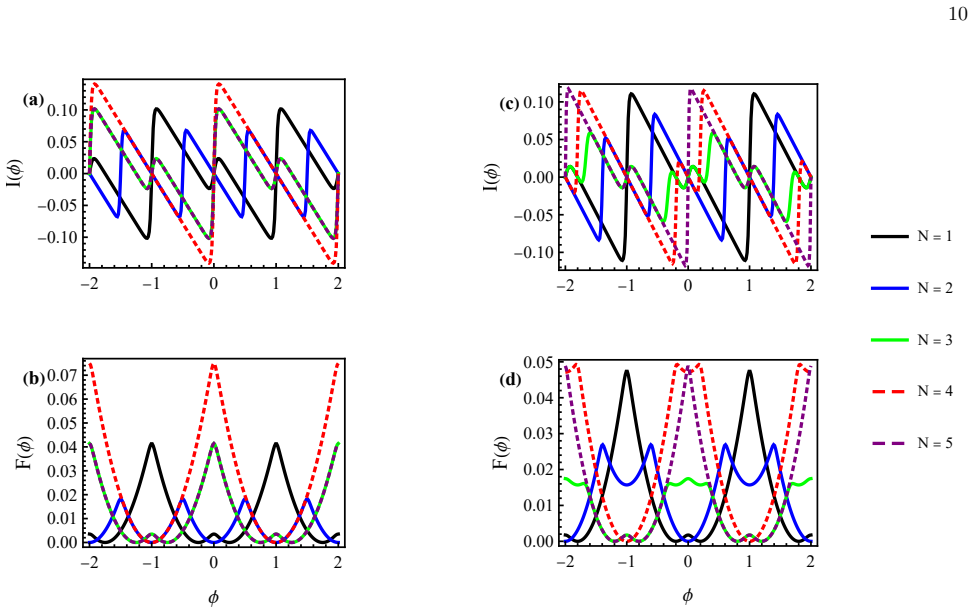
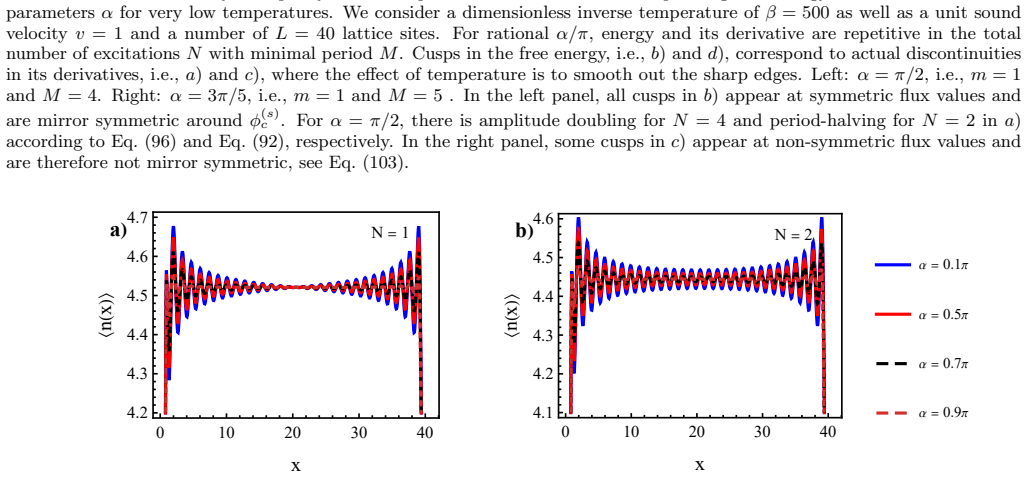
to discuss the physical implications. In Sec. III A we analytically investigate persistent currents for statistical parameters that are rational multiples ofπ. For Dirichlet boundaries, on the other hand, we discuss the impact of statistical transmutations on Friedel oscillations in Sec. III B. Finally in Sec. III B, we exemplarily discuss longitudinal sp...
2056
-
[2]
(116) in table Tab
Density-Density Correlation F unction for Periodic Boundary Conditions We list all zero-mode phases of Eq. (116) in table Tab. (S1), where they share the same functional form cos (x− y)Aj +tB j +C j for all indicesj= 1,2, ..,6. We see that the different phase contributions for the indicesj= 1,2 contain only a single quantum number each, where the expectat...
-
[3]
(118), whereas the decay coefficients can be found already in the maintext, in contrast to the periodic case
Density-Density Correlation F unction for Open Boundary Conditions In the following section, we define the phase factors of the density-density correlation function in Eq. (118), whereas the decay coefficients can be found already in the maintext, in contrast to the periodic case. The calculations are analogous to Sec. S0 1, where Eq. (47) and Eq. (50) ha...
-
[4]
F. D. M. Haldane, Journal of Physics C: Solid State Physics14, 2585 (1981)
1981
-
[5]
F. D. M. Haldane, Phys. Rev. Lett.47, 1840 (1981)
1981
-
[6]
Haldane, Physics Letters A81, 153 (1981)
F. Haldane, Physics Letters A81, 153 (1981)
1981
-
[7]
An introduction to bosonization
D. S´ en´ echal, An introduction to bosonization (1999), arXiv:cond-mat/9908262 [cond-mat.str-el]
work page internal anchor Pith review Pith/arXiv arXiv 1999
-
[8]
Giamarchi,Quantum Physics in One Dimension(Oxford University Press, 2003)
T. Giamarchi,Quantum Physics in One Dimension(Oxford University Press, 2003)
2003
-
[9]
One-dimensional quantum wires: A pedestrian approach to bosonization
S. Eggert, One-dimensional quantum wires: A pedestrian approach to bosonization (2009), arXiv:0708.0003 [cond-mat.str- el]
work page internal anchor Pith review Pith/arXiv arXiv 2009
-
[10]
M. A. Cazalilla, R. Citro, T. Giamarchi, E. Orignac, and M. Rigol, Rev. Mod. Phys.83, 1405 (2011)
2011
-
[11]
Tonks, Phys
L. Tonks, Phys. Rev.50, 955 (1936)
1936
-
[12]
Girardeau, Journal of Mathematical Physics1, 516 (1960)
M. Girardeau, Journal of Mathematical Physics1, 516 (1960)
1960
-
[13]
Jordan and E
P. Jordan and E. Wigner, Zeitschrift f¨ ur Physik47, 631 (1928)
1928
-
[14]
Posske, B
T. Posske, B. Trauzettel, and M. Thorwart, Phys. Rev. B96, 195422 (2017)
2017
-
[15]
Fradkin, Journal of Statistical Physics167, 427 (2017)
E. Fradkin, Journal of Statistical Physics167, 427 (2017)
2017
-
[16]
Valent´ ı-Rojas, N
G. Valent´ ı-Rojas, N. Westerberg, and P.¨Ohberg, Phys. Rev. Res.2, 033453 (2020)
2020
-
[17]
Valent´ ı-Rojas, A
G. Valent´ ı-Rojas, A. J. Baker, A. Celi, and P. ¨Ohberg, Phys. Rev. Res.5, 023128 (2023)
2023
-
[18]
Valent´ ı-Rojas, J
G. Valent´ ı-Rojas, J. Priestley, and P.¨Ohberg, New Journal of Physics27, 043007 (2025)
2025
-
[19]
M. A. Cazalilla, Journal of Physics B: Atomic, Molecular and Optical Physics37, S1 (2004)
2004
-
[20]
Wu and Y
Y.-S. Wu and Y. Yu, Phys. Rev. Lett.75, 890 (1995)
1995
-
[21]
K.-V. Pham, M. Gabay, and P. Lederer, Europhysics Letters51, 161 (2000)
2000
-
[22]
Calabrese and M
P. Calabrese and M. Mintchev, Phys. Rev. B75, 233104 (2007)
2007
-
[23]
Bellazzini, Journal of Physics A: Mathematical and Theoretical44, 035403 (2010)
B. Bellazzini, Journal of Physics A: Mathematical and Theoretical44, 035403 (2010)
2010
-
[24]
Liguori, M
A. Liguori, M. Mintchev, and L. Pilo, Nuclear Physics B569, 577 (2000)
2000
-
[25]
Kundu, Phys
A. Kundu, Phys. Rev. Lett.83, 1275 (1999)
1999
-
[26]
M. T. Batchelor, X.-W. Guan, and A. Kundu, Journal of Physics A: Mathematical and Theoretical41, 352002 (2008)
2008
-
[27]
Fr¨ olian, C
A. Fr¨ olian, C. S. Chisholm, E. Neri, C. R. Cabrera, R. Ramos, A. Celi, and L. Tarruell, Nature608, 293 (2022)
2022
-
[28]
C. S. Chisholm, A. Fr¨ olian, E. Neri, R. Ramos, L. Tarruell, and A. Celi, Phys. Rev. Res.4, 043088 (2022)
2022
-
[29]
Greschner, G
S. Greschner, G. Sun, D. Poletti, and L. Santos, Phys. Rev. Lett.113, 215303 (2014)
2014
-
[30]
Str¨ ater, S
C. Str¨ ater, S. C. L. Srivastava, and A. Eckardt, Phys. Rev. Lett.117, 205303 (2016)
2016
-
[31]
Bonkhoff, K
M. Bonkhoff, K. J¨ agering, S. Eggert, A. Pelster, M. Thorwart, and T. Posske, Phys. Rev. Lett.126, 163201 (2021)
2021
-
[32]
Aditya and D
S. Aditya and D. Sen, Phys. Rev. B103, 235162 (2021)
2021
-
[33]
J. Kwan, P. Segura, Y. Li, S. Kim, A. V. Gorshkov, A. Eckardt, B. Bakkali-Hassani, and M. Greiner, Science386, 1055 (2024)
2024
-
[34]
S. Dhar, B. Wang, M. Horvath, A. Vashisht, Y. Zeng, M. B. Zvonarev, N. Goldman, Y. Guo, M. Landini, and H.-C. N¨ agerl, Nature642, 53 (2025)
2025
-
[35]
B. Bakkali-Hassani, J. Kwan, P. Segura, Y. Li, I. Tesfaye, G. Valent´ ı-Rojas, A. Eckardt, and M. Greiner, Revealing pseudo- fermionization and chiral binding of one-dimensional anyons using adiabatic state preparation (2026), arXiv:2602.20421 [cond-mat.quant-gas]
-
[36]
H. J. Schulz and B. S. Shastry, Phys. Rev. Lett.80, 1924 (1998)
1924
-
[37]
Osterloh, L
A. Osterloh, L. Amico, and U. Eckern, Nuclear Physics B588, 531 (2000)
2000
-
[38]
C. D. Batista, Phys. Rev. B80, 180406 (2009)
2009
-
[39]
C. D. Batista and R. D. Somma, Phys. Rev. Lett.109, 227203 (2012)
2012
-
[40]
Rahmani, A
A. Rahmani, A. E. Feiguin, and C. D. Batista, Phys. Rev. Lett.113, 267201 (2014)
2014
-
[41]
Mishra, S
T. Mishra, S. Greschner, and L. Santos, Phys. Rev. A91, 043614 (2015)
2015
-
[42]
Posske and M
T. Posske and M. Thorwart, Phys. Rev. Lett.122, 097204 (2019)
2019
-
[43]
K¨ uhn, F
S. K¨ uhn, F. Gerken, L. Funcke, T. Hartung, P. Stornati, K. Jansen, and T. Posske, Phys. Rev. B107, 214422 (2023)
2023
-
[44]
Gerken, I
F. Gerken, I. Runkel, C. Schweigert, and T. Posske, Phys. Rev. Res.7, L012008 (2025)
2025
-
[45]
Shiraishi, Journal of Statistical Physics192, 170 (2025)
N. Shiraishi, Journal of Statistical Physics192, 170 (2025)
2025
- [46]
-
[47]
J. L. R. d’Alembert,Recherches sur la courbe que forme une corde tendu¨ e mise en vibration.(Berlin, Germany, 1749)
-
[48]
J. L. Cardy, Nuclear Physics B324, 581 (1989)
1989
-
[49]
Cardy and D
J. Cardy and D. Lewellen, Physics Letters B259, 274 (1991)
1991
-
[50]
Recknagel and V
A. Recknagel and V. Schomerus,Boundary Conformal Field Theory and the Worldsheet Approach to D-Branes, Cambridge Monographs on Mathematical Physics (Cambridge University Press, 2013)
2013
-
[51]
J. M. Leinaas and J. Myrheim, Il Nuovo Cimento B (1971-1996)37, 1 (1977)
1971
-
[52]
Pletyukhov and V
M. Pletyukhov and V. Gritsev, Phys. Rev. B70, 165316 (2004)
2004
-
[53]
Eggert and I
S. Eggert and I. Affleck, Phys. Rev. B46, 10866 (1992)
1992
-
[54]
Fabrizio and A
M. Fabrizio and A. O. Gogolin, Phys. Rev. B51, 17827 (1995)
1995
-
[55]
A. E. Mattsson, S. Eggert, and H. Johannesson, Phys. Rev. B56, 15615 (1997)
1997
-
[56]
Loss, Phys
D. Loss, Phys. Rev. Lett.69, 343 (1992). 22
1992
-
[57]
Schmeltzer, Phys
D. Schmeltzer, Phys. Rev. B47, 7591 (1993)
1993
-
[58]
J. Polo, W. Chetcuti, T. Haug, A. Minguzzi, K. Wright, and L. Amico, Physics Reports1137, 1 (2025)
2025
-
[59]
Friedel, Il Nuovo Cimento (1955-1965)7, 287 (1958)
J. Friedel, Il Nuovo Cimento (1955-1965)7, 287 (1958)
1955
-
[60]
Egger and H
R. Egger and H. Grabert, Phys. Rev. Lett.75, 3505 (1995)
1995
-
[61]
Rommer and S
S. Rommer and S. Eggert, Phys. Rev. B62, 4370 (2000)
2000
-
[62]
Anfuso and S
F. Anfuso and S. Eggert, Phys. Rev. B68, 241301 (2003)
2003
-
[63]
J. L. Cardy, Nucl. Phys. B240, 514 (1984)
1984
-
[64]
Abramowitz and I
M. Abramowitz and I. Stegun,Handbook of mathematical functions with formulas, graphs, and mathematical tables(Dover, New York, 1964)
1964
-
[65]
C. D. Batista and G. Ortiz, Advances in Physics53, 1 (2004)
2004
-
[66]
S. M. Badalyan, A. Matos-Abiague, G. Vignale, and J. Fabian, Phys. Rev. B81, 205314 (2010)
2010
-
[67]
Bonkhoff, K
M. Bonkhoff, K. J¨ agering, S. Hu, A. Pelster, S. Eggert, and I. Schneider, Phys. Rev. Lett.135, 036601 (2025)
2025
discussion (0)
Sign in with ORCID, Apple, or X to comment. Anyone can read and Pith papers without signing in.