REVIEW 4 major objections 4 minor 2 cited by
Upweighting Easy Samples in Fine-Tuning Mitigates Forgetting
T0 review · 4 major / 4 minor · reviewed 2026-08-09 · deepseek-v4-flash
Pith's one-line read A sample-reweighting scheme based only on the frozen pre-trained model's per-example losses is claimed to curb catastrophic forgetting during fine-tuning without any access to pre-training data.
desk verdict A simple, promising sample-weighting trick for forgetting, but the language results are confounded by a lower learning rate and the paper needs same-LR controls before I trust the mechanism. read the letter →
The pith
A machine-rendered reading of the paper's core claim, the machinery that carries it, and where it could break.
The reading
What carries the argument
The central object is the static sample-weight map $w_i = \exp(-f_i(\theta^*)/\tau)$, with $\tau$ set to the median pre-trained loss so the scheme is parameter-free; it is the minimizer of $g(\pi) = \sum_i \pi_i f_i(\theta^*) + \tau \sum_i \pi_i \log \pi_i$, the negative-entropy-regularized objective that is the exact inverse of DRO's hard-sample weighting. The weight map carries the argument by reshaping the fine-tuning data covariance into $\tilde{\Sigma}' = \mu(I_d - Q)$ (Theorem F.1), a matrix with a deliberately small eigenvalue along $\mathbf{e} - \beta\rho\|\mathbf{e}\|_2\mathbf{e}_\perp$; Theorem 7.2 gives the closed-form iterate $\hat{\theta}_K = \tilde{\theta}^* + (I_d - 2\hat{\eta}\tilde{\Sigma}')^K \mathbf{e}$, and Remark 7.4 shows the top eigenvector of $Q$ is precisely the stall direction along which FLOW stops learning, impeding overfitting to the fine-tuning task.
What would settle it
Run FLOW twice on the same fine-tuning dataset, once with the true per-example pre-trained losses and once with the same multiset of weights randomly permuted across examples; if ImageNet retention stays high in both runs, the per-example ordering is not the mechanism and FLOW is just implicit regularization from non-uniform weighting, whereas a collapse in the shuffled run would confirm the loss ordering is load-bearing. The paper's token-wise ablation (GSM8K 23.73 vs 62.55) is already a partial version of this test, since token-level losses are computed but their ordering turns out to be uninformative for the target task.
Extended reading notes
Core claim
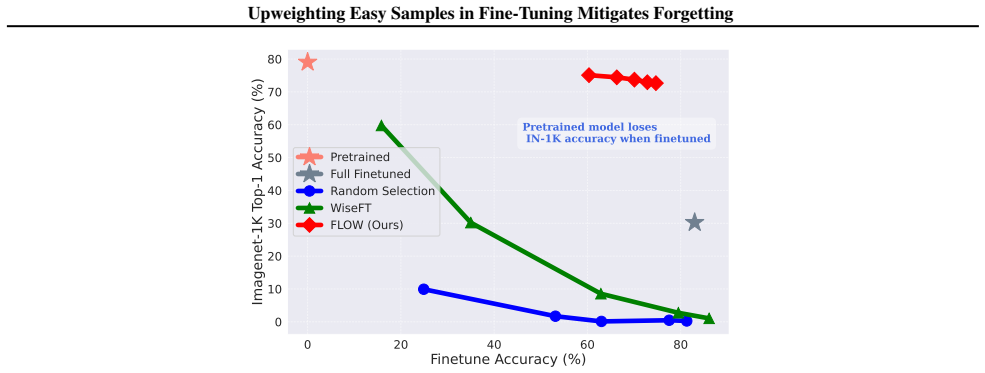
The central claim is that in the data-oblivious setting, catastrophic forgetting can be controlled entirely in sample space: the fine-tuning objective becomes $\sum_i w_i f_i(\theta)$ with static weights $w_i \propto \exp(-f_i(\theta^*)/\tau)$, derived as the minimizer of an entropy-regularized weighted loss (Proposition 4.3) that inverts the distributionally robust optimization weighting that concentrates on hard samples. The paper proves that for linear models the weighted data covariance is $\tilde{\Sigma}' = \mu(I_d - Q)$, whose smallest eigenvalue lies along the direction $\mathbf{e} - \beta\rho\|\mathbf{e}\|_2 \mathbf{e}_\perp$, and that gradient descent on the weighted loss stalls there, so FLOW's iterates stop short of the fine-tuning optimum $\tilde{\theta}^*$ to which vanilla fine-tuning converges exponentially fast (Theorem 7.2 and Remark 7.4). This trajectory includes a component orthogonal to the pre-trained-to-fine-tuned parameter difference $\mathbf{e}$, so FLOW goes beyond model averaging, and its total error on both tasks is at least as good as the optimally tuned convex average (Remark 7.5 and Theorem F.4). Empirically, the paper reports that FLOW achieves the best average of pre-training and target accuracy against standard fine-tuning, linear probing, $\ell^2$-regularization, WiSE-FT, and LoRA on both vision and language benchmarks, and that adding FLOW's weights to each of those baselines improves the base method's average.
Load-bearing premise
The load-bearing premise is that one number per example — the frozen pre-trained model's loss on that example, measured once at the start — correctly identifies which examples, when learned, preserve pre-trained skills, a signal the paper's own token-wise ablation (GSM8K drops from 62.55 to 23.73) shows can fail at finer granularity.
Editorial extensions
If this is right
- Retention without reference data: any pre-trained model can be fine-tuned with FLOW using one extra forward pass to compute the weights, since the weights depend only on the frozen model and the new task's data.
- FLOW is a drop-in amplifier: combining its weights with WiSE-FT, $\ell^2$-regularization, or LoRA improves each base method's average accuracy, showing the sample-space mechanism is orthogonal to parameter- and gradient-space interventions.
- The retention/accuracy trade-off is explicit and tunable: FLOW deliberately sacrifices accuracy on the hardest fine-tuning samples (those with the highest pre-trained loss), so the temperature percentile directly dials between pre-training retention and target-task performance.
- The theory identifies where learning stops: if the linear analysis transfers to neural networks through the linear-dynamics link, fine-tuning with FLOW halts precisely along the subspace whose learning would erase pre-trained capabilities, leaving the transferable directions to be learned.
Reading between the lines
- Granularity is the real dial: the paper's token-wise ablation (GSM8K drops from 62.55 to 23.73) shows the same formula flips from protective to destructive when the loss is read per token, so an adaptive-granularity version that weights information-bearing units rather than whole sequences or single tokens is a natural testable extension.
- The DRO duality the paper exploits suggests a smooth family of recipes: interpolating the weight exponent between FLOW's $\exp(-f_i/\tau)$ and DRO's $\exp(f_i/\tau)$ would give practitioners an explicit curve of retention-versus-accuracy operating points that neither method alone provides.
- Because weights are computed once from a frozen base model, they can be cached and reused across many fine-tuning runs of the same foundation model, making the method nearly free in workflows that repeatedly adapt one base model.
- The theory's stall direction is derived for a symmetric two-direction covariance; on real data one could estimate the small-eigenvalue subspace of the weighted covariance directly and test whether restricting fine-tuning to its complement reproduces FLOW's retention, which would extend the mechanism beyond the paper's assumed covariance structure.
Editorial analysis
A structured set of objections, weighed in public.
Referee Report
Summary. The paper proposes FLOW, a data-oblivious fine-tuning method that assigns sample weights exp(-f_i(theta*)/tau) based on the pre-trained model's per-sample losses, thereby upweighting 'easy' samples. The weighting scheme is derived as the minimizer of an entropy-regularized objective (Proposition 4.3), with tau set to the median loss in practice. The authors present vision and language experiments (ResNets on six datasets; Gemma 2 2B and Llama 3.2 3B on MetaMathQA) comparing against standard fine-tuning, L2 regularization, WiSE-FT, LoRA, and linear probing, and they develop a linear-model theory (Theorem 7.2 and Remark 7.4) claiming that FLOW stalls training in a certain subspace and impedes overfitting. The paper also shows that FLOW can be combined with WiSE-FT, L2 regularization, and LoRA to improve those baselines.
Significance. If the central claim is established, FLOW would be a simple, practically appealing method for the data-oblivious setting, with public code and a reproducible experimental pipeline. The paper honestly reports the hard-sample trade-off (Table 5) and provides a first-principles derivation of the weighting scheme rather than a purely heuristic one. However, the empirical comparison is confounded by unequal learning rates across methods, and the theory is not connected to the practical hyperparameter choice; these issues currently leave the main claim unproven.
major comments (4)
- [§5.2, Tables 6 and 7; §7, Theorem 7.2] FLOW's reported gains over standard fine-tuning are confounded by learning rate. In Tables 6 and 7, FLOW uses exactly half the learning rate of standard FT for both LLMs (Gemma 2 2B: 5e-6 vs 1e-5; Llama 3.2 3B: 1e-5 vs 2e-5), and the vision setup shows similar gaps (Table 8, e.g., ResNet-50 CIFAR-10: 5e-4 vs 5e-3). A lower learning rate alone reduces parameter drift and thus forgetting; indeed, L2-Regularization, run at FLOW's learning rate, already achieves GSM8K 62.85 vs FLOW's 62.55 on Gemma with a comparable general-capability average (49.19 vs 49.98, Table 2). Since the method is supposed to work through sample weighting, the experiments must hold the learning rate (or the effective update magnitude) fixed across methods, e.g., by also running standard FT at FLOW's LR or FLOW at standard FT's LR. Without such a control, the central empirical claim is unsupported.
- [§7, Remark 7.4] The theoretical analysis does not establish the mechanism for the experimental configuration. Theorem 7.2 compares FLOW at b_eta = 1/(2*mu) with vanilla FT at eta = 1/2, i.e., the two methods already differ by a learning-rate-dependent factor. More importantly, Remark 7.4's 'stalling' conclusion requires beta approaching 0, which corresponds to tau approaching 0 in the weighting formula, whereas the experiments use tau = median(f_i(theta*)). The paper does not connect the beta regime to the mu induced by tau = median, nor report a trajectory analysis for that mu. Please state what beta (or mu) the median-tau choice corresponds to, or analyze the trajectory at the experimentally used tau.
- [§5.1 and Table 5] The unified average metric masks a severe degradation on hard samples of the fine-tuning dataset. Table 5 shows that FLOW's accuracy on the top-10% hardest samples (by pre-trained loss) collapses relative to standard FT (CIFAR-10: 86.60 to 30.70; CIFAR-100: 56.40 to 21.30; Stanford Cars: 71.30 to 13.18). Because the 'Average' column in Tables 1 and 2 is a plain average of one pre-training score and one target score, it does not expose this tail behavior. I recommend reporting performance by loss deciles or a tail-aware metric, and discussing the trade-off as a central property of the method rather than a side effect.
- [§5, Table 2; §G.2] All reported results are single-seed (seed 42 in Tables 6-8). Many of the headline comparisons are small (e.g., Gemma 2B average: FLOW 49.98 vs L2-Reg 49.19; GSM8K: 62.55 vs 62.85), and without variance estimates it is not possible to tell whether the differences are meaningful. Please provide multiple seeds (at least for the main comparisons) or error bars, or explicitly qualify the conclusions as single-run observations.
minor comments (4)
- [§1] In the first paragraph of the Introduction, 'apre-trained' is a typographical error and should read 'a pre-trained'.
- [§B] Remark B.1 cites 'Theorem 4.2' but the correct reference is Proposition 4.3.
- [§4] The claim that FLOW is 'essentially parameter-free' (Remark 4.2) is slightly misleading: tau is a free parameter in the derivation, and the choice tau = median is a heuristic; Table 11 shows that performance varies strongly with tau.
- [§H, Figure 2] Figure 2 compares FLOW with 'random selection' at the same percentage of data, but FLOW trains on all data with weights; the comparison would be clearer if the x-axis were the effective sample size or if both methods used the same total gradient budget.
Circularity Check
No significant circularity: FLOW's weighting rule, theory, and evaluations form a self-contained chain.
full rationale
The paper's derivation chain is self-contained. The weighting rule in Algorithm 1 is derived as the minimizer of the entropy-regularized objective in Eq. (1) (Proposition 4.3), and the theoretical claims are direct calculations from that rule: Theorem 7.2 computes the weighted covariance E[exp(-<e,x>^2/tau) x x^T] for the chosen linear model, and the 'stalling' conclusion in Remark 7.4 follows by eigendecomposition of Q, not from any fitted value. The τ = median(f_i(θ*)) prescription is a heuristic set from pre-trained losses only; even the ViT-B/16 deviation to the 80th percentile is data-oblivious, so no evaluation quantity is used to fit the method. The sole overlapping-author citation (Das et al., 2024) is background on hard-sample weighting and is not load-bearing for FLOW's claims. Empirical comparisons are against external benchmarks (IN-1K, GSM8K, commonsense suites) under the same evaluation protocol for FLOW and baselines. The learning-rate mismatch between FLOW and standard FT in Tables 6-8 is a potential experimental-control confound, not a circularity; similarly, the token-wise weighting failure in Table 15 indicates a fragile granularity assumption but does not show that any prediction is equivalent to its input by construction. The paper also flags its own limitations (hard-sample sacrifice in Table 5, and the β→0 regime in Remark 7.4), which is consistent with an honest, non-circular presentation.
Assumptions & free parameters
free parameters (2)
- temperature tau =
median of per-sample pre-trained losses; 80th percentile in ViT-B/16 Food101
- beta (theory reparameterization) =
chosen in (0,1]; tau = 2*beta*(1-rho^2)*||e||^2 / (1-beta^2*rho^2)
assumptions (4)
- standard math Pre-training data covariance Sigma satisfies Sigma >= I_d
- ad hoc to paper Fine-tuning covariance is restricted to eSigma = I_d + rho(e e_perp^T + e_perp e^T)
- domain assumption Linear-model dynamics transfer to neural networks under gradient descent
- domain assumption Pre-trained per-sample losses are a valid proxy for sample easiness w.r.t. preserving pre-training behavior
Cite this review
Pith. "Pith review of Upweighting Easy Samples in Fine-Tuning Mitigates Forgetting." pith.science (2026). https://pith.science/paper/DSO37KUN
@misc{pith2026250202797,
  author       = {Pith},
  title        = {Pith review of: Upweighting Easy Samples in Fine-Tuning Mitigates Forgetting},
  year         = {2026},
  howpublished = {\url{https://pith.science/paper/DSO37KUN}},
  note         = {Machine review of arXiv:2502.02797}
}
abstract
Fine-tuning a pre-trained model on a downstream task often degrades its original capabilities, a phenomenon known as "catastrophic forgetting". This is especially an issue when one does not have access to the data and recipe used to develop the pre-trained model. Under this constraint, most existing methods for mitigating forgetting are inapplicable. To address this challenge, we propose a sample weighting scheme for the fine-tuning data solely based on the pre-trained model's losses. Specifically, we upweight the easy samples on which the pre-trained model's loss is low and vice versa to limit the drift from the pre-trained model. Our approach is orthogonal and yet complementary to existing methods; while such methods mostly operate on parameter or gradient space, we concentrate on the sample space. We theoretically analyze the impact of fine-tuning with our method in a linear setting, showing that it stalls learning in a certain subspace which inhibits overfitting to the target task. We empirically demonstrate the efficacy of our method on both language and vision tasks. As an example, when fine-tuning Gemma 2 2B on MetaMathQA, our method results in only a $0.8\%$ drop in accuracy on GSM8K (another math dataset) compared to standard fine-tuning, while preserving $5.4\%$ more accuracy on the pre-training datasets. Our code is publicly available at https://github.com/sanyalsunny111/FLOW_finetuning .
Figures


Figures from the paper (1 more)

Forward citations
Cited by 2 Pith papers
-
UniGen-AR: Unifying Visual Generation with Auto-Regressive Modeling
An MLLM-conditioned next-scale VAR decoder handles 15+ unified visual generation tasks with competitive quality and substantially lower latency than diffusion baselines.
-
Good SFT Optimizes for SFT, Better SFT Prepares for Reinforcement Learning
Reweighting SFT tokens by target-to-behavior likelihood ratios before RL improves post-RL accuracy, while raw SFT strength does not predict RL success.
Reference graph
Works this paper leans on
-
[1]
HellaSwag(Zellers et al., 2019): A benchmark designed to test commonsense reasoning. HellaSwag presents a context followed by several plausible endings, and the model must choose the most appropriate continuation
work page 2019
-
[2]
exp − ⟨r,z⟩ 2 α ! ⟨r,z⟩ 2 # r+ d−1X j=1 E
Then, we have: eΣ′ :=E ex∼ eP " exp − ⟨e, ex⟩ 2 α ! exex⊤ # =µ Id −(1−µ 2)ee⊤ −ρ 2(1−µ 2)e⊥e⊤ ⊥ +ρµ 2 ee⊤ ⊥ + e⊥e⊤ , whereµ= α α+2 1/2 = τ τ+2∥e∥ 2 2 1/2 . Proof. Recall that e and e⊥ are orthogonal to each other and both are unit-norm. Suppose {e⊥,3, e⊥,4, . . . ,e⊥,d} is an orthonormal basis for the (d−2) -dimensional subspace of Rd orthogonal to e and ...
work page 2016
-
[3]
ARC Challenge(Clark et al., 2018): A benchmark part of the AI2 reasoning challenge designed to test advanced scientific reasoning and knowledge application. ARC Challenge presents 2,590 multiple-choice science questions drawn from grade 3-9 standardized tests, where each question typically includes a scientific scenario or phenomenon followed by four poss...
work page 2018
-
[4]
URL https://proceedings.mlr.press/ v108/farajtabar20a.html. Gao, L., Tow, J., Abbasi, B., Biderman, S., Black, S., DiPofi, A., Foster, C., Golding, L., Hsu, J., Le Noac’h, A., Li, H., McDonell, K., Muennighoff, N., Ociepa, C., Phang, J., Reynolds, L., Schoelkopf, H., Skowron, A., Sutawika, L., Tang, E., Thite, A., Wang, B., Wang, K., and Zou, A. A framewo...
arXiv 2024
-
[5]
SIQA(Sap et al., 2019): A benchmark designed to evaluate social commonsense intelligence and emotional reasoning. SIQA presents a social situation context followed by a question and three possible answers, requiring models to demonstrate an understanding of social interactions, emotional responses, and behavioral implications
work page 2019
-
[6]
Open Book QA(Mihaylov et al., 2018): A benchmark designed to assess understanding of elementary science concepts in an open-book exam format. OBQA presents 5,957 multiple-choice questions paired with a small ”book” of 1,326 core science facts, requiring models to combine these facts with common knowledge to arrive at correct answers
work page 2018
-
[7]
MMLU(Hendrycks et al., 2021a): A benchmark designed to evaluate massive multitask language understanding. MMLU presents approximately 16,000 multiple-choice questions spanning 57 subjects including mathematics, philoso- phy, law, and medicine, requiring models to demonstrate broad knowledge and reasoning capabilities
-
[8]
MBPP(Austin et al., 2021): A benchmark designed to evaluate basic Python programming capabilities. The entire MBPP dataset presents 974 Python programming problems, where each problem includes a natural language task description and three test cases written as assert statements, requiring models to generate functionally correct Python code solutions
work page 2021
Show all 38 references
-
[9]
org/CorpusID:215786151
URL https://api.semanticscholar. org/CorpusID:215786151. Lee, K., Lee, K., Shin, J., and Lee, H. Over- coming catastrophic forgetting with unlabeled data in the wild.2019 IEEE/CVF International Con- ference on Computer Vision (ICCV), pp. 312–321, 2019b. URL https://api.semanti...
2019
-
[10]
ISBN 9781510860964
Curran Associates Inc. ISBN 9781510860964. Loshchilov, I. and Hutter, F. Online batch selection for faster training of neural networks.ArXiv, abs/1511.06343,
-
[11]
org/CorpusID:5324823
URL https://api.semanticscholar. org/CorpusID:5324823. Lubana, E. S., Trivedi, P., Koutra, D., and Dick, R. How do quadratic regularizers prevent catastrophic forgetting: The role of interpolation.COLLAS, 2021. Mallya, A. and Lazebnik, S. Packnet: Adding multiple tasks to a si...
2021
-
[13]
Rajasegaran, J., Hayat, M., Khan, S
URL https://proceedings.mlr.press/ v139/radford21a.html. Rajasegaran, J., Hayat, M., Khan, S. H., Khan, F. S., and Shao, L. Random path selection for continual learning. Advances in neural information processing systems, 32, 2019. 14 Upweighting Easy Samples in Fine-Tuning Mit...
2019
-
[14]
org/CorpusID:245007201
URL https://api.semanticscholar. org/CorpusID:245007201. Rebuffi, S.-A., Kolesnikov, A., Sperl, G., and Lampert, C. H. icarl: Incremental classifier and representation learning. In2017 IEEE Conference on Computer Vision and Pattern Recognition (CVPR), pp. 5533–5542, 2017. doi:...
2017 arXiv
-
[15]
org/CorpusID:12253672
URL https://api.semanticscholar. org/CorpusID:12253672. Wang, L., Zhang, X., Li, Q., Zhu, J., and Zhong, Y . Coscl: Cooperation of small continual learners is stronger than a big one. InComputer Vision – ECCV 2022: 17th Euro- pean Conference, Tel Aviv, Israel, October 23–27, 2...
2022 doi
-
[18]
important
URL https://openreview.net/forum? id=Sk7KsfW0-. Yu, L., Jiang, W., Shi, H., Yu, J., Liu, Z., Zhang, Y ., Kwok, J. T., Li, Z., Weller, A., and Liu, W. Metamath: Boot- strap your own mathematical questions for large language models.arXiv preprint arXiv:2309.12284, 2023. Zellers,...
2016 arXiv
-
[20]
Following a similar setup as us, Biderman et al
effectively mitigates forgetting. Following a similar setup as us, Biderman et al. (2024) fine-tuned language models on MetaMathQA (Yu et al., 2023) and then evaluated the fine-tuned model on several general capability tasks, viz., HellaSwag (Zellers et al., 2019), ARC-c (Clar...
2024
-
[22]
ARC Easy(Clark et al., 2018): A benchmark part of the AI2 reasoning challenge designed to test basic scientific reasoning and knowledge. ARC Easy presents 5,197 multiple-choice science questions drawn from grade 3-9 standardized tests, where each question typically includes a ...
2018
-
[24]
PIQA presents a goal and two possible solutions, requiring models to choose the most appropriate solution that demonstrates an understanding of everyday physical interactions
PIQA(Bisk et al., 2020): A benchmark designed to evaluate physical commonsense understanding in natural language. PIQA presents a goal and two possible solutions, requiring models to choose the most appropriate solution that demonstrates an understanding of everyday physical i...
2020
-
[29]
GSM8K(Cobbe et al., 2021): A benchmark designed to evaluate multi-step mathematical reasoning capabilities. The GSM8K test set contains 1,000 grade school math word problems, where each problem requires 2-8 steps to solve using basic arithmetic operations (addition, subtractio...
2021
-
[30]
It is a widely used large-scale image classification dataset, consisting of over a million images spanning 1000 classes
ImageNet-1K(Russakovsky et al., 2015) serves as the pre-training dataset for all our vision base models. It is a widely used large-scale image classification dataset, consisting of over a million images spanning 1000 classes
2015
-
[31]
It consists of 60,000 32x32 color images divided into ten classes, with 6,000 images per class
CIFAR-10(Krizhevsky, 2009) is a widely used dataset for image classification tasks. It consists of 60,000 32x32 color images divided into ten classes, with 6,000 images per class
2009
-
[32]
This dataset is used for fine-grained image classification tasks
CIFAR-100(Krizhevsky, 2009) extends CIFAR-10 by providing 100 classes containing 600 images each. This dataset is used for fine-grained image classification tasks
2009
-
[33]
Caltech101(Li et al., 2022) comprises images of a diverse range of objects across 101 categories with diverse set of image classes
2022
-
[34]
This dataset is commonly used for fine-grained image classification and flower recognition tasks
Flowers102(Nilsback & Zisserman, 2008) comprises 102 categories of flowers, with each category containing between 40 to 258 images. This dataset is commonly used for fine-grained image classification and flower recognition tasks. 30 Upweighting Easy Samples in Fine-Tuning Miti...
2008
-
[35]
It provides a rich resource for fine-grained car classification task
Cars(Krause et al., 2013) refers to the Stanford Cars dataset, which includes 16,185 images of 196 classes of cars. It provides a rich resource for fine-grained car classification task
2013
-
[36]
This dataset is widely used for fine-grained dog breed classification and recognition tasks
Dogs(Parkhi et al., 2012) pertains to the Stanford Dogs dataset, containing 20,580 images of 120 breeds of dogs. This dataset is widely used for fine-grained dog breed classification and recognition tasks
2012
-
[37]
learning without forgetting
Food101(Bossard et al., 2014) is a large-scale dataset for food classification containing 101 categories with 1,000 images per class, commonly used to evaluate models on fine-grained object recognition tasks. 31 Upweighting Easy Samples in Fine-Tuning Mitigates Forgetting H. D...
2016
-
[38]
We use varying α∈[0,1] for WiSE-FT
with a standard model fine-tuning and with FLOW after fine-tuning Gemma 2 2B on MetaMathQA. We use varying α∈[0,1] for WiSE-FT. The results indicate that combining Wise-FT withFLOWoutperforms vanilla WiSE-FT with standard fine-tuning. 36
-
[715]
findings-emnlp.715/
URL https://aclanthology.org/2023. findings-emnlp.715/. Wightman, R., Touvron, H., and J ´egou, H. Resnet strikes back: An improved training procedure in timm. NEURIPS, workshop. Wolf, T., Debut, L., Sanh, V ., Chaumond, J., Delangue, C., Moi, A., Cistac, P., Rault, T., Louf, ...
2023 arXiv
-
[2015]
org/CorpusID:6546520
URL https://api.semanticscholar. org/CorpusID:6546520. Aljundi, R., Chakravarty, P., and Tuytelaars, T. Expert gate: Lifelong learning with a network of experts. In 2017 IEEE Conference on Computer Vision and Pattern Recognition (CVPR), pp. 7120–7129, 2017. doi: 10.1109/ CVPR....
2017 arXiv
-
[2016]
org/CorpusID:4704285
URL https://api.semanticscholar. org/CorpusID:4704285. Kleiman, A., Dziugaite, G. K., Frankle, J., Kakade, S., and Paul, M. Soup to go: mitigating forgetting during continual learning with model averaging, 2025. URL https://arxiv.org/abs/2501.05559. Krause, J., Stark, M., Deng...
2025 arXiv
-
[2017]
org/CorpusID:19243534
URL https://api.semanticscholar. org/CorpusID:19243534. Jung, S., Ahn, H., Cha, S., and Moon, T. Continual learn- ing with node-importance based adaptive group sparse regularization. InProceedings of the 34th International Conference on Neural Information Processing Systems, N...
2020
-
[2018]
org/CorpusID:3652214
URL https://api.semanticscholar. org/CorpusID:3652214. Xie, S. M., Pham, H., Dong, X., Du, N., Liu, H., Lu, Y ., Liang, P. S., Le, Q. V ., Ma, T., and Yu, A. W. Doremi: Optimizing data mixtures speeds up language model pre- training.Advances in Neural Information Processing Sy...
2024
-
[2019]
org/CorpusID:102353035
URL https://api.semanticscholar. org/CorpusID:102353035. Panda, A., Isik, B., Qi, X., Koyejo, S., Weissman, T., and Mittal, P. Lottery ticket adaptation: Mitigating destructive interference in llms, 2024.https://arxiv. org/abs/2406.16797, 2024. Parkhi, O. M., Vedaldi, A., and ...
2024 arXiv
-
[2020]
cc/paper_files/paper/2020/file/ aa2a77371374094fe9e0bc1de3f94ed9-Paper
URL https://proceedings.neurips. cc/paper_files/paper/2020/file/ aa2a77371374094fe9e0bc1de3f94ed9-Paper. pdf. Bossard, L., Guillaumin, M., and Van Gool, L. Food-101 – mining discriminative components with random forests. InEuropean Conference on Computer Vision, 2014. Caccia, ...
2020 arXiv
-
[2021]
org/CorpusID:232427874
URL https://api.semanticscholar. org/CorpusID:232427874. Ben-Tal, A., Den Hertog, D., De Waegenaere, A., Melen- berg, B., and Rennen, G. Robust solutions of optimization problems affected by uncertain probabilities.Manage- ment Science, 59(2):341–357, 2013. Biderman, D., Porte...
2013
-
[2022]
Katharopoulos, A
URL https://proceedings.mlr.press/ v162/kang22b.html. Katharopoulos, A. and Fleuret, F. Biased importance sam- pling for deep neural network training.arXiv preprint arXiv:1706.00043, 2017. Katharopoulos, A. and Fleuret, F. Not all samples are created equal: Deep learning with ...
2017 arXiv
- [2023]
Reviewed August 9, 2026 · model on record in the stance chip above.
Discussion (0). Continue with ORCID to comment.