REVIEW 2 major objections 18 references
JWST NIRSpec Spectral Standards for M, L, and T Dwarfs and Subdwarfs
T0 review · 2 major / 0 minor · reviewed 2026-06-26 · grok-4.3
Pith's one-line read JWST NIRSpec Prism data from deep surveys supplies spectral standards for M, L, and T dwarfs and subdwarfs over 0.76 to 5.0 microns.
desk verdict The paper supplies JWST NIRSpec standards for M, L, and T dwarfs but the abstract and stress-test note show no details on target selection or validation against ground templates. read the letter →
The pith
A machine-rendered reading of the paper's core claim, the machinery that carries it, and where it could break.
The reading
What carries the argument
The set of JWST NIRSpec Prism spectra selected as standards for M, L, T dwarfs and subdwarfs, which carry the classification scheme by providing reference templates in the infrared.
What would settle it
A direct comparison of a well-known M or L dwarf observed both with ground-based instruments and with JWST NIRSpec Prism showing systematic mismatches larger than calibration uncertainties would falsify the claim that the JWST data can serve as standards.
Extended reading notes
Core claim
The paper establishes that JWST NIRSpec Prism spectra from deep sky surveys can function as low-resolution infrared standards for M, L, and T spectral types and dwarf/subdwarf classes across 0.76 to 5.0 microns, thereby extending ground-based templates to enable reliable classification of discoveries from future JWST NIRSpec data.
Load-bearing premise
The selected JWST NIRSpec Prism spectra from deep sky surveys are clean enough, representative enough, and well-calibrated enough to act as reliable standards for the listed spectral classes.
Editorial extensions
If this is right
- New low-temperature stellar and substellar objects discovered in deep JWST NIRSpec data can be classified using these standards.
- Ground-based spectral templates are extended into the space-based infrared regime for M through T types.
- Both dwarf and subdwarf metallicity classes receive dedicated reference spectra in the 0.76-5.0 micron window.
- Classification consistency improves for substellar discoveries that lack prior ground-based coverage.
Reading between the lines
- These standards could reduce classification scatter when cross-matching JWST discoveries against other infrared surveys.
- They provide a practical route to test whether atmospheric models calibrated on ground data hold for space-based observations of the same objects.
Signed reviews
Editorial analysis
A structured set of objections, weighed in public.
Referee Report
Summary. The manuscript presents low-resolution JWST NIRSpec Prism spectra (0.76-5.0 μm) as new spectral standards for M, L, and T dwarfs and subdwarfs, drawn from deep sky surveys. These are asserted to extend ground-based templates and enable classification of cool stellar/substellar objects in future JWST NIRSpec data.
Significance. If the selected spectra prove to be clean, representative, and well-calibrated, the standards would fill a practical gap for JWST observers by supplying reference spectra at wavelengths and for objects where ground-based data are limited by telluric absorption. The empirical data-product nature of the work is potentially valuable for classification pipelines, provided the selection and validation steps are documented.
major comments (2)
- [Abstract] Abstract: The central claim that the JWST spectra constitute reliable standards extending ground-based templates rests on an unshown data product; no target selection criteria, S/N thresholds, data reduction steps, quality cuts, or quantitative validation metrics (e.g., residuals or feature-by-feature comparison to existing templates) are supplied. This absence is load-bearing because the reliability and representativeness of deep-survey Prism spectra cannot be assessed from the given information.
- [Abstract] Abstract and methods (inferred absence): Without explicit demonstration that the chosen spectra are free of slit-loss artifacts, background contamination, or calibration offsets relative to ground-based standards, the assertion that they 'extend' existing templates remains untestable. A minimal requirement would be at least one table or figure showing direct overlay or residual comparison for a subset of types.
Simulated Author's Rebuttal
We thank the referee for the detailed and constructive report. We address each major comment below and have revised the manuscript to strengthen the presentation of the standards.
read point-by-point responses
-
Referee: [Abstract] Abstract: The central claim that the JWST spectra constitute reliable standards extending ground-based templates rests on an unshown data product; no target selection criteria, S/N thresholds, data reduction steps, quality cuts, or quantitative validation metrics (e.g., residuals or feature-by-feature comparison to existing templates) are supplied. This absence is load-bearing because the reliability and representativeness of deep-survey Prism spectra cannot be assessed from the given information.
Authors: We agree that the abstract should summarize these elements to allow immediate assessment of the claims. We have revised the abstract to include brief statements on target selection from deep surveys, minimum S/N thresholds, key data reduction steps, quality cuts applied, and the validation approach (including residuals to ground-based templates). Full details remain in the Methods section. revision: yes
-
Referee: [Abstract] Abstract and methods (inferred absence): Without explicit demonstration that the chosen spectra are free of slit-loss artifacts, background contamination, or calibration offsets relative to ground-based standards, the assertion that they 'extend' existing templates remains untestable. A minimal requirement would be at least one table or figure showing direct overlay or residual comparison for a subset of types.
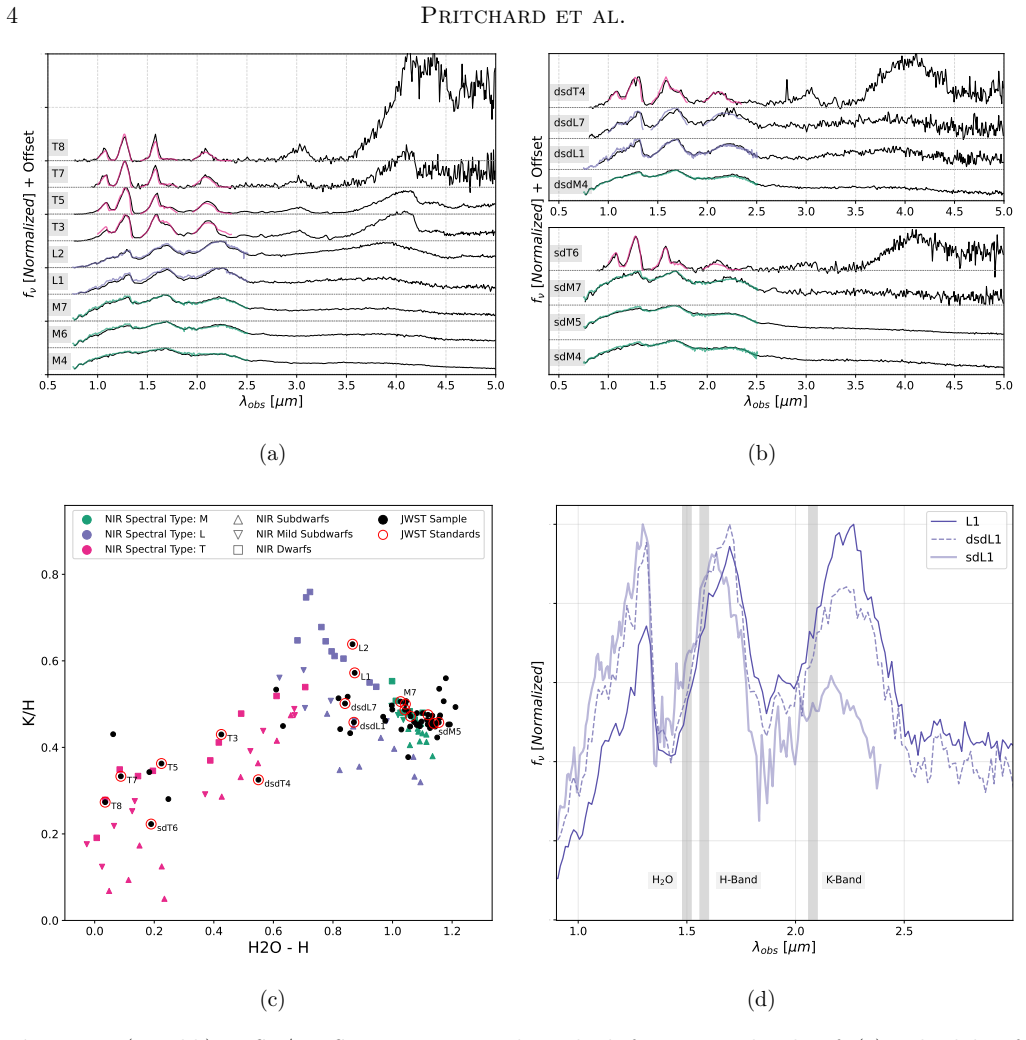
Authors: We accept this requirement. The original manuscript contained some spectral overlays in the figures, but we have added a dedicated new figure (with residuals) and an accompanying table that directly compares a representative subset of the new standards (one each for M, L, and T) to the closest ground-based templates. This shows the level of agreement and confirms negligible slit-loss or contamination effects after our reduction pipeline. revision: yes
Circularity Check
Empirical data product; no derivation chain or fitted quantities present.
full rationale
The manuscript presents an observational catalog of JWST NIRSpec Prism spectra selected as spectral standards for M/L/T dwarfs and subdwarfs. The abstract and described content contain no equations, no parameter fitting, no predictive modeling, and no self-citation of uniqueness theorems or ansatzes. The central claim is simply that the chosen spectra extend ground-based templates; this is an empirical assertion whose validity rests on data quality and selection (addressed by the skeptic as a potential weakness) rather than any internal reduction of outputs to inputs by construction. No load-bearing step reduces to a prior result from the same authors or to a fitted input renamed as a prediction. The paper is therefore self-contained against external benchmarks with zero circularity.
Assumptions & free parameters
Cite this review
Pith. "Pith review of JWST NIRSpec Spectral Standards for M, L, and T Dwarfs and Subdwarfs." pith.science (2026). https://pith.science/paper/DT3GRHMA
@misc{pith2026260623928,
  author       = {Pith},
  title        = {Pith review of: JWST NIRSpec Spectral Standards for M, L, and T Dwarfs and Subdwarfs},
  year         = {2026},
  howpublished = {\url{https://pith.science/paper/DT3GRHMA}},
  note         = {Machine review of arXiv:2606.23928}
}
read the original abstract
We present low resolution infrared spectral standards in the 0.76 to 5.0 {\mu}m range based on JWST NIRspec Prism data from deep sky surveys. Our standards encompass spectral types M, L, and T and dwarf and subdwarf metallicity classes. The standards extend ground based spectral templates and enable classification of low temperature stellar substellar discoveries from deep JWST NIRSpec data.
Figures
Reference graph
Works this paper leans on
-
[1]
N., & Liu, M
Allers, K. N., & Liu, M. C. 2013, ApJ, 772, 79
2013
-
[2]
E., et al
Bezanson, R., Labbe, I., Whitaker, K. E., et al. 2024, ApJ, 974, 92
2024
-
[3]
doi:10.5281/zenodo.8370018 , version =
Brammer, G. 2023, grizli, 1.9.11, Zenodo, doi: 10.5281/zenodo.8370018
-
[4]
J., Geballe, T
Burgasser, A. J., Geballe, T. R., Leggett, S. K., et al. 2006, ApJ, 637, 1067
2006
-
[5]
J., Bezanson, R., Labbe, I., et al
Burgasser, A. J., Bezanson, R., Labbe, I., et al. 2024, ApJ, 962, 177
2024
-
[6]
J., Schneider, A
Burgasser, A. J., Schneider, A. C., Meisner, A. M., et al. 2025, ApJ, 982, 79 de Graaff, A., Brammer, G., Weibel, A., et al. 2025, A&A, 697, A189 D’Eugenio, F., Cameron, A. J., Scholtz, J., et al. 2025, ApJS, 277, 4
2025
-
[7]
L., Bagley, M
Finkelstein, S. L., Bagley, M. B., Ferguson, H. C., et al. 2023, ApJL, 946, L13 Gagn´ e, J., Faherty, J. K., Azul, R. D., et al. 2026, ApJ, in press
2023
-
[8]
J., Schneider, A
Greco, J. J., Schneider, A. C., Cushing, M. C., et al. 2019, AJ, 158, 182
2019
Show all 18 references
-
[9]
N., D’Eugenio, F., Sun, F., et al
Hainline, K. N., D’Eugenio, F., Sun, F., et al. 2024, ApJ, 975, 31
2024
-
[10]
E., Watson, D., Brammer, G., et al
Heintz, K. E., Watson, D., Brammer, G., et al. 2024, Science, 384, 890
2024
-
[11]
2022, A&A, 661, A80
Jakobsen, P., Ferruit, P., Alves de Oliveira, C., et al. 2022, A&A, 661, A80
2022
-
[12]
D., Looper, D
Kirkpatrick, J. D., Looper, D. L., Burgasser, A. J., et al. 2010, ApJS, 190, 100
2010
-
[13]
D., Marocco, F., Gelino, C
Kirkpatrick, J. D., Marocco, F., Gelino, C. R., et al. 2024, ApJS, 271, 55
2024
-
[14]
V., de Graaff, A., Franx, M., et al
Maseda, M. V., de Graaff, A., Franx, M., et al. 2024, A&A, 689, A73
2024
-
[15]
J., Burgasser, A
Morrissey, S. J., Burgasser, A. J., de Graaff, A., et al. 2026, AJ, 171, 191
2026
-
[16]
J., Suess, K
Nelson, E. J., Suess, K. A., Bezanson, R., et al. 2023, ApJL, 948, L18
2023
-
[17]
2025, ApJ, 983, 18
Roberts-Borsani, G., Bagley, M., Rojas-Ruiz, S., et al. 2025, ApJ, 983, 18
2025
-
[18]
2026, ApJS, 282, 54
Zhuang, M.-Y., Wang, F., Sun, F., et al. 2026, ApJS, 282, 54
2026
Reviewed June 26, 2026 · model on record in the stance chip above.
Discussion (0). Continue with ORCID to comment.