REVIEW 3 major objections 5 minor 64 references
Enhancing Large Language Models for Mobility Analytics with Semantic Location Tokenization
T0 review · 3 major / 5 minor · reviewed 2026-08-07 · deepseek-v4-flash
Pith's one-line read QT-Mob claims that replacing bare location IDs with semantically rich discrete tokens, learned by hierarchical vector quantization, and fine-tuning the LLM on several complementary mobility objectives at once lets a 1B-parameter language…
desk verdict A well-engineered, additive contribution to LLM mobility analytics whose headline gains depend on a user-profile leakage check that the paper never explicitly passes. read the letter →
The pith
A machine-rendered reading of the paper's core claim, the machinery that carries it, and where it could break.
The reading
What carries the argument
The load-bearing mechanism is residual vector quantization (RQ-VAE) applied to location descriptions, followed by multi-objective instruction tuning. RQ-VAE decomposes a location's encoded representation into a sequence of L tokens by repeatedly subtracting the nearest codebook vector, producing hierarchical codes where coarse-to-fine levels share prefixes among semantically related places; here L=4 with 256 codes per level. The token sequences are added as new vocabulary entries to Llama3.2-1B, which is then fine-tuned with LoRA on next-location prediction, mobility recovery, and bidirectional location-alignment prompts, with per-user statistical profiles prepended. The token hierarchy is what lets a short sequence of discrete symbols carry rich location semantics, and the complementary objectives are what bind those symbols to the LLM's textual representations.
What would settle it
Recompute the reported Hit@1 numbers after rebuilding every user profile strictly from records whose timestamps fall inside the training interval, then re-run QT-Mob on the same chronological test split; if the margins over MobilityLLM collapse, the profiles leaked test information. A quicker check is to inspect the released code for whether profile statistics for a test trajectory can include future records of the same user.
Extended reading notes
Core claim
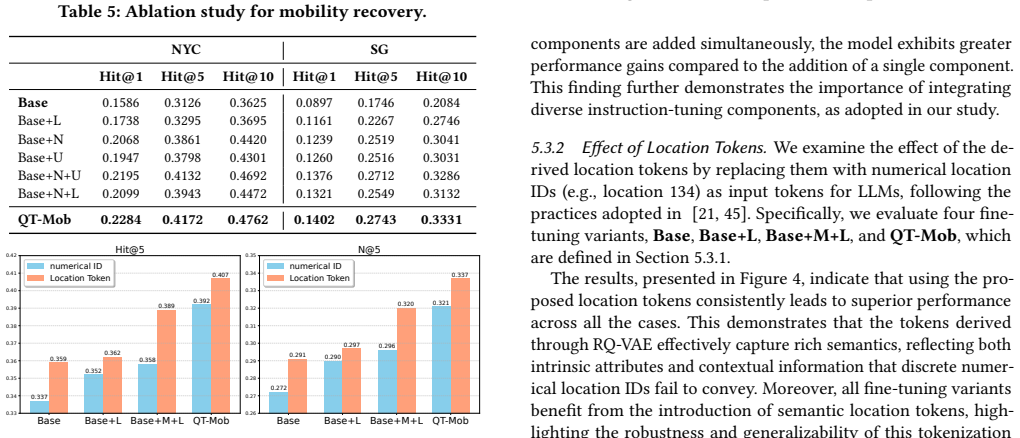
QT-Mob's central claim is that adapting an LLM to mobility analytics works best when locations are tokenized into a compact hierarchy of semantic tokens rather than mapped to arbitrary integers, and when supervision spans several mobility tasks at once. The location tokenizer encodes each location's name, category, coordinates, geohash, address, and nearby POI context with Llama3.2-1B, then runs the representation through four levels of residual quantization, each with 256 codes, so that similar locations share common token prefixes. The resulting tokens are appended to the LLM vocabulary and the model is instruction-tuned jointly for next-location prediction, masked mobility recovery, and two location-alignment directions (description to tokens and tokens to description), with a user profile inserted in each prompt. Across the NYC, Singapore, and cellular-tower datasets, the framework outperforms all compared deep-learning and LLM baselines on both tasks. Ablations attribute the gain to all three fine-tuning components and show that the learned tokens beat numerical location IDs in every tested variant.
Load-bearing premise
The evaluation assumes that each user profile is built only from trajectories that ended before the test period, so no future visit information leaks into the prompt.
Editorial extensions
If this is right
- If QT-Mob is right, LLM-based mobility systems no longer need to choose between numeric location IDs and dense embeddings; compact semantic tokens give a discrete interface that still encodes context.
- The 38.5% and 40.6% Hit@1 gains over MobilityLLM on NYC and Singapore suggest that input representation may matter more than model scale when adapting an LLM to mobility data.
- Because mobility recovery improves alongside next-location prediction, the multi-objective fine-tuning transfers across tasks, pointing toward a single generalist trajectory model instead of separate task-specific heads.
- Since the tokens are built from textual descriptions rather than fixed ID tables, the approach can extend to unseen locations without retraining, which the paper supports with a zero-shot-style comparison against LLM-Move.
- Performance stays similar across several 1B-scale LLM backbones, implying that the gains come from the tokenizer and training objectives rather than from any particular pretrained model.
Reading between the lines
- The evaluation rests on an unstated premise: the user profiles injected into prompts are computed only from training-split trajectories. The paper describes a chronological per-user split but never says test-period visits are excluded, so if profiles include future frequencies, part of the Hit@1 gain could come from leakage.
- The same tokenization-and-alignment recipe could be tested on other geospatial sequence problems such as route recommendation or traffic prediction, since the alignment objectives are task-agnostic.
- A direct test of the semantic-token claim would compare QT-Mob's tokens against randomly assigned but equally compact token sequences under identical multi-objective tuning; the paper compares against numeric IDs but not against shuffled code assignments.
- For deployment, the practical overhead remains open: the paper does not report inference latency or tokenizer build cost relative to baselines.
Editorial analysis
A structured set of objections, weighed in public.
Referee Report
Summary. The paper proposes QT-Mob, a two-stage framework for adapting LLMs to mobility analytics: first, a location tokenization module uses RQ-VAE to encode rich textual location descriptions into compact discrete semantic tokens; second, the LLM is fine-tuned with multiple objectives, including next-location prediction, mobility recovery, location alignment, and user-profile-augmented instruction data. Experiments on three real-world mobility datasets (NYC, SG, CE) report consistent improvements over deep-learning and LLM baselines on next-location prediction and mobility recovery, with ablation studies and backbone robustness checks. The core claims are that semantic location tokens outperform numerical IDs and that multi-objective instruction tuning improves generalization.
Significance. If the reported results are trustworthy, QT-Mob is a useful contribution to the growing area of LLMs for spatio-temporal and mobility data. The paper addresses a real limitation of prior LLM mobility models by replacing opaque location IDs with semantically structured discrete tokens, and it evaluates across three datasets, five LLM backbones, and two tasks with available code. The interpretability case study and representation-consistency analysis in Appendix D.3 are also strengths. However, the significance of the empirical claim depends on resolving a potential data-leakage issue in user-profile construction and on providing uncertainty information for the reported gains; both are load-bearing for the paper's central conclusion.
major comments (3)
- [§4.3 and §5.1.1] The paper never states that user profiles are computed exclusively from the training-split mobility records. Section 4.3 says profiles are 'generated based on statistical features extracted from historical mobility trajectories,' but Section 5.1.1 only defines a chronological 70/10/20 split without restricting the profile computation window. If a profile for a test instance is built from all of the user's records, including validation or test trajectories, then the target location of a next-location-prediction instance will likely appear among the 'top locations and frequencies' in the prompt, allowing the model to copy the answer rather than reason. This would directly inflate the Hit@1 and N@K gains reported in Section 5.2.1, including the claimed relative improvements of 38.5%, 40.6%, and 14.7% over MobilityLLM. The authors must explicitly state that profiles are computed from the training split only and, ideally, verify that the target location is never present in the profile prompt for test instances.
- [Tables 2 and 3; §5.1.3] The experiments are repeated 5 times but only averages are reported, with no standard deviations, confidence intervals, or significance tests. This is especially problematic because several comparisons are close, such as Hit@5 on CE (QT-Mob 0.2728 vs. MobilityLLM 0.2623) and Hit@10 on NYC (QT-Mob 0.4562 vs. MobilityLLM 0.4781, where the baseline is actually higher). Without variance information, the reader cannot judge whether the claimed improvements are statistically meaningful, and the 'consistently outperforms' statement in Section 5.2.1 is unsupported for those metrics.
- [§5.1.4 and §5.2.1] The inference setup for QT-Mob uses 'prefix_allowed_tokens_fn' to restrict generation to valid location tokens, but the LLM-based baselines (LLM-Move, AgentMove, GenUP, MobilityLLM) are described as using their default settings from their papers. If those baselines are not given equivalent constrained decoding, some of their generated outputs may be invalid location tokens, which would unfairly depress their Hit@K and N@K scores. The authors should clarify whether all LLM baselines share the same decoding constraint, or report results under identical constrained-decoding conditions.
minor comments (5)
- [Abstract] The phrase 'three real-world dataset' should be 'three real-world datasets.'
- [§5.2.1] The sentence 'LLM-Move and AgentMove achieves slighted worse performance' contains a typo; it should read 'achieve slightly worse performance.'
- [Appendix D.1 and Table 7] The text in Appendix D.1 says the Base model for Table 7 is built using 'solely on the mobility recovery component (+M),' but Table 7 reports next-location prediction results. This is inconsistent with the table caption and with the analogous NYC setup in Section 5.3.1; the appendix text should be corrected.
- [§5.4] In Figure 6b, the text says all locations in the Changi Airport area 'share the same token,' but each location is represented by a sequence of four tokens; the claim should specify that they share the same first-level (coarsest) token.
- [§5.2.1] The claim that GenUP 'outperforms other deep learning models, except STHGCN' is not correct across datasets: on CE, GenUP outperforms STHGCN on every reported metric, and on SG the comparison varies by metric. The sentence should be qualified or the table cited more precisely.
Circularity Check
No significant circularity: QT-Mob's central claims are evaluated on held-out trajectories; self-citations are not load-bearing.
full rationale
QT-Mob's derivation chain is not circular. The location tokenizer is an RQ-VAE trained to reconstruct Llama embeddings of location descriptions (Eqs. 1-5), and the instruction-tuning objectives (next-location prediction, mobility recovery, token-text alignment) are trained on the training split, with the headline results in Table 2 measured on the chronological 20% test split of each user, which is external to the tokenizer loss. The alignment objectives do create a representation loop (Llama encodes descriptions, RQ-VAE produces tokens, and the same Llama is fine-tuned to map tokens back to descriptions), but this is representation learning rather than a derivation of the downstream predictions: the next-location labels and recovery masks are not used to construct the tokens. The only author self-citations are [1], [4], and [5]; [4] supplies the CE dataset and [5] is a survey, and neither carries the correctness of the method. No uniqueness theorem or ansatz is imported from the authors' prior work. A possible data-leakage concern exists about whether the user profiles described in Section 4.3 are computed only from training-split trajectories; if they include test-period records, the reported gains would be inflated. That is an evaluation-integrity risk, not a circularity, because the paper never equates the profile with the prediction target by construction and no equation in the paper forces the result. The score of 1 reflects only the minor, non-load-bearing self-citations.
Assumptions & free parameters
free parameters (7)
- Number of quantization levels L =
4
- Codebook size per level K =
256
- Codebook dimension =
32
- Weight alpha in residual quantization loss =
Not reported
- Mask ratio for mobility recovery =
20%-50%
- Top-k counts for user profile statistics =
Not specified
- LoRA rank =
128
assumptions (5)
- standard math RQ-VAE with argmin code selection and stop-gradient is a valid differentiable surrogate for discrete code learning.
- domain assumption Static location descriptions (name, category, coordinates, address, and nearby POI statistics) capture enough location semantics to improve downstream reasoning.
- domain assumption Llama3.2-1B-Instruct embeddings are suitable location representations as input to quantization.
- domain assumption The chronological 70/10/20 per-user split prevents test-period information from leaking into prompts, including user profile statistics.
- domain assumption The base LLM can absorb newly added discrete tokens through LoRA fine-tuning without losing its language capabilities.
Cite this review
Pith. "Pith review of Enhancing Large Language Models for Mobility Analytics with Semantic Location Tokenization." pith.science (2026). https://pith.science/paper/DVOBRWJ7
@misc{pith2026250611109,
  author       = {Pith},
  title        = {Pith review of: Enhancing Large Language Models for Mobility Analytics with Semantic Location Tokenization},
  year         = {2026},
  howpublished = {\url{https://pith.science/paper/DVOBRWJ7}},
  note         = {Machine review of arXiv:2506.11109}
}
read the original abstract
The widespread adoption of location-based services has led to the generation of vast amounts of mobility data, providing significant opportunities to model user movement dynamics within urban environments. Recent advancements have focused on adapting Large Language Models (LLMs) for mobility analytics. However, existing methods face two primary limitations: inadequate semantic representation of locations (i.e., discrete IDs) and insufficient modeling of mobility signals within LLMs (i.e., single templated instruction fine-tuning). To address these issues, we propose QT-Mob, a novel framework that significantly enhances LLMs for mobility analytics. QT-Mob introduces a location tokenization module that learns compact, semantically rich tokens to represent locations, preserving contextual information while ensuring compatibility with LLMs. Furthermore, QT-Mob incorporates a series of complementary fine-tuning objectives that align the learned tokens with the internal representations in LLMs, improving the model's comprehension of sequential movement patterns and location semantics. The proposed QT-Mob framework not only enhances LLMs' ability to interpret mobility data but also provides a more generalizable approach for various mobility analytics tasks. Experiments on three real-world dataset demonstrate the superior performance in both next-location prediction and mobility recovery tasks, outperforming existing deep learning and LLM-based methods.
Figures


Figures from the paper (3 more)


Reference graph
Works this paper leans on
-
[1]
Pasquale Balsebre, Weiming Huang, and Gao Cong. 2024. LAMP: A Language Model on the Map.CoRRabs/2403.09059 (2024)
arXiv 2024
-
[2]
Dawei Chen, Cheng Soon Ong, and Lexing Xie. 2016. Learning Points and Routes to Recommend Trajectories. InCIKM. 2227–2232
work page 2016
-
[3]
Xinlei Chen and Kaiming He. 2021. Exploring Simple Siamese Representation Learning. InCVPR. 15750–15758
work page 2021
-
[4]
Yile Chen, Gao Cong, and Cuauhtemoc Anda. 2023. TERI: An Effective Framework for Trajectory Recovery with Irregular Time Intervals.Proc. VLDB Endow.17, 3 (2023), 414–426
work page 2023
-
[5]
Yile Chen, Weiming Huang, Kaiqi Zhao, Yue Jiang, and Gao Cong. 2025. Self- supervised representation learning for geospatial objects: A survey.Information Fusion(2025)
work page 2025
-
[6]
Zaiben Chen, Heng Tao Shen, and Xiaofang Zhou. 2011. Discovering popular routes from trajectories. InICDE. 900–911
work page 2011
-
[7]
Jacob Devlin, Ming-Wei Chang, Kenton Lee, and Kristina Toutanova. 2019. BERT: Pre-training of Deep Bidirectional Transformers for Language Understanding. In NAACL. 4171–4186
2019
-
[8]
Jie Feng, Yuwei Du, Jie Zhao, and Yong Li. 2025. AgentMove: A Large Language Model based Agentic Framework for Zero-shot Next Location Prediction.NAACL (2025). KDD ’25, August 3–7, 2025, Toronto, ON, Canada Yile Chen et al
work page 2025
Show all 64 references
-
[9]
Jie Feng, Yong Li, Chao Zhang, Funing Sun, Fanchao Meng, Ang Guo, and Depeng Jin. 2018. DeepMove: Predicting Human Mobility with Attentional Recurrent Networks. InWWW. 1459–1468
2018
-
[10]
Shanshan Feng, Xutao Li, Yifeng Zeng, Gao Cong, Yeow Meng Chee, and Quan Yuan. 2015. Personalized Ranking Metric Embedding for Next New POI Recom- mendation. InIJCAI. 2069–2075
2015
-
[11]
Shanshan Feng, Haoming Lyu, Caishun Chen, and Yew-Soon Ong. 2024. Where to Move Next: Zero-shot Generalization of LLMs for Next POI Recommendation. CoRRabs/2404.01855 (2024)
2024 arXiv
-
[12]
Letian Gong, Yan Lin, Xinyue Zhang, Yiwen Lu, Xuedi Han, Yichen Liu, Shengnan Guo, Youfang Lin, and Huaiyu Wan. 2024. Mobility-LLM: Learning Visiting In- tentions and Travel Preferences from Human Mobility Data with Large Language Models. InNeurIPS
2024
-
[13]
Wes Gurnee and Max Tegmark. 2024. Language Models Represent Space and Time. InICLR
2024
-
[14]
Sepp Hochreiter and Jürgen Schmidhuber. 1997. Long Short-Term Memory. Neural Comput.9, 8 (Nov. 1997), 1735–1780
1997
-
[15]
Hu, Yelong Shen, Phillip Wallis, Zeyuan Allen-Zhu, Yuanzhi Li, Shean Wang, Lu Wang, and Weizhu Chen
Edward J. Hu, Yelong Shen, Phillip Wallis, Zeyuan Allen-Zhu, Yuanzhi Li, Shean Wang, Lu Wang, and Weizhu Chen. 2022. LoRA: Low-Rank Adaptation of Large Language Models. InICLR
2022
-
[16]
Bowen Jin, Gang Liu, Chi Han, Meng Jiang, Heng Ji, and Jiawei Han. 2023. Large Language Models on Graphs: A Comprehensive Survey.CoRRabs/2312.02783 (2023)
2023 arXiv
-
[17]
Zhang, Xiaoming Shi, Pin-Yu Chen, Yuxuan Liang, Yuan-Fang Li, Shirui Pan, and Qingsong Wen
Ming Jin, Shiyu Wang, Lintao Ma, Zhixuan Chu, James Y. Zhang, Xiaoming Shi, Pin-Yu Chen, Yuxuan Liang, Yuan-Fang Li, Shirui Pan, and Qingsong Wen. 2024. Time-LLM: Time Series Forecasting by Reprogramming Large Language Models. InICLR
2024
-
[18]
Siqi Lai, Zhao Xu, Weijia Zhang, Hao Liu, and Hui Xiong. 2023. Large Lan- guage Models as Traffic Signal Control Agents: Capacity and Opportunity.CoRR abs/2312.16044 (2023)
2023 arXiv
-
[19]
Yantong Lai, Yijun Su, Lingwei Wei, Tianqi He, Haitao Wang, Gaode Chen, Daren Zha, Qiang Liu, and Xingxing Wang. 2024. Disentangled Contrastive Hypergraph Learning for Next POI Recommendation. InSIGIR. 1452–1462
2024
-
[20]
Doyup Lee, Chiheon Kim, Saehoon Kim, Minsu Cho, and Wook-Shin Han. 2022. Autoregressive Image Generation using Residual Quantization. InCVPR. 11513– 11522
2022
-
[21]
Peibo Li, Maarten de Rijke, Hao Xue, Shuang Ao, Yang Song, and Flora D. Salim
-
[22]
Zhonghang Li, Lianghao Xia, Jiabin Tang, Yong Xu, Lei Shi, Long Xia, Dawei Yin, and Chao Huang. 2024. UrbanGPT: Spatio-Temporal Large Language Models. In KDD. 5351–5362
2024
-
[23]
Yuxuan Liang, Kun Ouyang, Yiwei Wang, Xu Liu, Hongyang Chen, Junbo Zhang, Yu Zheng, and Roger Zimmermann. 2022. TrajFormer: Efficient Trajectory Classification with Transformers. InCIKM. 1229–1237
2022
-
[24]
Nicholas Lim, Bryan Hooi, See-Kiong Ng, Xueou Wang, Yong Liang Goh, Ren- rong Weng, and Jagannadan Varadarajan. 2020. STP-UDGAT: Spatial-Temporal- Preference User Dimensional Graph Attention Network for Next POI Recom- mendation. InCIKM. 845–854
2020
-
[25]
Yan Lin, Huaiyu Wan, Shengnan Guo, and Youfang Lin. 2021. Pre-training Context and Time Aware Location Embeddings from Spatial-Temporal Trajectories for User Next Location Prediction. InAAAI. 4241–4248
2021
-
[26]
Yanchi Liu, Chuanren Liu, Bin Liu, Meng Qu, and Hui Xiong. 2016. Unified Point-of-Interest Recommendation with Temporal Interval Assessment. InKDD. 1015–1024
2016
-
[27]
Massimiliano Luca, Gianni Barlacchi, Bruno Lepri, and Luca Pappalardo. 2023. A Survey on Deep Learning for Human Mobility.ACM Comput. Surv.55, 2 (2023), 7:1–7:44
2023
-
[28]
Yingtao Luo, Qiang Liu, and Zhaocheng Liu. 2021. STAN: Spatio-Temporal Attention Network for Next Location Recommendation. InWWW. 2177–2185
2021
-
[29]
Lobell, and Stefano Ermon
Rohin Manvi, Samar Khanna, Gengchen Mai, Marshall Burke, David B. Lobell, and Stefano Ermon. 2024. GeoLLM: Extracting Geospatial Knowledge from Large Language Models. InICLR
2024
-
[30]
Wesley Mathew, Ruben Raposo, and Bruno Martins. 2012. Predicting future locations with hidden Markov models. InUbicomp. 911–918
2012
-
[31]
Meta. 2024. Llama-3.2-1B-Instruct. https://huggingface.co/meta-llama/Llama- 3.2-1B-Instruct
2024
-
[32]
Hao Miao, Yan Zhao, Chenjuan Guo, Bin Yang, Kai Zheng, Feiteng Huang, Jian- dong Xie, and Christian S. Jensen. 2024. A Unified Replay-Based Continuous Learning Framework for Spatio-Temporal Prediction on Streaming Data. InICDE. 1050–1062
2024
-
[33]
Xuan Rao, Lisi Chen, Yong Liu, Shuo Shang, Bin Yao, and Peng Han. 2022. Graph- Flashback Network for Next Location Recommendation. InKDD. 1463–1471
2022
-
[34]
Huimin Ren, Sijie Ruan, Yanhua Li, Jie Bao, Chuishi Meng, Ruiyuan Li, and Yu Zheng. 2021. MTrajRec: Map-Constrained Trajectory Recovery via Seq2Seq Multi-task Learning. InKDD. 1410–1419
2021
-
[35]
Steffen Rendle, Christoph Freudenthaler, and Lars Schmidt-Thieme. 2010. Factor- izing personalized Markov chains for next-basket recommendation. InWWW. 811–820
2010
-
[36]
Junjun Si, Jin Yang, Yang Xiang, Hanqiu Wang, Li Li, Rongqing Zhang, Bo Tu, and Xiangqun Chen. 2024. TrajBERT: BERT-Based Trajectory Recovery With Spatial-Temporal Refinement for Implicit Sparse Trajectories.IEEE Transactions on Mobile Computing23, 5 (May 2024), 4849–4860
2024
-
[37]
Han Su, Kai Zheng, Haozhou Wang, Jiamin Huang, and Xiaofang Zhou. 2013. Calibrating trajectory data for similarity-based analysis. InSIGMOD. 833–844
2013
-
[38]
Hao Sun, Changjie Yang, Liwei Deng, Fan Zhou, Feiteng Huang, and Kai Zheng
-
[39]
Ke Sun, Tieyun Qian, Tong Chen, Yile Liang, Quoc Viet Hung Nguyen, and Hongzhi Yin. 2020. Where to Go Next: Modeling Long- and Short-Term User Preferences for Point-of-Interest Recommendation. InAAAI. 214–221
2020
-
[40]
Tianao Sun, Ke Fu, Weiming Huang, Kai Zhao, Yongshun Gong, and Meng Chen
-
[41]
Aäron van den Oord, Oriol Vinyals, and Koray Kavukcuoglu. 2017. Neural Discrete Representation Learning. InNIPS. 6306–6315
2017
-
[42]
Jiawei Wang, Renhe Jiang, Chuang Yang, Zengqing Wu, Makoto Onizuka, Ryosuke Shibasaki, and Chuan Xiao. 2024. Large Language Models as Urban Res- idents: An LLM Agent Framework for Personal Mobility Generation. InNeurIPS
2024
-
[43]
Going Where, by Whom, and at What Time: Next Location Prediction Considering User Preference and Temporal Regularity. InKDD. 2784–2793
-
[44]
Yingzi Wang, Nicholas Jing Yuan, Defu Lian, Linli Xu, Xing Xie, Enhong Chen, and Yong Rui. 2015. Regularity and Conformity: Location Prediction Using Heterogeneous Mobility Data. InKDD. 1275–1284
2015
-
[45]
Wilson Wongso, Hao Xue, and Flora D. Salim. 2024. GenUP: Generative User Profilers as In-Context Learners for Next POI Recommender Systems.CoRR abs/2410.20643 (2024)
2024 arXiv
-
[46]
Jingyuan Wang, Ning Wu, Xinxi Lu, Wayne Xin Zhao, and Kai Feng. 2021. Deep Trajectory Recovery with Fine-Grained Calibration using Kalman Filter.IEEE Trans. Knowl. Data Eng.33, 3 (2021), 921–934
2021
-
[47]
Dongbo Xi, Fuzhen Zhuang, Yanchi Liu, Jingjing Gu, Hui Xiong, and Qing He
-
[48]
Tong Xia, Yunhan Qi, Jie Feng, Fengli Xu, Funing Sun, Diansheng Guo, and Yong Li. 2021. AttnMove: History Enhanced Trajectory Recovery via Attentional Network.AAAI35, 5 (2021), 4494–4502
2021
-
[49]
Yuxia Wu, Ke Li, Guoshuai Zhao, and Xueming Qian. 2022. Personalized Long- and Short-term Preference Learning for Next POI Recommendation.IEEE Trans. Knowl. Data Eng.34, 4 (2022), 1944–1957
2022
-
[50]
Xiaodong Yan, Tengwei Song, Yifeng Jiao, Jianshan He, Jiaotuan Wang, Ruopeng Li, and Wei Chu. 2023. Spatio-Temporal Hypergraph Learning for Next POI Recommendation. InSIGIR. 403–412
2023
-
[51]
Zheng, and Zhiyong Yu
Dingqi Yang, Daqing Zhang, Vincent W. Zheng, and Zhiyong Yu. 2015. Modeling User Activity Preference by Leveraging User Spatial Temporal Characteristics in LBSNs.IEEE Trans. Syst. Man Cybern. Syst.45, 1 (2015), 129–142
2015
-
[52]
Song Yang, Jiamou Liu, and Kaiqi Zhao. 2022. GETNext: Trajectory Flow Map Enhanced Transformer for Next POI Recommendation. InSIGIR. 1144–1153
2022
-
[53]
Jian Xie, Kai Zhang, Jiangjie Chen, Tinghui Zhu, Renze Lou, Yuandong Tian, Yanghua Xiao, and Yu Su. 2024. TravelPlanner: A Benchmark for Real-World Planning with Language Agents. InICML
2024
-
[54]
Quan Yuan, Gao Cong, Zongyang Ma, Aixin Sun, and Nadia Magnenat-Thalmann
-
[55]
Qianru Zhang, Peng Yang, Junliang Yu, Haixin Wang, Xingwei He, Siu-Ming Yiu, and Hongzhi Yin. 2024. A Survey on Point-of-Interest Recommendation: Models, Architectures, and Security.CoRRabs/2410.02191 (2024)
2024 arXiv
-
[56]
Weijia Zhang, Jindong Han, Zhao Xu, Hang Ni, Hao Liu, and Hui Xiong. 2024. Urban Foundation Models: A Survey. InKDD. 6633–6643
2024
-
[57]
Fudan Yu, Wenxuan Ao, Huan Yan, Guozhen Zhang, Wei Wu, and Yong Li. 2022. Spatio-Temporal Vehicle Trajectory Recovery on Road Network Based on Traffic Camera Video Data. InKDD. 4413–4421
2022
-
[58]
Bowen Zheng, Yupeng Hou, Hongyu Lu, Yu Chen, Wayne Xin Zhao, Ming Chen, and Ji-Rong Wen. 2024. Adapting Large Language Models by Integrating Collaborative Semantics for Recommendation. InICDE. 1435–1448
2024
-
[59]
Hi-Life Bar & Grill
He Zhu, Wenjia Zhang, Nuoxian Huang, Boyang Li, Luyao Niu, Zipei Fan, Tianle Lun, Yicheng Tao, Junyou Su, Zhaoya Gong, Chenyu Fang, and Xing Liu. 2024. PlanGPT: Enhancing Urban Planning with Tailored Language Model and Efficient Retrieval.CoRRabs/2402.19273 (2024). Enhancing L...
2024 arXiv
-
[62]
Wayne Xin Zhao, Kun Zhou, Junyi Li, Tianyi Tang, Xiaolei Wang, Yupeng Hou, Yingqian Min, et al . 2023. A Survey of Large Language Models.CoRR abs/2303.18223 (2023)
2023 arXiv
-
[2013]
Time-aware point-of-interest recommendation. InSIGIR. 363–372
-
[2019]
Modelling of Bi-Directional Spatio-Temporal Dependence and Users’ Dy- namic Preferences for Missing POI Check-In Identification. InAAAI. 5458–5465
-
[2021]
PeriodicMove: Shift-aware Human Mobility Recovery with Graph Neural Network. InCIKM. 1734–1743
-
[2024]
In SIGIR
Large Language Models for Next Point-of-Interest Recommendation. In SIGIR. 1463–1472
Reviewed August 7, 2026 · model on record in the stance chip above.
Discussion (0). Sign in to comment.