REVIEW 3 major objections 5 minor 61 references
Project-Based Learning in Introductory Quantum Computing Courses: A Case Study on Quantum Algorithms for Medical Imaging
T0 review · 3 major / 5 minor · reviewed 2026-08-05 · deepseek-v4-flash
Pith's one-line read Project-based learning built around an HHL-versus-ART imaging benchmark gives introductory quantum computing students a concrete way to master and critique quantum algorithms, while the toy CT reconstruction shows NISQ-era hardware is not y
desk verdict Honest, checkable small case study whose pedagogical headline outruns its evidence; the technical toy demo is fine but the ART-vs-HHL comparison is not well posed. read the letter →
The pith
A machine-rendered reading of the paper's core claim, the machinery that carries it, and where it could break.
The reading
What carries the argument
The central mechanism is the HHL algorithm, a quantum routine that solves linear systems by encoding b in quantum amplitudes, using quantum phase estimation to expose the eigenvalues of A, rotating an ancilla by the inverse of each eigenvalue, and then uncomputing the phases to leave a quantum state proportional to A^-1 b. Because HHL requires a Hermitian, positive-definite matrix, the paper replaces the CT system Ax=b with the regularized normal equations (A^T A + I)x = A^T b; the identity term prevents division by zero but is acknowledged to add a slight downward bias. Around this algorithm sits the project-based learning scaffold: an early-semester narrative assignment, minimal skeleton c
What would settle it
For the pedagogical claim, run the same module across a cohort with a pre/post quantum-computing concept inventory and compare with a lecture-only control group; if gains vanish, the self-report is not evidence of learning. For the technical claim, reconstruct a non-singular phantom with the same number of projections, apply ART and HHL to the identical regularized system, and compare per-pixel errors; if HHL matches ART on the same system, the current result would be an artifact of the small singular problem.
Extended reading notes
Core claim
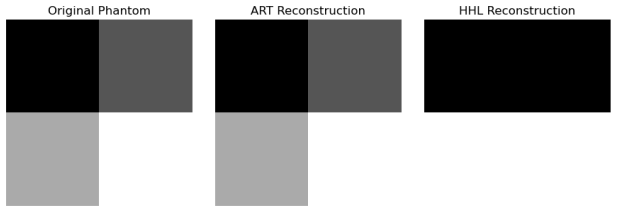
The core discovery is best stated as two paired claims. First, the project is offered as evidence that PBL works in introductory quantum computing: the authors report that writing, debugging, and benchmarking every HHL subroutine themselves moved concepts such as quantum phase estimation, controlled rotations, and post-selection from theory to felt experience, and that requiring a conference-style paper and interdisciplinary mentorship strengthened the learning. Second, the technical benchmark is offered as evidence that HHL is not yet practically useful for medical imaging: on a 2x2 phantom with the projection matrix preprocessed through the regularized normal equations (A^T A+I)x = A^T b,
Load-bearing premise
The pedagogical headline rests on the authors' own report that the project deepened their understanding, with no independent learning measure; the technical comparison treats a small, underdetermined projection system as a fair test of two methods that are actually solving different regularized problems.
Editorial extensions
If this is right
- If the pedagogical claim is right, introductory quantum courses can adopt a low-cost PBL template: pair a specific quantum algorithm with a student-chosen application, add a writing-and-submission requirement, and let students benchmark the quantum method against a classical baseline.
- If the technical claim is right, HHL will not enter clinical CT pipelines on current hardware; near-term gains, if any, have to come from hybrid schemes where quantum solvers handle only selected subproblems.
- The readout limitation generalizes beyond imaging: HHL's formal speedup applies to extracting inner products, so any application that needs all entries of the solution vector pays a repetition cost that grows with problem size.
- The regularized normal-equation trick is itself a transferable lesson: quantum solvers often solve a modified version of the original problem, and the modification's bias must be reported alongside the result.
Reading between the lines
- A sharper version of the benchmark would use a non-singular projection geometry so that ART and HHL solve exactly the same linear system; that design would separate the bias from the regularization term from the approximation error intrinsic to HHL.
- The same PBL template could be aimed at other quantum primitives, such as quantum phase estimation alone or a variational eigensolver, with the conference-paper deliverable reused to make students articulate precisely when the quantum route beats its classical baseline.
- A cohort-scale replication with pre/post concept testing would show whether the self-reported learning gains transfer beyond the authors' own experience.
Editorial analysis
A structured set of objections, weighed in public.
Referee Report
Summary. The paper describes a Project-Based Learning (PBL) assignment in which the authors, as students, implemented the Harrow-Hassidim-Lloyd (HHL) quantum algorithm for a 2×2 computed tomography (CT) image reconstruction problem and benchmarked it against the classical Algebraic Reconstruction Technique (ART). The manuscript has two intertwined claims: (i) a pedagogical claim that this kind of interdisciplinary PBL module, culminating in a conference-style paper, enhances conceptual understanding, engagement, and critical evaluation skills in introductory quantum computing courses; and (ii) a technical claim, stated in Section II, that NISQ-era quantum computers are not yet capable of handling industrial-scale image reconstruction problems. The technical component is implemented in Qiskit with a noiseless AerSimulator, uses a regularized normal-equations formulation (AᵀA + I)x = Aᵀb, and the authors acknowledge in Section IV and V that the result is not medical-grade and lists several practical limitations.
Significance. If the pedagogical claim were properly supported, the paper would offer a useful, reproducible template for project-based quantum computing education: the GitHub repository, the explicit HHL circuit breakdown, and the honest discussion of state-preparation and readout overhead are concrete assets. The technical demonstration is also independently checkable from the printed matrices, and the authors are commendably clear that the toy problem is not a clinical benchmark. However, the paper's central contribution is educational, and the evidence for 'enhanced conceptual understanding' is an n=1 self-report with no measured outcomes. The technical comparison, while informative as a student exercise, is not a clean benchmark because the two algorithms solve different linear systems. The paper is suitable for a teaching-oriented venue after substantial revision, but in its current form the claims outrun the data.
major comments (3)
- [§I.B.2 and §VII–VIII] The stated objective §I.B.2 is to 'evaluate educational impact' by assessing changes in (a) conceptual understanding, (b) confidence in mapping domain problems to quantum formulations, and (c) ability to critique classical vs. quantum solvers. No such assessment appears anywhere in the paper: there are no pre/post tests, no rubric, no survey instruments, no independent evaluator, and no student-produced artifacts (other than the paper itself). The conclusions in §VIII ('fostered deeper conceptual understanding') and the abstract ('demonstrated that Project-Based Learning ... enhances conceptual understanding') are therefore unsupported. This is load-bearing for the central claim. The paper should be reframed as an experience report / case study, or actual assessment data should be added.
- [§IV, Eq. (ATA + I)x = ATb] The printed projection matrix A is singular: row1 + row2 = row3 + row4. The HHL solver is applied to the regularized normal equations (AᵀA + I)x = Aᵀb, while ART is applied directly to Ax = b. These are different mathematical problems; the reported HHL-vs-ART discrepancy could reflect the regularization bias of the identity shift (and the difference between least-squares and exact solutions) rather than any intrinsic limitation of quantum linear solvers. The conclusion that the comparison reveals NISQ limitations is therefore not cleanly supported. To make the benchmark meaningful, the authors should either apply ART to the same regularized normal equations, or apply HHL to the original system using an embedding that does not change the solution, or explicitly quantify the bias introduced by the identity shift.
- [§IV and §V] The HHL implementation is run on a noiseless AerSimulator with state-vector access, not on NISQ hardware. The paper nonetheless states (Section II) that 'these calculations reveal that Noisy Intermediate-Scale Quantum (NISQ) era quantum computers are not yet capable of handling industrial scale image reconstruction problems.' The experimental component cannot support this hardware-readiness claim; the noise, decoherence, and resource limitations discussed in §V are drawn from the literature (e.g., refs [29], [30], [49]), not from the reported experiment. The authors should clearly separate what the simulation demonstrates (algorithm mechanics, state-preparation overhead, readout overhead) from what is known from the wider literature about NISQ hardware.
minor comments (5)
- [Abstract and §II] Typo: 'Harrow-Hassidim-Lloyd' is spelled 'Harrow-Hassidim-Loyd' in the abstract and in §II.
- [§IV and Fig. 7] The text says the circuit uses 'one ancilla qubit for eigenvalue reciprocals, three "clock" qubits ..., and two system qubits', but Fig. 7's caption says 'five phase-estimation "clock" qubits'. The discrepancy should be reconciled.
- [§III.C] The statement that ART has 'worst-case computational complexity of O(n^3)' is vague and not tied to a specific iterative count or matrix structure. Either clarify the model or remove the complexity claim.
- [§III.C] Reference [48] is cited before earlier references in the same section and out of numerical order; the reference list should be reordered to match the citation style.
- [§VIII] Minor grammatical issues: 'In such course interdisciplinary, real-world problems...' and similar phrases should be edited for clarity.
Circularity Check
Technical 'NISQ limitation' result is an artifact of the regularized normal equations; HHL benchmark solves a different problem by construction.
-
self definitional
[Section IV, Eq. (1) and regularized normal equations; Fig. 8]
"A direct HHL application requires A to be Hermitian and well-conditioned. Neither is true, so we solve the normal equations ( ATA + I) x = ATb, which are Hermitian, positive-definite, and exhibit required eigenvalues. Adding I keeps eigenvalues away from 0. This improves robustness at the cost of a slight downward bias... The HHL quantum algorithm is noisy and thus the darker parts in the top look the same and the lighter parts on the bottom are the same."
The HHL solver is defined on (A^T A + I)x = A^T b rather than on Eq. (1), Ax=b. For the printed A and b, the phantom is (1,2,3,4) while the regularized solution is (1,5/3,7/3,3); the difference is exactly the +I regularization. The 'almost correct' HHL reconstruction in Fig. 8 is thus the deterministic solution of the modified system, up to QPE truncation, not a sample of quantum noise (the simulation is noiseless). The paper's 'calculations reveal' that HHL is inaccurate for CT is therefore a restatement of the authors' own regularization choice, not a first-principles empirical result about NISQ hardware. The ART-vs-HHL gap is a comparison of two different equations.
full rationale
The paper contains one genuine circular construction in the technical benchmark. HHL is not applied to Ax=b as claimed in Eq. (1); instead the authors solve the regularized normal equations (A^T A + I)x = A^T b. Since the printed A and b yield the phantom x=(1,2,3,4), the regularized solution is x_reg=(1,5/3,7/3,3). The 'almost correct' HHL reconstruction in Fig. 8 is therefore the exact solution of the modified system—the 'downward bias' is the +I term—so the observed inaccuracy is an artifact of the problem definition, not of NISQ hardware. The claim that 'these calculations reveal' NISQ limitations is thus partly a restatement of the regularized input, giving one by-construction 'prediction'. Separately, the educational headline ('PBL enhances conceptual understanding') rests on the authors' self-report in Sections VII–VIII; Section I.B.2 promises an impact assessment that never appears. This is a missing-support/evidence problem rather than a formal circular reduction, so it does not by itself raise the circularity score beyond a minor self-referential element. The only self-citation, [40], is to the authors' own GitHub code and is not load-bearing to the central claim. Overall, moderate circularity: one technical prediction reduces by construction, while the pedagogical claim has independent external grounding in the PBL literature.
Assumptions & free parameters
free parameters (4)
- ART relaxation parameter lambda (Eq. 2) =
not reported
- Identity regularization weight in ATA + I =
1
- QPE clock register size =
3 (text) or 5 (Fig. 7)
- Hamiltonian simulation time t in e^{iAt} =
not reported
assumptions (5)
- standard math HHL solves a linear system when A is sparse, Hermitian, and well-conditioned, with O(log n) ideal complexity
- domain assumption The line-integral model Ax = b represents CT reconstruction geometry
- domain assumption Project-based learning improves conceptual understanding and engagement
- standard math State-vector simulation on a noiseless AerSimulator equals the ideal quantum output
- ad hoc to paper Normal equations with identity shift (ATA + I) are a valid HHL preconditioning
Cite this review
Pith. "Pith review of Project-Based Learning in Introductory Quantum Computing Courses: A Case Study on Quantum Algorithms for Medical Imaging." pith.science (2026). https://pith.science/paper/DWNCBNQJ
@misc{pith2026250821321,
  author       = {Pith},
  title        = {Pith review of: Project-Based Learning in Introductory Quantum Computing Courses: A Case Study on Quantum Algorithms for Medical Imaging},
  year         = {2026},
  howpublished = {\url{https://pith.science/paper/DWNCBNQJ}},
  note         = {Machine review of arXiv:2508.21321}
}
read the original abstract
Quantum computing introduces abstract concepts and non-intuitive behaviors that can be challenging for students to grasp through traditional lecture-based instruction alone. This paper demonstrates how Project-Based Learning (PBL) can be leveraged to bridge that gap. This can be done by engaging students in a real-world, interdisciplinary task that combines quantum computing with their field of interest. As part of a similar assignment, we investigated the application of the Harrow-Hassidim-Lloyd (HHL) algorithm for computed tomography (CT) image reconstruction and benchmarked its performance against the classical Algebraic Reconstruction Technique (ART). Through implementing and analyzing both methods on a small-scale problem, we gained practical experience with quantum algorithms, critically evaluated their limitations, and developed technical writing and research skills. The experience demonstrated that Project-Based Learning not only enhances conceptual understanding but also encourages students to engage deeply with emerging technologies through research, implementation, and reflection. We recommend the integration of similar PBL modules in introductory quantum computing courses. The assignment also works better if students are required to write and submit a conference-style paper, supported by mentorship from faculty across the different fields. In such course interdisciplinary, real-world problems can transform abstract theory into meaningful learning experiences and better prepare students for future advancements in quantum technologies.
Figures


Figures from the paper (5 more)


Reference graph
Works this paper leans on
-
[29]
Khanal, B. and Rivas, P., 2023, July. ”Evaluating the impact of noise on variational quantum circuits in nisq era devices.” In 2023 Congress in Computer Science, Computer Engineering, & Applied Computing (CSCE) (pp. 1658-1664). IEEE
work page 2023
-
[30]
Bertrand Tsemo, P., Jayashankar, A., Sugisaki, K., Baskaran, N., Chakraborty, S. and Prasannaa, V .S., 2024. ”Enhancing the Harrow- Hassidim-Lloyd (HHL) algorithm in systems with large condition num- bers.” arXiv e-prints, pp.arXiv-2407
work page 2024
-
[49]
Ichikawa, T., Hakoshima, H., Inui, K., Ito, K., Matsuda, R., Mitarai, K., Miyamoto, K., Mizukami, W., Mizuta, K., Mori, T. and Nakano, Y ., 2024. ”Current numbers of qubits and their uses.” Nature Reviews Physics, 6(6), pp.345-347
work page 2024
-
[1]
”The Philosophy of John Dewey.” H
Dewey, J., 1928. ”The Philosophy of John Dewey.” H. Holt
work page 1928
-
[2]
Handrianto, C. and Rahman, M.A., 2018. ”Project based learning: a review of literature on its outcomes and implementation issues.” LET: Linguistics, Literature and English Teaching Journal, 8(2), pp.110-129
work page 2018
-
[3]
”Learning by doing and communicating.” John Dewey’s democracy and education
Waks, L.J., 2017. ”Learning by doing and communicating.” John Dewey’s democracy and education. A centennial handbook, pp.15-22
work page 2017
-
[4]
”The Project Method (1918).” Schools, 17(1), pp.136-149
Heard Kilpatrick, W., 2020. ”The Project Method (1918).” Schools, 17(1), pp.136-149
work page 2020
-
[5]
Peterson, B.W., 2012. ”Uncovering the progressive past: The origins of project-based learning.” UnBoxed: A Journal of Adult Learning in Schools, 8, pp.1-4
work page 2012
Show all 61 references
-
[6]
and Wiggins, A., 2016
Kokotsaki, D., Menzies, V . and Wiggins, A., 2016. Project-based learn- ing: A review of the literature. Improving schools, 19(3), pp.267-277
2016
-
[7]
”A theoretical approach to project-based learning in community-based settings.” Project-Based Learning in Second Language Acquisition, pp.48-59
Skalet, E., 2019. ”A theoretical approach to project-based learning in community-based settings.” Project-Based Learning in Second Language Acquisition, pp.48-59
2019
-
[8]
and Delawsky, S., 2013
Johnson, C.S. and Delawsky, S., 2013. Project-based learning and student engagement. Academic research international, 4(4), p.560
2013
-
[9]
”Student leadership development: The contribution of project-based learning.” Unpublished Master’s thesis
Cocco, S., 2006. ”Student leadership development: The contribution of project-based learning.” Unpublished Master’s thesis. Royal Roads University, Victoria, BC
2006
-
[10]
and Kilic ¸, A., 2023
S ¸ahin, S ¸. and Kilic ¸, A., 2023. ”Effectiveness of the Project-Based 6E Learning Model.” European Journal of Open, Distance & E-Learning, 25(1)
2023
-
[11]
and Kilic ¸, A., 2024
S ¸ahin, S ¸. and Kilic ¸, A., 2024. ”Comparison of the effectiveness of project-based 6E learning and problem-based quantum learning: Solomon four-group design.” Journal of Research in Innovative Teaching & Learning
2024
-
[12]
and Singh, C., 2024
Hu, P., Li, Y . and Singh, C., 2024. ”Investigating and improving student understanding of the basics of quantum computing.” Physical Review Physics Education Research, 20(2), p.020108
2024
-
[13]
and Lloyd, S., 2009
Harrow, A.W., Hassidim, A. and Lloyd, S., 2009. ”Quantum algorithm for linear systems of equations.” Physical Review Letters, 103(15), p.150502
2009
-
[14]
”Algebraic reconstruction in CT from limited views.” IEEE transactions on medical imaging, 8(1), pp.50-55
Andersen, A.H., 1989. ”Algebraic reconstruction in CT from limited views.” IEEE transactions on medical imaging, 8(1), pp.50-55
1989
-
[15]
and Kwek, L.C., 2022
Lau, J.W.Z., Lim, K.H., Shrotriya, H. and Kwek, L.C., 2022. ”NISQ computing: where are we and where do we go?” AAPPS bulletin, 32(1), p.27
2022
-
[16]
and Di Chiro, G., 1975
Brooks, R.A. and Di Chiro, G., 1975. ”Theory of image reconstruction in computed tomography.” Radiology, 117(3), pp.561-572
1975
-
[17]
”A tutorial on ART (algebraic reconstruction tech- niques).” IEEE Transactions on Nuclear Science, 21(3), pp.78-93
Gordon, R., 1974. ”A tutorial on ART (algebraic reconstruction tech- niques).” IEEE Transactions on Nuclear Science, 21(3), pp.78-93
1974
-
[18]
and Zhao, X., 2021
Zhang, W., Zhao, S., Pan, H., Zhao, Y . and Zhao, X., 2021. ”An iterative reconstruction method based on monochromatic images for dual energy CT.” Medical physics, 48(10), pp.6437-6452
2021
-
[19]
and Rindos, A.J., 2019, November
Mohammadbagherpoor, H., Oh, Y .H., Dreher, P., Singh, A., Yu, X. and Rindos, A.J., 2019, November. ”An improved implementation approach for quantum phase estimation on quantum computers.” In 2019 IEEE International Conference on Rebooting Computing (ICRC) (pp. 1-9). IEEE
2019
-
[20]
and Tennyson, J., 2022
Tilly, J., Chen, H., Cao, S., Picozzi, D., Setia, K., Li, Y ., Grant, E., Wossnig, L., Rungger, I., Booth, G.H. and Tennyson, J., 2022. ”The variational quantum eigensolver: a review of methods and best practices.” Physics Reports, 986, pp.1-128
2022
-
[21]
and Salomaa, M.M., 2004
Mottonen, M., Vartiainen, J.J., Bergholm, V . and Salomaa, M.M., 2004. ”Transformation of quantum states using uniformly controlled rotations.” arXiv preprint quant-ph/0407010
2004 arXiv
-
[22]
and Chen, Y .A., 2023
Liu, L.Z., Fei, Y .Y ., Mao, Y ., Hu, Y ., Zhang, R., Yin, X.F., Jiang, X., Li, L., Liu, N.L., Xu, F. and Chen, Y .A., 2023. ”Full-period quantum phase estimation.” Physical Review Letters, 130(12), p.120802
2023
-
[23]
and Aamir, R., 2012, November
Tang, N.D., De Ruiter, N., Mohr, J.L., Butler, A.P., Butler, P.H. and Aamir, R., 2012, November. ”Using algebraic reconstruction in com- puted tomography.” In Proceedings of the 27th Conference on Image and Vision Computing New Zealand (pp. 216-221)
2012
-
[24]
”Quantum Machine Learning Algorithms: Read the Fine Print.” Nature Physics, p.5
Aaronson, S., 2014. ”Quantum Machine Learning Algorithms: Read the Fine Print.” Nature Physics, p.5
2014
-
[25]
and Wossnig, L., 2018
Dervovic, D., Herbster, M., Mountney, P., Severini, S., Usher, N. and Wossnig, L., 2018. ”Quantum linear systems algorithms: a primer.” arXiv preprint arXiv:1802.08227
2018 arXiv
-
[26]
and Mosey, S., 2022
Hanna, R., Sutcliffe, M., Charlton, P. and Mosey, S., 2022. ”Effi- cient algebraic image reconstruction technique for computed tomogra- phy.” Insight-Non-Destructive Testing and Condition Monitoring, 64(6), pp.326-333
2022
-
[27]
and Hasegawa, Y ., 2016
Kera, H. and Hasegawa, Y ., 2016. ”Noise-tolerant algebraic method for reconstruction of nonlinear dynamical systems.” Nonlinear Dynamics, 85(1), pp.675-692
2016
-
[28]
and Woo, E.H.,
Greenleaf, J.F., Johnson, S.A., Lee, S.L., Hermant, G.T. and Woo, E.H.,
-
[31]
and Nazario, Z., 2022
Bravyi, S., Dial, O., Gambetta, J.M., Gil, D. and Nazario, Z., 2022. ”The future of quantum computing with superconducting qubits.” Journal of Applied Physics, 132(16)
2022
-
[32]
and Lidar, D.A., 2024
Tripathi, V ., Kowsari, D., Saurav, K., Zhang, H., Levenson-Falk, E.M. and Lidar, D.A., 2024. ”Benchmarking quantum gates and circuits.” arXiv preprint arXiv:2407.09942
2024 arXiv
-
[33]
and Prasannaa, V .S., 2022
Baskaran, N., Rawat, A.S., Jayashankar, A., Chakravarti, D., Sugisaki, K., Roy, S., Mandal, S.B., Mukherjee, D. and Prasannaa, V .S., 2022. ”Adapting the HHL algorithm to quantum many-body theory.” arXiv preprint arXiv:2212.14781
2022 arXiv
-
[34]
and Imankulov, T., 2023
Daribayev, B., Mukhanbet, A. and Imankulov, T., 2023. ”Implementation of the hhl algorithm for solving the poisson equation on quantum simulators.” Applied Sciences, 13(20), p.11491
2023
-
[35]
and Oliva, P., 2022
Donato, S., Brombal, L., Pe ˜na, L.A., Arfelli, F., Contillo, A., Delogu, P., Di Lillo, F., Di Trapani, V ., Fanti, V ., Longo, R. and Oliva, P., 2022. ”Optimization of a customized simultaneous algebraic reconstruction technique algorithm for phase-contrast breast computed to...
2022
-
[36]
and Hawkins, R.M., 2021
McLeavy, C.M., Chunara, M.H., Gravell, R.J., Rauf, A., Cushnie, A., Talbot, C.S. and Hawkins, R.M., 2021. ”The future of CT: deep learning reconstruction.” Clinical radiology, 76(6), pp.407-415
2021
-
[37]
and Hirota, K., 2024
Yan, F., Huang, H., Pedrycz, W. and Hirota, K., 2024. ”Review of medical image processing using quantum-enabled algorithms.” Artificial Intelligence Review, 57(11), p.300
2024
-
[38]
and Berry, D.W., 2024
Morales, M.E., Pira, L., Schleich, P., Koor, K., Costa, P., An, D., Aspuru- Guzik, A., Lin, L., Rebentrost, P. and Berry, D.W., 2024. ”Quantum linear system solvers: A survey of algorithms and applications.” arXiv preprint arXiv:2411.02522
2024 arXiv
-
[39]
and Krause, D., 2023
Wegner, M., Gargioni, E. and Krause, D., 2023. ”Classification of phantoms for medical imaging.” Procedia CIRP, 119, pp.1140-1145
2023
-
[40]
Gautam, HHL Algorithm in Qiskit
N. Gautam, HHL Algorithm in Qiskit. GitHub repository, 2025. [Online]. Available: https://github.com/nischalgautambaylor/HHL- Algorithm-Qiskit
2025
-
[41]
and Johnson, B.R., 2024
Javadi-Abhari, A., Treinish, M., Krsulich, K., Wood, C.J., Lishman, J., Gacon, J., Martiel, S., Nation, P.D., Bishop, L.S., Cross, A.W. and Johnson, B.R., 2024. ”Quantum computing with Qiskit.” arXiv preprint arXiv:2405.08810
2024 arXiv
-
[42]
*Qiskit — IBM Quantum*
IBM, 2024. *Qiskit — IBM Quantum*. [online] Available at: ¡https://www.ibm.com/quantum/qiskit¿ [Accessed 26 April 2025]
2024
-
[43]
*IBM Quantum Documentation: Guides and References*
IBM, 2024. *IBM Quantum Documentation: Guides and References*. [online] Available at: ¡https://docs.quantum.ibm.com/guides¿ [Accessed 26 April 2025]
2024
-
[44]
and Szefer, J., 2024, October
Tan, Y ., Kukina, H. and Szefer, J., 2024, October. ”Study of Attacks on the HHL Quantum Algorithm.” In 2024 IEEE 6th International Conference on Trust, Privacy and Security in Intelligent Systems, and Applications (TPS-ISA) (pp. 481-488). IEEE
2024
-
[45]
and Rahim, R.A., 2010, December
Zakaria, Z., Jaafar, N.H., Yazid, N.A.M., Mansor, M.S.B., Rahiman, M.H.F. and Rahim, R.A., 2010, December. ”Sinogram concept approach in image reconstruction algorithm of a Computed Tomography System using MATLAB.” In 2010 International conference on computer appli- cations an...
2010
-
[46]
and Popescu, P.G., 2022
T ˘an˘asescu, A., Constantinescu, D. and Popescu, P.G., 2022. ”Distribu- tion of controlled unitary quantum gates towards factoring large numbers on today’s small-register devices.” Scientific Reports, 12(1), p.21310
2022
-
[47]
and Hempel, C., 2024
Jamadagni, A., L ¨auchli, A.M. and Hempel, C., 2024. ”Benchmarking quantum computer simulation software packages: state vector simula- tors.” arXiv preprint ArXiv:2401.09076
2024 arXiv
-
[48]
and Wong, H.Y ., 2023
Zaman, A., Morrell, H.J. and Wong, H.Y ., 2023. ”A step-by-step HHL algorithm walkthrough to enhance understanding of critical quantum computing concepts.” IEEE Access, 11, pp.77117-77131
2023
-
[50]
and Pistoia, M., 2024
Yalovetzky, R., Minssen, P., Herman, D. and Pistoia, M., 2024. ”Solving linear systems on quantum hardware with hybrid HHL++.” Scientific Reports, 14(1), p.20610
2024
-
[51]
and Guo, G.P., 2024
Ye, C.C., An, N.B., Ma, T.Y ., Dou, M.H., Bai, W., Sun, D.J., Chen, Z.Y . and Guo, G.P., 2024. ”A hybrid quantum-classical framework for computational fluid dynamics.” Physics of Fluids, 36(12)
2024
-
[52]
and Wendt, J., 1995
Anderson, J.D. and Wendt, J., 1995. ”Computational fluid dynamics” (V ol. 206, p. 332). New York: McGraw-hill
1995
-
[53]
and Fujii, K., 2019
Mitarai, K., Kitagawa, M. and Fujii, K., 2019. ”Quantum analog-digital conversion.” Physical Review A, 99(1), p.012301
2019
-
[54]
and Somaroo, S.S., 1998
Cory, D.G., Price, M.D., Maas, W., Knill, E., Laflamme, R., Zurek, W.H., Havel, T.F. and Somaroo, S.S., 1998. ”Experimental quantum error correction.” Physical Review Letters, 81(10), p.2152
1998
-
[55]
”Detailed Error Analysis of the HHL Algorithm.” arXiv preprint arXiv:2401.17182
Phillips, X.L.C., 2024. ”Detailed Error Analysis of the HHL Algorithm.” arXiv preprint arXiv:2401.17182
2024 arXiv
-
[56]
and Pecht, M., 2024
Memon, Q.A., Al Ahmad, M. and Pecht, M., 2024. ”Quantum comput- ing: navigating the future of computation, challenges, and technological breakthroughs.” Quantum Reports, 6(4), pp.627-663
2024
-
[57]
Google Quantum AI’s Quest for Error-Corrected Quantum Computers
AbuGhanem, M., 2024. Google Quantum AI’s Quest for Error-Corrected Quantum Computers. arXiv preprint arXiv:2410.00917
2024 arXiv
-
[58]
and Allcock, D.T.C., 2021
Srinivas, R., Burd, S.C., Knaack, H.M., Sutherland, R.T., Kwiatkowski, A., Glancy, S., Knill, E., Wineland, D.J., Leibfried, D., Wilson, A.C. and Allcock, D.T.C., 2021. ”High-fidelity laser-free universal control of trapped ion qubits.” Nature, 597(7875), pp.209-213
2021
-
[59]
and Rivas, P., 2024, July
Khanal, B. and Rivas, P., 2024, July. ”Learning robust observable to address noise in quantum machine learning.” In World Congress in Computer Science, Computer Engineering & Applied Computing (pp. 43-56). Cham: Springer Nature Switzerland
2024
-
[60]
”Computed tomography, sinograms, and image reconstruction in the classroom.” Physics Education, 55(3), p.034001
Fagerstrom, J.M., 2020. ”Computed tomography, sinograms, and image reconstruction in the classroom.” Physics Education, 55(3), p.034001
2020
-
[1974]
”Algebraic reconstruction of spatial distributions of acoustic ab- sorption within tissue from their two-dimensional acoustic projections.” Acoustical Holography: V olume 5, pp.591-603
Reviewed August 5, 2026 · model on record in the stance chip above.
Discussion (0). Sign in to comment.