REVIEW 3 major objections 6 minor 44 references
LDGM-based CSS codes with bounded logical operator weight achieve depolarizing thresholds around p=0.1 at rate 1/4.
Reviewed by Pith at T0; open to challenge. T0 means a machine referee read the full paper against a public rubric. the ladder, T0–T4 →
T0 review · deepseek-v4-flash
2026-08-01 23:58 UTC pith:DXFZIVZD
load-bearing objection The construction and DDE framework are real, but the headline fault-tolerance claim is unsupported because the paper reports physical BER, not logical error rates, and the simulated codes have distance at most 9. the 3 major comments →
LDGM-Based Quantum Codes for Fault-Tolerant Quantum Computation
The pith
A machine-rendered reading of the paper's core claim, the machinery that carries it, and where it could break.
Core claim
Take a classical systematic LDGM code, whose generator G̃=[I P] and parity-check H̃=[Pᵀ I] are both sparse and orthogonal. Left-multiplying these by row-reduction matrices M1 and M2 preserves the CSS orthogonality condition and sets the quantum rate. With a specially shaped M and P₂₂=0, the encoded logical X-bar and Z-bar operators have weight exactly y+1 or w_d+1, where y is the LDGM degree and w_d a design parameter. Belief propagation decodes on a two-layer graph, exploiting the depolarizing channel's X–Z error correlation; the paper reports thresholds near p=0.1 at rate 1/4 and N=19014, with error floors around 1e-4 to 1e-6, and a discrete density evolution whose predictions match simula
What carries the argument
The machinery is the sparse orthogonal pair G̃=[I P] and H̃=[Pᵀ I] of a systematic LDGM code, combined with row-reduction matrices M1, M2 that set the quantum rate while preserving GHᵀ=0. The decoding graph has a lower layer where the error pattern generates intermediate parity bits through a non-systematic LDGM code, and an upper layer where a matrix M compresses those bits to syndromes, using degree-1 'doping' syndrome nodes to inject reliable information at early iterations. Discrete density evolution (DDE) tracks discretized log-likelihood-ratio densities over this graph to predict error rates and to choose the doping count N_a, degree-2 node count N_b, and design degree w_d.
Load-bearing premise
The paper assumes that density evolution run on the graph for the all-zero codeword (0 = H_p c) predicts the error probability of belief propagation on the actual syndrome graph (s = H_p e), even though the former graph has no direct physical meaning in the quantum domain; this equivalence is stated without proof or citation.
What would settle it
For a fixed code instance (e.g., CSS(8,8) with N_a=5250, N_b=1750, N=19014), compute the DDE-predicted BER at p=0.095 and run full belief propagation on the actual syndrome graph with depolarizing noise. If the simulated BER deviates from DDE prediction beyond the finite-length/quantization margins reported in the paper, the assumed equivalence fails and the optimized parameters may be suboptimal. Alternatively, measure the logical operator weights of the constructed code explicitly; if any X-bar or Z-bar row has weight greater than max(y+1, w_d+1), the structural claim collapses.
If this is right
- Logical X and Z operators of weight y+1 or w_d+1 reduce the number of physical CNOTs needed for encoded Clifford gates, limiting error propagation in fault-tolerant circuits.
- The construction's rate can be adjusted over a wide range by choosing the dimensions of M1 and M2 without breaking the CSS condition.
- Exploiting the depolarizing channel's X/Z correlation through iterative information exchange yields better thresholds and lower error floors than independent decoding.
- DDE predicts the error-floor behavior of these quantum codes, giving a design tool that does not require full Monte-Carlo simulation for every parameter choice.
- The reported thresholds near p≈0.1 at rate 1/4, with error floors 1e-4 to 1e-6, provide a concrete operating point for fault-tolerant schemes at finite block length.
Where Pith is reading between the lines
- Editorial inference: If the DDE equivalence between the all-zero-codeword graph and the syndrome graph is confirmed rigorously, the same DDE machinery could be used to optimize other quantum code families with concatenated structures, including spatially coupled or irregular LDGM distributions.
- Editorial inference: Because LDGM codes have distance independent of block length, the error floor will not improve with N; for ultra-low target error rates, these codes would likely need concatenation with an outer code, a step the paper does not take.
- Editorial inference: The bounded logical weight opens the possibility of implementing logical Clifford gates with constant or slowly growing physical overhead, but the paper does not construct explicit gate circuits; verifying that overhead in a full fault-tolerant protocol would be a natural next test.
- Editorial inference: The doping structure (N_a degree-1 and N_b degree-2 syndrome nodes) may be reinterpreted as a code doping technique that could be optimized jointly with the LDGM degree distribution, potentially pushing thresholds closer to the hashing bound while keeping logical weight bounded.
Editorial analysis
A structured set of objections, weighed in public.
Referee Report
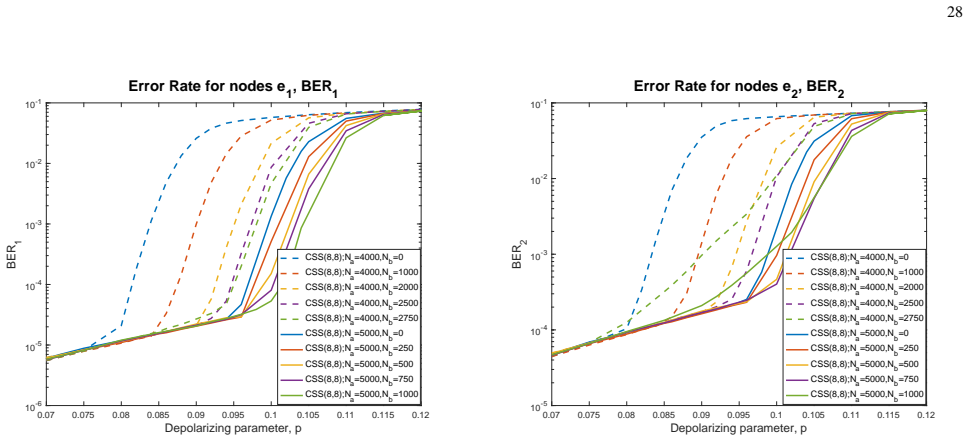
Summary. The paper constructs CSS quantum codes from the generator and parity-check matrices of classical LDGM codes by applying row operations (matrices M1, M2) to adjust the quantum rate. The decoder is belief propagation on a two-layer graph, with a doping upper layer and a regular LDGM lower layer. For the depolarizing channel, the X and Z decoders exchange information to exploit the correlation between X and Z errors, and discrete density evolution (DDE) is adapted to optimize the code parameters. Section IV presents a modified upper layer that bounds the weight of the logical X and Z operators by y+1 or w_d+1, claimed to be advantageous for fault-tolerant computation. Simulation results for rate-1/4 codes of length N=19014 report physical residual error rates (BER1/BER2) with thresholds near p≈0.1 and error floors between about 10^-6 and 10^-4 depending on the LDGM degree.
Significance. If the performance claims are substantiated, the paper would contribute a flexible construction of finite-length CSS codes with iterative decoding and low-weight logical operators, plus a DDE framework for the depolarizing channel. The low logical-operator weight (y+1 or w_d+1) is a concrete and potentially useful feature for fault-tolerant gate synthesis. The DDE extension to quantum depolarizing decoding is also of methodological interest. However, the significance depends crucially on two issues: the reported figures measure physical residual errors rather than the logical failure rate that determines fault-tolerance utility, and the DDE-to-quantum equivalence that drives the optimization is asserted without proof. Neither issue undermines the algebraic construction, but both must be resolved before the central claims can be accepted.
major comments (3)
- [Section VII (Figs. 5-10)] The reported performance metric is the physical residual bit error rate (BER1/BER2), not the logical failure probability. In a CSS code, a residual error with zero syndrome is either a stabilizer (harmless) or a non-trivial logical operator. Section IV shows that the logical X/Z generators have weight at most y+1 or w_d+1; for the simulated (8,8) codes this bounds the code distance by 9. A single logical failure therefore contributes about 9/19014 ≈ 4.7×10^-4 to BER1. A reported BER floor near 10^-6 is thus compatible with a logical failure rate of order 10^-3, which would be unacceptable for fault-tolerant computation. The abstract's claims that the codes are 'particularly well suited for fault-tolerant quantum computation' and possess 'excellent error correction capabilities' cannot be evaluated without logical error rates and a minimum-distance calculation. The paper should report log
- [Section VI.A] The paper asserts without proof that DDE performed on the graph 0=H_p c, with all syndrome nodes set to zero, predicts the error probability of belief propagation on the physical syndrome graph s=H_p e. The authors acknowledge that the former graph 'has no physical meaning in the quantum domain,' yet the equivalence is stated as a matter of course. In classical DDE, the all-zero codeword and syndrome-symmetry arguments require careful justification, and the extension to a quantum factor graph with correlated X/Z errors is not automatic. Since DDE is used to select N_a, N_b, and w_d and to validate the simulation results, this is load-bearing. Please provide a proof or a rigorous symmetry argument, and additionally verify the DDE predictions against syndrome-based BP for a set of parameters not used to motivate the claim.
- [Section VI.C / VII] The DDE predictions are only partially displayed: the no-correlation DDE curves are omitted in Figs. 5 and 6, and Figs. 7-10 contain no DDE curves at all. The claim of an 'excellent match' between DDE and simulation is therefore not fully supported by the presented data. Since the optimized designs (N_a, N_b, w_d) are selected on the basis of DDE, the authors should show DDE and simulated BER curves for all compared configurations, with confidence intervals or at least the number of Monte Carlo trials. This is necessary to distinguish genuine agreement from the freedom of unshown comparisons.
minor comments (6)
- [Section V, Eq. (11)] The notation p^{ez}_k ∝ ... would benefit from an explicit statement of the normalization constant; as written, the left side is a probability while the right side is an unnormalized weight. The intended sum-product update is clear but should be spelled out.
- [Section VI.C] The notation R^m p_{m(e1,c)} is used in Eqs. (25), (32)-(34) without a formal definition. Define R^m as the m-fold application of R, and specify the order of arguments when the tanh rule is applied to more than two incoming messages.
- [Section VII / Fig. captions] The notation 'CSS(8,8)' is not formally introduced; it presumably denotes the (y,y) degree of the LDGM lower layer. Please define it in the text or in a table.
- [References] The reference list contains an unnumbered entry 'M. M. Wilde, Quantum Information Theory' between [7] and [8], and the numbering of [8] onward appears shifted. Please correct the bibliography formatting.
- [Section VIII] The conclusion states that the proposed codes have 'performance only slightly worse than that of the best codes obtained when the only focus is on minimizing residual errors,' but no quantitative comparison to an explicit alternative code is provided. Either add such a comparison or soften the claim.
- [Section I / II] The paper would benefit from a discussion of how the proposed finite-length LDGM codes compare, in terms of logical error rate, with established families such as surface codes or quantum LDPC codes, especially because classical LDGM codes have notoriously poor minimum distance. The present discussion relies on MacKay's argument that distance is not everything, but the fault-tolerance claim makes such a comparison necessary.
Circularity Check
No significant circularity: the CSS construction, logical-weight bounds, and DDE predictions are derived or independently simulated; self-citations are not load-bearing.
full rationale
Walked the derivation chain. (i) The CSS construction in Sec. II.D proves GH^T=0 from \tilde G \tilde H^T=0 and row operations; it is self-contained. (ii) Sec. IV derives the logical operators \bar X and \bar Z from the standard form in (6)-(7), then sets P_22=0 and defines M so that M' has column weight w_d; the weights y+1 and w_d+1 follow algebraically. This is a designed property, not a fitted prediction. (iii) DDE in Sec. VI is developed from standard classical density evolution and its predictions are compared to independent Monte Carlo simulations in Figs. 5-10, not fitted to those curves; N_a and N_b are optimization parameters and p is a channel input. (iv) Self-citations [14]-[16] and [39] describe prior LDGM-CSS constructions and error-floor analysis, but the new claims do not reduce to them. The manuscript itself acknowledges that LDGM minimum distance is small by definition and that the DDE graph 'has no physical meaning in the quantum domain' (Sec. VI.A), with the DDE-to-syndrome-decoding equivalence asserted rather than proved; these are limitations or correctness risks, not circular reductions. No equation was found in which a prediction equals a fitted constant or an input is defined by an output.
Axiom & Free-Parameter Ledger
free parameters (6)
- y (LDGM bottom-layer node degree) =
8-12 for regular (y,y) LDGM codes
- w_d (degree of d nodes in upper layer) =
3 in original structure; 8=y in fault-tolerant structure
- N_a (number of doping syndrome nodes) =
4000-5500
- N_b (number of degree-2 syndrome nodes) =
0-2750
- N, K (block length and logical dimension) =
N=19014, K=4752 (rate ≈ 1/4)
- δ (DDE quantization step) =
not specified
axioms (7)
- standard math LDGM generator and parity-check matrices satisfy G̃H̃^T=0 for systematic LDGM codes.
- standard math Matrix A=(A1|A2) satisfying A1 A2^T + A2 A1^T=0 defines a stabilizer code.
- ad hoc to paper DDE on graph 0=H_p c predicts performance of BP on syndrome graph s=H_p e.
- domain assumption In DDE, messages into s_C from d_B and d_C have identical pmf; random graph concentration assumptions hold.
- domain assumption LDGM error floors can be controlled by degree selection and doping/concatenation so finite-length performance is useful.
- domain assumption Depolarizing channel can be modeled with P(X)=P(Y)=P(Z)=p/3 and marginals P(e_x=1)=P(e_z=1)=2p/3.
- standard math Every CSS code can be put in standard form (6) via Gaussian elimination and simultaneous column permutations.
invented entities (1)
-
s_A doping syndrome nodes (degree-1 syndrome nodes)
no independent evidence
read the original abstract
We construct a new family of Calderbank-Shor-Steane (CSS) codes using the generator and parity-check matrices of Low-Density Generator Matrix (LDGM) codes, with row operations applied to both matrices in order to achieve the desired quantum rate. Decoding is performed in an iterative manner, by applying message passing over the associated graph, and discrete Density Evolution (DDE) is used to optimize performance in the depolarizing channel. The proposed construction offers high flexibility and easiness in the design, producing quantum codes that possess excellent error correction capabilities. By properly designing the structure of the code, we are able to control and bound the weight of the stabilizer generators to a small value, which results in codes particularly well suited for fault-tolerant quantum computation. At the same time, these codes achieve very good performance in terms of error correction capability.
Figures




Reference graph
Works this paper leans on
-
[1]
Scheme for Reducing Decoherence in Quantum Computer Memory,
P. Shor, “Scheme for Reducing Decoherence in Quantum Computer Memory,”Physical Review A, vol. 52 (R), no. 4, pp. 2493-2496, October 1995
1995
-
[2]
Quantum Computation and Quantum Information,
M. A. Nielsen and I. L. Chuang, “Quantum Computation and Quantum Information,”Cambridge University Press,2000
2000
-
[3]
Good Quantum Error-Correcting Codes Exist,
R. Calderbank and P. W. Shor, “Good Quantum Error-Correcting Codes Exist,”Physical Review A, vol. 54, no. 2, pp. 1098-1105, August 1996. DRAFT 32
1996
-
[4]
Multiple Particle Interference and Quantum Error Correction,
A. Steane, “Multiple Particle Interference and Quantum Error Correction,”Proc. of the Royal Society A, vol. 452, no. 1954, pp. 2551-2577, November 1996
1954
-
[5]
Gottesman,Stabilizer Codes and Quantum Error Correction, Ph.D
D. Gottesman,Stabilizer Codes and Quantum Error Correction, Ph.D. thesis, California Institute of Technology, 1997. Available at https://arxiv.org/abs/quant-ph/9705052
Pith/arXiv arXiv 1997
-
[6]
A. R. Calderbank, E. M. Rains, P. W. Shor, and N. J. A. Sloane, Quantum error correction and orthogonal geometry,Phys. Rev. Lett.78(3), 405–408 (1997)
1997
-
[7]
Quantum Error Correction via Codes over GF(4),
A. R. Calderbank, E. M. Rains, P. W. Shor, and N. J. A. Sloane, “Quantum Error Correction via Codes over GF(4),”IEEE Trans. on Information Theory, vol. 44, no. 4, pp. 1369-1387, July 1998. M. M. Wilde,Quantum Information Theory, 2nd ed. Cambridge University Press, 2017
1998
-
[8]
Near Shannon Limit Error-Correcting Coding and Decoding: Turbo-Codes,
C. Berrou, A. Glavieux, and P. Thitimajshima, “Near Shannon Limit Error-Correcting Coding and Decoding: Turbo-Codes,” Proc. ICC’93, May 1993
1993
-
[9]
Low-Density Parity-Check Codes,
R. G. Gallager, “Low-Density Parity-Check Codes,”IEEE Trans. on Information Theory, vol. 8, no. 1, pp. 21-28, January 1962
1962
-
[10]
Good Error-Correcting Codes Based on Very Sparse Matrices,
D. J. C. MacKay, “Good Error-Correcting Codes Based on Very Sparse Matrices,”IEEE Trans. on Information Theory, vol. 45, no. 2, pp. 399-431, March 1999
1999
-
[11]
A Proposed Quantum Low Density Parity Check Code,
M. S. Postol, “A Proposed Quantum Low Density Parity Check Code,”arXiv:quant-ph/0108131v1, August 2001
Pith/arXiv arXiv 2001
-
[12]
Sparse-Graph Codes for Quantum Error-Correction,
D. J. C. MacKay, G. Mitchison, and P. L. McFadden, “Sparse-Graph Codes for Quantum Error-Correction,”IEEE Trans. on Information Theory, vol. 50, no. 10, pp. 2315-2330, October 2004
2004
-
[13]
Constructions and Performance of Classes of Quantum LDPC Codes,
T. Camara, H. Ollivier and J.-P. Tillich, “Constructions and Performance of Classes of Quantum LDPC Codes,”arXiv:quant- ph/0502086v2, April 2005
arXiv 2005
-
[14]
Quantum Error-Correction Using Codes with Low-Density Generator Matrix,
H. Lou and J. Garcia-Frias, “Quantum Error-Correction Using Codes with Low-Density Generator Matrix,”Proc. SPAWC’05, June 2005
2005
-
[15]
On the Application of Error-Correcting Codes with Low-Density Generator Matrix over Different Quantum Channels,
H. Lou and J. Garcia-Frias, “On the Application of Error-Correcting Codes with Low-Density Generator Matrix over Different Quantum Channels,”Proc. International Symposium on Turbo Codes, April 2006
2006
-
[16]
Design of Near-Optimum Quantum Error-Correcting Codes Based on Generator and Parity- Check Matrices of LDGM Codes,
J. Garcia-Frias and K. Liu, “Design of Near-Optimum Quantum Error-Correcting Codes Based on Generator and Parity- Check Matrices of LDGM Codes,”Proc. CISS’08, March 2008
2008
-
[17]
Approaching Near Shannon Performance by Iterative Decoding of Linear Codes with Low-Density Generator Matrix,
J. Garcia-Frias and W. Zhong, “Approaching Near Shannon Performance by Iterative Decoding of Linear Codes with Low-Density Generator Matrix,”IEEE Communications Letters,vol. 7, no. 6, pp. 266-268, June 2003
2003
-
[18]
Iterative Decoding Schemes for Source and Channel Coding of Correlated Sources,
J. Garcia-Frias, W. Zhong, and Y . Zhao, “Iterative Decoding Schemes for Source and Channel Coding of Correlated Sources,”Proc. Asilomar’02, November 2002
2002
-
[19]
LDGM Codes for Channel Coding and Joint Source-Channel Coding of Correlated Sources,
W. Zhong and J. Garcia-Frias, “LDGM Codes for Channel Coding and Joint Source-Channel Coding of Correlated Sources,” EURASIP Journal on Applied Signal Processing, vol. 2005, no. 6, pp. 942-953, May 2005
2005
-
[20]
Synthesis of Logical Clifford Operators via Symplectic Geometry,
N. Rengaswamy, R. Calderbank, S. Kadhe, and H. D. Pfister, “Synthesis of Logical Clifford Operators via Symplectic Geometry,” inProc. IEEE Int. Symp. Inf. Theory (ISIT), 2018, pp. 791–795. doi: 10.1109/ISIT.2018.8437652
arXiv 2018
-
[21]
Synthesis of Logical Clifford Operators via Symplectic Geometry,
N. Rengaswamy, R. Calderbank, S. Kadhe, and H. D. Pfister, “Synthesis of Logical Clifford Operators via Symplectic Geometry,”http://arxiv.org/abs/1803.06987, 2018
Pith/arXiv arXiv 2018
-
[22]
Asymptotically Good Quantum and Locally Testable Classical LDPC Codes,
P. Pantellev and G Kalachev, “Asymptotically Good Quantum and Locally Testable Classical LDPC Codes,” inProc. ACM SIGACT Symposium on Theory of Computing, 2022, pp. 375–388. doi: 10.1145/3519935.3520017
arXiv 2022
-
[23]
Quantum LDPC Codes With Almost Linear Minimum Distance,
P. Pantellev and G Kalachev, “Quantum LDPC Codes With Almost Linear Minimum Distance,”IEEE Trans. on Information Theory, vol.68, no. 1, pp. 213–229, January 2022. doi: 10.1109/TIT.2021.3119384
arXiv 2022
-
[24]
Quantum LDPC Codes of Almost Linear Distance via Homological Products,
L. Golowich and V . Guruswami, “Quantum LDPC Codes of Almost Linear Distance via Homological Products,” arXiv:quant-ph/2411.03646, November 2024. DRAFT 33
Pith/arXiv arXiv 2024
-
[25]
Error Floor Analysis in LDGM Codes
K. Liu, J. Garcia-Frias, “Error Floor Analysis in LDGM Codes”,Proc. ISIT’10, June 2010
2010
-
[26]
Parallel Concatenation of LDGM Codes to Approach Capacity Limits,
H. Chai, W. Zhong, and J. Garcia-Frias, “Parallel Concatenation of LDGM Codes to Approach Capacity Limits,”Proc. CISS’05, March 2005
2005
-
[27]
Approaching the Shannon Limit through Parallel Concatenation of Regular LDGM Codes,
W. Zhong, H. Chai, and J. Garcia-Frias, “Approaching the Shannon Limit through Parallel Concatenation of Regular LDGM Codes,”Proc. ISIT’05, September 2005
2005
-
[28]
On the Design of Low-Density Parity-Check Codes within 0.0045 dB of the Shannon Limit,
S.-Y . Chung, G. D. Forney, T. J. Richardson, and R. Urbanke, “On the Design of Low-Density Parity-Check Codes within 0.0045 dB of the Shannon Limit,”IEEE Communications Letters, vol. 5, no. 2, pp. 58-60, February 2001
2001
-
[29]
Probabilistic Reasoning in Intelligent Systems: Networks of Plausible Inference,
J. Pearl, “Probabilistic Reasoning in Intelligent Systems: Networks of Plausible Inference,”Morgan Kaufmann, 1988
1988
-
[30]
Factor Graphs and the Sum-Product Algorithm,
F. R. Kschischang, B. J. Frey, and H.-A. Loeliger, “Factor Graphs and the Sum-Product Algorithm,”IEEE Trans. on Information Theory, vol. 47, no. 2, pp. 498-519, February 2001
2001
-
[31]
A Concatenated [(4,1,3)] Quantum Convolutional Code,
A. C. A. de Almeida and R. Palazzo Jr., “A Concatenated [(4,1,3)] Quantum Convolutional Code,”Proc. ITW’04, October 2004
2004
-
[32]
Convolutional and Tail-Biting Quantum Error-Correcting Codes,
G. D. Forney, Jr., M. Grassl and S.Guha, “Convolutional and Tail-Biting Quantum Error-Correcting Codes,”arXiv:quant- ph/0511016v2, November 2006
arXiv 2006
-
[33]
M. Grassl and T. Beth, “Quantum BCH Codes,”arXiv:quant-ph/9910060v1, October 1999
Pith/arXiv arXiv 1999
-
[34]
M. Grassl and T. Beth, “Quantum Reed-Solomon Codes,”arXiv:quant-ph/9910059v1, October 1999
Pith/arXiv arXiv 1999
-
[35]
Constructions of Quantum Convolutional Codes,
M. Grassl and M. Roetteler, “Constructions of Quantum Convolutional Codes,”Proc. ISIT’07, June 2007
2007
-
[36]
Quantum Quasi-Cyclic LDPC Codes,
M. Hagiwara, and H. Imai, “Quantum Quasi-Cyclic LDPC Codes,”Proc. ISIT’07, June 2007
2007
-
[37]
Description of a Quantum Convolutional Code,
H. Ollivier and J.-P. Tillich, “Description of a Quantum Convolutional Code,”Phys. Rev. Lett., vol. 91, no. 17, pp. 177902- 1-4, October 2003
2003
-
[38]
Code Doping for Triggering Iterative Decoding Convergence,
S. ten Brink, “Code Doping for Triggering Iterative Decoding Convergence,”Proc. ISIT’01, June 2001
2001
-
[39]
Asymptotic Analysis of LDGM-Based Quantum Codes,
K. Liu and J. Garcia-Frias, “Asymptotic Analysis of LDGM-Based Quantum Codes,”Proc. CISS’09, March 2009
2009
-
[40]
Joint Source-Channel Decoding of Correlated Sources over Noisy Channels,
J. Garcia-Frias, “Joint Source-Channel Decoding of Correlated Sources over Noisy Channels,”Proc. DCC’01, March 2001
2001
-
[41]
Near Shannon/Slepian-Wolf Performance for Unknown Correlated Sources over AWGN Channels,
J. Garcia-Frias and Y . Zhao, “Near Shannon/Slepian-Wolf Performance for Unknown Correlated Sources over AWGN Channels,”IEEE Trans. on Communications, vol. 53, no. 4, pp. 555-559, April 2005
2005
-
[42]
Compression of Correlated Binary Sources Using Turbo Codes,
J. Garcia-Frias and Y . Zhao, “Compression of Correlated Binary Sources Using Turbo Codes,”IEEE Communications Letters, vol. 5, no. 10, pp. 417-419, October 2001
2001
-
[43]
Turbo-Like Codes for Transmission of Correlated Sources over Noisy Channels,
J. Garcia-Frias, Y . Zhao, and W. Zhong, “Turbo-Like Codes for Transmission of Correlated Sources over Noisy Channels,” IEEE Signal Processing Magazine, vol. 24, no. 5, pp. 58-66, September 2007
2007
-
[44]
Iterative decoding of binary block and convolutional codes,
J. Hagenauer, E. Offer and L. Papke “Iterative decoding of binary block and convolutional codes,”IEEE Trans. Inform. Theory, vol. 42, pp. 429-445, March 1996. DRAFT
1996
discussion (0)
Sign in with ORCID, Apple, or X to comment. Anyone can read and Pith papers without signing in.