Moment generating function of the tacnode process
Pith reviewed 2026-06-26 22:52 UTC · model grok-4.3
The pith
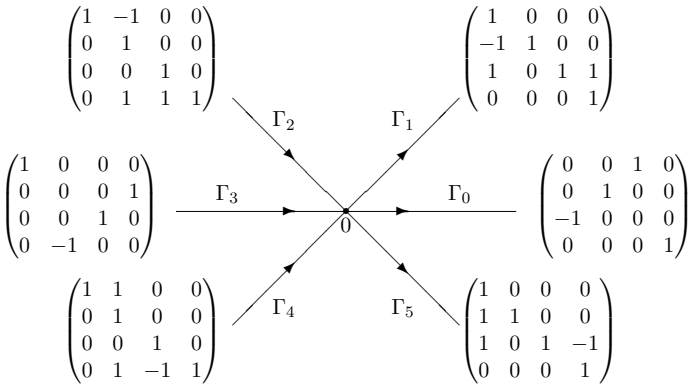
The m-point generating function of the tacnode process is expressed as an integral over the Hamiltonian of an 8m+4 system of coupled differential equations.
A machine-rendered reading of the paper's core claim, the machinery that carries it, and where it could break.
Core claim
The m-point generating function for the tacnode process admits an integral representation in terms of the Hamiltonian of an 8m+4 system of coupled differential equations. Differential identities for this Hamiltonian determine the large-gap asymptotics of the generating function up to and including the constant term. The resulting formulae give the asymptotic expectations, variances, and covariances of the counting functions on the union of m intervals and yield a joint central limit theorem for their fluctuations. These statements extend the previously known one-point theory to the multi-interval setting.
What carries the argument
The Hamiltonian of the 8m+4 coupled differential equations, which enters the integral representation of the m-point generating function and supplies the differential identities used for the asymptotics.
If this is right
- Large-gap asymptotics of the m-point generating function are obtained up to the constant term.
- Explicit asymptotic expressions exist for the expectations, variances, and covariances of the counting functions.
- The joint fluctuations of the counting functions obey a central limit theorem when the gaps are large.
- The one-point theory for the tacnode process extends directly to the multi-interval case with multiple discontinuities.
Where Pith is reading between the lines
- The Hamiltonian construction may supply similar integral representations for counting functions in other determinantal processes that admit coupled differential equation descriptions.
- The constant term extracted here could be compared with known constants appearing in the asymptotics of related non-intersecting particle systems.
- The method offers a route to compute higher-order corrections beyond the constant term by further differentiation of the same Hamiltonian identities.
Load-bearing premise
The differential identities satisfied by the Hamiltonian of the 8m+4 system hold and can be applied to extract the constant term in the large-gap expansion.
What would settle it
An independent numerical evaluation of the constant term in the large-gap expansion of the two-interval (m=2) generating function, compared against the value obtained from the Hamiltonian identities.
Figures



read the original abstract
The tacnode process is a universal determinantal point process arising in non-intersecting particle systems and random tiling models. In this paper, we study the generating function for the counting functions of the tacnode process on a union of $m$ intervals, $m\in\mathbb{N}^{+}$. Our first result provides an integral representation for the $m$-point generating function in terms of the Hamiltonian governing a system of $8m+4$ coupled differential equations. Combined with several differential identities for this Hamiltonian, the representation yields the large gap asymptotics, up to and including the constant term. As further applications, we obtain asymptotic formulae for the expectations, variances, and covariances of the counting functions, and establish a central limit theorem for their joint fluctuations. These results extend the previously known $1$-point theory for the tacnode process to the multi-interval setting with multiple discontinuities.
Editorial analysis
A structured set of objections, weighed in public.
Referee Report
Summary. The paper derives an integral representation for the m-point moment generating function of the tacnode process (a determinantal point process) in terms of the Hamiltonian of an 8m+4 system of coupled ODEs. Differential identities on this Hamiltonian are then used to extract large-gap asymptotics up to the constant term; further applications include asymptotic formulas for expectations, variances and covariances of the counting functions together with a joint central limit theorem. The work extends the existing one-point theory to the multi-interval setting.
Significance. If the integral representation and differential identities hold, the results supply a systematic route to precise multi-point asymptotics and fluctuation theorems for the tacnode process, a universal object appearing in non-intersecting paths and random tilings. The Hamiltonian formulation and the extraction of the constant term constitute a technical advance over prior one-point analyses.
minor comments (2)
- The abstract states that the representation 'yields the large gap asymptotics'; a brief sentence in the introduction clarifying which differential identities are new versus previously known would help readers locate the novelty.
- Notation for the 8m+4 Hamiltonian system is introduced without an explicit count of the independent variables; adding a short table or sentence listing the phase-space dimension would improve readability.
Simulated Author's Rebuttal
We thank the referee for their positive summary, recognition of the technical advance, and recommendation to accept the manuscript. There are no major comments requiring a point-by-point response.
Circularity Check
No significant circularity detected
full rationale
The derivation begins with an integral representation of the m-point generating function expressed via the Hamiltonian of an 8m+4 coupled ODE system, then applies differential identities on that Hamiltonian to extract large-gap asymptotics including the constant term. No quoted step reduces by construction to a fitted parameter, self-definition, or load-bearing self-citation chain; the central objects (Hamiltonian and identities) are introduced as governing the system rather than being defined in terms of the target asymptotics or generating function. The extension from 1-point to multi-interval cases is presented as a direct application of the new representation, with no reduction to prior fitted inputs or renamed empirical patterns.
Axiom & Free-Parameter Ledger
Reference graph
Works this paper leans on
-
[1]
Adler, J
[ADvM09] M. Adler, J. Delépine, and P. van Moerbeke, Dyson ’s nonintersecting Brownian motions with a few outliers, Comm. Pure Appl. Math. 62 (2009), 334–395. [ADvMV11] M. Adler, J. Delépine, P. van Moerbeke, and P. Vanhaecke, A PDE for non-intersecting Brownian motions and applications , Adv. Math. 226 (2011), 1715–1755. [AFvM13] M. Adler, P. L. Ferrari,...
2009
-
[2]
[DIZ97] P. Deift, A. Its, and X. Zhou, A Riemann-Hilbert approach to asymptotic problems arising in the theory of random matrix models, and also in the theory of integrable statistical mechanics , Ann. of Math. 146 (1997), 149–235. [DZ93] P. Deift and X. Zhou, A steepest descent method for oscillatory Riemann-Hilbert problems. Asymp- totics for the MKdV e...
-
[3]
[IIKS90] A. Its, A. G. Izergin, V. E. Korepin, and N. A. Slavnov, Differential equations for quantum correlation functions, Internat. J. Modern Phys. B 4 (1990), no. 5, 1003–1037. [IK08] A. R. Its and I. Krasovsky, Hankel determinant and orthogonal polynomials for the Gaussian weight with a jump , Contemp. Math. 458 (2008), 215–248. [JMMS80] M. Jimbo, T. ...
1990
-
[4]
[Joh13] , Non-colliding Brownian motions and the extended tacnode process , Comm. Math. Phys. 319 (2013), 231–267. [KT04] M. Katori and H. Tanemura, Symmetry of matrix-valued stochastic processes and noncolliding dif- fusion particle systems , J. Math. Phys. 45 (2004), 3058–3085. [KT07] , Noncolliding Brownian motion and determinantal processes , J. Stat....
work page internal anchor Pith review Pith/arXiv arXiv 2013
-
[5]
Yao and L
[YZ24] L.-M. Yao and L. Zhang, On the gap probability of the tacnode process , Adv. Math. 438 (2024), Paper No. 109474. 74
2024
discussion (0)
Sign in with ORCID, Apple, or X to comment. Anyone can read and Pith papers without signing in.