Best-First Ordered Statistics Decoding of Quantum LDPC Codes
Pith reviewed 2026-06-29 20:42 UTC · model grok-4.3
The pith
Best-First OSD matches BP+OSD accuracy on quantum LDPC codes while using 1/100th the candidate queries.
A machine-rendered reading of the paper's core claim, the machinery that carries it, and where it could break.
Core claim
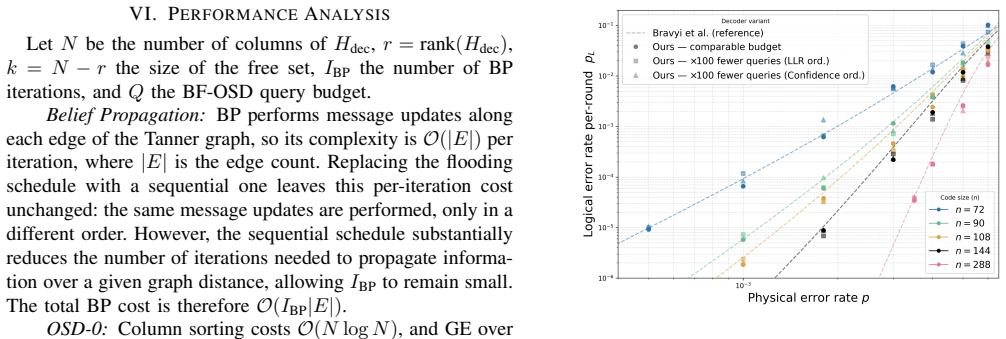
BF-OSD traverses the space of syndrome-consistent error patterns in order of decreasing likelihood after a fixed, small number of BP iterations instead of conditioning the OSD call on BP convergence. On a family of bivariate bicycle codes under circuit-level noise, the method achieves decoding performance equivalent to the BP+OSD baseline while exploring the solution space with one-hundredth of the query budget.
What carries the argument
Best-first traversal of likelihood-ordered error candidates after a fixed number of BP iterations
If this is right
- Decoding remains effective even when BP fails to converge, which is common under realistic circuit noise.
- The query budget for list decoding drops by roughly two orders of magnitude while preserving accuracy.
- The method applies directly to degenerate codes where many distinct errors produce the same syndrome.
- A fixed BP iteration count removes the need for convergence-based early stopping logic.
Where Pith is reading between the lines
- The same ordering principle could be applied to other list-decoding tasks that currently rely on exhaustive enumeration of short lists.
- Lower per-shot query counts may allow higher clock rates or reduced hardware overhead for real-time quantum decoders.
- If the likelihood ordering remains informative after few BP steps on additional code families, the fixed-iteration design choice becomes broadly useful.
Load-bearing premise
The performance equivalence and query reduction observed for bivariate bicycle codes under the chosen circuit-level noise model will generalize to other QLDPC codes and noise regimes without code-specific tuning.
What would settle it
Monte Carlo simulations on a different QLDPC family such as hypergraph-product codes under the same circuit-level noise model that show either a gap in logical error rate or no reduction in query count relative to BP+OSD.
Figures

read the original abstract
Belief Propagation (BP) followed by Ordered Statistics Decoding (OSD) has emerged as the gold standard for decoding quantum low-density parity-check (QLDPC) codes. Recent advancements in this field have proposed new methods and algorithms to lower the complexity of this standard pipeline. Because of code degeneracy, and more in general because multiple distinct error patterns can produce the same syndrome, OSD is inherently a list-decoding technique; that is, it enumerates a set of syndrome-consistent candidates and returns the most probable one. In this work, we propose a variant of OSD, which we call Best-First OSD (BF-OSD), that explores the error-candidate space more efficiently by traversing it in order of decreasing likelihood, rather than by brute-force enumeration of a pre-selected subset. In addition, we depart from the conventional BP+OSD cascade: instead of conditioning the OSD invocation on BP convergence, we invoke OSD after a fixed, small number of BP iterations. This design choice is motivated by the full circuit-level noise regime, in which BP is particularly unreliable. Monte Carlo simulations of a family of Bivariate Bicycle (BB) codes under full circuit-level noise show that BF-OSD matches the performance of the BP+OSD baseline while exploring the solution space with 1/100th of the query budget.
Editorial analysis
A structured set of objections, weighed in public.
Referee Report
Summary. The paper claims that a Best-First Ordered Statistics Decoding (BF-OSD) approach, which traverses error candidates in likelihood order and invokes OSD after a fixed number of BP iterations, achieves equivalent decoding performance to the standard BP+OSD method on Bivariate Bicycle quantum LDPC codes under circuit-level noise, but with only 1/100th the OSD query budget, as demonstrated by Monte Carlo simulations.
Significance. If validated, this offers a substantial efficiency gain in decoding complexity for QLDPC codes, addressing practical challenges in quantum error correction by reducing the number of candidate evaluations needed. The empirical results on BB codes provide a useful data point for decoder design in the circuit-noise regime.
major comments (1)
- The abstract reports matching performance with 1/100 query budget on BB codes, but provides no error bars, no details on the exact noise model parameters, no comparison baselines beyond the standard cascade, and no statement on whether the 1/100 factor is averaged or worst-case. This weakens the support for the central empirical claim.
Simulated Author's Rebuttal
We thank the referee for their insightful comments on our manuscript. We provide a point-by-point response to the major comment below.
read point-by-point responses
-
Referee: The abstract reports matching performance with 1/100 query budget on BB codes, but provides no error bars, no details on the exact noise model parameters, no comparison baselines beyond the standard cascade, and no statement on whether the 1/100 factor is averaged or worst-case. This weakens the support for the central empirical claim.
Authors: We acknowledge the abstract's brevity limits the inclusion of these specifics. The full manuscript details the exact circuit-level noise model parameters in the experimental setup. Error bars are included in the logical error rate plots from the Monte Carlo simulations. The comparison is to the standard BP+OSD cascade, which is the relevant baseline for demonstrating the query efficiency gain; additional baselines are discussed in the related work section. The 1/100 factor is the average reduction in candidate queries observed across the simulations. To better support the central claim in the abstract, we will revise it to include a short statement on the noise model and the averaged nature of the query reduction. revision: yes
Circularity Check
No significant circularity
full rationale
The paper presents an algorithmic variant (BF-OSD with fixed BP iterations) whose performance is evaluated exclusively through Monte Carlo simulations on BB codes. No derivation, uniqueness theorem, or fitted parameter is invoked whose output is then relabeled as a prediction; the reported equivalence in logical error rate and query reduction is a direct empirical outcome, not a self-referential reduction. No load-bearing self-citations appear in the provided text.
Axiom & Free-Parameter Ledger
axioms (2)
- domain assumption Multiple distinct error patterns can produce the same syndrome due to code degeneracy.
- domain assumption BP is particularly unreliable under full circuit-level noise.
Reference graph
Works this paper leans on
- [1]
-
[2]
Good quantum error-correcting codes exist,
A. R. Calderbank and P. W. Shor, “Good quantum error-correcting codes exist,”Physical Review A, vol. 54, no. 2, p. 1098, 1996
1996
-
[3]
Multiple-particle interference and quantum error correction,
A. Steane, “Multiple-particle interference and quantum error correction,” Proceedings of the Royal Society of London. Series A: Mathematical, Physical and Engineering Sciences, vol. 452, no. 1954, pp. 2551–2577, 1996
1954
-
[4]
High-threshold and low-overhead fault-tolerant quantum memory,
S. Bravyi, A. W. Cross, J. M. Gambetta, D. Maslov, P. Rall, and T. J. Yoder, “High-threshold and low-overhead fault-tolerant quantum memory,”Nature, vol. 627, no. 8005, pp. 778–782, 2024
2024
-
[5]
Degenerate quantum LDPC codes with good finite length performance,
P. Panteleev and G. Kalachev, “Degenerate quantum LDPC codes with good finite length performance,”Quantum, vol. 5, p. 585, 2021
2021
-
[6]
Decoding across the quantum low-density parity-check code landscape,
J. Roffe, D. R. White, S. Burton, and E. Campbell, “Decoding across the quantum low-density parity-check code landscape,”Physical Review Research, vol. 2, no. 4, p. 043423, 2020
2020
-
[7]
Efficient serial Message-Passing schedules for LDPC decoding,
E. Sharon, S. Litsyn, and J. Goldberger, “Efficient serial Message-Passing schedules for LDPC decoding,”IEEE Transactions on Information Theory, vol. 53, no. 11, pp. 4076–4091, Nov. 2007
2007
-
[8]
Topological quantum memory,
E. Dennis, A. Kitaev, A. Landahl, and J. Preskill, “Topological quantum memory,”Journal of Mathematical Physics, vol. 43, no. 9, pp. 4452– 4505, 2002
2002
-
[9]
Surface codes: Towards practical large-scale quantum computation,
A. G. Fowler, M. Mariantoni, J. M. Martinis, and A. N. Cleland, “Surface codes: Towards practical large-scale quantum computation,”Physical Review A—Atomic, Molecular, and Optical Physics, vol. 86, no. 3, p. 032324, 2012
2012
-
[10]
Soft-decision decoding of linear block codes based on ordered statistics,
M. P. C. Fossorier and S. Lin, “Soft-decision decoding of linear block codes based on ordered statistics,”IEEE Transactions on Information Theory, vol. 41, no. 5, pp. 1379–1396, 1995
1995
-
[11]
Matroids and the greedy algorithm,
J. Edmonds, “Matroids and the greedy algorithm,”Mathematical pro- gramming, vol. 1, no. 1, pp. 127–136, 1971
1971
discussion (0)
Sign in with ORCID, Apple, or X to comment. Anyone can read and Pith papers without signing in.