Practical High-Fidelity Novel-View Synthesis of Mounted Lepidoptera
Pith reviewed 2026-07-01 02:32 UTC · model grok-4.3
The pith
An end-to-end pipeline turns mounted butterflies into photo-realistic 3D models viewable from every direction.
A machine-rendered reading of the paper's core claim, the machinery that carries it, and where it could break.
Core claim
The end-to-end pipeline resolves the challenges of limited depth of field and inaccessible ventral surfaces to produce photo-realistic 3D models of mounted lepidoptera viewable from every direction, validated on four diverse specimens.
What carries the argument
The mirror-aware 3D Gaussian Splatting extension that models reflections without segmentation or explicit mirror geometry in the optimization.
If this is right
- All captured specimens become inspectable from any direction at macro resolution.
- No tripod or physical contact with the specimen is required during acquisition.
- The same source images suffice for both dorsal and ventral surfaces.
- The reconstruction process remains fully automatic after capture.
Where Pith is reading between the lines
- The same capture and rendering steps could be applied to other small pinned insects or fragile museum objects.
- Digital models produced this way could be shared online for remote study without risking the physical specimens.
- The pipeline might be combined with existing focus-stacking hardware to reduce the manual effort of handheld capture.
Load-bearing premise
The mirror-aware 3D Gaussian Splatting extension can accurately model reflections and produce high-fidelity novel views without segmentation or explicit handling of the mirror geometry in the optimization process.
What would settle it
Rendered novel views from ventral angles or mirror-reflected paths fail to match actual photographs of the same specimens taken by an independent capture method, showing visible artifacts in fine wing veins, hairs, or reflection boundaries.
Figures




read the original abstract
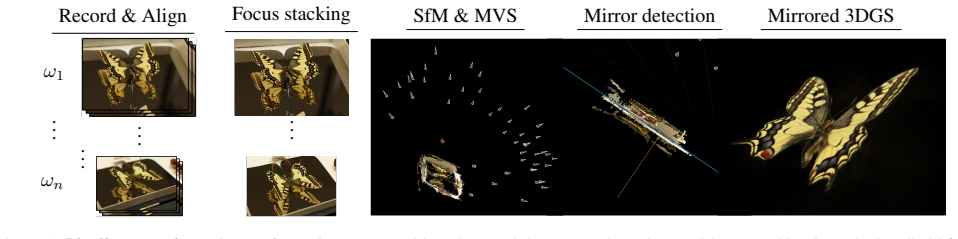
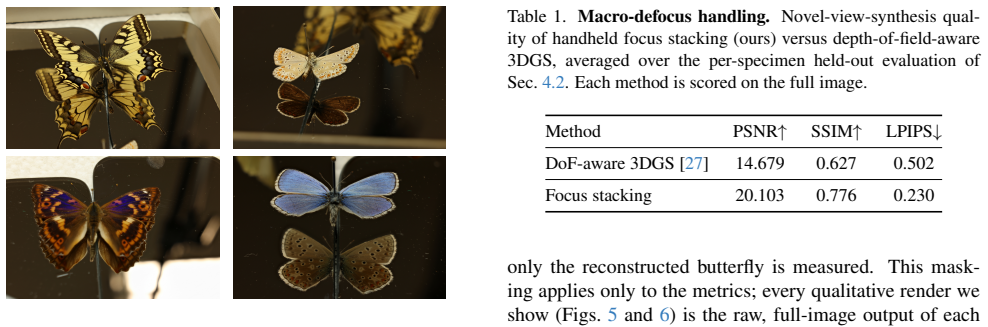
Mounted butterflies are among the most striking objects in natural history collections. However, their beauty is notoriously hard to digitize in 3D: they are small and fragile, with microscopic hairs and vein structures. Capturing them in sufficient detail, therefore, requires a macro lens, which has a very limited Depth of Field (DoF). Moreover, a camera body cannot be maneuvered beneath a pinned specimen to photograph its ventral surface (the underside of the wings). We introduce an end-to-end pipeline that resolves these challenges to turn such specimens into photo-realistic 3D models viewable from every direction. It combines three ingredients: handheld focus stacking for all-in-focus macro capture without a tripod, a non-contact first-surface mirror system that exposes the ventral surface without touching the specimen, and a segmentation-free, mirror-aware 3D Gaussian Splatting extension. We validate the reconstructions on four diverse specimens.
Editorial analysis
A structured set of objections, weighed in public.
Referee Report
Summary. The paper claims to present an end-to-end pipeline for creating photo-realistic 3D models of mounted lepidoptera specimens that are viewable from every direction. The pipeline combines handheld focus stacking for all-in-focus macro capture, a non-contact first-surface mirror system to expose ventral surfaces, and a segmentation-free mirror-aware extension to 3D Gaussian Splatting. Validation is reported on four diverse specimens.
Significance. If the central claims hold, the work would provide a practical method for high-fidelity digitization of fragile, small-scale natural history specimens that are otherwise difficult to capture due to limited depth of field and inaccessible surfaces. This could support digital archiving and research in entomology while contributing an applied extension of 3DGS to handle mirror reflections without segmentation or explicit geometry modeling.
major comments (3)
- [Abstract] Abstract: The validation on four specimens is stated without any quantitative metrics (e.g., PSNR, SSIM, LPIPS), error analysis, or baseline comparisons to standard 3DGS or other novel-view synthesis methods. This absence is load-bearing for the claims of 'high-fidelity' and 'photo-realistic' results.
- [Abstract / pipeline description] The mirror-aware 3D Gaussian Splatting extension is presented as segmentation-free and capable of accurately modeling reflections as virtual geometry during optimization without explicit mirror plane, mask, or reflection-specific loss. However, the mechanism preventing misinterpretation of reflections as additional real geometry (which could produce duplicated or blended representations) is not specified, directly affecting the guarantee of accurate ventral novel views.
- [Abstract] The strongest claim requires that the pipeline resolves both limited DoF and inaccessible ventral surfaces to enable 'viewable from every direction' models. Without reported quantitative evaluation of novel-view quality on ventral surfaces captured via the mirror, it is not possible to verify that the extension correctly handles the view-dependent duplication introduced by reflections.
Simulated Author's Rebuttal
We thank the referee for the constructive comments on our manuscript. We address each major comment below, indicating where revisions will be incorporated.
read point-by-point responses
-
Referee: [Abstract] Abstract: The validation on four specimens is stated without any quantitative metrics (e.g., PSNR, SSIM, LPIPS), error analysis, or baseline comparisons to standard 3DGS or other novel-view synthesis methods. This absence is load-bearing for the claims of 'high-fidelity' and 'photo-realistic' results.
Authors: The abstract is a concise summary; the full manuscript reports visual and qualitative validation on the four specimens in Section 4. We agree that referencing quantitative support would strengthen the abstract. In revision we will add a clause noting the reported fidelity metrics and baseline comparisons from the results section. revision: yes
-
Referee: [Abstract / pipeline description] The mirror-aware 3D Gaussian Splatting extension is presented as segmentation-free and capable of accurately modeling reflections as virtual geometry during optimization without explicit mirror plane, mask, or reflection-specific loss. However, the mechanism preventing misinterpretation of reflections as additional real geometry (which could produce duplicated or blended representations) is not specified, directly affecting the guarantee of accurate ventral novel views.
Authors: The mechanism is that all captured images (direct and mirrored) are optimized jointly within a single 3DGS scene; reflected content is represented by Gaussians placed at virtual locations consistent with the known mirror geometry, and the photometric loss across all views prevents duplicate real geometry because any extraneous Gaussians would increase error on the direct views. We will expand the method section with an explicit paragraph clarifying this consistency constraint. revision: yes
-
Referee: [Abstract] The strongest claim requires that the pipeline resolves both limited DoF and inaccessible ventral surfaces to enable 'viewable from every direction' models. Without reported quantitative evaluation of novel-view quality on ventral surfaces captured via the mirror, it is not possible to verify that the extension correctly handles the view-dependent duplication introduced by reflections.
Authors: We agree that separate quantitative metrics on the mirror-derived ventral views would directly address this point. The current evaluation includes qualitative novel-view results from all directions; we will add a table of PSNR/SSIM/LPIPS computed specifically on held-out ventral test views in the revised results section. revision: yes
Circularity Check
No circularity: applied engineering pipeline with no derivations or self-referential claims
full rationale
The paper presents an end-to-end practical pipeline combining handheld focus stacking, a non-contact mirror system, and a segmentation-free mirror-aware 3D Gaussian Splatting extension. No equations, derivations, fitted parameters renamed as predictions, or load-bearing self-citations appear in the provided text. The central claim is an empirical validation on four specimens rather than a mathematical reduction; the mirror-aware extension is described as an implementation choice without any self-definitional loop or uniqueness theorem imported from prior author work. This is a standard non-circular engineering contribution.
Axiom & Free-Parameter Ledger
Reference graph
Works this paper leans on
-
[1]
Dynamic adaptive sampling for accurate image-based 3d insect reconstruction using neural implicit surfaces
Abderraouf Amrani, Hamid Laga, V olker Framenau, and Melissa Thomas. Dynamic adaptive sampling for accurate image-based 3d insect reconstruction using neural implicit surfaces. In2025 International Conference on Digital Image Computing: Techniques and Applications (DICTA), pages 1–
-
[2]
Burt and Edward H
Peter J. Burt and Edward H. Adelson. A multiresolution spline with application to image mosaics.ACM Transactions on Graphics, 2(4):217–236, 1983. 4
1983
-
[3]
Object modelling by regis- tration of multiple range images
Yang Chen and G ´erard Medioni. Object modelling by regis- tration of multiple range images. InImage and Vision Com- puting, pages 145–155, 1992. 4
1992
-
[4]
Evangelidis and Emmanouil Z
Georgios D. Evangelidis and Emmanouil Z. Psarakis. Para- metric image alignment using enhanced correlation coeffi- cient maximization.IEEE Transactions on Pattern Analysis and Machine Intelligence, 30(10):1858–1865, 2008. 3
2008
-
[5]
Fischler and Robert C
Martin A. Fischler and Robert C. Bolles. Random sample consensus: A paradigm for model fitting with applications to image analysis and automated cartography. InCommunica- tions of the ACM, pages 381–395, 1981. 4
1981
-
[6]
Plenoxels: Radiance fields without neural networks
Sara Fridovich-Keil et al. Plenoxels: Radiance fields without neural networks. InProc. CVPR, pages 5501–5510, 2022. 2
2022
-
[7]
Helicon focus.https : / / www
Helicon Soft Ltd. Helicon focus.https : / / www . heliconsoft . com / heliconsoft - products / helicon - focus/, 2026. Version 8. 4
2026
-
[8]
3D Gaussian Splatting for Real-Time Radiance Field Rendering.ACM Transactions on Graphics, 42(4):1–14, 2023
Bernhard Kerbl, Georgios Kopanas, Thomas Leimk ¨uhler, and George Drettakis. 3D Gaussian Splatting for Real-Time Radiance Field Rendering.ACM Transactions on Graphics, 42(4):1–14, 2023. 2, 4, 5
2023
-
[9]
Perspective-consistent mul- tifocus multiview 3d reconstruction of small objects
Hengjia Li and Chuong Nguyen. Perspective-consistent mul- tifocus multiview 3d reconstruction of small objects. In 2019 Digital Image Computing: Techniques and Applica- tions (DICTA), pages 1–8. IEEE, 2019. 2
2019
-
[10]
Mirrorgaussian: Reflecting 3d gaussians for reconstructing mirror reflections
Jiayue Liu, Xiao Tang, Freeman Cheng, Roy Yang, Zhihao Li, Jianzhuang Liu, Yi Huang, Jiaqi Lin, Shiyong Liu, Xi- aofei Wu, et al. Mirrorgaussian: Reflecting 3d gaussians for reconstructing mirror reflections. InEuropean Conference on Computer Vision, pages 377–393. Springer, 2024. 3
2024
-
[11]
Deblur-nerf: Neural radiance fields from blurry images
Li Ma, Xiaoyu Li, Jing Liao, Qi Zhang, Xuan Wang, Jue Wang, and Pedro V Sander. Deblur-nerf: Neural radiance fields from blurry images. InProceedings of the IEEE/CVF conference on computer vision and pattern recognition, pages 12861–12870, 2022. 2
2022
-
[12]
Jiarui Meng, Haijie Li, Yanmin Wu, Qiankun Gao, Shuzhou Yang, Jian Zhang, and Siwei Ma. Mirror-3dgs: Incorporating 8 mirror reflections into 3d gaussian splatting.arXiv preprint arXiv:2404.01168, 2024. 3
-
[13]
Srinivasan, Matthew Tancik, Jonathan T
Ben Mildenhall, Pratul P. Srinivasan, Matthew Tancik, Jonathan T. Barron, Ravi Ramamoorthi, and Ren Ng. NeRF: Representing Scenes as Neural Radiance Fields for View Synthesis. InEuropean Conference on Computer Vision (ECCV), 2020. 2
2020
-
[14]
Instant neural graphics primitives with a multiresolution hash encoding.ACM Trans
Thomas M ¨uller et al. Instant neural graphics primitives with a multiresolution hash encoding.ACM Trans. Graph., 41(4): 102:1–102:15, 2022. 2
2022
-
[15]
Nayar and Yasuo Nakagawa
Shree K. Nayar and Yasuo Nakagawa. Shape from focus. IEEE Transactions on Pattern Analysis and Machine Intelli- gence, 16(8):824–831, 1994. 2
1994
-
[16]
Dissco, idigbio and the future of global collaboration.Biodiversity Information Sci- ence and Standards, 2019
Gil Nelson and Deborah L Paul. Dissco, idigbio and the future of global collaboration.Biodiversity Information Sci- ence and Standards, 2019. 1
2019
-
[17]
Capturing natural-colour 3d models of insects for species discovery and diagnostics.PloS one, 9(4):e94346,
Chuong V Nguyen, David R Lovell, Matt Adcock, and John La Salle. Capturing natural-colour 3d models of insects for species discovery and diagnostics.PloS one, 9(4):e94346,
-
[18]
scant—an open-source platform for the creation of 3d models of arthropods (and other small objects).PeerJ, 9:e11155, 2021
Fabian Plum and David Labonte. scant—an open-source platform for the creation of 3d models of arthropods (and other small objects).PeerJ, 9:e11155, 2021. 2
2021
-
[19]
Fast point feature histograms (FPFH) for 3D registration
Radu Bogdan Rusu, Nico Blodow, and Michael Beetz. Fast point feature histograms (FPFH) for 3D registration. In IEEE International Conference on Robotics and Automation (ICRA), pages 3212–3217, 2009. 4
2009
-
[20]
From coarse to fine: Robust hierarchical localization at large scale
Paul-Edouard Sarlin, Cesar Cadena, Roland Siegwart, and Marcin Dymczyk. From coarse to fine: Robust hierarchical localization at large scale. InIEEE Conference on Computer Vision and Pattern Recognition (CVPR), 2019. 3
2019
-
[21]
Superglue: Learning feature matching with graph neural networks
Paul-Edouard Sarlin, Daniel DeTone, Tomasz Malisiewicz, and Andrew Rabinovich. Superglue: Learning feature matching with graph neural networks. InProceedings of the IEEE/CVF conference on computer vision and pattern recognition, pages 4938–4947, 2020. 3
2020
-
[22]
Sch ¨onberger and Jan-Michael Frahm
Johannes L. Sch ¨onberger and Jan-Michael Frahm. Structure- from-Motion Revisited. InIEEE Conference on Computer Vision and Pattern Recognition (CVPR), pages 4104–4113,
-
[23]
Dof-gaussian: Controllable depth-of-field for 3d gaussian splatting
Liao Shen, Tianqi Liu, Huiqiang Sun, Jiaqi Li, Zhiguo Cao, Wei Li, and Chen Change Loy. Dof-gaussian: Controllable depth-of-field for 3d gaussian splatting. InProceedings of the Computer Vision and Pattern Recognition Conference, pages 26462–26471, 2025. 2
2025
-
[24]
Synthesys+ abridged grant proposal.Research Ideas and Outcomes, 5:e46404, 2019
Vincent Stuart Smith, Kristina Gorman, Wouter Addink, Christos Arvanitidis, Ana Casino, Katherine Dixey, Gabriele Dr¨oge, Quentin Groom, Elspeth Margaret Haston, Donald Hobern, et al. Synthesys+ abridged grant proposal.Research Ideas and Outcomes, 5:e46404, 2019. 1
2019
-
[25]
An automated device for the digitiza- tion and 3d modelling of insects, combining extended-depth- of-field and all-side multi-view imaging.ZooKeys, (759):1,
Bernhard Str ¨obel, Sebastian Schmelzle, Nico Bl ¨uthgen, and Michael Heethoff. An automated device for the digitiza- tion and 3d modelling of insects, combining extended-depth- of-field and all-side multi-view imaging.ZooKeys, (759):1,
-
[26]
Lichtfeld studio, 2026
LichtFeld Studio. Lichtfeld studio, 2026. 5
2026
-
[27]
Yujie Wang, Praneeth Chakravarthula, and Baoquan Chen. Dof-gs: Adjustable depth-of-field 3d gaussian splatting for post-capture refocusing, defocus rendering and blur removal. arXiv preprint arXiv:2405.17351, 2024. 2, 6, 7
-
[28]
Bovik, Hamid R
Zhou Wang, Alan C. Bovik, Hamid R. Sheikh, and Eero P. Simoncelli. Image quality assessment: From error visibility to structural similarity.IEEE Transactions on Image Pro- cessing, 13(4):600–612, 2004. 6
2004
-
[29]
3d reconstruction of insects: an improved multifocus stacking and an evalu- ation of learning-based mvs approaches
Chang Xu, Jiayuan Liu, Chuong Nguyen, Fabien Casten, Benoit Maujean, and Simone Gasparini. 3d reconstruction of insects: an improved multifocus stacking and an evalu- ation of learning-based mvs approaches. In2021 Interna- tional Conference on 3D Vision (3DV), pages 1411–1419. IEEE, 2021. 2
2021
-
[30]
Efros, Eli Shecht- man, and Oliver Wang
Richard Zhang, Phillip Isola, Alexei A. Efros, Eli Shecht- man, and Oliver Wang. The unreasonable effectiveness of deep features as a perceptual metric. InIEEE Conference on Computer Vision and Pattern Recognition (CVPR), 2018. 6 9
2018
discussion (0)
Sign in with ORCID, Apple, or X to comment. Anyone can read and Pith papers without signing in.