The Merger-Driven Origin of the Vast Extended Stellar Disc Around the Andromeda Galaxy
Pith reviewed 2026-07-03 08:27 UTC · model grok-4.3
The pith
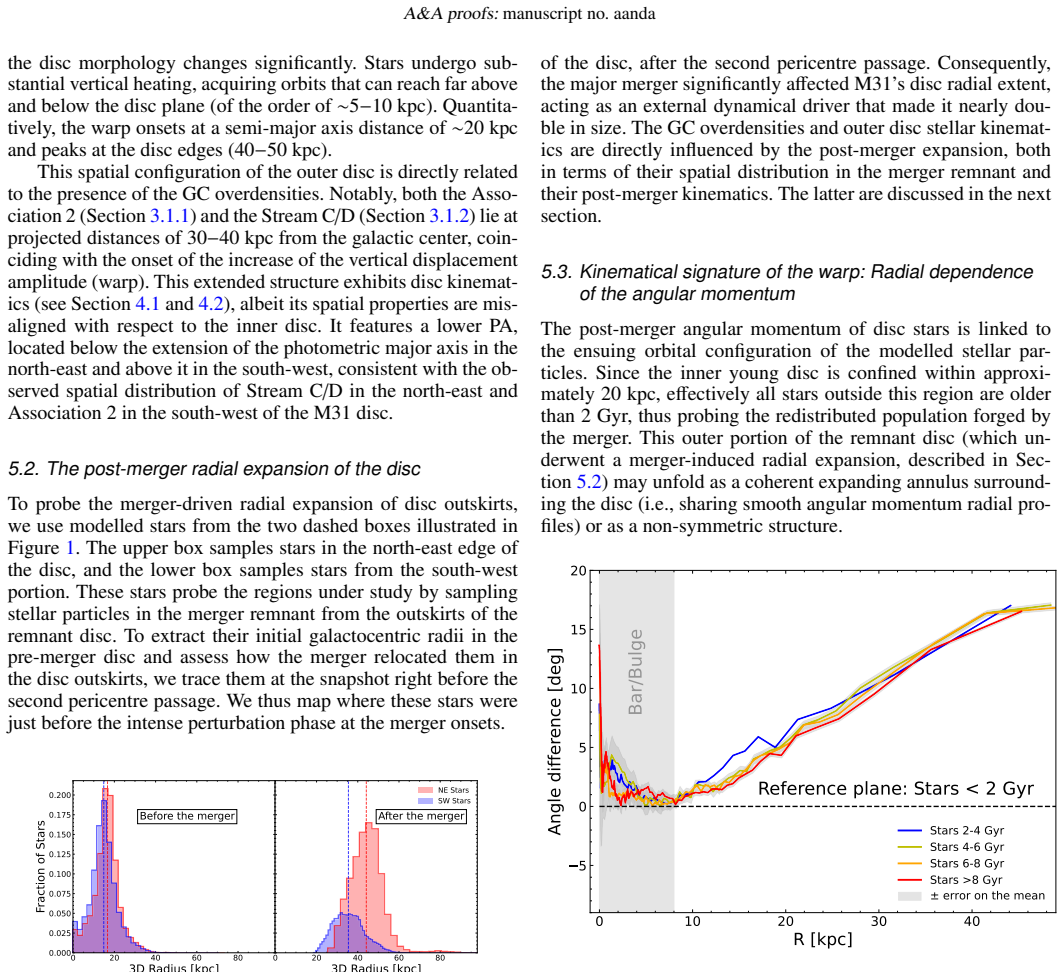
A major merger 2-4 Gyr ago stretched the Andromeda disc by nearly a factor of two, extending it past 40 kpc and imprinting a radius-dependent warp on older stars.
A machine-rendered reading of the paper's core claim, the machinery that carries it, and where it could break.
Core claim
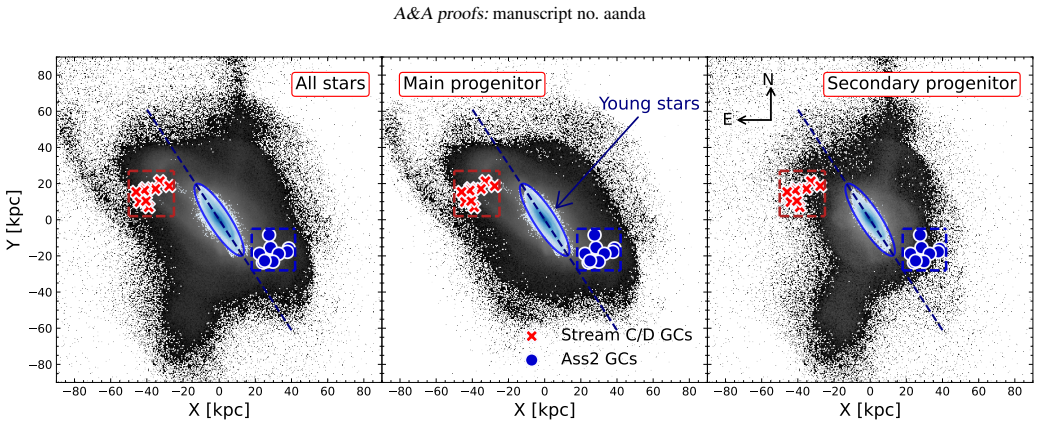
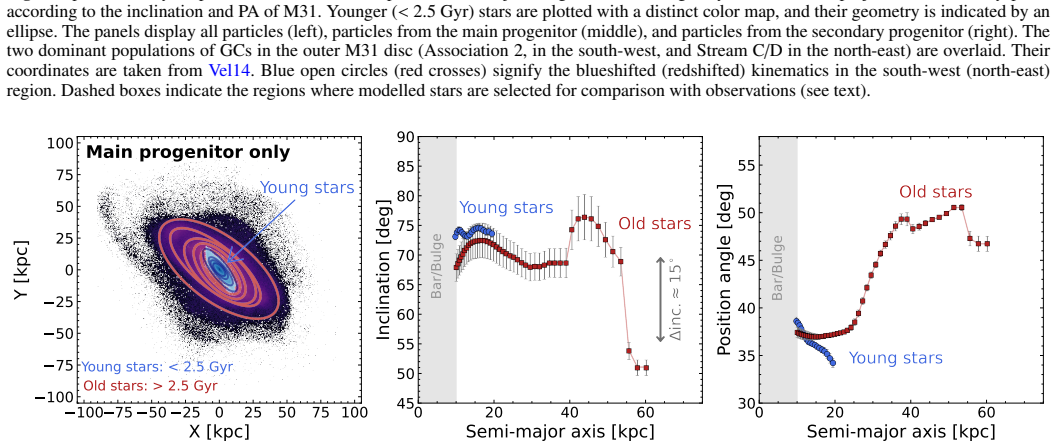
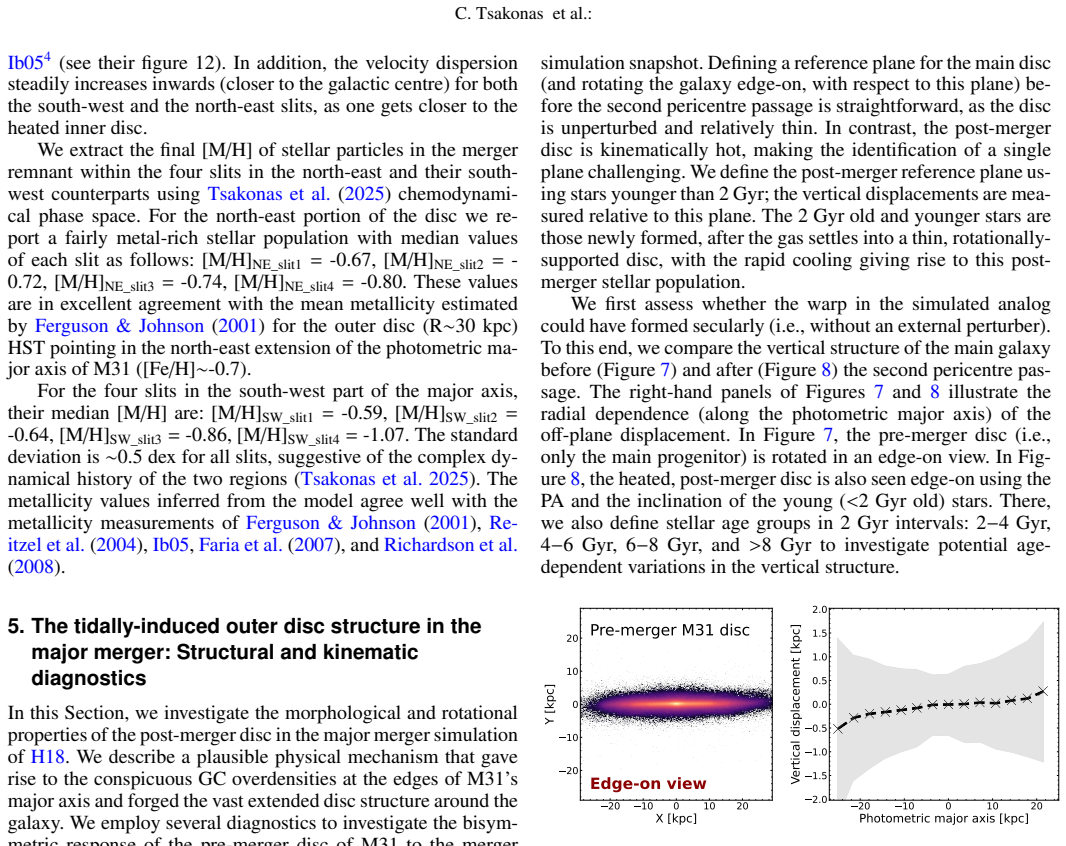
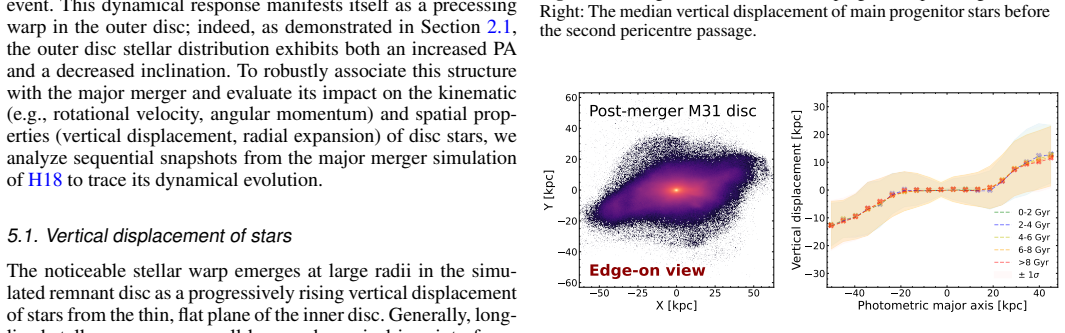
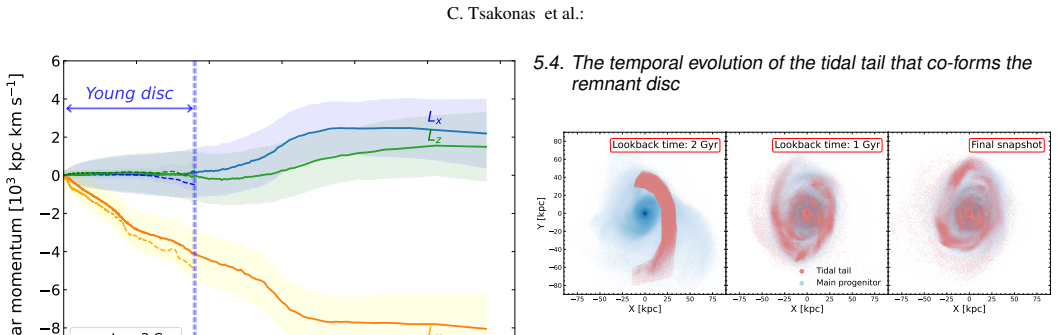
The merger transforms the disc of the progenitor galaxy, which becomes kinematically hot and asymmetric. In addition, the post-merger disc gets stretched by almost a factor of 2, and its extent spans distances greater than 40 kpc. The stellar warp in populations older than 2 Gyr is characterized by a monotonic decrease of inclination with radius, with the outer stellar distribution appearing less edge-on at larger galactic radii. These results provide a comprehensive picture of the evolution of the giant disc of M31, the closest merger-inflicted massive galaxy.
What carries the argument
N-body hydrodynamical simulation of a 1:4 mass-ratio major merger 2-4 Gyr ago, used to compare pre- and post-merger disc particles against resolved stellar tracers and globular clusters in M31.
If this is right
- The outer disc must rotate prograde at a velocity close to that of the HI gas.
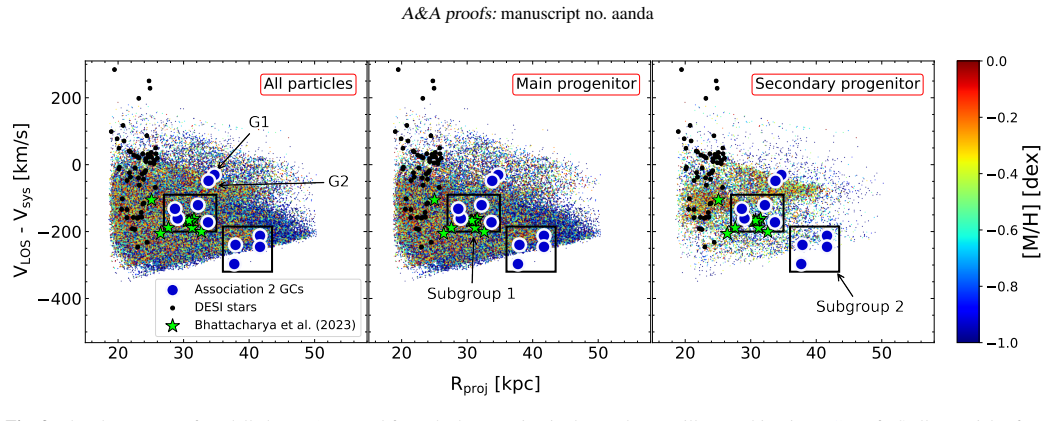
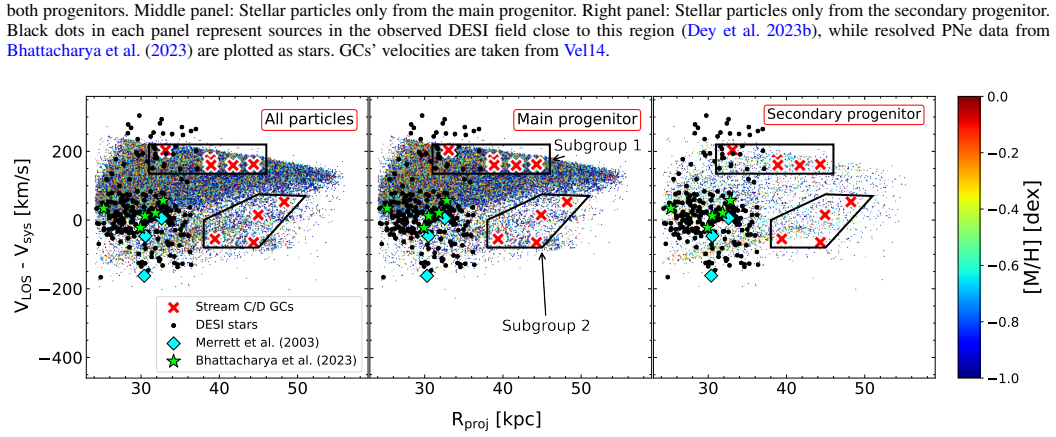
- Two distinct groups of globular clusters in the disc outskirts must exhibit significant prograde rotation consistent with the stretched disc.
- Stellar populations older than 2 Gyr must display the specific warp signature of decreasing inclination with increasing radius.
- The disc must appear kinematically hot and asymmetric as a direct result of the merger perturbation.
Where Pith is reading between the lines
- The same merger-driven stretching and warping process may operate in other massive spirals that show extended discs and recent star-formation bursts.
- Spectroscopic surveys targeting age-selected tracers at 30-50 kpc radii could directly test the predicted monotonic inclination change.
- The simulation framework could be rerun with varied mass ratios or timings to predict observable differences in outer-disc asymmetry or metallicity gradients.
Load-bearing premise
The available N-body hydrodynamical simulation accurately reproduces the morphology of the inner halo substructures, the age-velocity dispersion relation, and the star formation history in the disc, allowing it to serve as a valid analog for the evolution of the outer disc.
What would settle it
High-resolution mapping of outer-disc stars older than 2 Gyr that shows either no factor-of-two radial stretch or a warp inclination that does not decrease monotonically with radius would rule out the merger origin.
Figures
read the original abstract
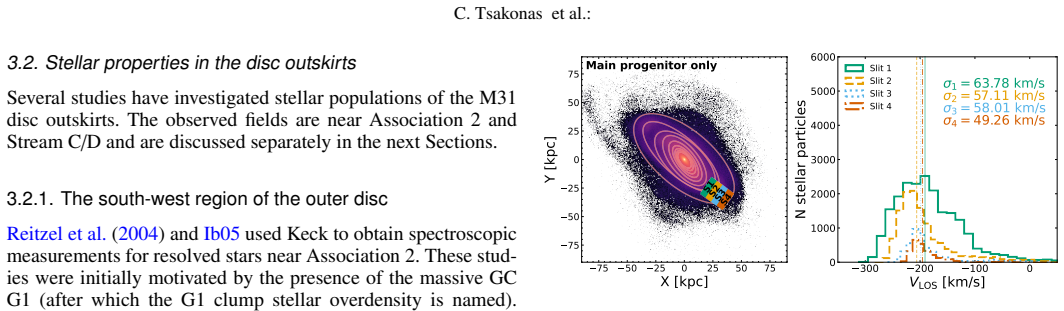
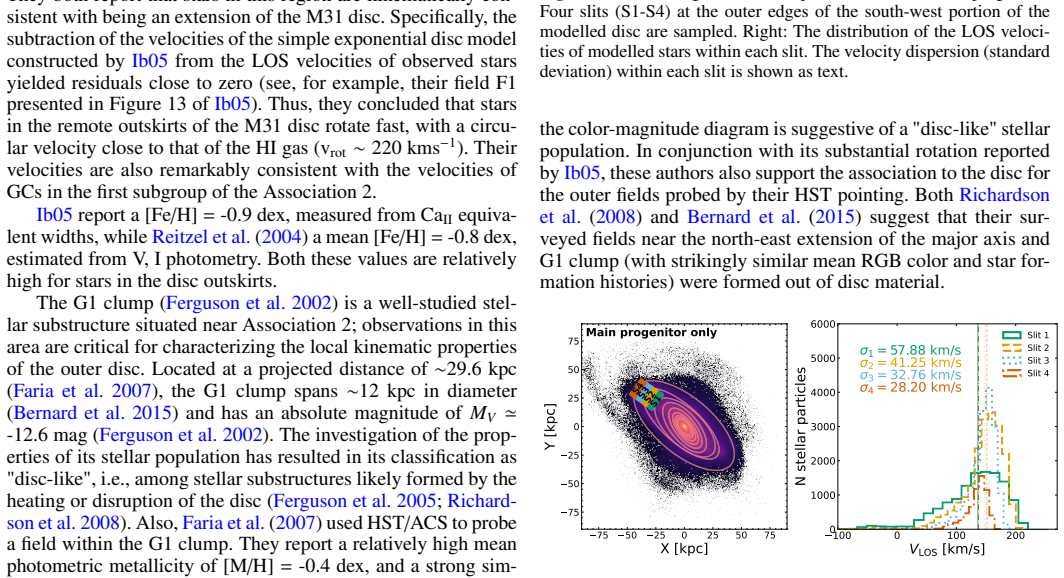
The closest giant spiral, the Andromeda galaxy (M31), shows compelling evidence for a recent, gas-rich major merger event. Pronounced substructures in its inner halo and a kinematically hot stellar disc, whose star formation history shows a widespread star formation episode 2.5 Gyr ago, are telltale evidence that may be directly linked to a major (mass ratio 1 to 4) merger event that took place 2-4 Gyr ago. Spectroscopy of resolved giant stars in the remote outskirts of M31's disc revealed a vast extended structure that rotates with a circular velocity close to the HI gas. In addition, the spatial distribution and significant prograde rotation of two distinct, compact groups of globular clusters (GCs) in the disc outskirts are unusual for typical inner halo GCs. We employ an available N-body hydrodynamical simulation of a major merger that reproduces the morphology of the inner halo substructures, the age-velocity dispersion relation, and the star formation history in the disc. We compare model particles with resolved tracers in the M31 disc. To examine the evolution of the progenitor M31 disc -- that appears to get stretched, distorted, and warped due to the gravitational perturbation inflicted by the major merger -- we investigate the properties of the pre- versus post-merger discs of the simulated analog. The merger transforms the disc of the progenitor galaxy, which becomes kinematically hot and asymmetric. In addition, the post-merger disc gets stretched by almost a factor of 2, and its extent spans distances greater than 40 kpc. The stellar warp in populations older than 2 Gyr is characterized by a monotonic decrease of inclination with radius, with the outer stellar distribution appearing less edge-on at larger galactic radii. These results provide a comprehensive picture of the evolution of the giant disc of M31, the closest merger-inflicted massive galaxy.
Editorial analysis
A structured set of objections, weighed in public.
Referee Report
Summary. The paper claims that the vast extended stellar disc around M31, which rotates with the HI gas and extends beyond 40 kpc with prograde globular clusters, results from a gas-rich major merger 2-4 Gyr ago. An existing N-body hydrodynamical simulation, selected for reproducing inner halo substructures, the age-velocity dispersion relation, and disc star formation history, is used to show that the merger transforms the progenitor disc into a kinematically hot and asymmetric state, stretches it by nearly a factor of 2, and induces a warp in populations older than 2 Gyr with monotonic decrease in inclination with radius.
Significance. If the simulation holds as a valid analog, the work provides a unified merger-driven model linking M31's inner halo features to its remote disc structure, offering a consistent picture of how major mergers can stretch and warp giant galaxy discs. The strength lies in leveraging a pre-existing simulation that already matches multiple inner properties, enabling a coherent evolutionary narrative without introducing new free parameters.
major comments (2)
- [Abstract] Abstract: The claim that the post-merger disc gets stretched by almost a factor of 2 and spans distances greater than 40 kpc is presented as a direct outcome of the simulation, but no quantitative match metrics (e.g., rotation velocity comparisons, surface density profiles, or particle-tracer residuals) to the observed outer disc or GC groups are reported.
- [Approach] Approach (as described in the abstract): The simulation is pre-selected for matching inner halo substructures, age-velocity dispersion relation, and star formation history; this introduces a potential circularity risk for the outer-disc predictions (stretching, warp), as no independent outer-region constraints such as outer rotation curve or resolution tests at r > 40 kpc are described.
minor comments (1)
- The abstract refers to 'resolved tracers in the M31 disc' without specifying the observational datasets or references for the extended structure and GC groups, which would aid clarity.
Simulated Author's Rebuttal
We thank the referee for their constructive comments on our manuscript. We address each major comment below and indicate where revisions will be made to strengthen the presentation of results.
read point-by-point responses
-
Referee: [Abstract] Abstract: The claim that the post-merger disc gets stretched by almost a factor of 2 and spans distances greater than 40 kpc is presented as a direct outcome of the simulation, but no quantitative match metrics (e.g., rotation velocity comparisons, surface density profiles, or particle-tracer residuals) to the observed outer disc or GC groups are reported.
Authors: We agree that quantitative metrics would improve the abstract and overall rigor. The main text already shows particle distributions and kinematic comparisons in figures, but these are primarily qualitative. In the revised manuscript we will add explicit quantitative comparisons, including rotation velocity profiles, surface density profiles, and particle-tracer residuals for the outer disc and the two GC groups, both in the abstract and in a dedicated results subsection. revision: yes
-
Referee: [Approach] Approach (as described in the abstract): The simulation is pre-selected for matching inner halo substructures, age-velocity dispersion relation, and star formation history; this introduces a potential circularity risk for the outer-disc predictions (stretching, warp), as no independent outer-region constraints such as outer rotation curve or resolution tests at r > 40 kpc are described.
Authors: The simulation was selected solely on the basis of its prior matches to inner-halo and disc properties; no outer-disc data entered the selection. The stretching and warp therefore constitute genuine predictions. We will revise the methods and discussion sections to clarify this independence explicitly and to add a direct comparison of the simulated outer rotation curve to the observed HI and stellar data. We will also include a brief resolution discussion confirming that the particle distribution extends reliably beyond 40 kpc. revision: partial
Circularity Check
No circularity: simulation analog validated on inner properties yields independent outer-disc outcomes
full rationale
The paper selects an existing N-body hydrodynamical simulation on the basis that it reproduces inner halo substructures, the age-velocity dispersion relation, and the star formation history. It then examines the pre- versus post-merger discs within that simulation to obtain the reported stretching factor of ~2, radial extent >40 kpc, and monotonic warp inclination decrease. These outer-disc quantities are dynamical outputs of the simulation under the merger perturbation, not quantities fitted to the same inner data or redefined by construction. No equations, self-citations, or ansatzes in the provided text reduce any claimed result to its inputs. The derivation therefore remains self-contained against the external benchmark of the simulation's independent evolution.
Axiom & Free-Parameter Ledger
axioms (1)
- domain assumption The selected N-body hydrodynamical simulation accurately reproduces M31's inner halo substructures, age-velocity dispersion relation, and disc star formation history.
Reference graph
Works this paper leans on
-
[1]
The Hubble sequence: just a vestige of merger events?
The Hubble sequence: just a vestige of merger events?. , keywords =. doi:10.1051/0004-6361/200912115 , archivePrefix =. 0903.3962 , primaryClass =
work page internal anchor Pith review Pith/arXiv arXiv doi:10.1051/0004-6361/200912115
-
[2]
The Milky Way: An Exceptionally Quiet Galaxy; Implications for the formation of spiral galaxies
The Milky Way, an Exceptionally Quiet Galaxy: Implications for the Formation of Spiral Galaxies. , keywords =. doi:10.1086/516727 , archivePrefix =. astro-ph/0702585 , primaryClass =
work page internal anchor Pith review Pith/arXiv arXiv doi:10.1086/516727
-
[3]
How was the Hubble sequence 6 Gyrs ago?
How was the Hubble sequence 6 Gyr ago?. , keywords =. doi:10.1051/0004-6361/200912704 , archivePrefix =. 0906.2805 , primaryClass =
work page internal anchor Pith review Pith/arXiv arXiv doi:10.1051/0004-6361/200912704
-
[4]
A 2-3 billion year old major merger paradigm for the Andromeda galaxy and its outskirts
A 2-3 billion year old major merger paradigm for the Andromeda galaxy and its outskirts. , keywords =. doi:10.1093/mnras/stx3343 , archivePrefix =. 1801.04279 , primaryClass =
work page internal anchor Pith review Pith/arXiv arXiv doi:10.1093/mnras/stx3343
-
[5]
and Haberland, Matt and Reddy, Tyler and Cournapeau, David and Burovski, Evgeni and Peterson, Pearu and Weckesser, Warren and Bright, Jonathan and
Virtanen, Pauli and Gommers, Ralf and Oliphant, Travis E. and Haberland, Matt and Reddy, Tyler and Cournapeau, David and Burovski, Evgeni and Peterson, Pearu and Weckesser, Warren and Bright, Jonathan and. Nature Methods , year =
-
[6]
Nature Reviews Physics , keywords =
Cosmological simulations of galaxy formation. Nature Reviews Physics , keywords =. doi:10.1038/s42254-019-0127-2 , archivePrefix =. 1909.07976 , primaryClass =
-
[7]
, year = 1972, month = dec, volume = 178, pages =
Galactic Bridges and Tails. , year = 1972, month = dec, volume =. doi:10.1086/151823 , adsurl =
-
[8]
Morpho-kinematics of z~1 galaxies probe the hierarchical scenario
Morpho-kinematics of z 1 galaxies probe the hierarchical scenario. , keywords =. doi:10.1093/mnras/stw2711 , archivePrefix =. 1611.03499 , primaryClass =
work page internal anchor Pith review Pith/arXiv arXiv doi:10.1093/mnras/stw2711
-
[9]
First results from the IllustrisTNG simulations: the stellar mass content of groups and clusters of galaxies. , keywords =. doi:10.1093/mnras/stx3112 , archivePrefix =. 1707.03406 , primaryClass =
work page internal anchor Pith review Pith/arXiv arXiv doi:10.1093/mnras/stx3112
-
[10]
Dynamics and Stellar Content of the Giant Southern Stream in M31. I. Keck Spectroscopy of Red Giant Stars. , keywords =. doi:10.1086/499562 , archivePrefix =. astro-ph/0406145 , primaryClass =
work page internal anchor Pith review Pith/arXiv arXiv doi:10.1086/499562
-
[11]
Elemental Abundances in M31: A Comparative Analysis of Alpha and Iron Element Abundances in the the Outer Disk, Giant Stellar Stream, and Inner Halo of M31. , keywords =. doi:10.3847/1538-4357/ab6659 , archivePrefix =. 1909.00006 , primaryClass =
-
[12]
Kinematics and Metallicity of Red Giant Branch Stars in the Northeast Shelf of M31. , keywords =. doi:10.3847/1538-3881/ac7146 , archivePrefix =. 2203.16675 , primaryClass =
-
[13]
Charles R. Harris and K. Jarrod Millman and St. Array programming with. 2020 , month = sep, journal =. doi:10.1038/s41586-020-2649-2 , publisher =
-
[14]
Computing in Science and Engineering , keywords =
Python for Scientific Computing. Computing in Science and Engineering , keywords =. doi:10.1109/MCSE.2007.58 , adsurl =
-
[15]
Computing in Science and Engineering , keywords =
Matplotlib: A 2D Graphics Environment. Computing in Science and Engineering , keywords =. doi:10.1109/MCSE.2007.55 , adsurl =
-
[16]
Astropy: A Community Python Package for Astronomy
Astropy: A community Python package for astronomy. , keywords =. doi:10.1051/0004-6361/201322068 , archivePrefix =. 1307.6212 , primaryClass =
work page internal anchor Pith review Pith/arXiv arXiv doi:10.1051/0004-6361/201322068
-
[17]
Evidence for an accretion origin for the outer halo globular cluster system of M31
Evidence for an Accretion Origin for the Outer Halo Globular Cluster System of M31. , keywords =. doi:10.1088/2041-8205/717/1/L11 , archivePrefix =. 1005.3812 , primaryClass =
work page internal anchor Pith review Pith/arXiv arXiv doi:10.1088/2041-8205/717/1/l11 2041
-
[18]
Globular cluster ages and their relation to high-redshift stellar cluster formation times from different globular cluster models. , keywords =. doi:10.1093/mnras/staf015 , archivePrefix =. 2410.12901 , primaryClass =
-
[19]
Measuring M31 globular cluster ages and metallicities using both photometry and spectroscopy. , keywords =. doi:10.1093/mnras/stae282 , archivePrefix =. 2401.13918 , primaryClass =
-
[20]
Star Clusters in M31. VII. Global Kinematics and Metallicity Subpopulations of the Globular Clusters. , keywords =. doi:10.3847/0004-637X/824/1/42 , archivePrefix =. 1603.06947 , primaryClass =
work page internal anchor Pith review Pith/arXiv arXiv doi:10.3847/0004-637x/824/1/42
-
[21]
2MASS NIR photometry for 693 candidate globular clusters in M31 and the Revised Bologna Catalogue
2MASS NIR photometry for 693 candidate globular clusters in M 31 and the Revised Bologna Catalogue. , keywords =. doi:10.1051/0004-6361:20035632 , archivePrefix =. astro-ph/0312448 , primaryClass =
work page internal anchor Pith review Pith/arXiv arXiv doi:10.1051/0004-6361:20035632
-
[22]
An updated survey of globular clusters in M 31. I. Classification and radial velocity for 76 candidate clusters. , keywords =. doi:10.1051/0004-6361:20065309 , archivePrefix =. astro-ph/0605718 , primaryClass =
work page internal anchor Pith review Pith/arXiv arXiv doi:10.1051/0004-6361:20065309
-
[23]
An updated survey of globular clusters in M 31. II. Newly discovered bright and remote clusters. , keywords =. doi:10.1051/0004-6361:20077788 , archivePrefix =. 0705.4037 , primaryClass =
work page internal anchor Pith review Pith/arXiv arXiv doi:10.1051/0004-6361:20077788
-
[24]
An updated survey of globular clusters in M 31. III. A spectroscopic metallicity scale for the Revised Bologna Catalog. , keywords =. doi:10.1051/0004-6361/200912583 , archivePrefix =. 0910.2462 , primaryClass =
work page internal anchor Pith review Pith/arXiv arXiv doi:10.1051/0004-6361/200912583
-
[25]
Chemo-dynamical substructure in the M31 inner halo globular clusters: further evidence for a recent accretion event. , keywords =. doi:10.1093/mnras/stac3325 , archivePrefix =. 2211.07877 , primaryClass =
-
[26]
Galaxy archaeology for wet mergers: Globular cluster age distributions in the Milky Way and nearby galaxies. , keywords =. doi:10.1051/0004-6361/202348010 , archivePrefix =. 2309.11545 , primaryClass =
-
[27]
Globular cluster numbers in dark matter haloes in a dual formation scenario: an empirical model within EMERGE. , keywords =. doi:10.1093/mnras/stab1701 , archivePrefix =. 2012.09172 , primaryClass =
-
[28]
Sculpting Andromeda - made-to-measure models for M31's bar and composite bulge: dynamics, stellar and dark matter mass. , keywords =. doi:10.1093/mnras/sty2311 , archivePrefix =. 1808.07494 , primaryClass =
work page internal anchor Pith review Pith/arXiv arXiv doi:10.1093/mnras/sty2311
-
[29]
Resolving the Disc-Halo Degeneracy I: A Look at NGC 628
Resolving the disc-halo degeneracy - I: a look at NGC 628. , keywords =. doi:10.1093/mnras/sty310 , archivePrefix =. 1802.00465 , primaryClass =
work page internal anchor Pith review Pith/arXiv arXiv doi:10.1093/mnras/sty310
-
[30]
Metallicities of outer halo M31 globular clusters from integrated light calcium-II triplet spectroscopy. , keywords =. doi:10.1093/mnras/stac752 , archivePrefix =. 2203.08840 , primaryClass =
-
[31]
A trail of the invisible: blue globular clusters trace the radial density distribution of the dark matter - case study of NGC 4278. , keywords =. doi:10.1093/mnras/stad882 , archivePrefix =. 2301.02292 , primaryClass =
-
[32]
Origin of the system of globular clusters in the Milky Way. , keywords =. doi:10.1051/0004-6361/201936135 , archivePrefix =. 1906.08271 , primaryClass =
-
[33]
Extragalactic Globular Clusters and Galaxy Formation. , keywords =. doi:10.1146/annurev.astro.44.051905.092441 , archivePrefix =. astro-ph/0602601 , primaryClass =
-
[34]
The Formation of Globular Clusters. arXiv e-prints , keywords =. doi:10.48550/arXiv.2501.16438 , archivePrefix =. 2501.16438 , primaryClass =
-
[35]
The outer halo globular cluster system of M31 - I. The final PAndAS catalogue
The outer halo globular cluster system of M31 - I. The final PAndAS catalogue. , keywords =. doi:10.1093/mnras/stu771 , archivePrefix =. 1404.5807 , primaryClass =
work page internal anchor Pith review Pith/arXiv arXiv doi:10.1093/mnras/stu771
-
[36]
An updated catalog of M31 globular-like clusters: UBVRI photometry, ages, and masses
An Updated Catalog of M31 Globular-like Clusters: UBVRI Photometry, Ages, and Masses. , keywords =. doi:10.1088/0004-637X/725/1/200 , archivePrefix =. 1009.3582 , primaryClass =
work page internal anchor Pith review Pith/arXiv arXiv doi:10.1088/0004-637x/725/1/200
-
[37]
Formation of a spiral galaxy in a major merger
Formation of a Spiral Galaxy in a Major Merger. , keywords =. doi:10.1086/429486 , archivePrefix =. astro-ph/0411379 , primaryClass =
work page internal anchor Pith review Pith/arXiv arXiv doi:10.1086/429486
-
[38]
Globular Clusters in the Outer Halo of M31
Globular clusters in the outer halo of M 31. , keywords =. doi:10.1051/0004-6361/201834748 , archivePrefix =. 1901.11229 , primaryClass =
work page internal anchor Pith review Pith/arXiv arXiv doi:10.1051/0004-6361/201834748 1901
-
[39]
The M31 globular cluster system: ugriz and K-band photometry and structural parameters. , keywords =. doi:10.1111/j.1365-2966.2009.15952.x , archivePrefix =. 0910.5475 , primaryClass =
-
[40]
New 2MASS Near-infrared Photometry for Globular Clusters in M31. , keywords =. doi:10.1088/0004-6256/148/1/4 , adsurl =
-
[41]
Extragalactic Globular Clusters. II. The M31 Globular Cluster System. , keywords =. doi:10.1086/169836 , adsurl =
-
[42]
Accreted globular clusters and horizontal branch morphology in the outer halo of M31. , keywords =. doi:10.1093/mnrasl/slaf067 , archivePrefix =. 2506.21267 , primaryClass =
-
[43]
How do Disks Survive Mergers?. , keywords =. doi:10.1088/0004-637X/691/2/1168 , archivePrefix =. 0806.1739 , primaryClass =
work page internal anchor Pith review Pith/arXiv arXiv doi:10.1088/0004-637x/691/2/1168
-
[44]
Composition of halo clusters and the formation of the galactic halo. , keywords =. doi:10.1086/156499 , adsurl =
-
[45]
Proper motions and dynamics of the Milky Way globular cluster system from Gaia DR2
Proper motions and dynamics of the Milky Way globular cluster system from Gaia DR2. , keywords =. doi:10.1093/mnras/stz171 , archivePrefix =. 1807.09775 , primaryClass =
work page internal anchor Pith review Pith/arXiv arXiv doi:10.1093/mnras/stz171
-
[46]
2010, MNRAS, 405, 933, doi: 10.1111/j.1365-2966.2010.16536.x
The masses of the Milky Way and Andromeda galaxies. , keywords =. doi:10.1111/j.1365-2966.2010.16708.x , archivePrefix =. 1002.4565 , primaryClass =
-
[47]
Shapes of dark matter haloes with discrete globular cluster dynamics: The example of NGC 5128 (Centaurus A). , keywords =. doi:10.1051/0004-6361/202349097 , archivePrefix =. 2403.13109 , primaryClass =
-
[48]
Dynamics of the Globular Cluster System Associated with M87 (NGC 4486). II. Analysis. , keywords =. doi:10.1086/322347 , archivePrefix =. astro-ph/0106005 , primaryClass =
work page internal anchor Pith review Pith/arXiv arXiv doi:10.1086/322347
-
[49]
The LAMOST spectroscopic survey of globular clusters in M31 and M33. I. catalog and new identifications. Research in Astronomy and Astrophysics , keywords =. doi:10.1088/1674-4527/15/8/020 , archivePrefix =. 1505.08062 , primaryClass =
work page internal anchor Pith review Pith/arXiv arXiv doi:10.1088/1674-4527/15/8/020
-
[50]
Rotational Kinematics in the Globular Cluster System of M31: Insights from Bayesian Inference. arXiv e-prints , keywords =. doi:10.48550/arXiv.2601.05380 , archivePrefix =. 2601.05380 , primaryClass =
-
[51]
Formation of gas discs in merging galaxies. , keywords =. doi:10.1046/j.1365-8711.2002.05335.x , archivePrefix =. astro-ph/0201250 , primaryClass =
-
[52]
Star Clusters in M31. II. Old Cluster Metallicities and Ages from Hectospec Data. , keywords =. doi:10.1088/0004-6256/141/2/61 , archivePrefix =. 1101.3779 , primaryClass =
work page internal anchor Pith review Pith/arXiv arXiv doi:10.1088/0004-6256/141/2/61
-
[53]
The survey of planetary nebulae in Andromeda (M 31). II. Age-velocity dispersion relation in the disc from planetary nebulae. , keywords =. doi:10.1051/0004-6361/201935898 , archivePrefix =. 1909.09724 , primaryClass =
-
[54]
Distances and metallicities for 17 Local Group galaxies. , keywords =. doi:10.1111/j.1365-2966.2004.08514.x , archivePrefix =. astro-ph/0410489 , primaryClass =
-
[55]
A census of orbital properties of the M31 satellites
A census of orbital properties of the M31 satellites. , keywords =. doi:10.1093/mnras/sts634 , archivePrefix =. 1211.2638 , primaryClass =
work page internal anchor Pith review Pith/arXiv arXiv doi:10.1093/mnras/sts634
-
[56]
Hectospec, the MMT's 300 Optical Fiber-Fed Spectrograph
Hectospec, the MMT's 300 Optical Fiber-Fed Spectrograph. , keywords =. doi:10.1086/497385 , archivePrefix =. astro-ph/0508554 , primaryClass =
work page internal anchor Pith review Pith/arXiv arXiv doi:10.1086/497385
-
[57]
The Detailed Chemical Properties of M31 Star Clusters. I. Fe, Alpha and Light Elements. , keywords =. doi:10.1088/0004-637X/797/2/116 , archivePrefix =. 1411.0696 , primaryClass =
work page internal anchor Pith review Pith/arXiv arXiv doi:10.1088/0004-637x/797/2/116
-
[58]
The LAMOST Spectroscopic Survey of Star Clusters in M31. II. Metallicities, Ages, and Masses. , keywords =. doi:10.3847/0004-6256/152/2/45 , archivePrefix =. 1605.08128 , primaryClass =
work page internal anchor Pith review Pith/arXiv arXiv doi:10.3847/0004-6256/152/2/45
-
[59]
Evidence for Stellar Substructure in the Halo and Outer Disk of M31
Evidence for Stellar Substructure in the Halo and Outer Disk of M31. , keywords =. doi:10.1086/342019 , archivePrefix =. astro-ph/0205530 , primaryClass =
work page internal anchor Pith review Pith/arXiv arXiv doi:10.1086/342019
-
[60]
Probing the Nature of the G1 Clump Stellar Overdensity in the Outskirts of M31
Probing the Nature of the G1 Clump Stellar Overdensity in the Outskirts of M31. , keywords =. doi:10.1086/511156 , archivePrefix =. astro-ph/0611852 , primaryClass =
work page internal anchor Pith review Pith/arXiv arXiv doi:10.1086/511156
-
[61]
The nature and origin of substructure in the outskirts of M31 - II. Detailed star formation histories. , keywords =. doi:10.1093/mnras/stu2309 , archivePrefix =. 1406.2247 , primaryClass =
work page internal anchor Pith review Pith/arXiv arXiv doi:10.1093/mnras/stu2309
-
[62]
Keck Spectroscopy of Red Giant Stars in the Vicinity of M31's Massive Globular Cluster G1
Keck Spectroscopy of Red Giant Stars in the Vicinity of M31'S Massive Globular Cluster G1. , keywords =. doi:10.1086/382517 , archivePrefix =. astro-ph/0309295 , primaryClass =
work page internal anchor Pith review Pith/arXiv arXiv doi:10.1086/382517
-
[63]
The outer halo globular cluster system of M31 - II. Kinematics
The outer halo globular cluster system of M31 - II. Kinematics. , keywords =. doi:10.1093/mnras/stu1055 , archivePrefix =. 1406.0186 , primaryClass =
work page internal anchor Pith review Pith/arXiv arXiv doi:10.1093/mnras/stu1055
-
[64]
PAndAS' progeny: extending the M31 dwarf galaxy cabal
PAndAS' Progeny: Extending the M31 Dwarf Galaxy Cabal. , keywords =. doi:10.1088/0004-637X/732/2/76 , archivePrefix =. 1102.2902 , primaryClass =
work page internal anchor Pith review Pith/arXiv arXiv doi:10.1088/0004-637x/732/2/76
-
[65]
The remnants of galaxy formation from a panoramic survey of the region around M31
The remnants of galaxy formation from a panoramic survey of the region around M31. , keywords =. doi:10.1038/nature08327 , archivePrefix =. 0909.0398 , primaryClass =
work page internal anchor Pith review Pith/arXiv arXiv doi:10.1038/nature08327
-
[66]
The Large-scale Structure of the Halo of the Andromeda Galaxy. II. Hierarchical Structure in the Pan-Andromeda Archaeological Survey. , keywords =. doi:10.3847/1538-4357/aae8e7 , archivePrefix =. 1810.08234 , primaryClass =
work page internal anchor Pith review Pith/arXiv arXiv doi:10.3847/1538-4357/aae8e7
-
[67]
Properties of the lower segment of M31's North West stream. , keywords =. doi:10.1093/mnras/stae2726 , archivePrefix =. 2409.07410 , primaryClass =
-
[68]
A relationship between stellar metallicity gradients and galaxy age in dwarf galaxies. , keywords =. doi:10.1093/mnras/staa3958 , archivePrefix =. 2009.01241 , primaryClass =
-
[69]
Prolate rotation and metallicity gradient in the transforming dwarf galaxy Phoenix
Prolate rotation and metallicity gradient in the transforming dwarf galaxy Phoenix. , keywords =. doi:10.1093/mnras/stw3188 , archivePrefix =. 1612.01560 , primaryClass =
work page internal anchor Pith review Pith/arXiv arXiv doi:10.1093/mnras/stw3188
-
[70]
The mass-metallicity gradient relation of early-type galaxies
The Mass-Metallicity Gradient Relation of Early-Type Galaxies. , keywords =. doi:10.1088/0004-637X/691/2/L138 , archivePrefix =. 0901.0548 , primaryClass =
work page internal anchor Pith review Pith/arXiv arXiv doi:10.1088/0004-637x/691/2/l138
-
[71]
A Low-mass Stellar-debris Stream Associated with a Globular Cluster Pair in the Halo. , keywords =. doi:10.3847/2041-8213/aba49f , archivePrefix =. 2007.05132 , primaryClass =
-
[72]
A giant stream of metal-rich stars in the halo of the galaxy M31
A giant stream of metal-rich stars in the halo of the galaxy M31. , keywords =. doi:10.1038/35083506 , archivePrefix =. astro-ph/0107090 , primaryClass =
work page internal anchor Pith review Pith/arXiv arXiv doi:10.1038/35083506
-
[73]
The three-dimensional structure of the giant stellar stream in Andromeda. , keywords =. doi:10.1046/j.1365-8711.2003.06785.x , archivePrefix =. astro-ph/0305160 , primaryClass =
-
[74]
Taking measure of the Andromeda halo: a kinematic analysis of the giant stream surrounding M31. , keywords =. doi:10.1111/j.1365-2966.2004.07759.x , archivePrefix =. astro-ph/0403068 , primaryClass =
-
[75]
DESI Observations of the Andromeda Galaxy: Revealing the Immigration History of Our Nearest Neighbor. , keywords =. doi:10.3847/1538-4357/aca5f8 , archivePrefix =. 2208.11683 , primaryClass =
-
[76]
A clear age-velocity dispersion correlation in Andromeda's stellar disk
A Clear Age-Velocity Dispersion Correlation in Andromeda s Stellar Disk. , keywords =. doi:10.1088/0004-637X/803/1/24 , archivePrefix =. 1502.03820 , primaryClass =
work page internal anchor Pith review Pith/arXiv arXiv doi:10.1088/0004-637x/803/1/24
-
[77]
I., Schawinski, K., Kaviraj, S., et al
The star formation history and dust content in the far outer disc of M31. , keywords =. doi:10.1111/j.1365-2966.2011.20234.x , archivePrefix =. 1111.5234 , primaryClass =
-
[78]
The Panchromatic Hubble Andromeda Treasury
The Panchromatic Hubble Andromeda Treasury. , keywords =. doi:10.1088/0067-0049/200/2/18 , archivePrefix =. 1204.0010 , primaryClass =
work page internal anchor Pith review Pith/arXiv arXiv doi:10.1088/0067-0049/200/2/18
-
[79]
Azimuthal Misalignments in Stellar Warp Structure as Dynamical Tracers of Mergers in Milky Way─like Galaxies. , keywords =. doi:10.3847/2041-8213/ae11b4 , archivePrefix =. 2510.04194 , primaryClass =
-
[80]
The survey of planetary nebulae in Andromeda (M31): VII. Predictions of a major merger simulation model compared with chemodynamical data of the disc and inner halo substructures. , keywords =. doi:10.1051/0004-6361/202453175 , archivePrefix =. 2502.00886 , primaryClass =
discussion (0)
Sign in with ORCID, Apple, or X to comment. Anyone can read and Pith papers without signing in.