Superconductivity from emergent dipolar interactions in a fractionalized Fermi liquid
Pith reviewed 2026-06-27 02:35 UTC · model grok-4.3
The pith
Emergent dipolar interactions between spinon-chargon bound states drive d_{x^2-y^2} superconductivity in fractionalized Fermi liquids.
A machine-rendered reading of the paper's core claim, the machinery that carries it, and where it could break.
Core claim
Because of the projective action of translation symmetry on the spinons and chargons, the Fourier components of the repulsive dipolar interaction between neutral spinon-chargon bound states are peaked at the antiferromagnetic wave vector, thereby providing a robust microscopic mechanism for d_{x^2-y^2} pairing in a fractionalized metal.
What carries the argument
The emergent dipolar two-body potential between spinon-chargon bound states, whose momentum dependence is fixed by the projective representation of translations on spinons and chargons.
If this is right
- The mechanism applies directly to the spin-fermion model or Hertz-Millis theory at small doping.
- Pairing arises in the presence of the emergent U(1) gauge field of the fractionalized Fermi liquid.
- The same projective symmetry enforces robustness of the d-wave channel over other symmetries.
- The transition occurs from a fractionalized metal with a small Fermi surface to a d-wave superconductor.
Where Pith is reading between the lines
- This pairing route may operate in doped Mott insulators where conventional spin-fluctuation glue is modified by fractionalization.
- Analogous momentum structures could appear in other lattice geometries or symmetry groups, potentially stabilizing different pairing channels.
- Spectroscopic probes sensitive to the gauge-neutral composites before the superconducting transition could test the dipolar interaction profile.
Load-bearing premise
Doped electrons enter the system as neutral spinon-chargon bound states that form a small reconstructed Fermi surface.
What would settle it
An explicit calculation of the two-body interaction Fourier transform that does not peak at the antiferromagnetic wave vector, or an observation that d-wave pairing fails to appear under these conditions.
Figures


read the original abstract
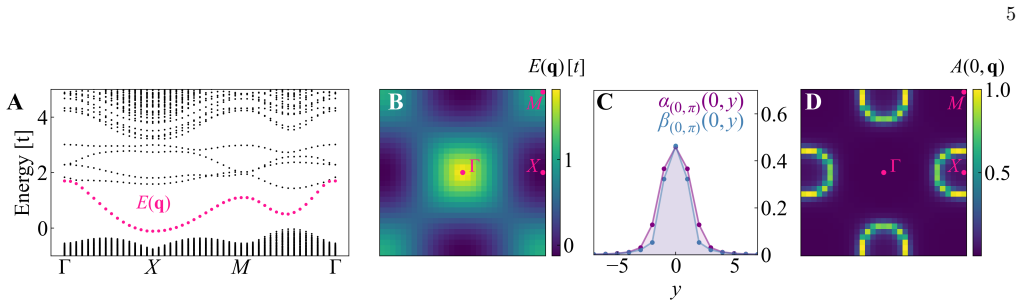
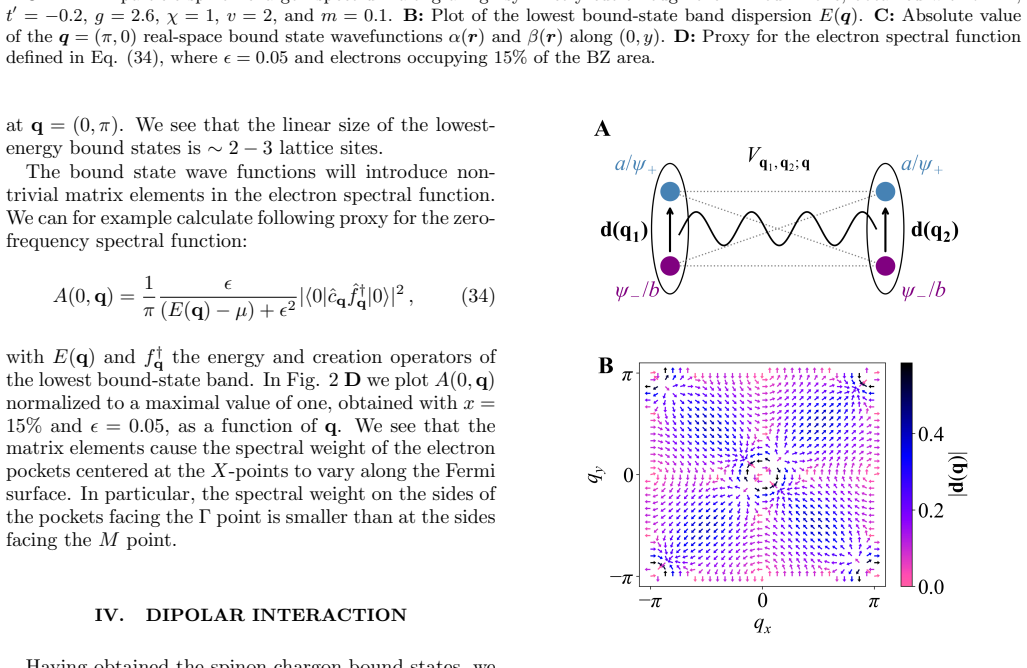
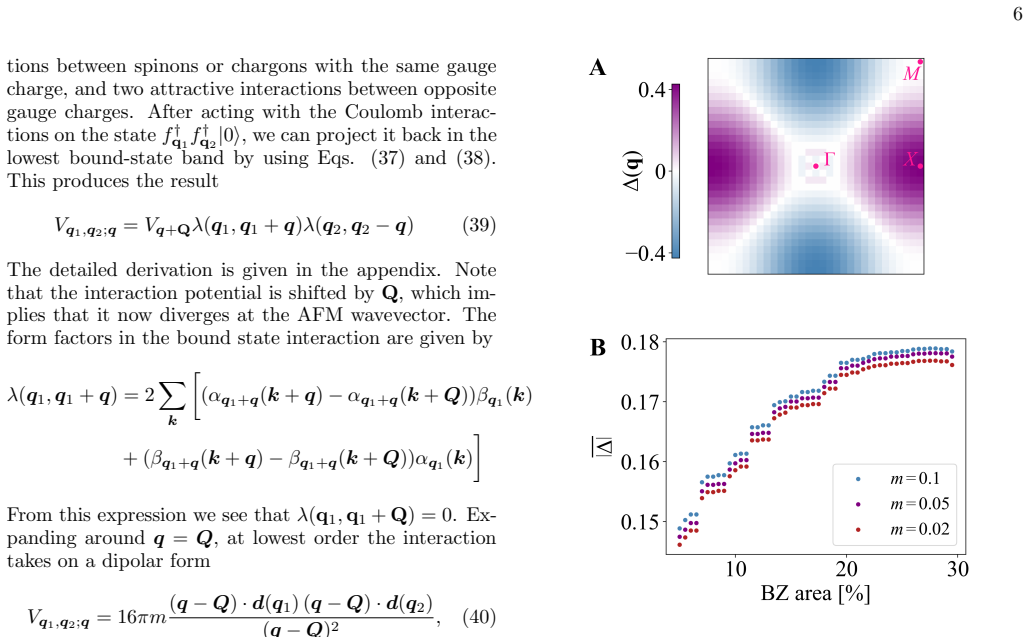
Starting from the spin-fermion model or Hertz-Millis theory describing electrons coupled to anti-ferromagnetic spin fluctuations we develop a theory to describe the transition from a fractionalized Fermi liquid into a $d_{x^2-y^2}$ superconductor. We focus on small electron doping on top of the half-filled state. The doped electrons enter the system as spinon-chargon bound states, which form a small, reconstructed Fermi surface. The bound states are neutral under the emergent U(1) gauge symmetry of the fractionalized Fermi liquid, but interact via a dipolar two-body potential. We show that because of the projective action of translation symmetry on the spinons and chargons, the Fourier components of this repulsive dipolar interaction are peaked at the anti-ferromagnetic wave vector, thereby providing a robust microscopic mechanism for $d_{x^2-y^2}$ pairing in a fractionalized metal.
Editorial analysis
A structured set of objections, weighed in public.
Referee Report
Summary. The manuscript develops a theory for the transition from a fractionalized Fermi liquid to a d_{x^2-y^2} superconductor at small electron doping, starting from the spin-fermion model (or Hertz-Millis theory). Doped electrons are argued to enter as spinon-chargon bound states forming a small reconstructed Fermi surface; these composites are neutral under the emergent U(1) gauge symmetry but interact via a repulsive dipolar two-body potential. Projective translation symmetry on the spinons and chargons causes the Fourier components of this potential to peak at the antiferromagnetic wavevector, furnishing a microscopic mechanism for d-wave pairing.
Significance. If the central derivation holds, the work supplies a symmetry-protected route to d_{x^2-y^2} superconductivity inside a fractionalized metal without additional fine-tuning, which would be of clear interest for theories of cuprate and related unconventional superconductors. The explicit use of projective representations to fix the momentum structure of the emergent interaction is a conceptual strength.
major comments (2)
- [Abstract, paragraph 2] Abstract, paragraph 2: the statement that the spinon-chargon bound states 'remain neutral under the emergent U(1) gauge symmetry' and form a 'small, reconstructed Fermi surface' is presented as following directly from the spin-fermion model, yet this neutrality is load-bearing for the entire subsequent argument; without an explicit demonstration that the composite carries zero net gauge charge (rather than an effective charge that would alter the dipolar interaction), the peaking at the AF wavevector and the resulting pairing mechanism lack a secure microscopic foundation.
- [Derivation of dipolar interaction] The section deriving the dipolar interaction: the claim that projective translation symmetry forces the Fourier components of the repulsive dipolar potential to peak at the antiferromagnetic wavevector presupposes that the bound states are strictly neutral and that their internal structure preserves the projective action; if the binding leaves a residual gauge charge or modifies the projective representation, the momentum dependence would be altered and the 'robust' d_{x^2-y^2} mechanism would not follow.
minor comments (1)
- [Abstract] The abstract would benefit from a single sentence clarifying the doping range (e.g., 'x < 0.1') over which the small-FS reconstruction is assumed to hold.
Simulated Author's Rebuttal
We thank the referee for their careful reading of the manuscript and for the positive assessment of its potential significance. We address each major comment below.
read point-by-point responses
-
Referee: [Abstract, paragraph 2] Abstract, paragraph 2: the statement that the spinon-chargon bound states 'remain neutral under the emergent U(1) gauge symmetry' and form a 'small, reconstructed Fermi surface' is presented as following directly from the spin-fermion model, yet this neutrality is load-bearing for the entire subsequent argument; without an explicit demonstration that the composite carries zero net gauge charge (rather than an effective charge that would alter the dipolar interaction), the peaking at the AF wavevector and the resulting pairing mechanism lack a secure microscopic foundation.
Authors: In the spin-fermion model the electron operator is decomposed into a gauge-neutral spinon and a gauge-charged chargon such that the physical electron carries zero net gauge charge. The doped electron therefore enters as a local spinon-chargon bound state whose net gauge charge is identically zero by construction of the decomposition. We agree that an explicit restatement of this charge assignment in the abstract and introduction would remove any ambiguity, and we will add a short clarifying sentence together with a reference to the gauge-charge counting in the revised manuscript. revision: yes
-
Referee: [Derivation of dipolar interaction] The section deriving the dipolar interaction: the claim that projective translation symmetry forces the Fourier components of the repulsive dipolar potential to peak at the antiferromagnetic wavevector presupposes that the bound states are strictly neutral and that their internal structure preserves the projective action; if the binding leaves a residual gauge charge or modifies the projective representation, the momentum dependence would be altered and the 'robust' d_{x^2-y^2} mechanism would not follow.
Authors: The projective action of translations is defined on the microscopic spinon and chargon fields before binding. Because the bound state is a local, gauge-neutral composite, it transforms under the tensor product of the individual projective representations; the binding does not alter this combined representation. The dipolar potential is obtained after the gauge field has been integrated out in the neutral sector, so its momentum dependence is fixed by the projective symmetry of the composites. We will nevertheless insert a brief paragraph in the derivation section that explicitly verifies the projective representation of the bound-state operator, thereby confirming that the AF peaking is preserved. revision: yes
Circularity Check
No significant circularity; symmetry argument is deductive from starting model
full rationale
The derivation begins from the standard spin-fermion/Hertz-Millis model and uses the projective action of translation symmetry on spinons and chargons to deduce that the Fourier components of the emergent dipolar interaction peak at the antiferromagnetic wavevector. This is a symmetry-based deduction, not a redefinition or fit. The neutrality of spinon-chargon bound states and small reconstructed FS are stated as consequences of the fractionalized Fermi liquid setup under the model, without evidence that they are redefined circularly or that the pairing result is forced by construction. No self-citations, ansatze smuggled via citation, or renamings of known results are present in the provided text that load-bear the central claim. The result is therefore self-contained.
Axiom & Free-Parameter Ledger
axioms (2)
- domain assumption Projective action of translation symmetry on spinons and chargons
- domain assumption Doped electrons enter as spinon-chargon bound states forming a small reconstructed Fermi surface
invented entities (1)
-
spinon-chargon bound states
no independent evidence
Reference graph
Works this paper leans on
-
[1]
Note that the coupling term contains a sign factor which ensures that the bosonic field indeed induces AFM fluctuations for the fermion spins
The spin fluctuations are coupled to the electrons, which are described byS f: Sf = Z β 0 dτ X r ¯cr(∂τ −µ)c r +g(−1) x+y nr ·¯crσcr −t X ⟨r,r′⟩ (¯crcr′ +h.c.)−t ′ X ⟨⟨r,r′⟩⟩ (¯crcr′ +h.c.) (2) In the fermion part of the action we have introduced a chemical potentialµ, a coupling strengthg, and nearest and next-nearest hopping terms with respective ampli-...
2020
-
[2]
Senthil, S
T. Senthil, S. Sachdev, and M. Vojta, Fractionalized fermi liquids, Phys. Rev. Lett.90, 216403 (2003)
2003
-
[3]
R. K. Kaul, A. Kolezhuk, M. Levin, S. Sachdev, and T. Senthil, Hole dynamics in an antiferromagnet across a deconfined quantum critical point, Phys. Rev. B75, 235122 (2007)
2007
-
[4]
M. Punk, A. Allais, and S. Sachdev, Quantum dimer model for the pseudogap metal, Proceedings of the Na- tional Academy of Sciences112, 9552 (2015)
2015
-
[5]
Sachdev, E
S. Sachdev, E. Berg, S. Chatterjee, and Y. Schattner, Spin density wave order, topological order, and fermi sur- face reconstruction, Phys. Rev. B94, 115147 (2016)
2016
-
[6]
B´ eran, D
P. B´ eran, D. Poilblanc, and R. Laughlin, Evidence for composite nature of quasiparticles in the 2d t-j model, Nuclear Physics B473, 707 (1996)
1996
-
[7]
Baskaran, 3/2-fermi liquid: The secret of high-tc cuprates, arXiv preprint arXiv:0709.0902 (2007)
G. Baskaran, 3/2-fermi liquid: The secret of high-tc cuprates, arXiv preprint arXiv:0709.0902 (2007)
Pith/arXiv arXiv 2007
-
[8]
W. F. Brinkman and T. M. Rice, Single-particle excita- tions in magnetic insulators, Phys. Rev. B2, 1324 (1970)
1970
-
[9]
S. A. Trugman, Interaction of holes in a hubbard antifer- romagnet and high-temperature superconductivity, Phys. Rev. B37, 1597 (1988)
1988
-
[10]
B. I. Shraiman and E. D. Siggia, Mobile vacancies in a quantum heisenberg antiferromagnet, Phys. Rev. Lett. 61, 467 (1988)
1988
-
[11]
Dagotto, Correlated electrons in high-temperature su- perconductors, Rev
E. Dagotto, Correlated electrons in high-temperature su- perconductors, Rev. Mod. Phys.66, 763 (1994)
1994
-
[12]
Grusdt, M
F. Grusdt, M. K´ anasz-Nagy, A. Bohrdt, C. S. Chiu, G. Ji, M. Greiner, D. Greif, and E. Demler, Parton theory of magnetic polarons: Mesonic resonances and signatures in dynamics, Phys. Rev. X8, 011046 (2018)
2018
-
[13]
C. S. Chiu, G. Ji, A. Bohrdt, M. Xu, M. Knap, E. Demler, F. Grusdt, M. Greiner, and D. Greif, String patterns in the doped hubbard model, Science365, 251 (2019)
2019
-
[14]
Koepsell, J
J. Koepsell, J. Vijayan, P. Sompet, F. Grusdt, T. A. Hilker, E. Demler, G. Salomon, I. Bloch, and C. Gross, Imaging magnetic polarons in the doped fermi–hubbard model, Nature572, 358 (2019)
2019
-
[15]
T. Helm, M. V. Kartsovnik, I. Sheikin, M. Bartkowiak, F. Wolff-Fabris, N. Bittner, W. Biberacher, M. Lam- bacher, A. Erb, J. Wosnitza, and R. Gross, Magnetic breakdown in the electron-doped cuprate superconductor nd2−xcexcuo4: The reconstructed fermi surface survives in the strongly overdoped regime, Phys. Rev. Lett.105, 247002 (2010)
2010
-
[16]
J. He, C. R. Rotundu, M. S. Scheurer, Y. He, M. Hashimoto, K.-J. Xu, Y. Wang, E. W. Huang, T. Jia, S. Chen, B. Moritz, D. Lu, Y. S. Lee, T. P. Dev- ereaux, and Z. xun Shen, Fermi surface reconstruction in electron-doped cuprates without antiferromagnetic long- range order, Proceedings of the National Academy of Sci- ences116, 3449 (2019)
2019
-
[17]
K.-J. Xu, Q. Guo, M. Hashimoto, Z.-X. Li, S.-D. Chen, J. He, Y. He, C. Li, M. H. Berntsen, C. R. Rotundu, Y. S. Lee, T. P. Devereaux, A. Rydh, D.-H. Lu, D.-H. Lee, 8 O. Tjernberg, and Z.-X. Shen, Bogoliubov quasiparticle on the gossamer fermi surface in electron-doped cuprates, Nature Physics19, 1834 (2023)
2023
-
[18]
H. J. Schulz, Functional Integrals for Correlated Elec- trons, arXiv e-prints , cond-mat/9402103 (1994)
Pith/arXiv arXiv 1994
-
[19]
Dupuis, Spin fluctuations and pseudogap in the two- dimensional half-filled hubbard model at weak coupling, Phys
N. Dupuis, Spin fluctuations and pseudogap in the two- dimensional half-filled hubbard model at weak coupling, Phys. Rev. B65, 245118 (2002)
2002
-
[20]
Borejsza and N
K. Borejsza and N. Dupuis, Antiferromagnetism and single-particle properties in the two-dimensional half- filled hubbard model: A nonlinear sigma model approach, Phys. Rev. B69, 085119 (2004)
2004
-
[21]
R. K. Kaul, Y. B. Kim, S. Sachdev, and T. Senthil, Al- gebraic charge liquids, Nature Physics4, 28 (2008)
2008
-
[22]
Sachdev, M
S. Sachdev, M. A. Metlitski, Y. Qi, and C. Xu, Fluc- tuating spin density waves in metals, Phys. Rev. B80, 155129 (2009)
2009
-
[23]
Qi and S
Y. Qi and S. Sachdev, Effective theory of fermi pockets in fluctuating antiferromagnets, Phys. Rev. B81, 115129 (2010)
2010
-
[24]
Chowdhury and S
D. Chowdhury and S. Sachdev, Higgs criticality in a two- dimensional metal, Phys. Rev. B91, 115123 (2015)
2015
-
[25]
Chatterjee, S
S. Chatterjee, S. Sachdev, and M. S. Scheurer, Intertwin- ing topological order and broken symmetry in a theory of fluctuating spin-density waves, Phys. Rev. Lett.119, 227002 (2017)
2017
-
[26]
Chatterjee, S
S. Chatterjee, S. Sachdev, and A. Eberlein, Thermal and electrical transport in metals and superconductors across antiferromagnetic and topological quantum transitions, Phys. Rev. B96, 075103 (2017)
2017
-
[27]
M. S. Scheurer, S. Chatterjee, W. Wu, M. Ferrero, A. Georges, and S. Sachdev, Topological order in the pseudogap metal, Proceedings of the National Academy of Sciences115, E3665 (2018)
2018
-
[28]
W. Wu, M. S. Scheurer, S. Chatterjee, S. Sachdev, A. Georges, and M. Ferrero, Pseudogap and fermi-surface topology in the two-dimensional hubbard model, Phys. Rev. X8, 021048 (2018)
2018
-
[29]
Sachdev, Topological order, emergent gauge fields, and fermi surface reconstruction, Reports on Progress in Physics82, 014001 (2018)
S. Sachdev, Topological order, emergent gauge fields, and fermi surface reconstruction, Reports on Progress in Physics82, 014001 (2018)
2018
-
[30]
Sachdev, H
S. Sachdev, H. D. Scammell, M. S. Scheurer, and G. Tarnopolsky, Gauge theory for the cuprates near op- timal doping, Phys. Rev. B99, 054516 (2019)
2019
-
[31]
Zhang and S
Y.-H. Zhang and S. Sachdev, Deconfined criticality and ghost fermi surfaces at the onset of antiferromagnetism in a metal, Phys. Rev. B102, 155124 (2020)
2020
-
[32]
P. M. Bonetti and W. Metzner, Su(2) gauge theory of the pseudogap phase in the two-dimensional hubbard model, Phys. Rev. B106, 205152 (2022)
2022
-
[33]
E. A. Stepanov, S. Brener, V. Harkov, M. I. Katsnel- son, and A. I. Lichtenstein, Spin dynamics of itinerant electrons: Local magnetic moment formation and berry phase, Phys. Rev. B105, 155151 (2022)
2022
-
[34]
Nikolaenko, J
A. Nikolaenko, J. von Milczewski, D. G. Joshi, and S. Sachdev, Spin density wave, fermi liquid, and frac- tionalized phases in a theory of antiferromagnetic metals using paramagnons and bosonic spinons, Phys. Rev. B 108, 045123 (2023)
2023
-
[35]
I. A. Goremykin and A. A. Katanin, Antiferromagnetic and spin spiral correlations in the doped two-dimensional hubbard model: Gauge symmetry, ward identities, and dynamical mean-field theory analysis, Phys. Rev. B110, 085153 (2024)
2024
-
[36]
Nikolaenko, P
A. Nikolaenko, P. M. Bonetti, A. Kale, M. Lebrat, M. Greiner, and S. Sachdev, Canted magnetism and𭟋 2 fractionalization in metallic states of the lieb lattice hub- bard model near quarter filling, Phys. Rev. B112, 045129 (2025)
2025
-
[37]
D. Vilardi and P. M. Bonetti, Sc ∗ superconductiv- ity and spin stiffnesses in thesu(2) gauge theory of the two-dimensional hubbard model, arXiv preprint arXiv:2511.03436 (2025)
arXiv 2025
-
[38]
Forni, P
P. Forni, P. M. Bonetti, H. M¨ uller-Groeling, D. Vilardi, and W. Metzner, Spin susceptibility in a pseudogap state with fluctuating spiral magnetic order, Phys. Rev. B113, 045144 (2026)
2026
-
[39]
S. Sachdev, Lectures on insulating and conducting quantum spin liquids, arXiv preprint arXiv:2512.23962 (2025)
Pith/arXiv arXiv 2025
-
[40]
H. M¨ uller-Groeling, P. M. Bonetti, P. Forni, and W. Met- zner, Su (2) gauge theory of fluctuating stripe order in the two-dimensional hubbard model, arXiv preprint arXiv:2603.13071 (2026)
Pith/arXiv arXiv 2026
-
[41]
A. M. Polyakov,Gauge Fields and Strings, Vol. 3 (1987)
1987
-
[42]
J. E. Hirsch, Attractive interaction and pairing in fermion systems with strong on-site repulsion, Phys. Rev. Lett. 54, 1317 (1985)
1985
-
[43]
Emery, The mechanisms of organic superconductiv- ity, Synthetic Metals13, 21 (1986), proceedings of the Workshop ”Synthetic Metals III”
V. Emery, The mechanisms of organic superconductiv- ity, Synthetic Metals13, 21 (1986), proceedings of the Workshop ”Synthetic Metals III”
1986
-
[44]
D. J. Scalapino, E. Loh, and J. E. Hirsch,d-wave pairing near a spin-density-wave instability, Phys. Rev. B34, 8190 (1986)
1986
-
[45]
Miyake, S
K. Miyake, S. Schmitt-Rink, and C. M. Varma, Spin-fluctuation-mediated even-parity pairing in heavy- fermion superconductors, Phys. Rev. B34, 6554 (1986)
1986
-
[46]
Zhang and S
Y.-H. Zhang and S. Sachdev, From the pseudogap metal to the fermi liquid using ancilla qubits, Phys. Rev. Res. 2, 023172 (2020)
2020
-
[47]
Christos, Z.-X
M. Christos, Z.-X. Luo, H. Shackleton, Y.-H. Zhang, M. S. Scheurer, and S. Sachdev, A model of d-wave super- conductivity, antiferromagnetism, and charge order on the square lattice, Proceedings of the National Academy of Sciences120, e2302701120 (2023)
2023
-
[48]
Christos and S
M. Christos and S. Sachdev, Emergence of nodal bogoli- ubov quasiparticles across the transition from the pseu- dogap metal to the d-wave superconductor, npj Quantum Materials9, 4 (2024)
2024
-
[49]
Christos, L
M. Christos, L. Shackleton, S. Sachdev, and Z.-X. Luo, Deconfined quantum criticality of nodald-wave super- conductivity, n´ eel order, and charge order on the square lattice at half-filling, Phys. Rev. Res.6, 033018 (2024). 9 Appendix A: Derivation of the Shraiman-Siggia interaction In this section, we derive the form of the spinon-chargon HamiltonianH ψ...
2024
-
[50]
We do this by replacing|q| →2 q sin2(qx/2) + sin2(qy/2)
Coulomb interaction The Coulomb potential obtained via the spinon polarization is Vq = Π(0, vq)−1 = v2q2 + 4m2 8πv 3|q| arctan v|q| 2m − m 4πv 2 −1 .(B1) As this expression was obtained via a continuum approximation for the spinons, we need to restore the periodicity under shifts by reciprocal lattice vectors. We do this by replacing|q| →2 q sin2(qx/2) + ...
-
[51]
This means we obtain two types of bound state wavefunctions that have momentum eigenvalueqin the first MBZ or momentum eigenvalueq+Qin the second MBZ
Brillouin zone unfolding To solve the spinon-chargon bound state problem numerically, we work in the folded or first magnetic Brillouin zone (MBZ). This means we obtain two types of bound state wavefunctions that have momentum eigenvalueqin the first MBZ or momentum eigenvalueq+Qin the second MBZ. To unfold the spectrum, i.e. associate every bound state w...
-
[52]
2A) andV q1,−q1;q are the dipolar interaction matrix elements that we derive from the bound state wavefunctions in the next section
Superconductivity To obtain the superconducting order parameter at temperatureT, we numerically solve the BCS self-consistency equation ∆q1(T) =− X q Vq1,−q1;q ∆q1+q(T) 2 p [E(q1 +q)] 2 +|∆ q1+q(T)| 2 tanh "p [E(q1 +q)] 2 +|∆ q1+q(T)| 2 2kBT # ,(B4) whereE(q) is the bound state dispersion (see Fig. 2A) andV q1,−q1;q are the dipolar interaction matrix elem...
-
[53]
ˆψ+ˆb← → ˆψ+ˆb ,(C12)
-
[54]
ˆψ+ˆb← → ˆψ−ˆa . We ignore the relative momentum between fermions and spinons for now and define the following short-hand notation A=α ∗ q1+q ˆf † q1+q E=α ∗ q2−q ˆf † q2−q (C13) B=β ∗ q1+q+Q ˆf † q1+q+Q F=β ∗ q2−q+Q ˆf † q2−q C=α q1 ˆfq1 G=α q2 ˆfq2 D=β q1+Q ˆfq1+Q H=β q2+Q ˆfq2+Q , with spin indices again implicit. Summing all possibilities of scatterin...
discussion (0)
Sign in with ORCID, Apple, or X to comment. Anyone can read and Pith papers without signing in.