REVIEW 3 major objections 6 minor 48 references
Quantum-assisted Stacking Sequence Retrieval and Laminated Composite Design
T0 review · 3 major / 6 minor · reviewed 2026-08-12 · deepseek-v4-flash
Pith's one-line read The paper claims that stacking sequence retrieval in composite design can be solved by quantum-assisted methods, and that a tensor-network solver matches or beats the classical state of the art on most tested cases up to 200 plies.
desk verdict Solid competition report with a credible DMRG benchmark, but the 'outperforming classical methods' claim rests on on-manifold test targets and an unfair Opti-BLESS baseline, so treat the headline as plausible rather than proven. read the letter →
The pith
A machine-rendered reading of the paper's core claim, the machinery that carries it, and where it could break.
The reading
What carries the argument
The load-bearing construction is a diagonal Hamiltonian whose basis states encode ply-angle sequences: each ply is a $d$-dimensional quantum register (two qubits for the four conventional angles), and the energy of a state is the squared distance from the target lamination parameters plus penalty terms for disorientation, contiguity, the 10% rule, and the balanced condition. DMRG minimizes this Hamiltonian in matrix product form, with bond dimension and number of sweeps as the primary tuning parameters. F-VQE applies a filter function to the measured probability distribution so that low-energy states are amplified while the overall state remains a superposition. A nearest-neighbor bias term $\alpha \sum_{n=1}^{N-1} \delta_{s_n,s_{n+1}}$ tunes clustering versus dispersion of same-angle plies, and an excitation-preserving partial-swap circuit conserves ply-angle counts when the objective is, for example, maximizing the buckling factor under biaxial loading.
What would settle it
Run DMRG, LAYLA, and Opti-BLESS on random target points inside the feasible lamination-parameter space rather than targets derived from valid sequences, holding ply count and constraints fixed. If DMRG's error and runtime advantage over LAYLA and Opti-BLESS shrinks or reverses on such targets, the paper's competitiveness claim is specific to its generated test distribution.
Extended reading notes
Core claim
The central claim is that stacking sequence retrieval can be represented as the minimization of a Hamiltonian over quantum basis states, with manufacturing constraints added as penalty terms, and that this representation is not just a theoretical construction but a working solver. DMRG, run as a classical tensor-network ground-state solver, produced valid stacking sequences whose lamination parameters stayed within about 0.2 of the targets for ply counts from 15 to 200, and it required less computation time than LAYLA on nearly all configurations while matching or beating both classical methods on accuracy. F-VQE, which reshapes the probability distribution of the variational state to amplify low-energy configurations, is claimed to fix the early state-collapse observed in the authors' earlier variational approach and to converge to the optimal stacking sequence across all tested 8- and 10-ply instances. Because DMRG cannot represent the entanglement a true quantum computer could generate, the authors present it as a conservative baseline and argue that actual quantum hardware is likely to do at least as well.
Load-bearing premise
The load-bearing premise is that target lamination parameters generated from valid stacking sequences represent the targets that actually arise from the first level of bi-level optimization; if real targets are less regular or not achievable by any valid sequence, the reported accuracy and runtime comparisons may not transfer.
Editorial extensions
If this is right
- If these results are correct, a tensor-network solver with modest bond dimensions is a practical alternative for the stacking sequence retrieval step in composite design, since it stays accurate to about 0.2 in lamination-parameter distance up to 200 plies.
- The F-VQE demonstration implies that variational quantum circuits can avoid premature collapse and amplify good candidate states, addressing a known weakness of earlier hardware-efficient variational approaches.
- Handling 15-degree ply-angle increments opens the formulation to design spaces beyond the conventional 0, ±45, and 90 degree laminates without changing the underlying encoding.
- The buckling-factor objective and the nearest-neighbor clustering bias show that the same machinery can optimize properties beyond stiffness matching and can encode manufacturing-cost preferences.
- Since DMRG is entanglement-limited, the authors conclude that actual quantum algorithms are a potential upgrade path that could exceed this baseline performance.
Reading between the lines
- A next natural test, not reported in the paper, would be to run the same comparison on targets produced by a real first-level optimizer, since targets generated from valid sequences make the optimal loss exactly zero by construction.
- The near-constant error of about 0.2 across ply counts suggests the bottleneck is the solver's representation, not the problem size; if so, even larger laminates are within reach at that accuracy.
- The same basis-state encoding applies to any layer-wise design problem with discrete choices and additive layer contributions, so the method could be carried over to wind-turbine blades, battery stacks, or hybrid-material panels.
Editorial analysis
A structured set of objections, weighed in public.
Referee Report
Summary. This manuscript reports the QAIMS lab's finalist submission to the Airbus/BMW Quantum Computing Challenge. It extends the authors' earlier work on quantum/tensor-network stacking sequence retrieval by (i) enforcing the full set of manufacturing constraints in DMRG, (ii) implementing F-VQE for lamination-parameter matching and buckling-factor maximization, (iii) adding a nearest-neighbor clustering/dispersion term, and (iv) benchmarking DMRG against LAYLA and Opti-BLESS on symmetric laminates with up to 200 plies. The central claim is that, with the full set of constraints, DMRG is competitive with and outperforms LAYLA and Opti-BLESS on most test cases in both accuracy and efficiency, which the authors take as evidence that quantum-inspired and ultimately quantum algorithms could be a viable route for SSR in composite laminate design.
Significance. If the comparative claim survives scrutiny, this would be one of the largest-scale demonstrations of a quantum-inspired method on a practically motivated combinatorial design problem, and the open-source implementation would provide a useful baseline. The DMRG implementation with all manufacturing constraints as MPO penalties, the use of known-optimum benchmark targets, and the explicit head-to-head comparison with two classical SSR codes are concrete strengths. The F-VQE results show that probability-shaping filters maintain superposition and amplify good states, addressing a limitation of the earlier HWE approach. However, the benchmarking limitations identified below mean that the central 'outperforming' conclusion is, at present, an extrapolation from a favorable instance distribution rather than a demonstrated property on representative SSR problems.
major comments (3)
- [§2.3.2, Fig. 8] The benchmark constructs all target lamination parameters from valid stacking sequences (Section 2.3.2: 'we generated a diverse set of target lamination parameters corresponding to valid stacking sequences'), so every instance has an exactly feasible optimum with loss 0. In the bi-level workflow of Section 2.1, the SSR target comes from the first-level continuous lamination-parameter optimization, which generically produces targets that no valid stacking sequence achieves exactly; for such off-manifold targets, accuracy is determined by the trade-off between matching the lamination parameters and satisfying the manufacturing constraints. The comparison in Figure 8 therefore does not exercise the regime where the claimed advantage matters most. To support the conclusion that DMRG outperforms LAYLA and Opti-BLESS on representative SSR problems, the authors should add benchmarks with off-manifold targets (e.g., perturbed targets or targets from a first-level optimizer) and report both the lamination-parameter distance and the constraint-violation rate.
- [§2.3.2/§5.2.2, Fig. 8] Opti-BLESS is evaluated without constraint enforcement (Section 2.3.2 and Section 5.2.2), while DMRG and LAYLA produce valid stacks; unconstrained solutions may violate manufacturing rules, so their reported distances are not on equal terms with the DMRG/LAYLA results in Figure 8. The comparison is further weakened because Opti-BLESS was run on only 10 of the 40 targets per configuration (Section 5.2.2), making the distributions noisier. The paper also acknowledges that LAYLA's hyperparameters were not tuned (Section 2.5). The central 'outperforming in most cases' claim needs a like-for-like comparison, with constraints enabled for all methods (or a common feasibility filter) and matched trial counts.
- [§2.4/§5.1/§5.2.1] The buckling-factor experiments do not use a fixed hyperparameter setting: Section 2.4 states that the penalty was 'incrementally increased ... until optimization produced a valid result,' and Section 5.1 reports h=0.1 chosen 'after testing.' Per-trial, outcome-dependent penalty adjustment makes it difficult to separate algorithmic performance from oracle-like tuning. For reproducibility, the constrained buckling results should be obtained under a fixed penalty schedule or a predefined selection rule applied identically to all trials.
minor comments (6)
- [§2.3.2] The sampling procedure for the 'diverse set of target lamination parameters' is not specified; please state how many random valid sequences were used, how the ply counts were selected, and the random seed, so the benchmark is reproducible.
- [Eq. (7)] The product in the basis-state encoding should run over |s_n⟩ for n=1,...,N; as typeset it reads |sN⟩ for every factor, which obscures the encoding.
- [Eq. (15)] There is a stray comma after (zn−zn−1), and the vD formula uses a summation index k with terms depending on n; please align the indexing and notation.
- [Fig. 8] The caption and Section 5.2.2 do not report how many independent DMRG runs are summarized in each box, nor how the vertical mean-runtime line combines the five bond dimensions and four sweep counts; please clarify.
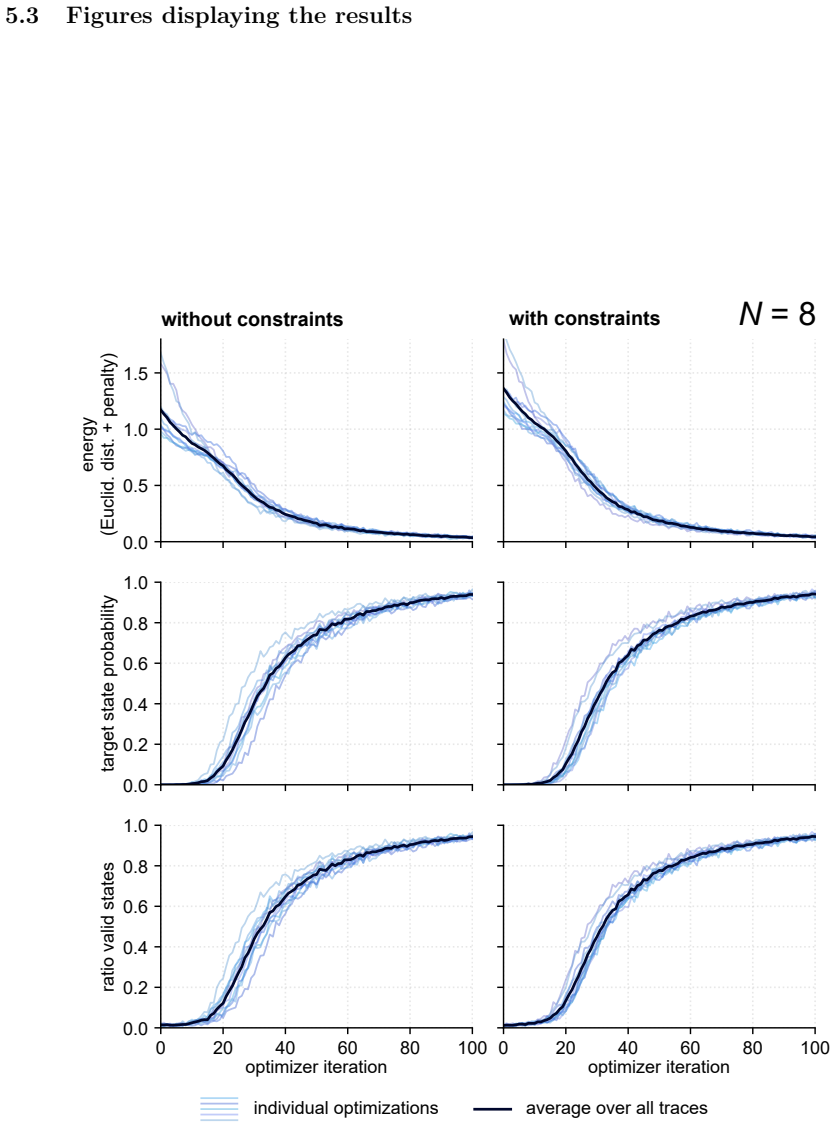
- [§2.4] The statement that F-VQE 'consistently identified the optimal state across all trials' should be qualified as 'the optimal basis state was sampled at least once among the 1000 shots,' because Figures 4 and 5 show that the target-state probability remains well below 1 throughout optimization.
- [§5.2.1] The statement that no significant dependence on the parameter-optimization scheme was found is not accompanied by data; either show the comparison or omit the claim.
Circularity Check
No circularity found: the benchmark targets, classical baselines, and ground-truth checks are external; self-citations provide prior formulation but are not load-bearing for the new claims.
full rationale
The paper's derivation chain is self-contained with respect to the claims it actually makes. For the comparative study, the target lamination parameters are generated from valid stacking sequences (Sec. 2.3.2), which gives a known zero-loss optimum and provides an external reference; this is a benchmark construction, not a fitted input. DMRG's penalty weights (Table 2) are hyperparameters chosen a priori and scaled inversely with ply count, not calibrated to the test targets and not renamed as predictions. F-VQE results are checked against brute-force ground truth via histograms of all permutations (Figs. 6 and 7), and the DMRG-versus-classical comparison uses independent open-source implementations LAYLA and Opti-BLESS. Self-citations to [1] supply encoding, MPO, and DMRG implementation details, but those are prior published tools; the new demonstrations—full constraint set, 15-degree ply increments, buckling maximization, and clustering-dispersion control—are executed and evaluated in this paper, and the competitive-performance claim rests on those new experiments, not on the self-citation alone. No equation is defined in terms of a predicted quantity, and no uniqueness theorem from the authors' prior work is invoked to force a choice. The paper itself flags limitations such as Opti-BLESS being run without constraint enforcement (Sec. 5.2.2) and F-VQE's shot-limited scaling (Sec. 2.5); these affect comparability and generalizability, but they are not circular reductions. Overall, no specific circular step can be quoted from the text, so the appropriate score is 0.
Assumptions & free parameters
free parameters (5)
- Constraint penalty weights gamma_c =
Disorientation 1.0/N, contiguity 0.5/N, 10-percent-rule 0.2/N, balanced 0.2/N (DMRG); gamma=0.05 (F-VQE LP search)
- Buckling penalty gamma =
Started at 5, incremented by 5 per trial until a valid stacking sequence is produced
- Clustering/dispersion bias alpha =
Varied across negative and positive values (Figure 10)
- Laminate thickness h for buckling objective =
0.1
- Positivity offset lambda_max =
Sufficiently large constant, value not specified
assumptions (7)
- domain assumption Classical lamination theory relates the ABD stiffness matrix to stacking sequence via lamination parameters (eqs. 2, 12-15)
- domain assumption Symmetry of the laminate around the midplane, so B-lamination parameters vanish
- domain assumption The set of manufacturing constraints (disorientation, contiguity, balanced, 10-percent rule) is the authoritative full set (Section 2.2.1)
- standard math DMRG with matrix product states provides a faithful approximate ground-state solver for the loss Hamiltonian
- standard math F-VQE converges to a distribution shaped by the chosen filter function
- domain assumption Buckling factor closed-form (eq. 16) applies for biaxially loaded simply supported plate with m=n=1
- ad hoc to paper Target lamination parameters generated from valid stacking sequences constitute a representative benchmark
Cite this review
Pith. "Pith review of Quantum-assisted Stacking Sequence Retrieval and Laminated Composite Design." pith.science (2026). https://pith.science/paper/E5M7V7PL
@misc{pith2026241110303,
  author       = {Pith},
  title        = {Pith review of: Quantum-assisted Stacking Sequence Retrieval and Laminated Composite Design},
  year         = {2026},
  howpublished = {\url{https://pith.science/paper/E5M7V7PL}},
  note         = {Machine review of arXiv:2411.10303}
}
read the original abstract
We, the QAIMS lab lab at the Aerospace Faculty of TU Delft, participated as finalists in the Airbus/BMW Quantum Computing Challenge 2024. Stacking sequence retrieval, a complex combinatorial task within a bi-level optimization framework, is crucial for designing laminated composites that meet aerospace requirements for weight, strength, and stiffness. This document presents the scientifically relevant sections of our submission, which builds on our prior research on applying quantum computation to this challenging design problem. For the competition, we expanded our previous work in several significant ways. First, we incorporated a full set of manufacturing constraints into our algorithmic framework, including those previously established theoretically but not yet demonstrated, thereby aligning our approach more closely with real-world manufacturing demands. We implemented the F-VQE algorithm, which enhances the probability shaping of optimal solutions, improving on simpler variational quantum algorithms. Our approach also demonstrates flexibility by accommodating diverse objectives as well as finer ply-angle increments alongside the previously demonstrated conventional ply angles. Scalability was tested using the DMRG algorithm, which, despite limitations in entanglement representation, enabled simulations with up to 200 plies. Results were directly compared to conventional stacking sequence retrieval algorithms with DMRG showing high competitiveness. Given DMRG's limited entanglement capabilities, it serves as a conservative baseline, suggesting potential for even greater performance on fully realized quantum systems. This document serves to make our competition results publicly available as we prepare a formal publication on these findings and their implications for aerospace materials design optimization.
Figures


Figures from the paper (7 more)


Reference graph
Works this paper leans on
-
[1]
Arne Wulff et al. “Quantum computing and tensor networks for laminate design: A novel approach to stacking sequence retrieval”. In:Computer Methods in Applied Mechanics and Engineering 432 (2024), p. 117380.issn: 0045-7825. doi: https://doi.org/10.1016/j.cma.2024.117380
arXiv 2024
-
[2]
Bending and Stretching of Certain Types of Heterogeneous Ae- olotropic Elastic Plates
E. Reissner and Y. Stavsky. “Bending and Stretching of Certain Types of Heterogeneous Ae- olotropic Elastic Plates”. In:Journal of Applied Mechanics 28 (3 Sept. 1961), pp. 402–408.issn: 0021-8936. doi: 10.1115/1.3641719
-
[3]
On the Theory of Laminated Anisotropic Shells and Plates
S. B. Dong, K. S. Pister, and R. L. Taylor. “On the Theory of Laminated Anisotropic Shells and Plates”. In:Journal of the Aerospace Sciences 29 (8 Aug. 1962), pp. 969–975.issn: 1936-9999.doi: 10.2514/8.9668
-
[4]
Stephen W. Tsai and H. Thomas Hahn.Introduction to Composite Materials. Routledge, Oct. 1980. isbn: 9780203750148. doi: 10.1201/9780203750148
-
[5]
Optimum stacking sequence design of com- posite materials Part I: Constant stiffness design
Hossein Ghiasi, Damiano Pasini, and Larry Lessard. “Optimum stacking sequence design of com- posite materials Part I: Constant stiffness design”. In:Composite Structures 90 (1 Sept. 2009), pp. 1–11. issn: 02638223. doi: 10.1016/j.compstruct.2009.01.006
-
[6]
Optimum stacking sequence design of composite materials Part II: Variable stiffness design
Hossein Ghiasi et al. “Optimum stacking sequence design of composite materials Part II: Variable stiffness design”. In: Composite Structures 93 (1 Dec. 2010), pp. 1–13.issn: 02638223. doi: 10. 1016/j.compstruct.2010.06.001
work page 2010
-
[7]
A review on optimization of composite structures Part I: Laminated composites
S. Nikbakt, S. Kamarian, and M. Shakeri. “A review on optimization of composite structures Part I: Laminated composites”. In:Composite Structures 195 (July 2018), pp. 158–185.issn: 02638223. doi: 10.1016/j.compstruct.2018.03.063
-
[8]
A review on optimization of composite structures Part II: Functionally graded materials
S. Nikbakht, S. Kamarian, and M. Shakeri. “A review on optimization of composite structures Part II: Functionally graded materials”. In:Composite Structures 214 (Apr. 2019), pp. 83–102. issn: 02638223. doi: 10.1016/j.compstruct.2019.01.105
Show all 48 references
-
[9]
S. W. Tsai and N. J. Pagano. Invariant Properties of Composite Materials . 1968. url: https : //apps.dtic.mil/sti/citations/AD0668761
1968
-
[10]
Optimal Design of Variable Stiffness Composite Structures Using Lam- ination Parameters
Samuel T. IJsselmuiden. “Optimal Design of Variable Stiffness Composite Structures Using Lam- ination Parameters”. In: (2011). url: http://resolver.tudelft.nl/uuid:973a564b- 5734- 42c4-a67c-1044f1e25f1c
2011
-
[11]
Static and dynamic aeroelastic tailoring with composite blending and manoeuvre load alleviation
Marco Tito Bordogna et al. “Static and dynamic aeroelastic tailoring with composite blending and manoeuvre load alleviation”. In: Structural and Multidisciplinary Optimization 61.5 (Jan. 2020), pp. 2193–2216. issn: 1615-1488. doi: 10.1007/s00158-019-02446-w
2020 doi
-
[12]
Two-level optimization technique of composite laminate panels by genetic algo- rithms
Koetsu Yamazaki. “Two-level optimization technique of composite laminate panels by genetic algo- rithms”. In: vol. 37. American Institute of Aeronautics and Astronautics, Apr. 1996, pp. 1882–1887. doi: 10.2514/6.1996-1539
1996 doi
-
[13]
Multi-step blended stacking sequence design of panel assemblies with buckling constraints
Samuel T. IJsselmuiden et al. “Multi-step blended stacking sequence design of panel assemblies with buckling constraints”. In: Composites Part B: Engineering 40 (4 June 2009), pp. 329–336. issn: 13598368. doi: 10.1016/j.compositesb.2008.12.002
2009 doi
-
[14]
A lamination parameter-based strategy for solving an integer- continuous problem arising in composite optimization
Dianzi Liu and Vassili V. Toropov. “A lamination parameter-based strategy for solving an integer- continuous problem arising in composite optimization”. In: Computers & Structures 128 (Nov. 2013), pp. 170–174.issn: 00457949. doi: 10.1016/j.compstruc.2013.06.003
2013 doi
-
[15]
Two-level layup optimization of com- posite laminate using lamination parameters
Xiaoyang Liu, Carol A. Featherston, and David Kennedy. “Two-level layup optimization of com- posite laminate using lamination parameters”. In:Composite Structures 211 (Mar. 2019), pp. 337–
2019
-
[16]
Efficient design optimization of nonconventional laminated composites using lamination parameters: A state of the art
Mazen A. Albazzan et al. “Efficient design optimization of nonconventional laminated composites using lamination parameters: A state of the art”. In:Composite Structures 209 (Feb. 2019), pp. 362–
2019
-
[17]
Airframe-Stuctural-Design
Michael Chun-Yung Niu. Airframe-Stuctural-Design. Technical Book Co, 1988.isbn: 962-7128-04- X
1988
-
[18]
J A Bailie, R P Ley, and A Pasricha.A summary and review of composite laminate design guide- lines, NAS1-19347. 1997. url: https://www.abbottaerospace.com/downloads/nasa- nas1- 19347-summary-and-review-of-composite-laminate-design-guidelines/
1997
-
[19]
Department of Defense, USA, June
Composite Materials Handbook (Volume 3) MIL-HDBK-17-3F . Department of Defense, USA, June
-
[20]
Ising formulations of many NP problems
Andrew Lucas. “Ising formulations of many NP problems”. In:Frontiers in Physics 2 (2014), pp. 1–
2014
-
[21]
A Quantum Approximate Optimization Algorithm
Edward Farhi, Jeffrey Goldstone, and Sam Gutmann. “A Quantum Approximate Optimization Algorithm”. In: Arxiv (Nov. 2014). arXiv:1411.4028. url: http://arxiv.org/abs/1411.4028
2014 arXiv
-
[22]
Quantum Supremacy through the Quantum Approximate Optimization Algorithm
Edward Farhi and Aram W Harrow. “Quantum Supremacy through the Quantum Approximate Optimization Algorithm”. In: Arxiv (Feb. 2016). arXiv: 1602.07674. url: http://arxiv.org/ abs/1602.07674
2016 arXiv
-
[23]
Filtering variational quantum algorithms for combinatorial optimization
David Amaro et al. “Filtering variational quantum algorithms for combinatorial optimization”. In: Quantum Science and Technology 7 (1 Jan. 2022), p. 015021.issn: 2058-9565.doi: 10.1088/2058- 9565/ac3e54
2022 doi
-
[24]
A method using beam search to design the lay-ups of composite laminates with many plies
Noémie Fedon et al. “A method using beam search to design the lay-ups of composite laminates with many plies”. In:Composites Part C: Open Access 4 (Mar. 2021), p. 100072.issn: 26666820. doi: 10.1016/j.jcomc.2020.100072
2021
-
[25]
doi: 10.3389/fphy.2014.00005
issn: 2296-424X. doi: 10.3389/fphy.2014.00005
2014
-
[26]
Variational quantum algorithms
M. Cerezo et al. “Variational quantum algorithms”. In:Nature Reviews Physics 3 (9 Aug. 2021), pp. 625–644. issn: 2522-5820. doi: 10.1038/s42254-021-00348-9
2021 doi
-
[27]
Hybrid Quantum-Classical Algorithms and Quantum Error Mitigation
Suguru Endo et al. “Hybrid Quantum-Classical Algorithms and Quantum Error Mitigation”. In: Journal of the Physical Society of Japan 90 (3 Mar. 2021), p. 032001.issn: 0031-9015. doi: 10. 7566/JPSJ.90.032001
2021
-
[28]
Noisy intermediate-scale quantum algorithms
Kishor Bharti et al. “Noisy intermediate-scale quantum algorithms”. In:Reviews of Modern Physics 94 (1 Feb. 2022), p. 015004.issn: 0034-6861. doi: 10.1103/RevModPhys.94.015004
2022 doi
-
[29]
Density-matrix algorithms for quantum renormalization groups
Steven R. White. “Density-matrix algorithms for quantum renormalization groups”. In:Physical Review B 48 (14 Oct. 1993), pp. 10345–10356.issn: 0163-1829.doi: 10.1103/PhysRevB.48.10345
1993 doi
-
[30]
Permutation genetic algorithm for stacking sequence design of composite lami- nates
Boyang Liu et al. “Permutation genetic algorithm for stacking sequence design of composite lami- nates”. In:Computer Methods in Applied Mechanics and Engineering 186 (2-4 June 2000), pp. 357–
2000
-
[31]
Density Matrix Renormalization Group and Periodic Boundary Conditions: A Quantum Information Perspective
F. Verstraete, D. Porras, and J. I. Cirac. “Density Matrix Renormalization Group and Periodic Boundary Conditions: A Quantum Information Perspective”. In:Physical Review Letters 93 (22 Nov. 2004), p. 227205.issn: 0031-9007. doi: 10.1103/PhysRevLett.93.227205
2004 doi
-
[32]
The density-matrix renormalization group in the age of matrix product states
Ulrich Schollwöck. “The density-matrix renormalization group in the age of matrix product states”. In: Annals of Physics 326 (1 Jan. 2011), pp. 96–192.issn: 00034916. doi: 10.1016/j.aop.2010. 09.012
2011 doi
-
[33]
LAYLA: a method using beam search to design the lay-ups of composite laminates with many plies
Noémie Fedon. LAYLA: a method using beam search to design the lay-ups of composite laminates with many plies . 2021. url: https://github.com/noemiefedon/LAYLA
2021
-
[34]
Opti-BLESS
Terence Macquart. Opti-BLESS. 2021. url: https://github.com/TMacquart/OptiBLESS
2021
-
[35]
A repair algorithm for composite laminates to satisfy lay-up design guide- lines
Noémie Fedon et al. “A repair algorithm for composite laminates to satisfy lay-up design guide- lines”.In: Composite Structures259(2021),p.113448. issn:0263-8223. doi: 10.1016/j.compstruct. 2020.113448
2021
-
[36]
CornerTransferMatrixRenormalizationGroupMethod
TomotoshiNishinoandKouichiOkunishi.“CornerTransferMatrixRenormalizationGroupMethod”. In: Journal of the Physical Society of Japan 65 (4 Apr. 1996), pp. 891–894.issn: 0031-9015. doi: 10.1143/JPSJ.65.891
1996 doi
-
[37]
A floating node method for the modelling of discontinuities in composites
BY Chen et al. “A floating node method for the modelling of discontinuities in composites”. In: Engineering Fracture Mechanics 127 (2014), pp. 104–134
2014
-
[38]
Modelling the tensile failure of composites with the floating node method
BY Chen, TE Tay, and ST Pinho. “Modelling the tensile failure of composites with the floating node method”. In:Computer Methods in Applied Mechanics and Engineering 308 (2016), pp. 414– 442
2016
-
[39]
Modelling delamination migration in angle-ply laminates
BY Chen et al. “Modelling delamination migration in angle-ply laminates”. In:Composites Science and Technology 142 (2017), pp. 145–155
2017
-
[40]
Optimum design of laminated composite plates using lamination parameters
Mitsunori Miki and Yoshihiko Sugiyama. “Optimum design of laminated composite plates using lamination parameters”. In: American Institute of Aeronautics and Astronautics, Apr. 1991.doi: 10.2514/6.1991-971. 11
1991 doi
-
[41]
Effectsofgeometrical and material parameters on free vibration analysis of fiber metal laminated plates
FaramarzAshenaiGhasemi,RezaPaknejad,andKeramatMalekzadehFard.“Effectsofgeometrical and material parameters on free vibration analysis of fiber metal laminated plates”. In:Mechanics & Industry 14.4 (2013), pp. 229–238.doi: 10.1051/meca/2013062
2013
-
[42]
Lamination Parameters for Sandwich and Hybrid Material Composites
Gustavo H. C. Silva and Yasser Meddaikar. “Lamination Parameters for Sandwich and Hybrid Material Composites”. In:AIAA Journal 58.10 (2020), pp. 4604–4611.doi: 10.2514/1.J059093
2020 doi
-
[48]
Quantumalgorithmsforelectronicstructurecalculations:Particle- hole Hamiltonian and optimized wave-function expansions
PanagiotisKl.Barkoutsosetal.“Quantumalgorithmsforelectronicstructurecalculations:Particle- hole Hamiltonian and optimized wave-function expansions”. In:Phys. Rev. A 98 (2 Aug. 2018), p. 022322. doi: 10.1103/PhysRevA.98.022322. 12 5 Supplementary information 5.1 Additional info...
2018 doi
-
[200]
Golden Application
where a ten-fold increase in time can be observed for 40 and 60 sweeps with bond dimensions of 16 and 32. In addition, fig. 9 shows that DMRG can effectively handle ply angles at15◦ separation, which is a huge increase in ply-angle choices over the conventional45◦ separation. ...
-
[350]
doi: 10.1016/j.compstruct.2018.12.054
issn: 02638223. doi: 10.1016/j.compstruct.2018.12.054
2018 doi
- [372]
-
[374]
doi: 10.1016/j.compstruct.2018.10.095
issn: 02638223. doi: 10.1016/j.compstruct.2018.10.095
2018 doi
-
[2002]
url: https://www.abbottaerospace.com/downloads/mil-hdbk-17f/. 10
Reviewed August 12, 2026 · model on record in the stance chip above.
Discussion (0). Continue with ORCID to comment.