REVIEW 3 major objections 6 minor 1 cited by
Generative AI and Large Language Models in Language Preservation: Opportunities and Challenges
T0 review · 3 major / 6 minor · reviewed 2026-08-10 · deepseek-v4-flash
Pith's one-line read Generative AI can help save endangered languages, but only within a community-governed evaluation framework, and this paper builds that framework around data stewardship and risk.
desk verdict A useful governance checklist for GenAI in language preservation, but the 'systematic evaluation' claim is oversold and the ImpactScore is illustrative, not a defined method. read the letter →
The pith
A machine-rendered reading of the paper's core claim, the machinery that carries it, and where it could break.
The reading
What carries the argument
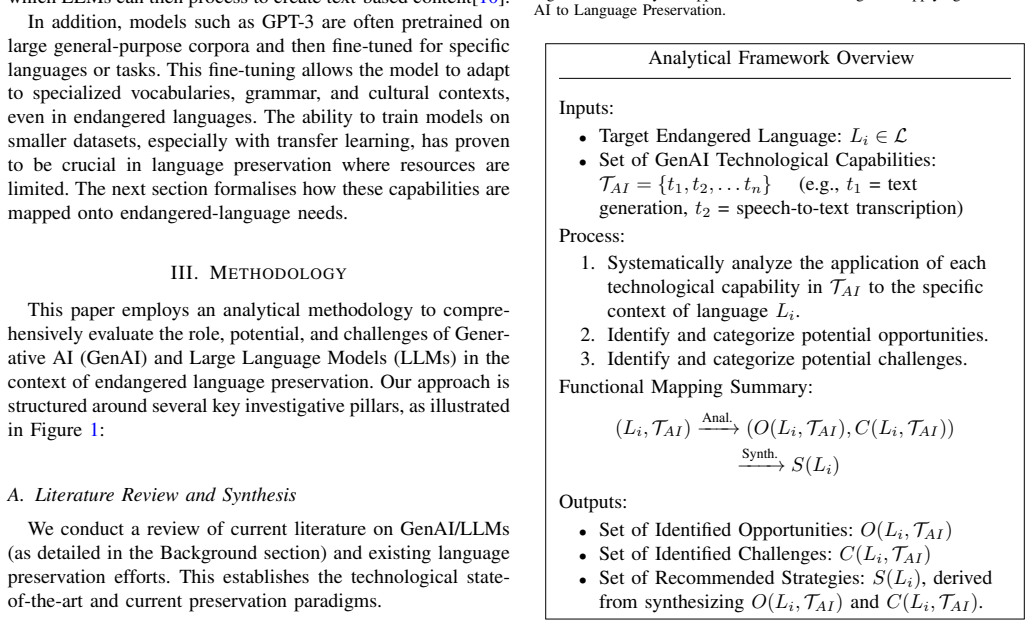
The load-bearing mechanism is a formalized evaluation framework built on a mapping: for a target endangered language $L_i$ and a set of generative-AI capabilities $T_{AI}$, the analysis identifies opportunity set $O(L_i,T_{AI})$ and challenge set $C(L_i,T_{AI})$, then synthesizes a recommended strategy $S(L_i)$. The framework is operationalized by the ImpactScore rubric, a weighted multi-criteria score that combines opportunity fit, data availability, community support, ethical risk, and resource needs for any proposed intervention. It also adapts a human-centered project cycle in which problem identification and solution implementation feed each other through readiness, strategy, use-case discovery, operating model, infrastructure, and awareness. The framework does its work by forcing every deployment decision through community governance and ethical risk assessment rather than through technical feasibility or accuracy alone.
What would settle it
Apply the ImpactScore rubric with identical weights to a set of endangered-language interventions whose outcomes are already known; if low-scoring interventions succeed as often as high-scoring ones, or if the Maori ASR model's word error rate measured on a held-out benchmark is far from the 8% quoted from a media profile, the framework's predictive value and its headline case evidence would be called into question.
Extended reading notes
Core claim
The paper's central claim is that generative AI can genuinely support endangered-language preservation, but only when interventions are selected and run through a systematic evaluation tied to language-specific needs and community governance. It introduces a framework that maps a target language and a set of AI capabilities to explicit opportunity, challenge, and strategy sets, then reports that applying it to Te Reo Māori surfaces both a success and the remaining risks. The success is a community-led automatic speech recognition initiative, reported at 92% accuracy or an 8% word error rate, which the paper contrasts with weaker efforts by large technology companies. The reusable output is an ImpactScore rubric that ranks interventions by opportunity fit, data availability, community support, ethical risk, and resource needs. The author's stated conclusion is that this technology can revolutionize preservation only when anchored in community-centric data stewardship, continuous evaluation, and transparent risk management.
Load-bearing premise
The demonstration that the framework works rests on a single successful case, Te Reo Māori, and the headline accuracy figure in that case is quoted from a media profile rather than measured or peer-reviewed in this paper; if that case is unrepresentative or those numbers are wrong, the evidence for the framework's broad usefulness weakens.
Editorial extensions
If this is right
- A language community or funder can rank candidate AI projects before investing, avoiding tools whose data needs or ethical risks outweigh their benefits.
- Policymakers can use the ImpactScore as a shared criterion for funding and approving preservation programs, making community support and data sovereignty formal, weighable factors.
- Evaluation of preservation tools would move beyond raw accuracy to include cultural resonance and authenticity, since the paper treats those as necessary conditions for success.
- Low-resource techniques such as transfer learning, data augmentation, and adapters become priority research directions because data scarcity is identified as the binding constraint.
- The Te Reo Māori application becomes a template other endangered-language communities can adapt, not just a one-off success story.
Reading between the lines
- A natural test, not run in the paper, is to score many endangered-language projects with the same ImpactScore weights and check whether higher scores predict larger measurable gains in language use over several years.
- The framework's logic implies that two speech recognizers with identical accuracy can receive opposite recommendations if one is community-owned and the other is not, because governance is a scored factor.
- The same lens could be turned on AI development itself: choices about data augmentation or multilingual adapters are not neutral technical details but decisions that affect data sovereignty and cultural authenticity, so the framework would treat them as governance questions.
Signed reviews
Editorial analysis
A structured set of objections, weighed in public.
Referee Report
Summary. This paper argues that Generative AI and LLMs can support endangered-language preservation, but only under community-centric governance and continuous evaluation. Its central contribution is a proposed analytical framework (Figure 2) that maps a target language and a set of AI capabilities to identified opportunities, challenges, and strategies, together with an ImpactScore multi-criteria rubric (Section VI) for prioritizing interventions. The framework is illustrated through a narrative worked example for Te Reo Māori, drawing on community-led ASR efforts, and the paper concludes with directions for future work. The manuscript is written as a conceptual/position piece rather than an empirical study, but the abstract and conclusion advance stronger claims: that the framework 'systematically evaluates' GenAI applications and that its efficacy has been demonstrated.
Significance. If the claimed framework were actually operational and validated, it would address a real gap: language communities, researchers, and policymakers currently lack structured tools for deciding when and how to use GenAI in endangered-language contexts. The paper usefully emphasizes data sovereignty, community governance, and ethical risk, and the Te Reo Māori case is a relevant and constructive example. However, as written the contribution is essentially a well-organized taxonomy and checklist. The central evaluative machinery is underspecified, and the single case study is presented narratively with no validation. The paper is therefore a reasonable roadmap and discussion piece, but it does not yet deliver the 'systematic evaluation' methodology promised in the abstract.
major comments (3)
- [Section VI, Eq. (1)] The ImpactScore rubric, which the paper presents as the tool for systematic evaluation and prioritization, is not defined. The equation ImpactScore(Ik, Li) = f(OpportunityFit, DataAvailability, CommunitySupport, EthicalRiskLevel, ResourceNeeds) leaves the function f, the factor scales, and the aggregation method unspecified. Appendix E then explicitly labels the weights 'illustrative' and the assessment 'hypothetical,' and the resulting score 0.78 is not derived from any reproducible procedure. As a result, two analysts applying the rubric could arrive at different scores or no score at all, so the claimed 'systematic' property is not observable. This is load-bearing because the abstract and Section VII present the rubric as a core part of the proposed methodology.
- [Section IV and Appendix A] The paper claims in the abstract to 'demonstrate its efficacy' through the Te Reo Māori case, but the demonstration is a narrative application. Table I and Appendix A describe how the framework components could be filled in for Te Reo Māori, yet there is no comparison against a baseline, a counterfactual, or an independent audit showing that this framework leads to better identification of opportunities, challenges, or strategies than an unstructured analysis. The case study can illustrate the framework, but it cannot validate the claim that the framework is effective. The paper should either provide such a test or explicitly reframe the contribution as a set of heuristic guidelines rather than a validated methodology.
- [Section V-A, Te Hiku Media ASR claim] The quantitative evidence supporting the main case study is not verified. The paper states that Te Hiku Media's ASR model achieved 92% accuracy, corresponding to 8% WER, compared to 'baselines which might be 20% WER or higher,' and cites a TIME profile [11] rather than a peer-reviewed evaluation or model report. The 20% baseline is not cited at all. Because this accuracy claim is the strongest concrete evidence in the paper and supports the broader argument that community-led AI can succeed, it needs to be grounded in a primary source or clearly labeled as an unverified secondary report.
minor comments (6)
- [Section I] The claim that 'UNESCO says that 40 percent of the world's languages are endangered' lacks a citation; a reference to the UNESCO Atlas of the World's Languages in Danger should be added.
- [Section I] The phrase 'field photography' appears among traditional preservation methods; this seems to be a typo or an odd inclusion, and the intended method is likely 'field recording' or 'photographic documentation.'
- [Section V-A] Reference [11] is a TIME profile; when citing secondary sources for technical performance figures, the paper should state that the figure is as reported by the profile and direct readers to the primary evaluation if one exists.
- [Figure 2] The arrows labeled 'Anal.' and 'Synth.' are not defined. Since the framework is meant to be systematic, the reader would benefit from a brief description of what these operations consist of, even if the paper is conceptual.
- [Appendix E] The illustrative ImpactScore assessment is clearly labeled hypothetical, which is good, but the main text should similarly emphasize that the '0.78' score is illustrative and not a measured result, to avoid any impression that it is an outcome of the Te Reo Māori case.
- [References] Some references lack full bibliographic details, including [20] and [24]; please ensure all citations conform to the journal's reference style.
Circularity Check
No significant circularity: the framework is definitional notation, the Te Reo Māori case is an external worked illustration, and the ImpactScore is explicitly hypothetical rather than a fitted prediction.
full rationale
The paper's central derivation chain is a qualitative analytical framework (Fig. 2) that maps a target language and a set of GenAI capabilities to opportunity and challenge sets, which are then synthesized into strategies. This mapping is presented as notation and process, not as an empirical result fitted to data. The Te Reo Māori case is used as a worked illustration, with the 92% ASR accuracy figure and community-governance facts drawn from an external TIME profile [11], not from any parameter estimated by the framework. The ImpactScore rubric in Section VI explicitly leaves the aggregation function f unspecified, and Appendix E labels its weights and factor ratings as 'hypothetical' and 'illustrative'; the resulting 0.78 value is therefore not a prediction derived from the framework. The author's self-citations [6] and [23] support background claims about bias and multilingual model difficulties, but they are not load-bearing for any uniqueness argument or derivation step. The main weakness is under-specification: without a defined f or an external benchmark, the framework's 'systematic' property is not independently validated. That is a completeness and validity concern, not circularity. Hence no circular step is exhibited, and the appropriate score is low.
Assumptions & free parameters
free parameters (1)
- ImpactScore weights =
OpportunityFit=0.3, DataAvailability=0.2, CommunitySupport=0.3, EthicalRiskLevel=0.1, ResourceNeeds=0.1
assumptions (3)
- domain assumption Language endangerment is a crisis that warrants technological intervention
- ad hoc to paper Community governance and data sovereignty are necessary conditions for ethical GenAI language preservation
- ad hoc to paper The Te Reo Maori case is representative of endangered language preservation contexts
invented entities (2)
-
Analytical framework mapping (Li, TAI) to O, C, S
-
ImpactScore rubric
Cite this review
Pith. "Pith review of Generative AI and Large Language Models in Language Preservation: Opportunities and Challenges." pith.science (2026). https://pith.science/paper/E66NSEIY
@misc{pith2026250111496,
  author       = {Pith},
  title        = {Pith review of: Generative AI and Large Language Models in Language Preservation: Opportunities and Challenges},
  year         = {2026},
  howpublished = {\url{https://pith.science/paper/E66NSEIY}},
  note         = {Machine review of arXiv:2501.11496}
}
read the original abstract
The global crisis of language endangerment meets a technological turning point as Generative AI (GenAI) and Large Language Models (LLMs) unlock new frontiers in automating corpus creation, transcription, translation, and tutoring. However, this promise is imperiled by fragmented practices and the critical lack of a methodology to navigate the fraught balance between LLM capabilities and the profound risks of data scarcity, cultural misappropriation, and ethical missteps. This paper introduces a novel analytical framework that systematically evaluates GenAI applications against language-specific needs, embedding community governance and ethical safeguards as foundational pillars. We demonstrate its efficacy through the Te Reo M\=aori revitalization, where it illuminates successes, such as community-led Automatic Speech Recognition achieving 92% accuracy, while critically surfacing persistent challenges in data sovereignty and model bias for digital archives and educational tools. Our findings underscore that GenAI can indeed revolutionize language preservation, but only when interventions are rigorously anchored in community-centric data stewardship, continuous evaluation, and transparent risk management. Ultimately, this framework provides an indispensable toolkit for researchers, language communities, and policymakers, aiming to catalyze the ethical and high-impact deployment of LLMs to safeguard the world's linguistic heritage.
Figures


Forward citations
Cited by 1 Pith paper
-
Tiny QA Benchmark++: Ultra-Lightweight, Synthetic Multilingual Dataset Generation & Smoke-Tests for Continuous LLM Evaluation
A lightweight multilingual QA smoke-test suite with a 52-item English core and an LLM-based generator is shown to reflect model size and language performance differences in seconds.
Reference graph
Works this paper leans on
-
[11]
Peter-lucas jones: Using ai to preserve indigenous languages,
A. R. Chow, “Peter-lucas jones: Using ai to preserve indigenous languages,” TIME, September 2024. [Online]. Available: https: //time.com/7012841/peter-lucas-jones/
-
[1]
(2025) Language diversity index
National Geographic Society. (2025) Language diversity index. Accessed: Jan. 20, 2025. [Online]. Available: https://education.national geographic.org/resource/language-diversity-index-map/
work page 2025
-
[2]
Global predictors of language endangerment and the future of linguistic diversity,
L. Bromham, R. Dinnage, H. Skirg ˚ard, A. Ritchie, M. Cardillo, F. Meakins, S. Greenhill, and X. Hua, “Global predictors of language endangerment and the future of linguistic diversity,” Nature Ecology & Evolution , vol. 6, no. 2, pp. 163–173, 2022. [Online]. Available: https://doi.org/10.1038/s41559-021-01604-y
-
[3]
United Nations Educational, Scientific and Cultural Organization, “Recommendation concerning the promotion and use of multilingualism and universal access to cyberspace,” Online; Accessed: Jan. 20, 2025, 2003, adopted by the General Conference at its 32nd session on 15 October 2003. [Online]. Available: https://unesdoc.unesco.org/ark: /48223/pf0000133171
work page 2025
-
[4]
Generative ai as digital media,
G. Abiri, “Generative ai as digital media,” Harvard Journal of Sport and Entertainment Law , vol. 15, no. 2, 2024, peking University School of Transnational Law Research Paper. [Online]. Available: https://ssrn.com/abstract=4878339
work page 2024
-
[5]
U. Ajuzieogu, “Multimodal generative ai for african language preserva- tion: A framework for language documentation and revitalization,” Ph.D. dissertation, 10 2022
work page 2022
-
[6]
Framework for fairness in machine learning using detecting and mitigating bias in ai algorithms,
V . Koc, “Framework for fairness in machine learning using detecting and mitigating bias in ai algorithms,” in 2025 3rd IEEE International Conference on Business Analytics for Technology and Security (ICBATS- 2025), Dubai, United Arab Emirates, May 1-2 2025
work page 2025
-
[7]
A. Vaswani, N. Shazeer, N. Parmar, J. Uszkoreit, L. Jones, A. N. Gomez, L. u. Kaiser, and I. Polosukhin, “Attention is all you need,” in Advances in Neural Information Processing Systems , I. Guyon, U. V . Luxburg, S. Bengio, H. Wallach, R. Fergus, S. Vishwanathan, and R. Garnett, Eds., vol. 30. Curran Associates, Inc., 2017. [Online]. Available: https://...
work page 2017
Show all 34 references
-
[8]
Recent advances in generative ai and large language models: Current status, challenges, and perspec- tives,
D. H. Hagos, R. Battle, and D. B. Rawat, “Recent advances in generative ai and large language models: Current status, challenges, and perspec- tives,” IEEE Transactions on Artificial Intelligence , vol. 5, no. 12, pp. 5873–5893, 2024
2024
-
[9]
Schillaci, LLM Adoption Trends and Associated Risks
Z. Schillaci, LLM Adoption Trends and Associated Risks . Cham: Springer Nature Switzerland, 2024, pp. 121–128. [Online]. Available: https://doi.org/10.1007/978-3-031-54827-7 13
2024 doi
-
[10]
Ai-driven territorial intelligence: An integrated approach to enhancing digital sovereignty,
B. Bentalha and M. Boukare, “Ai-driven territorial intelligence: An integrated approach to enhancing digital sovereignty,” in Generative AI and Implications for Ethics, Security, and Data Management . IGI Global, 2024, pp. 231–261
2024
-
[12]
When large language models meet personalization: perspectives of challenges and opportunities,
J. Chen, Z. Liu, X. Huang, C. Wu, Q. Liu, G. Jiang, Y . Pu, Y . Lei, X. Chen, X. Wang, K. Zheng, D. Lian, and E. Chen, “When large language models meet personalization: perspectives of challenges and opportunities,” World Wide Web , vol. 27, no. 4, Jun. 2024. [Online]. Availab...
2024 doi
-
[13]
Privacy-preserving techniques in generative ai and large language models: A narrative review,
G. Feretzakis, K. Papaspyridis, A. Gkoulalas-Divanis, and V . S. Verykios, “Privacy-preserving techniques in generative ai and large language models: A narrative review,” Information, vol. 15, no. 11,
-
[14]
Large language models: A comprehensive survey of its applications, challenges, limitations, and future prospects,
M. U. Hadi, Q. A. Tashi, R. Qureshi, and et al., “Large language models: A comprehensive survey of its applications, challenges, limitations, and future prospects,” TechRxiv, February 10 2025
2025
-
[15]
Language preservation efforts get an ai boost,
H. Barath, “Language preservation efforts get an ai boost,” Dartmouth News, April 2025. [Online]. Available: https://home.dartmouth.edu/new s/2025/04/language-preservations-efforts-get-ai-boost
2025
-
[16]
Impact of conversational and generative ai systems on libraries: A use case large language model (llm),
R. Khan, N. Gupta, A. Sinhababu, and R. C. and, “Impact of conversational and generative ai systems on libraries: A use case large language model (llm),” Science & Technology Libraries , vol. 43, no. 4, pp. 319–333, 2024. [Online]. Available: https: //doi.org/10.1080/0194262X....
2024
-
[17]
Toward text data augmentation for sentiment analysis,
H. Q. Abonizio, E. C. Paraiso, and S. Barbon, “Toward text data augmentation for sentiment analysis,” IEEE Transactions on Artificial Intelligence, vol. 3, no. 5, pp. 657–668, 2022
2022
-
[18]
Adapting multilingual LLMs to low-resource languages with knowledge graphs via adapters,
D. Gurgurov, M. Hartmann, and S. Ostermann, “Adapting multilingual LLMs to low-resource languages with knowledge graphs via adapters,” in Proceedings of the 1st Workshop on Knowledge Graphs and Large Language Models (KaLLM 2024) , R. Biswas, L.-A. Kaffee, O. Agarwal, P. Minerv...
2024
-
[19]
Exploration of tpus for ai applications,
D. Sanmart ´ın Carri´on, V . Prohaska, and O. Diez, “Exploration of tpus for ai applications,” in Proceedings of the Second International Conference on Advances in Computing Research (ACR’24) . Springer, 2024, pp. 559–570. 9
2024
-
[20]
Here’s what the sellside is saying about deepseek,
Financial Times, “Here’s what the sellside is saying about deepseek,” FT Alphaville , 2024. [Online]. Available: https://www.ft.com/content/c 82933fe-be28-463b-8336-d71a2ff5bbbf
2024
-
[21]
The national science foundation launches nairr pilot to democratize ai research,
TIME, “The national science foundation launches nairr pilot to democratize ai research,” TIME, 2024. [Online]. Available: https: //time.com/6589134/nairr-ai-resource-access/
2024
-
[22]
Does the grammatical structure of prompts influence the responses of generative artificial intelligence? an exploratory analysis in spanish,
R. Viveros-Mu ˜noz, J. Carrasco-S ´aez, C. Contreras-Saavedra, S. San- Mart´ın-Quiroga, and C. E. Contreras-Saavedra, “Does the grammatical structure of prompts influence the responses of generative artificial intelligence? an exploratory analysis in spanish,” Applied Sciences...
2025
-
[23]
Complexities for non-latin languages & llm evaluations,
V . Koc, “Complexities for non-latin languages & llm evaluations,” 03 2025, accessed on the urldate. [Online]. Available: https://www.comet. com/site/blog/complexities-for-non-latin-languages-llm-evaluations/
2025
-
[24]
The challenge of ai-generated content in scientific publishing,
Proceedings of the National Academy of Sciences, “The challenge of ai-generated content in scientific publishing,” PNAS, vol. 120, no. 15, 2023
2023
-
[25]
AI-based Framework for Discriminating Human-authored and AI- generated Text,
M. A. Wani, A. A. Abd El-Latif, M. ELAffendi, and A. Hussain, “AI-based Framework for Discriminating Human-authored and AI- generated Text,” IEEE Transactions on Artificial Intelligence , vol. 1, no. 01, pp. 1–15, Dec. 2024. [Online]. Available: https://doi.ieeecomp utersociet...
2024
-
[26]
Artificial intelligence may affect diversity: architecture and cultural context reflected through chatgpt, midjourney, and google maps,
I. Campo-Ruiz, “Artificial intelligence may affect diversity: architecture and cultural context reflected through chatgpt, midjourney, and google maps,” Humanities and Social Sciences Communications, vol. 12, no. 24, 2025
2025
-
[27]
Ai, cultural heritage, and bias: Some key queries that arise from the use of genai,
A. Foka and G. Griffin, “Ai, cultural heritage, and bias: Some key queries that arise from the use of genai,” Heritage, vol. 7, no. 11, pp. 6125–6136,
-
[28]
The geopolitics of open source ai,
Business Insider, “The geopolitics of open source ai,” Business Insider, May 2025. [Online]. Available: https://www.businessinsider.com/marc -andreessen-us-china-open-source-ai-a16z-2025-5
2025
-
[29]
Available: https://www.mdpi.com/2571-9408/7/11/287
[Online]. Available: https://www.mdpi.com/2571-9408/7/11/287
-
[30]
(2025) Technology foundations of generative ai: Architectures, algorithms, and innovations
PwC Germany. (2025) Technology foundations of generative ai: Architectures, algorithms, and innovations. Accessed: Jan. 20, 2025. [Online]. Available: https://www.pwc.de/en/digitale-transformation/ge nerative-ai-artificial-intelligence/the-genai-building-blocks/technology -fou...
2025
-
[31]
Future shock: Generative ai and the international ai policy and governance crisis,
D. Leslie and A. M. Perini, “Future shock: Generative ai and the international ai policy and governance crisis,” Harvard Data Science Review, no. Special Issue 5, may 31 2024. [Online]. Available: https://hdsr.mitpress.mit.edu/pub/yixt9mqu
2024
-
[32]
Ai for impacts: A framework for evaluating ai interventions in language preservation,
PMC, “Ai for impacts: A framework for evaluating ai interventions in language preservation,” Journal of AI and Society , 2024. Vincent Koc (Senior Member, IEEE) has worked in both industry and academia for over two decades, specializing in artificial intelligence, language tec...
2024
-
[33]
Following generative ai down the rabbit hole: Redefining copyright’s boundaries in the age of human-machine collaborations,
S. K. Mizrahi, “Following generative ai down the rabbit hole: Redefining copyright’s boundaries in the age of human-machine collaborations,” Ph.D. dissertation, Universit ´e d’Ottawa/University of Ottawa, 2024. [Online]. Available: http://hdl.handle.net/10393/49858
2024
-
[2024]
Available: https://www.mdpi.com/2078-2489/15/11/697
[Online]. Available: https://www.mdpi.com/2078-2489/15/11/697
Reviewed August 10, 2026 · model on record in the stance chip above.
Discussion (0). Continue with ORCID to comment.