REVIEW 1 major objections 2 minor 82 references
CPG-PAD: Concept-Informed Prompts Guided Presentation Attack Detection
T0 review · 1 major / 2 minor · reviewed 2026-07-03 · grok-4.3
Pith's one-line read Concept-informed prompts guided by XAI heatmaps let presentation attack detectors capture transferable attack cues instead of dataset biases.
desk verdict CPG-PAD adds XAI concept discovery and injection to VLM prompt learning for PAD, a coherent design step that targets domain generalization but leaves the actual gains unverified in the abstract. read the letter →
The pith
A machine-rendered reading of the paper's core claim, the machinery that carries it, and where it could break.
The reading
What carries the argument
The Visual Concept-driven Enhancement (VCE) module that employs XAI to discover PAD-relevant concepts and generate concept-associated heatmaps, paired with the Prompt-based Concept Injection (PCI) mechanism that integrates them via a Visual-Prompt Decoder and concept-mapping loss.
What would settle it
An ablation study showing that removing the concept guidance and heatmaps yields no gain or a drop in cross-domain accuracy on the nine datasets compared with standard prompt learning baselines.
Extended reading notes
Core claim
The central claim is that inserting model-level concept guidance into the prompt learning process enables the model to align prompts with PAD-relevant visual semantics rather than domain-specific artifacts, thereby capturing generalizable and domain-invariant attack cues while suppressing dataset biases.
Load-bearing premise
XAI techniques can automatically discover visual concepts that provide localized guidance aligned with transferable attack cues rather than domain-specific artifacts.
Editorial extensions
If this is right
- The method achieves state-of-the-art cross-domain performance under multi-source, limited-source, and single-source training regimes across nine benchmark datasets.
- Prompts become aligned with the model's internal concept space instead of overfitting to class-label supervision alone.
- Dataset-specific biases are suppressed while domain-invariant attack cues such as those from printed photos, replayed videos, and 3D masks are retained.
- Vision-language models can be adapted to PAD without the representations collapsing to training-domain artifacts.
Reading between the lines
- The same concept-injection pattern could be tested on other domain-shift problems in vision such as medical image classification across scanner types.
- If the discovered concepts prove stable, the framework might reduce the need for collecting new labeled target-domain attack samples.
- Deployment on edge devices would require checking whether the added XAI and decoder steps preserve real-time inference speed.
Editorial analysis
A structured set of objections, weighed in public.
Referee Report
Summary. The manuscript proposes CPG-PAD, a framework for presentation attack detection that introduces model-level concept guidance into prompt learning for vision-language models. A Visual Concept-driven Enhancement (VCE) module uses XAI techniques to discover PAD-relevant visual concepts and produce localized heatmaps; these guide a Prompt-based Concept Injection (PCI) mechanism that integrates the concepts via a Visual-Prompt Decoder (VPD) and a concept-mapping loss. The design is intended to favor transferable attack cues over dataset-specific biases. The abstract claims that extensive experiments across nine benchmark datasets show consistent state-of-the-art cross-domain performance under multi-source, limited-source, and single-source settings.
Significance. If the empirical claims hold, the integration of XAI-derived concept heatmaps with prompt learning offers a concrete mechanism for improving domain invariance in PAD, a persistent challenge in biometric security. The approach is logically consistent with the stated pipeline and could be extended to other fine-grained visual tasks that require suppression of spurious domain cues.
major comments (1)
- [Abstract] Abstract: the abstract asserts SOTA results from 'extensive experiments' across nine datasets under multiple settings but supplies no quantitative metrics, baselines, error analysis, or derivation details; without these it is impossible to verify whether the data or methods support the central claim of consistent cross-domain superiority.
minor comments (2)
- The description of how the concept-mapping loss interacts with the VPD could be expanded with a concrete formulation or pseudocode to clarify the alignment objective.
- The paper would benefit from an explicit statement of the nine datasets and the precise cross-domain protocols (e.g., which domains are held out) in the experimental section.
Simulated Author's Rebuttal
We thank the referee for the detailed and constructive review. The single major comment is addressed point-by-point below. We agree that the abstract would be strengthened by the inclusion of quantitative highlights and will revise accordingly.
read point-by-point responses
-
Referee: [Abstract] Abstract: the abstract asserts SOTA results from 'extensive experiments' across nine datasets under multiple settings but supplies no quantitative metrics, baselines, error analysis, or derivation details; without these it is impossible to verify whether the data or methods support the central claim of consistent cross-domain superiority.
Authors: We acknowledge that the current abstract is purely qualitative and does not report any numerical results. While the full experimental evidence (including all baselines, HTER/AUC values, statistical significance, and cross-domain protocols) appears in Sections 4–5 and the supplementary material, we agree that embedding a concise set of key metrics in the abstract will improve verifiability. In the revised version we will add one or two representative quantitative statements (e.g., average cross-domain HTER reduction) while preserving the abstract’s length limit. revision: yes
Circularity Check
No significant circularity identified
full rationale
The provided abstract and description outline a methodological pipeline (VCE module using XAI for concept discovery, followed by PCI via VPD and concept-mapping loss) without any equations, parameter fitting, or self-citations. No load-bearing step reduces a claimed prediction or result to its own inputs by construction, self-definition, or imported uniqueness. The central claim of domain-invariant cues is presented as an intended design outcome rather than a derived quantity forced by fitting or renaming. This is the most common honest finding for a purely descriptive methods paper with no visible mathematical or empirical circularity in the given text.
Assumptions & free parameters
Cite this review
Pith. "Pith review of CPG-PAD: Concept-Informed Prompts Guided Presentation Attack Detection." pith.science (2026). https://pith.science/paper/E6K4Z6BI
@misc{pith2026260701303,
  author       = {Pith},
  title        = {Pith review of: CPG-PAD: Concept-Informed Prompts Guided Presentation Attack Detection},
  year         = {2026},
  howpublished = {\url{https://pith.science/paper/E6K4Z6BI}},
  note         = {Machine review of arXiv:2607.01303}
}
read the original abstract
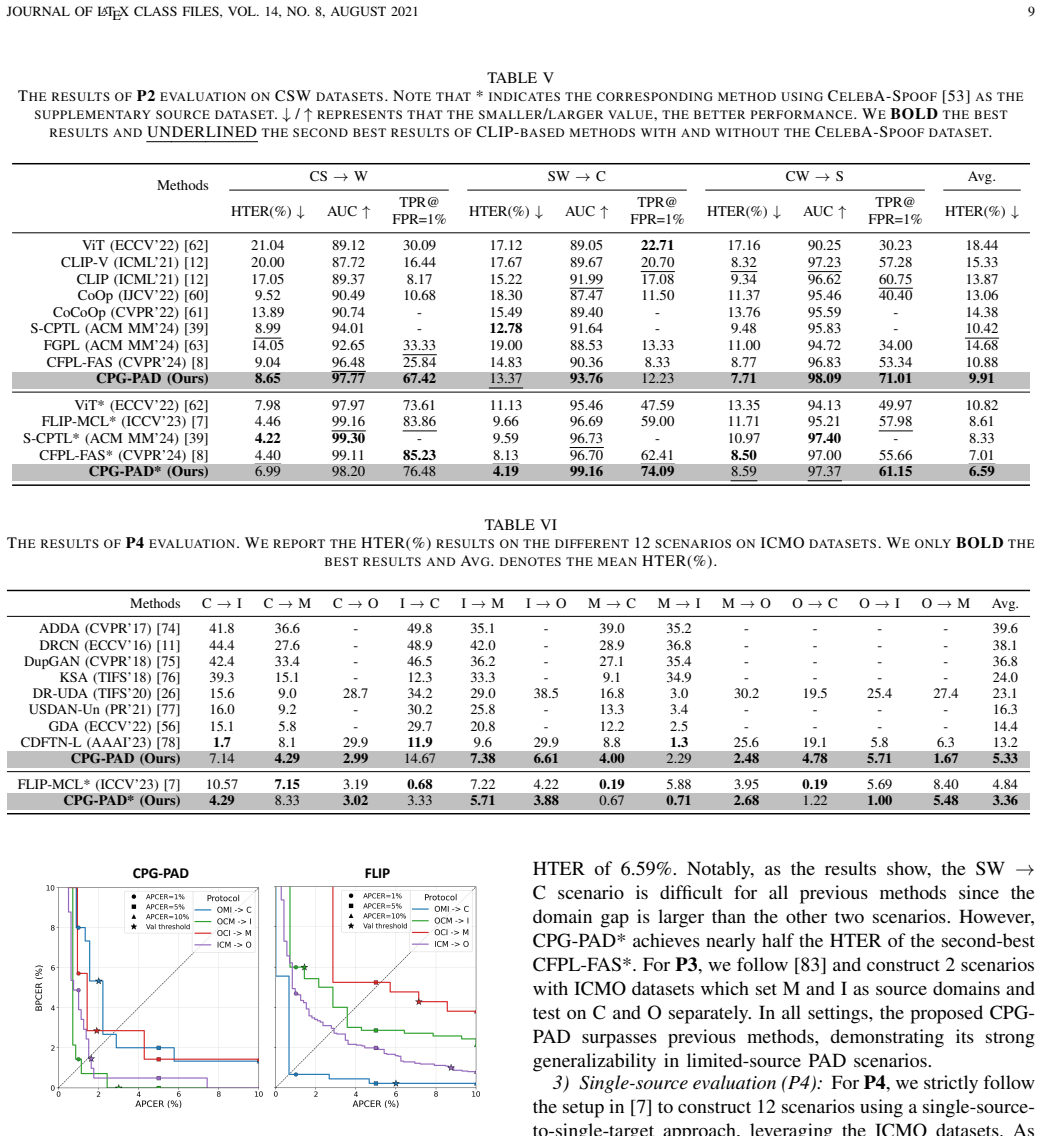
Presentation Attack Detection (PAD) serves as a crucial safeguard for face recognition systems against presentation attacks such as printed photos, replayed videos, and 3D masks. Despite significant progress, existing PAD models still struggle to generalize across unseen domains due to variations in sensors, lighting, and attack materials. Recent Vision-Language Models (VLMs) have shown strong generalization ability, yet their applications in PAD remain limited because learned prompts, typically optimized under class-label supervision, fail to explicitly align with fine-grained attack-relevant visual semantics. As a result, the learned representations often overfit domain-specific artifacts instead of capturing transferable attack cues. To address this, we propose Concept-Informed Prompts Guided Presentation Attack Detection (CPG-PAD), a framework that introduces model-level concept guidance into the prompt learning process. Specifically, we design a Visual Concept-driven Enhancement (VCE) module that employs eXplainable AI (XAI) techniques to automatically discover PAD-relevant visual concepts and generate concept-associated heatmaps providing localized fine-grained guidance. Guided by these heatmaps, a Prompt-based Concept Injection (PCI) mechanism integrates these concepts into the prompt space through a Visual-Prompt Decoder (VPD) and a concept-mapping loss, enabling prompts to align with the model's internal concept space. This design enables CPG-PAD to capture generalizable and domain-invariant attack cues while effectively suppressing dataset-specific biases. Extensive experiments across nine benchmark datasets demonstrate that CPG-PAD consistently achieves state-of-the-art cross-domain performance under multi-source, limited-source, and single-source settings.
Figures


Figures from the paper (5 more)



Reference graph
Works this paper leans on
-
[3]
Contrastive context-aware learning for 3d high- fidelity mask face presentation attack detection,
A. Liu, C. Zhao, Z. Yu, J. Wan, A. Su, X. Liu, Z. Tan, S. Escalera, J. Xing, Y . Lianget al., “Contrastive context-aware learning for 3d high- fidelity mask face presentation attack detection,”IEEE Transactions on Information Forensics and Security, vol. 17, pp. 2497–2507, 2022
work page 2022
-
[4]
Face liveness detection based on texture and frequency analyses,
G. Kim, S. Eum, J. K. Suhr, D. I. Kim, K. R. Park, and J. Kim, “Face liveness detection based on texture and frequency analyses,” in2012 5th IAPR international conference on biometrics (ICB). IEEE, 2012, pp. 67–72
work page 2012
-
[5]
Face liveness detection with component dependent descriptor,
J. Yang, Z. Lei, S. Liao, and S. Z. Li, “Face liveness detection with component dependent descriptor,” in2013 international conference on biometrics (ICB). IEEE, 2013, pp. 1–6
work page 2013
-
[6]
Face liveness detection by learning multispectral reflectance distributions,
Z. Zhang, D. Yi, Z. Lei, and S. Z. Li, “Face liveness detection by learning multispectral reflectance distributions,” in2011 IEEE International Conference on Automatic Face & Gesture Recognition (FG). IEEE, 2011, pp. 436–441
work page 2011
-
[7]
Flip: Cross-domain face anti-spoofing with language guidance,
K. Srivatsan, M. Naseer, and K. Nandakumar, “Flip: Cross-domain face anti-spoofing with language guidance,” inProceedings of the IEEE/CVF International Conference on Computer Vision (ICCV), October 2023, pp. 19 685–19 696
work page 2023
-
[8]
Cfpl-fas: Class free prompt learning for generalizable face anti- spoofing,
A. Liu, S. Xue, J. Gan, J. Wan, Y . Liang, J. Deng, S. Escalera, and Z. Lei, “Cfpl-fas: Class free prompt learning for generalizable face anti- spoofing,” inProceedings of the IEEE/CVF Conference on Computer Vision and Pattern Recognition, 2024, pp. 222–232
work page 2024
-
[9]
Instance-aware domain generalization for face anti-spoofing,
Q. Zhou, K.-Y . Zhang, T. Yao, X. Lu, R. Yi, S. Ding, and L. Ma, “Instance-aware domain generalization for face anti-spoofing,” inPro- ceedings of the IEEE/CVF conference on computer vision and pattern recognition, 2023, pp. 20 453–20 463
work page 2023
-
[10]
Gradient alignment for cross-domain face anti- spoofing,
B. M. Le and S. S. Woo, “Gradient alignment for cross-domain face anti- spoofing,” inProceedings of the IEEE/CVF Conference on Computer Vision and Pattern Recognition, 2024, pp. 188–199
work page 2024
Show all 82 references
-
[11]
Deep reconstruction-classification networks for unsupervised domain adap- tation,
M. Ghifary, W. B. Kleijn, M. Zhang, D. Balduzzi, and W. Li, “Deep reconstruction-classification networks for unsupervised domain adap- tation,” inComputer Vision–ECCV 2016: 14th European Conference, Amsterdam, The Netherlands, October 11–14, 2016, Proceedings, Part IV 14. Spri...
2016
-
[12]
Learning transferable visual models from natural language supervision,
A. Radford, J. W. Kim, C. Hallacy, A. Ramesh, G. Goh, S. Agarwal, G. Sastry, A. Askell, P. Mishkin, J. Clarket al., “Learning transferable visual models from natural language supervision,” inInternational conference on machine learning. PmLR, 2021, pp. 8748–8763
2021
-
[13]
Grad-cam: Visual explanations from deep networks via gradient-based localization,
R. R. Selvaraju, M. Cogswell, A. Das, R. Vedantam, D. Parikh, and D. Batra, “Grad-cam: Visual explanations from deep networks via gradient-based localization,” inProceedings of the IEEE international conference on computer vision, 2017, pp. 618–626
2017
-
[14]
Towards automatic concept-based explanations,
A. Ghorbani, J. Wexler, J. Y . Zou, and B. Kim, “Towards automatic concept-based explanations,”Advances in neural information processing systems, vol. 32, 2019
2019
-
[15]
Craft: Concept recursive activation factor- ization for explainability,
T. Fel, A. Picard, L. Bethune, T. Boissin, D. Vigouroux, J. Colin, R. Cad `ene, and T. Serre, “Craft: Concept recursive activation factor- ization for explainability,” inProceedings of the IEEE/CVF Conference on Computer Vision and Pattern Recognition, 2023, pp. 2711–2721
2023
-
[16]
Lbp- top based countermeasure against face spoofing attacks,
T. de Freitas Pereira, A. Anjos, J. M. De Martino, and S. Marcel, “Lbp- top based countermeasure against face spoofing attacks,” inAsian conference on computer vision. Springer, 2012, pp. 121–132
2012
-
[17]
Face spoofing detec- tion using colour texture analysis,
Z. Boulkenafet, J. Komulainen, and A. Hadid, “Face spoofing detec- tion using colour texture analysis,”IEEE Transactions on Information Forensics and Security, vol. 11, no. 8, pp. 1818–1830, 2016
2016
-
[18]
Context based face anti- spoofing,
J. Komulainen, A. Hadid, and M. Pietik ¨ainen, “Context based face anti- spoofing,” in2013 IEEE sixth international conference on biometrics: theory, applications and systems (BTAS). IEEE, 2013, pp. 1–8
2013
-
[19]
Secure face unlock: Spoof detection on smartphones,
K. Patel, H. Han, and A. K. Jain, “Secure face unlock: Spoof detection on smartphones,”IEEE transactions on information forensics and security, vol. 11, no. 10, pp. 2268–2283, 2016
2016
-
[20]
Learning deep models for face anti- spoofing: Binary or auxiliary supervision,
Y . Liu, A. Jourabloo, and X. Liu, “Learning deep models for face anti- spoofing: Binary or auxiliary supervision,” inProceedings of the IEEE conference on computer vision and pattern recognition, 2018, pp. 389– 398. JOURNAL OF LATEX CLASS FILES, VOL. 14, NO. 8, AUGUST 2021 13
2018
-
[21]
Searching central difference convolutional networks for face anti- spoofing,
Z. Yu, C. Zhao, Z. Wang, Y . Qin, Z. Su, X. Li, F. Zhou, and G. Zhao, “Searching central difference convolutional networks for face anti- spoofing,” inProceedings of the IEEE/CVF conference on computer vision and pattern recognition, 2020, pp. 5295–5305
2020
-
[22]
Deep spatial gradient and temporal depth learning for face anti-spoofing,
Z. Wang, Z. Yu, C. Zhao, X. Zhu, Y . Qin, Q. Zhou, F. Zhou, and Z. Lei, “Deep spatial gradient and temporal depth learning for face anti-spoofing,” inProceedings of the IEEE/CVF conference on computer vision and pattern recognition, 2020, pp. 5042–5051
2020
-
[23]
Face anti-spoofing using transformers with relation-aware mechanism,
Z. Wang, Q. Wang, W. Deng, and G. Guo, “Face anti-spoofing using transformers with relation-aware mechanism,”IEEE Transactions on Biometrics, Behavior, and Identity Science, vol. 4, no. 3, pp. 439–450, 2022
2022
-
[24]
On the effectiveness of vision transformers for zero-shot face anti-spoofing,
A. George and S. Marcel, “On the effectiveness of vision transformers for zero-shot face anti-spoofing,” in2021 IEEE international joint conference on biometrics (IJCB). IEEE, 2021, pp. 1–8
2021
-
[26]
Unsupervised adversarial domain adaptation for cross-domain face presentation attack detection,
G. Wang, H. Han, S. Shan, and X. Chen, “Unsupervised adversarial domain adaptation for cross-domain face presentation attack detection,” IEEE Transactions on Information Forensics and Security, vol. 16, pp. 56–69, 2020
2020
-
[27]
Self-domain adaptation for face anti-spoofing,
J. Wang, J. Zhang, Y . Bian, Y . Cai, C. Wang, and S. Pu, “Self-domain adaptation for face anti-spoofing,” inProceedings of the AAAI conference on artificial intelligence, vol. 35, no. 4, 2021, pp. 2746–2754
2021
-
[28]
Towards unsupervised domain generalization for face anti-spoofing,
Y . Liu, Y . Chen, M. Gou, C.-T. Huang, Y . Wang, W. Dai, and H. Xiong, “Towards unsupervised domain generalization for face anti-spoofing,” in Proceedings of the IEEE/CVF International Conference on Computer Vision, 2023, pp. 20 654–20 664
2023
-
[29]
Dual reweighting domain generalization for face presentation attack detection,
S. Liu, K.-Y . Zhang, T. Yao, K. Sheng, S. Ding, Y . Tai, J. Li, Y . Xie, and L. Ma, “Dual reweighting domain generalization for face presentation attack detection,”arXiv preprint arXiv:2106.16128, 2021
2021
-
[30]
Regularized fine-grained meta face anti-spoofing,
R. Shao, X. Lan, and P. C. Yuen, “Regularized fine-grained meta face anti-spoofing,” inProceedings of the AAAI conference on artificial intelligence, vol. 34, no. 07, 2020, pp. 11 974–11 981
2020
-
[31]
Test-time domain generalization for face anti-spoofing,
Q. Zhou, K.-Y . Zhang, T. Yao, X. Lu, S. Ding, and L. Ma, “Test-time domain generalization for face anti-spoofing,” inProceedings of the IEEE/CVF Conference on Computer Vision and Pattern Recognition, 2024, pp. 175–187
2024
-
[32]
Rethinking general- izable face anti-spoofing via hierarchical prototype-guided distribution refinement in hyperbolic space,
C. Hu, K.-Y . Zhang, T. Yao, S. Ding, and L. Ma, “Rethinking general- izable face anti-spoofing via hierarchical prototype-guided distribution refinement in hyperbolic space,” inProceedings of the IEEE/CVF Conference on Computer Vision and Pattern Recognition, 2024, pp. 1032–1041
2024
-
[33]
Exploiting temporal and depth information for multi-frame face anti- spoofing,
Z. Wang, C. Zhao, Y . Qin, Q. Zhou, G. Qi, J. Wan, and Z. Lei, “Exploiting temporal and depth information for multi-frame face anti- spoofing,”arXiv preprint arXiv:1811.05118, 2018
2018 arXiv
-
[34]
Face anti-spoofing via robust auxiliary estimation and discriminative feature learning,
P.-K. Huang, M.-C. Chin, and C.-T. Hsu, “Face anti-spoofing via robust auxiliary estimation and discriminative feature learning,” inAsian Conference on Pattern Recognition. Springer, 2021, pp. 443–458
2021
-
[35]
Learning multiple explainable and generalizable cues for face anti-spoofing,
Y . Bian, P. Zhang, J. Wang, C. Wang, and S. Pu, “Learning multiple explainable and generalizable cues for face anti-spoofing,” inICASSP 2022-2022 IEEE International Conference on Acoustics, Speech and Signal Processing (ICASSP). IEEE, 2022, pp. 2310–2314
2022
-
[36]
An attention-guided framework for explainable biometric presentation attack detection,
S. Pan, S. Hoque, and F. Deravi, “An attention-guided framework for explainable biometric presentation attack detection,”Sensors, vol. 22, no. 9, p. 3365, 2022
2022
-
[37]
Are foundation models all you need for zero-shot face presentation attack detection?
L. J. Gonzalez-Soler, J. E. Tapia, and C. Busch, “Are foundation models all you need for zero-shot face presentation attack detection?” in2025 IEEE 19th International Conference on Automatic Face and Gesture Recognition (FG). IEEE, 2025, pp. 1–10
2025
-
[38]
Foundpad: Foundation models reloaded for face presentation attack detection,
G. Ozgur, E. Caldeira, T. Chettaoui, F. Boutros, R. Ramachandra, and N. Damer, “Foundpad: Foundation models reloaded for face presentation attack detection,” inProceedings of the Winter Conference on Applica- tions of Computer Vision, 2025, pp. 745–755
2025
-
[39]
Style-conditional prompt token learning for generalizable face anti- spoofing,
J. Guo, H. Liu, Y . Luo, X. Hu, H. Zou, Y . Zhang, H. Liu, and B. Zhao, “Style-conditional prompt token learning for generalizable face anti- spoofing,” inProceedings of the 32nd ACM International Conference on Multimedia, 2024, pp. 994–1003
2024
-
[40]
Domain generalization for face anti-spoofing via content- aware composite prompt engineering,
J. Guo, A. Liu, Y . Diao, J. Zhang, H. Ma, B. Zhao, R. Hong, and M. Wang, “Domain generalization for face anti-spoofing via content- aware composite prompt engineering,”IEEE Transactions on Multime- dia, 2025
2025
-
[41]
Tf-fas: twofold-element fine-grained semantic guidance for generaliz- able face anti-spoofing,
X. Wang, K.-Y . Zhang, T. Yao, Q. Zhou, S. Ding, P. Dai, and R. Ji, “Tf-fas: twofold-element fine-grained semantic guidance for generaliz- able face anti-spoofing,” inEuropean Conference on Computer Vision. Springer, 2024, pp. 148–168
2024
-
[42]
Dgpdl: Domain-guided prompt distribution learning for generalizable face anti-spoofing,
A. Liu, X. Lin, R. Zhi, Y . Liang, X. Zhu, Z. Cai, J. Wan, S. Escalera, and Z. Lei, “Dgpdl: Domain-guided prompt distribution learning for generalizable face anti-spoofing,”IEEE Transactions on Pattern Analysis and Machine Intelligence, 2026
2026
-
[43]
Icpe-fas: Instance and category prompts engineering for generalizable face anti-spoofing: A. liu et al
A. Liu, X. Lin, H. Ma, X. Yu, J. Guo, Z. Yu, J. Wan, Z. Cai, Z. Lei, and Y . Liang, “Icpe-fas: Instance and category prompts engineering for generalizable face anti-spoofing: A. liu et al.”International Journal of Computer Vision, vol. 134, no. 6, p. 292, 2026
2026
-
[44]
Ablation-cam: Visual explanations for deep convolutional network via gradient-free localization,
H. G. Ramaswamyet al., “Ablation-cam: Visual explanations for deep convolutional network via gradient-free localization,” inproceedings of the IEEE/CVF winter conference on applications of computer vision, 2020, pp. 983–991
2020
-
[45]
Grad-cam++: Generalized gradient-based visual explanations for deep convolutional networks,
A. Chattopadhay, A. Sarkar, P. Howlader, and V . N. Balasubramanian, “Grad-cam++: Generalized gradient-based visual explanations for deep convolutional networks,” in2018 IEEE winter conference on applica- tions of computer vision (WACV). IEEE, 2018, pp. 839–847
2018
-
[46]
On pixel-wise explanations for non-linear classifier deci- sions by layer-wise relevance propagation,
S. Bach, A. Binder, G. Montavon, F. Klauschen, K.-R. M ¨uller, and W. Samek, “On pixel-wise explanations for non-linear classifier deci- sions by layer-wise relevance propagation,”PloS one, vol. 10, no. 7, p. e0130140, 2015
2015
-
[47]
Rise: Randomized input sampling for explanation of black- box models,
V . Petsiuk, “Rise: Randomized input sampling for explanation of black- box models,”arXiv preprint arXiv:1806.07421, 2018
2018 arXiv
-
[48]
Interpretability beyond feature attribution: Quantitative testing with concept activation vectors (tcav),
B. Kim, M. Wattenberg, J. Gilmer, C. Cai, J. Wexler, F. Viegas et al., “Interpretability beyond feature attribution: Quantitative testing with concept activation vectors (tcav),” inInternational conference on machine learning. PMLR, 2018, pp. 2668–2677
2018
-
[49]
Convex and semi-nonnegative ma- trix factorizations,
C. H. Ding, T. Li, and M. I. Jordan, “Convex and semi-nonnegative ma- trix factorizations,”IEEE transactions on pattern analysis and machine intelligence, vol. 32, no. 1, pp. 45–55, 2008
2008
-
[50]
A holistic approach to unifying automatic concept extraction and concept importance estimation,
T. Fel, V . Boutin, L. B ´ethune, R. Cad `ene, M. Moayeri, L. And ´eol, M. Chalvidal, and T. Serre, “A holistic approach to unifying automatic concept extraction and concept importance estimation,”Advances in Neural Information Processing Systems, vol. 36, pp. 54 805–54 818, 2023
2023
-
[51]
Attention is all you need,
A. Vaswani, N. Shazeer, N. Parmar, J. Uszkoreit, L. Jones, A. N. Gomez, L. Kaiser, and I. Polosukhin, “Attention is all you need,” inProceedings of the 31st International Conference on Neural Information Processing Systems, ser. NIPS’17. Red Hook, NY , USA: Curran Associates I...
2017
-
[52]
The hungarian method for the assignment problem,
H. W. Kuhn, “The hungarian method for the assignment problem,”Naval research logistics quarterly, vol. 2, no. 1-2, pp. 83–97, 1955
1955
-
[53]
Celeba- spoof: Large-scale face anti-spoofing dataset with rich annotations,
Y . Zhang, Z. Yin, Y . Li, G. Yin, J. Yan, J. Shao, and Z. Liu, “Celeba- spoof: Large-scale face anti-spoofing dataset with rich annotations,” in Computer Vision–ECCV 2020: 16th European Conference, Glasgow, UK, August 23–28, 2020, Proceedings, Part XII 16. Springer, 2020, pp. 70–85
2020
-
[54]
Syn- thesizing the preferred inputs for neurons in neural networks via deep generator networks,
A. Nguyen, A. Dosovitskiy, J. Yosinski, T. Brox, and J. Clune, “Syn- thesizing the preferred inputs for neurons in neural networks via deep generator networks,”Advances in neural information processing systems, vol. 29, 2016
2016
-
[55]
Feature generation and hypothesis verification for reliable face anti-spoofing,
S. Liu, S. Lu, H. Xu, J. Yang, S. Ding, and L. Ma, “Feature generation and hypothesis verification for reliable face anti-spoofing,” inProceed- ings of the AAAI Conference on Artificial Intelligence, vol. 36, no. 2, 2022, pp. 1782–1791
2022
-
[56]
Generative domain adaptation for face anti-spoofing,
Q. Zhou, K.-Y . Zhang, T. Yao, R. Yi, K. Sheng, S. Ding, and L. Ma, “Generative domain adaptation for face anti-spoofing,” inEuropean conference on computer vision. Springer, 2022, pp. 335–356
2022
-
[57]
Domain generalization via shuffled style assembly for face anti-spoofing,
Z. Wang, Z. Wang, Z. Yu, W. Deng, J. Li, T. Gao, and Z. Wang, “Domain generalization via shuffled style assembly for face anti-spoofing,” in Proceedings of the IEEE/CVF conference on computer vision and pattern recognition, 2022, pp. 4123–4133
2022
-
[58]
Rethinking domain generalization for face anti-spoofing: Separability and alignment,
Y . Sun, Y . Liu, X. Liu, Y . Li, and W.-S. Chu, “Rethinking domain generalization for face anti-spoofing: Separability and alignment,” in Proceedings of the IEEE/CVF conference on computer vision and pattern recognition, 2023, pp. 24 563–24 574
2023
-
[59]
Domain invariant vision transformer learning for face anti-spoofing,
C.-H. Liao, W.-C. Chen, H.-T. Liu, Y .-R. Yeh, M.-C. Hu, and C.-S. Chen, “Domain invariant vision transformer learning for face anti-spoofing,” inProceedings of the IEEE/CVF winter conference on applications of computer vision, 2023, pp. 6098–6107
2023
-
[60]
Learning to prompt for vision-language models,
K. Zhou, J. Yang, C. C. Loy, and Z. Liu, “Learning to prompt for vision-language models,”Int. J. Comput. Vision, vol. 130, no. 9, p. 2337–2348, Sep. 2022. [Online]. Available: https://doi.org/10.1007/ s11263-022-01653-1 JOURNAL OF LATEX CLASS FILES, VOL. 14, NO. 8, AUGUST 2021 14
2022
-
[61]
Conditional prompt learning for vision-language models,
——, “Conditional prompt learning for vision-language models,” in Proceedings of the IEEE/CVF conference on computer vision and pattern recognition, 2022, pp. 16 816–16 825
2022
-
[62]
Adaptive transformers for robust few-shot cross- domain face anti-spoofing,
H.-P. Huang, D. Sun, Y . Liu, W.-S. Chu, T. Xiao, J. Yuan, H. Adam, and M.-H. Yang, “Adaptive transformers for robust few-shot cross- domain face anti-spoofing,” inEuropean conference on computer vision. Springer, 2022, pp. 37–54
2022
-
[63]
Fine-grained prompt learning for face anti-spoofing,
X. Hu, H. Liu, H. Yuan, Z. Fu, Y . Luo, N. Zhang, H. Zou, J. Gan, and Y . Zhang, “Fine-grained prompt learning for face anti-spoofing,” in Proceedings of the 32nd ACM International Conference on Multimedia, 2024, pp. 7619–7628
2024
-
[64]
Interpretable face anti-spoofing: Enhancing gener- alization with multimodal large language models,
G. Zhang, K. Wang, H. Yue, A. Liu, G. Zhang, K. Yao, E. Ding, and J. Wang, “Interpretable face anti-spoofing: Enhancing gener- alization with multimodal large language models,”arXiv preprint arXiv:2501.01720, 2025
2025
-
[65]
Information Tech- nology - Biometric presentation attack detection - Part 3: Testing and Reporting, International Organization for Standardization, 2023
ISO/IEC JTC1 SC37 Biometrics,ISO/IEC 30107-3. Information Tech- nology - Biometric presentation attack detection - Part 3: Testing and Reporting, International Organization for Standardization, 2023
2023
-
[66]
Face spoof detection with image distortion analysis,
D. Wen, H. Han, and A. K. Jain, “Face spoof detection with image distortion analysis,”IEEE Transactions on Information Forensics and Security, vol. 10, no. 4, pp. 746–761, 2015
2015
-
[67]
A face anti- spoofing database with diverse attacks,
Z. Zhang, J. Yan, S. Liu, Z. Lei, D. Yi, and S. Z. Li, “A face anti- spoofing database with diverse attacks,” in2012 5th IAPR international conference on Biometrics (ICB). IEEE, 2012, pp. 26–31
2012
-
[68]
On the effectiveness of local binary patterns in face anti-spoofing,
I. Chingovska, A. Anjos, and S. Marcel, “On the effectiveness of local binary patterns in face anti-spoofing,” in2012 BIOSIG-proceedings of the international conference of biometrics special interest group (BIOSIG). IEEE, 2012, pp. 1–7
2012
-
[69]
Oulu-npu: A mobile face presentation attack database with real-world variations,
Z. Boulkenafet, J. Komulainen, L. Li, X. Feng, and A. Hadid, “Oulu-npu: A mobile face presentation attack database with real-world variations,” in2017 12th IEEE international conference on automatic face & gesture recognition (FG 2017). IEEE, 2017, pp. 612–618
2017
-
[70]
Casia-surf: A large-scale multi-modal benchmark for face anti-spoofing,
S. Zhang, A. Liu, J. Wan, Y . Liang, G. Guo, S. Escalera, H. J. Escalante, and S. Z. Li, “Casia-surf: A large-scale multi-modal benchmark for face anti-spoofing,”IEEE Transactions on Biometrics, Behavior, and Identity Science, vol. 2, no. 2, pp. 182–193, 2020
2020
-
[71]
Casia-surf cefa: A benchmark for multi-modal cross-ethnicity face anti-spoofing,
A. Liu, Z. Tan, J. Wan, S. Escalera, G. Guo, and S. Z. Li, “Casia-surf cefa: A benchmark for multi-modal cross-ethnicity face anti-spoofing,” inProceedings of the IEEE/CVF winter conference on applications of computer vision, 2021, pp. 1179–1187
2021
-
[72]
Biometric face presentation attack detection with multi- channel convolutional neural network,
A. George, Z. Mostaani, D. Geissenbuhler, O. Nikisins, A. Anjos, and S. Marcel, “Biometric face presentation attack detection with multi- channel convolutional neural network,”IEEE transactions on informa- tion forensics and security, vol. 15, pp. 42–55, 2019
2019
-
[73]
Multi-domain learning for updating face anti-spoofing models,
X. Guo, Y . Liu, A. Jain, and X. Liu, “Multi-domain learning for updating face anti-spoofing models,” inEuropean conference on computer vision. Springer, 2022, pp. 230–249
2022
-
[74]
Adversarial discrim- inative domain adaptation,
E. Tzeng, J. Hoffman, K. Saenko, and T. Darrell, “Adversarial discrim- inative domain adaptation,” inProceedings of the IEEE conference on computer vision and pattern recognition, 2017, pp. 7167–7176
2017
-
[75]
Duplex generative adversarial network for unsupervised domain adaptation,
L. Hu, M. Kan, S. Shan, and X. Chen, “Duplex generative adversarial network for unsupervised domain adaptation,” inProceedings of the IEEE conference on computer vision and pattern recognition, 2018, pp. 1498–1507
2018
-
[76]
Unsuper- vised domain adaptation for face anti-spoofing,
H. Li, W. Li, H. Cao, S. Wang, F. Huang, and A. C. Kot, “Unsuper- vised domain adaptation for face anti-spoofing,”IEEE Transactions on Information Forensics and Security, vol. 13, no. 7, pp. 1794–1809, 2018
2018
-
[77]
Unified unsupervised and semi-supervised domain adaptation network for cross-scenario face anti- spoofing,
Y . Jia, J. Zhang, S. Shan, and X. Chen, “Unified unsupervised and semi-supervised domain adaptation network for cross-scenario face anti- spoofing,”Pattern Recognition, vol. 115, p. 107888, 2021
2021
-
[78]
Cyclically disentangled feature translation for face anti-spoofing,
H. Yue, K. Wang, G. Zhang, H. Feng, J. Han, E. Ding, and J. Wang, “Cyclically disentangled feature translation for face anti-spoofing,” in Proceedings of the AAAI conference on artificial intelligence, vol. 37, no. 3, 2023, pp. 3358–3366
2023
-
[79]
Single-side domain generaliza- tion for face anti-spoofing,
Y . Jia, J. Zhang, S. Shan, and X. Chen, “Single-side domain generaliza- tion for face anti-spoofing,” inProceedings of the IEEE/CVF conference on computer vision and pattern recognition, 2020, pp. 8484–8493
2020
-
[80]
Learning meta pattern for face anti-spoofing,
R. Cai, Z. Li, R. Wan, H. Li, Y . Hu, and A. C. Kot, “Learning meta pattern for face anti-spoofing,”IEEE Transactions on Information Forensics and Security, vol. 17, pp. 1201–1213, 2022
2022
-
[81]
Causal interven- tion for generalizable face anti-spoofing,
Y . Liu, Y . Chen, W. Dai, C. Li, J. Zou, and H. Xiong, “Causal interven- tion for generalizable face anti-spoofing,” in2022 IEEE International Conference on Multimedia and Expo (ICME). IEEE, 2022, pp. 01–06
2022
-
[82]
Domain- generalized face anti-spoofing with unknown attacks,
Z.-W. Hong, Y .-C. Lin, H.-T. Liu, Y .-R. Yeh, and C.-S. Chen, “Domain- generalized face anti-spoofing with unknown attacks,” in2023 IEEE International Conference on Image Processing (ICIP). IEEE, 2023, pp. 820–824
2023
-
[83]
Bottom-up domain prompt tuning for generalized face anti-spoofing,
S.-Q. Liu, Q. Wang, and P. C. Yuen, “Bottom-up domain prompt tuning for generalized face anti-spoofing,” inEuropean Conference on Computer Vision. Springer, 2024, pp. 170–187
2024
-
[84]
From intuition to investigation: A tool-augmented reasoning mllm framework for generalizable face anti- spoofing,
H. Zhang, K. Wang, G. Zhang, H. Yue, Z. Tan, S. Peng, T. Zhang, X. Tan, K. Chen, W. Heet al., “From intuition to investigation: A tool-augmented reasoning mllm framework for generalizable face anti- spoofing,” inProceedings of the IEEE/CVF Conference on Computer Vision and Pat...
2026
-
[85]
Visualizing data using t-sne
L. Van der Maaten and G. Hinton, “Visualizing data using t-sne.”Journal of machine learning research, vol. 9, no. 11, 2008
2008
Reviewed July 3, 2026 · model on record in the stance chip above.
Discussion (0). Continue with ORCID to comment.