GaussTrace: Provenance Analysis of 3D Gaussian Splatting Models with Evidence-based LLM Reasoning
Pith reviewed 2026-06-27 13:37 UTC · model grok-4.3
The pith
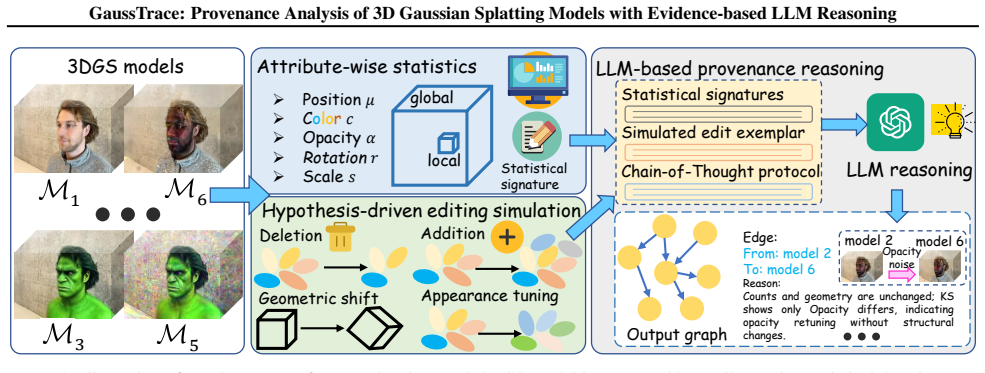
GaussTrace constructs directed provenance graphs for 3D Gaussian Splatting models by feeding attribute-wise statistical profiles and simulated edits into an LLM for chain-of-thought inference.
A machine-rendered reading of the paper's core claim, the machinery that carries it, and where it could break.
Core claim
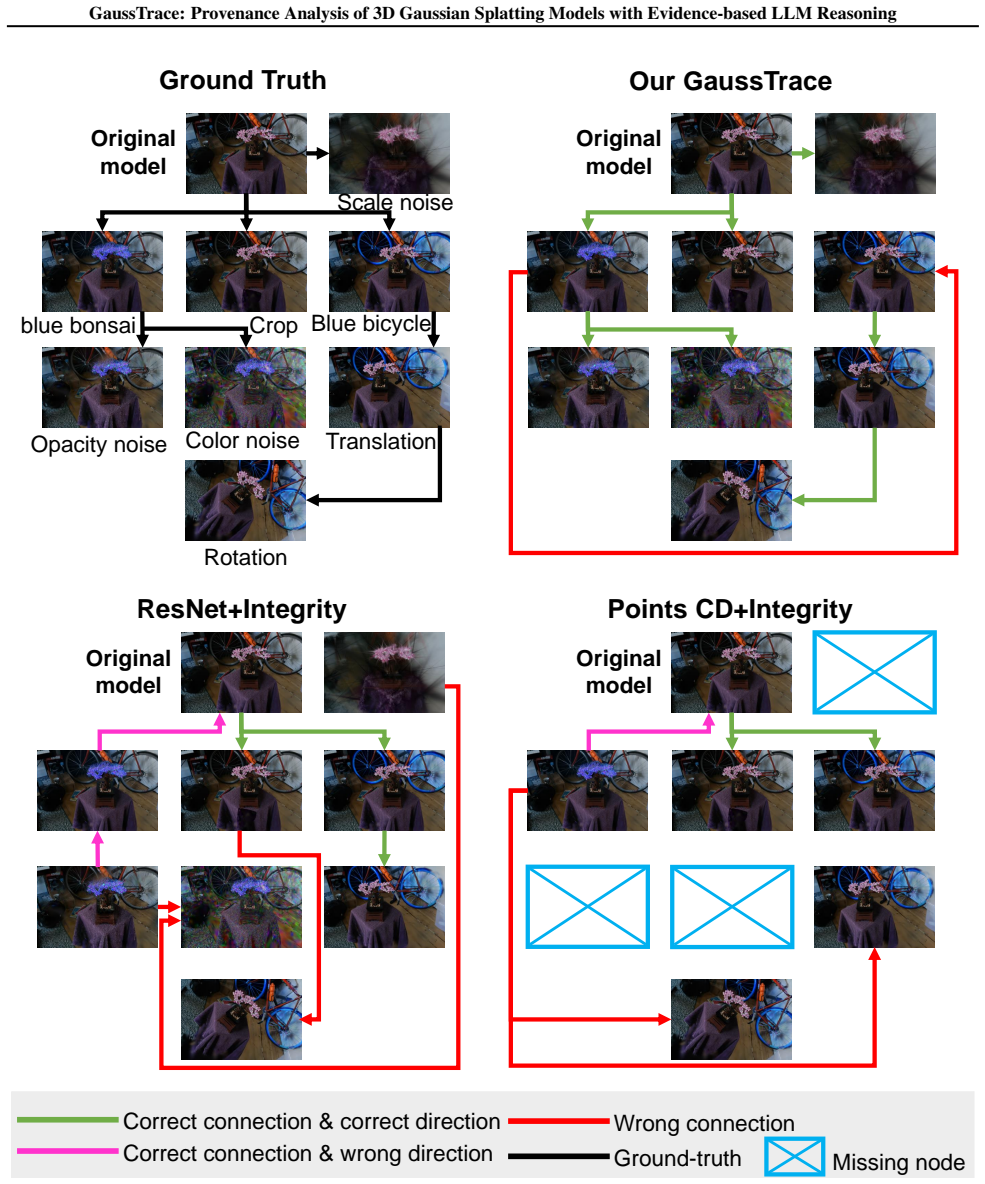
GaussTrace formulates provenance analysis as an evidence-based reasoning problem. It builds upon attribute-wise statistical profiling of 3DGS parameters to capture intrinsic properties. Hypothesis-driven editing simulations of common operations provide auxiliary evidence for plausible transformation pathways. These statistical and simulated cues jointly enable a Large Language Model to perform structured Chain-of-Thought reasoning, yielding directional provenance inferences and explainable edge reasons. Experimental results demonstrate that GaussTrace effectively constructs evolutionary relationships among diverse 3DGS models, delivering accurate, interpretable, and robust provenance graphs
What carries the argument
Evidence-based LLM reasoning that combines attribute-wise statistical profiling of 3DGS parameters with hypothesis-driven simulations of editing operations to infer directional transformation edges.
If this is right
- Produces directed provenance graphs that link diverse 3DGS models through inferred editing sequences.
- Yields both the graph structure and explicit textual reasons for each inferred edge.
- Operates without any model training step or access to original editing histories.
- Maintains performance across varied 3DGS models and editing operation types.
Where Pith is reading between the lines
- The same statistical-plus-simulation evidence pattern could be tested on other explicit 3D representations such as meshes or neural radiance fields.
- If the LLM inferences prove stable, platforms could run lightweight provenance checks on uploaded 3D assets as a standard forensic step.
- A natural next measurement would be to quantify how often the method correctly ranks multiple plausible edit orders when more than one sequence is possible.
Load-bearing premise
Attribute-wise statistical profiles plus simulated editing operations supply enough independent evidence for an LLM to produce reliable directional inferences about real-world transformation sequences.
What would settle it
Apply GaussTrace to a controlled collection of 3DGS models whose exact sequence of real edits is known in advance and measure whether the inferred directed graph recovers the correct chronological order at rates above chance.
Figures




read the original abstract
3D Gaussian Splatting (3DGS) is a powerful technique for creating high-fidelity 3D assets. However, the widespread sharing and iterative modification of 3DGS models across digital platforms create pressing challenges for intellectual property protection and forensic traceability. To address this, we propose GaussTrace, a novel framework for constructing directed provenance graphs for 3DGS models. GaussTrace formulates provenance analysis as an evidence-based reasoning problem. It builds upon attribute-wise statistical profiling of 3DGS parameters to capture intrinsic properties. Moreover, we introduce hypothesis-driven editing simulations of common operations to provide auxiliary evidence for plausible transformation pathways. These statistical and simulated cues jointly enable a Large Language Model (LLM) to perform structured Chain-of-Thought (CoT) reasoning, yielding directional provenance inferences and explainable edge reasons. Experimental results demonstrate that GaussTrace effectively constructs evolutionary relationships among diverse 3DGS models, delivering accurate, interpretable, and robust provenance graphs without requiring model training or access to editing histories. Project page: https://haolianghan.github.io/GaussTrace.
Editorial analysis
A structured set of objections, weighed in public.
Referee Report
Summary. The paper introduces GaussTrace, a framework for provenance analysis of 3D Gaussian Splatting (3DGS) models. It constructs directed provenance graphs by combining attribute-wise statistical profiling of 3DGS parameters with hypothesis-driven editing simulations. These provide evidence for a Large Language Model to perform Chain-of-Thought reasoning, producing directional inferences and explainable reasons for edges. The approach requires no model training or access to editing histories, and experimental results are claimed to show accurate, interpretable, and robust graphs for diverse 3DGS models.
Significance. If the central claims hold, this work could be significant for addressing intellectual property and traceability issues in the growing field of 3D asset creation and sharing using 3DGS. The method's training-free nature and use of LLM for structured reasoning on simulated evidence is a notable strength, offering interpretability valuable for forensic applications. It could inspire similar LLM-augmented approaches in other generative model domains.
major comments (2)
- [§3] §3 (Method): The assumption that attribute-wise statistical profiles augmented by editing simulations supply unique, disambiguating signatures for different transformation sequences is not validated. Multiple operations (pruning, densification, rotation, color shift) can induce statistically similar shifts in the same parameter distributions, leaving directional inferences dependent on untested LLM internal knowledge rather than provided evidence. This is load-bearing for the accuracy claim.
- [§4] §4 (Experiments): No quantitative metrics, error analysis, dataset details, ablation studies, or baseline comparisons are described to support the reported accuracy and robustness. Without these, it is impossible to determine whether results are affected by post-hoc choices in CoT prompts or simulation parameters, undermining the central experimental claim.
minor comments (2)
- [Abstract] Abstract: Specify the number and types of 3DGS models tested and the set of simulated edits to better contextualize the scope of the claimed results.
- [Notation] Notation: Introduce formal equations or definitions for the attribute-wise statistical profiles (means, covariances, opacities) to improve clarity and enable reproducibility.
Simulated Author's Rebuttal
We thank the referee for the detailed and constructive feedback. The comments highlight important areas for strengthening the validation of our method and the rigor of the experimental evaluation. We address each major comment below and commit to revisions that directly respond to the concerns raised.
read point-by-point responses
-
Referee: [§3] §3 (Method): The assumption that attribute-wise statistical profiles augmented by editing simulations supply unique, disambiguating signatures for different transformation sequences is not validated. Multiple operations (pruning, densification, rotation, color shift) can induce statistically similar shifts in the same parameter distributions, leaving directional inferences dependent on untested LLM internal knowledge rather than provided evidence. This is load-bearing for the accuracy claim.
Authors: We agree that explicit validation of signature uniqueness is necessary and currently insufficient in the manuscript. Section 3 describes how attribute-wise profiles compute multiple statistical moments (mean, variance, kurtosis) per parameter and how hypothesis-driven simulations generate operation-specific outcome tables (e.g., pruning reduces count while shifting opacity distributions in a characteristic way). The CoT prompt explicitly instructs the LLM to reason only from the supplied evidence. Nevertheless, the referee correctly notes that controlled tests distinguishing overlapping effects are absent. In revision we will add a new subsection with targeted experiments that isolate pairs of similar operations and quantify how often the joint evidence yields correct directional inference. revision: yes
-
Referee: [§4] §4 (Experiments): No quantitative metrics, error analysis, dataset details, ablation studies, or baseline comparisons are described to support the reported accuracy and robustness. Without these, it is impossible to determine whether results are affected by post-hoc choices in CoT prompts or simulation parameters, undermining the central experimental claim.
Authors: The referee is correct: the experimental section as written relies on qualitative demonstrations without the quantitative support required to substantiate the accuracy and robustness claims. We will revise §4 to include (1) dataset specifications and model counts, (2) quantitative metrics such as directional accuracy and graph edit distance against ground-truth provenance, (3) ablation studies on simulation parameters and CoT prompt variants, (4) error analysis across repeated runs, and (5) comparison against a simple statistical-matching baseline. These additions will be presented with tables and statistical significance tests. revision: yes
Circularity Check
No significant circularity detected
full rationale
The paper describes a framework that constructs provenance graphs via attribute-wise statistical profiling of 3DGS parameters combined with hypothesis-driven editing simulations, followed by LLM CoT reasoning. No equations, fitted parameters, self-definitional loops, or load-bearing self-citations appear in the abstract or described method. The central claim of accurate directed graphs is presented as validated by experiments on diverse models rather than reduced to the inputs by construction, rendering the derivation self-contained.
Axiom & Free-Parameter Ledger
Reference graph
Works this paper leans on
-
[1]
Langley , title =
P. Langley , title =. Proceedings of the 17th International Conference on Machine Learning (ICML 2000) , address =. 2000 , pages =
2000
-
[2]
T. M. Mitchell. The Need for Biases in Learning Generalizations. 1980
1980
-
[3]
M. J. Kearns , title =
-
[4]
Machine Learning: An Artificial Intelligence Approach, Vol. I. 1983
1983
-
[5]
R. O. Duda and P. E. Hart and D. G. Stork. Pattern Classification. 2000
2000
-
[6]
Suppressed for Anonymity , author=
-
[7]
Newell and P
A. Newell and P. S. Rosenbloom. Mechanisms of Skill Acquisition and the Law of Practice. Cognitive Skills and Their Acquisition. 1981
1981
-
[8]
A. L. Samuel. Some Studies in Machine Learning Using the Game of Checkers. IBM Journal of Research and Development. 1959
1959
-
[9]
3d gaussian splatting: Survey, technologies, challenges, and opportunities
Bao, Y., Ding, T., Huo, J., Liu, Y., Li, Y., Li, W., Gao, Y., and Luo, J. 3d gaussian splatting: Survey, technologies, challenges, and opportunities. IEEE Transactions on Circuits and Systems for Video Technology, 2025
2025
-
[10]
T., Mildenhall, B., Verbin, D., Srinivasan, P
Barron, J. T., Mildenhall, B., Verbin, D., Srinivasan, P. P., and Hedman, P. Mip- N e RF 360: Unbounded anti-aliased neural radiance fields. In Proceedings of the IEEE/CVF Conference on Computer Vision and Pattern Recognition, 2022
2022
-
[11]
S URF : Speeded up robust features
Bay, H., Tuytelaars, T., and Van Gool, L. S URF : Speeded up robust features. In European Conference on Computer Vision, 2006
2006
-
[12]
U- P hylogeny: Undirected provenance graph construction in the wild
Bharati, A., Moreira, D., Pinto, A., Brogan, J., Bowyer, K., Flynn, P., Scheirer, W., and Rocha, A. U- P hylogeny: Undirected provenance graph construction in the wild. In IEEE International Conference on Image Processing, 2017
2017
-
[13]
Beyond pixels: Image provenance analysis leveraging metadata
Bharati, A., Moreira, D., Brogan, J., Hale, P., Bowyer, K., Flynn, P., Rocha, A., and Scheirer, W. Beyond pixels: Image provenance analysis leveraging metadata. In IEEE Winter Conference on Applications of Computer Vision, 2019
2019
-
[14]
J., de Rezende Rocha, A., Bowyer, K
Bharati, A., Moreira, D., Flynn, P. J., de Rezende Rocha, A., Bowyer, K. W., and Scheirer, W. J. Transformation-aware embeddings for image provenance. IEEE Transactions on Information Forensics and Security, 2021
2021
-
[15]
Butt, M. A. and Maragos, P. Optimum design of chamfer distance transforms. IEEE Transactions on Image Processing, 1998
1998
-
[16]
Gaussian E ditor: Swift and controllable 3 D editing with gaussian splatting
Chen, Y., Chen, Z., Zhang, C., Wang, F., Yang, X., Wang, Y., Cai, Z., Yang, L., Liu, H., and Lin, G. Gaussian E ditor: Swift and controllable 3 D editing with gaussian splatting. In Proceedings of the IEEE/CVF Conference on Computer Vision and Pattern Recognition, 2024 a
2024
-
[17]
Splat F ormer: Point transformer for robust 3 D gaussian splatting
Chen, Y., Mihajlovic, M., Chen, X., Wang, Y., Prokudin, S., and Tang, S. Splat F ormer: Point transformer for robust 3 D gaussian splatting. arXiv preprint arXiv:2411.06390, 2024 b
arXiv 2024
-
[18]
Image phylogeny by minimal spanning trees
Dias, Z., Rocha, A., and Goldenstein, S. Image phylogeny by minimal spanning trees. IEEE Transactions on Information Forensics and Security, 2011
2011
-
[19]
An image is worth 16x16 words: Transformers for image recognition at scale
Dosovitskiy, A., Beyer, L., Kolesnikov, A., Weissenborn, D., Zhai, X., Unterthiner, T., Dehghani, M., Minderer, M., Heigold, G., Gelly, S., Uszkoreit, J., and Houlsby, N. An image is worth 16x16 words: Transformers for image recognition at scale. arXiv preprint arXiv:2010.11929, 2020
Pith/arXiv arXiv 2010
-
[20]
Trufor: Leveraging all-round clues for trustworthy image forgery detection and localization
Guillaro, F., Cozzolino, D., Sud, A., Dufour, N., and Verdoliva, L. Trufor: Leveraging all-round clues for trustworthy image forgery detection and localization. In Proceedings of the IEEE/CVF conference on computer vision and pattern recognition, 2023
2023
-
[21]
G S-Checker: Tampering localization for 3D gaussian splatting
Han, H., Luo, Z., Qi, J., Rocha, A., and Wan, R. G S-Checker: Tampering localization for 3D gaussian splatting. In Proceedings of the AAAI Conference on Artificial Intelligence, 2026
2026
-
[22]
A., Holynski, A., and Kanazawa, A
Haque, A., Tancik, M., Efros, A. A., Holynski, A., and Kanazawa, A. Instruct- NeRF2NeRF : Editing 3 D scenes with instructions. In Proceedings of the IEEE/CVF International Conference on Computer Vision, 2023
2023
-
[23]
Deep residual learning for image recognition
He, K., Zhang, X., Ren, S., and Sun, J. Deep residual learning for image recognition. In Proceedings of the IEEE Conference on Computer Vision and Pattern Recognition, 2016
2016
-
[24]
Deep blending for free-viewpoint image-based rendering
Hedman, P., Philip, J., Price, T., Frahm, J.-M., Drettakis, G., and Brostow, G. Deep blending for free-viewpoint image-based rendering. ACM Transactions on Graphics, 2018
2018
-
[25]
Huang, G., Liu, Z., Van Der Maaten, L., and Weinberger, K. Q. Densely connected convolutional networks. In Proceedings of the IEEE Conference on Computer Vision and Pattern Recognition, 2017
2017
-
[26]
C., See, S., and Wan, R
Huang, X., Li, R., Cheung, Y.-m., Cheung, K. C., See, S., and Wan, R. Gaussian M arker: Uncertainty-aware copyright protection of 3 D gaussian splatting. Advances in Neural Information Processing Systems, 2024
2024
-
[27]
Marksplatter: Generalizable watermarking for 3d gaussian splatting model via splatter image structure
Huang, X., Luo, Z., Song, Q., Wang, R., and Wan, R. Marksplatter: Generalizable watermarking for 3d gaussian splatting model via splatter image structure. In Proceedings of the 33rd ACM International Conference on Multimedia, 2025
2025
-
[28]
I., Jang, M., Kim, J
Jang, Y., Lee, D. I., Jang, M., Kim, J. W., Yang, F., and Kim, S. WateRF : Robust watermarks in radiance fields for protection of copyrights. In Proceedings of the IEEE/CVF Conference on Computer Vision and Pattern Recognition, 2024
2024
-
[29]
3 D-GSW : 3 D gaussian splatting for robust watermarking
Jang, Y., Park, H., Yang, F., Ko, H., Choo, E., and Kim, S. 3 D-GSW : 3 D gaussian splatting for robust watermarking. In Proceedings of the Computer Vision and Pattern Recognition Conference, 2025
2025
-
[30]
and Chang, S.-F
Kennedy, L. and Chang, S.-F. Internet image archaeology: Automatically tracing the manipulation history of photographs on the web. In Proceedings of the ACM International Conference on Multimedia, 2008
2008
-
[31]
3 D gaussian splatting for real-time radiance field rendering
Kerbl, B., Kopanas, G., Leimk \"u hler, T., and Drettakis, G. 3 D gaussian splatting for real-time radiance field rendering. ACM Transactions on Graphics, 2023
2023
-
[32]
Point-based neural rendering with per-view optimization
Kopanas, G., Philip, J., Leimk \"u hler, T., and Drettakis, G. Point-based neural rendering with per-view optimization. In Computer Graphics Forum, 2021
2021
-
[33]
Neural point catacaustics for novel-view synthesis of reflections
Kopanas, G., Leimk \"u hler, T., Rainer, G., Jambon, C., and Drettakis, G. Neural point catacaustics for novel-view synthesis of reflections. ACM Transactions on Graphics, 2022
2022
-
[34]
Kruskal, J. B. On the shortest spanning subtree of a graph and the traveling salesman problem. Proceedings of the American Mathematical society, 1956
1956
-
[35]
Vastgaussian: Vast 3 D gaussians for large scene reconstruction
Lin, J., Li, Z., Tang, X., Liu, J., Liu, S., Liu, J., Lu, Y., Wu, X., Xu, S., Yan, Y., et al. Vastgaussian: Vast 3 D gaussians for large scene reconstruction. In Proceedings of the IEEE/CVF Conference on Computer Vision and Pattern Recognition, 2024
2024
-
[36]
Lowe, D. G. Distinctive image features from scale-invariant keypoints. International Journal of Computer Vision, 2004
2004
-
[37]
Scaffold- GS : Structured 3 D gaussians for view-adaptive rendering
Lu, T., Yu, M., Xu, L., Xiangli, Y., Wang, L., Lin, D., and Dai, B. Scaffold- GS : Structured 3 D gaussians for view-adaptive rendering. In Proceedings of the IEEE/CVF Conference on Computer Vision and Pattern Recognition, 2024
2024
-
[38]
C., See, S., and Wan, R
Luo, Z., Guo, Q., Cheung, K. C., See, S., and Wan, R. Copyrnerf: Protecting the copyright of neural radiance fields. In Proceedings of the IEEE/CVF international conference on computer vision, 2023
2023
-
[39]
The nerf signature: Codebook-aided watermarking for neural radiance fields
Luo, Z., Rocha, A., Shi, B., Guo, Q., Li, H., and Wan, R. The nerf signature: Codebook-aided watermarking for neural radiance fields. IEEE Transactions on Pattern Analysis and Machine Intelligence, 2025
2025
-
[40]
D EG auss: Defending against malicious 3 D editing for gaussian splatting
Meng, L., Shao, M., Qiao, Y., and Lv, X. D EG auss: Defending against malicious 3 D editing for gaussian splatting. Advances in Neural Information Processing Systems, 2025
2025
-
[41]
P., Tancik, M., Barron, J
Mildenhall, B., Srinivasan, P. P., Tancik, M., Barron, J. T., Ramamoorthi, R., and Ng, R. Nerf: Representing scenes as neural radiance fields for view synthesis. In European Conference on Computer Vision, 2020
2020
-
[42]
W., Flynn, P
Moreira, D., Bharati, A., Brogan, J., Pinto, A., Parowski, M., Bowyer, K. W., Flynn, P. J., Rocha, A., and Scheirer, W. J. Image provenance analysis at scale. IEEE Transactions on Image Processing, 2018
2018
-
[43]
C., See, S., and Wan, R
Song, Q., Luo, Z., Cheung, K. C., See, S., and Wan, R. Geometry C loak: Preventing tgs-based 3 D reconstruction from copyrighted images. Advances in Neural Information Processing Systems, 2024 a
2024
-
[44]
C., See, S., and Wan, R
Song, Q., Luo, Z., Cheung, K. C., See, S., and Wan, R. Protecting nerfs’ copyright via plug-and-play watermarking base model. In European Conference on Computer Vision, 2024 b
2024
-
[45]
C., See, S., and Wan, R
Song, Q., Luo, Z., Cheung, K. C., See, S., and Wan, R. Align 3d representation and text embedding for 3d content personalization. In Proceedings of the 33rd ACM International Conference on Multimedia, 2025
2025
-
[46]
V., Zhou, D., et al
Wei, J., Wang, X., Schuurmans, D., Bosma, M., Xia, F., Chi, E., Le, Q. V., Zhou, D., et al. Chain-of-thought prompting elicits reasoning in large language models. Advances in neural information processing systems, 2022
2022
-
[47]
Physgaussian: Physics-integrated 3 D gaussians for generative dynamics
Xie, T., Zong, Z., Qiu, Y., Li, X., Feng, Y., Yang, Y., and Jiang, C. Physgaussian: Physics-integrated 3 D gaussians for generative dynamics. In Proceedings of the IEEE/CVF Conference on Computer Vision and Pattern Recognition, 2024
2024
-
[48]
Deformable 3 D gaussians for high-fidelity monocular dynamic scene reconstruction
Yang, Z., Gao, X., Zhou, W., Jiao, S., Zhang, Y., and Jin, X. Deformable 3 D gaussians for high-fidelity monocular dynamic scene reconstruction. In Proceedings of the IEEE/CVF Conference on Computer Vision and Pattern Recognition, 2024
2024
-
[49]
Differentiable surface splatting for point-based geometry processing
Yifan, W., Serena, F., Wu, S., \"O ztireli, C., and Sorkine-Hornung, O. Differentiable surface splatting for point-based geometry processing. ACM Transactions On Graphics, 2019
2019
-
[50]
Mip- S platting: Alias-free 3 D gaussian splatting
Yu, Z., Chen, A., Huang, B., Sattler, T., and Geiger, A. Mip- S platting: Alias-free 3 D gaussian splatting. In Proceedings of the IEEE/CVF Conference on Computer Vision and Pattern Recognition, 2024
2024
-
[51]
Image provenance analysis via graph encoding with vision transformer
Zhang, K., Kong, C., Wang, S., Rocha, A., and Li, H. Image provenance analysis via graph encoding with vision transformer. IEEE Transactions on Information Forensics and Security, 2025
2025
-
[52]
H., Karaman, S., and Chang, S.-F
Zhang, X., Sun, Z. H., Karaman, S., and Chang, S.-F. Discovering image manipulation history by pairwise relation and forensics tools. IEEE Journal of Selected Topics in Signal Processing, 2020
2020
-
[53]
GS-H ider: Hiding messages into 3 D gaussian splatting
Zhang, X., Meng, J., Li, R., Xu, Z., Zhang, Y., and Zhang, J. GS-H ider: Hiding messages into 3 D gaussian splatting. Advances in Neural Information Processing Systems, 2024
2024
-
[54]
Triplane meets gaussian splatting: Fast and generalizable single-view 3d reconstruction with transformers
Zou, Z.-X., Yu, Z., Guo, Y.-C., Li, Y., Liang, D., Cao, Y.-P., and Zhang, S.-H. Triplane meets gaussian splatting: Fast and generalizable single-view 3d reconstruction with transformers. In Proceedings of the IEEE/CVF conference on computer vision and pattern recognition, 2024
2024
discussion (0)
Sign in with ORCID, Apple, or X to comment. Anyone can read and Pith papers without signing in.