A Distributionally Robust Framework for Learned Reconstructions in Inverse Problems
Pith reviewed 2026-06-30 05:22 UTC · model grok-4.3
The pith
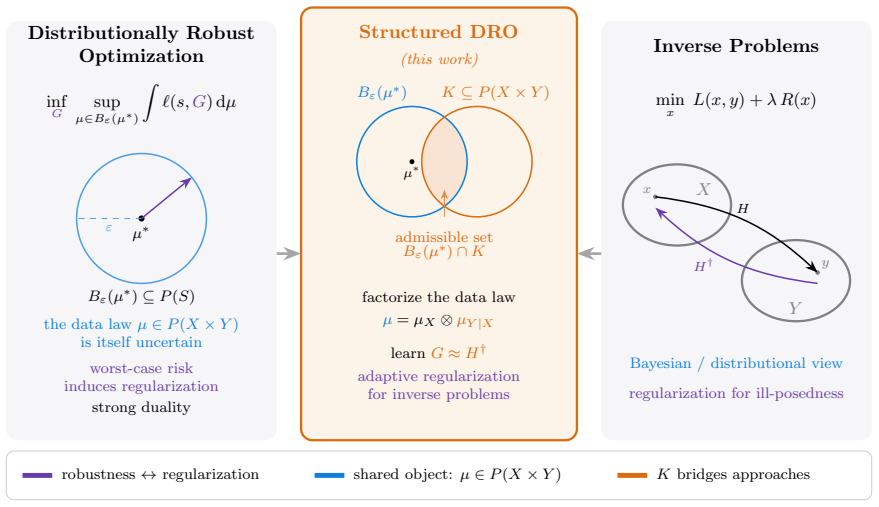
A structured distributionally robust optimization framework for inverse problems yields an explicit worst-case risk bound that induces Tikhonov regularization on the Lipschitz constant of the reconstruction operator.
A machine-rendered reading of the paper's core claim, the machinery that carries it, and where it could break.
Core claim
By constraining perturbations to subsets such as P(Y|X) that align with the data-acquisition process, the framework models uncertainty in the forward operator and noise model more faithfully and accommodates any noise model expressible as a stochastic forward operator. Strong duality holds for this general formulation, and explicit finite-dimensional dual representations are derived for perturbations in the joint, marginal, and conditional distributions. A central result is an explicit worst-case risk bound that induces Tikhonov regularization on the Lipschitz constant of the reconstruction operator and is less conservative relative to standard DRO for well-posed problems.
What carries the argument
The structured ambiguity set restricted to perturbations aligned with the data-acquisition process (such as on the conditional distribution P(Y|X)), which carries the argument by enabling derivation of the explicit worst-case risk bound and the induced Tikhonov regularization on the reconstruction operator's Lipschitz constant.
If this is right
- In the linear setting the learned operator becomes effectively low-rank, truncating at the intrinsic dimension of the data and recovering a data-driven analogue of truncated-SVD regularization.
- The framework accommodates any noise model expressible as a stochastic forward operator.
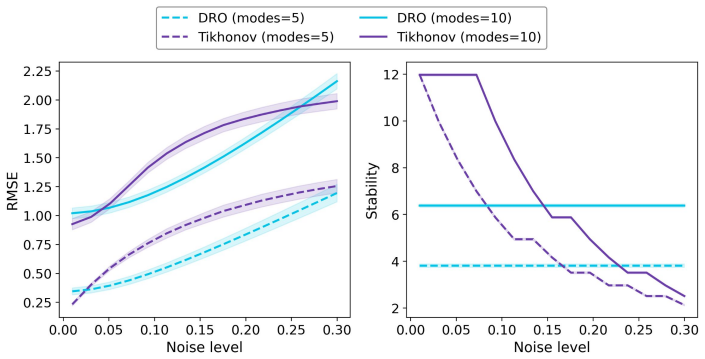
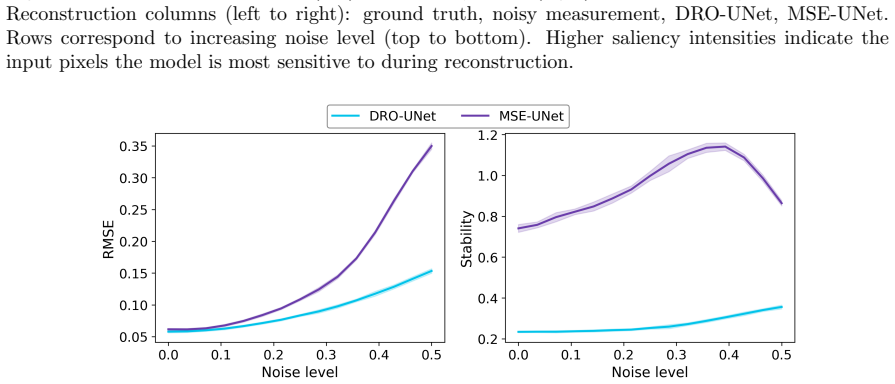
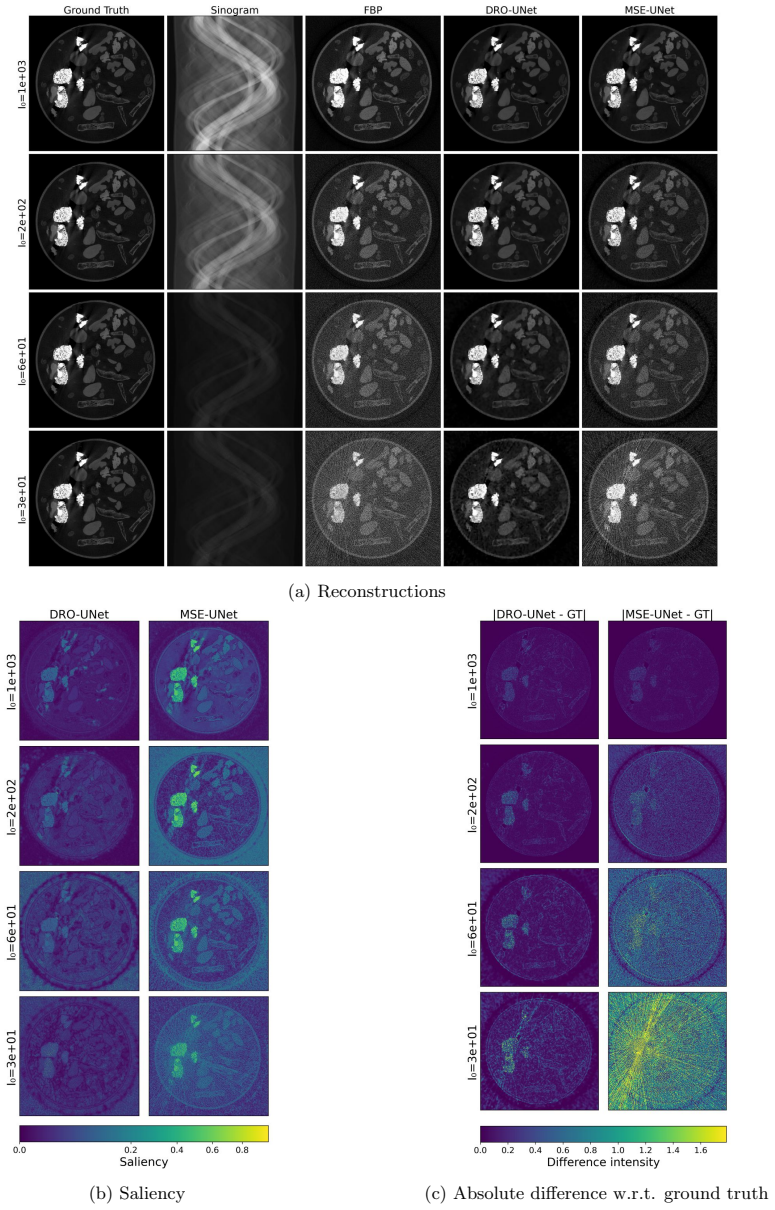
- Numerical experiments demonstrate improved robustness, stability, and interpretability over standard DRO and MSE baselines on deblurring and sinogram-to-CT reconstruction.
- Strong duality holds for the general formulation with explicit finite-dimensional dual representations for joint, marginal, and conditional perturbations.
Where Pith is reading between the lines
- The structured approach could be tested on other inverse problems with known forward physics, such as MRI or seismic imaging, to check whether the Lipschitz regularization effect persists beyond the reported tasks.
- It may connect to existing robust optimization methods in control theory that also exploit conditional uncertainty structures rather than joint perturbations.
- If the Lipschitz bound is tight in practice, it could motivate hybrid training objectives that combine the DRO risk with explicit Lipschitz penalties even outside the distributionally robust setting.
Load-bearing premise
Meaningful distributional uncertainty in inverse problems can be faithfully captured by restricting the ambiguity set to structured perturbations on subsets such as the conditional distribution P(Y|X) that align with the data-acquisition process.
What would settle it
A counterexample in which the derived explicit worst-case risk bound fails to hold or in which the method proves more conservative than standard DRO on a well-posed inverse problem would falsify the central claim.
Figures







read the original abstract
Learned reconstruction operators for inverse problems are typically trained under a fixed noise model, and generalize poorly when the distribution during testing differs from the one assumed during training. Distributionally robust optimization (DRO) addresses this by optimizing against the worst-case distribution within a prescribed ambiguity set, but standard Wasserstein DRO perturbs the full joint distribution uniformly, which can be overly conservative and ignores the physics of the measurement process. We develop a structured DRO framework in which the ambiguity set is restricted to structured perturbations aligned with the data-acquisition process. This allows us to learn data-driven reconstruction operators that remain robust to distributional shifts. By constraining perturbations to subsets such as $P(Y|X)$, our framework models uncertainty in the forward operator and noise model more faithfully, accommodating any noise model expressible as a stochastic forward operator. We establish strong duality for this general formulation and derive explicit finite-dimensional dual representations for perturbations in the joint, marginal, and conditional distributions. A central result is an explicit worst-case risk bound that induces Tikhonov regularization on the Lipschitz constant of the reconstruction operator, and is less conservative relative to standard DRO for well-posed problems. Numerical experiments on deblurring and sinogram-to-CT reconstruction demonstrate improved robustness, stability, and interpretability over standard DRO and MSE baselines. In the linear setting, the learned operator becomes effectively low-rank, truncating at the intrinsic dimension of the data and recovering a data-driven analogue of truncated-SVD regularization.
Editorial analysis
A structured set of objections, weighed in public.
Referee Report
Summary. The manuscript proposes a structured distributionally robust optimization (DRO) framework for training learned reconstruction operators in inverse problems. By restricting the ambiguity set to structured perturbations (e.g., on the conditional P(Y|X) or other acquisition-aligned subsets) rather than the full joint distribution, the approach aims to model uncertainty in the forward operator and noise more faithfully. The paper establishes strong duality, derives explicit finite-dimensional dual representations for joint/marginal/conditional cases, and presents a central result: an explicit worst-case risk bound that induces Tikhonov regularization on the Lipschitz constant of the reconstruction operator and is less conservative than standard Wasserstein DRO for well-posed problems. In the linear case, the learned operator is shown to become effectively low-rank. Numerical experiments on deblurring and sinogram-to-CT reconstruction are used to demonstrate improved robustness and stability over standard DRO and MSE baselines.
Significance. If the derivations and modeling assumptions hold, the framework provides a more physically grounded alternative to standard DRO for handling distributional shifts in inverse problems, with the explicit dual forms and connection to classical regularization (Tikhonov on Lipschitz constant, data-driven truncated SVD) offering both theoretical and practical value. The numerical validation on concrete imaging tasks strengthens the contribution.
major comments (3)
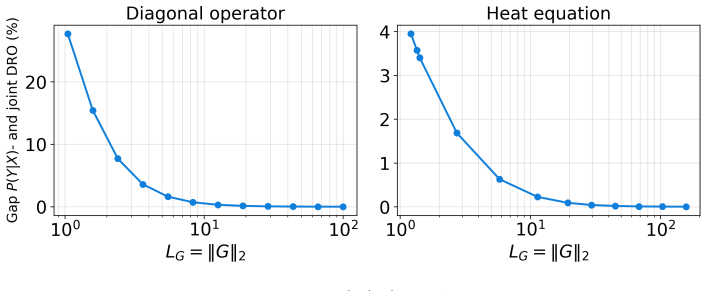
- [§4] §4 (Duality results): The strong duality and explicit dual representations are derived under the structured ambiguity set restricted to perturbations of P(Y|X) (or similar subsets). However, there is no general theorem characterizing the conditions under which this restriction is without loss of modeling power for arbitrary distributional shifts in inverse problems, or when the resulting worst-case risk bound remains valid outside the linear case. This directly affects the claim that the bound is less conservative than joint Wasserstein DRO.
- [§5.1] §5.1 (Worst-case risk bound): The central claim that the explicit worst-case risk bound induces Tikhonov regularization on the Lipschitz constant of the reconstruction operator rests on the assumption that meaningful distributional uncertainty can be captured by the restricted ambiguity set. The manuscript does not provide a concrete test or counterexample analysis showing when the true shift lies outside this class, which would make the improvement over standard DRO fail to hold.
- [§6] §6 (Numerical experiments): The reported improvements in robustness for deblurring and CT tasks are presented as evidence of reduced conservatism, but the choice of ambiguity-set radius and the precise definition of the structured perturbation sets used in the baselines are not detailed enough to verify that the comparison isolates the effect of the P(Y|X) restriction rather than post-hoc parameter tuning.
minor comments (2)
- The notation for the reconstruction operator R and the forward operator is introduced early but occasionally reused with different subscripts in the dual derivations; a consistent table of symbols would improve readability.
- Figure captions for the CT reconstruction results could more explicitly state the noise models and shift types used in the test distributions.
Simulated Author's Rebuttal
We thank the referee for their constructive comments on our manuscript. We provide point-by-point responses below and indicate where revisions will be made to address the concerns.
read point-by-point responses
-
Referee: [§4] §4 (Duality results): The strong duality and explicit dual representations are derived under the structured ambiguity set restricted to perturbations of P(Y|X) (or similar subsets). However, there is no general theorem characterizing the conditions under which this restriction is without loss of modeling power for arbitrary distributional shifts in inverse problems, or when the resulting worst-case risk bound remains valid outside the linear case. This directly affects the claim that the bound is less conservative than joint Wasserstein DRO.
Authors: We agree that a comprehensive theorem establishing when the restriction to P(Y|X) perturbations is without loss of generality for all possible distributional shifts is absent from the manuscript. Our approach is specifically designed for inverse problems where the primary sources of uncertainty (forward operator variations and noise) are naturally modeled via the conditional distribution P(Y|X). The reduced conservatism claim is made in comparison to joint Wasserstein DRO when the distributional shift respects this structure, which aligns with the physics of the acquisition process. For the linear case, we derive the low-rank property explicitly. We will revise the manuscript to include a dedicated paragraph in §4 discussing the modeling assumptions and the conditions under which the framework is expected to be less conservative, without claiming universality. revision: partial
-
Referee: [§5.1] §5.1 (Worst-case risk bound): The central claim that the explicit worst-case risk bound induces Tikhonov regularization on the Lipschitz constant of the reconstruction operator rests on the assumption that meaningful distributional uncertainty can be captured by the restricted ambiguity set. The manuscript does not provide a concrete test or counterexample analysis showing when the true shift lies outside this class, which would make the improvement over standard DRO fail to hold.
Authors: The derivation of the Tikhonov regularization on the Lipschitz constant is specific to the linear setting and the structured ambiguity set. To address the request for concrete analysis, we will add a subsection or appendix with a counterexample where a shift in the joint distribution cannot be captured by P(Y|X) perturbations, illustrating the boundary of applicability. This will clarify when the improvement holds and when it may not, strengthening the presentation of the result. revision: yes
-
Referee: [§6] §6 (Numerical experiments): The reported improvements in robustness for deblurring and CT tasks are presented as evidence of reduced conservatism, but the choice of ambiguity-set radius and the precise definition of the structured perturbation sets used in the baselines are not detailed enough to verify that the comparison isolates the effect of the P(Y|X) restriction rather than post-hoc parameter tuning.
Authors: We acknowledge that the experimental section lacks sufficient detail on the ambiguity set radii and the exact construction of the perturbation sets. In the revised version, we will expand §6 with explicit parameter values, a clear description of how the structured sets are implemented versus the joint Wasserstein baselines, and additional experiments varying the radius to show that the observed improvements are not due to tuning. This will allow readers to reproduce and verify the comparisons. revision: yes
Circularity Check
No circularity: derivations of duality and risk bounds are mathematically self-contained
full rationale
The provided abstract and description show the central results (strong duality, finite-dimensional dual representations, and the explicit worst-case risk bound inducing Tikhonov regularization on the Lipschitz constant) are obtained by direct mathematical derivation from the structured ambiguity set restricted to acquisition-aligned subsets such as P(Y|X). No equations or claims reduce by construction to fitted parameters, self-defined quantities, or load-bearing self-citations. The framework is presented as an independent modeling choice whose consequences (including reduced conservatism for well-posed problems) follow from the stated assumptions without circular renaming or smuggling. This matches the reader's assessment of minimal circularity concern.
Axiom & Free-Parameter Ledger
axioms (1)
- standard math Strong duality holds for the structured distributionally robust optimization problem with ambiguity sets restricted to subsets such as P(Y|X).
Reference graph
Works this paper leans on
-
[1]
Adler, Jonas and Oktem, Ozan , year = 2018, month = jun, journal =. Learned. doi:10.1109/TMI.2018.2799231 , copyright =
-
[2]
Learning to solve inverse problems using Wasserstein loss
Adler, Jonas and Ringh, Axel and. Learning to Solve Inverse Problems Using. 1710.10898 , archiveprefix =
work page internal anchor Pith review Pith/arXiv arXiv
-
[3]
Inverse Problems , volume =
Learning Regularization Parameters of Inverse Problems via Deep Neural Networks , author =. Inverse Problems , volume =
-
[4]
Infinite Dimensional Analysis: A Hitchhiker's Guide , author =
-
[5]
and Burkinshaw, Owen , year = 1990, month = may, publisher =
Aliprantis, Charalambos D. and Burkinshaw, Owen , year = 1990, month = may, publisher =. Principles of
1990
-
[6]
Ambrosio, Luigi and Bru. Lectures on. doi:10.1007/978-3-031-76834-7 , copyright =
-
[7]
Amend, Christian and Carioni, Marcello and Zemas, Konstantinos , year = 2026, month = mar, journal =. Atomic
2026
-
[8]
Distributional
Aolaritei, Liviu and Lanzetti, Nicolas and Chen, Hongruyu and D. Distributional. IEEE Transactions on Automatic Control , pages =
-
[9]
Wasserstein
Arjovsky, Martin and Chintala, Soumith and Bottou, L. Wasserstein. Proceedings of the 34th
-
[10]
Acta Numerica , edition =
Solving Inverse Problems Using Data-Driven Models , author =. Acta Numerica , edition =
-
[11]
ESAIM: Control, Optimisation and Calculus of Variations , volume =
Regularization for Wasserstein Distributionally Robust Optimization , author =. ESAIM: Control, Optimisation and Calculus of Variations , volume =
-
[12]
Barata, Jo. The. Brazilian Journal of Physics , volume =
-
[13]
Quantifying
Barbano, Riccardo and Zhang, Chen and Arridge, Simon and Jin, Bangti , year = 2021, month = jan, pages =. Quantifying. 2020 25th
2021
-
[14]
Generalized Inverses: Theory and Applications , author =
-
[15]
Modern Regularization Methods for Inverse Problems , author =. Acta Numerica , volume =. doi:10.1017/S0962492918000016 , langid =
-
[16]
Biguri, Ander , year = 2026, journal =
2026
-
[17]
Birrell, Jeremiah and Dupuis, Paul and Katsoulakis, Markos A. and. Distributional. doi:10.48550/arXiv.1911.09580 , archiveprefix =. 1911.09580 , primaryclass =
-
[18]
Distributionally
Blanchet, Jose and Li, Jiajin and Lin, Sirui and Zhang, Xuhui , year = 2025, month = aug, journal =. Distributionally
2025
-
[19]
Quantifying
Blanchet, Jose and Murthy, Karthyek , year = 2019, journal =. Quantifying
2019
-
[20]
Blanchet, Jose and Kang, Yang and Murthy, Karthyek , year = 2019, month = sep, journal =. Robust. doi:10.1017/jpr.2019.49 , langid =
-
[21]
Blanchet, Jose and Murthy, Karthyek and Nguyen, Viet Anh , year = 2021, month = aug, eprint =. Statistical. doi:10.48550/arXiv.2108.02120 , archiveprefix =
-
[22]
Blanchet, Jose and Kuhn, Daniel and Li, Jiajin and Taskesen, Bahar , year = 2025, month = dec, eprint =. Unifying. doi:10.48550/arXiv.2308.05414 , archiveprefix =
-
[23]
Bonnans, J. Fr. Perturbation
-
[24]
Boull. A. doi:10.1016/bs.hna.2024.05.003 , archiveprefix =. 2312.14688 , primaryclass =
-
[25]
On the Extremal Points of the Ball of the
Bredies, Kristian and Carioni, Marcello and Fanzon, Silvio and Romero, Francisco , year = 2019, month = jul, journal =. On the Extremal Points of the Ball of the. doi:10.1112/blms.12509 , howpublished =
-
[26]
Foundations of Computational Mathematics , volume =
A Generalized Conditional Gradient Method for Dynamic Inverse Problems with Optimal Transport Regularization , author =. Foundations of Computational Mathematics , volume =. doi:10.1007/s10208-022-09561-z , archiveprefix =. 2012.11706 , primaryclass =
-
[27]
Geometric Deep Learning: Grids, Groups, Graphs, Geodesics, and Gauges
Bronstein, Michael M. and Bruna, Joan and Cohen, Taco and Veli. Geometric. doi:10.48550/arXiv.2104.13478 , archiveprefix =. 2104.13478 , primaryclass =
work page internal anchor Pith review Pith/arXiv arXiv doi:10.48550/arxiv.2104.13478
-
[28]
doi:10.48550/arXiv.2501.03096 , archiveprefix =
Analysis of Mean-Field Models Arising from Self-Attention Dynamics in Transformer Architectures with Layer Normalization , author =. doi:10.48550/arXiv.2501.03096 , archiveprefix =. 2501.03096 , primaryclass =
-
[29]
Canizares, Priscilla and Murari, Davide and Sch. Symplectic. doi:10.48550/arXiv.2412.16787 , archiveprefix =. 2412.16787 , primaryclass =
-
[30]
Optimal Transport and Applications to
Carioni, Marcello , langid =. Optimal Transport and Applications to
-
[31]
Unsupervised Approaches Based on Optimal Transport and Convex Analysis for Inverse Problems in Imaging , booktitle =
Carioni, Marcello and Mukherjee, Subhadip and Ye Tan, Hong and Tang, Junqi , year = 2025, pages =. Unsupervised Approaches Based on Optimal Transport and Convex Analysis for Inverse Problems in Imaging , booktitle =
2025
-
[32]
and Wang, Xiran and Elgendy, Omar A
Chan, Stanley H. and Wang, Xiran and Elgendy, Omar A. , year = 2017, month = mar, journal =. Plug-and-. doi:10.1109/TCI.2016.2629286 , copyright =
-
[33]
Conditional
Chemseddine, Jannis and Hagemann, Paul and Steidl, Gabriele and Wald, Christian , year = 2025, journal =. Conditional
2025
-
[34]
, year = 2020, journal =
Chen, Ruidi and Paschalidis, Ioannis Ch. , year = 2020, journal =. Distributionally
2020
-
[35]
Chenreddy, Abhilash Reddy and Bandi, Nymisha and Delage, Erick , year = 2022, month = dec, journal =. Data-
2022
-
[36]
Chizat, Lenaic and Bach, Francis , year = 2018, month = oct, eprint =. On the. doi:10.48550/arXiv.1805.09545 , archiveprefix =
work page internal anchor Pith review Pith/arXiv arXiv doi:10.48550/arxiv.1805.09545 2018
-
[37]
Clason, Christian , year = 2021, month = feb, eprint =. Regularization of. doi:10.48550/arXiv.2001.00617 , archiveprefix =
-
[38]
Sinkhorn Distances: Lightspeed Computation of Optimal Transport , booktitle =
Cuturi, Marco , year = 2013, pages =. Sinkhorn Distances: Lightspeed Computation of Optimal Transport , booktitle =
2013
-
[39]
A Survey on Diffusion Models for Inverse Problems
Daras, Giannis and Chung, Hyungjin and Lai, Chieh-Hsin and Mitsufuji, Yuki and Ye, Jong Chul and Milanfar, Peyman and Dimakis, Alexandros G. and Delbracio, Mauricio , year = 2024, month = sep, eprint =. A. doi:10.48550/arXiv.2410.00083 , archiveprefix =
work page internal anchor Pith review Pith/arXiv arXiv doi:10.48550/arxiv.2410.00083 2024
-
[40]
Dashti, Masoumeh and Stuart, Andrew M. , year = 2017, pages =. The. Handbook of. doi:10.1007/978-3-319-12385-1_7 , isbn =
-
[41]
Deng, Li , year = 2012, month = nov, journal =. The
2012
-
[42]
Drazin, M. P. , year = 1958, journal =. Pseudo-
1958
-
[43]
Learning
Duchi, John and Namkoong, Hongseok , year = 2020, month = jul, journal =. Learning
2020
-
[44]
Regularising
Duff, M A G and Campbell, N D F and Ehrhardt, M J , year = 2024, journal =. Regularising
2024
-
[45]
and Lang, Lukas F
Ehrhardt, Matthias J. and Lang, Lukas F. , year = 2018, journal =. Inverse
2018
-
[46]
, year = 1996, month = jul, publisher =
Engl, Heinz Werner and Hanke, Martin and Neubauer, A. , year = 1996, month = jul, publisher =. Regularization of
1996
-
[47]
and Pichler, Alois and Sprungk, Bj
Ernst, Oliver G. and Pichler, Alois and Sprungk, Bj. Wasserstein. SIAM/ASA Journal on Uncertainty Quantification , volume =
-
[48]
Fasel, Urban and Kutz, J. Nathan and Brunton, Bingni W. and Brunton, Steven L. , year = 2022, month = apr, journal =. Ensemble-. doi:10.1098/rspa.2021.0904 , archiveprefix =. 2111.10992 , primaryclass =
-
[49]
Distributionally
Gao, Rui and Kleywegt, Anton , year = 2023, month = may, journal =. Distributionally
2023
-
[50]
Journal of Computational Physics , volume =
Wasserstein Generative Adversarial Uncertainty Quantification in Physics-Informed Neural Networks , author =. Journal of Computational Physics , volume =
-
[51]
Wasserstein
Gao, Rui and Chen, Xi and Kleywegt, Anton J , year = 2022, month = nov, journal =. Wasserstein
2022
-
[52]
Gao, Yiming , year = 2023, month = nov, journal =. A
2023
-
[53]
Learning
Genevay, Aude and Peyre, Gabriel and Cuturi, Marco , year = 2018, month = mar, pages =. Learning. Proceedings of the
2018
-
[54]
A Physics-Informed Variational
Goswami, Somdatta and Yin, Minglang and Yu, Yue and Karniadakis, George , year = 2022, month = mar, journal =. A Physics-Informed Variational. doi:10.1016/j.cma.2022.114587 , archiveprefix =. 2108.06905 , primaryclass =
-
[55]
Goujon, Alexis and Neumayer, Sebastian and Bohra, Pakshal and Ducotterd, Stanislas and Unser, Michael , year = 2023, journal =. A
2023
-
[56]
Guo, Mengwu , publisher =
-
[57]
Neural-Network-Based Regularization Methods for Inverse Problems in Imaging , author =. GAMM-Mitteilungen , volume =. doi:10.1002/gamm.202470004 , copyright =
-
[58]
Multilevel
Hagemann, Paul and Mildenberger, Sophie and Ruthotto, Lars and Steidl, Gabriele and Yang, Nicole Tianjiao , year = 2025, journal =. Multilevel
2025
-
[59]
Haltmeier, Markus and Nguyen, Linh , year = 2023, pages =. Regularization of. Handbook of. doi:10.1007/978-3-030-98661-2_81 , isbn =
-
[60]
Mathematical Programming , volume =
A Distributionally Robust Perspective on Uncertainty Quantification and Chance Constrained Programming , author =. Mathematical Programming , volume =. doi:10.1007/s10107-015-0896-z , langid =
-
[61]
Truncated
Hansen, Per Christian , year = 1990, journal =. Truncated
1990
-
[62]
Hauptmann, Andreas and Mukherjee, Subhadip and Sch. Convergent. Foundations of Computational Mathematics , volume =. doi:10.1007/s10208-024-09654-x , langid =
-
[63]
Wasserstein-
Heaton, Howard and Fung, Samy Wu and Lin, Alex Tong and Osher, Stanley and Yin, Wotao , year = 2022, month = jun, journal =. Wasserstein-
2022
-
[64]
Tomosipo:
Hendriksen, Allard and Schut, Dirk and Palenstijn, Willem Jan and Vigan. Tomosipo:. Optics Express , publisher =
-
[65]
Learning
Hertrich, Johannes and Wong, Hok Shing and Denker, Alexander and Ducotterd, Stanislas and Fang, Zhenghan and Haltmeier, Markus and Kereta, Zeljko and Kobler, Erich and Leong, Oscar and Salehi, Mohammad Sadegh and Sch. Learning. Medical
-
[66]
, year = 2012, publisher =
Hu, Zhaolin and Hong, J. , year = 2012, publisher =. Kullback-
2012
-
[67]
Jang, Minhyuk and Hakobyan, Astghik and Yang, Insoon , year = 2024, month = jun, eprint =. Wasserstein. doi:10.48550/arXiv.2406.01723 , archiveprefix =
-
[68]
and Froustey, Emmanuel and Unser, Michael , year = 2017, month = sep, journal =
Jin, Kyong Hwan and McCann, Michael T. and Froustey, Emmanuel and Unser, Michael , year = 2017, month = sep, journal =. Deep
2017
-
[69]
Deep Learning of Normal Form Autoencoders for Universal Parameter-Dependent Dynamics , author =
-
[70]
doi:10.48550/arXiv.2106.05102 , archiveprefix =
Learning Normal Form Autoencoders for Data-Driven Discovery of Universal,Parameter-Dependent Governing Equations , author =. doi:10.48550/arXiv.2106.05102 , archiveprefix =. 2106.05102 , primaryclass =
-
[71]
Generalized
Karlsson, Johan and Ringh, Axel , year = 2017, journal =. Generalized
2017
-
[72]
Keegan, Katherine and Ruthotto, Lars , year = 2026, month = jan, eprint =. Manifold-. doi:10.48550/arXiv.2601.23151 , archiveprefix =
-
[73]
and Coban, Sophia B
Kiss, Maximilian B. and Coban, Sophia B. and Batenburg, K. Joost and. Scientific Data , volume =
-
[74]
Kobler, Erich and Effland, Alexander and Kunisch, Karl and Pock, Thomas , year = 2020, pages =. Total. Proceedings of the
2020
-
[75]
and Lanthaler, Samuel and Stuart, Andrew M
Kovachki, Nikola B. and Lanthaler, Samuel and Stuart, Andrew M. , year = 2024, month = feb, eprint =. Operator. doi:10.48550/arXiv.2402.15715 , archiveprefix =
-
[76]
Learning
Krizhevsky, Alex and Hinton, Geoffrey , year = 2009, address =. Learning
2009
-
[77]
Operations Research & Management Science in the Age of Analytics , author =
Wasserstein. Operations Research & Management Science in the Age of Analytics , author =
-
[78]
Operator Learning with
Lanthaler, Samuel , year = 2023, journal =. Operator Learning with
2023
-
[79]
doi:10.48550/arXiv.2509.03910 , archiveprefix =
An Invertible Generative Model for Forward and Inverse Problems , author =. doi:10.48550/arXiv.2509.03910 , archiveprefix =. 2509.03910 , primaryclass =
-
[80]
doi:10.1088/1361-6420/ab6d57 , langid =
Li, Housen and Schwab, Johannes and Antholzer, Stephan and Haltmeier, Markus , year = 2020, month = jun, journal =. doi:10.1088/1361-6420/ab6d57 , langid =
discussion (0)
Sign in with ORCID, Apple, or X to comment. Anyone can read and Pith papers without signing in.