Lee-Yang zeros and edge singularity in a mean-field approach
Pith reviewed 2026-05-20 04:20 UTC · model grok-4.3
The pith
In a minimal mean-field QCD model with finite-size effects, Lee-Yang zeros locate the critical point when corrections from irrelevant operators are included.
A machine-rendered reading of the paper's core claim, the machinery that carries it, and where it could break.
Core claim
In the minimal mean-field effective model of QCD with finite-size effects, the temperature dependence of Lee-Yang zeros and their relation to the edge singularity enable finite-size scaling methods using these zeros and susceptibility ratios to identify the critical point, though accurate determination requires careful treatment of corrections from irrelevant operators.
What carries the argument
Lee-Yang zeros of the partition function in the complex chemical potential plane, analyzed via their temperature dependence, finite-size scaling, and connection to the edge singularity.
If this is right
- Finite-size scaling of Lee-Yang zeros successfully identifies the critical point.
- Susceptibility ratio methods also locate the critical point in the model.
- Corrections from irrelevant operators are required for accurate determination of the critical point location.
- The zeros move toward the edge singularity as temperature and system size vary.
Where Pith is reading between the lines
- The same scaling approach might be tested on lattice QCD data at imaginary chemical potential to cross-check critical point estimates.
- If the mean-field picture holds near the critical region, zero-based methods could help reduce systematic uncertainties in full QCD calculations.
- Extending the model to include additional degrees of freedom would test whether the edge singularity identification remains stable.
Load-bearing premise
The minimal mean-field effective model of QCD with finite-size effects incorporated accurately captures the analytic structure of the partition function at complex chemical potentials that is relevant for locating the critical point.
What would settle it
Observation that the critical point extracted from Lee-Yang zero scaling differs substantially from the value obtained after including irrelevant operator corrections, or fails to agree with susceptibility ratio results, would show the methods do not determine the point accurately.
Figures




read the original abstract
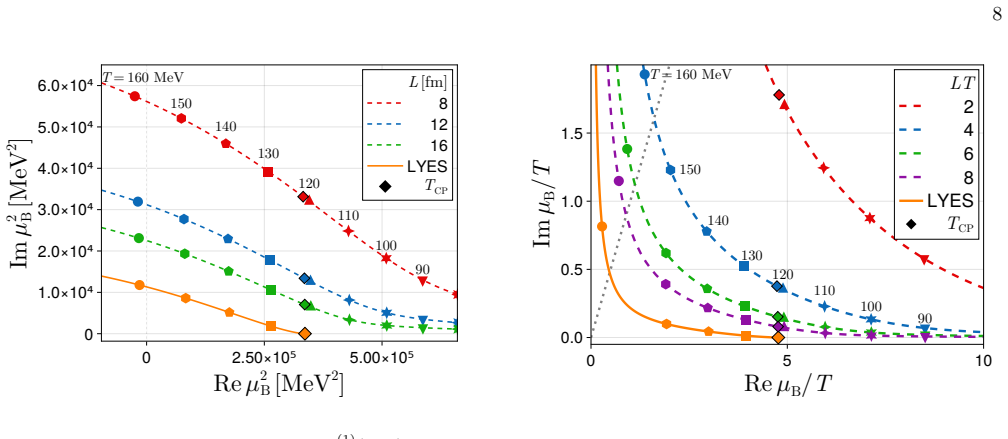
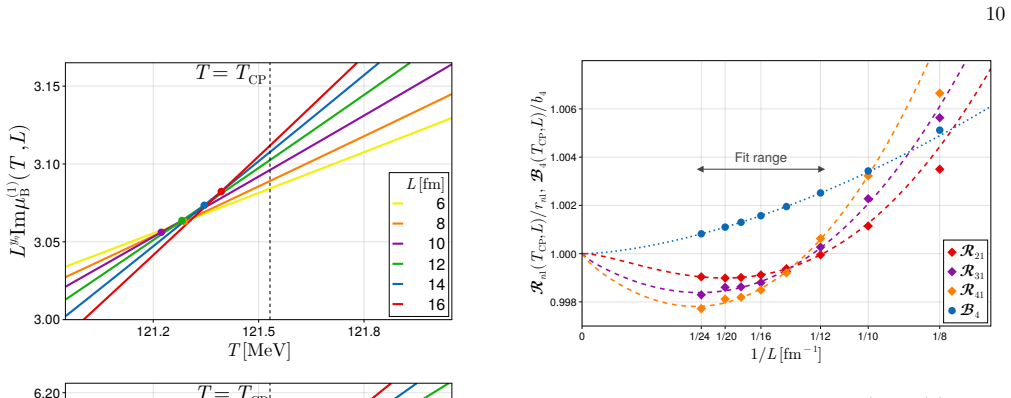
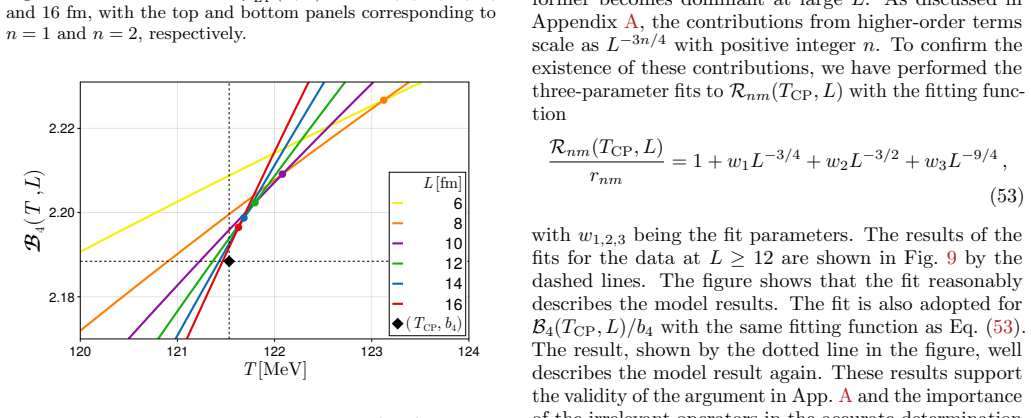
The analytic structure of the partition function in finite-volume systems is investigated at complex chemical potentials in a minimal mean-field effective model of QCD with finite-size effects incorporated. We discuss the temperature dependence of the Lee-Yang zeros and their relation to the edge singularity for various system sizes. Different methods for locating the critical point based on finite-size scaling of Lee-Yang zeros and susceptibility ratios are compared. We demonstrate that these methods can successfully identify the critical point, whereas a careful treatment of corrections from irrelevant operators is crucial for its accurate determination.
Editorial analysis
A structured set of objections, weighed in public.
Referee Report
Summary. The manuscript investigates the analytic structure of the partition function in a minimal mean-field effective model of QCD with finite-size effects at complex chemical potentials. It analyzes the temperature dependence of Lee-Yang zeros and their relation to the edge singularity for different system sizes. Different finite-size scaling methods based on Lee-Yang zeros and susceptibility ratios are compared for locating the critical point, with the demonstration that these methods identify the known critical point once corrections from irrelevant operators are included.
Significance. If the results hold, the work offers a controlled benchmark in a solvable mean-field model for validating finite-size scaling techniques that locate critical points via Lee-Yang zeros. It explicitly shows the necessity of accounting for corrections from irrelevant operators, which strengthens the reliability of such methods and may guide their application in lattice QCD or experimental contexts. The direct comparison to the model's known critical point is a clear strength of the analysis.
major comments (1)
- The central claim that corrections from irrelevant operators are crucial for accurate determination of the critical point would be strengthened by a quantitative comparison (e.g., deviation from the known critical chemical potential with and without the corrections) in the section presenting the susceptibility ratio and Lee-Yang zero scaling results.
minor comments (2)
- The abstract could briefly specify the form of the mean-field effective potential or the key parameters entering the model to orient readers.
- Figure captions for the plots of Lee-Yang zeros versus temperature should explicitly list the system sizes and the values of any fixed parameters used.
Simulated Author's Rebuttal
We thank the referee for the positive assessment of our work and the constructive suggestion. We address the major comment below and have revised the manuscript to incorporate the recommended quantitative comparison.
read point-by-point responses
-
Referee: The central claim that corrections from irrelevant operators are crucial for accurate determination of the critical point would be strengthened by a quantitative comparison (e.g., deviation from the known critical chemical potential with and without the corrections) in the section presenting the susceptibility ratio and Lee-Yang zero scaling results.
Authors: We agree that a direct quantitative comparison would strengthen the presentation of our central claim. In the revised manuscript we have added a new table in the section on finite-size scaling methods that reports the extracted critical chemical potential for both the susceptibility-ratio and Lee-Yang-zero approaches, with and without the inclusion of corrections from irrelevant operators. The table lists the absolute and relative deviations from the known mean-field critical value for several system sizes. These numbers show that the deviations are reduced by roughly an order of magnitude once the corrections are taken into account, thereby providing explicit support for the necessity of including them. revision: yes
Circularity Check
No significant circularity; derivation is self-contained within the model study
full rationale
The paper performs a controlled numerical and scaling analysis inside a minimal mean-field effective model of QCD whose critical point is known by construction. Finite-size Lee-Yang zeros and susceptibility ratios are computed directly from the model's partition function at complex chemical potentials; the scaling relations and corrections from irrelevant operators are applied to recover the model's own critical point. No load-bearing step reduces a prediction to a fitted parameter by definition, nor does any central claim rest on a self-citation chain that itself lacks independent verification. The model parameters and ansatz are stated explicitly as part of the effective theory setup rather than derived from the target result. This is the standard honest outcome for a model-study paper whose conclusions are benchmarked against the model's internal critical point.
Axiom & Free-Parameter Ledger
axioms (1)
- domain assumption The minimal mean-field effective model of QCD with finite-size effects accurately represents the partition function's analytic structure at complex chemical potentials.
Lean theorems connected to this paper
-
IndisputableMonolith/Cost/FunctionalEquation.leanwashburn_uniqueness_aczel unclear?
unclearRelation between the paper passage and the cited Recognition theorem.
Z = ∫ dϕ̄ exp(−V U(ϕ̄)/T) ... finite-size scaling relation ... irrelevant operators ... L^{y_5} with y_5 = −3/4
-
IndisputableMonolith/Foundation/AlexanderDuality.leanalexander_duality_circle_linking unclear?
unclearRelation between the paper passage and the cited Recognition theorem.
Lee-Yang zeros ... edge singularity ... intersection analysis of R_{n1}(T,L) and B_4
What do these tags mean?
- matches
- The paper's claim is directly supported by a theorem in the formal canon.
- supports
- The theorem supports part of the paper's argument, but the paper may add assumptions or extra steps.
- extends
- The paper goes beyond the formal theorem; the theorem is a base layer rather than the whole result.
- uses
- The paper appears to rely on the theorem as machinery.
- contradicts
- The paper's claim conflicts with a theorem or certificate in the canon.
- unclear
- Pith found a possible connection, but the passage is too broad, indirect, or ambiguous to say the theorem truly supports the claim.
Reference graph
Works this paper leans on
-
[1]
J. L. Cardy, ed.,Finite Size Scaling(1988)
work page 1988
- [2]
-
[3]
M. E. Fisher and M. N. Barber, Phys. Rev. Lett.28, 1516 (1972)
work page 1972
- [4]
-
[5]
Critical Phenomena and Renormalization-Group Theory
A. Pelissetto and E. Vicari, Phys. Rept.368, 549 (2002), arXiv:cond-mat/0012164
work page internal anchor Pith review Pith/arXiv arXiv 2002
- [6]
-
[7]
The three-dimensional, three-state Potts Model in an External Field
F. Karsch and S. Stickan, Phys. Lett. B488, 319 (2000), arXiv:hep-lat/0007019
work page internal anchor Pith review Pith/arXiv arXiv 2000
-
[8]
X.-Y. Jin, Y. Kuramashi, Y. Nakamura, S. Takeda, and A. Ukawa, Phys. Rev. D96, 034523 (2017), arXiv:1706.01178 [hep-lat]
work page internal anchor Pith review Pith/arXiv arXiv 2017
-
[9]
A. M. Ferrenberg, J. Xu, and D. P. Landau, Phys. Rev. 13 E97, 043301 (2018), arXiv:1806.03558 [physics.comp-ph]
work page internal anchor Pith review Pith/arXiv arXiv 2018
-
[10]
Y. Kuramashi, Y. Nakamura, H. Ohno, and S. Takeda, Phys. Rev. D101, 054509 (2020), arXiv:2001.04398 [hep- lat]
- [11]
- [12]
-
[13]
Philipsen, Symmetry13, 2079 (2021), arXiv:2111.03590 [hep-lat]
O. Philipsen, Symmetry13, 2079 (2021), arXiv:2111.03590 [hep-lat]
-
[14]
A. Kiyohara, M. Kitazawa, S. Ejiri, and K. Kanaya, Phys. Rev. D104, 114509 (2021), arXiv:2108.00118 [hep-lat]
-
[15]
R. Ashikawa, M. Kitazawa, S. Ejiri, and K. Kanaya, Phys. Rev. D110, 074508 (2024), arXiv:2407.09156 [hep-lat]
-
[16]
Phase structure of heavy dense lattice QCD and the three-state Potts model
S. Ejiri and M. Koiida, Phys. Rev. D113, 074515 (2026), arXiv:2601.06446 [hep-lat]
work page internal anchor Pith review Pith/arXiv arXiv 2026
- [17]
-
[18]
T. D. Lee and C.-N. Yang, Phys. Rev.87, 410 (1952)
work page 1952
-
[19]
M. E. Fischer, Lect. Theor. Phys. c7, 1 (1965)
work page 1965
-
[20]
C. Itzykson, R. B. Pearson, and J. B. Zuber, Nucl. Phys. B220, 415 (1983)
work page 1983
-
[21]
I. Bena, M. Droz, and A. Lipowski, Int. J. Mod. Phys. B 19, 4269 (2005), arXiv:cond-mat/0501297 [cond-mat]
work page internal anchor Pith review Pith/arXiv arXiv 2005
-
[22]
M. E. Fisher, Phys. Rev. Lett.40, 1610 (1978)
work page 1978
-
[23]
A. M. Halasz, A. D. Jackson, and J. J. M. Verbaarschot, Phys. Lett. B395, 293 (1997), arXiv:hep-lat/9611008
work page internal anchor Pith review Pith/arXiv arXiv 1997
- [24]
-
[25]
M. A. Stephanov, Phys. Rev. D73, 094508 (2006), arXiv:hep-lat/0603014
work page internal anchor Pith review Pith/arXiv arXiv 2006
-
[26]
Complex singularities around the QCD critical point at finite densities
S. Ejiri, Y. Shinno, and H. Yoneyama, PTEP2014, 083B02 (2014), arXiv:1404.6004 [hep-lat]
work page internal anchor Pith review Pith/arXiv arXiv 2014
-
[27]
X. An, D. Mesterh´ azy, and M. A. Stephanov, J. Stat. Mech.1803, 033207 (2018), arXiv:1707.06447 [hep-th]
work page internal anchor Pith review Pith/arXiv arXiv 2018
-
[28]
M. Giordano, K. Kapas, S. D. Katz, D. Nogradi, and A. Pasztor, Phys. Rev. D101, 074511 (2020), [Erratum: Phys.Rev.D 104, 119901 (2021)], arXiv:1911.00043 [hep- lat]
-
[29]
Search of QCD phase transition points in the canonical approach of the NJL model
M. Wakayama and A. Hosaka, Phys. Lett. B795, 548 (2019), arXiv:1905.10956 [hep-lat]
work page internal anchor Pith review Pith/arXiv arXiv 2019
-
[30]
A. Connelly, G. Johnson, F. Rennecke, and V. Skokov, Phys. Rev. Lett.125, 191602 (2020), arXiv:2006.12541 [cond-mat.stat-mech]
-
[31]
S. Mukherjee, F. Rennecke, and V. V. Skokov, Phys. Rev. D105, 014026 (2022), arXiv:2110.02241 [hep-ph]
-
[32]
F. Rennecke and V. V. Skokov, Annals Phys.444, 169010 (2022), arXiv:2203.16651 [hep-ph]
- [33]
- [34]
-
[35]
F. Di Renzo, M. Aliberti, and P. Dimopoulos, PoSLAT- TICE2024, 174 (2025), arXiv:2502.03392 [hep-lat]
- [36]
-
[37]
F. Di Renzo, D. A. Clarke, P. Dimopoulos, J. Goswami, C. Schmidt, S. Singh, and K. Zambello, PoSLAT- TICE2023, 169 (2024), arXiv:2401.09619 [hep-lat]
- [38]
- [39]
- [40]
-
[41]
P. Dimopoulos, L. Dini, F. Di Renzo, J. Goswami, G. Nico- tra, C. Schmidt, S. Singh, K. Zambello, and F. Ziesch´ e, Phys. Rev. D105, 034513 (2022), arXiv:2110.15933 [hep- lat]
-
[42]
D. Bollweg, J. Goswami, O. Kaczmarek, F. Karsch, S. Mukherjee, P. Petreczky, C. Schmidt, and P. Scior (HotQCD), Phys. Rev. D105, 074511 (2022), arXiv:2202.09184 [hep-lat]
-
[43]
G. Basar, Phys. Rev. C110, 015203 (2024), arXiv:2312.06952 [hep-th]
- [44]
-
[45]
Schmidt, PoSLATTICE2024, 005 (2025), arXiv:2504.00629 [hep-lat]
C. Schmidt, PoSLATTICE2024, 005 (2025), arXiv:2504.00629 [hep-lat]
- [46]
- [47]
-
[48]
M. Kitazawa, T. Wada, and K. Kanaya, PoSQCHSC24, 115 (2025), arXiv:2503.22246 [hep-ph]
-
[49]
L. F. Palhares, E. S. Fraga, and T. Kodama, J. Phys. G 38, 085101 (2011), arXiv:0904.4830 [nucl-th]
work page internal anchor Pith review Pith/arXiv arXiv 2011
-
[50]
Influence of finite volume and magnetic field effects on the QCD phase diagram
N. Magdy, M. Csan´ ad, and R. A. Lacey, J. Phys. G44, 025101 (2017), arXiv:1510.04380 [nucl-th]
work page internal anchor Pith review Pith/arXiv arXiv 2017
-
[51]
G. Kov´ acs, P. Kov´ acs, P. M. Lo, K. Redlich, and G. Wolf, Phys. Rev. D108, 076010 (2023), arXiv:2307.10301 [hep- ph]
-
[52]
A. Bhattacharyya, P. Deb, S. K. Ghosh, R. Ray, and S. Sur, Phys. Rev. D87, 054009 (2013), arXiv:1212.5893 [hep-ph]
work page internal anchor Pith review Pith/arXiv arXiv 2013
-
[53]
Z. Pan, Z.-F. Cui, C.-H. Chang, and H.-S. Zong, Int. J. Mod. Phys. A32, 1750067 (2017), arXiv:1611.07370 [hep-ph]
work page internal anchor Pith review Pith/arXiv arXiv 2017
-
[54]
Q. Wang, Y. Xiq, and H. Zong, Mod. Phys. Lett. A33, 1850232 (2018), arXiv:1806.05315 [hep-ph]
work page internal anchor Pith review Pith/arXiv arXiv 2018
-
[55]
The Effect of Fluctuations on the QCD Critical Point in a Finite Volume
R.-A. Tripolt, J. Braun, B. Klein, and B.-J. Schaefer, Phys. Rev. D90, 054012 (2014), arXiv:1308.0164 [hep- ph]
work page internal anchor Pith review Pith/arXiv arXiv 2014
-
[56]
Volume dependence of baryon number cumulants and their ratios
G. Almasi, R. Pisarski, and V. Skokov, Phys. Rev. D95, 056015 (2017), arXiv:1612.04416 [hep-ph]
work page internal anchor Pith review Pith/arXiv arXiv 2017
-
[57]
J. Bernhardt, C. S. Fischer, P. Isserstedt, and B.-J. Schae- fer, Phys. Rev. D104, 074035 (2021), arXiv:2107.05504 [hep-ph]
-
[58]
J. Bernhardt, C. S. Fischer, and P. Isserstedt, Phys. Lett. B841, 137908 (2023), arXiv:2208.01981 [hep-ph]
-
[59]
G. Kov´ acs, P. M. Lo, K. Redlich, and C. Sasaki, (2025), arXiv:2510.24507 [hep-ph]
-
[60]
M. Laine and A. Vuorinen,Basics of Thermal Field The- ory, Vol. 925 (Springer, 2016) arXiv:1701.01554 [hep-ph]
- [61]
- [62]
- [63]
-
[64]
Partition function zeros for the Ising model on complete graphs and on annealed scale-free networks
M. Krasnytska, B. Berche, Y. Holovatch, and R. Kenna, J. Phys. A49, 135001 (2016), arXiv:1510.00534 [cond- mat.stat-mech]
work page internal anchor Pith review Pith/arXiv arXiv 2016
-
[65]
Bounding scalar operator dimensions in 4D CFT
R. Rattazzi, V. S. Rychkov, E. Tonni, and A. Vichi, JHEP12, 031 (2008), arXiv:0807.0004 [hep-th]
work page internal anchor Pith review Pith/arXiv arXiv 2008
-
[66]
Bootstrapping the 3d Ising stress tensor,
C.-H. Chang, V. Dommes, R. S. Erramilli, A. Hom- rich, P. Kravchuk, A. Liu, M. S. Mitchell, D. Poland, and D. Simmons-Duffin, JHEP03, 136 (2025), arXiv:2411.15300 [hep-th]. 14
-
[67]
L. N. Trefethen and J. A. C. Weideman, SIAM Review 56, 385 (2014)
work page 2014
-
[68]
Fluctuations of conserved charges in relativistic heavy ion collisions: An introduction
M. Asakawa and M. Kitazawa, Prog. Part. Nucl. Phys. 90, 299 (2016), arXiv:1512.05038 [nucl-th]
work page internal anchor Pith review Pith/arXiv arXiv 2016
-
[69]
S. Borsanyi, Z. Fodor, J. N. Guenther, P. Parotto, A. Pasz- tor, C. Ratti, V. Vovchenko, and C. H. Wong, Phys. Rev. D112, L111505 (2025), arXiv:2502.10267 [hep-lat]
- [70]
-
[71]
P. Parotto, M. Bluhm, D. Mroczek, M. Nahrgang, J. Noronha-Hostler, K. Rajagopal, C. Ratti, T. Sch¨ afer, and M. Stephanov, Phys. Rev. C101, 034901 (2020), arXiv:1805.05249 [hep-ph]
- [72]
-
[73]
L. Moueddene, N. G. Fytas, and B. Berche, Phys. Rev. E110, 064144 (2024), arXiv:2410.01710 [cond-mat.stat- mech]
- [74]
-
[75]
Scaling properties of net-baryon number fluctuations at the deconfinement critical point
M. Szyma´ nski, P. M. Lo, K. Redlich, and C. Sasaki, (2026), arXiv:2605.08543 [hep-ph]
work page internal anchor Pith review Pith/arXiv arXiv 2026
- [76]
- [77]
-
[78]
L. O’Raifeartaigh, A. Wipf, and H. Yoneyama, Nucl. Phys. B271, 653 (1986)
work page 1986
-
[79]
P. M. Lo, (2026), arXiv:2602.21095 [nucl-th]
work page internal anchor Pith review Pith/arXiv arXiv 2026
discussion (0)
Sign in with ORCID, Apple, or X to comment. Anyone can read and Pith papers without signing in.