Co-evolution of bar and spiral arms in TNG50 simulations using Information Theory
Pith reviewed 2026-06-27 03:34 UTC · model grok-4.3
The pith
Bars and spiral arms regulate their co-evolution on equal footing in TNG50 simulations according to mutual information and transfer entropy measures.
A machine-rendered reading of the paper's core claim, the machinery that carries it, and where it could break.
Core claim
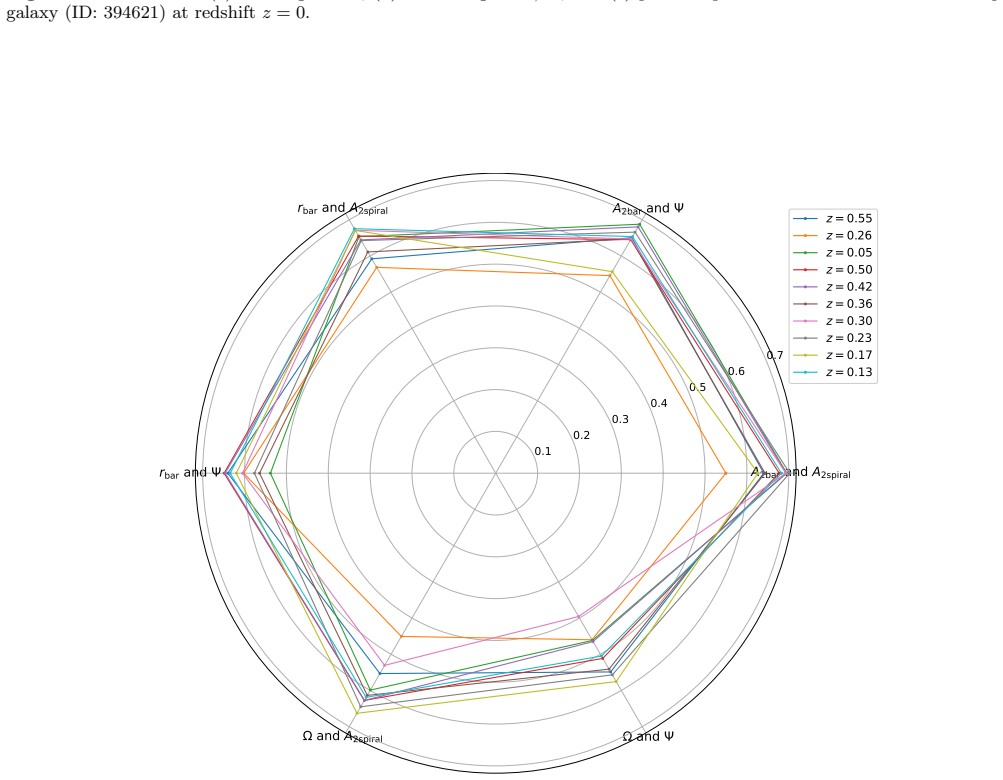
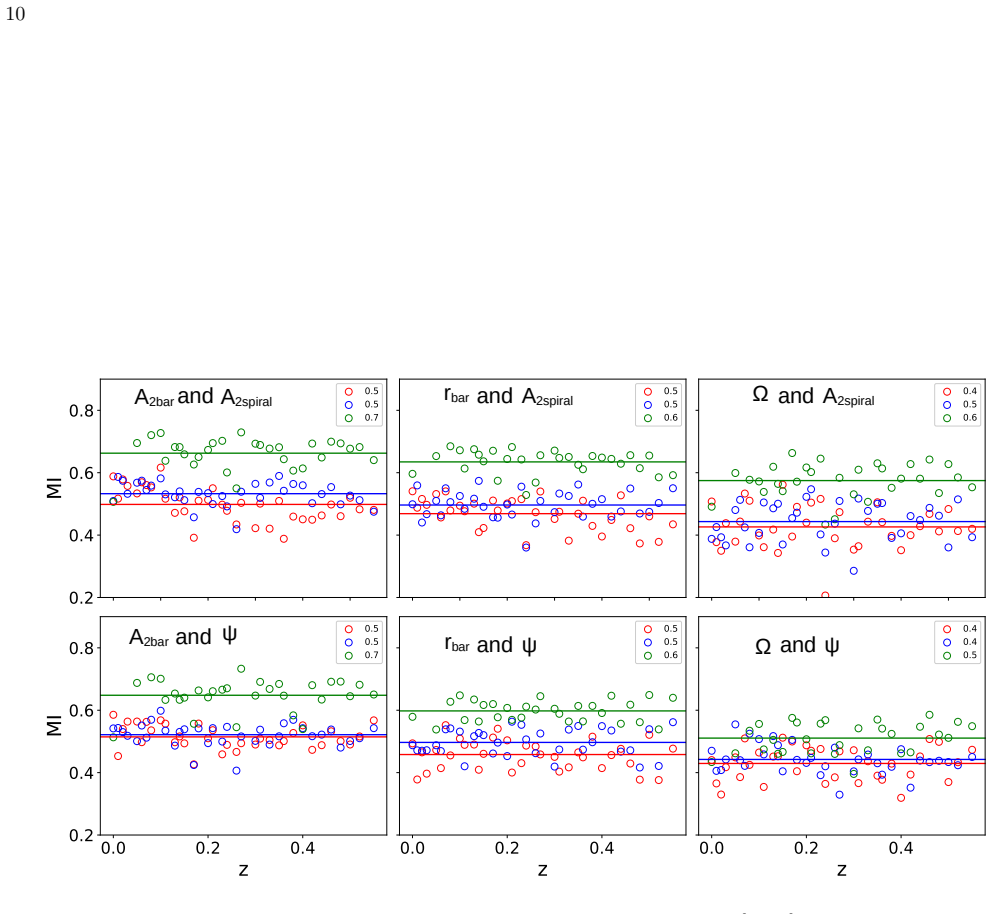
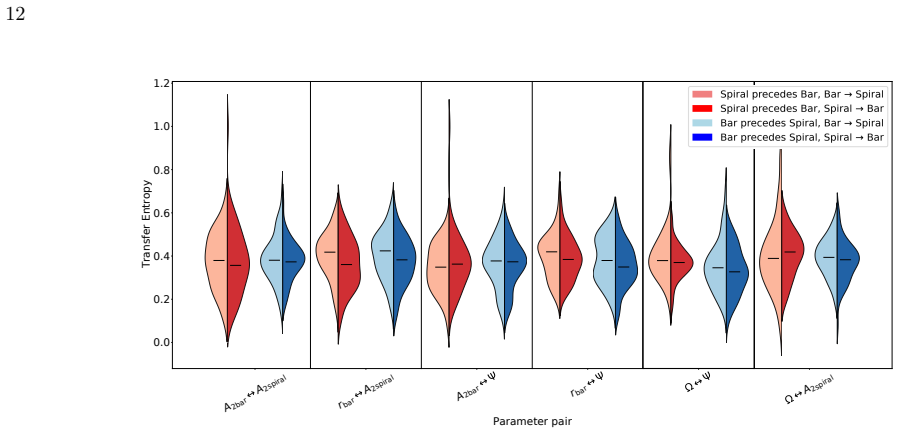
In samples where bars form before spirals and where spirals form before bars, mutual information between bar parameters (A2bar, rbar, Omega) and spiral parameters (A2spiral, Psi) reaches 0.4-0.8, while transfer entropy from bar to spiral and from spiral to bar both fall in the 0.33-0.42 range; the authors conclude that the bar and the spiral arm regulate their co-evolution on an equal footing.
What carries the argument
Transfer entropy computed on time series of bar and spiral parameters (A2bar, rbar, Omega, A2spiral, Psi), which quantifies directional information flow between the two structures.
If this is right
- High mutual information holds across both formation-order samples and the combined sample, confirming association between bar and spiral properties.
- Comparable transfer entropy and Liang flow values in both directions indicate symmetric rather than one-way influence.
- The symmetry persists even when the time lag between bar and spiral formation differs by 1.7 Gyr.
- The result applies to the specific set of kinematic and morphological parameters tracked in the TNG50 barred-spiral galaxies.
Where Pith is reading between the lines
- The same information-theoretic pipeline could be run on observational time series extracted from repeated imaging of nearby galaxies if sufficient temporal baselines become available.
- If the equal-footing result survives higher-resolution runs, it would constrain the resonance conditions that allow bars and spirals to lock into mutual regulation rather than one suppressing the other.
- The method supplies a quantitative test that could be applied to other pairs of galactic structures, such as rings and bars, once comparable time-series data exist.
Load-bearing premise
That cleanly partitioning galaxies into bars-first and spirals-first samples and applying transfer entropy to the resulting parameter time series reliably reveals causal directionality.
What would settle it
Finding that one direction of transfer entropy (bar-to-spiral or spiral-to-bar) is systematically and significantly larger than the other across a larger TNG50 subsample or across an independent simulation suite with different resolution or feedback prescriptions.
Figures


read the original abstract
Using Information Theory, we investigate the co-evolution of bars and spiral arms in barred-spiral galaxies from the cosmological magneto-hydrodynamic Illustris TNG50 simulations. We first calculate Mutual Information (MI) between a structural or kinematic parameter of the bar (bar strength $A_{2bar}$, bar length $r_{bar}$, bar pattern speed $\Omega$) and that of a spiral arm (spiral strength $A_{2spiral}$, spiral arm pitch angle $\Psi$). We calculate MI in two different galaxy samples: (i) one forming bars before spirals (ii) other forming spirals before bars. We note, spirals form immediately after bars in the first sample, whereas bars form 1.7 Gyrs after spirals in the second. We find a high mean MI value in each of these samples (0.4 - 0.5), and in the combined sample (0.4-0.8), confirming a fair degree of association of the bar and the spiral arm. To identify whether the bar or the spiral arm effectively drives their co-evolution, we calculate the Transfer Entropy (TE) (bar-to-spiral TE, spiral-to-bar TE), from the time series data of each of the above bar-spiral parameter pairs. We find that the median bar-to-spiral TE and spiral-to-bar TE values vary between $ 0.33$ and $ 0.42$ for each galaxy sample, comparable to those of the combined sample. A similar trend was observed in our calculated Liang information flow rates. Our novel approach may possibly indicate that the bar and the spiral arm regulate their co-evolution on an equal footing.
Editorial analysis
A structured set of objections, weighed in public.
Referee Report
Summary. The manuscript applies mutual information (MI) and transfer entropy (TE) to time series of bar (A_{2bar}, r_{bar}, Ω) and spiral (A_{2spiral}, Ψ) parameters from TNG50 galaxies. Galaxies are split into two formation-order samples (bars before spirals, with spirals forming immediately; spirals before bars, with bars forming after 1.7 Gyr), yielding high MI (0.4-0.5 per sample, 0.4-0.8 combined) and comparable median TE values (0.33-0.42) in both directions, plus similar Liang information flow rates. The authors conclude that this indicates bars and spirals regulate their co-evolution on equal footing.
Significance. If the information-theoretic measures prove robust, the work introduces a quantitative approach to assessing directional information flow in galactic morphological co-evolution using cosmological simulations. This could complement dynamical analyses and provide falsifiable metrics for regulatory roles, though the current presentation leaves the statistical support unverifiable.
major comments (3)
- [Abstract] Abstract: the central claim that comparable median TE values (0.33-0.42) indicate equal regulatory footing is load-bearing, yet no sample sizes, error bars, or statistical tests (e.g., for median equality or significance of MI/TE) are reported, rendering the ranges and the 'comparable' assessment unverifiable.
- [Abstract] Abstract: the two samples exhibit markedly different formation delays (immediate vs. 1.7 Gyr), but the manuscript provides no description of lag normalization, time-series alignment, or controls for non-stationarity around formation events in the TE calculations; without these, similar TE values do not necessarily demonstrate ongoing equal-footing regulation rather than formation-event dominance.
- [Abstract] Abstract: the partitioning into 'bars before spirals' and 'spirals before bars' samples relies on formation-epoch identification, but no explicit criteria (e.g., thresholds on A_2 or pattern speed), resolution controls, or robustness checks are described; this directly affects the reliability of the subsequent MI and TE comparisons.
minor comments (2)
- [Abstract] Abstract: the distinction between per-sample MI ranges (0.4-0.5) and the combined-sample range (0.4-0.8) is unclear without additional context on how the combined sample is constructed or whether it includes the separate samples.
- [Abstract] Abstract: 'Liang information flow rates' are invoked for confirmation but neither defined nor referenced, which could be clarified with a brief citation or equation in the methods.
Simulated Author's Rebuttal
We thank the referee for their careful reading and constructive feedback on our manuscript. We address each major comment below and will revise the manuscript to improve clarity and verifiability where needed.
read point-by-point responses
-
Referee: [Abstract] Abstract: the central claim that comparable median TE values (0.33-0.42) indicate equal regulatory footing is load-bearing, yet no sample sizes, error bars, or statistical tests (e.g., for median equality or significance of MI/TE) are reported, rendering the ranges and the 'comparable' assessment unverifiable.
Authors: We agree that the abstract lacks these details, which are necessary for verifiability. The full manuscript reports sample sizes of 28 galaxies in the bars-first sample and 19 in the spirals-first sample (combined N=47), with MI and TE values computed across all parameter pairs. In the revised version we will add these numbers to the abstract, report medians with interquartile ranges, and include a Wilcoxon rank-sum test (p>0.1 for median TE equality) to support the comparability statement. revision: yes
-
Referee: [Abstract] Abstract: the two samples exhibit markedly different formation delays (immediate vs. 1.7 Gyr), but the manuscript provides no description of lag normalization, time-series alignment, or controls for non-stationarity around formation events in the TE calculations; without these, similar TE values do not necessarily demonstrate ongoing equal-footing regulation rather than formation-event dominance.
Authors: Transfer entropy was computed on the raw simulation time series (snapshot cadence ~100 Myr) without explicit lag normalization or alignment beyond the natural simulation timeline, as the formation delays are intrinsic to the samples. We acknowledge that non-stationarity around formation epochs could influence the results. In revision we will add a methods subsection describing the time-series handling, perform a robustness test by recomputing TE after masking the 500 Myr window around each formation event, and discuss whether the comparable values persist. We maintain that the similarity across samples with different delays supports co-regulation rather than pure formation dominance, but the added checks will strengthen this interpretation. revision: partial
-
Referee: [Abstract] Abstract: the partitioning into 'bars before spirals' and 'spirals before bars' samples relies on formation-epoch identification, but no explicit criteria (e.g., thresholds on A_2 or pattern speed), resolution controls, or robustness checks are described; this directly affects the reliability of the subsequent MI and TE comparisons.
Authors: Formation epochs were identified when A2 first exceeds 0.2 (for both bars and spirals) sustained over two consecutive snapshots, with bar pattern speed Ω < 50 km/s/kpc as an additional kinematic criterion. TNG50 resolution is used throughout. We will expand the methods section with these explicit thresholds, include a resolution convergence note, and add robustness checks by varying the A2 threshold between 0.15–0.25 and recomputing all MI/TE values. These additions will directly address the reliability concern. revision: yes
Circularity Check
No significant circularity; computations are direct from simulation time series
full rationale
The paper computes Mutual Information and Transfer Entropy directly from time series of bar and spiral parameters extracted from TNG50 simulations across defined samples. No parameters are fitted to subsets and then relabeled as predictions, no self-definitional loops exist in the MI/TE definitions, and no load-bearing self-citations or imported uniqueness theorems are invoked in the provided text. The derivation chain consists of standard information-theoretic measures applied to external simulation outputs, remaining self-contained without reduction to its own inputs by construction.
Axiom & Free-Parameter Ledger
axioms (2)
- domain assumption Standard definitions of bar strength A2bar, bar length r_bar, bar pattern speed Ω, spiral strength A2spiral, and pitch angle Ψ accurately capture the structures in TNG50 outputs.
- domain assumption Transfer entropy estimated from the time series of these parameters can be interpreted as directional influence between bar and spiral evolution.
Reference graph
Works this paper leans on
-
[2]
, year = 1993, month = sep, volume =
Bars within bars in lenticular and spiral galaxies : a step in secular evolution?. , year = 1993, month = sep, volume =
1993
-
[3]
, keywords =
A strong correlation between bar strength and global star forming activity in isolated barred galaxies. , keywords =
-
[4]
1987 , publisher =
Galactic Dynamics , author =. 1987 , publisher =
1987
-
[9]
and Stavropoulos, I
Voglis, N. and Stavropoulos, I. and Kalapotharakos, C. , title =. Monthly Notices of the Royal Astronomical Society , volume =. 2006 , doi =
2006
-
[19]
and Thomas, Joy A
Cover, Thomas M. and Thomas, Joy A. , title =. 2006 , isbn =
2006
-
[26]
Shannon, C. E. , journal=. A mathematical theory of communication , year=
-
[28]
Simulated Bars May Be Shorter But Are Not Slower Than Observed: TNG50 vs. MaNGA. arXiv e-prints , keywords =
-
[41]
Arm Classifications for Spiral Galaxies. , keywords =. doi:10.1086/165034 , adsurl =
-
[47]
2024 , eprint=
Galaxy Zoo DESI: large-scale bars as a secular mechanism for triggering AGN , author=. 2024 , eprint=
2024
-
[51]
The stability and masses of disc galaxies. , keywords =. doi:10.1093/mnras/199.4.1069 , adsurl =
-
[52]
, year = 1973, month = dec, volume =
A Numerical Study of the Stability of Flattened Galaxies: or, can Cold Galaxies Survive?. , year = 1973, month = dec, volume =. doi:10.1086/152513 , adsurl =
-
[53]
Numerical simulations of bar formation in the Local Group. , keywords =. doi:10.1093/mnras/stac105 , archivePrefix =. 2201.05162 , primaryClass =
-
[54]
Bar formation and destruction in the FIRE-2 simulations. arXiv e-prints , keywords =. doi:10.48550/arXiv.2309.16811 , archivePrefix =. 2309.16811 , primaryClass =
-
[59]
Pettitt, Alex R. and Tasker, Elizabeth J. and Wadsley, James W. , title =. Monthly Notices of the Royal Astronomical Society , volume =. 2016 , month =. doi:10.1093/mnras/stw588 , url =
-
[60]
Monthly Notices of the Royal Astronomical Society , volume =
Pettitt, Alex R and Wadsley, J W , title =. Monthly Notices of the Royal Astronomical Society , volume =. 2017 , month =. doi:10.1093/mnras/stx3129 , url =
-
[63]
Galactic and Extragalactic Radio Astronomy , year = 1988, editor =
The structure of our Galaxy derived from observations of neutral hydrogen. Galactic and Extragalactic Radio Astronomy , year = 1988, editor =
1988
-
[79]
American Astronomical Society Meeting Abstracts 221 221, 206.02, 2013 , year=
Logarithmic Spiral Arm Pitch Angle of Late-Type Galaxies: Measurement and Relationship to Galactic Nuclear Supermassive Black Hole Mass , author=. American Astronomical Society Meeting Abstracts 221 221, 206.02, 2013 , year=
2013
-
[84]
Evaluating Information Transfer Between Auditory Cortical Neurons , journal =
Gour\'. Evaluating Information Transfer Between Auditory Cortical Neurons , journal =. 2007 , doi =
2007
-
[85]
The European Physical Journal B-Condensed Matter and Complex Systems , volume=
Analysing the information flow between financial time series: An improved estimator for transfer entropy , author=. The European Physical Journal B-Condensed Matter and Complex Systems , volume=. 2002 , publisher=
2002
-
[86]
Visual Areas Exert Feedforward and Feedback Influences through Distinct Frequency Channels , journal =. 2015 , issn =. doi:https://doi.org/10.1016/j.neuron.2014.12.018 , url =
-
[87]
Zeitschrift f
David Freedman and Persi Diaconis , title =. Zeitschrift f. 1981 , month = dec, doi =
1981
-
[88]
Pyleoclim: Paleoclimate Timeseries Analysis and Visualization With Python , volume =
Khider, Deborah and Emile-Geay, Julien and Zhu, Feng and James, Alexander and Landers, Jordan and Ratnakar, Varun and Gil, Yolanda , journal =. Pyleoclim: Paleoclimate Timeseries Analysis and Visualization With Python , volume =. 2022 , doi =
2022
-
[89]
2017 , howpublished =
Bontorin, Sebastiano , title =. 2017 , howpublished =
2017
-
[90]
Aditya K., Banerjee A., 2025, @doi [The Astrophysical Journal] 10.3847/1538-4357/ae0991 , 992, 179
-
[91]
Aguerri J. A. L., 1999, , https://ui.adsabs.harvard.edu/abs/1999A&A...351...43A 351, 43
1999
-
[92]
Ansar S., Das M., 2023, @doi [arXiv e-prints] 10.48550/arXiv.2311.11998 , https://ui.adsabs.harvard.edu/abs/2023arXiv231111998A p. arXiv:2311.11998
-
[93]
Athanassoula E., 2005, @doi [Monthly Notices of the Royal Astronomical Society] 10.1111/j.1365-2966.2005.08872.x , 358, 1477
-
[94]
Athanassoula E., Misiriotis A., 2002, @doi [Monthly Notices of the Royal Astronomical Society] 10.1046/j.1365-8711.2002.05028.x , 330, 35
-
[95]
Athanassoula E., Romero-Gómez M., Bosma A., Masdemont J. J., 2009, @doi [Monthly Notices of the Royal Astronomical Society] 10.1111/j.1365-2966.2009.15583.x , 400, 1706
-
[96]
Benjamin R. A., et al., 2005, @doi [The Astrophysical Journal] 10.1086/491785 , 630, L149
-
[97]
springer
Binney J., Tremaine S., 1987, Galactic Dynamics. springer
1987
-
[98]
Block D. L., Buta R., Knapen J. H., Elmegreen D. M., Elmegreen B. G., Puerari I., 2004, @doi [ ] 10.1086/421362 , https://ui.adsabs.harvard.edu/abs/2004AJ....128..183B 128, 183
-
[99]
Bontorin S., 2017, transfer\_entropy : Transfer Entropy between Two Time Series -- Implementation in Python, https://github.com/notsebastiano/transfer_entropy
2017
-
[100]
B., 1988, in Kellermann K
Burton W. B., 1988, in Kellermann K. I., Verschuur G. L., eds, , Galactic and Extragalactic Radio Astronomy. Springer, pp 295--358
1988
-
[101]
Buta R. J., Knapen J. H., Elmegreen B. G., Salo H., Laurikainen E., Elmegreen D. M., Puerari I., Block D. L., 2009, @doi [The Astronomical Journal] 10.1088/0004-6256/137/5/4487 , 137, 4487
-
[102]
Contopoulos G., Grosbol P., 1989, @doi [ ] 10.1007/BF00873080 , https://ui.adsabs.harvard.edu/abs/1989A&ARv...1..261C 1, 261
-
[103]
M., Thomas J
Cover T. M., Thomas J. A., 2006, Elements of Information Theory (Wiley Series in Telecommunications and Signal Processing). Wiley-Interscience, USA
2006
-
[104]
M., Hartmann D., Thaddeus P., 2001, @doi [The Astrophysical Journal] 10.1086/318388 , 547, 792
Dame T. M., Hartmann D., Thaddeus P., 2001, @doi [The Astrophysical Journal] 10.1086/318388 , 547, 792
work page internal anchor Pith review doi:10.1086/318388 2001
-
[105]
Das M., Laurikainen E., Salo H., Buta R., 2008, @doi [Astrophysics and Space Science] 10.1007/s10509-008-9873-9 , 317, 163–168
-
[106]
L., 2013, American Astronomical Society Meeting Abstracts 221 221, 206.02, 2013
Davis B. L., 2013, American Astronomical Society Meeting Abstracts 221 221, 206.02, 2013
2013
-
[107]
Dehnen W., Semczuk M., Sch \"o nrich R., 2023, @doi [ ] 10.1093/mnras/stac3184 , https://ui.adsabs.harvard.edu/abs/2023MNRAS.518.2712D 518, 2712
-
[109]
Díaz-García, S. Salo, H. Knapen, J. H. Herrera-Endoqui, M. 2019b, @doi [A&A] 10.1051/0004-6361/201936000 , 631, A94
-
[110]
Elmegreen D. M., et al., 2011, @doi [ ] 10.1088/0004-637X/737/1/32 , https://ui.adsabs.harvard.edu/abs/2011ApJ...737...32E 737, 32
-
[111]
Frankel N., et al., 2022, arXiv e-prints, https://ui.adsabs.harvard.edu/abs/2022arXiv220108406F p. arXiv:2201.08406
arXiv 2022
-
[112]
Fraser-McKelvie A., Merrifield M., Aragón-Salamanca A., Masters K., 2019, @doi [Proceedings of the International Astronomical Union] 10.1017/S1743921319008081 , 14, 226–230
-
[113]
Freedman D., Diaconis P., 1981, @doi [Zeitschrift f \"u r Wahrscheinlichkeitstheorie und Verwandte Gebiete] 10.1007/BF01025868 , 57, 453
-
[114]
Friedli D., Martinet L., 1993, , https://ui.adsabs.harvard.edu/abs/1993A&A...277...27F 277, 27
1993
-
[115]
Fujii M. S., Baba J., Saitoh T. R., Makino J., Kokubo E., Wada K., 2011, @doi [The Astrophysical Journal] 10.1088/0004-637x/730/2/109 , 730, 109
-
[116]
Galloway M. A., et al., 2015, @doi [Monthly Notices of the Royal Astronomical Society] 10.1093/mnras/stv235 , 448, 3442–3454
work page internal anchor Pith review doi:10.1093/mnras/stv235 2015
-
[117]
Garland I. L., et al., 2024, Galaxy Zoo DESI: large-scale bars as a secular mechanism for triggering AGN ( @eprint arXiv 2406.20096 ), https://arxiv.org/abs/2406.20096
arXiv 2024
-
[118]
Garma-Oehmichen L., Martinez-Medina L., Hernández-Toledo H., Puerari I., 2021, @doi [Monthly Notices of the Royal Astronomical Society] 10.1093/mnras/stab333 , 502, 4708–4722
-
[119]
George, K. Subramanian, S. Paul, K. T. 2019, @doi [A&A] 10.1051/0004-6361/201935207 , 628, A24
-
[120]
Gour\' e vitch B., Eggermont J. J., 2007, @doi [Journal of Neurophysiology] 10.1152/jn.01106.2006 , 97, 2533
work page internal anchor Pith review Pith/arXiv arXiv doi:10.1152/jn.01106.2006 2007
-
[121]
Grand R. J. J., Kawata D., Cropper M., 2013, @doi [Astronomy & Astrophysics] 10.1051/0004-6361/201321308 , 553, A77
-
[122]
Habibi A., Roshan M., Hosseinirad M., Khosroshahi H., Aguerri J. A. L., Cuomo V., Abbassi S., 2024, @doi [Astronomy & Astrophysics] 10.1051/0004-6361/202451028 , 691, A122
-
[123]
Hewitt I. B., Treuthardt P., 2020, @doi [Monthly Notices of the Royal Astronomical Society] 10.1093/mnras/staa354 , 493, 3854
-
[124]
Hogarth L. M., Saintonge A., Davis T. A., Ellison S. L., Lin L., López-Cobá C., Pan H. A., Thorp M. D., 2024, @doi [Monthly Notices of the Royal Astronomical Society] 10.1093/mnras/stae377 , 528, 6768
-
[125]
Izquierdo-Villalba D., et al., 2022, @doi [ ] 10.1093/mnras/stac1413 , https://ui.adsabs.harvard.edu/abs/2022MNRAS.514.1006I 514, 1006
-
[126]
Kataria S. K., Vivek M., 2023, @doi [Monthly Notices of the Royal Astronomical Society] 10.1093/mnras/stad3383 , 527, 3366
-
[127]
Khider D., Emile-Geay J., Zhu F., James A., Landers J., Ratnakar V., Gil Y., 2022, @doi [Paleoceanography and Paleoclimatology] 10.1029/2022PA004509 , 37, e2022PA004509
-
[128]
C., 2002, @doi [ ] 10.1086/339352 , https://ui.adsabs.harvard.edu/abs/2002ApJ...570..132K 570, 132
Kim W.-T., Ostriker E. C., 2002, @doi [ ] 10.1086/339352 , https://ui.adsabs.harvard.edu/abs/2002ApJ...570..132K 570, 132
-
[129]
Laurikainen E., Salo H., Buta R., 2004, @doi [The Astrophysical Journal] 10.1086/383462 , 607, 103–124
-
[130]
Liang X. S., 2008, @doi [Phys. Rev. E] 10.1103/PhysRevE.78.031113 , 78, 031113
-
[131]
S., 2013, @doi [Physica D: Nonlinear Phenomena] https://doi.org/10.1016/j.physd.2012.12.011 , 248, 1
Liang X. S., 2013, @doi [Physica D: Nonlinear Phenomena] https://doi.org/10.1016/j.physd.2012.12.011 , 248, 1
-
[132]
Liang X. S., 2014, @doi [Phys. Rev. E] 10.1103/PhysRevE.90.052150 , 90, 052150
-
[133]
Liang X. S., 2015, @doi [Phys. Rev. E] 10.1103/PhysRevE.92.022126 , 92, 022126
-
[134]
S., Kleeman R., 2005, @doi [Phys
Liang X. S., Kleeman R., 2005, @doi [Phys. Rev. Lett.] 10.1103/PhysRevLett.95.244101 , 95, 244101
-
[135]
, year = 1964, month = aug, volume =
Lin C. C., Shu F. H., 1964, @doi [ ] 10.1086/147955 , https://ui.adsabs.harvard.edu/abs/1964ApJ...140..646L 140, 646
-
[136]
L \'o pez P. D., Scannapieco C., Cora S. A., Gargiulo I. D., 2024, @doi [ ] 10.1093/mnras/stae576 , https://ui.adsabs.harvard.edu/abs/2024MNRAS.529..979L 529, 979
-
[137]
Lynden-Bell D., Kalnajs A. J., 1972, @doi [ ] 10.1093/mnras/157.1.1 , https://ui.adsabs.harvard.edu/abs/1972MNRAS.157....1L 157, 1
-
[138]
Marschinski R., Kantz H., 2002, The European Physical Journal B-Condensed Matter and Complex Systems, 30, 275
2002
-
[139]
Michikoshi S., Kokubo E., 2014, @doi [The Astrophysical Journal] 10.1088/0004-637x/787/2/174 , 787, 174
-
[140]
Mondal D., Chattopadhyay T., 2021, @doi [Celestial Mechanics and Dynamical Astronomy] 10.1007/s10569-021-10037-5 , 133
-
[141]
Mutlu-Pakdil B., Seigar M. S., Hewitt I. B., Treuthardt P., Berrier J. C., Koval L. E., 2017, @doi [Monthly Notices of the Royal Astronomical Society] 10.1093/mnras/stx2935 , 474, 2594
-
[142]
Nelson D., et al., 2019a, @doi [Computational Astrophysics and Cosmology] 10.1186/s40668-019-0028-x , https://ui.adsabs.harvard.edu/abs/2019ComAC...6....2N 6, 2
-
[143]
Nelson D., et al., 2019b, @doi [ ] 10.1093/mnras/stz2306 , https://ui.adsabs.harvard.edu/abs/2019MNRAS.490.3234N 490, 3234
work page internal anchor Pith review doi:10.1093/mnras/stz2306
-
[144]
Newnham L., Hess K. M., Masters K. L., Kruk S., Penny S. J., Lingard T., Smethurst R. J., 2020, @doi [Monthly Notices of the Royal Astronomical Society] 10.1093/mnras/staa064 , 492, 4697–4715
-
[145]
K., 2011, @doi [The Astrophysical Journal Supplement Series] 10.1088/0067-0049/198/1/4 , 198, 4
Oh S., Oh K., Yi S. K., 2011, @doi [The Astrophysical Journal Supplement Series] 10.1088/0067-0049/198/1/4 , 198, 4
-
[146]
title Radiative pressure feedback by a quasar in a galactic bulge
Patsis P. A., 2006, @doi [Monthly Notices of the Royal Astronomical Society: Letters] 10.1111/j.1745-3933.2006.00174.x , 369, L56
-
[147]
Pillepich A., et al., 2019, @doi [ ] 10.1093/mnras/stz2338 , https://ui.adsabs.harvard.edu/abs/2019MNRAS.490.3196P 490, 3196
discussion (0)
Sign in with ORCID, Apple, or X to comment. Anyone can read and Pith papers without signing in.