REVIEW 3 major objections 5 minor 6 cited by
SPEED-Bench is a benchmark for speculative decoding that claims speedups depend heavily on the prompt distribution and serving regime, and that standardized diverse workloads are needed to measure them fairly.
Reviewed by Pith at T0; open to challenge. T0 means a machine referee read the full paper against a public rubric. the ladder, T0–T4 →
T0 review · deepseek-v4-flash
2026-08-03 02:35 UTC pith:EEWGKQH2
load-bearing objection A genuinely useful benchmark for speculative decoding, with a diversity-driven split that is broader but not proven representative — worth reviewing. the 3 major comments →
SPEED-Bench: A Unified and Diverse Benchmark for Speculative Decoding
The pith
A machine-rendered reading of the paper's core claim, the machinery that carries it, and where it could break.
Core claim
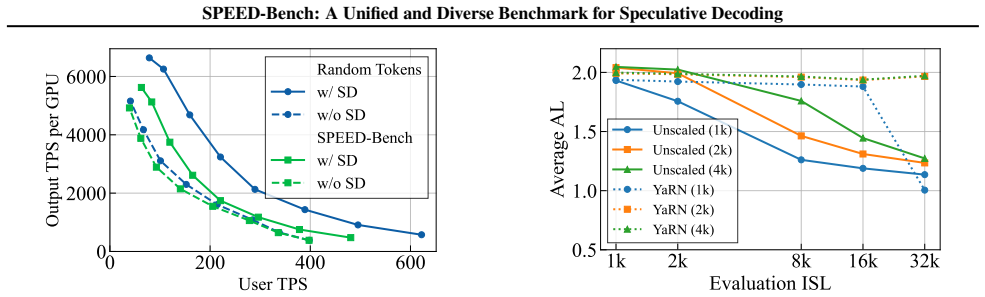
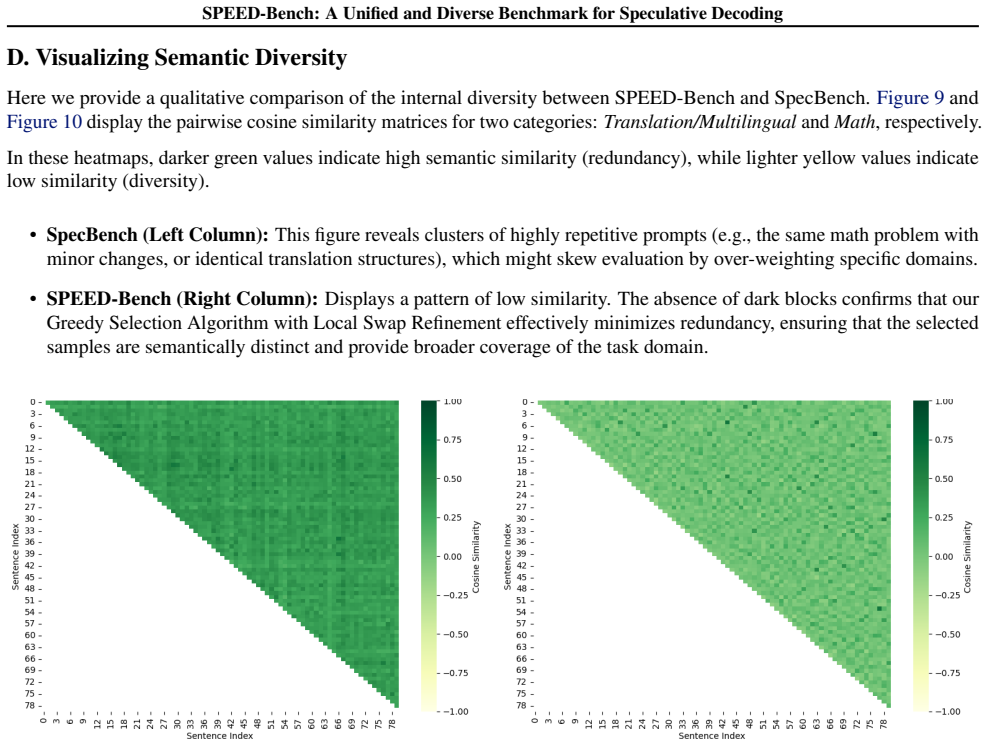
The paper argues that speculative decoding speed cannot be judged on narrow or synthetic workloads; evaluation needs semantically diverse, realistic data and production-grade measurement. Its Qualitative Split selects prompts by minimizing pairwise cosine similarity among embeddings via greedy selection with local swap refinement, cutting average semantic similarity by about 40% versus an earlier benchmark. A Throughput Split adds real prompts in fixed input-length buckets (1k–32k tokens) across three entropy tiers, enabling throughput-latency Pareto curves. A measurement framework normalizes tokenization and chat templates so all engines process identical sequences. Empirically, random-toke
What carries the argument
The load-bearing object is the greedy subset-selection algorithm with local swap refinement: it minimizes the sum of pairwise cosine similarities between row-normalized prompt embeddings, so the chosen prompts span the semantic space rather than clustering. For the throughput regime, the key identity is Speedup = (t_ar * AL) / t_sd, which separates domain-dependent acceptance length (AL) from system-dependent per-step latencies; the Throughput Split provides realistic workloads for measuring those latencies, allowing domain-specific speedups to be estimated without exhaustive testing.
Load-bearing premise
The whole benchmark rests on the assumption that maximizing semantic diversity in embedding space (cosine similarity) produces a prompt set whose diversity matches the real-world data distribution that matters for speculative decoding; nothing in the paper independently verifies that connection.
What would settle it
Sample, say, 1,000 prompts uniformly from logged production traffic for a coding assistant and a chat service, run a fixed drafter-target pair through the same measurement framework, and compare category-level acceptance lengths and the ranking across domains with SPEED-Bench's results; if the rankings diverge materially, the diversity-selection premise fails. Similarly, if random-token prompts on a mixture-of-experts model activate experts as evenly as real prompts do, the claimed synthetic-input distortion collapses.
If this is right
- If the benchmark is adopted, published SD speedups will become comparable across methods, because all measurements run on the same diverse prompts and the same underlying engine implementations.
- Synthetic token inputs should be retired for SD benchmarking: the paper measures a 23% average overestimate in throughput, and shows random inputs also distort expert routing in mixture-of-experts models.
- Optimal draft length is not a fixed property of a drafter; practitioners need to re-tune it for their batch size, since shorter drafts win in compute-bound high-batch regimes.
- Vocabulary-pruned drafters should be expected to lose accuracy on multilingual, retrieval-augmented, and summarization workloads even when math and coding look fine.
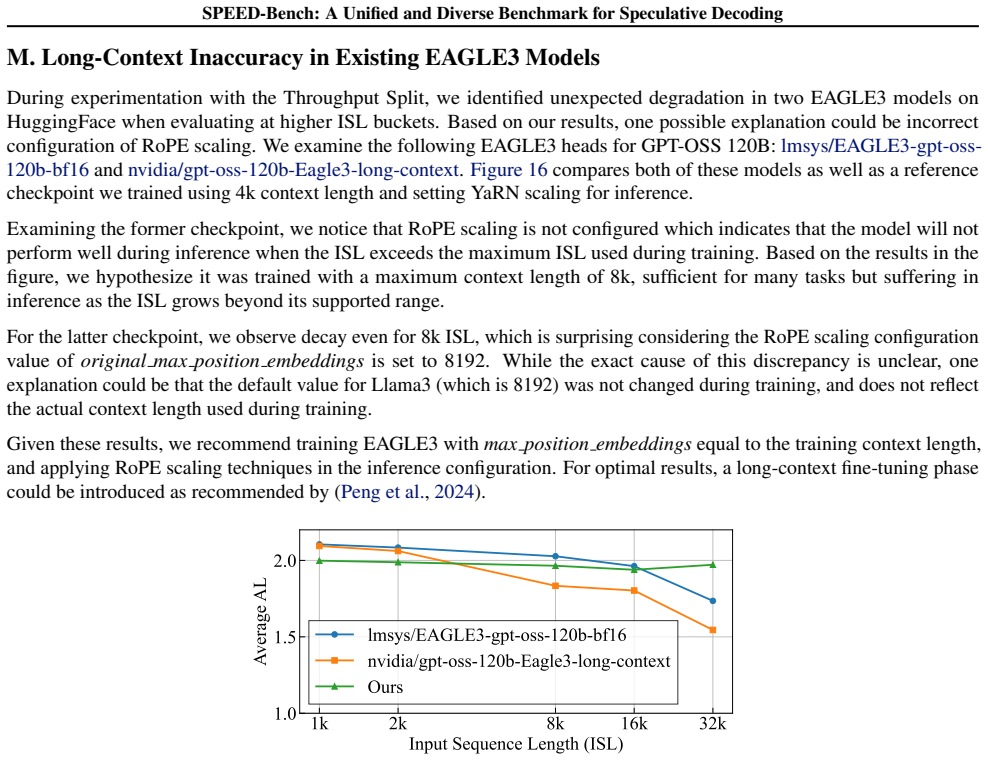
- Drafter training context length matters: models trained on short sequences degrade sharply beyond their training input length, and long-context scaling like YaRN recovers much of the accuracy.
- The authors identify a boundary on their own framework: above about 256 concurrent requests, the Python client-side loop can become a bottleneck, so the highest-concurrency regime is not yet fully covered.
Where Pith is reading between the lines
- Editorial inference: the selection algorithm optimizes embedding-space cosine distance, but embedding diversity is only a proxy for the task-level properties that determine acceptance rates; a validation against randomly sampled production traffic would strengthen the claim of representativeness.
- Editorial inference: the speedup decomposition suggests a calibration protocol: measuring per-step latencies once per hardware/engine/batch configuration and reusing them with domain-specific ALs could let the community extrapolate speedups to new domains cheaply.
- Editorial inference: the paper's finding that low-diversity benchmarks hide drafter differences implies that previously published comparisons on small, repetitive datasets may need re-checking, especially for multilingual and long-context claims.
- Boundary noted by the authors: their measurement client can become a bottleneck above roughly 256 concurrent requests, so the very-high-concurrency regime is not fully covered.
Editorial analysis
A structured set of objections, weighed in public.
Referee Report
Summary. SPEED-Bench proposes a benchmark suite for speculative decoding (SD) with two data splits and a measurement framework. The Qualitative Split selects 880 prompts from 18 public sources by greedily minimizing pairwise cosine similarity among prompt embeddings (Eq. 2, Algorithm 1), yielding 11 categories with 80 samples each. The Throughput Split provides fixed-ISL buckets (1k–32k) across three entropy classes for throughput-latency evaluation at batch sizes up to 512. The framework integrates with vLLM, TensorRT-LLM, SGLang, and SpecBench, and the paper reports experiments on Llama 3.3 70B, GPT-OSS 120B, DeepSeek R1, Qwen3 235B, and Qwen3-Next, covering acceptance rates, speedups, vocabulary pruning, synthetic-input artifacts, draft-length selection, and training-ISL effects. The paper claims SPEED-Bench will establish a unified evaluation standard for practical SD comparisons.
Significance. If the dataset and measurement pipeline are sound, SPEED-Bench is a useful step toward standardized SD evaluation. Its strengths include: the use of production-grade engines rather than high-level stubs; the Throughput Split, which addresses a real gap in batch-size/ISL coverage; the validation of a proxy formula for domain-specific speedups (Appendix H); and the demonstrations that synthetic random inputs distort both SD and baseline MoE throughput (Appendix G) and that vocabulary pruning degrades multilingual and RAG performance. The paper is also transparent about its conflict of interest and about acknowledged limitations (e.g., the GIL at BS>256, the unconfirmed causes of long-context EAGLE3 degradation). The main risk is whether the Qualitative Split's diversity-maximized subset is representative enough of real workloads to support the paper's strong claim of a 'unified evaluation standard.'
major comments (3)
- [§5, Eq. (2), Algorithm 1; Appendix C] The Qualitative Split is constructed by minimizing pairwise cosine similarity in an embedding space. This is a coverage/diversity objective, not a representativeness objective: it selects mutually dissimilar prompts that tend to lie in low-density regions and down-weights common, clustered prompt types. Appendix C shows that the optimized subset is stable across random seeds, but stability under resampling is not the same as unbiasedness relative to the source distribution or to real deployment workloads. Since the aggregate AL/speedup numbers in Table 1 and the comparisons with SpecBench in §8.3 rest entirely on this subset, the paper should either (a) validate that aggregate conclusions (draft-method rankings, category orderings) agree with those obtained from a uniform/stratified sample of the same source pools, or (b) compare the selected prompts against a held-out realistic workload
- [Table 1; §8.3 and Figure 5] The central quantitative results are reported without confidence intervals, standard errors, or repeated-run variation. With 80 samples per category and, apparently, a single measurement per cell, small differences between methods (e.g., the mean AL values of 2.44 for Vanilla and EAGLE3 on Llama 3.3 70B at Temperature=0; the mean AL differences across domains) cannot be assessed statistically. The claims that SPEED-Bench 'corrects' the SpecBench impression, or that one drafter outperforms another, need error bars or significance tests. This is especially important because the stated purpose of the benchmark is to enable reliable cross-method comparisons.
- [§5, 'Selection Algorithm'] The entire Qualitative Split depends on a single pre-trained embedder, OpenAI's text-embedding-3-large, used to compute cosine similarities. There is no evidence that the selected subset is stable across embedding models or that this embedding geometry is aligned with the task properties that actually determine SD acceptance rates and acceptance lengths. I request an ablation: recompute the selection with at least one other embedder (or an ensemble) and report subset overlap and the resulting differences in per-category AL/speedups. Without such evidence, the benchmark's diversity claims and the subsequent empirical conclusions are tied to a single, proprietary embedding choice.
minor comments (5)
- [Abstract and Conclusion] The abstract says 'unified evaluation standard' and the conclusion says 'establishes a unified evaluation ecosystem.' This is stronger than what the evidence currently supports, given the representativeness concern above; consider using 'a step toward' or 'a benchmark for.'
- [§5 vs Appendix A] The text says the Qualitative Split aggregates '18 publicly available datasets,' while Table 2 reports '24 distinct data sources' for SPEED-Bench. Please clarify whether this counts only the Qualitative Split or the union of both splits.
- [Table 2] Minor typo: 'Lanuages' should be 'Languages.' Also, the table lists 'Programming Lanuages' and 'Lanuages in Multilingual' with inconsistent capitalization.
- [References] The reference list contains duplicate entries for See et al. 2017 (2017a and 2017b with the same title and pages). Please deduplicate and use a single citation.
- [§7] The note that the asyncio/GIL introduces overhead at BS>256 is honest, but it would help to state explicitly which experimental points in Figures 6 and 7 are within the validated regime.
Circularity Check
No significant circularity: the benchmark is constructed by explicit, non-fitted selection rules and its claims are supported by direct measurements against external baselines.
full rationale
SPEED-Bench is a benchmark and measurement paper, not a derivation. The Qualitative Split is deliberately constructed to maximize embedding-space diversity (Eq. 2, Algorithm 1); this is a transparent design choice, not a fitted parameter later relabeled as a prediction. Acceptance lengths, speedups, and throughputs are measured directly from engine outputs, not derived from the selection objective. The comparisons with SpecBench in §8.3 are independent empirical measurements on differently sourced data, and the finding that low-diversity benchmarks hide differences is a consequence of the construction but is presented as a demonstration, not as a deduced law. The proxy Equation 3 in Appendix H is an algebraic identity, but it is used explicitly and checked against directly measured end-to-end speedups (Table 10), so it is not a hidden redefinition. The paper contains self-referential elements—NVIDIA employment, TensorRT-LLM, NVIDIA draft checkpoints—but these are disclosed conflicts of interest and are not used as evidence for the central claims. The stated limitations (GIL overhead at BS>256, unconfirmed causes of long-context degradation) are candid and do not hide circularity. The representativeness question raised about the diversity-maximizing selection is a validity concern, not a circularity concern; it does not reduce any claimed result to its own inputs. Therefore no circular step meets the evidentiary bar.
Axiom & Free-Parameter Ledger
axioms (3)
- domain assumption Maximizing semantic diversity in the embedding space (OpenAI text-embedding-3-large) yields a dataset representative of real-world SD workloads.
- domain assumption The entropy categorization (Low/Mixed/High) correctly reflects the difficulty of speculative decoding across domains.
- domain assumption The measurement framework accurately captures streaming response timings without engine-specific overheads.
read the original abstract
Speculative Decoding (SD) has emerged as a critical technique for accelerating Large Language Model (LLM) inference. Unlike deterministic system optimizations, SD performance is inherently data-dependent, meaning that diverse and representative workloads are essential for accurately measuring its effectiveness. Existing benchmarks suffer from limited task diversity, inadequate support for throughput-oriented evaluation, and a reliance on high-level implementations that fail to reflect production environments. To address this, we introduce SPEED-Bench, a comprehensive suite designed to standardize SD evaluation across diverse semantic domains and realistic serving regimes. SPEED-Bench offers a carefully curated Qualitative data split, selected by prioritizing semantic diversity across the data samples. Additionally, it includes a Throughput data split, allowing speedup evaluation across a range of concurrencies, from latency-sensitive low-batch settings to throughput-oriented high-load scenarios. By integrating with production engines like vLLM and TensorRT-LLM, SPEED-Bench allows practitioners to analyze system behaviors often masked by other benchmarks. We highlight this by quantifying how synthetic inputs overestimate real-world throughput, identifying batch-size dependent optimal draft lengths and biases in low-diversity data, and analyzing the caveats of vocabulary pruning in state-of-the-art drafters. We release SPEED-Bench to establish a unified evaluation standard for practical comparisons of SD algorithms.
Figures







Forward citations
Cited by 6 Pith papers
-
PSD: Pushing the Pareto Frontier of Diffusion LLMs via Parallel Speculative Decoding
PSD is a training-free framework that jointly optimizes spatial unmasking and temporal speculative decoding in diffusion LLMs to reach up to 5.5x tokens per forward pass while preserving accuracy comparable to greedy ...
-
Nemotron-Labs-Diffusion: A Tri-Mode Language Model Unifying Autoregressive, Diffusion, and Self-Speculation Decoding
Joint AR–diffusion training yields one tri-mode LM that switches AR, diffusion, and self-speculation, beating open AR/diffusion models on accuracy and tokens-per-forward.
-
DSpark: Confidence-Scheduled Speculative Decoding with Semi-Autoregressive Generation
DSpark's semi-autoregressive drafter plus load-aware confidence scheduling raises accepted draft length and shifts the production serving Pareto frontier by 60-85% higher per-user speed at matched throughput versus MTP-1.
-
Nemotron-Labs-3-Puzzle-75B-A9B: Compressing Hybrid MoE LLMs
Iterative Puzzle plus KD, RL, quantization, and MTP compresses Nemotron-3-Super to 75B total / 9B active parameters with ~2× interactive throughput and 8× 1M-context concurrency while retaining most parent accuracy.
-
Token-Operations-Oriented Inference Optimization Techniques for Large Models
The paper introduces a four-layer technical architecture for token-operations-oriented inference optimization in large models and reviews key technologies and industry status at each layer.
-
Token-Operations-Oriented Inference Optimization Techniques for Large Models
A survey of large-model inference optimization, organized as a four-layer 'token-operations' taxonomy: multi-model fusion, model optimization, compute-model fusion, and compute-network-model fusion.
Reference graph
Works this paper leans on
-
[1]
write newline
" write newline "" before.all 'output.state := FUNCTION n.dashify 't := "" t empty not t #1 #1 substring "-" = t #1 #2 substring "--" = not "--" * t #2 global.max substring 't := t #1 #1 substring "-" = "-" * t #2 global.max substring 't := while if t #1 #1 substring * t #2 global.max substring 't := if while FUNCTION format.date year duplicate empty "emp...
-
[2]
L., Almeida, D., Altenschmidt, J., Altman, S., Anadkat, S., et al
Achiam, J., Adler, S., Agarwal, S., Ahmad, L., Akkaya, I., Aleman, F. L., Almeida, D., Altenschmidt, J., Altman, S., Anadkat, S., et al. Gpt-4 technical report. arXiv preprint arXiv:2303.08774, 2023
Pith/arXiv arXiv 2023
-
[3]
Pard: Accelerating llm inference with low-cost parallel draft model adaptation
An, Z., Bai, H., Liu, Z., Li, D., and Barsoum, E. Pard: Accelerating llm inference with low-cost parallel draft model adaptation. arXiv preprint arXiv:2504.18583, 2025
arXiv 2025
-
[4]
Mt-bench-101: A fine-grained benchmark for evaluating large language models in multi-turn dialogues
Bai, G., Liu, J., Bu, X., He, Y., Liu, J., Zhou, Z., Lin, Z., Su, W., Ge, T., Zheng, B., et al. Mt-bench-101: A fine-grained benchmark for evaluating large language models in multi-turn dialogues. arXiv preprint arXiv:2402.14762, 2024
Pith/arXiv arXiv 2024
-
[5]
Nvidia nemotron 3: Efficient and open intelligence
Blakeman, A., Grattafiori, A., Basant, A., Gupta, A., Khattar, A., Renduchintala, A., Vavre, A., Shukla, A., Bercovich, A., Ficek, A., et al. Nvidia nemotron 3: Efficient and open intelligence. arXiv preprint arXiv:2512.20856, 2025
Pith/arXiv arXiv 2025
-
[6]
Long code arena: a set of benchmarks for long-context code models
Bogomolov, E., Eliseeva, A., Galimzyanov, T., Glukhov, E., Shapkin, A., Tigina, M., Golubev, Y., Kovrigin, A., van Deursen, A., Izadi, M., and Bryksin, T. Long code arena: a set of benchmarks for long-context code models. arXiv preprint arXiv:2406.11612, 2024
Pith/arXiv arXiv 2024
-
[7]
Bojar, O., Buck, C., Federmann, C., Haddow, B., Koehn, P., Leveling, J., Monz, C., Pecina, P., Post, M., Saint-Amand, H., Soricut, R., Specia, L., and Tamchyna, A. s. Findings of the 2014 workshop on statistical machine translation. In Proceedings of the Ninth Workshop on Statistical Machine Translation, pp.\ 12--58, Baltimore, Maryland, USA, June 2014. A...
2014
-
[8]
D., Chen, D., and Dao, T
Cai, T., Li, Y., Geng, Z., Peng, H., Lee, J. D., Chen, D., and Dao, T. Medusa: Simple llm inference acceleration framework with multiple decoding heads. In International Conference on Machine Learning, pp.\ 5209--5235. PMLR, 2024
2024
-
[9]
Accelerating large language model decoding with speculative sampling
Chen, C., Borgeaud, S., Irving, G., Lespiau, J.-B., Sifre, L., and Jumper, J. Accelerating large language model decoding with speculative sampling. arXiv preprint arXiv:2302.01318, 2023
Pith/arXiv arXiv 2023
-
[10]
Chen, M., Tworek, J., Jun, H., Yuan, Q., de Oliveira Pinto, H. P., Kaplan, J., Edwards, H., Burda, Y., Joseph, N., Brockman, G., Ray, A., Puri, R., Krueger, G., Petrov, M., Khlaaf, H., Sastry, G., Mishkin, P., Chan, B., Gray, S., Ryder, N., Pavlov, M., Power, A., Kaiser, L., Bavarian, M., Winter, C., Tillet, P., Such, F. P., Cummings, D., Plappert, M., Ch...
2021
-
[11]
Sequoia: Scalable, robust, and hardware-aware speculative decoding
Chen, Z., May, A., Svirschevski, R., Huang, Y., Ryabinin, M., Jia, Z., and Chen, B. Sequoia: Scalable, robust, and hardware-aware speculative decoding. CoRR, 2024
2024
-
[12]
Training verifiers to solve math word problems
Cobbe, K., Kosaraju, V., Bavarian, M., Chen, M., Jun, H., Kaiser, L., Plappert, M., Tworek, J., Hilton, J., Nakano, R., Hesse, C., and Schulman, J. Training verifiers to solve math word problems. arXiv preprint arXiv:2110.14168, 2021
Pith/arXiv arXiv 2021
-
[13]
Enhancing chat language models by scaling high-quality instructional conversations
Ding, N., Chen, Y., Xu, B., Qin, Y., Hu, S., Liu, Z., Sun, M., and Zhou, B. Enhancing chat language models by scaling high-quality instructional conversations. In Proceedings of the 2023 Conference on Empirical Methods in Natural Language Processing, pp.\ 3029--3051, 2023
2023
-
[14]
Dong, Z., Tang, T., Li, J., Zhao, W. X., and Wen, J.-R. Bamboo: A comprehensive benchmark for evaluating long text modeling capacities of large language models. arXiv preprint arXiv:2309.13345, 2023
Pith/arXiv arXiv 2023
-
[15]
Break the sequential dependency of llm inference using lookahead decoding
Fu, Y., Bailis, P., Stoica, I., and Zhang, H. Break the sequential dependency of llm inference using lookahead decoding. In Forty-first International Conference on Machine Learning
-
[16]
The llama 3 herd of models, 2024
Grattafiori, A., Dubey, A., Jauhri, A., and et al. The llama 3 herd of models, 2024. URL https://arxiv.org/abs/2407.21783
Pith/arXiv arXiv 2024
-
[17]
Deepseek-r1: Incentivizing reasoning capability in llms via reinforcement learning
Guo, D., Yang, D., Zhang, H., Song, J., Zhang, R., Xu, R., Zhu, Q., Ma, S., Wang, P., Bi, X., et al. Deepseek-r1: Incentivizing reasoning capability in llms via reinforcement learning. arXiv preprint arXiv:2501.12948, 2025
Pith/arXiv arXiv 2025
-
[18]
REST : Retrieval-based speculative decoding
He, Z., Zhong, Z., Cai, T., Lee, J., and He, D. REST : Retrieval-based speculative decoding. In Duh, K., Gomez, H., and Bethard, S. (eds.), Proceedings of the 2024 Conference of the North American Chapter of the Association for Computational Linguistics: Human Language Technologies (Volume 1: Long Papers), pp.\ 1582--1595, Mexico City, Mexico, June 2024. ...
-
[19]
Moesd: Unveil speculative decoding's potential for accelerating sparse moe
Huang, Z., Zhu, L., Zhan, Z., Hu, T., Mao, W., Yu, X., Liu, Y., and Zhang, T. Moesd: Unveil speculative decoding's potential for accelerating sparse moe. arXiv preprint arXiv:2505.19645, 2025
arXiv 2025
-
[20]
Livecodebench: Holistic and contamination free evaluation of large language models for code
Jain, N., Han, K., Gu, A., Li, W.-D., Yan, F., Zhang, T., Wang, S., Solar-Lezama, A., Sen, K., and Stoica, I. Livecodebench: Holistic and contamination free evaluation of large language models for code. arXiv preprint arXiv:2403.07974, 2024
Pith/arXiv arXiv 2024
-
[21]
H., Gonzalez, J
Kwon, W., Li, Z., Zhuang, S., Sheng, Y., Zheng, L., Yu, C. H., Gonzalez, J. E., Zhang, H., and Stoica, I. Efficient memory management for large language model serving with pagedattention. In Proceedings of the ACM SIGOPS 29th Symposium on Operating Systems Principles, 2023
2023
-
[22]
Fast inference from transformers via speculative decoding
Leviathan, Y., Kalman, M., and Matias, Y. Fast inference from transformers via speculative decoding. In International Conference on Machine Learning, pp.\ 19274--19286. PMLR, 2023
2023
-
[23]
M., Ghaddar, A., Sun, Q., Ma, L., Luo, Y., Li, D., Coates, M., Hao, J., and Zhang, Y
Li, D., Zhou, J., Brunswic, L. M., Ghaddar, A., Sun, Q., Ma, L., Luo, Y., Li, D., Coates, M., Hao, J., and Zhang, Y. Omni-thinker: Scaling multi-task rl in llms with hybrid reward and task scheduling, 2025 a . URL https://arxiv.org/abs/2507.14783
arXiv 2025
-
[24]
Competition-level code generation with alphacode
Li, Y., Choi, D., Chung, J., Kushman, N., Schrittwieser, J., Leblond, R., Eccles, T., Keeling, J., Gimeno, F., Dal Lago, A., Hubert, T., Choy, P., de Masson d'Autume, C., Babuschkin, I., Chen, X., Huang, P.-S., Welbl, J., Gowal, S., Cherepanov, A., Molloy, J., Mankowitz, D., Sutherland Robson, E., Kohli, P., de Freitas, N., Kavukcuoglu, K., and Vinyals, O...
Pith/arXiv arXiv 2022
-
[25]
EAGLE : Speculative sampling requires rethinking feature uncertainty
Li, Y., Wei, F., Zhang, C., and Zhang, H. EAGLE : Speculative sampling requires rethinking feature uncertainty. In International Conference on Machine Learning, 2024 a
2024
-
[26]
EAGLE-2 : Faster inference of language models with dynamic draft trees
Li, Y., Wei, F., Zhang, C., and Zhang, H. EAGLE-2 : Faster inference of language models with dynamic draft trees. In Empirical Methods in Natural Language Processing, 2024 b
2024
-
[27]
EAGLE-3 : Scaling up inference acceleration of large language models via training-time test
Li, Y., Wei, F., Zhang, C., and Zhang, H. EAGLE-3 : Scaling up inference acceleration of large language models via training-time test. In Annual Conference on Neural Information Processing Systems, 2025 b
2025
-
[28]
Repobench: Benchmarking repository-level code auto-completion systems, 2024 a
Liu, T., Xu, C., and McAuley, J. Repobench: Benchmarking repository-level code auto-completion systems, 2024 a . URL https://arxiv.org/abs/2306.03091
Pith/arXiv arXiv 2024
-
[29]
Chatqa: Surpassing gpt-4 on conversational qa and rag
Liu, Z., Ping, W., Roy, R., Xu, P., Lee, C., Shoeybi, M., and Catanzaro, B. Chatqa: Surpassing gpt-4 on conversational qa and rag. arXiv preprint arXiv:2401.10225, 2024 b
Pith/arXiv arXiv 2024
-
[30]
X., Sha, J., Wang, S., and Wen, J.-R
Luo, W., Zhao, W. X., Sha, J., Wang, S., and Wen, J.-R. Mmath: A multilingual benchmark for mathematical reasoning. arXiv preprint arXiv:2505.19126, 2025
Pith/arXiv arXiv 2025
-
[31]
Miao, X., Oliaro, G., Zhang, Z., Cheng, X., Wang, Z., Zhang, Z., Wong, R. Y. Y., Zhu, A., Yang, L., Shi, X., et al. Specinfer: Accelerating large language model serving with tree-based speculative inference and verification. In Proceedings of the 29th ACM International Conference on Architectural Support for Programming Languages and Operating Systems, Vo...
2024
-
[32]
Y., Singh, S., Tang, X., von Werra, L., and Longpre, S
Muennighoff, N., Liu, Q., Zebaze, A., Zheng, Q., Hui, B., Zhuo, T. Y., Singh, S., Tang, X., von Werra, L., and Longpre, S. Octopack: Instruction tuning code large language models. arXiv preprint arXiv:2308.07124, 2023
Pith/arXiv arXiv 2023
-
[33]
Tensorrt‑llm: High‑performance inference for large language models
NVIDIA . Tensorrt‑llm: High‑performance inference for large language models. https://github.com/NVIDIA/TensorRT-LLM, 2023. Accessed: 2026‑01‑06
2023
-
[34]
gpt-oss-120b & gpt-oss-20b model card, 2025
OpenAI. gpt-oss-120b & gpt-oss-20b model card, 2025. URL https://arxiv.org/abs/2508.10925
Pith/arXiv arXiv 2025
-
[35]
Paech, S. J. Eq-bench creative writing benchmark v3. https://github.com/EQ-bench/creative-writing-bench, 2025
2025
-
[36]
Mcif: Multimodal crosslingual instruction-following benchmark from scientific talks, 2025
Papi, S., Züfle, M., Gaido, M., Savoldi, B., Liu, D., Douros, I., Bentivogli, L., and Niehues, J. Mcif: Multimodal crosslingual instruction-following benchmark from scientific talks, 2025. URL https://arxiv.org/abs/2507.19634
arXiv 2025
-
[37]
Ya RN : Efficient context window extension of large language models
Peng, B., Quesnelle, J., Fan, H., and Shippole, E. Ya RN : Efficient context window extension of large language models. In The Twelfth International Conference on Learning Representations, 2024. URL https://openreview.net/forum?id=wHBfxhZu1u
2024
-
[38]
Phan, L., Gatti, A., Han, Z., and et al. Humanity's last exam, 2025. URL https://arxiv.org/abs/2501.14249
Pith/arXiv arXiv 2025
-
[39]
Project gutenberg
Project Gutenberg . Project gutenberg. https://www.gutenberg.org
-
[40]
E.-H., May, A., Chen, T., and Chen, B
Sadhukhan, R., Chen, J., Chen, Z., Tiwari, V., Lai, R., Shi, J., Yen, I. E.-H., May, A., Chen, T., and Chen, B. Magicdec: Breaking the latency-throughput tradeoff for long context generation with speculative decoding. In The Thirteenth International Conference on Learning Representations
-
[42]
See, A., Liu, P. J., and Manning, C. D. Get to the point: Summarization with pointer-generator networks. In Proceedings of the 55th Annual Meeting of the Association for Computational Linguistics (Volume 1: Long Papers), pp.\ 1073--1083, Vancouver, Canada, July 2017 b . Association for Computational Linguistics. doi:10.18653/v1/P17-1099
-
[43]
Taori, R., Gulrajani, I., Zhang, T., Dubois, Y., Li, X., Guestrin, C., Liang, P., and Hashimoto, T. B. Stanford alpaca: An instruction-following llama model. https://github.com/tatsu-lab/stanford_alpaca, 2023
2023
-
[44]
Ada-leval: Evaluating long-context llms with length-adaptable benchmarks
Wang, C., Duan, H., Zhang, S., Lin, D., and Chen, K. Ada-leval: Evaluating long-context llms with length-adaptable benchmarks. In Proceedings of the 2024 Conference of the North American Chapter of the Association for Computational Linguistics: Human Language Technologies (Volume 1: Long Papers), pp.\ 3712--3724, 2024 a
2024
-
[45]
Coser: Coordinating llm-based persona simulation of established roles, 2025
Wang, X., Wang, H., Zhang, Y., Yuan, X., Xu, R., tse Huang, J., Yuan, S., Guo, H., Chen, J., Wang, W., Xiao, Y., and Zhou, S. Coser: Coordinating llm-based persona simulation of established roles, 2025. URL https://arxiv.org/abs/2502.09082
arXiv 2025
-
[46]
Mmlu-pro: A more robust and challenging multi-task language understanding benchmark
Wang, Y., Ma, X., Zhang, G., Ni, Y., Chandra, A., Guo, S., Ren, W., Arulraj, A., He, X., Jiang, Z., et al. Mmlu-pro: A more robust and challenging multi-task language understanding benchmark. Advances in Neural Information Processing Systems, 37: 0 95266--95290, 2024 b
2024
-
[47]
Wang, Z. M., Peng, Z., Que, H., Liu, J., Zhou, W., Wu, Y., Guo, H., Gan, R., Ni, Z., Zhang, M., Zhang, Z., Ouyang, W., Xu, K., Chen, W., Fu, J., and Peng, J. Rolellm: Benchmarking, eliciting, and enhancing role-playing abilities of large language models. arXiv preprint arXiv: 2310.00746, 2023
Pith/arXiv arXiv 2023
-
[48]
L., Gugger, S., Drame, M., Lhoest, Q., and Rush, A
Wolf, T., Debut, L., Sanh, V., Chaumond, J., Delangue, C., Moi, A., Cistac, P., Rault, T., Louf, R., Funtowicz, M., Davison, J., Shleifer, S., von Platen, P., Ma, C., Jernite, Y., Plu, J., Xu, C., Scao, T. L., Gugger, S., Drame, M., Lhoest, Q., and Rush, A. M. Transformers: State-of-the-art natural language processing. In Proceedings of the 2020 Conferenc...
2020
-
[49]
Writingbench: A comprehensive benchmark for generative writing, 2025
Wu, Y., Mei, J., Yan, M., Li, C., Lai, S., Ren, Y., Wang, Z., Zhang, J., Wu, M., Jin, Q., and Huang, F. Writingbench: A comprehensive benchmark for generative writing, 2025. URL https://arxiv.org/abs/2503.05244
arXiv 2025
-
[50]
Xia, H., Yang, Z., Dong, Q., Wang, P., Li, Y., Ge, T., Liu, T., Li, W., and Sui, Z. Unlocking efficiency in large language model inference: A comprehensive survey of speculative decoding. In Ku, L.-W., Martins, A., and Srikumar, V. (eds.), Findings of the Association for Computational Linguistics ACL 2024, pp.\ 7655--7671, Bangkok, Thailand and virtual me...
-
[51]
Parallelspec: Parallel drafter for efficient speculative decoding
Xiao, Z., Zhang, H., Ge, T., Ouyang, S., Ordonez, V., and Yu, D. Parallelspec: Parallel drafter for efficient speculative decoding. arXiv preprint arXiv:2410.05589, 2024
Pith/arXiv arXiv 2024
-
[52]
Mimo-v2-flash technical report, 2026
Xiaomi, L.-C. Mimo-v2-flash technical report, 2026. URL https://arxiv.org/abs/2601.02780
Pith/arXiv arXiv 2026
-
[53]
Xu, Z., Jiang, F., Niu, L., Deng, Y., Poovendran, R., Choi, Y., and Lin, B. Y. Magpie: Alignment data synthesis from scratch by prompting aligned llms with nothing. arXiv preprint arXiv:2406.08464, 2024
Pith/arXiv arXiv 2024
-
[54]
Yang, A., Li, A., Yang, B., Zhang, B., Hui, B., Zheng, B., Yu, B., Gao, C., Huang, C., Lv, C., et al. Qwen3 technical report. arXiv preprint arXiv:2505.09388, 2025 a
Pith/arXiv arXiv 2025
-
[55]
Longspec: Long-context lossless speculative decoding with efficient drafting and verification
Yang, P., Du, C., Zhang, F., Wang, H., Pang, T., Du, C., and An, B. Longspec: Long-context lossless speculative decoding with efficient drafting and verification. In ES-FoMo III: 3rd Workshop on Efficient Systems for Foundation Models, 2025 b
2025
-
[56]
Improving massively multilingual neural machine translation and zero-shot translation
Zhang, B., Williams, P., Titov, I., and Sennrich, R. Improving massively multilingual neural machine translation and zero-shot translation. In Jurafsky, D., Chai, J., Schluter, N., and Tetreault, J. (eds.), Proceedings of the 58th Annual Meeting of the Association for Computational Linguistics, pp.\ 1628--1639, Online, July 2020. Association for Computati...
-
[57]
Judging llm-as-a-judge with mt-bench and chatbot arena
Zheng, L., Chiang, W.-L., Sheng, Y., Zhuang, S., Wu, Z., Zhuang, Y., Lin, Z., Li, Z., Li, D., Xing, E., et al. Judging llm-as-a-judge with mt-bench and chatbot arena. Advances in neural information processing systems, 36: 0 46595--46623, 2023
2023
-
[58]
Zheng, L., Yin, L., Xie, Z., Sun, C. L., Huang, J., Yu, C. H., Cao, S., Kozyrakis, C., Stoica, I., Gonzalez, J. E., Barrett, C., and Sheng, Y. Sglang: Efficient execution of structured language model programs. In Conference on Neural Information Processing Systems (NeurIPS), 2024. doi:10.48550/arXiv.2312.07104
discussion (0)
Sign in with ORCID, Apple, or X to comment. Anyone can read and Pith papers without signing in.