REVIEW 3 major objections 5 minor 5 references
Representing Long Volumetric Video with Temporal Gaussian Hierarchy
T0 review · 3 major / 5 minor · reviewed 2026-08-11 · deepseek-v4-flash
Pith's one-line read This paper claims that long volumetric video can be represented with a multi-level hierarchy of 4D Gaussian primitives in which only a small subset of primitives is active at any moment, giving near-constant GPU memory and compact storage…
desk verdict A genuinely new temporal hierarchy for 4D Gaussians that delivers near-constant memory on static-camera captures; the constant-memory claim overreaches for moving cameras, but the core contribution is solid. read the letter →
The pith
A machine-rendered reading of the paper's core claim, the machinery that carries it, and where it could break.
The reading
What carries the argument
The load-bearing object is the Temporal Gaussian Hierarchy, a tree of temporal segments: a root global segment holds static content, and level $l$ contains non-overlapping segments of length $S/2^l$. Each segment stores 4D Gaussian primitives. The placement rule of Eq. (6) assigns every Gaussian to the shortest segment whose temporal range fully contains its influence range, and the corrected offset $\tau_l = -S/2^{l+2}$ staggers segment boundaries so that Gaussians are not systematically pushed into longer segments. This makes segment lookup $O(\log N)$ and keeps the active Gaussian set per timestamp bounded. Two supporting mechanisms reduce storage and speed up rendering: a Compact Appearance Model that applies spherical harmonics only to Gaussians whose gradients exceed a threshold and then entropy-codes the coefficients, and a hardware-accelerated rasterizer that sorts Gaussians on the GPU and draws them as quads.
What would settle it
Render a synthetic multi-view sequence of fixed length where the entire visible scene changes color every frame, so no Gaussian influence range can extend across segments and the global segment absorbs almost nothing; then train the method on progressively longer versions of this sequence and measure GPU memory and storage. If VRAM or disk use grows with frame count rather than staying flat, the central constant-memory claim would be falsified.
Extended reading notes
Core claim
The central claim is that temporal redundancy can be turned into a structural guarantee. The method builds a multi-level hierarchy in which level $l$ partitions time into segments of length $S/2^l$, plus one global segment of infinite length for static content. Each 4D Gaussian has a temporal opacity profile with a finite influence range, and the placement rule puts every Gaussian into the shortest segment whose boundaries fully contain that range. Because the levels form a tree, a given timestamp activates exactly one segment per level, so the working set of Gaussians is determined by the hierarchy depth and the scene's distribution of motion, not by the video's frame count. The hierarchy update reassigns Gaussians to levels as their opacity profiles change during optimization, which keeps the constant-memory property throughout training. The paper reports that this representation trains with roughly constant VRAM, stores long videos compactly, and renders in real time.
Load-bearing premise
The method assumes that a scene can be split into time windows so that every moving piece's effect on the video fits inside one window, and that most of the scene barely changes over long stretches; if everything changes everywhere at once, the parts of the model that share content across time would be overwhelmed and the memory and storage savings would disappear.
Editorial extensions
If this is right
- A single model can reconstruct and render a volumetric video of arbitrary length with the same per-frame GPU working set, because only one segment per hierarchy level is active at any timestamp.
- Storage stays compact as videos grow: static and slow content is shared across long segments, and the sparse appearance model removes most spherical-harmonic coefficients; the paper reports 2.2 GB for an 18,000-frame sequence.
- Real-time playback at 1080p is feasible because rendering touches only the active Gaussian subset and uses hardware rasterization; the reported speed is about 450 FPS.
- Training no longer runs out of memory on videos several minutes long; previous 4D methods evaluated in the paper could only train on 300-frame segments on the same GPU hardware.
- The hierarchy assigns every Gaussian to a temporal-frequency band, so fast and slow scene regions become separable objects that can be handled differently in rendering or editing.
Reading between the lines
- If the same temporal-sharing principle transfers to other 4D representations, feature grids and point-cloud sequences could be given the same long-video scalability by partitioning them into this kind of segment tree.
- Because each segment holds a self-contained Gaussian set, one testable extension is streaming playback: a client could download only the active segments for the current timestamp, which would make minute-scale volumetric video deliverable over limited bandwidth.
- The hierarchy also separates content by temporal frequency, so after training one could selectively edit, slow down, or remove fast-moving layers without retraining the whole sequence.
- The paper does not run a long take with a moving camera; the representation lives in world coordinates, but camera motion would put visible regions into flux and is a natural test of where the constant-memory guarantee saturates.
Editorial analysis
A structured set of objections, weighed in public.
Referee Report
Summary. The paper proposes Temporal Gaussian Hierarchy (TGH), a hierarchical 4D representation for long multi-view volumetric video. TGH organizes 4D Gaussian primitives into temporal segments of exponentially decreasing length, plus one global infinite-length segment for static content, and loads only the segments active at a given timestamp. The authors claim this yields nearly constant GPU memory during training and rendering regardless of video length, compact storage, and state-of-the-art quality, and they evaluate on Neural3DV, ENeRF-Outdoor, MobileStage, CMU-Panoptic, and a newly collected SelfCap dataset with sequences up to 6,000 frames.
Significance. If the claims hold, the work is significant: it would move dynamic view synthesis from 1-2 second clips to minute-scale volumetric video with bounded GPU memory and real-time rendering. The temporal-hierarchy idea is coherent, the ablations in Fig. 9(c) show roughly constant VRAM as frame count grows in the tested setting, the sparse-SH appearance model gives substantial storage savings with minimal quality loss (Tab. 2), and the hardware rasterizer provides a clear speed improvement. However, the constant-memory claim is conditional on the global segment staying small and on static-background scenes, and the headline comparisons against baselines use summed VRAM rather than peak per-segment VRAM, which overstates the baselines' memory disadvantage. The contribution is real but the paper currently overclaims its scope and its baseline accounting needs correction.
major comments (3)
- [Sec. 5.1.3, Tab. 1, Figs. 1, 4-6] The VRAM values marked '*' sum per-segment training memory over all segments (e.g., 84 GB for four 300-frame segments on Neural3DV, and 450 GB for 60 segments in Fig. 1), whereas the baselines were actually trained segment-by-segment. Their peak GPU memory during any single training run is therefore approximately the per-segment value, not the sum. This makes the 'constant GPU memory' comparison against baselines misleading. Please report the per-segment peak VRAM alongside the summed total, and base claims of memory advantage over baselines on the per-segment peak.
- [Sec. 3.2.1, Eq. (6), and Sec. 5.1.1] The near-constant GPU memory claim relies on the global segment (length infinity) remaining small. For a moving camera or a scene whose static content is progressively revealed, newly observed static Gaussians have temporal influence ranges spanning the whole video and are placed in the global segment by Eq. (6); because the global segment is loaded at every timestamp, per-timestamp VRAM grows with the total observed spatial extent, i.e., with video length. The statement in Sec. 5.1.1 that world-coordinate placement handles moving cameras is not sufficient: world coordinates do not bound the number of persistent Gaussians when new regions are observed. All evaluated datasets use synchronized static camera arrays with largely static backgrounds, so this failure mode is untested. Please add a moving-camera or expanding-scene experiment measuring VRAM versus sequence length, or explicitly restrict the constant-memory claim to scenes with bounded spatial extent.
- [Fig. 9(c) and Sec. 5.3] The scalability plot that supports constant VRAM ends at 1,200 frames. The SelfCap results (6,000 and 3,540 frames) give single VRAM values (12.9 GB and 9.4 GB) but no VRAM-versus-frame-count curve and no comparison with a baseline under the same accounting. Consequently, the paper's central claim of constant memory at minute scale is not quantitatively demonstrated. Add a VRAM-versus-length sweep on a long sequence and report both peak and total memory for all methods.
minor comments (5)
- [Sec. 3.2.1, Eqs. (4) and (6)] The notation for the temporal influence interval is inconsistent: the displayed condition in Eq. (6) has duplicate and unclear interval symbols. Please rewrite the interval endpoints explicitly, for example as [tau_min, tau_max].
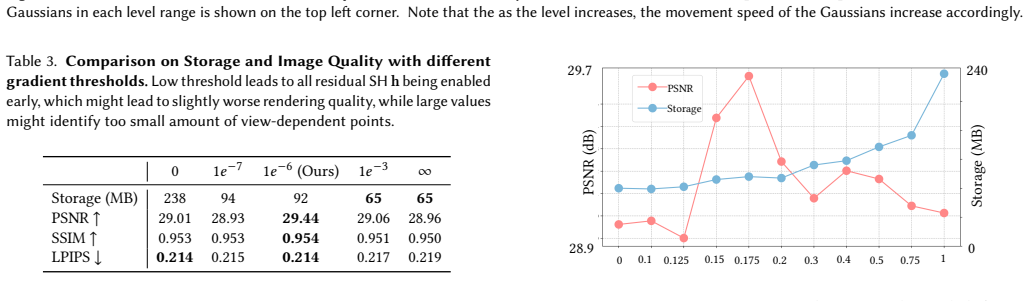
- [Tab. 2] The storage row for 'Ours' reads '0. 92 GB', which conflicts with the text and figure captions that report 92 MB; the decimal point appears to be misplaced.
- [Sec. 5.1.1] The sentence 'no explicit temporal consistency is enforced other than sharing the camera parameters' is confusing, because sharing camera parameters is not a temporal consistency mechanism; please rephrase.
- [Sec. 5.1.2] For 4K4D and ENeRF the reported storage includes video-encoded source images, while the proposed method's storage does not include source images; the storage comparison is therefore not on equal footing and this should be stated in the table or main text.
- [Sec. 3.2.2] The statement that copying segments to GPU memory 'can be parallelized with the rendering' needs implementation detail, such as asynchronous copy streams, to support the claim that there is no speed downgrade.
Circularity Check
No circularity: the memory and quality claims are structural properties validated on external benchmarks, with disclosed scope limitations rather than self-referential derivations.
full rationale
The paper's central claims are empirical: Temporal Gaussian Hierarchy is a defined representation (Eqs. 1-10), and its constant-memory behavior is evaluated on Neural3DV, ENeRF-Outdoor, MobileStage, CMU-Panoptic, and the new SelfCap dataset against external baselines such as 4DGS, 3DGS, and ENeRF. The placement rule in Eq. (6) and the one-segment-per-level rendering in Sec. 3.2.2 make the per-timestamp active set structurally limited to L segments plus the global segment, but the paper does not define the target result into existence; the actual VRAM constancy is measured, not assumed. Hyperparameters L, S, g_th, and lambda_h are tuned on Neural3DV and applied to other datasets, which is disclosed in Sec. 4 and is a standard transfer, not a fitted prediction masquerading as a finding. Self-citations (4K4D, MobileStage, EasyVolcap) serve as baselines, datasets, or implementation tools and are not load-bearing justifications of the central claim. The manuscript explicitly flags scope conditions: Sec. 5.1.1 states that the datasets 'mainly contain static backgrounds with dynamic foregrounds' and that this 'further justifies the use of the global segment and Compact Appearance model,' and Sec. 7 lists non-real-time training and sparse-view limitations. These are correctness/generality caveats, not circularity: the possible growth of the global segment under a moving camera is a real risk to the 'regardless of video length' wording, but it is an assumption failure, not an equation reducing to its inputs. No circular step was found.
Assumptions & free parameters
free parameters (6)
- Number of hierarchy levels L =
9
- Root segment length S =
10 seconds
- SH gradient threshold g_th =
1e-6
- View-dependent SH ratio lambda_h =
0.15
- Loss weights lambda_m, lambda_s, lambda_p =
0.8, 0.2, 0.01
- Opacity threshold o_th =
0.05
assumptions (7)
- standard math Standard properties of Gaussian distributions and spherical harmonics are used without proof.
- domain assumption The 4D Gaussian primitive definition (means, scales, opacities, quaternions, SH) from 4DGS is a sufficient scene representation for dynamic view synthesis.
- domain assumption Dynamic scenes can be decomposed into temporal segments of exponentially increasing length such that each Gaussian's influence range fits within one segment at its assigned level.
- domain assumption The datasets consist mainly of static backgrounds with dynamic foregrounds, so a single global segment can capture static content compactly.
- domain assumption Hardware rasterization pipelines can approximate 2D Gaussian splats by rectangular quads with minimal quality loss, enabling alpha blending of sorted Gaussians.
- domain assumption The 3DGS adaptive control scheme (split, clone, prune every 100 iterations) remains effective when applied only to active segments.
- domain assumption SfM point clouds per frame provide a sufficient initialization for the Gaussian hierarchy.
invented entities (2)
-
Temporal Gaussian Hierarchy (TGH)
independent evidence
-
Global segment (length infinity)
independent evidence
Cite this review
Pith. "Pith review of Representing Long Volumetric Video with Temporal Gaussian Hierarchy." pith.science (2026). https://pith.science/paper/EHOC4IVW
@misc{pith2026241209608,
  author       = {Pith},
  title        = {Pith review of: Representing Long Volumetric Video with Temporal Gaussian Hierarchy},
  year         = {2026},
  howpublished = {\url{https://pith.science/paper/EHOC4IVW}},
  note         = {Machine review of arXiv:2412.09608}
}
read the original abstract
This paper aims to address the challenge of reconstructing long volumetric videos from multi-view RGB videos. Recent dynamic view synthesis methods leverage powerful 4D representations, like feature grids or point cloud sequences, to achieve high-quality rendering results. However, they are typically limited to short (1~2s) video clips and often suffer from large memory footprints when dealing with longer videos. To solve this issue, we propose a novel 4D representation, named Temporal Gaussian Hierarchy, to compactly model long volumetric videos. Our key observation is that there are generally various degrees of temporal redundancy in dynamic scenes, which consist of areas changing at different speeds. Motivated by this, our approach builds a multi-level hierarchy of 4D Gaussian primitives, where each level separately describes scene regions with different degrees of content change, and adaptively shares Gaussian primitives to represent unchanged scene content over different temporal segments, thus effectively reducing the number of Gaussian primitives. In addition, the tree-like structure of the Gaussian hierarchy allows us to efficiently represent the scene at a particular moment with a subset of Gaussian primitives, leading to nearly constant GPU memory usage during the training or rendering regardless of the video length. Extensive experimental results demonstrate the superiority of our method over alternative methods in terms of training cost, rendering speed, and storage usage. To our knowledge, this work is the first approach capable of efficiently handling minutes of volumetric video data while maintaining state-of-the-art rendering quality. Our project page is available at: https://zju3dv.github.io/longvolcap.
Figures


Figures from the paper (11 more)




Reference graph
Works this paper leans on
-
[3]
Npbg++: Accelerating neural point-based graphics. In CVPR. Jiawei Ren, Liang Pan, Jiaxiang Tang, Chi Zhang, Ang Cao, Gang Zeng, and Ziwei Liu. 2023. Dreamgaussian4d: Generative 4d gaussian splatting. arXiv preprint arXiv:2312.17142 (2023). Robin Rombach, Andreas Blattmann, Dominik Lorenz, Patrick Esser, and Björn Ommer
arXiv 2023
-
[4]
InProceedings of the IEEE/CVF Conference on Computer Vision and Pattern Recognition (CVPR)
High-Resolution Image Synthesis With Latent Diffusion Models. InProceedings of the IEEE/CVF Conference on Computer Vision and Pattern Recognition (CVPR) . Darius Rückert, Linus Franke, and Marc Stamminger. 2022. Adop: Approximate differ- entiable one-pixel point rendering. ACM Transactions on Graphics (ToG) (2022). Jason Sanders and Edward Kandrot. 2010. ...
work page 2022
-
[5]
Zhou Wang, Alan C Bovik, Hamid R Sheikh, and Eero P Simoncelli
Ibrnet: Learning multi-view image-based rendering. Zhou Wang, Alan C Bovik, Hamid R Sheikh, and Eero P Simoncelli. 2004a. Image quality assessment: from error visibility to structural similarity. IEEE transactions on image processing 13, 4 (2004), 600–612. Zhou Wang, Alan C Bovik, Hamid R Sheikh, and Eero P Simoncelli. 2004b. Image quality assessment: fro...
arXiv 2004
-
[2021]
Jon Hasselgren, Nikolai Hofmann, and Jacob Munkberg
Fastnerf: High-fidelity neural rendering at 200fps. Jon Hasselgren, Nikolai Hofmann, and Jacob Munkberg. 2022. Shape, light, and material decomposition from images using monte carlo rendering and denoising. NeuRIPS (2022). Peter Hedman, Pratul P Srinivasan, Ben Mildenhall, Jonathan T Barron, and Paul Debevec. 2021. Baking neural radiance fields for real-t...
arXiv 2022
-
[2022]
InProceedings of the IEEE/CVF Conference on Computer Vision and Pattern Recognition
Neural 3d video synthesis from multi-view video. InProceedings of the IEEE/CVF Conference on Computer Vision and Pattern Recognition . 5521–5531. Zhengqi Li, Qianqian Wang, Forrester Cole, Richard Tucker, and Noah Snavely. 2023. Dynibar: Neural dynamic image-based rendering. In Proceedings of the IEEE/CVF Conference on Computer Vision and Pattern Recognit...
arXiv 2023
Reviewed August 11, 2026 · model on record in the stance chip above.
Discussion (0). Continue with ORCID to comment.