Estimation of black hole spins in low-mass AGNs and comparison with other types of AGNs
Pith reviewed 2026-07-01 04:41 UTC · model grok-4.3
The pith
Spins of supermassive black holes in low-mass AGNs decrease with increasing mass.
A machine-rendered reading of the paper's core claim, the machinery that carries it, and where it could break.
Core claim
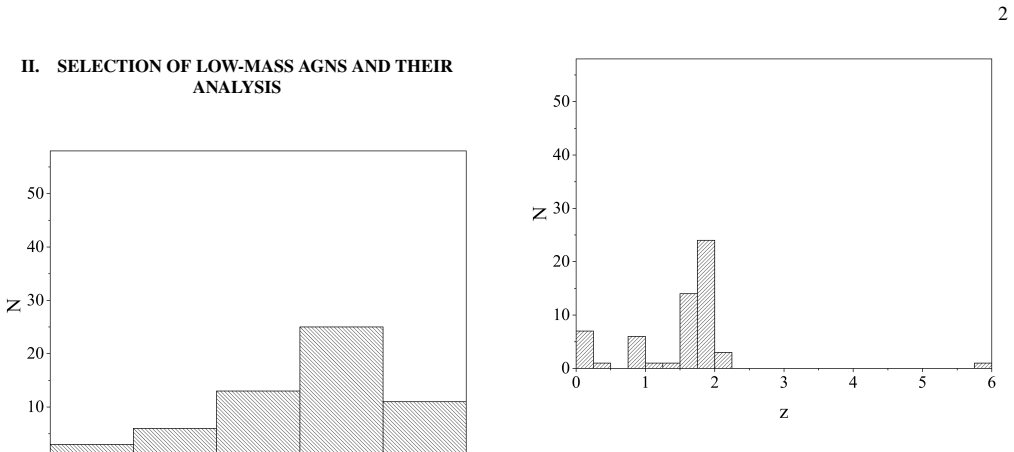
Spin estimates for 58 low-mass AGNs show a decrease with rising SMBH mass. This pattern leads to the conclusion that mergers and chaotic accretion are the main mechanisms of mass growth. A broader hypothesis follows: early low-mass SMBHs start with high spins, which decrease in the initial evolutionary stages and then increase again with the rate of increase gradually slowing.
What carries the argument
The observed anticorrelation between estimated black hole spin and SMBH mass in the low-mass AGN sample, which is used to identify dominant growth channels.
If this is right
- Mergers and chaotic accretion serve as the primary channels for supermassive black hole mass growth in this population.
- AGN evolution proceeds through an early phase of spin decrease followed by a later phase of slower spin increase.
- Low-mass AGNs correspond to an early evolutionary stage characterized by relatively high spins.
- The mass-spin relation can be used to compare growth histories across different AGN types.
Where Pith is reading between the lines
- The same anticorrelation may appear in spin distributions measured for higher-mass AGNs if the evolutionary sequence continues.
- Testing the hypothesis requires spin data for AGNs in the intermediate mass range to locate the transition from spin decrease to increase.
- If selection biases are ruled out, the trend implies that spin-up by prolonged coherent accretion is less common than chaotic processes at low masses.
Load-bearing premise
The spin values measured for the 58 low-mass AGNs are accurate and the observed decrease with mass is not caused by selection effects or systematic errors in the estimation method.
What would settle it
An independent measurement of spins in a comparable sample of low-mass AGNs that shows no decrease with mass would disprove the reported trend.
Figures


read the original abstract
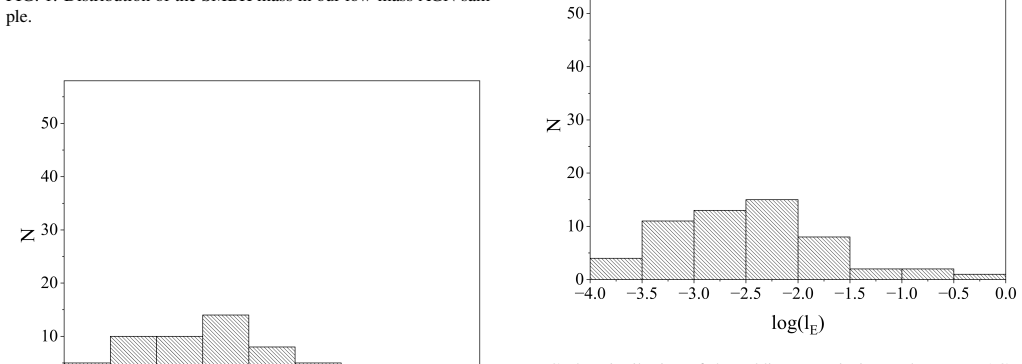
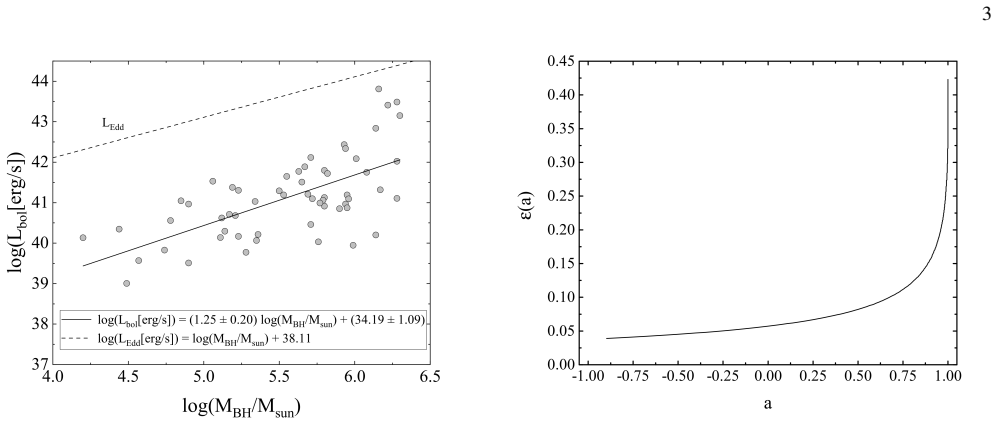
We estimated the spins of a sample of 58 low-mass AGNs. Analysis of the obtained spins showed that they decrease with increasing SMBH mass, leading us to hypothesize that mergers and/or chaotic accretion are the primary mechanisms for mass growth. In this regard, we proposed a more general hypothesis about the evolution of AGNs. We assume that early low-mass SMBHs have high spins, then, during their evolution, the spins initially decrease and then begin to increase, with the rate of increase gradually slowing.
Editorial analysis
A structured set of objections, weighed in public.
Referee Report
Summary. The manuscript estimates black hole spins for a sample of 58 low-mass AGNs and reports that the spins decrease with increasing SMBH mass. From this observed trend the authors hypothesize that mergers and/or chaotic accretion dominate mass growth, and they propose a broader evolutionary sequence in which early low-mass SMBHs begin with high spins that first decrease and later increase at a slowing rate.
Significance. If the spin values are shown to be free of mass-correlated systematics, the result would supply direct observational evidence linking spin evolution to specific growth channels in the low-mass regime and would help anchor models of SMBH assembly. The sample size is adequate for a trend search, but the absence of any validation against selection or measurement bias leaves the central claim unsupported at present.
major comments (3)
- [Abstract] Abstract: the spin estimation technique (reflection modeling, continuum fitting, or other), treatment of parameter degeneracies, error bars, and any statistical test of the reported mass trend are not described, rendering it impossible to evaluate whether the claimed decrease is physical or an artifact.
- [Results] The central claim that the observed spin-mass anticorrelation supports mergers/chaotic accretion as the dominant growth mode rests entirely on the assumption that the 58 spin measurements are unbiased across the sampled mass range; no test for mass-dependent systematics (e.g., inclination or ionization degeneracies that scale with Eddington ratio) is presented.
- [Discussion] The evolutionary hypothesis is constructed directly from the same trend used to infer the growth mechanism, creating a circularity that would require an independent prediction or external validation sample to be falsifiable.
minor comments (2)
- [Abstract] Notation for spin parameter a_* and mass M_BH should be defined at first use and used consistently.
- [Results] The manuscript should include a table or figure showing the individual spin values, masses, and uncertainties to allow readers to assess the trend directly.
Simulated Author's Rebuttal
We thank the referee for their thoughtful review and constructive criticism. We address each major comment below, indicating where revisions will be made to strengthen the manuscript.
read point-by-point responses
-
Referee: [Abstract] Abstract: the spin estimation technique (reflection modeling, continuum fitting, or other), treatment of parameter degeneracies, error bars, and any statistical test of the reported mass trend are not described, rendering it impossible to evaluate whether the claimed decrease is physical or an artifact.
Authors: We agree that the abstract is overly concise and omits key methodological details. In the revised manuscript we will expand the abstract to specify that spins were estimated via X-ray reflection modeling, that parameter degeneracies were explored with MCMC sampling, that typical 1-sigma uncertainties are reported, and that the mass-spin anticorrelation was quantified with a Spearman rank test (p-value provided). revision: yes
-
Referee: [Results] The central claim that the observed spin-mass anticorrelation supports mergers/chaotic accretion as the dominant growth mode rests entirely on the assumption that the 58 spin measurements are unbiased across the sampled mass range; no test for mass-dependent systematics (e.g., inclination or ionization degeneracies that scale with Eddington ratio) is presented.
Authors: The methods section already details the sample selection criteria and the reflection-modeling pipeline, but we acknowledge that a dedicated assessment of mass-dependent systematics was not performed. We will add a new subsection that examines correlations of fitted spin, inclination, and ionization parameter with black-hole mass and Eddington ratio, and we will discuss why these degeneracies are unlikely to produce the observed anticorrelation given the parameter distributions in our fits. revision: yes
-
Referee: [Discussion] The evolutionary hypothesis is constructed directly from the same trend used to infer the growth mechanism, creating a circularity that would require an independent prediction or external validation sample to be falsifiable.
Authors: The evolutionary sequence is offered as an interpretive hypothesis motivated by the trend and by existing theoretical work on merger-driven spin evolution. We will revise the discussion to present it explicitly as a working hypothesis, to state its falsifiable predictions (e.g., spin upturn at higher masses or consistency with independent spin indicators), and to note that confirmation will require larger samples or cross-checks with other techniques. revision: yes
Circularity Check
No circularity: observational trend interpreted as hypothesis
full rationale
The paper estimates spins for 58 low-mass AGNs, reports an observed decrease with SMBH mass, and proposes an evolutionary hypothesis based directly on that trend. This is standard inductive reasoning from data to interpretation, with no equations, fitted parameters renamed as predictions, self-citations, or uniqueness theorems that reduce any claim to its inputs by construction. The derivation chain is self-contained as measurement followed by post-observation hypothesis formation; no load-bearing step matches the enumerated circularity patterns.
Axiom & Free-Parameter Ledger
Reference graph
Works this paper leans on
-
[1]
considers AGNs with large masses, this method can also be used for low-mass objects): ε= 0.073 Lbol 1046 Lopt 1045 −1.5 4400 ˚A 5100 ˚A −2 M8µ1.5, (3) whereM 8 =M BH/108M⊙,µ= cosi,iis an inclination angle between the line of sight and the normal to the accre- tion disk plane,L opt is the optical luminosity (at 4400 ˚A). For self-consistency with our previ...
-
[2]
C. S. Reynolds, Measuring Black Hole Spin Using X-Ray Reflection Spectroscopy, Space Sci. Rev.183, 277 (2014), arXiv:1302.3260 [astro-ph.HE]
work page internal anchor Pith review Pith/arXiv arXiv 2014
-
[3]
Brenneman, Measuring Supermassive Black Hole Spins in AGN, Acta Polytechnica53, 652 (2013)
L. Brenneman, Measuring Supermassive Black Hole Spins in AGN, Acta Polytechnica53, 652 (2013)
2013
-
[4]
C. Done, C. Jin, M. Middleton, and M. Ward, A new way to measure supermassive black hole spin in accretion disc-dominated active galaxies, MNRAS434, 1955 (2013), arXiv:1306.4786 [astro-ph.HE]
work page internal anchor Pith review Pith/arXiv arXiv 1955
-
[5]
D. M. Capellupo, H. Netzer, P. Lira, B. Trakhtenbrot, and J. Mej´ıa-Restrepo, Active galactic nuclei at z∼1.5 - III. Ac- cretion discs and black hole spin, MNRAS460, 212 (2016), arXiv:1604.05310 [astro-ph.GA]
work page internal anchor Pith review Pith/arXiv arXiv 2016
-
[6]
Black hole spin: theory and observation
M. Middleton, Black Hole Spin: Theory and Observation, in Astrophysics of Black Holes: From Fundamental Aspects to Latest Developments, Astrophysics and Space Science Library, V ol. 440, edited by C. Bambi (2016) p. 99, arXiv:1507.06153 [astro-ph.HE]
work page internal anchor Pith review Pith/arXiv arXiv 2016
-
[7]
L. Mallick, A. C. Fabian, J. A. Garc ´ıa, J. A. Tomsick, M. L. Parker, T. Dauser, D. R. Wilkins, B. De Marco, J. F. Steiner, R. M. T. Connors, G. Mastroserio, A. G. Markowitz, C. Pinto, W. N. Alston, A. M. Lohfink, and P. Gandhi, High-density disc reflection spectroscopy of low-mass active galactic nuclei, MN- RAS513, 4361 (2022), arXiv:2203.04522 [astro-ph.HE]
-
[8]
R. D. Blandford and R. L. Znajek, Electromagnetic extraction of energy from Kerr black holes, MNRAS179, 433 (1977)
1977
-
[9]
R. D. Blandford and D. G. Payne, Hydromagnetic flows from accretion discs and the production of radio jets, MNRAS199, 883 (1982)
1982
- [10]
-
[11]
The spin dependence of the Blandford-Znajek effect
D. Garofalo, The Spin Dependence of the Blandford-Znajek Ef- fect, ApJ699, 400 (2009), arXiv:0904.3486 [astro-ph.HE]
work page internal anchor Pith review Pith/arXiv arXiv 2009
-
[12]
The Evolution of Radio Loud Active Galactic Nuclei as a Function of Black Hole Spin
D. Garofalo, D. A. Evans, and R. M. Sambruna, The evolution of radio-loud active galactic nuclei as a function of black hole spin, MNRAS406, 975 (2010), arXiv:1004.1166
work page internal anchor Pith review Pith/arXiv arXiv 2010
-
[13]
R. A. Daly, Bounds on Black Hole Spins, ApJ696, L32 (2009), arXiv:0903.4861 [astro-ph.CO]. 9
work page internal anchor Pith review Pith/arXiv arXiv 2009
-
[14]
R. A. Daly, Estimates of black hole spin properties of 55 sources, MNRAS414, 1253 (2011), arXiv:1103.0940
work page internal anchor Pith review Pith/arXiv arXiv 2011
-
[15]
R. A. Daly and T. B. Sprinkle, Black hole spin properties of 130 AGN, MNRAS438, 3233 (2014), arXiv:1312.4862
work page internal anchor Pith review Pith/arXiv arXiv 2014
-
[16]
Y . N. Gnedin, V . N. Globina, M. Y . Piotrovich, S. D. Buliga, and T. M. Natsvlishvili, Spins of Supermassive Black Holes and the Magnetic Fields of Accretion Disks in Active Galactic Nuclei with Maser Emission, Astrophysics57, 163 (2014)
2014
-
[17]
M. Y . Piotrovich, S. D. Buliga, Y . N. Gnedin, A. G. Mikhailov, and T. M. Natsvlishvili, Dependence of the Spin of Supermas- sive Black Holes on the Eddington Factor for Accretion Disks in Active Galactic Nuclei, Astrophysics59, 439 (2016)
2016
-
[18]
S. N. Zhang, W. Cui, and W. Chen, Black Hole Spin in X-Ray Binaries: Observational Consequences, ApJ482, L155 (1997), arXiv:astro-ph/9704072 [astro-ph]
work page internal anchor Pith review Pith/arXiv arXiv 1997
-
[19]
J. E. McClintock, R. Narayan, and J. F. Steiner, Black Hole Spin via Continuum Fitting and the Role of Spin in Powering Tran- sient Jets, Space Sci. Rev.183, 295 (2014), arXiv:1303.1583 [astro-ph.HE]
work page internal anchor Pith review Pith/arXiv arXiv 2014
- [20]
-
[21]
I. D. Novikov and K. S. Thorne, Astrophysics of black holes., in Black Holes (Les Astres Occlus), edited by C. Dewitt and B. S. Dewitt (Gordon and Breach, New York, 1973) pp. 343–450
1973
-
[22]
S. W. Davis, C. Done, and O. M. Blaes, Testing Accretion Disk Theory in Black Hole X-Ray Binaries, ApJ647, 525 (2006), astro-ph/0602245
work page internal anchor Pith review Pith/arXiv arXiv 2006
-
[23]
J. H. Krolik, Making black holes visible: accretion, radiation, and jets, in2007 STScI Spring Symposium on Black Holes (2007) pp. 309–321, arXiv:0709.1489 [astro-ph]
work page internal anchor Pith review Pith/arXiv arXiv 2007
-
[24]
J. H. Krolik, J. F. Hawley, and S. Hirose, The Relationship be- tween Accretion Disks and Jets, inRevista Mexicana de As- tronomia y Astrofisica, vol. 27, Revista Mexicana de Astrono- mia y Astrofisica Conference Series, V ol. 27 (2007) pp. 1–7
2007
-
[25]
J. D. Schnittman, J. H. Krolik, and S. C. Noble, Disk Emission from Magnetohydrodynamic Simulations of Spinning Black Holes, ApJ819, 48 (2016), arXiv:1512.00729 [astro-ph.HE]
work page internal anchor Pith review Pith/arXiv arXiv 2016
-
[26]
J. E. Greene and L. C. Ho, A New Sample of Low-Mass Black Holes in Active Galaxies, ApJ670, 92 (2007), arXiv:0707.2617 [astro-ph]
work page internal anchor Pith review Pith/arXiv arXiv 2007
-
[27]
Low-Mass AGN and Their Relation to the Fundamental Plane of Black Hole Accretion
K. G ¨ultekin, E. M. Cackett, A. L. King, J. M. Miller, and J. Pinkney, Low-mass AGNs and Their Relation to the Fun- damental Plane of Black Hole Accretion, ApJ788, L22 (2014), arXiv:1405.6986 [astro-ph.HE]
work page internal anchor Pith review Pith/arXiv arXiv 2014
-
[28]
J. E. Greene, A. J. Barth, and L. C. Ho, The smallest AGN host galaxies, New A Rev.50, 739 (2006), arXiv:astro-ph/0511810 [astro-ph]
work page internal anchor Pith review Pith/arXiv arXiv 2006
-
[29]
J. E. Greene, Low-mass black holes as the remnants of pri- mordial black hole formation, Nature Communications3, 1304 (2012), arXiv:1211.7082 [astro-ph.CO]
work page internal anchor Pith review Pith/arXiv arXiv 2012
-
[30]
J. E. Greene, J. Strader, and L. C. Ho, Intermediate-Mass Black Holes, ARA&A58, 257 (2020), arXiv:1911.09678 [astro- ph.GA]
work page internal anchor Pith review Pith/arXiv arXiv 2020
-
[31]
F. Koliopanos, B. C. Ciambur, A. W. Graham, N. A. Webb, M. Coriat, B. Mutlu-Pakdil, B. L. Davis, O. Godet, D. Bar- ret, and M. S. Seigar, Searching for intermediate-mass black holes in galaxies with low-luminosity AGN: a multiple-method approach, A&A601, A20 (2017), arXiv:1612.06794 [astro- ph.GA]
work page internal anchor Pith review Pith/arXiv arXiv 2017
-
[32]
M. V olonteri, M. Habouzit, and M. Colpi, The origins of massive black holes, Nature Reviews Physics3, 732 (2021), arXiv:2110.10175 [astro-ph.GA]
- [33]
-
[34]
D. D. Kocevski, M. Onoue, K. Inayoshi, J. R. Trump, P. Arra- bal Haro, A. Grazian, M. Dickinson, S. L. Finkelstein, J. S. Kartaltepe, M. Hirschmann, J. Aird, B. W. Holwerda, S. Fuji- moto, S. Juneau, R. O. Amor´ın, B. E. Backhaus, M. B. Bagley, G. Barro, E. F. Bell, L. Bisigello, A. Calabr`o, N. J. Cleri, M. C. Cooper, X. Ding, N. A. Grogin, L. C. Ho, T. ...
-
[35]
R. Pucha, S. Juneau, A. Dey, M. Siudek, M. Mezcua, J. Mous- takas, S. BenZvi, K. Hainline, R. Hviding, Y .-Y . Mao, D. M. Alexander, R. Alfarsy, C. Circosta, W.-J. Guo, V . Manwad- kar, P. Martini, B. A. Weaver, J. Aguilar, S. Ahlen, D. Bianchi, D. Brooks, R. Canning, T. Claybaugh, K. Dawson, A. de la Ma- corra, B. Dey, P. Doel, A. Font-Ribera, J. E. Fore...
-
[36]
K. A. Grishin, I. V . Chilingarian, F. Combes, F. E. Bauer, V . A. Toptun, I. Y . Katkov, D. Fabricant, F. Kolganov, and A. W. Graham, NGC 3259: A signal for an untapped population of slowly accreting intermediate-mass black holes, A&A702, A42 (2025), arXiv:2502.13202 [astro-ph.GA]
- [37]
-
[38]
N. I. Shakura and R. A. Sunyaev, Black holes in binary systems. Observational appearance., A&A24, 337 (1973)
1973
-
[39]
W. Yuan, H. Zhou, L. Dou, X.-B. Dong, X. Fan, and T.-G. Wang, Chandra and MMT Observations of Low-mass Black Hole Active Galactic Nuclei Accreting at Low Rates in Dwarf Galaxies, ApJ782, 55 (2014), arXiv:1401.5331 [astro-ph.GA]
work page internal anchor Pith review Pith/arXiv arXiv 2014
-
[40]
M. Y . Piotrovich, S. D. Buliga, and T. M. Natsvlishvili, Red Quasars: Selecting Candidates in SDSS DR16 and Estimating Their Physical Parameters 10.48550/arXiv.2605.00608 (2026), arXiv:2605.00608 [astro-ph.HE]
work page internal anchor Pith review Pith/arXiv arXiv doi:10.48550/arxiv.2605.00608 2026
- [41]
- [42]
- [43]
- [44]
- [45]
-
[46]
K. S. Thorne, Disk-Accretion onto a Black Hole. II. Evolution of the Hole, ApJ191, 507 (1974)
1974
-
[47]
The Most Massive Active Black-Holes at z~1.5-3.5 Have High Spins and Radiative Efficiencies
B. Trakhtenbrot, The Most Massive Active Black Holes at z ˜ 1.5-3.5 have High Spins and Radiative Efficiencies, ApJ789, L9 (2014), arXiv:1405.5877
work page internal anchor Pith review Pith/arXiv arXiv 2014
-
[48]
P. F. Hopkins, G. T. Richards, and L. Hernquist, An Obser- vational Determination of the Bolometric Quasar Luminosity Function, ApJ654, 731 (2007), arXiv:astro-ph/0605678 [astro- ph]
work page internal anchor Pith review Pith/arXiv arXiv 2007
-
[49]
M. C. Bentz, K. D. Denney, C. J. Grier, A. J. Barth, B. M. Peterson, M. Vestergaard, V . N. Bennert, G. Canalizo, G. De Rosa, A. V . Filippenko, E. L. Gates, J. E. Greene, W. Li, M. A. Malkan, R. W. Pogge, D. Stern, T. Treu, and J.-H. Woo, The Low-luminosity End of the Radius-Luminosity Relationship for Active Galactic Nuclei, ApJ767, 149 (2013), arXiv:1303.1742
work page internal anchor Pith review Pith/arXiv arXiv 2013
-
[50]
G. T. Richards, M. Lacy, L. J. Storrie-Lombardi, P. B. Hall, S. C. Gallagher, D. C. Hines, X. Fan, C. Papovich, D. E. Vanden Berk, G. B. Trammell, D. P. Schneider, M. Vestergaard, D. G. York, S. Jester, S. F. Anderson, T. Budav´ari, and A. S. Szalay, Spectral Energy Distributions and Multiwavelength Selection of Type 1 Quasars, ApJS166, 470 (2006), astro-...
work page internal anchor Pith review Pith/arXiv arXiv 2006
-
[51]
J. M. Bardeen, W. H. Press, and S. A. Teukolsky, Rotating Black Holes: Locally Nonrotating Frames, Energy Extraction, and Scalar Synchrotron Radiation, ApJ178, 347 (1972)
1972
-
[52]
Dust-to-Gas Ratio and Metallicity in Dwarf Galaxies
H. Hirashita, Dust-to-Gas Ratio and Metallicity in Dwarf Galaxies, ApJ522, 220 (1999), arXiv:astro-ph/9903316 [astro- ph]
work page internal anchor Pith review Pith/arXiv arXiv 1999
-
[53]
The AGN Obscuring Torus -- End of the "Doughnut" Paradigm?
M. Elitzur and I. Shlosman, The AGN-obscuring Torus: The End of the “Doughnut” Paradigm?, ApJ648, L101 (2006), arXiv:astro-ph/0605686 [astro-ph]
work page internal anchor Pith review Pith/arXiv arXiv 2006
-
[54]
On the Disappearance of the Broad-Line Region in Low-Luminosity Agns
M. Elitzur and L. C. Ho, On the Disappearance of the Broad- Line Region in Low-Luminosity Active Galactic Nuclei, ApJ 701, L91 (2009), arXiv:0907.3752 [astro-ph.CO]
work page internal anchor Pith review Pith/arXiv arXiv 2009
- [55]
-
[56]
M. Vestergaard and B. M. Peterson, Determining Central Black Hole Masses in Distant Active Galaxies and Quasars. II. Im- proved Optical and UV Scaling Relationships, ApJ641, 689 (2006), astro-ph/0601303
work page internal anchor Pith review Pith/arXiv arXiv 2006
-
[57]
V . L. Afanasiev, Y . N. Gnedin, M. Y . Piotrovich, T. M. Natsvlishvili, and S. D. Buliga, Determination of Supermassive Black Hole Spins Based on the Standard Shakura-Sunyaev Ac- cretion Disk Model and Polarimetric Observations, Astronomy Letters44, 362 (2018)
2018
- [58]
-
[59]
M. Azadi, B. Wilkes, J. Kuraszkiewicz, J. McDowell, R. Siebenmorgen, M. Ashby, M. Birkinshaw, D. Worrall, N. Abrams, P. Barthel, G. G. Fazio, M. Haas, S. Hyman, R. Mart´ınez-Galarza, and E. T. Meyer, Disentangling the AGN and Star formation Contributions to the Radio-X-Ray Emis- sion of Radio-loud Quasars at 1 ¡ Z ¡ 2, ApJ945, 145 (2023), arXiv:2011.03130...
-
[60]
S. W. Davis and A. Laor, The Radiative Efficiency of Accretion Flows in Individual Active Galactic Nuclei, ApJ728, 98 (2011), arXiv:1012.3213
work page internal anchor Pith review Pith/arXiv arXiv 2011
- [61]
discussion (0)
Sign in with ORCID, Apple, or X to comment. Anyone can read and Pith papers without signing in.