Unified Cosmological Scenario in Holographic f(Q) gravity: From Inflation to Late-Time Acceleration
Pith reviewed 2026-06-30 17:32 UTC · model grok-4.3
The pith
Holographic f(Q) gravity with power-law form unifies inflation and late-time acceleration in one setup.
A machine-rendered reading of the paper's core claim, the machinery that carries it, and where it could break.
Core claim
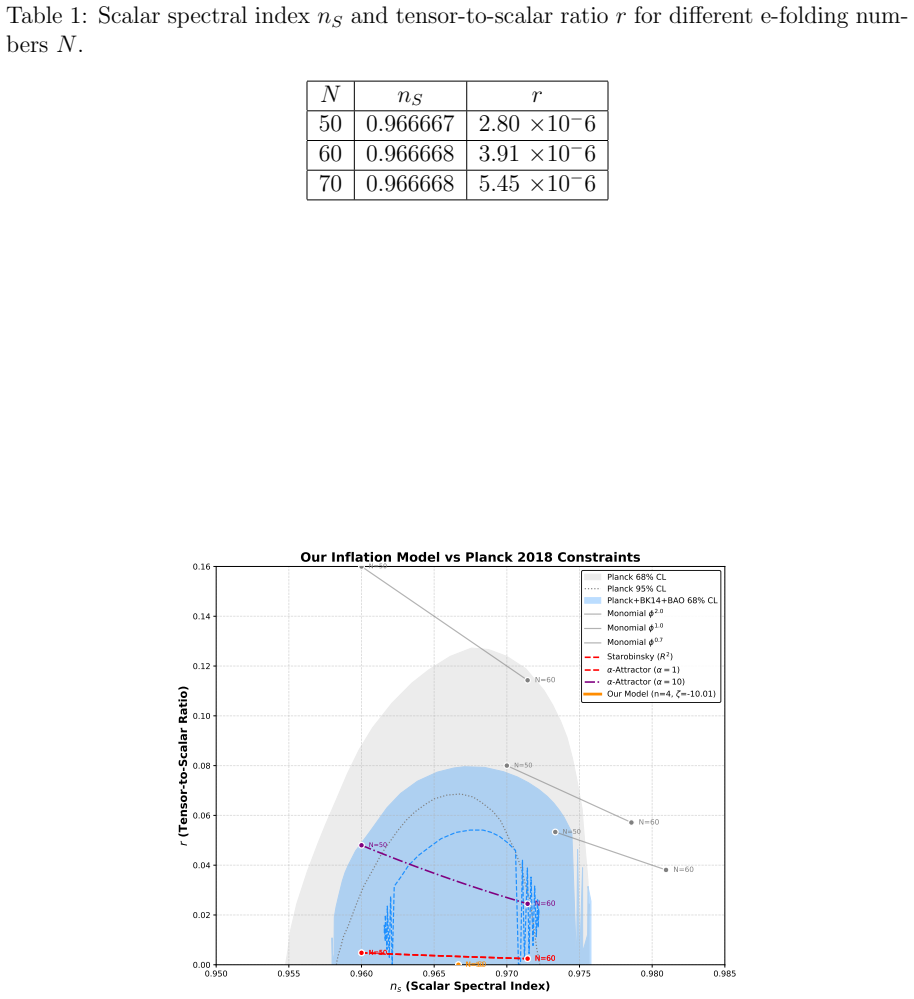
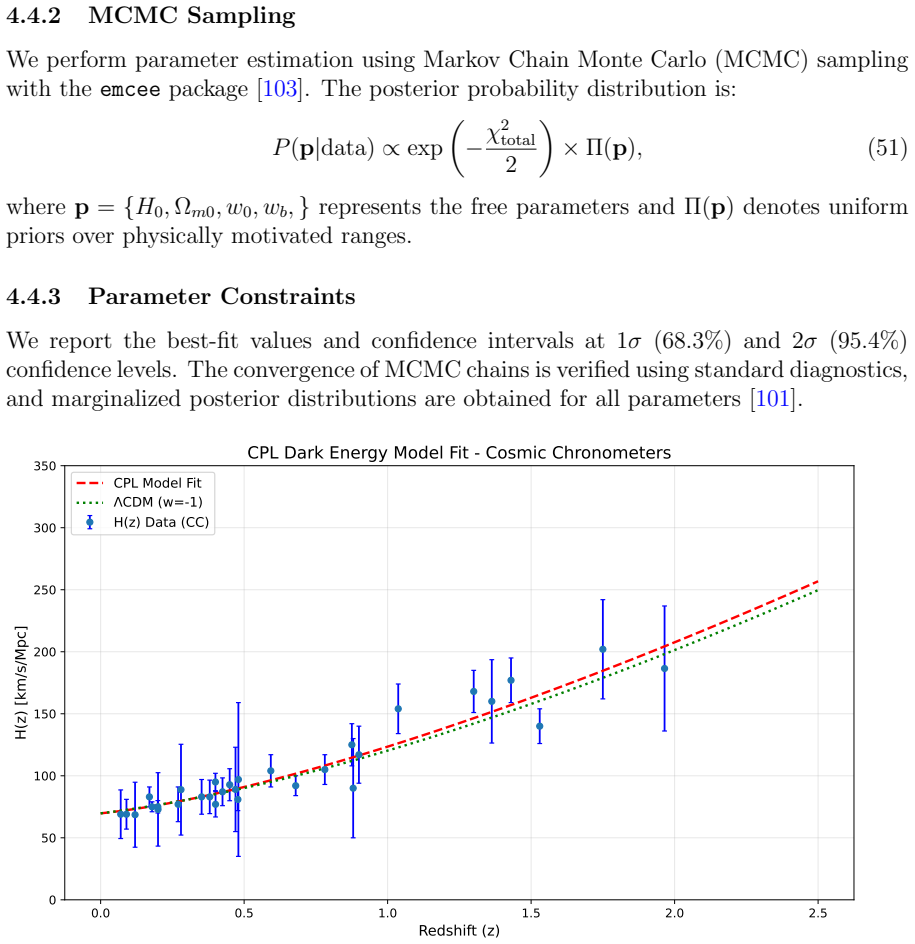
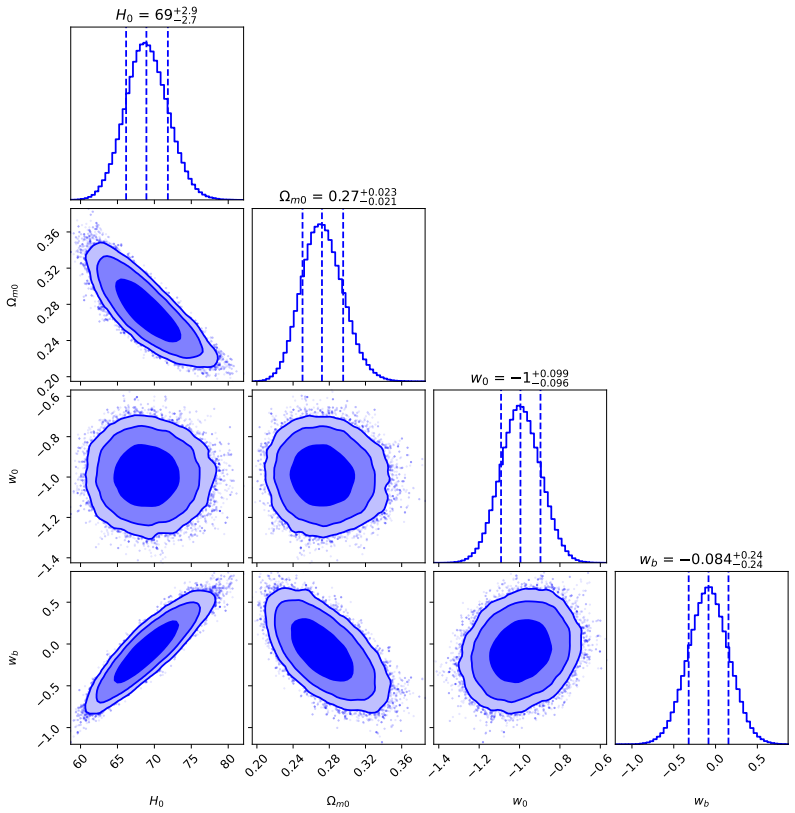
In the holographic f(Q) gravity with f(Q) = ζ Q^n and Barrow holographic fluid, a reconstructed Hubble parameter satisfies Planck-consistent slow-roll parameters for inflation and, when extended with CPL parametrization and fitted to CC+BAO data, remains compatible with LambdaCDM at low redshifts while showing mild deviations at higher redshifts, as confirmed by AIC and BIC analysis.
What carries the argument
Reconstruction of the Hubble parameter using the Barrow holographic fluid in the f(Q) = ζ Q^n model, enabling both slow-roll inflation analysis and late-time observational fitting.
If this is right
- Inflationary predictions match Planck 2018 with a very small tensor-to-scalar ratio.
- MCMC-constrained parameters show the model remains compatible with LambdaCDM at low redshifts.
- Mild deviations from LambdaCDM appear at higher redshifts.
- AIC and BIC comparisons quantify the fit quality relative to LambdaCDM.
Where Pith is reading between the lines
- If a single reconstruction succeeds, it could reduce reliance on separate mechanisms for early and late acceleration in modified gravity theories.
- High-redshift observations beyond current CC+BAO data could test whether the reported mild deviations persist or grow.
- Replacing the Barrow cutoff with other holographic prescriptions would test whether the unified Hubble reconstruction remains viable.
Load-bearing premise
The specific choice f(Q) = ζ Q^n together with the Barrow holographic fluid density allows a single Hubble reconstruction to satisfy both the slow-roll conditions at early times and the CPL-fitted expansion at late times without additional ad-hoc adjustments.
What would settle it
Imposing the MCMC-fitted parameters from CC+BAO data on the early-time Hubble reconstruction and checking whether the resulting slow-roll parameters still lie inside Planck 2018 bounds.
Figures
read the original abstract
The present paper reports a study of a unified cosmological scenario in the framework of holographic f(Q) gravity, where, in a single theoretical setup, both the early inflationary epoch and the late-time accelerated epoch are studied. Considering f(Q) = $\zeta Q^n$, we reconstruct the Hubble parameter in the presence of Barrow holographic fluid and study the inflationary behaviour through the slow-roll parameters, scalar spectral index $n_s$, and tensor-to-scalar ratio r. The obtained inflationary predictions are found to be consistent with the latest Planck 2018 observational constraints, with a very small value of the tensor-to-scalar ratio. In the next phase, we extend the study by including the matter sector. The Chevallier-Polarski-Linder (CPL) parametrization is used to connect the theoretical model with observational cosmology. Using combined Cosmic Chronometer (CC) and Baryon Acoustic Oscillation (BAO) datasets, the study constrains the model parameters through Markov Chain Monte Carlo (MCMC) analysis. From the observational results obtained this way, the study concludes that at low redshifts, the holographic f(Q) model considered here remains compatible with the standard LambdaCDM model, while mild deviations are observed at higher redshift. We have also performed the AIC and BIC analysis and commented on the goodness of fit in comparison with the LambdaCDM model. Hence, the present framework provides a viable unified description of inflation and late-time cosmic acceleration within holographic f(Q) gravity.
Editorial analysis
A structured set of objections, weighed in public.
Referee Report
Summary. The manuscript proposes a unified cosmological model in holographic f(Q) gravity using f(Q) = ζ Q^n together with a Barrow holographic fluid. It reconstructs the Hubble parameter separately for the inflationary epoch to compute slow-roll parameters, ns, and r (claimed consistent with Planck 2018), then extends the setup by adding a matter sector, adopts CPL parametrization (w0, wa), and performs MCMC constraints on combined CC+BAO data to assess late-time behavior and compare to ΛCDM via AIC/BIC.
Significance. If a single continuous Hubble evolution with fixed {ζ, n} were demonstrated to satisfy both slow-roll conditions at early times and the late-time data constraints without epoch-specific refitting, the work would provide a concrete example of modified gravity linking inflation and acceleration. The current presentation does not establish this continuity, limiting the significance to two decoupled reconstructions whose parameters overlap only by construction.
major comments (2)
- [Abstract; reconstruction and MCMC paragraphs] Abstract and the paragraphs describing the reconstruction and MCMC step: the central claim of a 'unified scenario' with a single theoretical setup requires that the same fixed values of ζ and n (plus holographic constants) produce one continuous H(z) satisfying both the inflationary slow-roll conditions and the CPL-fitted late-time expansion. The manuscript instead describes two distinct phases—holographic-fluid reconstruction for inflation followed by an independent inclusion of the matter sector and MCMC fit on CC+BAO—which leaves open whether the Friedmann equations are solved from a single differential equation across all redshifts or separately per epoch with different effective fluids or boundary conditions. This directly affects the load-bearing claim of unification.
- [MCMC analysis section] MCMC analysis section: the model parameters (n, ζ, holographic constants, w0, wa) are fitted directly to the same CC+BAO datasets used to claim compatibility with ΛCDM. Without an explicit joint fit or a demonstration that the inflationary values of n and ζ remain unchanged when the late-time sector is added, the late-time 'predictions' reduce to the fitted values by construction, undermining the assertion of independent consistency checks.
minor comments (2)
- [Inflationary reconstruction] The manuscript provides no derivation details, error budgets, or explicit checks against post-hoc parameter choices for the inflationary reconstruction; adding these would strengthen the slow-roll and ns/r claims.
- [AIC/BIC analysis] AIC and BIC comparisons are reported but without tabulating the exact ΔAIC/ΔBIC values or the number of free parameters used in each model; this should be clarified for reproducibility.
Simulated Author's Rebuttal
We thank the referee for the careful reading and constructive comments. The points raised correctly identify that our work performs separate epoch-specific reconstructions rather than a single continuous Hubble evolution with fixed parameters. We address each comment below and will revise the manuscript accordingly to clarify the scope of the claimed unification.
read point-by-point responses
-
Referee: [Abstract; reconstruction and MCMC paragraphs] Abstract and the paragraphs describing the reconstruction and MCMC step: the central claim of a 'unified scenario' with a single theoretical setup requires that the same fixed values of ζ and n (plus holographic constants) produce one continuous H(z) satisfying both the inflationary slow-roll conditions and the CPL-fitted late-time expansion. The manuscript instead describes two distinct phases—holographic-fluid reconstruction for inflation followed by an independent inclusion of the matter sector and MCMC fit on CC+BAO—which leaves open whether the Friedmann equations are solved from a single differential equation across all redshifts or separately per epoch with different effective fluids or boundary conditions. This directly affects the load-bearing claim of unification.
Authors: We agree with the referee that the manuscript presents two distinct reconstructions within the f(Q) = ζ Q^n holographic framework: one for inflation using the Barrow holographic fluid to obtain slow-roll parameters, and a separate late-time analysis that includes the matter sector and employs CPL parametrization fitted via MCMC to CC+BAO data. No single continuous H(z) is solved across all redshifts with fixed {ζ, n}. The unification is limited to the common theoretical setup (same f(Q) form and holographic fluid) applied independently to each epoch. We will revise the abstract and relevant paragraphs to remove or qualify the 'unified scenario' phrasing and explicitly state that the analyses are epoch-specific rather than a joint continuous solution. revision: yes
-
Referee: [MCMC analysis section] MCMC analysis section: the model parameters (n, ζ, holographic constants, w0, wa) are fitted directly to the same CC+BAO datasets used to claim compatibility with ΛCDM. Without an explicit joint fit or a demonstration that the inflationary values of n and ζ remain unchanged when the late-time sector is added, the late-time 'predictions' reduce to the fitted values by construction, undermining the assertion of independent consistency checks.
Authors: The referee is correct: the MCMC step fits n, ζ and the CPL parameters directly to the late-time CC+BAO data, so the late-time results are constrained by construction rather than serving as independent predictions from the inflationary values of n and ζ. No joint fit across epochs or fixed-parameter continuity is demonstrated. We will revise the MCMC section, results, and conclusions to clarify that the late-time constraints are independent fits within the model and that compatibility with ΛCDM is assessed from these fits, not as cross-epoch predictions. revision: yes
Circularity Check
No significant circularity; standard reconstruction and fitting procedures
full rationale
The paper reconstructs the Hubble parameter from the Friedmann equations in holographic f(Q) gravity with f(Q)=ζQ^n and Barrow fluid for the inflationary phase, then computes slow-roll parameters, ns and r for comparison to Planck 2018. Separately, it includes the matter sector, adopts CPL parametrization, and performs MCMC fitting to CC+BAO data to constrain parameters and compare to ΛCDM via AIC/BIC. These steps derive H(z) and constraints from the model equations and independent datasets rather than presupposing the target results. No quoted reduction shows a 'prediction' equivalent to its inputs by construction, no load-bearing self-citation chains, and no self-definitional loops. The unified claim rests on applying the same f(Q) form across epochs, which is an independent modeling choice evaluated against data.
Axiom & Free-Parameter Ledger
free parameters (4)
- exponent n
- prefactor ζ
- Barrow holographic parameters
- CPL parameters w0, wa
axioms (2)
- domain assumption FLRW metric and standard Friedmann equations hold in f(Q) gravity
- domain assumption Barrow entropy correction applies to the holographic screen
invented entities (1)
-
Barrow holographic fluid
no independent evidence
Reference graph
Works this paper leans on
-
[1]
Quantum fluctuations and a nonsingular uni- verse
V.F. Mukhanov and G.V. Chibisov, “Quantum fluctuations and a nonsingular uni- verse”.JETP Lett.33, 549-553 (1981)
1981
-
[2]
Efficient computation of cosmic microwave background anisotropies in closed Friedmann-Robertson-Walker models.Astrophys
Lewis, A.; Challinor, A.; and Lasenby, A. Efficient computation of cosmic microwave background anisotropies in closed Friedmann-Robertson-Walker models.Astrophys. J.,2000,538, 473. 19
2000
-
[3]
The Physics of Cosmic Acceleration
R.R. Caldwell and M. Kamionkowski, “The Physics of Cosmic Acceleration”.Ann. Rev. Nucl. Part. Sci.59, 397-429 (2009), doi:10.1146/annurev-nucl-010709-151330, [arXiv:0903.0866 [astro-ph.CO]]
work page internal anchor Pith review Pith/arXiv arXiv doi:10.1146/annurev-nucl-010709-151330 2009
-
[4]
The return of the cosmic constant
R. Caldwell and M. Kamionkowski, “The return of the cosmic constant”.Nature 458, 587-589 (2009), doi:10.1038/458587a
-
[5]
M. Li, X.D. Li, S. Wang and Y. Wang, “Dark Energy”.Commun. Theor. Phys.56, 525-604 (2011), doi:10.1088/0253-6102/56/3/24, [arXiv:1103.5870 [astro-ph.CO]]
work page internal anchor Pith review Pith/arXiv arXiv doi:10.1088/0253-6102/56/3/24 2011
-
[6]
K. Bamba, S. Capozziello, S. Nojiri and S.D. Odintsov, “Dark energy cosmol- ogy: the equivalent description via different theoretical models and cosmography tests”.Astrophys. Space Sci.342, 155-228 (2012), doi:10.1007/s10509-012-1181-8, [arXiv:1205.3421 [gr-qc]]
work page internal anchor Pith review Pith/arXiv arXiv doi:10.1007/s10509-012-1181-8 2012
-
[7]
Dark Energy-Current Advances and Ideas
F.S.N. Lobo, “Dark Energy-Current Advances and Ideas”. [arXiv:0807.1640 [gr-qc]]
-
[8]
The Effective Field Theory of Dark Energy
G. Gubitosi, F. Piazza and F. Vernizzi, “The Effective Field Theory of Dark Energy”.JCAP1302, 032 (2013), doi:10.1088/1475-7516/2013/02/032, [arXiv:1210.0201 [hep-th]]
work page internal anchor Pith review Pith/arXiv arXiv doi:10.1088/1475-7516/2013/02/032 2013
-
[9]
Dark Energy or Modified Gravity? An Effective Field Theory Approach
J.K. Bloomfield, E.E. Flanagan, M. Park and S. Watson, “Dark energy or mod- ified gravity? An effective field theory approach”.JCAP1308, 010 (2013), doi:10.1088/1475-7516/2013/08/010, [arXiv:1211.7054 [astro-ph.CO]]
work page internal anchor Pith review Pith/arXiv arXiv doi:10.1088/1475-7516/2013/08/010 2013
-
[10]
Essential Building Blocks of Dark Energy
J. Gleyzes, D. Langlois, F. Piazza and F. Vernizzi, “Essential Building Blocks of Dark Energy”.JCAP1308, 025 (2013), doi:10.1088/1475-7516/2013/08/025, [arXiv:1304.4840 [hep-th]]
work page internal anchor Pith review Pith/arXiv arXiv doi:10.1088/1475-7516/2013/08/025 2013
-
[11]
M. Li, X.D. Li, S. Wang and Y. Wang, “Dark energy: A brief review”.Front. Phys. 8(6), 828-846 (2013), doi:10.1007/s11467-013-0300-5
-
[12]
Observational constraints on interacting quintessence models
G. Olivares, F. Atrio-Barandela and D. Pavon, “Observational constraints on interacting quintessence models”.Phys. Rev. D71, 063523 (2005), doi:10.1103/PhysRevD.71.063523, [astro-ph/0503242]
work page internal anchor Pith review Pith/arXiv arXiv doi:10.1103/physrevd.71.063523 2005
-
[13]
S. Capozziello, “Curvature quintessence”.Int. J. Mod. Phys. D11, 483-491 (2002), doi:10.1142/S0218271802002025, [gr-qc/0201033]
work page internal anchor Pith review Pith/arXiv arXiv doi:10.1142/s0218271802002025 2002
-
[14]
The Cosmological Constant Problem and Quintessence
V. Sahni, “The cosmological constant problem and quintessence”.Class. Quant. Grav.19, 3435-3448 (2002), doi:10.1088/0264-9381/19/13/304, [astro-ph/0202076]
work page internal anchor Pith review Pith/arXiv arXiv doi:10.1088/0264-9381/19/13/304 2002
-
[15]
Curvature quintessence matched with observational data
S. Capozziello, V.F. Cardone, S. Carloni and A. Troisi, “Curvature quintessence matched with observational data”.Int. J. Mod. Phys. D12, 1969-1982 (2003), doi:10.1142/S0218271803004407, [astro-ph/0307018]
work page internal anchor Pith review Pith/arXiv arXiv doi:10.1142/s0218271803004407 1969
-
[16]
Quintessence and the Rest of the World
S.M. Carroll, “Quintessence and the rest of the world”.Phys. Rev. Lett.81, 3067- 3070 (1998), doi:10.1103/PhysRevLett.81.3067, [astro-ph/9806099]
work page internal anchor Pith review Pith/arXiv arXiv doi:10.1103/physrevlett.81.3067 1998
-
[17]
Cluster abundance constraints on quintessence models
L.M. Wang and P.J. Steinhardt, “Cluster abundance constraints on quintessence models”.Astrophys. J.508, 483-490 (1998), doi:10.1086/306436, [astro- ph/9804015]. 20
-
[18]
A.D. Linde, “Inflationary Cosmology”.Lect. Notes Phys.738, 1-54 (2008), doi:10.1007/978-3-540-74353-8 1, [arXiv:0705.0164 [hep-th]]
work page internal anchor Pith review Pith/arXiv arXiv doi:10.1007/978-3-540-74353-8 2008
-
[19]
Particle Physics Models of Inflation and the Cosmological Density Perturbation
D.H. Lyth and A. Riotto, “Particle physics models of inflation and the cosmo- logical density perturbation”.Phys. Rept.314, 1-146 (1999), doi:10.1016/S0370- 1573(98)00128-8, [hep-ph/9807278]
work page internal anchor Pith review Pith/arXiv arXiv doi:10.1016/s0370- 1999
-
[20]
A.D. Linde, “Chaotic Inflation”.Phys. Lett. B129, 177-181 (1983), doi:10.1016/0370-2693(83)90837-7
-
[21]
Inflationary cosmology in modified gravity theories
K. Bamba and S.D. Odintsov, “Inflationary cosmology in modified gravity theories”. Symmetry7(1), 220-240 (2015), doi:10.3390/sym7010220, [arXiv:1503.00442 [hep- th]]
work page internal anchor Pith review Pith/arXiv arXiv doi:10.3390/sym7010220 2015
-
[22]
D. Baumann, “TASI Lectures on Inflation”. [arXiv:0907.5424 [hep-th]]
-
[23]
J. Martin, C. Ringeval and V. Vennin, “Encyclopaedia Inflationaris”.Phys. Dark Univ.5–6, 75–235 (2014), doi:10.1016/j.dark.2014.01.003, [arXiv:1303.3787 [astro- ph.CO]]
-
[24]
Planck 2015 results. XX. Constraints on inflation
P.A.R. Adeet al. [Planck Collaboration], “Planck 2015 results. XX. Constraints on inflation”.Astron. Astrophys.594, A20 (2016), doi:10.1051/0004-6361/201525898, [arXiv:1502.02114 [astro-ph.CO]]
work page internal anchor Pith review Pith/arXiv arXiv doi:10.1051/0004-6361/201525898 2015
-
[25]
P.A.R. Adeet al. [BICEP2 and Keck Array Collaborations], “Improved Constraints on Cosmology and Foregrounds from BICEP2 and Keck Array Cosmic Microwave Background Data with Inclusion of 95 GHz Band”.Phys. Rev. Lett.116, 031302 (2016), doi:10.1103/PhysRevLett.116.031302, [arXiv:1510.09217 [astro-ph.CO]]
work page internal anchor Pith review Pith/arXiv arXiv doi:10.1103/physrevlett.116.031302 2016
-
[26]
S. Nojiri and S.D. Odintsov, “Modified gravity with negative and positive powers of the curvature: Unification of the inflation and of the cosmic acceleration”.Phys. Rev. D68, 123512 (2003), doi:10.1103/PhysRevD.68.123512, [hep-th/0307288]
work page internal anchor Pith review Pith/arXiv arXiv doi:10.1103/physrevd.68.123512 2003
-
[27]
Inflation, dark matter and dark energy in the string landscape
A.R. Liddle and L.A. Urena-Lopez, “Inflation, dark matter, and dark energy in the string landscape”.Phys. Rev. Lett.97, 161301 (2006), doi:10.1103/PhysRevLett.97.161301, [astro-ph/0605205]
work page internal anchor Pith review Pith/arXiv arXiv doi:10.1103/physrevlett.97.161301 2006
-
[28]
S. Nojiri and S.D. Odintsov, “Unifying phantom inflation with late-time accelera- tion: scalar phantom–non-phantom transition model and generalized holographic dark energy”.Gen. Rel. Grav.38, 1285-1304 (2006), doi:10.1007/s10714-006-0301- 6, [hep-th/0506212]
work page internal anchor Pith review Pith/arXiv arXiv doi:10.1007/s10714-006-0301- 2006
-
[29]
Some issues concerning holographic dark energy
M. Li, C. Lin and Y. Wang, “Some issues concerning holographic dark energy”. JCAP0805, 023 (2008), doi:10.1088/1475-7516/2008/05/023
-
[30]
Constraining slow-roll inflation in the pres- ence of dynamical dark energy
J.Q. Xia and X. Zhang, “Constraining slow-roll inflation in the pres- ence of dynamical dark energy”.Phys. Lett. B660(4), 287-292 (2008), doi:10.1016/j.physletb.2008.01.010
-
[31]
Unifying inflation with dark energy in mod- ifiedF(R) Hoˇ rava–Lifshitz gravity
S. Nojiri and S.D. Odintsov, “Unifying inflation with dark energy in mod- ifiedF(R) Hoˇ rava–Lifshitz gravity”.Eur. Phys. J. C70, 351–361 (2010), doi:10.1140/epjc/s10052-010-1455-7. 21
-
[32]
Inflation and dark energy from three-forms
T.S. Koivisto and N.J. Nunes, “Inflation and dark energy from three-forms”.Phys. Rev. D80, 103509 (2009), doi:10.1103/PhysRevD.80.103509
-
[33]
Vector field models of inflation and dark energy
T. Koivisto and D.F. Mota, “Vector field models of inflation and dark energy”. JCAP0808, 021 (2008), doi:10.1088/1475-7516/2008/08/021
-
[34]
Triple unification of inflation, dark matter, and dark energy using a single field
A.R. Liddle, C. Pahud and L.A. Ure˜ na-Lopez, “Triple unification of inflation, dark matter, and dark energy using a single field”.Phys. Rev. D77, 121301(R) (2008), doi:10.1103/PhysRevD.77.121301
-
[35]
M. Rinaldi, “Higgs dark energy”.Class. Quant. Grav.32, 045002 (2015), doi:10.1088/0264-9381/32/4/045002
-
[36]
Viable mimetic completion of uni- fied inflation-dark energy evolution in modified gravity
S. Nojiri, S.D. Odintsov and V.K. Oikonomou, “Viable mimetic completion of uni- fied inflation-dark energy evolution in modified gravity”.Phys. Rev. D94, 104050 (2016), doi:10.1103/PhysRevD.94.104050
-
[37]
Dark energy model with spinor matter and its quintom scenario
Y.-F. Cai and J. Wang, “Dark energy model with spinor matter and its quintom scenario”.Class. Quant. Grav.25, 165014 (2008), doi:10.1088/0264- 9381/25/16/165014
-
[38]
C.Q. Geng, C.C. Lee, E.N. Saridakis and Y.P. Wu, “Teleparallel dark energy”. Phys. Lett. B704(5), 384–387 (2011), doi:10.1016/j.physletb.2011.09.082
-
[39]
S.I. Vacaru, “Equivalent off-diagonal cosmological models and ekpyrotic scenarios inf(R)-modified, massive, and Einstein gravity”.Eur. Phys. J. C75, 176 (2015), doi:/10.1140/epjc/s10052-015-3407-8
-
[40]
Violation of the Equivalence Principle in Modified Theories of Grav- ity
G.J. Olmo, “Violation of the Equivalence Principle in Modified Theories of Grav- ity”.Phys. Rev. Lett.98, 061101 (2007), doi:10.1103/PhysRevLett.98.061101
-
[41]
Thermodynamic properties of modified gravity theories
K. Bamba, “Thermodynamic properties of modified gravity theories”.Int. J. Geom. Methods Mod. Phys.13(06), 1630007 (2016), doi:10.1142/S0219887816300075
-
[42]
Thermodynamics in f(R, R αβ, Rαβ, ϕ) theory of gravity
M. Zubair, F. Kousar and S. Bahamonde, “Thermodynamics in f(R, R αβ, Rαβ, ϕ) theory of gravity”.Phys. Dark Univ.14, 116–125 (2016), doi:10.1016/j.dark.2016.10.001
-
[43]
Unifying inflation with ΛCDM epoch in modified f(R) gravity consistent with Solar System tests
S. Nojiri and S.D. Odintsov, “Unifying inflation with ΛCDM epoch in modified f(R) gravity consistent with Solar System tests”.Phys. Lett. B657(4–5), 238–245 (2007), doi:10.1016/j.physletb.2007.10.027
-
[44]
The Gravity Lagrangian According to Solar System Experiments
G.J. Olmo, “The Gravity Lagrangian According to Solar System Experiments”. Phys. Rev. Lett.95, 261102 (2005), doi:10.1103/PhysRevLett.95.261102
-
[45]
Solar system experiments do not yet veto modified gravity models
V. Faraoni, “Solar system experiments do not yet veto modified gravity models”. Phys. Rev. D74, 023529 (2006), doi:10.1103/PhysRevD.74.023529
-
[46]
Quintessential dark energy crossing the phantom divide,
L. Iorio, “Solar system constraints on a Rindler-type extra-acceleration from modified gravity at large distances”.JCAP1105, 019 (2011), doi:10.1088/1475- 7516/2011/05/019. 22
-
[47]
Constraining extended theories of gravity using Solar System tests
G. Allemandi and M.L. Ruggiero, “Constraining extended theories of gravity using Solar System tests”.Gen. Rel. Grav.39, 1381–1388 (2007), doi:10.1007/s10714- 007-0441-3
-
[48]
Behavior off(R) gravity in the solar system, galaxies, and clusters
P. Zhang, “Behavior off(R) gravity in the solar system, galaxies, and clusters”. Phys. Rev. D76, 024007 (2007), doi:10.1103/PhysRevD.76.024007
-
[49]
Newtonian limit off(R) gravity
S. Capozziello, A. Stabile and A. Troisi, “Newtonian limit off(R) gravity”.Phys. Rev. D76, 104019 (2007), doi:10.1103/PhysRevD.76.104019
-
[50]
Phase space geometry in scalar-tensor cosmology
V. Faraoni, “Phase space geometry in scalar-tensor cosmology”.Ann. Phys.317(2), 366–382 (2005), doi:10.1016/j.aop.2004.11.009
-
[51]
Late time phenomena inf(T,T) gravity frame- work: role ofH 0 priors,
L.K. Duchaniya and B. Mishra, “Late time phenomena inf(T,T) gravity frame- work: role ofH 0 priors,”Eur. Phys. J. C85, 488 (2025), doi:10.1140/epjc/s10052- 025-14187-w
-
[52]
S.V. Lohakare and B. Mishra, “Stability off(Q, B) Gravity via Dynamical System Approach: A Comprehensive Bayesian Statistical Analysis,”Astrophys. J.978, 26 (2025), doi:10.3847/1538-4357/ad9602
-
[53]
Modelling the accelerating universe withf(Q) gravity: observational consistency,
S.A. Narawade, S.H. Shekh, B. Mishraet al., “Modelling the accelerating universe withf(Q) gravity: observational consistency,”Eur. Phys. J. C84, 773 (2024), doi:10.1140/epjc/s10052-024-13150-5
-
[54]
Dimensional Reduction in Quantum Gravity
G. ’t Hooft, “Dimensional Reduction in Quantum Gravity” (1993), arXiv:gr- qc/9310026
arXiv 1993
-
[55]
Effective Field Theory, Black Holes, and the Cosmological Constant
A.G. Cohen, D.B. Kaplan and A.E. Nelson, “Effective Field Theory, Black Holes, and the Cosmological Constant”.Phys. Rev. Lett.82(25), 4971–4974 (1999), doi:10.1103/PhysRevLett.82.4971
-
[56]
Kaniadakis Holographic Dark Energy Behavior in f(Q) Theory
S. Kalkan and C. Akta¸ s, “Kaniadakis Holographic Dark Energy Behavior in f(Q) Theory”Fortschr. Phys.74, e70102 (2026). doi: 10.1002/prop.70102
-
[57]
Models of Holographic Dark Energy inf(Q) Gravity,
S. H. Shekh, “Models of Holographic Dark Energy inf(Q) Gravity,”Phys. Dark Universe33, 100850 (2021). doi: 10.1016/j.dark.2021.100850
-
[58]
Barrow Holographic Dark Energy,
E. N. Saridakis, “Barrow Holographic Dark Energy,”Phys. Rev. D102, 123525 (2020). doi: 10.1103/PhysRevD.102.123525
-
[59]
Interacting New Holographic Dark Energy Model with VaryingGin Nonflat Universe,
V. Fayaz, F. Felegary, and H. Hossienkhani, “Interacting New Holographic Dark Energy Model with VaryingGin Nonflat Universe,”Can. J. Phys.91, 1084–1088 (2013). doi: 10.1139/cjp-2012-0503
-
[60]
Phase space of modified Gauss-Bonnet gravity
S. Carloni and J.P. Mimoso, “Phase space of modified Gauss-Bonnet gravity”.Eur. Phys. J. C77, 547 (2017), doi:10.1140/epjc/s10052-017-5110-4
-
[61]
Holographic Dark Energy Models: A Comparison from the Latest Observational Data,
M. Li, X.-D. Li, S. Wang, and X. Zhang, “Holographic Dark Energy Models: A Comparison from the Latest Observational Data,”J. Cosmol. Astropart. Phys.06, 036 (2009). doi: 10.1088/1475-7516/2009/06/036. 23
-
[62]
E.N. Saridakis, et.al.Modified Gravity and Cosmology: An Update by the CAN- TATA Network, Springer (2021), doi:10.1007/978-3-030-83715-0
-
[63]
F.W. Hehl, J.D. McCrea, E.W. Mielke, and Y. Ne’eman, “Metric-affine gauge the- ory of gravity: Field equations, Noether identities, world spinors, and breaking of di- lation invariance,”Phys. Rept.258, 1–171 (1995), doi:10.1016/0370-1573(94)00111- F
-
[64]
Coincident general relativity,
J.B. Jim´ enez, L. Heisenberg, and T. Koivisto, “Coincident general relativity,”Phys. Rev. D98, 044048 (2018), doi:10.1103/PhysRevD.98.044048
-
[65]
Signatures off(Q) Gravity in Cosmology,
N. Frusciante, “Signatures off(Q) Gravity in Cosmology,”Phys. Rev. D103, 044021 (2021). doi: 10.1103/PhysRevD.103.044021
-
[66]
Revisiting Cosmologies in Teleparal- lelism,
F. D’Ambrosio, L. Heisenberg, and S. Kuhn, “Revisiting Cosmologies in Teleparal- lelism,”Class. Quantum Grav.39, 025013 (2022). doi: 10.1088/1361-6382/ac3f99
-
[67]
The Geometrical Trinity of Gravity,
J. Beltr´ an Jim´ enez, L. Heisenberg, and T. S. Koivisto, “The Geometrical Trinity of Gravity,”Universe5, 173 (2019). doi: 10.3390/universe5070173
-
[68]
J. Beltr´ an Jim´ enez, L. Heisenberg, T. Koivisto, and S. Pekar, “Cosmology inf(Q) Geometry,”Phys. Rev. D101, 103507 (2020). doi: 10.1103/PhysRevD.101.103507
-
[69]
Noether Symmetries in Symmetric Teleparallel Cosmology,
K. F. Dialektopoulos, T. S. Koivisto, and S. Capozziello, “Noether Symmetries in Symmetric Teleparallel Cosmology,”Eur. Phys. J. C79, 606 (2019). doi: 10.1140/epjc/s10052-019-7106-8
-
[70]
Dynamical System Analysis of Dirac-Born- Infeld Scalar Field Cosmology in Coincidentf(Q) Gravity,
S. Ghosh, R. Solanki, and P. K. Sahoo, “Dynamical System Analysis of Dirac-Born- Infeld Scalar Field Cosmology in Coincidentf(Q) Gravity,”Chinese Phys. C48, 095102 (2024). doi: 10.1088/1674-1137/ad50aa
-
[71]
Accelerating Universe Scenario in Anisotropicf(Q) Cosmology,
M. Koussour and M. Bennai, “Accelerating Universe Scenario in Anisotropicf(Q) Cosmology,”Chinese J. Phys.79, 339–347 (2022). doi: 10.1016/j.cjph.2022.09.002
-
[72]
An Investigation of Inflationary and Bounce Cosmology within the Context off(Q) Gravity,
M. Ghosh and S. Chattopadhyay, “An Investigation of Inflationary and Bounce Cosmology within the Context off(Q) Gravity,”Int. J. Mod. Phys. A39, 2450084 (2024). doi: 10.1142/S0217751X24500842
-
[73]
Dynamical System Analysis of Scalar Field Cosmology in Coincidentf(Q) Gravity,
S. Ghosh, R. Solanki, and P. K. Sahoo, “Dynamical System Analysis of Scalar Field Cosmology in Coincidentf(Q) Gravity,”Phys. Scr.99, 055021 (2024). doi: 10.1088/1402-4896/ad39b5
-
[74]
L. Susskind, “The World as a Hologram”.J. Math. Phys.36, 6377 (1995). doi: 10.1063/1.531249
-
[75]
Detecting Dark Matter-Dark Energy Coupling with the Halo Mass Function
P. M. Sutter, P. M. Ricker, “Detecting Dark Matter-Dark Energy Coupling with the Halo Mass Function”.Astrophys. J.687, 7–11 (2008). doi: 10.1086/592036
-
[76]
A Cosmological Holographic Reconstruction off(Q) The- ory,
P. Saha and P. Rudra, “A Cosmological Holographic Reconstruction off(Q) The- ory,”Int. J. Mod. Phys. D34, 2550006 (2025). doi: 10.1142/S0218271825500063
-
[77]
Domain Wall and Holographic Dark Energy inf(Q) Theory of Gravity,
S. P. Hatkar, D. P. Tadas, and S. D. Katore, “Domain Wall and Holographic Dark Energy inf(Q) Theory of Gravity,”Int. J. Geom. Methods Mod. Phys.21, 2440033 (2024). doi: 10.1142/S0219887824400334 24
-
[78]
Study of Cosmological Dark Energy Models underf(Q) Gravity,
V. C. Dubey, U. K. Sharma, S. Ray, and A. Sanyal, “Study of Cosmological Dark Energy Models underf(Q) Gravity,”Phys. Dark Universe47, 101736 (2025). doi: 10.1016/j.dark.2024.101736
-
[79]
Warm Inflation Triggered by Entropies of Some Recent Dark Energy Models withinf(Q) Gravity,
R. Saleem, M. H. Rasool, M. I. Aslam, and I. Shahid, “Warm Inflation Triggered by Entropies of Some Recent Dark Energy Models withinf(Q) Gravity,”Chinese Phys. C48, 125102 (2024). doi: 10.1088/1674-1137/ad654e
-
[80]
A model of holographic dark energy
M. Li, “A model of holographic dark energy”.Phys. Lett. B603(1), 1–5 (2004), doi:10.1016/j.physletb.2004.10.014
discussion (0)
Sign in with ORCID, Apple, or X to comment. Anyone can read and Pith papers without signing in.