Hierarchical Bayesian Estimation of Covariance Matrices
Pith reviewed 2026-06-25 22:16 UTC · model grok-4.3
The pith
Finite Pólya tree priors on eigenvalues produce hierarchical Bayes estimators that approach oracle performance for covariance and precision matrices.
A machine-rendered reading of the paper's core claim, the machinery that carries it, and where it could break.
Core claim
The Haar measure Bayes rule in an oracle eigenvalue model is the minimum-risk estimator among all O(p)-equivariant procedures; a finite Pólya tree prior placed on the unknown eigenvalue distribution, together with Gibbs sampling, yields posterior draws that approximate these oracle rules and deliver practical estimators for the covariance and precision matrices.
What carries the argument
finite Pólya tree prior on the eigenvalue distribution, combined with Gibbs sampling to generate posterior draws that approximate the oracle Bayes rules within the O(p)-equivariant class
If this is right
- The derived oracle rules dominate the Haff empirical Bayes estimator and Ledoit-Wolf estimators under squared Frobenius, Stein, and squared Stein loss.
- The finite Pólya tree estimators approach oracle performance for both covariance and precision matrix estimation.
- Gibbs sampling from the hierarchical model supplies both point estimates and measures of uncertainty for the eigenvalues.
- The same construction works whether the target is the covariance or the precision matrix.
Where Pith is reading between the lines
- The framework could be adapted to other matrix-valued parameters by replacing the eigenvalue prior with a prior on the relevant spectral object.
- Because the method recovers the eigenvalue distribution nonparametrically, it may extend naturally to problems where the dimension p grows with sample size.
- Direct comparison on real data sets whose eigenvalue spectra are known from domain knowledge would test whether the approximation remains accurate outside simulated settings.
Load-bearing premise
A finite Pólya tree prior is flexible enough to recover the general form of the unknown eigenvalue distribution so that posterior draws approximate the oracle rules in finite samples.
What would settle it
A simulation in which the true eigenvalue distribution has structure (such as sharp multimodality or very heavy tails) that the finite Pólya tree cannot capture, causing the resulting estimators to fall well short of oracle performance.
Figures
read the original abstract
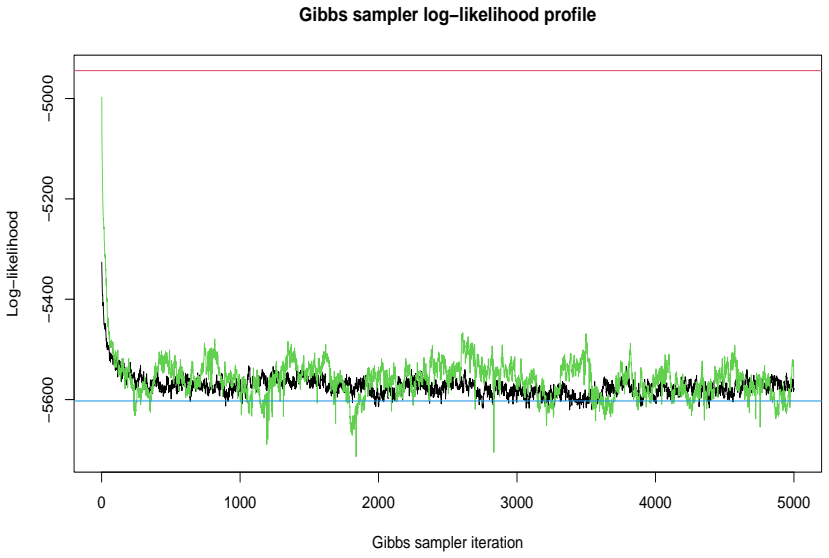
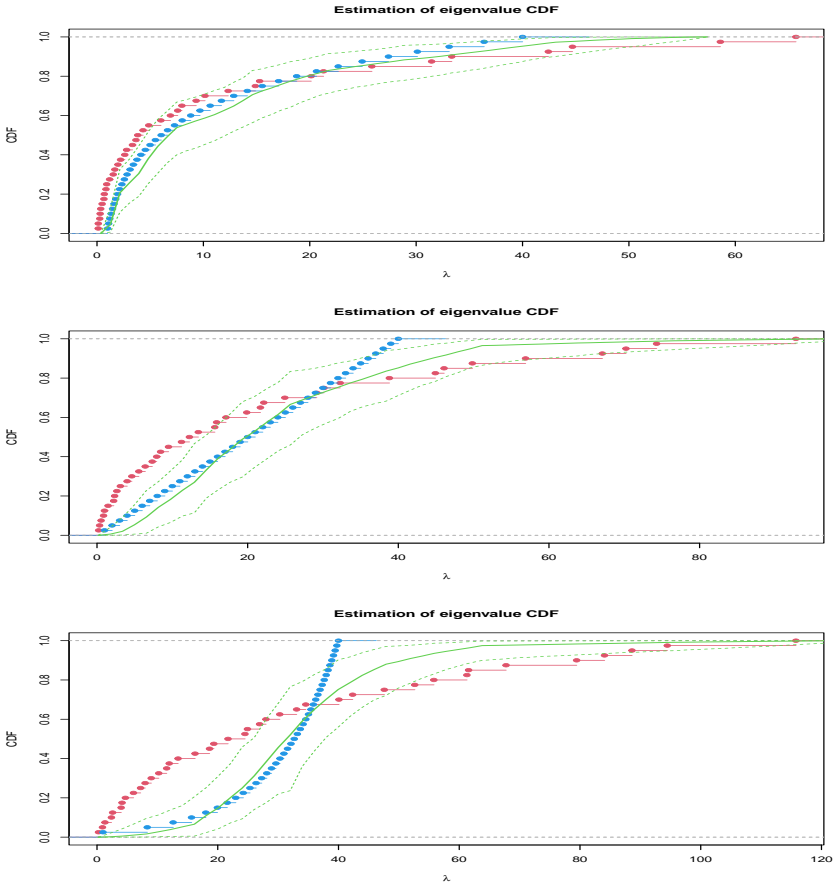
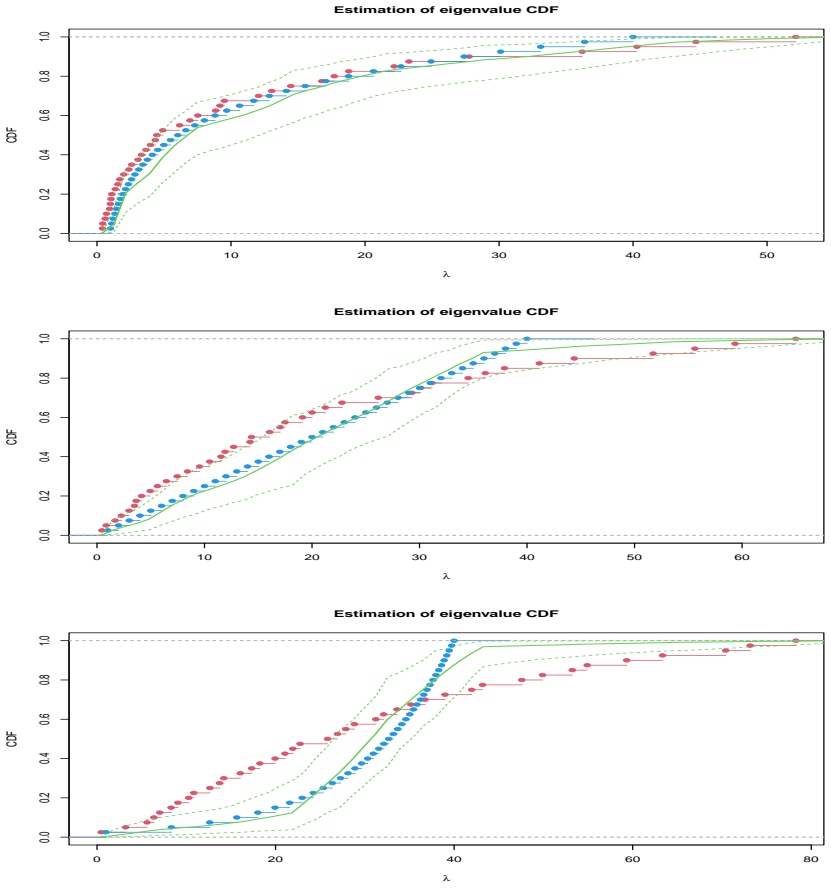
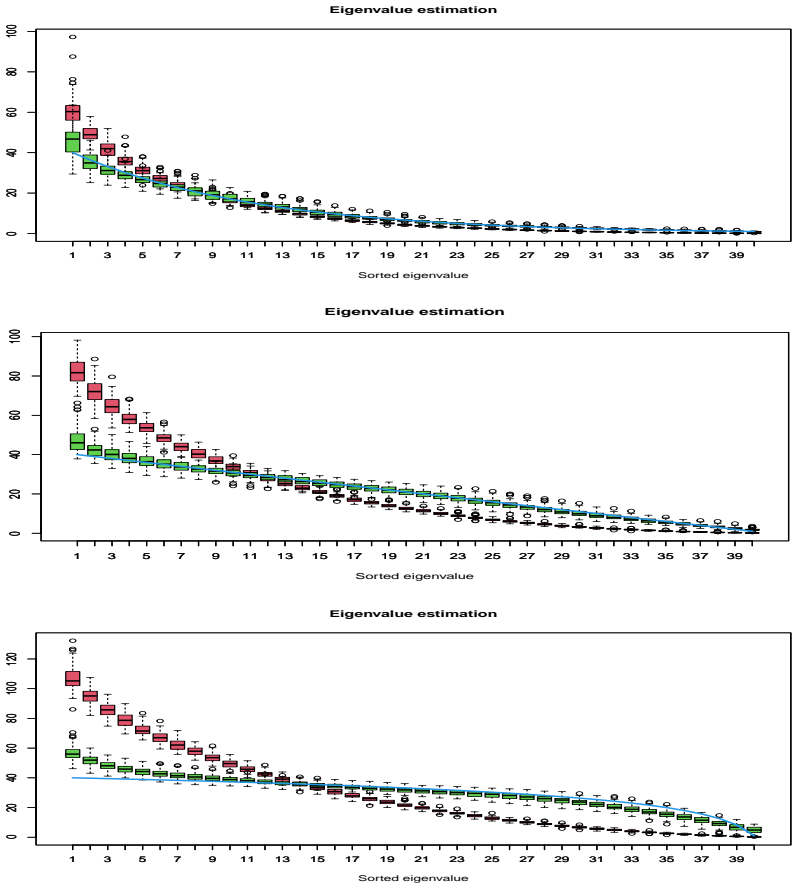
We develop a hierarchical Bayesian framework for covariance matrix estimation built on a key observation: while equivariance under the full general linear group GL(p) is well known, it is an extremely restrictive property -- estimators equivariant to GL(p) are limited to scalar multiples of the sample covariance matrix and carry considerably larger risks than shrinkage estimators. By contrast, commonly used shrinkage estimators, including the Haff empirical Bayes estimator, and the Ledoit--Wolf estimators, are all equivariant under the smaller orthogonal group O(p). Exploiting this structure, we establish that the Haar measure Bayes rule in an oracle eigenvalue model is the minimum risk estimator within the class of O(p)-equivariant estimators, and derive oracle Bayes rules for the covariance and precision matrices under the squared Frobenius, Stein, and squared Stein loss functions. These oracle rules serve as theoretical benchmarks that dominate all commonly used estimators. To approximate them when the true eigenvalues are unknown, we introduce a hierarchical Bayes model that places a finite P'olya tree prior on the eigenvalue distribution and uses Gibbs sampling to generate posterior draws, yielding both shrinkage estimates for the eigenvalues and approximations to the oracle Bayes rules. Simulations suggest that the finite P'olya tree prior is able to recover the general form of the distribution of the eigenvalues, and confirm that the resulting estimators closely approach oracle performance, substantially outperforming classical competitors for both covariance and precision matrix estimation.
Editorial analysis
A structured set of objections, weighed in public.
Referee Report
Summary. The paper develops a hierarchical Bayesian framework for covariance and precision matrix estimation. It first derives oracle Bayes rules under O(p)-equivariance (using Haar measure on the orthogonal group) that minimize risk within that class for squared Frobenius, Stein, and squared Stein losses; these rules dominate common shrinkage estimators such as Ledoit-Wolf and Haff. A finite Pólya tree prior is then placed on the unknown eigenvalue distribution, with Gibbs sampling used to obtain posterior draws that approximate the oracle rules when eigenvalues are unknown. Simulations are reported to show that the resulting estimators closely approach oracle performance and substantially outperform classical competitors.
Significance. If the finite Pólya tree approximation is reliable, the work supplies both theoretical benchmarks (oracle rules that are provably optimal within the O(p)-equivariant class) and a practical, computable procedure that can achieve near-oracle performance. This is potentially significant for high-dimensional covariance estimation, where O(p)-equivariant shrinkage is already standard but lacks a clear optimality benchmark or flexible nonparametric prior.
major comments (2)
- [Abstract (simulation claims)] The central performance claim rests on the finite Pólya tree prior recovering the general form of the unknown eigenvalue distribution (including possible multimodality or tail behavior not aligned with the centering measure). No explicit approximation-error bounds or exhaustive regime coverage are referenced in the abstract; the reported simulation outperformance therefore cannot yet be separated from possible simulation-design artifacts.
- [Abstract (hierarchical model and oracle approximation)] The derivation of the oracle rules is independent of the data and relies only on group invariance and Haar measure, but the hierarchical model is an approximation step whose fidelity is assessed solely by simulation. Without reported diagnostics on posterior concentration or coverage of eigenvalue laws outside the simulated cases, the claim that posterior draws 'closely approach oracle performance' remains unverified at the level needed to support the dominance result.
minor comments (1)
- Clarify whether the finite depth and dyadic partitions of the Pólya tree are chosen adaptively or fixed a priori, and how this choice affects recovery of arbitrary eigenvalue distributions.
Simulated Author's Rebuttal
We thank the referee for their careful reading and constructive feedback. Below we respond point-by-point to the major comments, indicating revisions that will be incorporated into a revised manuscript.
read point-by-point responses
-
Referee: [Abstract (simulation claims)] The central performance claim rests on the finite Pólya tree prior recovering the general form of the unknown eigenvalue distribution (including possible multimodality or tail behavior not aligned with the centering measure). No explicit approximation-error bounds or exhaustive regime coverage are referenced in the abstract; the reported simulation outperformance therefore cannot yet be separated from possible simulation-design artifacts.
Authors: The abstract summarizes results from the simulation studies in Section 5, which were constructed to include a range of eigenvalue distributions (unimodal, multimodal, and with varying tail behavior relative to the centering measure) in order to illustrate the flexibility of the finite Pólya tree. No theoretical approximation-error bounds are derived in the paper. We will revise the abstract to state more explicitly that the reported outperformance is observed in the simulation experiments described in the manuscript. revision: yes
-
Referee: [Abstract (hierarchical model and oracle approximation)] The derivation of the oracle rules is independent of the data and relies only on group invariance and Haar measure, but the hierarchical model is an approximation step whose fidelity is assessed solely by simulation. Without reported diagnostics on posterior concentration or coverage of eigenvalue laws outside the simulated cases, the claim that posterior draws 'closely approach oracle performance' remains unverified at the level needed to support the dominance result.
Authors: The oracle rules are derived solely from O(p)-equivariance and the Haar measure, independent of any data or prior. The finite Pólya tree model is presented as a computational approximation whose performance relative to the oracle is evaluated through the simulation studies. The manuscript does not supply posterior concentration diagnostics or coverage results for eigenvalue distributions outside those simulated. We will revise the abstract to qualify the approximation claim as being supported by the simulation evidence. revision: yes
Circularity Check
No circularity: oracle rules derived independently via Haar measure; approximation assessed by simulation
full rationale
The derivation begins with group-invariance arguments establishing the Haar-measure Bayes rule as the minimum-risk O(p)-equivariant estimator under standard losses; this step relies on external measure-theoretic facts, not on the paper's hierarchical model or data. The finite Pólya tree prior is then introduced separately as a practical approximation device whose fidelity is checked empirically via simulation rather than by algebraic identity or parameter fitting that re-labels inputs as outputs. No equation reduces to a prior result by construction, no uniqueness theorem is imported from the authors' own prior work, and no ansatz is smuggled via self-citation. The reported outperformance is therefore an empirical claim, not a definitional tautology.
Axiom & Free-Parameter Ledger
axioms (2)
- domain assumption Common shrinkage estimators including Haff and Ledoit-Wolf are O(p)-equivariant.
- domain assumption The Haar measure Bayes rule is the minimum-risk estimator among all O(p)-equivariant estimators.
Reference graph
Works this paper leans on
-
[1]
Proceedings of the Fourth
James, William and Stein, Charles , title =. Proceedings of the Fourth. 1961 , publisher =
1961
-
[2]
Stein, Charles , title =
-
[3]
Haff, L. R. , title =. The Annals of Statistics , volume =
-
[4]
Journal of Multivariate Analysis , volume =
Ledoit, Olivier and Wolf, Michael , title =. Journal of Multivariate Analysis , volume =
-
[5]
The Annals of Statistics , volume =
Ledoit, Olivier and Wolf, Michael , title =. The Annals of Statistics , volume =
-
[6]
, title =
Berger, James O. , title =. 1985 , series =
1985
-
[7]
Probability in the Engineering and Informational Sciences , volume =
Diaconis, Persi and Shahshahani, Mehrdad , title =. Probability in the Engineering and Informational Sciences , volume =
-
[8]
Annals of statistics , volume=
Optimal shrinkage of eigenvalues in the spiked covariance model , author=. Annals of statistics , volume=
-
[9]
Regularized estimation of large covariance matrices , author=
-
[10]
Biostatistics , volume=
Sparse inverse covariance estimation with the graphical lasso , author=. Biostatistics , volume=. 2008 , publisher=
2008
-
[11]
The Annals of Statistics , volume=
Maximum likelihood estimators for the matrix von Mises-Fisher and Bingham distributions , author=. The Annals of Statistics , volume=. 1979 , publisher=
1979
-
[12]
Statistica Sinica , year =
Weinstein, Asaf and Wallin, Jonas and Yekutieli, Daniel and Bogdan, Malgorzata , title =. Statistica Sinica , year =
-
[13]
2016 , note =
stcov: Stein's Covariance Estimator , author =. 2016 , note =
2016
-
[14]
Journal of Computational and Graphical Statistics , volume=
Simulation of the matrix Bingham--von Mises--Fisher distribution, with applications to multivariate and relational data , author=. Journal of Computational and Graphical Statistics , volume=. 2009 , publisher=
2009
discussion (0)
Sign in with ORCID, Apple, or X to comment. Anyone can read and Pith papers without signing in.