REVIEW 3 major objections 5 minor 1 cited by
A New Brown Dwarf Orbiting an M star and An Investigation on the Eccentricity Distribution of Transiting Long-Period Brown Dwarfs
T0 review · 3 major / 5 minor · reviewed 2026-08-06 · deepseek-v4-flash
Pith's one-line read Transiting brown dwarfs share giant-planet eccentricity patterns.
desk verdict Solid TOI-5575b discovery, but the central population claim rests on error bars that omit finite-sample variance. read the letter →
The pith
A machine-rendered reading of the paper's core claim, the machinery that carries it, and where it could break.
The reading
What carries the argument
The machine that carries the argument is the Beta distribution fit to measured eccentricities, with shape parameters $\alpha$ and $\beta$ defined on $e\in[0,1]$, combined with a Monte Carlo resampling that draws each system's eccentricity from a truncated Gaussian using its measurement uncertainty and refits 2000 synthetic datasets. The Beta distribution is used because it is naturally bounded between zero and one and can produce either peaked or monotone shapes with two parameters; comparing the $\alpha$ and $\beta$ pairs is what makes giant planets and brown dwarfs nearly identical and low-mass stars different. The sample itself, which uses true masses from transit measurements, a period cut of 10 to 1000 days to avoid tidal circularization, and exclusion of eccentricity upper limits for planets, is the supporting object that gives the comparison statistical weight.
What would settle it
Compile a transit-selected, completeness-corrected sample of long-period brown dwarfs, for instance from a uniform TESS survey or from Gaia astrometry, and recompute the eccentricity distribution with detection weights; if the corrected distribution peaks near $e\approx0.3$ or separates from the warm Jupiter distribution, then the claimed similarity is an observational selection effect.
Extended reading notes
Core claim
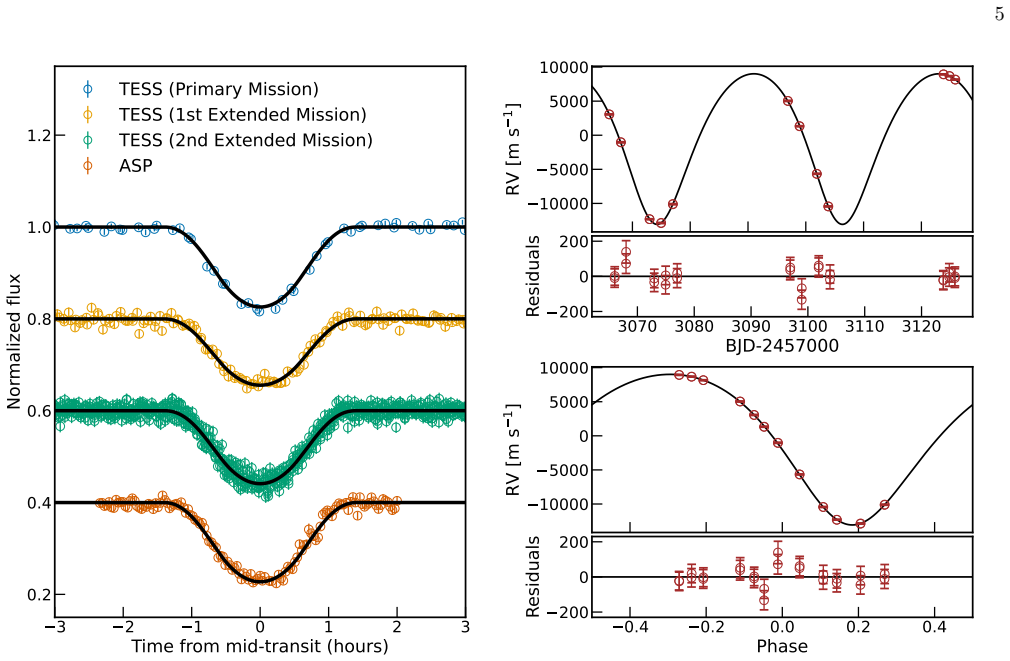
On the paper's own terms, the discovery is that TOI-5575b is the third-highest-mass-ratio transiting brown dwarf system known, with mass ratio $q=0.329\pm0.037$, companion mass $72.4\pm4.1\,M_J$, radius $0.84\pm0.07\,R_J$, period $32.072$ days, and eccentricity $0.187\pm0.002$, orbiting an M5V star of $0.21$ solar masses. The population claim is that for transiting companions with $10\le P\lesssim1000$ days, brown dwarfs with $13.6$ to $80$ Jupiter masses and giant planets with $0.3$ to $13.6$ Jupiter masses follow essentially the same eccentricity distribution, fitted by Beta distributions with shape parameters $\alpha=0.78^{+0.08}_{-0.12}$, $\beta=1.80^{+0.15}_{-0.20}$ for brown dwarfs and $\alpha=0.64^{+0.07}_{-0.06}$, $\beta=1.55^{+0.12}_{-0.10}$ for giant planets, overlapping within about $1\sigma$. Low-mass stars with $80$ to $150$ Jupiter masses are distinct, peaking near $e=0.3$. The paper contrasts this with direct-imaging results for cold companions at 5-100 AU, where brown dwarfs prefer high eccentricities and giant planets prefer low ones, and offers two scenarios: analogous inward dynamical evolution after different formation routes, or two sub-populations within each class whose superposition produces the matching distributions.
Load-bearing premise
The comparison assumes the 19 brown dwarfs, 78 warm Jupiters, and 15 low-mass stars represent their true populations, even though no completeness correction is applied for how transits and radial-velocity eccentricity measurements select high- versus low-eccentricity systems.
Editorial extensions
If this is right
- Inner brown dwarfs and warm Jupiters likely share a dominant dynamical evolution channel, such as scattering or disk-driven migration, rather than a star-like binary formation route.
- The period and scaled-semi-major-axis cuts imply that tidal circularization has not erased the primordial eccentricity signal, so the measured distribution records formation and migration history.
- The low-mass-star sample's peak near $e=0.3$ ties transiting low-mass stellar companions to the wider stellar binary population.
- The contrast with direct-imaging cold companions means eccentricity behavior depends on orbital distance, so models must treat inner and outer substellar populations separately.
- TOI-5575b itself, with a tidal circularization timescale far longer than the age of the Universe, becomes a preserved probe of the eccentricity pattern at 0.1-1.5 AU.
Reading between the lines
- An implication the authors leave implicit is that if the two-subgroup scenario is right, the high-eccentricity tail of warm Jupiters and brown dwarfs should correlate with signs of dynamical heating, such as outer stellar companions or high stellar metallicity, which future samples can test.
- Because the comparison is not corrected for transit detection sensitivity or radial-velocity eccentricity-measurement biases, a plausible extension is to repeat the analysis with survey completeness weights; the true underlying distributions could differ even though the observed ones match.
- The paper's tentative enhancement of high-eccentricity objects at 42.5 to 110 Jupiter masses suggests a testable prediction: as Gaia astrometry supplies more unbiased orbits, the claimed giant-planet/brown-dwarf similarity should persist at other mass ratios if it is real and dissolve if it is a selection artifact.
- If the similarity is genuine, the brown dwarf desert at short periods may be a dynamical outcome rather than a formation gap, because the eccentricity pattern implies migration from wider orbits.
Editorial analysis
A structured set of objections, weighed in public.
Referee Report
Summary. This paper reports the discovery and characterization of TOI-5575b, a transiting brown dwarf around an M5V star, with mass 72.4±4.1 M_J, radius 0.84±0.07 R_J, period 32.07 days, and eccentricity 0.187±0.002, based on TESS photometry, ground-based ASP photometry, 24 SPIRou radial velocities, NIRES spectroscopy, and speckle imaging. The authors then compile a sample of transiting long-period (10≤P≲1000 d) giant planets, brown dwarfs, and low-mass stars (78/19/15 systems), fit Beta distributions to the eccentricities via a Monte Carlo resampling, and claim that brown dwarfs and giant planets have nearly identical eccentricity distributions (a preference for circular orbits with a long high-eccentricity tail), while low-mass stars peak at e≈0.3. They discuss implications for formation channels and compare with direct-imaging samples.
Significance. The discovery analysis is careful and likely robust: the RV semi-amplitude (~11 km/s) and eccentricity are measured to high precision, dilution is modeled, and the secondary-eclipse and speckle/RUWE checks argue against a blended stellar binary. If the population comparison were as secure as the discovery, this would be a valuable contribution to the debate on brown-dwarf formation. However, the statistical support for the central population claim is currently incomplete: the resampling propagates only measurement errors, not finite-sample variance; the compiled samples are not demonstrated to be representative; and one of the secondary conclusions (the low-mass-star peak at e≈0.3) depends on the chosen cut. The paper is transparent about its sample construction and labels the formation scenarios as hypotheses, which is a strength.
major comments (3)
- [4.2] The Monte Carlo resampling in Section 4.2 draws each eccentricity from a truncated Gaussian TN(e_i, sigma_i^2, 0, 1) and refits the Beta distribution by least chi-square, but it never resamples the list of systems. This propagates only measurement noise; the finite-sample variance of having N=19, 78, and 15 objects drawn from the parent populations is absent. Because the median eccentricity uncertainties are tiny (0.006 for brown dwarfs, 0.023 for giant planets, 0.003 for low-mass stars), the 2,000 synthetic datasets are near-copies of the observed sample, and the alpha-beta contours in the right panel of Figure 4 are artificially narrow. The statement that the giant-planet and brown-dwarf parameters overlap within about 1 sigma therefore does not, by itself, establish that the underlying distributions are nearly identical. Please add a bootstrap over systems (or a hierarchical model) and a formal two-sample test that includes sampling variance, and report the result.
- [4.1] The compiled samples are not demonstrated to be representative of the underlying eccentricity distributions. The warm Jupiter sample excludes 11 systems with mass upper limits and 5 systems with eccentricity upper limits (Section 4.1), the brown-dwarf and low-mass-star samples are assembled from heterogeneous catalogs with different discovery biases, and no correction is applied for eccentricity-dependent transit detectability or for RV phase-coverage selection. The sentence in Section 4.1 that the excluded systems 'will not impact our conclusion significantly' is an assertion rather than a quantified test. At minimum, the population claim should be reframed as applying to transiting long-period systems with measured eccentricities, and a sensitivity check (e.g., including upper limits via survival analysis, or a Monte Carlo injection of eccentricity-dependent detection effects) should be added.
- [4.2 and Figure 5] The claimed peak at e≈0.3 for low-mass stars is not robust across the selection cuts used in the paper itself: Figure 5a shows that this peak disappears for the a/R*≥10 cut, and the paper attributes the disappearance to tidal circularization without demonstrating that the affected systems actually have short tidal circularization timescales. Please quantify the overlap between the period-selected and a/R*-selected samples, provide a tidal-circularization test for the systems with 10<a/R*<15, and state the low-mass-star conclusion as conditional on the adopted cut (a/R*≥15 or ≥20) if that is what the data support.
minor comments (5)
- [Title] The title contains a spurious space in 'Transiting'; please fix it.
- [Figure 2 caption] The legend strings '(0.3 Mc < 13.6 MJup)' are ambiguous or mispunctuated; they should read with explicit inequalities, e.g., '0.3 ≤ Mc < 13.6 MJup'.
- [2.1] The sentence beginning 'Quick Look Pipeline (QLP; Huang et al. 2020a,b) produce light curves' has a subject-verb agreement error; it should be 'produces'.
- [4.2] The validation sentence 'we validate that these results match with observations' is vague; please specify the goodness-of-fit criterion used and how the 30 synthetic datasets were selected.
- [5.2] The phrase 'numerous of astrometric binary stars' should be 'numerous astrometric binary stars'.
Circularity Check
No significant circularity: the eccentricity comparison is a descriptive fit of observed eccentricities, not a prediction derived from the fit parameters.
full rationale
The paper's two main products are the observational discovery of TOI-5575b and a population-level comparison of eccentricity distributions. Neither involves a claimed first-principles derivation that could reduce to its inputs. The Beta-distribution parameters in Section 4.2 are explicitly descriptive fits to measured eccentricities (Equation 1), and the paper does not present them as predictions or as consequences of a formation model. The formation scenarios in Section 5 are labeled hypotheses ('We put forward two possible hypotheses'), not derived conclusions. The comparison values for wide-orbit systems come from the independent work of Bowler et al. (2020). Sample construction uses external catalogs (Vowell et al. 2025; Barkaoui et al. 2025; NASA Exoplanet Archive) with explicit mass and period cuts justified by tidal circularization timescales from Jackson et al. (2008). Self-citations appear only in methodological contexts (e.g., Gan et al. 2023 photometry procedures; Lin et al. 2023 as a listed transiting brown dwarf; Gan 2023 in future prospects) and are not load-bearing for the central claim. The paper itself flags the main caveats: Section 4.1 acknowledges that excluding warm Jupiters with eccentricity upper limits could bias toward higher eccentricities, and Section 5.2 notes the sample sizes are still limited. The reviewer-style concern that the Section 4.2 Monte Carlo propagates only measurement noise rather than finite-sample variance is a statistical robustness limitation, not a circular identification of output with input, because the fitted parameters are not reused as inputs to any prediction. No circular step can be exhibited by quoting an equation in which the claimed result is equivalent by construction to the input data.
Assumptions & free parameters
free parameters (4)
- Beta distribution shape parameters (alpha, beta) for three populations =
GP: 0.64, 1.55; BD: 0.78, 1.80; LMS: 2.42, 5.12
- RV jitter sigma_SPIRou =
49.8 +/- 9.2 m/s
- TESS dilution factors =
0.997, 0.838, 0.905
- Scaled semi-major axis cuts a/R* =
10, 15, 20
assumptions (5)
- domain assumption Tidal circularization is negligible for P >= 10 days assuming Q_BD = Q* = 10^6.
- ad hoc to paper The compiled transiting catalogs are representative of the underlying eccentricity distribution without a selection-function correction.
- domain assumption A two-parameter Beta distribution adequately describes the eccentricity distribution of each population.
- standard math Truncated Gaussian resampling of each eccentricity with quoted errors captures measurement uncertainty.
- domain assumption Empirical stellar relations by Mann et al. and Baraffe et al. isochrones are valid for TOI-5575.
Cite this review
Pith. "Pith review of A New Brown Dwarf Orbiting an M star and An Investigation on the Eccentricity Distribution of Transiting Long-Period Brown Dwarfs." pith.science (2026). https://pith.science/paper/ERMB2XXR
@misc{pith2026250709461,
  author       = {Pith},
  title        = {Pith review of: A New Brown Dwarf Orbiting an M star and An Investigation on the Eccentricity Distribution of Transiting Long-Period Brown Dwarfs},
  year         = {2026},
  howpublished = {\url{https://pith.science/paper/ERMB2XXR}},
  note         = {Machine review of arXiv:2507.09461}
}
abstract
The orbital eccentricities of brown dwarfs encode valuable information of their formation and evolution history, providing insights into whether they resemble giant planets or stellar binaries. Here, we report the discovery of TOI-5575b, a long-period, massive brown dwarf orbiting a low-mass M5V star ($\rm 0.21\pm0.02\,M_\odot$) delivered by the TESS mission. The companion has a mass and radius of $\rm 72.4\pm4.1\,M_J$ and $\rm 0.84\pm0.07\,R_J$ on a 32-day moderately eccentric orbit ($e=0.187\pm0.002$), making it the third highest-mass-ratio transiting brown dwarf system known to date. Building on this discovery, we investigate the eccentricity distributions of a sample of transiting long-period ($10\leq P\lesssim 1000$ days, $\sim$0.1-1.5 AU) giant planets, brown dwarfs and low-mass stars. We find that brown dwarfs exhibit an eccentricity behavior nearly identical to that of giant planets: a preference for circular orbits with a long tail toward high eccentricities. Such a trend contrasts sharply with direct imaging findings, where cold (5-100 AU) brown dwarfs and giant planets display distinct eccentricity distributions. Our results suggest that transiting long-period brown dwarfs and giant planets probably 1) form in different routes at exterior orbits but undergo analogous dynamical evolution processes and migrate inwards; or 2) both contain two sub-groups, one with widely spread eccentricities while the other has circular orbits, that jointly sculpt the eccentricity distributions. The low-mass-star systems appear to be a distinctive population, showing a peak eccentricity at about 0.3, akin to more massive stellar binaries.
Figures


Figures from the paper (2 more)


Forward citations
Cited by 1 Pith paper
-
On the Eccentricity Distribution and Tidal Evolution of Transiting Brown Dwarfs
Short-period (P<16 d) transiting brown dwarfs are low-eccentricity while longer-period ones are more excited; assuming a shared primordial Beta distribution, tidal evolution constrains Q_BD ≈ 10^{7.1–8.1}.
Reference graph
Works this paper leans on
-
[1]
L., Chen, X., Ciardi, D., et al
Akeson, R. L., Chen, X., Ciardi, D., et al. 2013, PASP, 125, 989, doi: 10.1086/672273
doi:10.1086/672273 2013
-
[2]
2025, MNRAS, doi: 10.1093/mnras/staf418 15 Figure A1
Alqasim, A., Hirano, T., Hori, Y., et al. 2025, MNRAS, doi: 10.1093/mnras/staf418 15 Figure A1. The normalized TESS light curves of TOI-5575. The left, middle and right panels are data from Primary, First and Second Extended Missions. The light curve from the Primary Mission was extracted with a 3 × 3 pixel box aperture while the light curves from the Fir...
-
[3]
Hauschildt, P. H. 2003, A&A, 402, 701, doi: 10.1051/0004-6361:20030252
-
[4]
2025, A&A, 696, A44, doi: 10.1051/0004-6361/202453508 Beaug´ e, C., & Nesvorn´ y, D
Barkaoui, K., Sebastian, D., Z´ u˜ niga-Fern´ andez, S., et al. 2025, A&A, 696, A44, doi: 10.1051/0004-6361/202453508 Beaug´ e, C., & Nesvorn´ y, D. 2012, ApJ, 751, 119, doi: 10.1088/0004-637X/751/2/119
-
[5]
Bellm, E. C., Kulkarni, S. R., Graham, M. J., et al. 2019, PASP, 131, 018002, doi: 10.1088/1538-3873/aaecbe
-
[6]
Benedict, G. F., Henry, T. J., Franz, O. G., et al. 2016, AJ, 152, 141, doi: 10.3847/0004-6256/152/5/141
-
[7]
Boss, A. P. 2000, ApJL, 536, L101, doi: 10.1086/312737
-
[8]
Bowler, B. P., Blunt, S. C., & Nielsen, E. L. 2020, AJ, 159, 63, doi: 10.3847/1538-3881/ab5b11 16 T able B1.Radial velocities measurements for TOI-5575 from SPIRou. BJD R V (m s −1) σR V(m s−1) 2460065.995 -42867.1 16.8 2460066.009 -42881.0 17.5 2460067.997 -46980.4 25.2 2460068.012 -46946.8 39.8 2460072.960 -58244.1 16.7 2460072.974 -58238.5 17.0 2460074...
Show all 107 references
-
[9]
L., Stef´ ansson, G., et al
Brady, M., Bean, J. L., Stef´ ansson, G., et al. 2025, AJ, 169, 64, doi: 10.3847/1538-3881/ad9c66
2025 doi
-
[10]
J., Kirkpatrick, J
Burgasser, A. J., Kirkpatrick, J. D., Reid, I. N., et al. 2003, ApJ, 586, 512, doi: 10.1086/346263
2003 doi
-
[11]
W., Irwin, J
Carmichael, T. W., Irwin, J. M., Murgas, F., et al. 2022, MNRAS, 514, 4944, doi: 10.1093/mnras/stac1666
2022 doi
-
[12]
N., & Davies, M
Carrera, D., Raymond, S. N., & Davies, M. B. 2019, A&A, 629, L7, doi: 10.1051/0004-6361/201935744
2019 doi
-
[13]
E., Megeath, S
Charbonneau, D., Allen, L. E., Megeath, S. T., et al. 2005, ApJ, 626, 523, doi: 10.1086/429991
2005 doi
-
[14]
A., van Belle, G
Clark, C. A., van Belle, G. T., Horch, E. P., et al. 2024, AJ, 167, 56, doi: 10.3847/1538-3881/ad0bfd
2024 doi
-
[15]
A., Kielkopf, J
Collins, K. A., Kielkopf, J. F., Stassun, K. G., & Hessman, F. V. 2017, AJ, 153, 77, doi: 10.3847/1538-3881/153/2/77
2017 doi
-
[16]
J., Artigau, ´E., Doyon, R., et al
Cook, N. J., Artigau, ´E., Doyon, R., et al. 2022, PASP, 134, 114509, doi: 10.1088/1538-3873/ac9e74
2022 doi
-
[17]
C., Rayner, J
Cushing, M. C., Rayner, J. T., & Vacca, W. D. 2005, ApJ, 623, 1115, doi: 10.1086/428040
2005 doi
-
[18]
C., Vacca, W
Cushing, M. C., Vacca, W. D., & Rayner, J. T. 2004, PASP, 116, 362, doi: 10.1086/382907
2004 doi
-
[19]
M., Skrutskie, M
Cutri, R. M., Skrutskie, M. F., van Dyk, S., et al. 2003, 2MASS All Sky Catalog of point sources. 832 nmz Figure D1. Top panel: Secondary component detection limits obtained using speckle imaging obtained with speckle polarimeter on the SAI-2.5m telescope. Bottom panel: Gem- i...
2003
-
[20]
I., & Johnson, J
Dawson, R. I., & Johnson, J. A. 2012, ApJ, 756, 122, doi: 10.1088/0004-637X/756/2/122 —. 2018, ARA&A, 56, 175, doi: 10.1146/annurev-astro-081817-051853
2012 doi
-
[21]
I., & Murray-Clay, R
Dawson, R. I., & Murray-Clay, R. A. 2013, ApJL, 767, L24, doi: 10.1088/2041-8205/767/2/L24 D ´ ıaz, R. F., Damiani, C., Deleuil, M., et al. 2013, A&A, 551, L9, doi: 10.1051/0004-6361/201321124 Do ´O, C. R., O’Neil, K. K., Konopacky, Q. M., et al. 2023, AJ, 166, 48, doi: 10.384...
2013 doi
-
[22]
F., Kouach, D., Moutou, C., et al
Donati, J. F., Kouach, D., Moutou, C., et al. 2020, MNRAS, 498, 5684, doi: 10.1093/mnras/staa2569
2020 doi
-
[23]
X., Dawson, R
Dong, J., Huang, C. X., Dawson, R. I., et al. 2021, ApJS, 255, 6, doi: 10.3847/1538-4365/abf73c 17
2021 doi
-
[24]
I., Libby-Roberts, J
Doyle, L., Ca˜ nas, C. I., Libby-Roberts, J. E., et al. 2025, MNRAS, 536, 3745, doi: 10.1093/mnras/stae2819
2025 doi
-
[25]
1991, A&A, 248, 485
Duquennoy, A., & Mayor, M. 1991, A&A, 248, 485
1991
-
[26]
P., & Kisseleva-Eggleton, L
Eggleton, P. P., & Kisseleva-Eggleton, L. 2006, Ap&SS, 304, 75, doi: 10.1007/s10509-006-9078-z
2006 doi
-
[27]
B., van Roestel, J., & Rodriguez, A
El-Badry, K., Burdge, K. B., van Roestel, J., & Rodriguez, A. C. 2023, The Open Journal of Astrophysics, 6, 33, doi: 10.21105/astro.2307.15729
2023 arXiv
-
[28]
2018, Research Notes of the American Astronomical Society, 2, 209, doi: 10.3847/2515-5172/aaef38
Espinoza, N. 2018, Research Notes of the American Astronomical Society, 2, 209, doi: 10.3847/2515-5172/aaef38
2018 doi
-
[29]
2019, MNRAS, 490, 2262, doi: 10.1093/mnras/stz2688
Espinoza, N., Kossakowski, D., & Brahm, R. 2019, MNRAS, 490, 2262, doi: 10.1093/mnras/stz2688
2019 doi
-
[30]
2007, ApJ, 669, 1298, doi: 10.1086/521702 Ferreira dos Santos, T., Rice, M., Wang, X.-Y., & Wang, S
Fabrycky, D., & Tremaine, S. 2007, ApJ, 669, 1298, doi: 10.1086/521702 Ferreira dos Santos, T., Rice, M., Wang, X.-Y., & Wang, S. 2024, AJ, 168, 145, doi: 10.3847/1538-3881/ad6b7f
2007 doi
-
[31]
2016, The Journal of Open Source Software, 1, 24, doi: 10.21105/joss.00024
Foreman-Mackey, D. 2016, The Journal of Open Source Software, 1, 24, doi: 10.21105/joss.00024
2016 doi
-
[32]
2017, AJ, 154, 220, doi: 10.3847/1538-3881/aa9332
Foreman-Mackey, D., Agol, E., Ambikasaran, S., & Angus, R. 2017, AJ, 154, 220, doi: 10.3847/1538-3881/aa9332
2017 doi
-
[33]
J., Petigura, E
Fulton, B. J., Petigura, E. A., Blunt, S., & Sinukoff, E. 2018, PASP, 130, 044504, doi: 10.1088/1538-3873/aaaaa8 Gaia Collaboration, Brown, A. G. A., Vallenari, A., et al. 2021, A&A, 649, A1, doi: 10.1051/0004-6361/202039657 Gaia Collaboration, Vallenari, A., Brown, A. G. A., ...
2018 doi
-
[34]
2023, Research Notes of the American Astronomical Society, 7, 226, doi: 10.3847/2515-5172/ad0643
Gan, T. 2023, Research Notes of the American Astronomical Society, 7, 226, doi: 10.3847/2515-5172/ad0643
2023 doi
-
[35]
2023, AJ, 166, 165, doi: 10.3847/1538-3881/acf56d
Gan, T., Cadieux, C., Jahandar, F., et al. 2023, AJ, 166, 165, doi: 10.3847/1538-3881/acf56d
2023 doi
-
[36]
J., et al
Giacalone, S., Dai, F., Zanazzi, J. J., et al. 2024, AJ, 168, 189, doi: 10.3847/1538-3881/ad785a
2024 doi
-
[37]
2003, ApJ, 585, 1024, doi: 10.1086/346202
Goldreich, P., & Sari, R. 2003, ApJ, 585, 1024, doi: 10.1086/346202
2003 doi
-
[38]
1966, Icarus, 5, 375, doi: 10.1016/0019-1035(66)90051-0
Goldreich, P., & Soter, S. 1966, Icarus, 5, 375, doi: 10.1016/0019-1035(66)90051-0
1966 doi
-
[39]
Grether, D., & Lineweaver, C. H. 2006, ApJ, 640, 1051, doi: 10.1086/500161
2006 doi
-
[40]
2023, A&A, 674, A9, doi: 10.1051/0004-6361/202243969
Halbwachs, J.-L., Pourbaix, D., Arenou, F., et al. 2023, A&A, 674, A9, doi: 10.1051/0004-6361/202243969
2023 doi
-
[41]
C., & Rasio, F
Heggie, D. C., & Rasio, F. A. 1996, MNRAS, 282, 1064, doi: 10.1093/mnras/282.3.1064
1996 doi
-
[42]
A., Casewell, S
Henderson, B. A., Casewell, S. L., Jord´ an, A., et al. 2024, MNRAS, 533, 2823, doi: 10.1093/mnras/stae1940
2024 doi
-
[43]
W., Myers, A
Hogg, D. W., Myers, A. D., & Bovy, J. 2010, ApJ, 725, 2166, doi: 10.1088/0004-637X/725/2/2166
2010 doi
-
[44]
2023, A&A, 674, A10, doi: 10.1051/0004-6361/202244161
Holl, B., Sozzetti, A., Sahlmann, J., et al. 2023, A&A, 674, A10, doi: 10.1051/0004-6361/202244161
2023 doi
-
[45]
B., Everett, M
Howell, S. B., Everett, M. E., Horch, E. P., et al. 2016, ApJL, 829, L2, doi: 10.3847/2041-8205/829/1/L2
2016 doi
-
[46]
Ciardi, D. R. 2011, AJ, 142, 19, doi: 10.1088/0004-6256/142/1/19
2011 doi
-
[47]
X., Vanderburg, A., P´ al, A., et al
Huang, C. X., Vanderburg, A., P´ al, A., et al. 2020a, Research Notes of the American Astronomical Society, 4, 204, doi: 10.3847/2515-5172/abca2e —. 2020b, Research Notes of the American Astronomical Society, 4, 206, doi: 10.3847/2515-5172/abca2d
-
[48]
2013, A&A, 553, A6, doi: 10.1051/0004-6361/201219058
Husser, T.-O., Wende-von Berg, S., Dreizler, S., et al. 2013, A&A, 553, A6, doi: 10.1051/0004-6361/201219058
2013 doi
-
[49]
Ida, S., Lin, D. N. C., & Nagasawa, M. 2013, ApJ, 775, 42, doi: 10.1088/0004-637X/775/1/42
2013 doi
-
[50]
2020, MNRAS, 494, 5666, doi: 10.1093/mnras/staa1073
Ida, S., Muto, T., Matsumura, S., & Brasser, R. 2020, MNRAS, 494, 5666, doi: 10.1093/mnras/staa1073
2020 doi
-
[51]
2008, ApJ, 678, 1396, doi: 10.1086/529187
Jackson, B., Greenberg, R., & Barnes, R. 2008, ApJ, 678, 1396, doi: 10.1086/529187
2008 doi
-
[52]
M., Twicken, J
Jenkins, J. M., Twicken, J. D., McCauliff, S., et al. 2016, in Proc. SPIE, Vol. 9913, Software and Cyberinfrastructure for Astronomy IV, 99133E, doi: 10.1117/12.2233418
2016 doi
-
[53]
Kipping, D. M. 2013, MNRAS, 435, 2152, doi: 10.1093/mnras/stt1435
2013 doi
-
[54]
2016, ARA&A, 54, 271, doi: 10.1146/annurev-astro-081915-023307
Kratter, K., & Lodato, G. 2016, ARA&A, 54, 271, doi: 10.1146/annurev-astro-081915-023307
2016 doi
-
[55]
2015, PASP, 127, 1161, doi: 10.1086/683602
Kreidberg, L. 2015, PASP, 127, 1161, doi: 10.1086/683602
2015 doi
-
[56]
2022, ApJS, 259, 33, doi: 10.3847/1538-4365/ac5688
Kunimoto, M., Daylan, T., Guerrero, N., et al. 2022, ApJS, 259, 33, doi: 10.3847/1538-4365/ac5688
2022 doi
-
[57]
Lai, D., & Mu˜ noz, D. J. 2023, ARA&A, 61, 517, doi: 10.1146/annurev-astro-052622-022933
2023 doi
-
[58]
N., Kobulnicky, H
Larsen, A., Swaby, T. N., Kobulnicky, H. A., et al. 2025, AJ, 169, 246, doi: 10.3847/1538-3881/adbb54
2025 doi
-
[59]
Laughlin, G., Bodenheimer, P., & Adams, F. C. 1997, ApJ, 482, 420, doi: 10.1086/304125 Lightkurve Collaboration, Cardoso, J. V. d. M. a., Hedges, C., et al. 2018, Lightkurve: Kepler and TESS time series analysis in Python. http://ascl.net/1812.013
1997 doi
-
[60]
Lin, D. N. C., Bodenheimer, P., & Richardson, D. C. 1996, Nature, 380, 606, doi: 10.1038/380606a0
1996 doi
-
[61]
X., et al
Lin, Z., Gan, T., Wang, S. X., et al. 2023, MNRAS, 523, 6162, doi: 10.1093/mnras/stad1745
2023 doi
-
[62]
2014, MNRAS, 439, 2781, doi: 10.1093/mnras/stu134
Ma, B., & Ge, J. 2014, MNRAS, 439, 2781, doi: 10.1093/mnras/stu134
2014 doi
-
[63]
W., Deacon, N
Mann, A. W., Deacon, N. R., Gaidos, E., et al. 2014, AJ, 147, 160, doi: 10.1088/0004-6256/147/6/160
2014 doi
-
[64]
W., Feiden, G
Mann, A. W., Feiden, G. A., Gaidos, E., Boyajian, T., & von Braun, K. 2015, ApJ, 804, 64, doi: 10.1088/0004-637X/804/1/64
2015 doi
-
[65]
W., Dupuy, T., Kraus, A
Mann, A. W., Dupuy, T., Kraus, A. L., et al. 2019, ApJ, 871, 63, doi: 10.3847/1538-4357/aaf3bc 18
2019 doi
- [66]
-
[67]
J., Laher, R
Masci, F. J., Laher, R. R., Rusholme, B., et al. 2019, PASP, 131, 018003, doi: 10.1088/1538-3873/aae8ac
2019 doi
-
[68]
P., et al
Nagpal, V., Blunt, S., Bowler, B. P., et al. 2023, AJ, 165, 32, doi: 10.3847/1538-3881/ac9fd2
2023 doi
-
[69]
Naoz, S., & Fabrycky, D. C. 2014, ApJ, 793, 137, doi: 10.1088/0004-637X/793/2/137
2014 doi
-
[70]
2011, Nature, 473, 187, doi: 10.1038/nature10076
Teyssandier, J. 2011, Nature, 473, 187, doi: 10.1038/nature10076
2011 doi
-
[71]
R., Charbonneau, D., Irwin, J., et al
Newton, E. R., Charbonneau, D., Irwin, J., et al. 2014, AJ, 147, 20, doi: 10.1088/0004-6256/147/1/20
2014 doi
-
[72]
J., & Mamajek, E
Pecaut, M. J., & Mamajek, E. E. 2013, ApJS, 208, 9, doi: 10.1088/0067-0049/208/1/9
2013 doi
-
[73]
2016, ApJ, 829, 132, doi: 10.3847/0004-637X/829/2/132
Petrovich, C., & Tremaine, S. 2016, ApJ, 829, 132, doi: 10.3847/0004-637X/829/2/132
2016 doi
-
[74]
B., Hubickyj, O., Bodenheimer, P., et al
Pollack, J. B., Hubickyj, O., Bodenheimer, P., et al. 1996, Icarus, 124, 62, doi: 10.1006/icar.1996.0190
1996
-
[75]
2022, A&A, 664, A94, doi: 10.1051/0004-6361/202243454
Psaridi, A., Bouchy, F., Lendl, M., et al. 2022, A&A, 664, A94, doi: 10.1051/0004-6361/202243454
2022 doi
-
[76]
A., & Ford, E
Rasio, F. A., & Ford, E. B. 1996, Science, 274, 954, doi: 10.1126/science.274.5289.954
1996 doi
-
[77]
R., Winn, J
Ricker, G. R., Winn, J. N., Vanderspek, R., et al. 2015, Journal of Astronomical Telescopes, Instruments, and Systems, 1, 014003, doi: 10.1117/1.JATIS.1.1.014003
2015 doi
-
[78]
R., Muirhead, P
Rojas-Ayala, B., Covey, K. R., Muirhead, P. S., & Lloyd, J. P. 2012, ApJ, 748, 93, doi: 10.1088/0004-637X/748/2/93
2012 doi
-
[79]
J., Howell, S
Scott, N. J., Howell, S. B., Gnilka, C. L., et al. 2021, Frontiers in Astronomy and Space Sciences, 8, 138, doi: 10.3389/fspas.2021.716560
2021
-
[80]
J., Beatty, T
Siverd, R. J., Beatty, T. G., Pepper, J., et al. 2012, ApJ, 761, 123, doi: 10.1088/0004-637X/761/2/123
2012 doi
-
[81]
2023, MNRAS, 522, 2707, doi: 10.1093/mnras/stad1131
Siwek, M., Weinberger, R., & Hernquist, L. 2023, MNRAS, 522, 2707, doi: 10.1093/mnras/stad1131
2023 doi
-
[82]
C., Stumpe, M
Smith, J. C., Stumpe, M. C., Van Cleve, J. E., et al. 2012, PASP, 124, 1000, doi: 10.1086/667697
2012 doi
-
[83]
Speagle, J. S. 2020, MNRAS, 493, 3132, doi: 10.1093/mnras/staa278
2020 doi
-
[84]
S., Burrows, A., & Milsom, J
Spiegel, D. S., Burrows, A., & Milsom, J. A. 2011, ApJ, 727, 57, doi: 10.1088/0004-637X/727/1/57
2011 doi
-
[85]
G., Collins, K
Stassun, K. G., Collins, K. A., & Gaudi, B. S. 2017, AJ, 153, 136, doi: 10.3847/1538-3881/aa5df3
2017 doi
-
[86]
G., & Torres, G
Stassun, K. G., & Torres, G. 2016, AJ, 152, 180, doi: 10.3847/0004-6256/152/6/180 —. 2018, ApJ, 862, 61, doi: 10.3847/1538-4357/aacafc
2016 doi
-
[87]
G., Oelkers, R
Stassun, K. G., Oelkers, R. J., Paegert, M., et al. 2019, AJ, 158, 138, doi: 10.3847/1538-3881/ab3467 Stef´ ansson, G., Mahadevan, S., Winn, J. N., et al. 2025, AJ, 169, 107, doi: 10.3847/1538-3881/ada9e1
2019 doi
-
[88]
T., Haswell, C
Stevenson, A. T., Haswell, C. A., Faria, J. P., et al. 2025, MNRAS, 539, 727, doi: 10.1093/mnras/staf502
2025 doi
-
[89]
A., Safonov, B
Strakhov, I. A., Safonov, B. S., & Cheryasov, D. V. 2023, Astrophysical Bulletin, 78, 234, doi: 10.1134/S1990341323020104
2023 doi
-
[90]
C., Smith, J
Stumpe, M. C., Smith, J. C., Catanzarite, J. H., et al. 2014, PASP, 126, 100, doi: 10.1086/674989
2014 doi
-
[91]
C., Smith, J
Stumpe, M. C., Smith, J. C., Van Cleve, J. E., et al. 2012, PASP, 124, 985, doi: 10.1086/667698
2012 doi
-
[92]
C., Mahadevan, S., Bender, C
Terrien, R. C., Mahadevan, S., Bender, C. F., et al. 2012, ApJL, 747, L38, doi: 10.1088/2041-8205/747/2/L38
2012 doi
-
[93]
2020, MNRAS, 495, 3920, doi: 10.1093/mnras/staa1363
Teyssandier, J., & Lai, D. 2020, MNRAS, 495, 3920, doi: 10.1093/mnras/staa1363
2020 doi
-
[94]
2020, MNRAS, 491, 5158, doi: 10.1093/mnras/stz3299
Tokovinin, A., & Moe, M. 2020, MNRAS, 491, 5158, doi: 10.1093/mnras/stz3299
2020 doi
-
[95]
Triaud, A. H. M. J., Queloz, D., Bouchy, F., et al. 2009, A&A, 506, 377, doi: 10.1051/0004-6361/200911897
2009 doi
-
[96]
Triaud, A. H. M. J., Hebb, L., Anderson, D. R., et al. 2013, A&A, 549, A18, doi: 10.1051/0004-6361/201219643
2013 doi
-
[97]
2023, A&A, 680, A16, doi: 10.1051/0004-6361/202347578
Unger, N., S´ egransan, D., Barbato, D., et al. 2023, A&A, 680, A16, doi: 10.1051/0004-6361/202347578
2023 doi
-
[98]
D., Cushing, M
Vacca, W. D., Cushing, M. C., & Rayner, J. T. 2003, PASP, 115, 389, doi: 10.1086/346193
2003 doi
-
[99]
2024, A&A, 688, A128, doi: 10.1051/0004-6361/202449421 Van Eylen, V., Albrecht, S., Huang, X., et al
Valli, R., Tiede, C., Vigna-G´ omez, A., et al. 2024, A&A, 688, A128, doi: 10.1051/0004-6361/202449421 Van Eylen, V., Albrecht, S., Huang, X., et al. 2019, AJ, 157, 61, doi: 10.3847/1538-3881/aaf22f
2024 doi
-
[100]
E., et al
Virtanen, P., Gommers, R., Oliphant, T. E., et al. 2020, Nature Methods, 17, 261, doi: 10.1038/s41592-019-0686-2
2020 doi
- [101]
-
[102]
C., Henderson, C
Wilson, J. C., Henderson, C. P., Herter, T. L., et al. 2004, in Proc. SPIE, Vol. 5492, Ground-based Instrumentation for Astronomy, ed. A. F. M. Moorwood & M. Iye, 1295–1305, doi: 10.1117/12.550925
2004 doi
-
[103]
L., Eisenhardt, P
Wright, E. L., Eisenhardt, P. R. M., Mainzer, A. K., et al. 2010, AJ, 140, 1868, doi: 10.1088/0004-6256/140/6/1868
2010 doi
-
[104]
Matzner, C. D. 2025, ApJL, 982, L34, doi: 10.3847/2041-8213/adb751
2025 doi
- [105]
-
[106]
´A., Bayliss, D., et al
Zhou, G., Bakos, G. ´A., Bayliss, D., et al. 2019, AJ, 157, 31, doi: 10.3847/1538-3881/aaf1bb
2019 doi
-
[107]
2020, AJ, 159, 19, doi: 10.3847/1538-3881/ab55e9
Ziegler, C., Tokovinin, A., Brice˜ no, C., et al. 2020, AJ, 159, 19, doi: 10.3847/1538-3881/ab55e9
2020 doi
Reviewed August 6, 2026 · model on record in the stance chip above.
Discussion (0). Continue with ORCID to comment.