Shape-Preserving Evolution of the Global Ultraviolet Quasar Luminosity Function to zsimeq7.5
Pith reviewed 2026-06-26 10:07 UTC · model grok-4.3
The pith
The ultraviolet quasar luminosity function preserves its shape from redshift 0.1 to 7.5, evolving only through separate shifts in characteristic luminosity and overall density.
A machine-rendered reading of the paper's core claim, the machinery that carries it, and where it could break.
Core claim
For a double-power-law local luminosity function, the fiducial shape-preserving LADE model yields the lowest AIC and BIC values, and twelve DPL-based LADE models outperform both flexible double-power-law reference models. Repeating the grid search with a modified-Schechter local luminosity function recovers the same preferred evolutionary structure, showing that the result is not driven solely by the choice of local shape. The fitted luminosity-evolution component rises rapidly to z approximately 2 to 3 and then flattens or declines slowly, while the density-evolution component requires a declining effective normalization toward high redshift in the preferred models.
What carries the argument
The luminosity and density evolution (LADE) framework, which holds the local luminosity function shape fixed and applies independent parametric factors for luminosity evolution and density evolution.
If this is right
- The global UV quasar luminosity function admits a compact empirical description without requiring redshift-dependent changes to its shape.
- Luminosity evolution is the more stable component, rising sharply to z approximately 2-3 before flattening.
- Density evolution consistently shows a declining normalization at high redshift across the best-performing models.
- The preference for shape-preserving evolution holds for both double-power-law and modified-Schechter forms of the local luminosity function.
Where Pith is reading between the lines
- If the shape is preserved, it may indicate that the physical processes setting the quasar luminosity distribution operate similarly across epochs.
- The separation of luminosity and density factors could simplify comparisons with models of black-hole growth and accretion-rate distributions.
- Extending the same analysis to z greater than 7.5 with future surveys would provide a direct test of whether the fixed shape continues.
- A fixed-shape model may reduce uncertainty when estimating the integrated quasar contribution to cosmic reionization or the UV background.
Load-bearing premise
The shape of the local luminosity function remains unchanged at all redshifts, with only its characteristic luminosity and normalization allowed to evolve through separate factors.
What would settle it
A statistically significant change in the faint-end or bright-end slope of the luminosity function measured independently at z greater than 4 compared with the local slope would falsify the fixed-shape premise.
Figures



read the original abstract
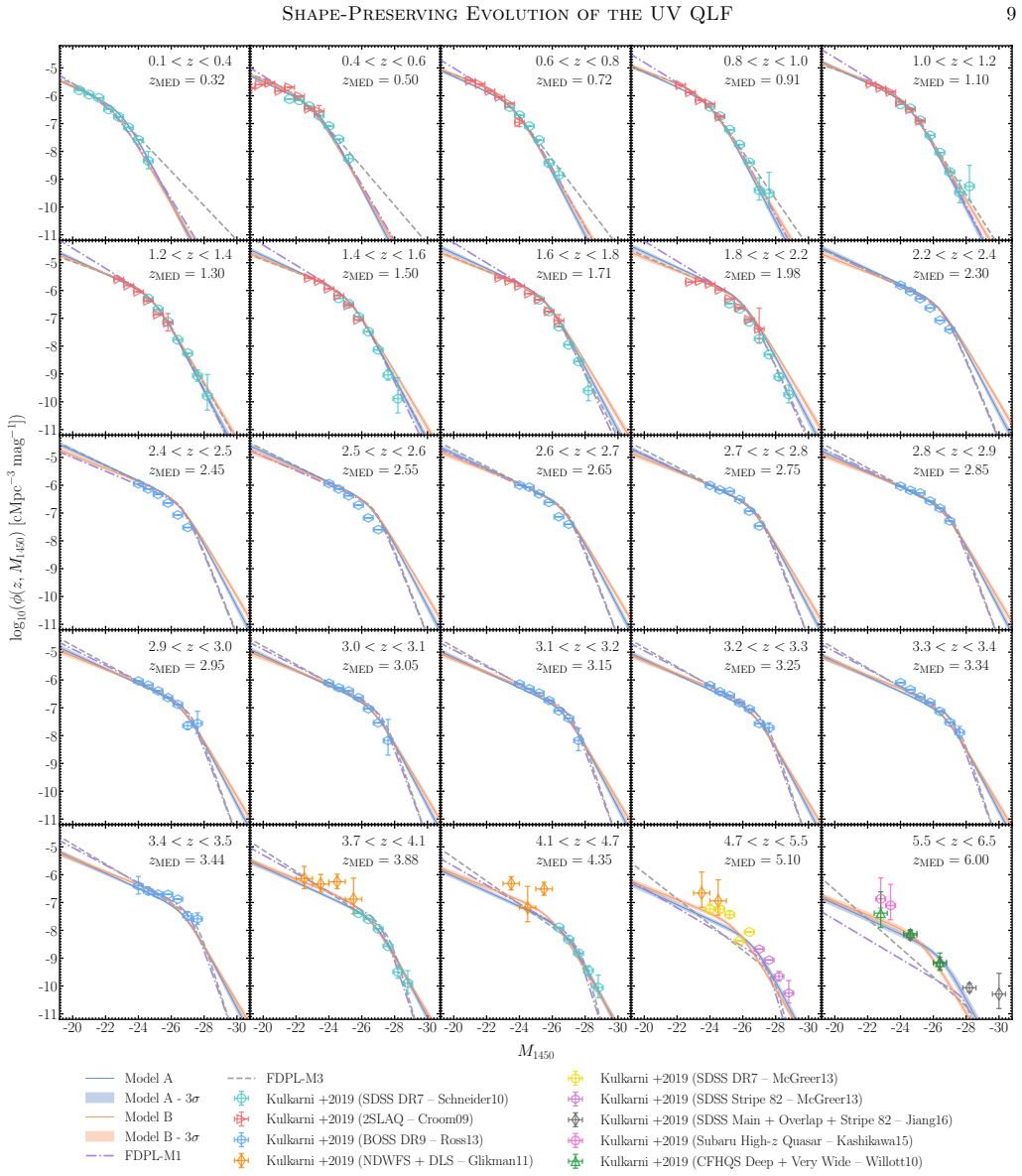
We present a global unbinned-likelihood analysis of the rest-frame ultraviolet (UV) quasar luminosity function (QLF) over $0.1\le z\le7.5$, using a final analysis sample of 70,960 Type~1 quasars selected from the homogenized compilation of Kulkarni et al. (2019). We test a shape-preserving luminosity and density evolution (LADE) framework, in which the local luminosity function (LF) shape is fixed and the redshift evolution is described by separate density- and luminosity-evolution factors. For a double-power-law (DPL) local LF, we search 81 LADE models built from nine density-evolution and nine luminosity-evolution functions, and compare them with two flexible double-power-law (FDPL) reference models. The fiducial shape-preserving LADE model gives the lowest Akaike information criterion (AIC) and Bayesian information criterion (BIC) values among the main models considered, and 12 DPL-based LADE models have lower AIC and BIC values than both FDPL reference models. Repeating the model-grid analysis with a modified-Schechter local LF gives the same preferred evolutionary structure, indicating that the result is not driven only by the assumed local LF shape. The fitted evolution functions further show that the luminosity-evolution component is the more stable part of the LADE decomposition: it rises rapidly to $z\simeq2$--3 and then flattens or slowly declines. The density-evolution component is more model dependent, but the preferred LADE models consistently require a declining effective normalization toward high redshift. Taken together, we conclude that a shape-preserving framework offers a statistically efficient and compact empirical description of the global UV QLF.
Editorial analysis
A structured set of objections, weighed in public.
Referee Report
Summary. The manuscript reports a global unbinned-likelihood analysis of the rest-frame UV quasar luminosity function over 0.1 ≤ z ≤ 7.5 using a homogenized sample of 70,960 Type 1 quasars. It evaluates a shape-preserving LADE framework in which the local LF shape is held fixed while redshift evolution is parameterized by separate density- and luminosity-evolution factors. For a double-power-law local LF, 81 LADE models are compared against two flexible double-power-law (FDPL) references via AIC and BIC; the fiducial LADE model yields the lowest values, 12 LADE models outperform both FDPLs, and the same evolutionary structure is recovered when the local LF is changed to a modified-Schechter form.
Significance. If the AIC/BIC preference survives scrutiny of the likelihood implementation and completeness corrections, the work supplies a statistically efficient, compact empirical description of global QLF evolution. The decomposition isolates a relatively stable luminosity-evolution component (rapid rise to z ≃ 2–3 followed by flattening) from a more model-dependent density-evolution component that declines at high redshift. Strengths include the large sample size, explicit grid search over evolution functions, unbinned likelihood, and explicit robustness test against a different local LF shape.
minor comments (3)
- [Abstract and §4] The abstract and §4 state that the fiducial LADE model is preferred, but do not identify which of the 81 combinations (specific density- and luminosity-evolution functions) constitutes the fiducial; adding a one-sentence definition would improve clarity.
- [§3] The unbinned likelihood implementation (including how survey completeness and selection functions enter the likelihood) is central to the model ranking; a short appendix or subsection deriving the exact likelihood expression would allow readers to verify absence of systematic bias in the AIC/BIC differences.
- [Table 2] Table 2 (or equivalent) lists AIC/BIC for the 81 models; adding a column for the number of free parameters per model would make the information-criterion comparison more transparent.
Simulated Author's Rebuttal
We thank the referee for their positive assessment of the manuscript, accurate summary of the analysis, and recommendation for minor revision. The report highlights the strengths of the large sample, unbinned likelihood approach, and robustness tests. No specific major comments were provided in the report.
Circularity Check
No significant circularity; model selection performed on external data
full rationale
The paper performs unbinned likelihood fitting and AIC/BIC comparison of LADE models against an external 70,960-object quasar compilation (Kulkarni et al. 2019). The shape-preserving assumption is stated explicitly as a modeling choice and is tested for robustness by repeating the grid with a modified-Schechter local LF, recovering the same evolutionary structure. No step reduces a prediction or central claim to a fitted parameter or self-citation by construction; the ranking is driven by data likelihood, not internal redefinition.
Axiom & Free-Parameter Ledger
free parameters (3)
- parameters of the nine density-evolution functions
- parameters of the nine luminosity-evolution functions
- DPL local LF parameters
axioms (2)
- domain assumption The local luminosity function shape is fixed across all redshifts.
- domain assumption The quasar sample from Kulkarni et al. (2019) is complete and unbiased after homogenization.
Reference graph
Works this paper leans on
-
[1]
Evolution of the AGN UV luminosity function from redshift 7.5
Evolution of the AGN UV luminosity function from redshift 7.5. , keywords =. doi:10.1093/mnras/stz1493 , archivePrefix =. 1807.09774 , primaryClass =
work page internal anchor Pith review Pith/arXiv arXiv doi:10.1093/mnras/stz1493
-
[2]
The Sloan Digital Sky Survey Quasar Catalog. V. Seventh Data Release. , keywords =. doi:10.1088/0004-6256/139/6/2360 , archivePrefix =. 1004.1167 , primaryClass =
work page internal anchor Pith review Pith/arXiv arXiv doi:10.1088/0004-6256/139/6/2360
-
[3]
The 2dF-SDSS LRG and QSO Survey: the spectroscopic QSO catalogue. , keywords =. doi:10.1111/j.1365-2966.2008.14052.x , archivePrefix =. 0810.4955 , primaryClass =
-
[4]
The SDSS-III Baryon Oscillation Spectroscopic Survey: The Quasar Luminosity Function from Data Release Nine. , keywords =. doi:10.1088/0004-637X/773/1/14 , archivePrefix =. 1210.6389 , primaryClass =
work page internal anchor Pith review Pith/arXiv arXiv doi:10.1088/0004-637x/773/1/14
-
[5]
The Faint End of the Quasar Luminosity Function at z -0.5ex 4: Implications for Ionization of the Intergalactic Medium and Cosmic Downsizing. , keywords =. doi:10.1088/2041-8205/728/2/L26 , archivePrefix =. 1101.0537 , primaryClass =
work page internal anchor Pith review Pith/arXiv arXiv doi:10.1088/2041-8205/728/2/l26 2041
-
[6]
A Survey of Luminous High-redshift Quasars with SDSS and WISE. II. the Bright End of the Quasar Luminosity Function at z 5. , keywords =. doi:10.3847/0004-637X/829/1/33 , archivePrefix =. 1607.04415 , primaryClass =
work page internal anchor Pith review Pith/arXiv arXiv doi:10.3847/0004-637x/829/1/33
-
[7]
The z=5 Quasar Luminosity Function from SDSS Stripe 82
The z = 5 Quasar Luminosity Function from SDSS Stripe 82. , keywords =. doi:10.1088/0004-637X/768/2/105 , archivePrefix =. 1212.4493 , primaryClass =
work page internal anchor Pith review Pith/arXiv arXiv doi:10.1088/0004-637x/768/2/105
-
[8]
The Final SDSS High-Redshift Quasar Sample of 52 Quasars at z>5.7
The Final SDSS High-redshift Quasar Sample of 52 Quasars at z>5.7. , keywords =. doi:10.3847/1538-4357/833/2/222 , archivePrefix =. 1610.05369 , primaryClass =
work page internal anchor Pith review Pith/arXiv arXiv doi:10.3847/1538-4357/833/2/222
-
[9]
The Canada-France High-z Quasar Survey: nine new quasars and the luminosity function at redshift 6
The Canada-France High-z Quasar Survey: Nine New Quasars and the Luminosity Function at Redshift 6. , keywords =. doi:10.1088/0004-6256/139/3/906 , archivePrefix =. 0912.0281 , primaryClass =
work page internal anchor Pith review Pith/arXiv arXiv doi:10.1088/0004-6256/139/3/906
-
[10]
The Subaru high-z quasar survey: discovery of faint z~6 quasars
The Subaru High-z Quasar Survey: Discovery of Faint z -0.5ex 6 Quasars. , keywords =. doi:10.1088/0004-637X/798/1/28 , archivePrefix =. 1410.7401 , primaryClass =
work page internal anchor Pith review Pith/arXiv arXiv doi:10.1088/0004-637x/798/1/28
-
[11]
Faint AGNs at z > 4 in the CANDELS GOODS-S field: looking for contributors to the reionization of the Universe. , keywords =. doi:10.1051/0004-6361/201425334 , archivePrefix =. 1502.02562 , primaryClass =
work page internal anchor Pith review Pith/arXiv arXiv doi:10.1051/0004-6361/201425334
-
[12]
A luminous quasar at a redshift of z = 7.085
A luminous quasar at a redshift of z = 7.085. , keywords =. doi:10.1038/nature10159 , archivePrefix =. 1106.6088 , primaryClass =
work page internal anchor Pith review Pith/arXiv arXiv doi:10.1038/nature10159
-
[13]
The identification of z-dropouts in Pan-STARRS1: three quasars at 6.5<z<6.7
The Identification of Z-dropouts in Pan-STARRS1: Three Quasars at 6.5< z< 6.7. , keywords =. doi:10.1088/2041-8205/801/1/L11 , archivePrefix =. 1502.01927 , primaryClass =
work page internal anchor Pith review Pith/arXiv arXiv doi:10.1088/2041-8205/801/1/l11 2041
-
[14]
An 800-million-solar-mass black hole in a significantly neutral Universe at redshift 7.5
An 800-million-solar-mass black hole in a significantly neutral Universe at a redshift of 7.5. , keywords =. doi:10.1038/nature25180 , archivePrefix =. 1712.01860 , primaryClass =
work page internal anchor Pith review Pith/arXiv arXiv doi:10.1038/nature25180
-
[15]
The first ultraviolet quasar stacked spectrum at z=2.4 from WFC3
The first ultraviolet quasar-stacked spectrum at z ≃ 2.4 from WFC3. , keywords =. doi:10.1093/mnras/stv516 , archivePrefix =. 1503.02075 , primaryClass =
work page internal anchor Pith review Pith/arXiv arXiv doi:10.1093/mnras/stv516
-
[16]
Composite Quasar Spectra From the Sloan Digital Sky Survey
Composite Quasar Spectra from the Sloan Digital Sky Survey. , keywords =. doi:10.1086/321167 , archivePrefix =. astro-ph/0105231 , primaryClass =
work page internal anchor Pith review Pith/arXiv arXiv doi:10.1086/321167
-
[17]
The Astrophysical Journal , volume=
Analysis of complete quasar samples to obtain parameters of luminosity and evolution functions , author=. The Astrophysical Journal , volume=
-
[18]
High-redshift quasars found in Sloan Digital Sky Survey commissioning data. IV. Luminosity function from the fall equatorial stripe sample , author=. The Astronomical Journal , volume=. 2001 , publisher=
2001
-
[19]
arXiv preprint astro-ph/9905116 , year=
Distance measures in cosmology , author=. arXiv preprint astro-ph/9905116 , year=
-
[20]
Publications of the Astronomical Society of the Pacific , volume=
emcee: the MCMC hammer , author=. Publications of the Astronomical Society of the Pacific , volume=. 2013 , publisher=
2013
-
[21]
The radio and optical luminosity evolution of quasars. II. The SDSS sample , author=. The Astrophysical Journal , volume=. 2013 , publisher=
2013
-
[22]
The Astrophysical Journal , volume=
Gamma-ray luminosity and photon index evolution of FSRQ blazars and contribution to the gamma-ray background , author=. The Astrophysical Journal , volume=. 2014 , publisher=
2014
-
[23]
A Mixture Evolution Scenario of the AGN Radio Luminosity Function. II. Do Low-and High-power Radio-loud AGNs Evolve Differently? , author=. The Astrophysical Journal , volume=. 2017 , publisher=
2017
-
[24]
, archivePrefix = "arXiv", eprint =
The VLA-COSMOS 3 GHz Large Project: Cosmic star formation history since z 5. , archivePrefix = "arXiv", eprint =. doi:10.1051/0004-6361/201629436 , adsurl =
-
[25]
An Ultra-deep Multiband Very Large Array (VLA) Survey of the Faint Radio Sky (COSMOS-XS): New Constraints on the Cosmic Star Formation History. , keywords =. doi:10.3847/1538-4357/ac99db , archivePrefix =. 2204.04167 , primaryClass =
-
[26]
Constraints on cosmic star formation history via a new modeling of the radio luminosity function of star-forming galaxies. , keywords =. doi:10.1051/0004-6361/202347746 , archivePrefix =. 2311.08975 , primaryClass =
-
[27]
Quasar UV luminosity function evolution up to z=8
Quasar UV luminosity function evolution up to z = 8. , keywords =. doi:10.1093/mnras/stw3168 , archivePrefix =. 1612.01544 , primaryClass =
work page internal anchor Pith review Pith/arXiv arXiv doi:10.1093/mnras/stw3168
-
[28]
The evolution of optically selected QSOs - II. , keywords =. doi:10.1093/mnras/235.3.935 , adsurl =
-
[29]
IEEE Transactions on Automatic Control , keywords =
A New Look at the Statistical Model Identification. IEEE Transactions on Automatic Control , keywords =
-
[30]
The Annals of Statistics , number =
Gideon Schwarz , title =. The Annals of Statistics , number =. 1978 , doi =
1978
-
[31]
2002 , publisher=
Model selection and multimodel inference: a practical information-theoretic approach , author=. 2002 , publisher=
2002
-
[32]
Masses of quasars. , keywords =. doi:10.1093/mnras/200.1.115 , adsurl =
-
[33]
On the Cosmological Evolution of the Luminosity Function and the Accretion Rate of Quasars
On the Cosmological Evolution of the Luminosity Function and the Accretion Rate of Quasars. , keywords =. doi:10.1086/308468 , archivePrefix =. astro-ph/9810426 , primaryClass =
work page internal anchor Pith review Pith/arXiv arXiv doi:10.1086/308468
-
[34]
Constraints on QSO Models from a Relation between the QSO Luminosity Function and the Local Black Hole Mass Function. , keywords =. doi:10.1086/381049 , archivePrefix =. astro-ph/0311404 , primaryClass =
work page internal anchor Pith review Pith/arXiv arXiv doi:10.1086/381049
-
[35]
An Observational Determination of the Bolometric Quasar Luminosity Function
An Observational Determination of the Bolometric Quasar Luminosity Function. , keywords =. doi:10.1086/509629 , archivePrefix =. astro-ph/0605678 , primaryClass =
work page internal anchor Pith review Pith/arXiv arXiv doi:10.1086/509629
-
[36]
The Luminosity Function of X-Ray-selected Active Galactic Nuclei: Evolution of Supermassive Black Holes at High Redshift. , keywords =. doi:10.1086/529572 , archivePrefix =. 0710.2461 , primaryClass =
work page internal anchor Pith review Pith/arXiv arXiv doi:10.1086/529572
-
[37]
The XMM-Newton serendipitous survey. VI. The X-ray luminosity function. , keywords =. doi:10.1051/0004-6361:200810919 , archivePrefix =. 0811.1450 , primaryClass =
work page internal anchor Pith review Pith/arXiv arXiv doi:10.1051/0004-6361:200810919
-
[38]
The evolution of the hard X-ray luminosity function of AGN. , keywords =. doi:10.1111/j.1365-2966.2009.15829.x , archivePrefix =. 0910.1141 , primaryClass =
-
[39]
The Intrinsic Quasar Luminosity Function: Accounting for Accretion Disk Anisotropy
The Intrinsic Quasar Luminosity Function: Accounting for Accretion Disk Anisotropy. , keywords =. doi:10.1088/0004-637X/787/1/73 , archivePrefix =. 1404.3151 , primaryClass =
work page internal anchor Pith review Pith/arXiv arXiv doi:10.1088/0004-637x/787/1/73
-
[40]
Quasar Luminosity Functions from Joint Evolution of Black Holes and Host Galaxies
Quasar Luminosity Functions from Joint Evolution of Black Holes and Host Galaxies. , keywords =. doi:10.1086/507122 , archivePrefix =. astro-ph/0603819 , primaryClass =
work page internal anchor Pith review Pith/arXiv arXiv doi:10.1086/507122
-
[41]
Modelling the cosmological co-evolution of supermassive black holes and galaxies - I. BH scaling relations and the AGN luminosity function. , keywords =. doi:10.1111/j.1365-2966.2008.12988.x , archivePrefix =. 0711.2053 , primaryClass =
-
[42]
Observational constraints on growth of massive black holes. , keywords =. doi:10.1046/j.1365-8711.2002.05532.x , archivePrefix =. astro-ph/0203082 , primaryClass =
-
[43]
Radiative Transfer in a Clumpy Universe. IV. New Synthesis Models of the Cosmic UV/X-Ray Background. , keywords =. doi:10.1088/0004-637X/746/2/125 , adsurl =
-
[44]
Minor Contribution of Quasars to Ionizing Photon Budget at z 6: Update on Quasar Luminosity Function at the Faint End with Subaru/Suprime-Cam. , keywords =. doi:10.3847/2041-8213/aa8cc6 , archivePrefix =. 1709.04413 , primaryClass =
work page internal anchor Pith review Pith/arXiv arXiv doi:10.3847/2041-8213/aa8cc6 2041
-
[45]
Consistent modelling of the meta-galactic UV background and the thermal/ionization history of the intergalactic medium. , keywords =. doi:10.1093/mnras/stz222 , archivePrefix =. 1801.04931 , primaryClass =
work page internal anchor Pith review Pith/arXiv arXiv doi:10.1093/mnras/stz222
-
[46]
The 2dF QSO Redshift Survey - I. The optical luminosity function of quasi-stellar objects. , keywords =. doi:10.1046/j.1365-8711.2000.03730.x , archivePrefix =. astro-ph/0005368 , primaryClass =
-
[47]
The 2dF QSO Redshift Survey - XII. The spectroscopic catalogue and luminosity function. , keywords =. doi:10.1111/j.1365-2966.2004.07619.x , archivePrefix =. astro-ph/0403040 , primaryClass =
-
[48]
The Sloan Digital Sky Survey Quasar Survey: Quasar Luminosity Function from Data Release 3. , keywords =. doi:10.1086/503559 , archivePrefix =. astro-ph/0601434 , primaryClass =
-
[49]
The Sloan Digital Sky Survey Quasar Catalog: twelfth data release
The Sloan Digital Sky Survey Quasar Catalog: Twelfth data release. , keywords =. doi:10.1051/0004-6361/201527999 , archivePrefix =. 1608.06483 , primaryClass =
work page internal anchor Pith review Pith/arXiv arXiv doi:10.1051/0004-6361/201527999
-
[50]
The Sloan Digital Sky Survey Quasar Catalog: Fourteenth Data Release
The Sloan Digital Sky Survey Quasar Catalog: Fourteenth data release. , keywords =. doi:10.1051/0004-6361/201732445 , archivePrefix =. 1712.05029 , primaryClass =
work page internal anchor Pith review Pith/arXiv arXiv doi:10.1051/0004-6361/201732445
-
[51]
The Sloan Digital Sky Survey Quasar Catalog: Sixteenth Data Release. , keywords =. doi:10.3847/1538-4365/aba623 , archivePrefix =. 2007.09001 , primaryClass =
-
[52]
High-Redshift Quasars Found in Sloan Digital Sky Survey Commissioning Data. IV. Luminosity Function from the Fall Equatorial Stripe Sample. , keywords =. doi:10.1086/318033 , archivePrefix =. astro-ph/0008123 , primaryClass =
work page internal anchor Pith review Pith/arXiv arXiv doi:10.1086/318033
-
[53]
Constraining the Evolution of the Ionizing Background and the Epoch of Reionization with z -0.5ex 6 Quasars. II. A Sample of 19 Quasars. , keywords =. doi:10.1086/504836 , archivePrefix =. astro-ph/0512082 , primaryClass =
work page internal anchor Pith review Pith/arXiv arXiv doi:10.1086/504836
-
[54]
The Luminosity Function of Bright QSOs at z 4 and Implications for the Cosmic Ionizing Background. , keywords =. doi:10.3847/1538-4357/abedb5 , archivePrefix =. 2103.10446 , primaryClass =
-
[55]
The Quasar Luminosity Function at Redshift 4 with Hyper Suprime-Cam Wide Survey
The quasar luminosity function at redshift 4 with the Hyper Suprime-Cam Wide Survey. , keywords =. doi:10.1093/pasj/psx091 , archivePrefix =. 1704.05996 , primaryClass =
work page internal anchor Pith review Pith/arXiv arXiv doi:10.1093/pasj/psx091
-
[56]
Subaru High-z Exploration of Low-luminosity Quasars (SHELLQs). V. Quasar Luminosity Function and Contribution to Cosmic Reionization at z = 6. , keywords =. doi:10.3847/1538-4357/aaee7a , archivePrefix =. 1811.01963 , primaryClass =
-
[57]
Exploring Reionization-era Quasars. III. Discovery of 16 Quasars at 6.4 z 6.9 with DESI Legacy Imaging Surveys and the UKIRT Hemisphere Survey and Quasar Luminosity Function at z 6.7. , keywords =. doi:10.3847/1538-4357/ab2be5 , archivePrefix =. 1810.11926 , primaryClass =
-
[58]
Exploring Reionization-era Quasars. IV. Discovery of Six New z 6.5 Quasars with DES, VHS, and unWISE Photometry. , keywords =. doi:10.3847/1538-3881/ab1be1 , archivePrefix =. 1811.11915 , primaryClass =
work page internal anchor Pith review Pith/arXiv arXiv doi:10.3847/1538-3881/ab1be1
-
[59]
The 2dF-SDSS LRG and QSO survey: the QSO luminosity function at 0.4 < z < 2.6. , keywords =. doi:10.1111/j.1365-2966.2009.15398.x , archivePrefix =. 0907.2727 , primaryClass =
-
[60]
The Astrophysical Journal , volume=
A mixture evolution scenario of the AGN radio luminosity function , author=. The Astrophysical Journal , volume=. 2016 , publisher=
2016
-
[61]
Determining the core radio luminosity function of radio AGNs via copula
Determining the Core Radio Luminosity Function of Radio AGNs via Copula. , keywords =. doi:10.3847/1538-4365/aaed3b , archivePrefix =. 1810.12713 , primaryClass =
work page internal anchor Pith review Pith/arXiv arXiv doi:10.3847/1538-4365/aaed3b
-
[62]
Revisiting the 150 MHz Radio Luminosity Function of Star-forming Galaxies with LOFAR Deep Fields through a Refined Statistical Framework. , keywords =. doi:10.3847/1538-4357/ae2474 , adsurl =
-
[63]
Secondary standard stars for absolute spectrophotometry. , keywords =. doi:10.1086/160817 , adsurl =
-
[64]
The Steep-spectrum Radio-loud AGN Luminosity Function and Its Implications for Black Hole Growth and Star Formation. arXiv e-prints , keywords =. doi:10.48550/arXiv.2603.15449 , archivePrefix =. 2603.15449 , primaryClass =
-
[65]
Monthly Notices of the Royal Astronomical Society , volume=
The 60- and far-infrared luminosity functions of IRAS galaxies , author=. Monthly Notices of the Royal Astronomical Society , volume=. 1990 , publisher=
1990
-
[66]
Cosmic evolution of star-forming galaxies to z ≃ 1.8 in the faint low-frequency radio source population. , keywords =. doi:10.1093/mnras/stz3401 , archivePrefix =. 1912.00934 , primaryClass =
-
[67]
The Astrophysical Journal , volume=
A New Estimate of the Cosmic Star Formation Density from a Radio-selected Sample, and the Contribution of H-dark Galaxies at z≥ 3 , author=. The Astrophysical Journal , volume=. 2022 , publisher=
2022
-
[68]
The LOFAR Two-metre Sky Survey: the radio view of the cosmic star formation history. , keywords =. doi:10.1093/mnras/stad1602 , archivePrefix =. 2305.15510 , primaryClass =
-
[69]
The XXL survey. LII. The evolution of radio AGN LF determined via parametric methods from GMRT, ATCA, VLA, and Cambridge interferometer observations. , keywords =. doi:10.1051/0004-6361/202346947 , archivePrefix =. 2312.14683 , primaryClass =
-
[70]
Annual Review of Astronomy and Astrophysics , year = 2014, month = aug, volume =
Cosmic Star-Formation History. Annual Review of Astronomy and Astrophysics , year = 2014, month = aug, volume =
2014
-
[71]
Cosmological evolution of radio sources found at 1.4 GHz. , keywords =. doi:10.1086/162382 , adsurl =
discussion (0)
Sign in with ORCID, Apple, or X to comment. Anyone can read and Pith papers without signing in.