Loss Landscape Diagnosis for Gradient-Based Gray-Scott System Inversion: Disentangling the Roles of PINN Components
Pith reviewed 2026-06-27 13:52 UTC · model grok-4.3
The pith
The residual loss alone produces a quadratic and smooth landscape for Gray-Scott parameter inversion, avoiding the flat-plateau pathology seen in direct unrolled simulation.
A machine-rendered reading of the paper's core claim, the machinery that carries it, and where it could break.
Core claim
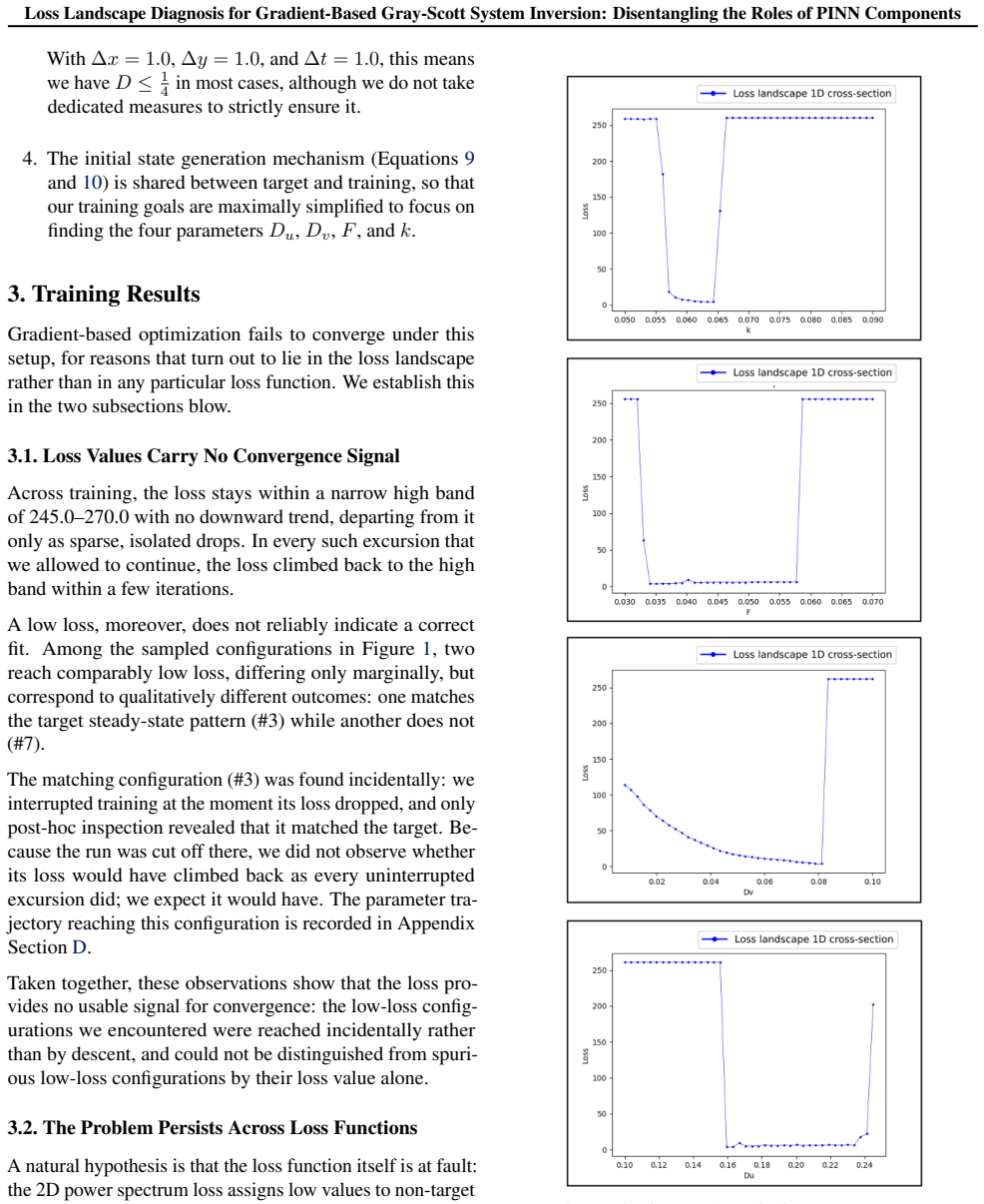
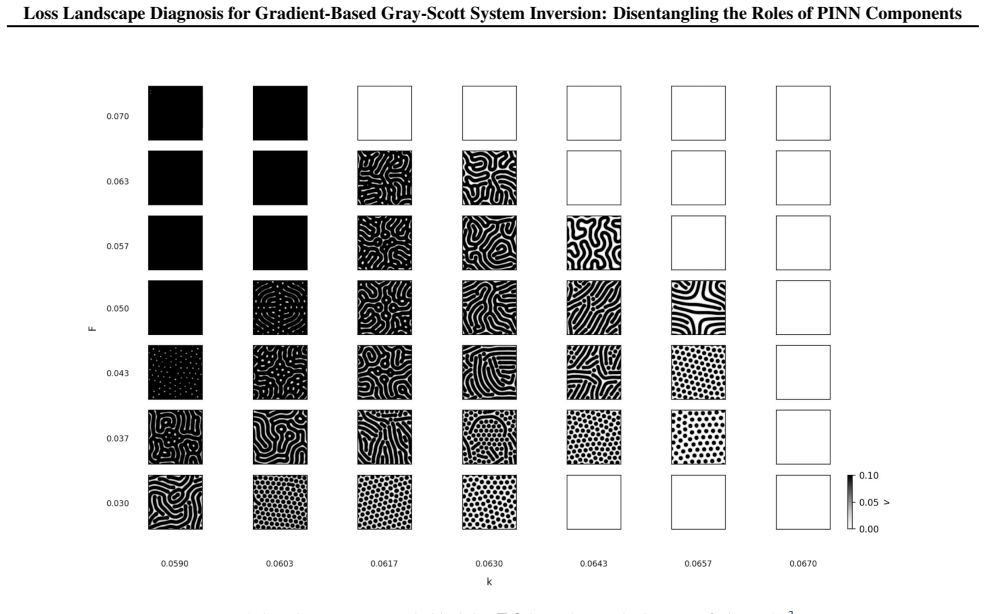
Direct backpropagation of a steady-state loss through unrolled Gray-Scott simulation fails to converge. The loss landscape exhibits flat plateaus with no gradient signal, bounded by sharp cliffs aligned with bifurcation boundaries. This geometry recurs across loss functions and gradient routing methods. With the neural network fixed, the residual loss is quadratic in the PDE parameters and yields a smooth landscape that implicitly encodes the full PDE dynamics across all initial conditions. The neural network cannot repair an ill-posed parameter subspace and serves only to complete the observed data.
What carries the argument
The flat-plateaus-and-cliffs geometry in the loss landscape of direct unrolled simulation, contrasted with the quadratic residual loss obtained when the neural network is fixed.
If this is right
- The flat-plateaus-and-cliffs structure causes non-convergence independent of simulation numerics or loss choice.
- The residual loss alone avoids the pathology by encoding full PDE dynamics across initial conditions.
- The neural network cannot repair ill-posed parameter subspaces.
- The findings carry concrete design implications for structuring PINN-type losses.
Where Pith is reading between the lines
- The same landscape diagnosis could be tested on inversion tasks for other reaction-diffusion systems.
- Adding the residual loss term directly to unrolled simulation might restore convergence.
- The explicit separation of loss and network roles may apply to inverse problems in other PDE families.
Load-bearing premise
The observed flat-plateaus-and-cliffs geometry is the root cause of non-convergence and is inherited by any gradient routing method, independent of numerical details in the unrolled simulation or choice of loss function.
What would settle it
A direct plot of the loss versus Gray-Scott parameters showing no flat plateaus or cliffs, or successful convergence under the same unrolled simulation setup, would falsify the landscape diagnosis.
Figures




read the original abstract
Gradient-based inversion of reaction-diffusion systems is typically approached via surrogate models or physics-informed neural networks (PINNs), while the most direct route, backpropagation through the PDE's structure itself, has largely been avoided. We pursue this direct route as a diagnostic probe, backpropagating a steady-state loss through unrolled Gray-Scott simulation to recover its parameters, with no surrogate or neural-network augmentation. Optimization fails to converge, and plotting the landscape directly locates the failure in its geometry -- flat plateaus with no gradient signal, bounded by sharp cliffs that align with bifurcation boundaries -- a structure that recurs across loss functions and is inherited however the gradients are routed to parameters. Reading this minimal setup as an ablation of PINN, we disentangle each component's role: with the neural network fixed, the residual loss is quadratic in the PDE parameters and yields a smooth landscape, so it alone already avoids the pathology, by implicitly encoding the full PDE dynamics across all initial conditions. The neural network, for its part, cannot repair an ill-posed parameter subspace, and so serves only to complete the observed data -- a division of labor not previously made explicit. These findings carry concrete design implications for PINN-type methods and a broader heuristic on when added dimensions actually help.
Editorial analysis
A structured set of objections, weighed in public.
Referee Report
Summary. The manuscript claims that direct backpropagation through unrolled Gray-Scott simulations for parameter inversion fails due to a loss landscape of flat plateaus (no gradient signal) bounded by sharp cliffs at bifurcation boundaries; this geometry recurs across loss functions and gradient-routing methods. Treating the setup as a PINN ablation, it concludes that fixing the neural network and using only the residual loss produces a quadratic, smooth landscape in the PDE parameters (F, k), thereby avoiding the pathology because the residual implicitly encodes the full PDE dynamics across all initial conditions, while the network serves only to complete observed data. These observations are said to yield concrete design implications for PINN-type methods.
Significance. If the component disentanglement and the quadratic-residual explanation hold, the work would clarify why residual losses can stabilize inversion in reaction-diffusion systems and provide a heuristic for when added model dimensions (e.g., neural networks) help versus when they cannot repair an ill-posed parameter subspace. The empirical landscape diagnosis could inform optimization strategies beyond the specific Gray-Scott case.
major comments (2)
- [Abstract] Abstract: the assertion that the residual loss (NN fixed) avoids pathology 'by implicitly encoding the full PDE dynamics across all initial conditions' is not supported by the construction. For any fixed field (u, v) the residual takes the linear form r = A·(F, k) − b, so the loss ||r||² is quadratic regardless of other trajectories; nothing in the formulation enforces or encodes correct dynamics for arbitrary other initial conditions. This over-interpretation is load-bearing for the claimed division of labor between residual loss and network.
- [Abstract] Abstract: the central empirical claim that the flat-plateaus-and-cliffs geometry 'recurs across loss functions and is inherited however the gradients are routed' is stated without quantitative measures, error bars, or verification that the flat regions are not discretization or floating-point artifacts. The absence of such checks weakens the assertion that the geometry is the root cause independent of numerical details in the unrolled simulation.
Simulated Author's Rebuttal
We thank the referee for their thorough review and insightful comments on our work. We address each of the major comments below and outline the revisions we will make to strengthen the manuscript.
read point-by-point responses
-
Referee: [Abstract] Abstract: the assertion that the residual loss (NN fixed) avoids pathology 'by implicitly encoding the full PDE dynamics across all initial conditions' is not supported by the construction. For any fixed field (u, v) the residual takes the linear form r = A·(F, k) − b, so the loss ||r||² is quadratic regardless of other trajectories; nothing in the formulation enforces or encodes correct dynamics for arbitrary other initial conditions. This over-interpretation is load-bearing for the claimed division of labor between residual loss and network.
Authors: We agree with the referee that the residual loss for a fixed (u, v) field takes the form of a quadratic in (F, k) without necessarily encoding dynamics for other initial conditions. The original phrasing overstated the mechanism. The core finding—that the residual loss produces a smooth landscape while the unrolled simulation does not—still holds, but we will revise the abstract to remove the claim about implicitly encoding the full PDE dynamics across all initial conditions and instead emphasize the quadratic nature of the residual loss in the parameters. revision: yes
-
Referee: [Abstract] Abstract: the central empirical claim that the flat-plateaus-and-cliffs geometry 'recurs across loss functions and is inherited however the gradients are routed' is stated without quantitative measures, error bars, or verification that the flat regions are not discretization or floating-point artifacts. The absence of such checks weakens the assertion that the geometry is the root cause independent of numerical details in the unrolled simulation.
Authors: The referee correctly notes that our presentation of the recurring geometry relies on qualitative visualization without accompanying quantitative metrics or explicit checks against numerical artifacts. In the revision, we will incorporate quantitative measures of the flat regions (e.g., the measure of parameter space where gradient norms fall below a threshold) and perform additional experiments varying discretization parameters and floating-point precision to confirm the geometry persists. This will provide stronger evidence that the observed pathology is not an artifact. revision: yes
Circularity Check
No significant circularity; algebraic claim and empirical plots are self-contained
full rationale
The paper's central derivation consists of an algebraic statement that the residual loss (with NN fixed) is quadratic in the PDE parameters F and k for any fixed field, plus empirical visualization of the resulting loss landscape. This quadratic property follows directly from the definition of the residual r = A·(F,k) - b and the loss ||r||²; it is not obtained by fitting a parameter inside the paper and then relabeling the fit as a prediction. No load-bearing step reduces to a self-citation, an imported uniqueness theorem, or an ansatz smuggled via prior work. The additional interpretive phrase 'implicitly encoding the full PDE dynamics across all initial conditions' is presented as a reading of the construction rather than a mathematical identity that collapses back to the inputs by definition. The derivation therefore remains independent of any internal fitting or self-referential loop.
Axiom & Free-Parameter Ledger
axioms (1)
- domain assumption The Gray-Scott simulation steps are differentiable so that gradients can be routed through the unrolled trajectory
Reference graph
Works this paper leans on
-
[1]
A Reaction-Diffusion Model of Human Brain Development , url =
Lef. A Reaction-Diffusion Model of Human Brain Development , url =. 2010 , bdsk-url-1 =. doi:10.1371/journal.pcbi.1000749 , journal =
-
[2]
Kondo, Shigeru , copyright =. The present and future of. Development , jt =. 2022 , bdsk-url-1 =. doi:10.1242/dev.200974 , edat =
-
[3]
Parameterized Physics-informed Neural Networks for Parameterized
Cho, Woojin and Jo, Minju and Lim, Haksoo and Lee, Kookjin and Lee, Dongeun and Hong, Sanghyun and Park, Noseong , booktitle =. Parameterized Physics-informed Neural Networks for Parameterized. 2024 , editor =
2024
-
[4]
Raissi and P
M. Raissi and P. Perdikaris and G.E. Karniadakis , doi =. Physics-informed neural networks: A deep learning framework for solving forward and inverse problems involving nonlinear partial differential equations , url =. Journal of Computational Physics , keywords =. 2019 , bdsk-url-1 =
2019
-
[5]
Physics-informed neural networks approach for 1
Giampaolo, Fabio and De Rosa, Mariapia and Qi, Pian and Izzo, Stefano and Cuomo, Salvatore , date =. Physics-informed neural networks approach for 1. Advanced Modeling and Simulation in Engineering Sciences , number =. 2022 , bdsk-url-1 =. doi:10.1186/s40323-022-00219-7 , id =
-
[6]
Characterizing possible failure modes in physics-informed neural networks , url =
Krishnapriyan, Aditi and Gholami, Amir and Zhe, Shandian and Kirby, Robert and Mahoney, Michael W , booktitle =. Characterizing possible failure modes in physics-informed neural networks , url =. 2021 , bdsk-url-1 =
2021
-
[7]
Journal of Computational Physics , keywords =
Haoyang Zheng and Yao Huang and Ziyang Huang and Wenrui Hao and Guang Lin , doi =. Journal of Computational Physics , keywords =. 2024 , bdsk-url-1 =
2024
-
[8]
Very Deep Convolutional Networks for Large-Scale Image Recognition
Karen Simonyan and Andrew Zisserman. Very Deep Convolutional Networks for Large-Scale Image Recognition. International Conference on Learning Representations. 2015
2015
-
[9]
and Ecker, Alexander S
Gatys, Leon A. and Ecker, Alexander S. and Bethge, Matthias , title =. Proceedings of the IEEE Conference on Computer Vision and Pattern Recognition (CVPR) , month =
-
[10]
Global Bifurcation Map of the Homogeneous States in the
Delgado, Joaqu\'. Global Bifurcation Map of the Homogeneous States in the. International Journal of Bifurcation and Chaos , number =. 2017 , bdsk-url-1 =. doi:10.1142/S0218127417300245 , eprint =
-
[11]
Gandy, Demi L. and Nelson, Martin R. , doi =. Analyzing Pattern Formation in the. 2022 , bdsk-url-1 =. https://doi.org/10.1137/21M1402868 , journal =
-
[12]
Learning system parameters from
Schn. Learning system parameters from. Machine Learning , number =. 2023 , bdsk-url-1 =. doi:10.1007/s10994-023-06334-9 , id =
-
[13]
2026 , eprint=
Solving Inverse Problems in Stochastic Self-Organizing Systems through Invariant Representations , author=. 2026 , eprint=
2026
-
[14]
and Bergman, Alexander W
Sitzmann, Vincent and Martel, Julien N.P. and Bergman, Alexander W. and Lindell, David B. and Wetzstein, Gordon , title =. Conference on Neural Information Processing Systems (NeurIPS) , year=
discussion (0)
Sign in with ORCID, Apple, or X to comment. Anyone can read and Pith papers without signing in.