The omnidirectional trace in H 1 (Ω)
Pith reviewed 2026-05-20 09:26 UTC · model grok-4.3
The pith
The omnidirectional trace defines a closed subset of H¹(Ω) whose elements possess a consistent boundary value matching all directional traces.
A machine-rendered reading of the paper's core claim, the machinery that carries it, and where it could break.
Core claim
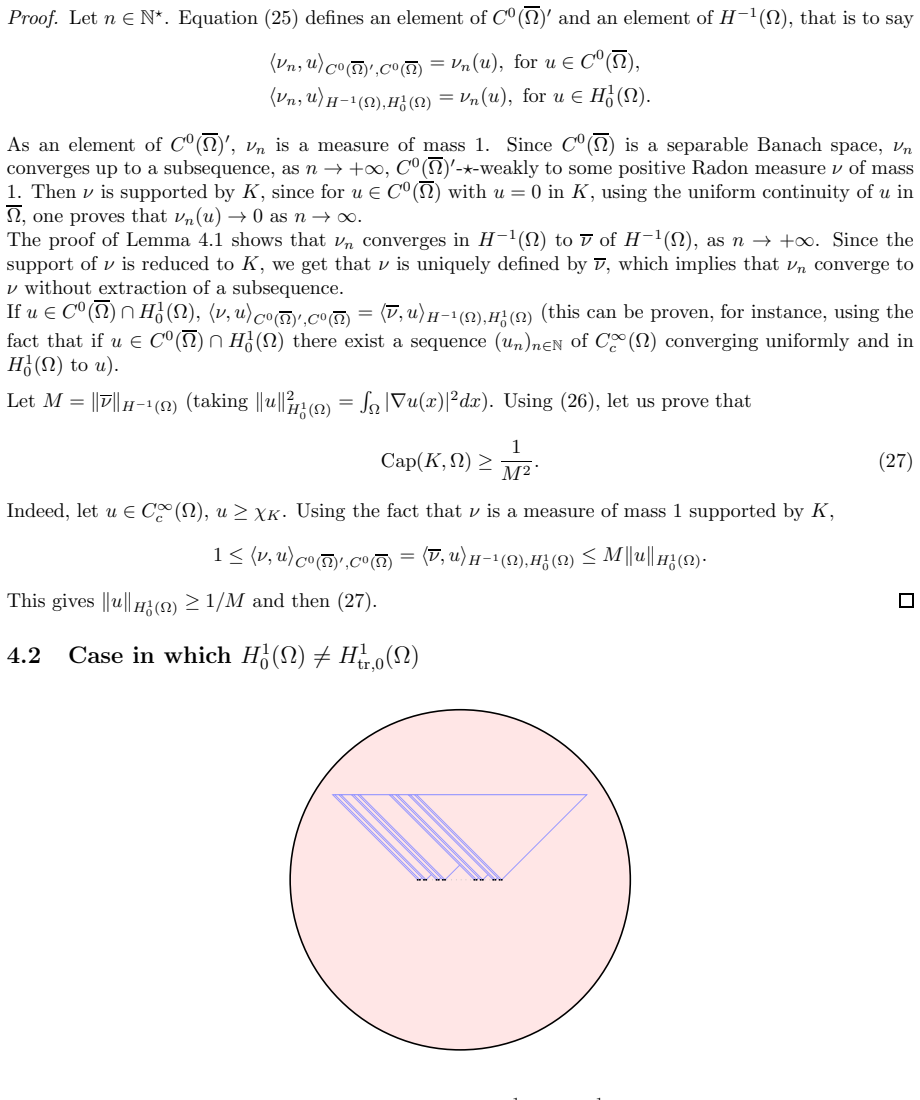
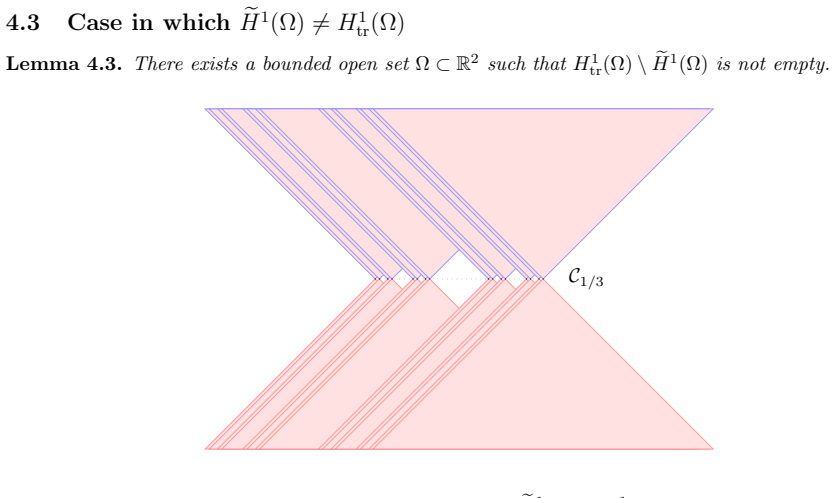
The paper introduces the omnidirectional trace for elements u of H¹(Ω) that admit a single boundary function g such that, for every direction, the directional trace of u equals g almost everywhere with respect to the directional measure. The collection of all such u, denoted H¹_tr(Ω), is proved closed in H¹(Ω). It always contains the H¹-closure of C₀(Ω) ∩ H¹(Ω) and equals this closure when the dimension is one. The omnidirectional trace satisfies an integration-by-parts identity that combines the values of the trace at opposite boundary points.
What carries the argument
The omnidirectional trace, defined as the single boundary function that equals the directional trace almost everywhere with respect to the directional measure for every direction.
If this is right
- The set H¹_tr(Ω) is closed in H¹(Ω).
- H¹_tr(Ω) always contains the H¹-closure of C₀(Ω) ∩ H¹(Ω).
- In one dimension H¹_tr(Ω) equals the H¹-closure of C₀(Ω) ∩ H¹(Ω).
- The omnidirectional trace satisfies an integration-by-parts formula combining values at opposite boundary points.
- Variational problems involving explicit boundary values on the domain can be solved using this trace.
Where Pith is reading between the lines
- In higher dimensions the inclusion of the closure can be strict, so some functions without compact support still possess well-defined omnidirectional traces.
- The construction may apply to other function spaces or to domains that are not open or bounded.
- Numerical methods for boundary-value problems on non-smooth domains could employ the omnidirectional trace to enforce conditions weakly.
- The integration-by-parts identity might yield new weak formulations for elliptic or parabolic equations on arbitrary domains.
Load-bearing premise
There exists a single function on the boundary that coincides almost everywhere with the directional trace for every direction with respect to the directional measure.
What would settle it
A sequence of functions each possessing an omnidirectional trace that converges in the H¹ norm to a limit whose directional traces disagree on a positive-measure set of directions would show the set is not closed.
Figures


read the original abstract
We first prove that all the functions in L 2 whose directional derivative is in L 2 have a directional trace on the boundary of any open bounded domain, without assumptions on its regularity. This enables us to define the omnidirectional trace of the elements of the Sobolev space H 1 ($\Omega$) for which there exists a function on the boundary that is almost everywhere equal, with respect to the directional measure, to the directional trace, regardless of the direction. The set of all these elements of H 1 ($\Omega$), denoted by H 1 tr ($\Omega$), is shown to be closed, and to always contain the closure in H 1 ($\Omega$) of the set C 0 ($\Omega$)$\cap$ H 1 ($\Omega$) (it is always equal to this set in the 1D case, and can be strictly greater in higher dimensions). The omnidirectional trace always satisfies an integration-by-parts formula, which combines the values of the trace on opposite points of the boundary. Examples show that this notion enables the resolution of variational problems involving the values at the boundary of the domain.
Editorial analysis
A structured set of objections, weighed in public.
Referee Report
Summary. The manuscript proves that L² functions with L² directional derivatives admit directional traces on the boundary of any bounded open set Ω, without boundary regularity assumptions. It defines the omnidirectional trace on the subset H¹_tr(Ω) of H¹(Ω) consisting of those functions for which a single boundary function g exists that coincides almost everywhere with the directional trace for every direction with respect to the associated directional measure. The set H¹_tr(Ω) is shown to be closed in H¹(Ω), to contain the H¹-closure of C₀(Ω) ∩ H¹(Ω) (with equality in one dimension and possible strict inclusion in higher dimensions), and to satisfy an integration-by-parts formula that pairs trace values at opposite boundary points. Examples illustrate applications to variational problems with boundary values.
Significance. If the results hold, the construction supplies a trace-like operator on domains too irregular for the classical trace theorem, while preserving key functional-analytic properties such as closedness and an integration-by-parts identity. The observation that H¹_tr(Ω) can properly contain the closure of compactly supported functions in dimensions greater than one identifies a new class of functions with consistent directional boundary values, which may enlarge the scope of variational formulations on non-Lipschitz or fractal domains.
major comments (1)
- [Integration-by-parts formula] Integration-by-parts formula (abstract and the section establishing the formula): the claim that the omnidirectional trace combines values at 'opposite points of the boundary' for arbitrary bounded open Ω is load-bearing for the utility of the formula. On domains with inward cusps or fractal boundaries a line parallel to a fixed direction may intersect ∂Ω in more than two points or in a positive-measure set; it is unclear how the pairing of opposite points is defined or whether the directional trace remains a well-defined point value at those intersections. A precise statement of the pairing and a verification that the formula continues to hold under the paper's minimal assumptions are required.
minor comments (2)
- [Definition of omnidirectional trace] The definition of the directional measure and the precise sense in which 'almost everywhere with respect to the directional measure' is understood should be stated explicitly before the definition of H¹_tr(Ω) to make the consistency condition across directions unambiguous.
- Notation: the symbol H¹_tr(Ω) is introduced without an immediate comparison to the standard trace space H^{1/2}(∂Ω) or to H₀¹(Ω); a short remark clarifying the relationship would improve readability.
Simulated Author's Rebuttal
We thank the referee for their thorough review and valuable feedback on our manuscript. We address the major comment regarding the integration-by-parts formula below, and we will incorporate clarifications in the revised version to enhance the precision of our statements.
read point-by-point responses
-
Referee: [Integration-by-parts formula] Integration-by-parts formula (abstract and the section establishing the formula): the claim that the omnidirectional trace combines values at 'opposite points of the boundary' for arbitrary bounded open Ω is load-bearing for the utility of the formula. On domains with inward cusps or fractal boundaries a line parallel to a fixed direction may intersect ∂Ω in more than two points or in a positive-measure set; it is unclear how the pairing of opposite points is defined or whether the directional trace remains a well-defined point value at those intersections. A precise statement of the pairing and a verification that the formula continues to hold under the paper's minimal assumptions are required.
Authors: We appreciate the referee's observation concerning the integration-by-parts formula on general domains. In our construction, the directional traces are defined with respect to the directional measures on the boundary, and the integration-by-parts identity is obtained by applying the one-dimensional fundamental theorem of calculus along almost every line in a given direction. For each such line, the intersection with Ω is a countable union of open intervals, and the boundary terms arise from the endpoints of these intervals, which we refer to as 'opposite points' in the sense of the entry and exit points for each segment. The omnidirectional trace is a single function g on ∂Ω that matches these directional traces a.e. with respect to the respective measures. We acknowledge that the manuscript's presentation of this pairing could be made more explicit, particularly for domains where a line may intersect the boundary in multiple points or sets of positive measure. In the revised manuscript, we will provide a detailed definition of the pairing, clarifying that the formula accounts for all such paired contributions along each line, and include a proof sketch or reference to the one-dimensional case that verifies the identity holds under our assumptions of Ω being bounded and open. This revision will not alter the main results but will improve readability and address the referee's concern directly. revision: yes
Circularity Check
No significant circularity; derivation is self-contained
full rationale
The paper first proves existence of directional traces on arbitrary bounded open domains for L² functions with directional derivative in L², using direct arguments. It then defines H¹_tr(Ω) as the subset of H¹(Ω) for which a single boundary function g exists that coincides a.e. with each directional trace w.r.t. the corresponding measure. Closedness of this set, its containment of the H¹-closure of C₀(Ω) ∩ H¹(Ω), equality in 1D, and the integration-by-parts formula are all established by subsequent proofs relying on standard Sobolev and measure-theoretic tools. No self-definitional reductions, fitted inputs renamed as predictions, or load-bearing self-citations appear; the central claims do not reduce to their inputs by construction and remain independent of the definition step.
Axiom & Free-Parameter Ledger
axioms (2)
- standard math H1(Ω) consists of L2 functions whose distributional derivatives are in L2
- domain assumption Directional traces exist for L2 functions with directional derivative in L2 on any bounded open set
invented entities (1)
-
omnidirectional trace
no independent evidence
Reference graph
Works this paper leans on
- [1]
-
[2]
W. Arendt and A. F. M. ter Elst. The Dirichlet-to-Neumann opera tor on rough domains. J. Differential Equations, 251(8):2100–2124, 2011
work page 2011
- [3]
-
[4]
W. Arendt and M. Warma. The Laplacian with Robin boundary condit ions on arbitrary domains. Potential Anal., 19(4):341–363, 2003
work page 2003
-
[5]
L. Boccardo, T. Gallou¨ et, and L. Orsina. Existence and uniquen ess of entropy solutions for nonlinear elliptic equations with measure data. Ann. Inst. H. Poincar´ eC Anal. Non Lin´ eaire, 13(5):539–551, 1996
work page 1996
- [6]
-
[7]
D. Bucur and A. Giacomini. A variational approach to the isoperime tric inequality for the Robin eigenvalue problem. Arch. Ration. Mech. Anal., 198(3):927–961, 2010
work page 2010
-
[8]
D. L. Cohn. Measure Theory. Birkh¨ auser Advanced Texts Basler Lehrb¨ ucher. Birkh¨ auser New York, NY, 2013
work page 2013
-
[9]
B. E. J. Dahlberg. Estimates of harmonic measure. Arch. Rational Mech. Anal., 65(3):275–288, 1977
work page 1977
-
[10]
D. E. Edmunds and W. D. Evans. Spectral theory and differential operators. Oxford Mathemati- cal Monographs. The Clarendon Press, Oxford University Press, New York, 1987. Oxford Science Publications
work page 1987
-
[11]
L. C. Evans and R. F. Gariepy. Measure theory and fine properties of functions. Textbooks in Mathematics. CRC Press, Boca Raton, FL, revised edition, 2015
work page 2015
- [12]
- [13]
-
[14]
T. Gallou¨ et and R. Herbin.Mesure, int´ egration,probabilit´ es. Collection R´ ef´ erences sciences. Ellipses, Paris, 2022
work page 2022
-
[15]
K. Kazaniecki and M. Wojciechowski. Trace Operator on von Ko ch’s Snowflake. Potential Anal., 61(4):659–684, 2024
work page 2024
-
[16]
J. L. Lewis. Approximation of Sobolev functions in Jordan domain s. Ark. Mat., 25(2):255–264, 1987
work page 1987
-
[17]
V. Maz’ya. Sobolev Spaces with Applications to Elliptic Partial Differential Equations, volume 342 of A series of comprehensive studies in mathematics. Springer, 1985
work page 1985
-
[18]
W. F. Pfeffer. The Gauss-Green theorem. Advances in Mathematics, 87(1):93–147, 1991
work page 1991
- [19]
-
[20]
M. Sauter. Uniqueness of the approximative trace. Indiana Univ. Math. J., 69(1):171–204, 2020. 29
work page 2020
-
[21]
P. Shvartsman. On the boundary values of Sobolev W 1 p -functions. Adv. Math., 225(4):2162–2221, 2010
work page 2010
-
[22]
W. P. Ziemer. Weakly Differentiable Functions: Sobolev Spaces and Functions of Bounded Variation. Springer-Verlag, 1989. 30
work page 1989
discussion (0)
Sign in with ORCID, Apple, or X to comment. Anyone can read and Pith papers without signing in.