Hot quark matter and (proto-) neutron stars
Pith reviewed 2026-05-25 01:43 UTC · model grok-4.3
The pith
Hot proto-neutron star models contain hyperons and Δ-isobars but no deconfined quarks, which appear only in cold neutron stars.
A machine-rendered reading of the paper's core claim, the machinery that carries it, and where it could break.
Core claim
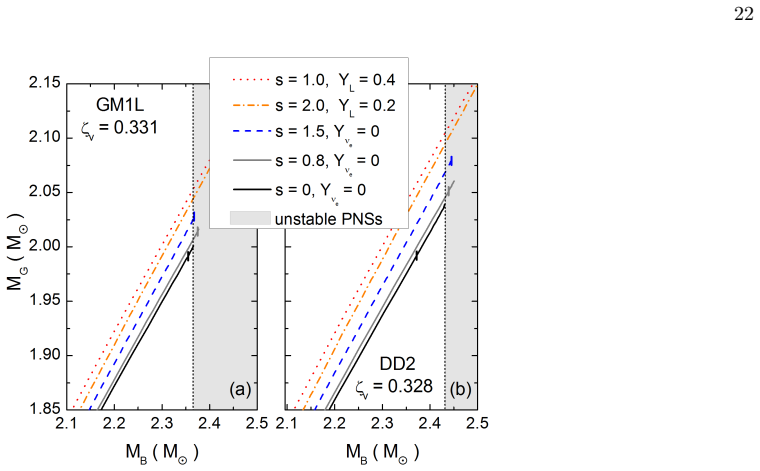
Using a non-local extension of the 3-flavor PNJL model that includes flavor-mixing, momentum-dependent quark masses, and vector interactions, the authors determine the composition of baryonic matter at finite temperature. They find that proto-neutron stars with entropies and lepton fractions typical of their early evolution contain substantial amounts of hyperons and Δ-isobars but no deconfined quarks. Deconfined quarks appear only in the cold neutron star stage.
What carries the argument
The non-local three-flavor Polyakov-Nambu-Jona-Lasinio (PNJL) model with vector interactions and momentum-dependent masses, used to fix the quark-hadron composition and locate the critical end point in the QCD phase diagram.
If this is right
- Proto-neutron stars evolve into neutron stars without encountering a deconfined quark phase.
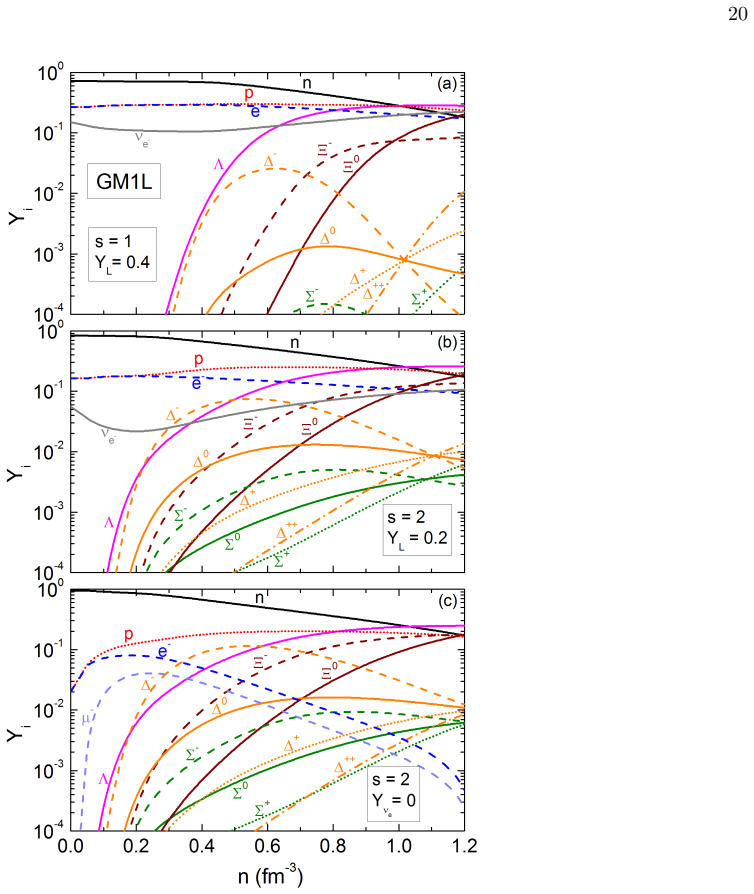
- Hyperons and Δ-isobars reach significant fractions in the hot phase while quarks remain confined.
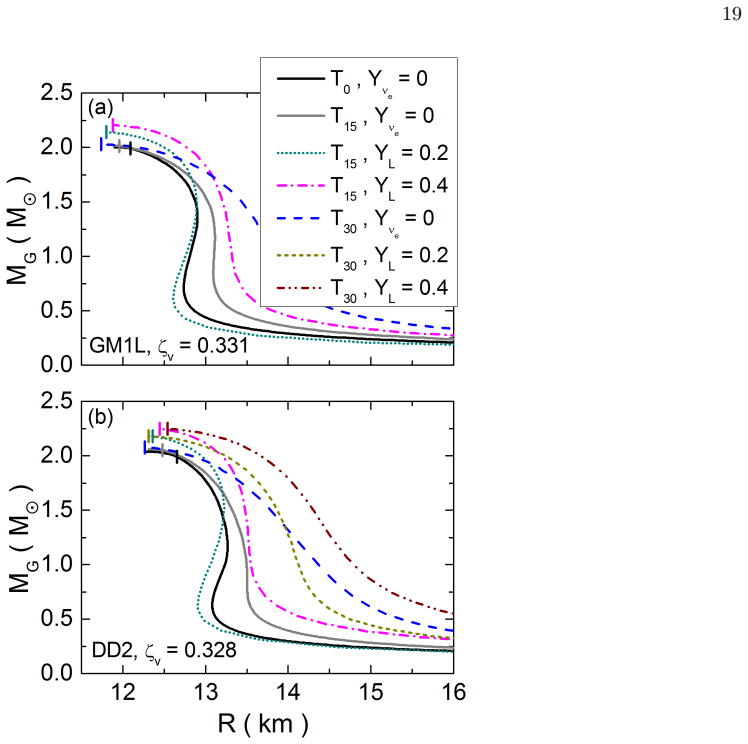
- The baryon-mass versus gravitational-mass diagram traces a specific cooling path set by these compositions.
- A spinodal region and critical end point exist in the QCD phase diagram at temperatures and chemical potentials reachable in the model.
Where Pith is reading between the lines
- Gravitational-wave signals from the early hot phase of a merger remnant may lack features associated with quark deconfinement.
- Cooling curves or neutrino emission from young neutron stars could be compared against the predicted absence of quarks to test the composition sequence.
- Adding rotation or magnetic fields to the same model framework might shift the temperature at which quarks first appear.
Load-bearing premise
The chosen non-local extension of the 3-flavor PNJL model with its vector interactions and momentum-dependent masses correctly captures the QCD phase structure and baryon composition at the temperatures and densities inside proto-neutron stars.
What would settle it
An independent model calculation that produces deconfined quarks inside proto-neutron star matter at the same entropies and lepton fractions would falsify the claim that quarks exist only after cooling.
Figures




read the original abstract
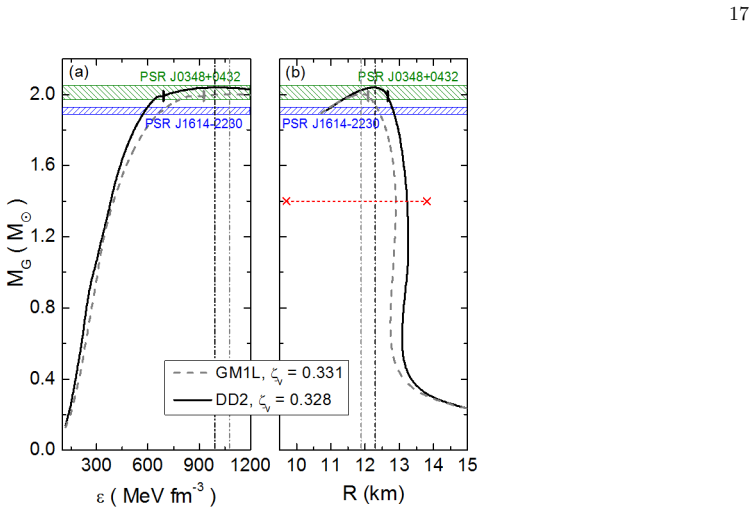
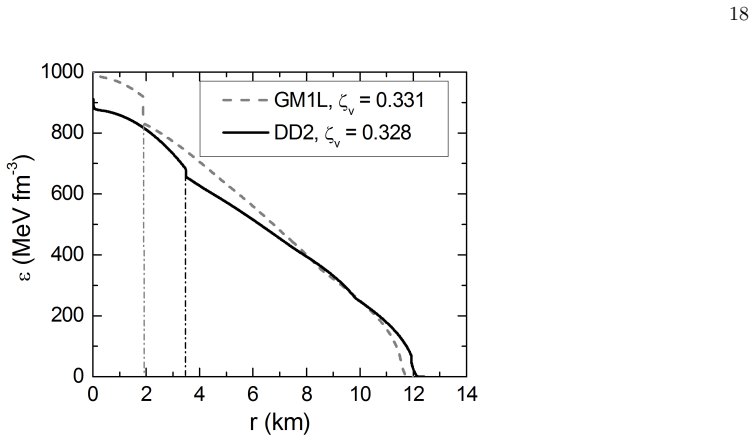
In part one of this paper, we use a non-local extension of the 3-flavor Polyakov-Nambu-Jona-Lasinio model, which takes into account flavor-mixing, momentum dependent quark masses, and vector interactions among quarks, to investigate the possible existence of a spinodal region (determined by the vanishing of the speed of sound) in the QCD phase diagram and determine the temperature and chemical potential of the critical end point. In part two of the paper, we investigate the quark-hadron composition of baryonic matter at zero as well as non-zero temperature. This is of great topical interest for the analysis and interpretation of neutron star merger events such as GW170817. With this in mind, we determine the composition of proto-neutron star matter for entropies and lepton fractions that are typical of such matter. These compositions are used to delineate the evolution of proto-neutron stars to neutron stars in the baryon-mass versus gravitational-mass diagram. The hot stellar models turn out to contain significant fractions of hyperons and $\Delta$-isobars but no deconfined quarks. The latter, are found to exist only in cold neutron stars.
Editorial analysis
A structured set of objections, weighed in public.
Referee Report
Summary. The manuscript employs a non-local three-flavor PNJL model that incorporates flavor mixing, momentum-dependent quark masses, and vector interactions to locate the critical endpoint and spinodal region in the QCD phase diagram. It then determines the baryon composition of matter at zero and finite temperature for entropies and lepton fractions typical of proto-neutron stars, using these to trace evolutionary tracks in the baryon-mass versus gravitational-mass plane. The central result is that hot models contain significant fractions of hyperons and Δ-isobars but no deconfined quarks, while deconfined quarks appear only in cold neutron stars.
Significance. If the model results hold, the work would contribute to the interpretation of neutron-star merger signals by providing explicit predictions for the hyperon and Δ content of hot matter and the distinction between hot and cold compositions. The use of a single effective model to connect the phase diagram to stellar sequences is a concrete step, though its predictive power depends on the robustness of the chosen parameters.
major comments (2)
- [Part two (stellar composition and evolution)] The central claim that deconfined quarks are absent from hot proto-neutron-star matter (S ≈ 1–2, Y_L ≈ 0.3–0.4) but present in cold neutron stars is controlled by the fixed vector coupling G_v and the non-local form factor. The manuscript determines the CEP and spinodal once with these parameters but does not recompute the stellar compositions or evolutionary tracks under modest variations of G_v or the regulator; such variations can shift the deconfinement line at finite temperature and density, directly affecting the reported absence of quarks.
- [Abstract and phase-diagram section] No quantitative error estimates, tables of parameter values, or direct comparisons to lattice QCD or alternative models (e.g., other NJL variants or chiral effective theories) are supplied for the high-density, finite-temperature regime. This leaves the composition results (hyperon and Δ fractions, quark absence) without demonstrated uncertainty ranges or cross-validation.
minor comments (2)
- The abstract would be clearer if it stated the specific numerical values adopted for the vector coupling and non-local regulator.
- Notation for entropy per baryon and lepton fraction should be defined explicitly when first used in the stellar-model discussion.
Simulated Author's Rebuttal
We thank the referee for the careful reading of our manuscript and the constructive comments. We respond to each major comment below, indicating where we agree and what revisions we will incorporate.
read point-by-point responses
-
Referee: [Part two (stellar composition and evolution)] The central claim that deconfined quarks are absent from hot proto-neutron-star matter (S ≈ 1–2, Y_L ≈ 0.3–0.4) but present in cold neutron stars is controlled by the fixed vector coupling G_v and the non-local form factor. The manuscript determines the CEP and spinodal once with these parameters but does not recompute the stellar compositions or evolutionary tracks under modest variations of G_v or the regulator; such variations can shift the deconfinement line at finite temperature and density, directly affecting the reported absence of quarks.
Authors: We agree that the results for the absence of deconfined quarks in hot matter depend on the specific choice of G_v and the non-local form factor. These were fixed by reproducing vacuum meson properties and nuclear saturation density as described in Section II of the manuscript. A full recomputation of all evolutionary tracks under parameter variations would be a substantial extension. In the revised version we will add a dedicated paragraph discussing the sensitivity of the deconfinement line to modest changes in G_v (drawing on existing PNJL literature) and note that the qualitative conclusion remains stable within the range of G_v values consistent with our calibration. We therefore mark this as a partial revision. revision: partial
-
Referee: [Abstract and phase-diagram section] No quantitative error estimates, tables of parameter values, or direct comparisons to lattice QCD or alternative models (e.g., other NJL variants or chiral effective theories) are supplied for the high-density, finite-temperature regime. This leaves the composition results (hyperon and Δ fractions, quark absence) without demonstrated uncertainty ranges or cross-validation.
Authors: The model parameters (including G_v and the regulator) are listed in Table I together with the fitting procedure to meson observables and nuclear matter. Direct lattice QCD data at the relevant high chemical potentials are unavailable owing to the sign problem; we will therefore add explicit references to other effective-model studies of the CEP and high-density composition in the revised text. Quantitative uncertainty bands on the stellar composition fractions would require a dedicated Bayesian analysis that lies beyond the present scope. We will expand the discussion of model limitations and cross-model comparisons but cannot supply numerical error estimates without new methodological work. revision: partial
Circularity Check
No circularity; stellar composition is direct model output
full rationale
The derivation applies the non-local 3-flavor PNJL model (with fixed vector coupling, non-local regulator, and momentum-dependent masses) to compute the EOS, locate the CEP via vanishing speed of sound, and then solve the Tolman-Oppenheimer-Volkoff equation plus beta-equilibrium conditions at finite entropy and lepton fraction. The reported absence of deconfined quarks in hot matter is an output of those equations at the chosen parameter values, not a re-expression of the inputs. No self-citation is invoked to justify uniqueness, no fitted subset is relabeled as a prediction of the target quantity, and no ansatz is smuggled via prior work. The calculation is self-contained once the model Lagrangian and parameter set are stated.
Axiom & Free-Parameter Ledger
free parameters (1)
- PNJL coupling constants and non-local form factors
axioms (1)
- domain assumption The non-local 3-flavor PNJL model with flavor mixing and vector interactions provides a reliable effective description of QCD thermodynamics at finite temperature and baryon density.
Lean theorems connected to this paper
-
IndisputableMonolith/Cost/FunctionalEquation.leanwashburn_uniqueness_aczel unclear?
unclearRelation between the paper passage and the cited Recognition theorem.
non-local extension of the 3-flavor Polyakov-Nambu-Jona-Lasinio model... vector interactions... momentum dependent quark masses... ζv = GV/GS
-
IndisputableMonolith/Foundation/RealityFromDistinction.leanreality_from_one_distinction unclear?
unclearRelation between the paper passage and the cited Recognition theorem.
spinodal region (determined by the vanishing of the speed of sound)... critical end point
What do these tags mean?
- matches
- The paper's claim is directly supported by a theorem in the formal canon.
- supports
- The theorem supports part of the paper's argument, but the paper may add assumptions or extra steps.
- extends
- The paper goes beyond the formal theorem; the theorem is a base layer rather than the whole result.
- uses
- The paper appears to rely on the theorem as machinery.
- contradicts
- The paper's claim conflicts with a theorem or certificate in the canon.
- unclear
- Pith found a possible connection, but the passage is too broad, indirect, or ambiguous to say the theorem truly supports the claim.
Forward citations
Cited by 1 Pith paper
-
Dark Matter Heating in Evolving Proto-Neutron Stars: A Two-Fluid Approach
Dark matter cores heat baryonic matter in evolving proto-neutron stars by deepening the gravitational potential while halos cool it, providing a diagnostic distinct from hyperons.
Reference graph
Works this paper leans on
-
[1]
B. Friman and C. H¨ ohne and J. Knoll and S. Leupold and J. Randrup and R. Rapp and P. Senger, (Eds.), Lecture Notes in Physics, Berlin Springer Verlag 814 (2011)
work page 2011
-
[2]
https://www.gsi.de/en/researchaccelerators/fair.htm
-
[3]
D. Blaschke, J. Aichelin, E. Bratkovskaya, V. Friese, M. Gazdzicki, J. Randrup, O. Rogachevsky, O. Teryaev, and V. Toneev, European Physical Journal A 52, 267 (2016)
work page 2016
-
[4]
http://nica.jinr.ru/
-
[5]
https://j-parc.jp/researcher/index-e.html
-
[6]
https://home.cern/science/accelerators/super-proton-synchrotron
-
[7]
https://www.bnl.gov/bes2015/index.php
-
[8]
J. Roark and V. Dexheimer, Phys. Rev. C 98, 055805 (2018), URL https://link.aps.org/doi/10.1103/PhysRevC.98. 055805
-
[9]
M. Buballa, Physics Reports 407, 205 (2005), URL http://www.sciencedirect.com/science/article/pii/ S037015730400506X
work page 2005
-
[10]
K. Fukushima, Phys. Rev. D77, 114028 (2008), [Erratum: Phys. Rev.D78,039902(2008)]
work page 2008
-
[11]
G. A. Contrera, D. G. Dumm, and N. N. Scoccola, Phys. Lett. B 661, 113 (2008), URL http://www.sciencedirect. com/science/article/pii/S0370269308001421
work page 2008
-
[12]
Contrera, G. A. and Orsaria, M. and Scoccola, N. N., Phys. Rev. D 82, 054026 (2010), URL http://link.aps.org/doi/ 10.1103/PhysRevD.82.054026
-
[13]
J. P. Carlomagno, Phys. Rev. D 97, 094012 (2018), URL https://link.aps.org/doi/10.1103/PhysRevD.97.094012
- [14]
-
[15]
S. Borsanyi, Z. Fodor, C. Hoelbling, S. D. Katz, S. Krieg, and K. K. Szabo, Phys. Lett. B730, 99 (2014)
work page 2014
-
[16]
The QCD phase diagram from analytic continuation
R. Bellwied, S. Borsanyi, Z. Fodor, J. G¨ unther, S. D. Katz, C. Ratti, and K. K. Szabo, Phys. Lett. B751, 559 (2015), 1507.07510
work page internal anchor Pith review Pith/arXiv arXiv 2015
- [17]
-
[18]
E. R. Most, L. J. Papenfort, V. Dexheimer, M. Hanauske, S. Schramm, H. St¨ ocker, and L. Rezzolla, Phys. Rev. Lett.122, 061101 (2019), 1807.03684
work page internal anchor Pith review Pith/arXiv arXiv 2019
-
[19]
Identifying a first-order phase transition in neutron star mergers through gravitational waves
A. Bauswein, N.-U. F. Bastian, D. B. Blaschke, K. Chatziioannou, J. A. Clark, T. Fischer, and M. Oertel, Phys. Rev. Lett. 122, 061102 (2019), 1809.01116
work page internal anchor Pith review Pith/arXiv arXiv 2019
-
[20]
Steinheimer, Jan and Randrup, Jørgen, Phys. Rev. Lett. 109, 212301 (2012), URL http://link.aps.org/doi/10.1103/ PhysRevLett.109.212301
work page 2012
-
[21]
J. Steinheimer and J. Randrup, The European Physical Journal A 52, 239 (2016), URL http://dx.doi.org/10.1140/ epja/i2016-16239-2
work page 2016
-
[22]
Sasaki, C. and Friman, B. and Redlich, K., Phys. Rev. Lett. 99, 232301 (2007), URL http://link.aps.org/doi/10.1103/ PhysRevLett.99.232301
work page 2007
-
[23]
Sasaki, C. and Friman, B. and Redlich, K., Phys. Rev. D 77, 034024 (2008), URL http://link.aps.org/doi/10.1103/ PhysRevD.77.034024
work page 2008
-
[24]
Li, Feng and Ko, Che Ming, Phys. Rev. C 95, 055203 (2017), URL https://link.aps.org/doi/10.1103/PhysRevC.95. 055203
- [25]
-
[26]
C. D. Roberts and S. M. Schmidt, Prog. Part. Nucl. Phys. 45, S1 (2000)
work page 2000
-
[27]
Shapiro delay measurement of a two solar mass neutron star
P. Demorest, T. Pennucci, S. Ransom, M. Roberts, and J. Hessels, Nature 467, 1081 (2010), 1010.5788
work page internal anchor Pith review Pith/arXiv arXiv 2010
-
[28]
R. S. Lynch et al., Astrophys. J. 763, 81 (2013), 1209.4296
work page internal anchor Pith review Pith/arXiv arXiv 2013
-
[29]
A Massive Pulsar in a Compact Relativistic Binary
J. Antoniadis et al., Science 340, 6131 (2013), 1304.6875
work page internal anchor Pith review Pith/arXiv arXiv 2013
-
[30]
Z. Arzoumanian, A. Brazier, S. Burke-Spolaor, S. Chamberlin, S. Chatterjee, B. Christy, J. M. Cordes, N. J. Cornish, F. Crawford, H. T. Cromartie, et al., The Astrophysical Journal Supplement Series 235, 37 (2018), URL https://doi. org/10.3847%2F1538-4365%2Faab5b0
work page 2018
-
[31]
Neutron-star radius constraints from GW170817 and future detections
A. Bauswein, O. Just, H.-T. Janka, and N. Stergioulas, Astrophys. J. 850, L34 (2017), 1710.06843
work page internal anchor Pith review Pith/arXiv arXiv 2017
-
[32]
F. J. Fattoyev, J. Piekarewicz, and C. J. Horowitz, Phys. Rev. Lett. 120, 172702 (2018), 1711.06615
work page internal anchor Pith review Pith/arXiv arXiv 2018
-
[35]
Gravitational-wave constraints on the neutron-star-matter Equation of State
E. Annala, T. Gorda, A. Kurkela, and A. Vuorinen, Phys. Rev. Lett. 120, 172703 (2018), 1711.02644
work page internal anchor Pith review Pith/arXiv arXiv 2018
-
[36]
Scarpettini, A. and G´ omez Dumm, D. and Scoccola, Norberto N., Phys. Rev. D 69, 114018 (2004), URL http://link. aps.org/doi/10.1103/PhysRevD.69.114018
-
[37]
Carlomagno, J. P. and G´ omez Dumm, D. and Scoccola, N. N., Phys. Rev. D 88, 074034 (2013), URL http://link.aps. org/doi/10.1103/PhysRevD.88.074034
-
[38]
Contrera, G. A. and Dumm, D. G´ omez and Scoccola, Norberto N., Phys. Rev. D 81, 054005 (2010), URL http://link. aps.org/doi/10.1103/PhysRevD.81.054005
-
[39]
Characteristics of the chiral phase transition in nonlocal quark models
D. Gomez Dumm and N. N. Scoccola, Phys. Rev. C72, 014909 (2005), hep-ph/0410262
work page internal anchor Pith review Pith/arXiv arXiv 2005
-
[40]
R¨ oßner, S. and Ratti, C. and Weise, W., Phys. Rev. D 75, 034007 (2007), URL http://link.aps.org/doi/10.1103/ PhysRevD.75.034007
work page 2007
-
[41]
M. G. Orsaria, G. Malfatti, M. Mariani, I. F. Ranea-Sandoval, F. Garc´ ıa, W. M. Spinella, G. A. Contrera, G. Lugones, and F. Weber, J. Phys. G46, 073002 (2019)
work page 2019
-
[42]
M. Tanabashi et al. (Particle Data Group), Phys. Rev. D98, 030001 (2018)
work page 2018
-
[43]
G. A. Contrera, A. G. Grunfeld, and D. B. Blaschke, Phys. Part. Nucl. Lett. 11, 342 (2014)
work page 2014
-
[44]
M. B. Parappilly, P. O. Bowman, U. M. Heller, D. B. Leinweber, A. G. Williams, and J. B. Zhang, Phys. Rev. D 73, 054504 (2006), URL https://link.aps.org/doi/10.1103/PhysRevD.73.054504
- [45]
-
[46]
Y. Aoki, S. Borsanyi, S. Durr, Z. Fodor, S. D. Katz, S. Krieg, and K. K. Szabo, JHEP 06, 088 (2009)
work page 2009
-
[47]
A. Bazavov, N. Brambilla, H. T. Ding, P. Petreczky, H. P. Schadler, A. Vairo, and J. H. Weber, Phys. Rev. D93, 114502 (2016)
work page 2016
- [48]
-
[49]
M. Marczenko, D. Blaschke, K. Redlich, and C. Sasaki, Phys. Rev. D 98, 103021 (2018), URL https://link.aps.org/ doi/10.1103/PhysRevD.98.103021
-
[50]
Simultaneous chiral symmetry restoration and deconfinement - Consequences for the QCD phase diagram
T. Kl¨ ahn, T. Fischer, and M. Hempel, Astrophys. J.836, 89 (2017), 1603.03679
work page internal anchor Pith review Pith/arXiv arXiv 2017
-
[51]
Z. Zhang and T. Kunihiro, Phys. Rev. D 80, 014015 (2009), URL https://link.aps.org/doi/10.1103/PhysRevD.80. 014015
- [52]
-
[53]
C. Ratti, Reports on Progress in Physics 81, 084301 (2018), URL https://doi.org/10.1088%2F1361-6633%2Faabb97
work page 2018
-
[54]
Randrup, Jørgen, Phys. Rev. C 79, 054911 (2009), URL http://link.aps.org/doi/10.1103/PhysRevC.79.054911
-
[55]
Randrup, Jørgen, Phys. Rev. C 82, 034902 (2010), URL http://link.aps.org/doi/10.1103/PhysRevC.82.034902
-
[56]
Dense matter in compact stars - A pedagogical introduction
A. Schmitt, Lect. Notes Phys. 811, 1 (2010), 1001.3294
work page internal anchor Pith review Pith/arXiv arXiv 2010
- [57]
- [58]
-
[59]
Density Dependent Hadron Field Theory
C. Fuchs, H. Lenske, and H. H. Wolter, Phys. Rev. C52, 3043 (1995), nucl-th/9507044
work page internal anchor Pith review Pith/arXiv arXiv 1995
-
[60]
T. A. Rijken, M. M. Nagels, and Y. Yamamoto, Progress of Theoretical Physics Supplement 185, 14 (2010), URL http: //dx.doi.org/10.1143/PTPS.185.14
-
[61]
W. M. Spinella, Ph.D. thesis, Claremont Graduate University & San Diego State University (2017)
work page 2017
-
[62]
W. M. Spinella, F. Weber, M. G. Orsaria, and G. A. Contrera, Universe 4, 64 (2018), 1805.05772
work page internal anchor Pith review Pith/arXiv arXiv 2018
-
[63]
Composition and thermodynamics of nuclear matter with light clusters
S. Typel, G. Ropke, T. Kl¨ ahn, D. Blaschke, and H. H. Wolter, Phys. Rev. C81, 015803 (2010), 0908.2344
work page internal anchor Pith review Pith/arXiv arXiv 2010
-
[64]
Net-baryon number fluctuations in the Hybrid Quark-Meson-Nucleon model at finite density
M. Marczenko and C. Sasaki, Phys. Rev. D97, 036011 (2018), 1711.05521
work page internal anchor Pith review Pith/arXiv arXiv 2018
-
[65]
F. Hofmann, C. M. Keil, and H. Lenske, Phys. Rev. C 64, 025804 (2001), URL https://link.aps.org/doi/10.1103/ PhysRevC.64.025804
work page 2001
-
[66]
M. Prakash, I. Bombaci, M. Prakash, P. J. Ellis, J. M. Lattimer, and R. Knorren, Physics Reports 280, 1 (1997), ISSN 0370-1573, URL http://www.sciencedirect.com/science/article/pii/S0370157396000233
work page 1997
-
[67]
K. Kajantie, L. K¨ arkk¨ ainen, and K. Rummukainen, Nuclear Physics B 357, 693 (1991), ISSN 0550-3213, URL http: //www.sciencedirect.com/science/article/pii/055032139190486H
-
[68]
H. Sotani, N. Yasutake, T. Maruyama, and T. Tatsumi, Phys. Rev. D 83, 024014 (2011), URL https://link.aps.org/ doi/10.1103/PhysRevD.83.024014
-
[69]
N. Yasutake, R. Lastowiecki, S. Beni´ c, D. Blaschke, T. Maruyama, and T. Tatsumi, Phys. Rev. C89, 065803 (2014), URL https://link.aps.org/doi/10.1103/PhysRevC.89.065803
-
[70]
M. Hempel, V. Dexheimer, S. Schramm, and I. Iosilevskiy, Phys. Rev. C 88, 014906 (2013), URL https://link.aps.org/ doi/10.1103/PhysRevC.88.014906
- [71]
-
[72]
Phases of Dense Quarks at Large N_c
L. McLerran and R. D. Pisarski, Nucl. Phys. A796, 83 (2007), 0706.2191
work page internal anchor Pith review Pith/arXiv arXiv 2007
-
[73]
G. Baym, T. Hatsuda, T. Kojo, P. D. Powell, Y. Song, and T. Takatsuka, Rept. Prog. Phys.81, 056902 (2018), 1707.04966
work page internal anchor Pith review Pith/arXiv arXiv 2018
-
[74]
D. Blaschke, F. Sandin, T. Kl¨ ahn, and J. Berdermann, Phys. Rev. C 80, 065807 (2009), URL https://link.aps.org/ doi/10.1103/PhysRevC.80.065807
-
[75]
Neutron matter from chiral effective field theory interactions
T. Kr¨ uger, I. Tews, K. Hebeler, and A. Schwenk, Phys. Rev.C88, 025802 (2013), 1304.2212
work page internal anchor Pith review Pith/arXiv arXiv 2013
-
[76]
Equation of state and neutron star properties constrained by nuclear physics and observation
K. Hebeler, J. M. Lattimer, C. J. Pethick, and A. Schwenk, Astrophys. J. 773, 11 (2013), 1303.4662
work page internal anchor Pith review Pith/arXiv arXiv 2013
-
[77]
Constraining neutron star matter with QCD
A. Kurkela, E. S. Fraga, J. Schaffner-Bielich, and A. Vuorinen, Astrophys. J. 789, 127 (2014), 1402.6618
work page internal anchor Pith review Pith/arXiv arXiv 2014
-
[78]
R. C. Tolman, Phys. Rev. 55, 364 (1939)
work page 1939
-
[79]
S. B. Ruester, V. Werth, M. Buballa, I. A. Shovkovy, and D. H. Rischke, Phys. Rev. D72, 034004 (2005), hep-ph/0503184. 27
work page internal anchor Pith review Pith/arXiv arXiv 2005
-
[80]
D. E. Alvarez-Castillo, D. B. Blaschke, A. G. Grunfeld, and V. P. Pagura, Phys. Rev. D99, 063010 (2019), 1805.04105
work page internal anchor Pith review Pith/arXiv arXiv 2019
-
[81]
D. Blaschke, S. Fredriksson, H. Grigorian, A. M. ¨Ozta¸ s, and F. Sandin, Phys. Rev. D 72, 065020 (2005), URL https: //link.aps.org/doi/10.1103/PhysRevD.72.065020
-
[82]
J. A. Pons, S. Reddy, M. Prakash, J. M. Lattimer, and J. A. Miralles, The Astrophysical Journal 513, 780 (1999), URL https://doi.org/10.1086%2F306889
work page 1999
discussion (0)
Sign in with ORCID, Apple, or X to comment. Anyone can read and Pith papers without signing in.