Fluid-Antenna-Aided Active User Detection With 1D-CNN Channel Reconstruction for Unsourced Random Access
Pith reviewed 2026-07-01 03:58 UTC · model grok-4.3
The pith
A 1D-CNN reconstructs full channel vectors from partial observations in fluid antenna systems to improve active user detection in unsourced random access.
A machine-rendered reading of the paper's core claim, the machinery that carries it, and where it could break.
Core claim
The central claim is that the proposed 1D-CNN channel reconstructor learns the nonlinear mapping from partial channel observations to the full channel vector in fluid antenna systems, and that exploiting the reconstructed channels for port selection substantially reduces the active user detection error rate compared with conventional approaches relying on traditional antenna configurations.
What carries the argument
The 1D-CNN channel reconstructor, which learns a nonlinear mapping from partial channel observations to the full channel vector to enable improved port selection.
If this is right
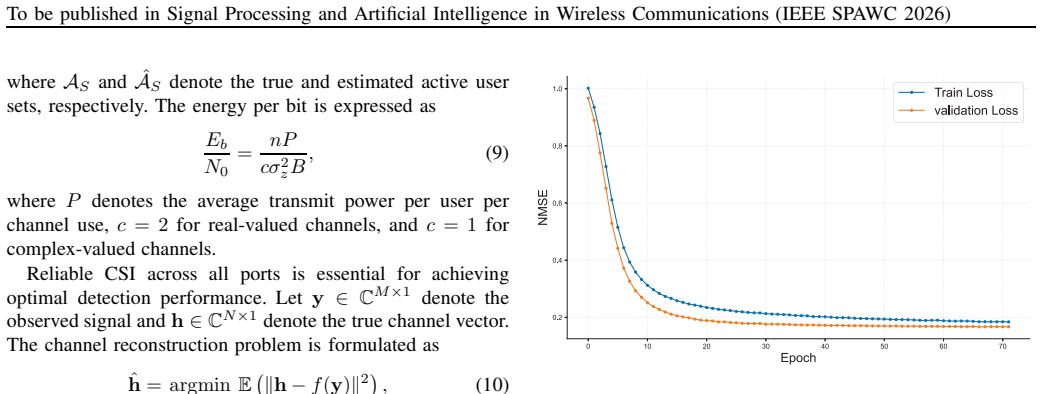
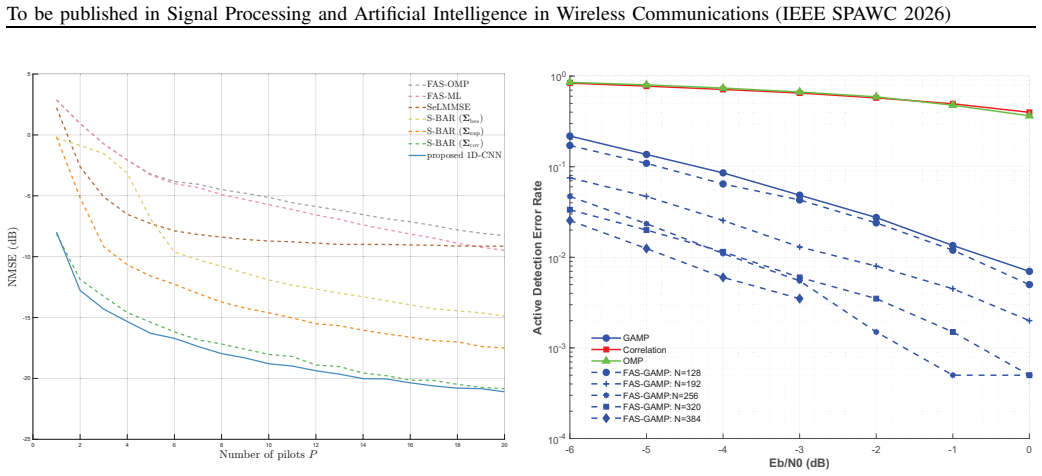
- The 1D-CNN reconstructor achieves superior normalized mean squared error performance under varying pilot lengths.
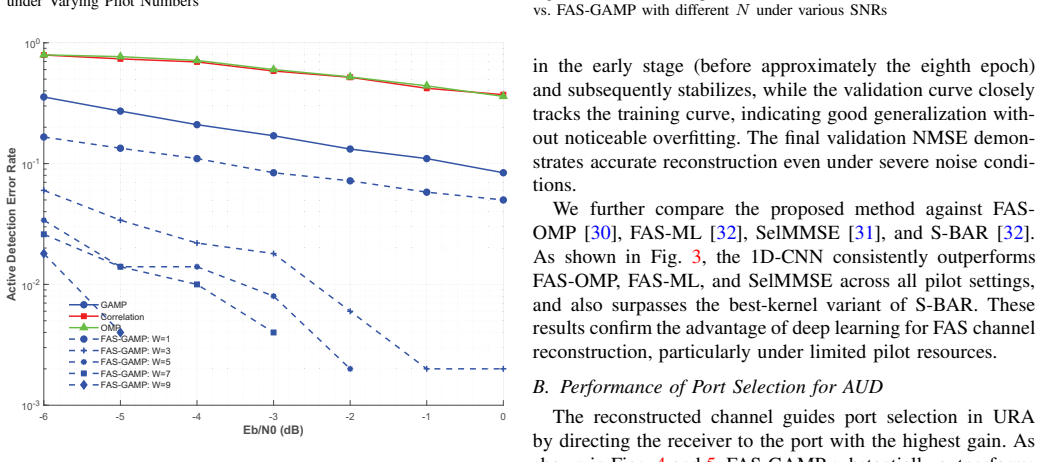
- The reconstructed channel information reduces the active user detection error rate compared with conventional antenna configurations.
- Fluid antenna systems combined with this reconstruction method enhance performance in unsourced random access scenarios.
- Port selection based on reconstructed channels provides a practical way to exploit fluid antenna flexibility.
Where Pith is reading between the lines
- The same reconstruction approach could be tested on other wireless tasks such as beamforming or localization that also rely on accurate channel state information.
- Training the network on multiple channel models might improve robustness when real propagation environments differ from the simulation assumptions.
- Combining the 1D-CNN with other machine-learning detectors could further lower error rates in large-scale unsourced access.
Load-bearing premise
The nonlinear mapping learned by the 1D-CNN from partial channel observations to full channel vectors will hold and improve port selection in real-world channels beyond the simulated conditions.
What would settle it
An experiment measuring normalized mean squared error or active user detection error rate on measured fluid-antenna channels that shows no improvement over traditional reconstruction methods would falsify the central claim.
Figures
read the original abstract
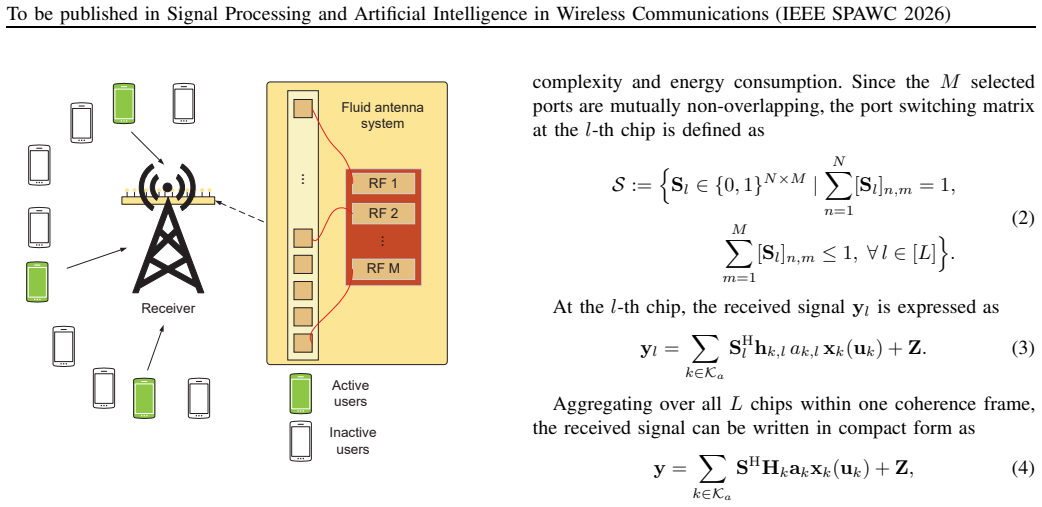
In this paper, we investigate the application of fluid antenna systems (FAS) for active user detection (AUD) in unsourced random access (URA). A channel reconstruction method based on a one-dimensional convolutional neural network (1D-CNN) is proposed to effectively learn the nonlinear mapping from partial channel observations to the full channel vector. Furthermore, the reconstructed channel information is exploited to improve AUD performance via port selection. Simulation results demonstrate that the proposed 1D-CNN channel reconstructor significantly outperforms traditional methods under varying pilot lengths, achieving superior normalized mean squared error (NMSE) performance. Additionally, the reconstructed channel substantially reduces the AUD error rate compared with conventional approaches relying on traditional antenna configurations.
Editorial analysis
A structured set of objections, weighed in public.
Referee Report
Summary. The paper proposes a fluid-antenna system (FAS) approach to active user detection (AUD) in unsourced random access (URA). It introduces a 1D-CNN to learn a nonlinear mapping from partial channel observations to the full channel vector and uses the reconstructed channels for port selection. Simulation results are reported to show that the 1D-CNN reconstructor achieves lower normalized mean squared error (NMSE) than traditional methods across varying pilot lengths and that the reconstructed channels yield lower AUD error rates than conventional fixed-antenna baselines.
Significance. If the reported simulation gains are substantiated, the work would provide empirical evidence that a 1D-CNN can usefully reconstruct channels in fluid-antenna settings and thereby improve AUD performance in URA. Such a result would be of interest to researchers working on machine-learning-assisted grant-free access and fluid-antenna architectures for massive connectivity.
major comments (1)
- The abstract states that the 1D-CNN yields superior NMSE and reduced AUD error rate, yet supplies no information on training data, validation procedure, loss function, hyper-parameter selection, or statistical significance testing. Without these details the central empirical claim cannot be evaluated and the reported performance advantage remains unsupported.
minor comments (1)
- The abstract would be clearer if it named the underlying channel model and the specific pilot-length values used in the comparisons.
Simulated Author's Rebuttal
We thank the referee for the constructive comment. We address it point by point below and will revise the manuscript to improve transparency of the empirical results.
read point-by-point responses
-
Referee: The abstract states that the 1D-CNN yields superior NMSE and reduced AUD error rate, yet supplies no information on training data, validation procedure, loss function, hyper-parameter selection, or statistical significance testing. Without these details the central empirical claim cannot be evaluated and the reported performance advantage remains unsupported.
Authors: We agree that the abstract provides no information on these aspects and that the manuscript as written does not supply sufficient detail on the 1D-CNN training process, validation, loss function, hyper-parameters, or statistical testing to allow independent evaluation of the reported NMSE and AUD gains. We will add a dedicated subsection in the revised manuscript describing the training data (generated from the channel model), validation procedure, loss function, hyper-parameter selection method, and any statistical significance analysis. We will also revise the abstract to include a brief reference to the training approach. These changes will be incorporated in the next version. revision: yes
Circularity Check
No significant circularity
full rationale
The paper presents an empirical proposal for a 1D-CNN channel reconstructor in fluid-antenna-aided unsourced random access, with performance claims resting entirely on simulation comparisons to traditional methods (lower NMSE across pilot lengths and reduced AUD error). No equations, derivations, or claims reduce by construction to fitted parameters renamed as predictions, self-definitional mappings, or load-bearing self-citations. The central results are externally falsifiable via the reported simulation benchmarks and do not invoke uniqueness theorems or ansatzes from prior author work. This is a standard non-circular empirical ML application paper.
Axiom & Free-Parameter Ledger
Reference graph
Works this paper leans on
-
[1]
On fundamental limits of slow-fluid antenna multiple access for unsourced random access,
Z. Zhang et al. , “On fundamental limits of slow-fluid antenna multiple access for unsourced random access,” IEEE Wireless Commun. Lett. , vol. 14, no. 11, pp. 3455–3459, Nov. 2025
2025
-
[2]
Integrated sensing and communications for un- sourced random access: Fundamental limits and practical mo del,
M. J. Ahmadi, et al. ,“Integrated sensing and communications for un- sourced random access: Fundamental limits and practical mo del,” IEEE Trans. Wireless Commun. , vol. 25, pp. 16547-16561, 2026
2026
-
[3]
Z. Zhang , et al., “Integrated sensing and communications for unsourced random access via spectrum sharing compressive sensing app roach with massive MIMO receiver,” IEEE Trans. V eh. Technol., Early Access, DOI: 10.1109/TVT.2026.3657304
-
[4]
Unsourced random access via random scattering with turbo probabilistic data association detector and treatin g collision as interference,
Z. Zhang, et al. , “Unsourced random access via random scattering with turbo probabilistic data association detector and treatin g collision as interference,” IEEE Trans. Wireless Commun., vol. 23, no. 12, pp. 17899- 17914, Dec. 2024
2024
-
[5]
Efficient ODMA for unsourced random access in MIMO and hybrid massive MIMO,
Z. Zhang, et al. , “Efficient ODMA for unsourced random access in MIMO and hybrid massive MIMO,” IEEE Internet Things J. , vol. 11, no. 23, pp. 38846-38860, 1 Dec.1, 2024
2024
-
[6]
Joint pattern, data and channel estimation for un- sourced random access in GMAC and MIMO systems,
Z. Zhang, et al. , “Joint pattern, data and channel estimation for un- sourced random access in GMAC and MIMO systems,” IEEE Trans. Wireless Commun., Early Access, DOI: 10.1109/TWC.2026.3705749
-
[8]
Flui d antenna systems,
K. K. Wong, A. Shojaeifard, K.-F. Tong and Y . Zhang, “Flui d antenna systems,” IEEE Trans. Wireless Commun., vol. 20, no. 3, pp. 1950–1962, Mar. 2021
1950
-
[9]
Perf ormance limits of fluid antenna systems,
K. K. Wong, A. Shojaeifard, K. F. Tong, and Y . Zhang, “Perf ormance limits of fluid antenna systems,” IEEE Commun. Lett. , vol. 24, no. 11, pp. 2469–2472, Nov. 2020
2020
-
[10]
V ariable block-correlation modeling and optimization for secrecy analysis in fluid antenna systems,
T. Wu, et al. , “V ariable block-correlation modeling and optimization for secrecy analysis in fluid antenna systems,” IEEE Trans. Wireless Commun., vol. 25, pp. 15069-15085, 2026
2026
-
[11]
Scalable fluid antenna systems: A new paradigm for array signal processing,
T. Wu, et al., “Scalable fluid antenna systems: A new paradigm for array signal processing,” IEEE J. Sel. Topics Signal Process. , Early Access, 2026, DOI:10.1109/JSTSP .2026.3673981
-
[12]
Finite-aperture fluid antenna array design: Analysis and algorithm,
Z. Zhang, et al. , “Finite-aperture fluid antenna array design: Analysis and algorithm,” IEEE Wireless Commun. Lett. , vol. 15, pp. 3199-3203, 2026
2026
-
[13]
Cramer-rao bounds for activity detection in conven- tional and fluid antenna systems
Z. Zhang, et al. , “Cramer-rao bounds for activity detection in conven- tional and fluid antenna systems”, IEEE Wireless Commun. Lett. , vol. 15, pp. 3059-3063, 2026
2026
-
[14]
Fluid antenna systems enabling 6G: Principles, applica- tions, and research directions
T. Wu, et al. , “Fluid antenna systems enabling 6G: Principles, applica- tions, and research directions”, IEEE Wireless Commun. , Early Access, 2025, doi:10.1109/MWC.2025.36295972025
-
[15]
Reimagining wireless connectivity: The F AS- RIS synergy for 6G smart cities,
T. Wu et al., “Reimagining wireless connectivity: The F AS- RIS synergy for 6G smart cities,” IEEE Commun. Mag. , DOI: 10.1109/MCOM.001.2500802
-
[16]
Fluid antenna system-assisted self-interference cance l- lation for in-band full duplex communications,
H. Hong et al. , “Fluid antenna system-assisted self-interference cance l- lation for in-band full duplex communications,” IEEE Trans. Wireless Commun., vol. 25, pp. 7476-7489, 2026
2026
-
[17]
FAS meets OFDM: Enabling wideband 5G NR,
H. Hong et al., “FAS meets OFDM: Enabling wideband 5G NR,” IEEE Trans. Commun., vol. 73, no. 11, pp. 12884–12898, Nov. 2025
2025
-
[18]
Downlink OFDM-FAMA in 5G-NR systems,
H. Hong et al. , “Downlink OFDM-FAMA in 5G-NR systems,” IEEE Trans. Wireless Commun., vol. 24, no. 12, pp. 10116–10132, Dec. 2025
2025
-
[19]
Co ded fluid antenna multiple access over fast fading channels,
H. Hong, K. -K. Wong, K. -F. Tong, H. Shin and Y . Zhang, “Co ded fluid antenna multiple access over fast fading channels,” IEEE Wireless Commun. Lett. , vol. 14, no. 4, pp. 1249–1253, April 2025
2025
-
[20]
Fluid antenna multiple access for 6G: A holistic review,
H. Hong et al., “Fluid antenna multiple access for 6G: A holistic review,” IEEE Open J. Commun. Soc. , vol. 7, pp. 2607–2633, 2026
2026
-
[21]
A tutorial on fluid antenna system for 6G networks: Encompassing communication theory, optimization methods and hard- ware designs,
W. K. New et al. , “A tutorial on fluid antenna system for 6G networks: Encompassing communication theory, optimization methods and hard- ware designs,” IEEE Commun. Surv. Tuts., vol. 27, no. 4, pp. 2325–2377, Aug. 2025
2025
-
[22]
Fundamental tradeoffs for multiple access in finite- blocklength regime,
Z. Zhang, et al. , “Fundamental tradeoffs for multiple access in finite- blocklength regime,” accepted to in Proc. IEEE Int. Conf. Computer Communication and Artificial Intelligence (CCAI) , preprint: arXiv: 2601.05165, 2026
-
[23]
On fundamental limits for fluid antenna-assisted integrated sensing and communications for unsourced rando m access,
Z. Zhang, et al. , “On fundamental limits for fluid antenna-assisted integrated sensing and communications for unsourced rando m access,” IEEE J. Sel. Areas Commun. , vol. 44, pp. 136-149, 2026
2026
-
[24]
Backscatter device-aided integrated sensing and com- munication: A pareto optimization framework,
Y . Zhang et al. , “Backscatter device-aided integrated sensing and com- munication: A pareto optimization framework,” IEEE Trans. Wireless Commun., vol. 25, pp. 17958-17974, 2026
2026
-
[25]
Tlebaldiyeva, et al
L. Tlebaldiyeva, et al. , ”Outage Performance of Fluid Antenna System (FAS)-aided Terahertz Communication Networks,” in Proc. IEEE Int. Conf. Commun. (ICC) , Rome, Italy, 2023, pp. 1922-1927
2023
-
[26]
Finite-blocklength fluid antenna systems with spatial block-correlation channel model,
Z. Zhang, et al. , “Finite-blocklength fluid antenna systems with spatial block-correlation channel model,” IEEE Wireless Commun. Lett. , vol. 15, pp. 1911-1915, 2026
1911
-
[27]
Coded pattern unsourced random access with analyses on sparse pattern demapper,
Z. Zhang, et al., “Coded pattern unsourced random access with analyses on sparse pattern demapper,” IEEE Trans. Wireless Commun. , vol. 25, pp. 5306-5319, 2026
2026
-
[28]
Channel estimation for Rydberg atomic receivers,
B. Xu, et al. , “Channel estimation for Rydberg atomic receivers,” IEEE Wirel. Commun. Lett. , vol. 14, no. 9, pp. 2957–2961, Jun. 2025
2025
-
[29]
Resource allocation for near-field communications: Fundamentals, tools, and outlooks,
B. Xu, et al. , “Resource allocation for near-field communications: Fundamentals, tools, and outlooks,” IEEE Wireless Commun. , vol. 31, no. 5, pp. 42–50, Jul. 2024
2024
-
[30]
A contemporary survey on fluid antenna systems: fundamentals and networking perspectives,
H. Hong et al. , “A contemporary survey on fluid antenna systems: fundamentals and networking perspectives,” IEEE Trans. Netw. Sci. Eng., vol. 13, pp. 2305–2328, 2026
2026
-
[31]
Fluid antenna with linear MMSE channel estimation for large-scale cellular networks,
C. Skouroumounis, et al. , “Fluid antenna with linear MMSE channel estimation for large-scale cellular networks,” IEEE Trans. Commun. , vol. 71, no. 2, pp. 1112–1125, Feb. 2023
2023
-
[32]
Successive Bayesian Reconstructor for Channel Estimation in Fluid Antenna Systems,
Z. Zhang, et al. , “Successive Bayesian Reconstructor for Channel Estimation in Fluid Antenna Systems,” IEEE Trans. Wireless Commun. , vol. 24, no. 3, pp. 1992-2006, March 2025
1992
-
[33]
A Novel OFDM Autoencoder Featuring CNN-Based Channel Estimation for Internet of V essels,
B. Lin, et al. , “A Novel OFDM Autoencoder Featuring CNN-Based Channel Estimation for Internet of V essels,” IEEE Internet Things J. , vol. 7, no. 8, pp. 7601-7611, Aug. 2020
2020
-
[34]
C. Wang, et al. , “Large Language Model Empowered Design of Fluid Antenna Systems: Challenges, Frameworks, and Case Studies for 6G,” IEEE Wireless Commun. , Early Access, DOI: 10.1109/MWC.2025.3600949
-
[35]
AI-Empowered Fluid Antenna Systems: Opportunities, Challenges, and Future Directions,
C. Wang, et al., “AI-Empowered Fluid Antenna Systems: Opportunities, Challenges, and Future Directions,” IEEE Wireless Commun. , vol. 31, no. 5, pp. 34-41, October 2024
2024
-
[36]
A coded compressed sensing scheme for unsourced multiple access,
V . K. Amalladinne, et al. , “A coded compressed sensing scheme for unsourced multiple access,” IEEE Trans. Inf. Theory , vol. 66, no. 10, pp. 6509–6533, Oct. 2020
2020
-
[37]
LDPC codes with soft interference cancellation for uncoordinated unsourced multiple access,
A. K. Pradhan, et al. , “LDPC codes with soft interference cancellation for uncoordinated unsourced multiple access,” in Proc. IEEE Int. Conf. Commun. (ICC) , Jun. 2021, pp. 1–6. 5
2021
discussion (0)
Sign in with ORCID, Apple, or X to comment. Anyone can read and Pith papers without signing in.