Conflict-Freedom as a Progress Condition
Pith reviewed 2026-05-20 02:21 UTC · model grok-4.3
The pith
Every sequential object has a read-write conflict-free linearizable implementation.
A machine-rendered reading of the paper's core claim, the machinery that carries it, and where it could break.
Core claim
Conflict-freedom guarantees progress to an operation that runs in isolation from non-commuting operations. We show that this condition is universal: there exists a read-write implementation, for any sequential object, that is both linearizable and conflict-free. The construction relies on a generalized commit-adopt object that correctly handles conflict detection and linearization for arbitrary operation semantics.
What carries the argument
Generalized commit-adopt object that detects conflicts between operations and determines their linearization order for any sequential object.
Load-bearing premise
A generalized commit-adopt object can be implemented to correctly detect conflicts and establish linearization points for every arbitrary sequential object.
What would settle it
An execution in the proposed construction that produces a non-linearizable history, or a specific sequential object for which no read-write conflict-free linearizable implementation exists.
Figures

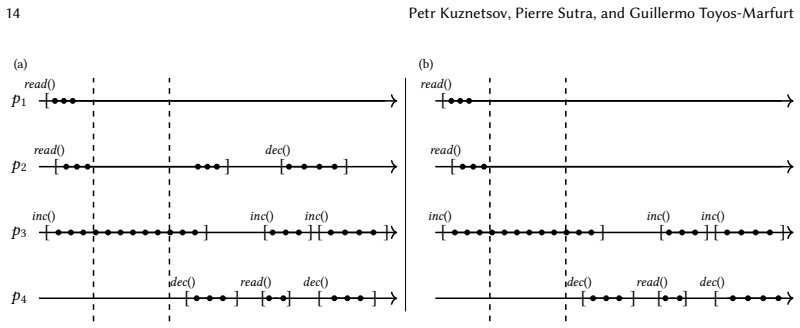
read the original abstract
An obstruction-free implementation guarantees progress to every operation that is given enough time to take steps in isolation. But, as we show in this paper, the mere presence of concurrent operations alone does not have to prevent progress; only incomplete conflicting (non-commuting) operations may do so. This progress condition, that we call conflict-freedom, is a natural generalization of obstruction-freedom that promises efficient implementations for objects exhibiting semantic commutativity. We show that, as with obstruction-freedom, every sequential object has a read-write conflict-free linearizable implementation. Our conflict-free universal construction is based on a novel generalization of the instrumental commit-adopt object, interesting in its own right.
Editorial analysis
A structured set of objections, weighed in public.
Referee Report
Summary. The paper introduces conflict-freedom as a progress condition generalizing obstruction-freedom: an operation makes progress provided no incomplete conflicting (non-commuting) operations exist. It claims that every sequential object admits a linearizable implementation from read-write registers under this condition, via a novel generalization of the commit-adopt object that detects conflicts and assigns linearization points.
Significance. If correct, the result strengthens the obstruction-free universal construction by weakening the progress assumption to exploit semantic commutativity, potentially enabling more efficient implementations for objects such as sets or counters. The generalized commit-adopt object is presented as independently interesting.
major comments (1)
- The central claim rests on the correctness of the generalized commit-adopt object introduced for arbitrary sequential objects. The manuscript must supply an explicit lemma (or §4.2) proving that conflict detection correctly identifies non-commuting pairs and that linearization points are placed only after all prior conflicting operations complete, for every possible commutativity relation; without this, the reduction to the universal construction does not go through.
minor comments (2)
- Clarify in the abstract and §1 whether conflict-freedom is strictly weaker than obstruction-freedom or incomparable in some schedules.
- Add a small example (e.g., a set with insert/delete) showing how the generalized commit-adopt permits concurrent non-conflicting operations.
Simulated Author's Rebuttal
We thank the referee for their careful reading of the manuscript and for the constructive feedback. We address the major comment below and will revise the paper to strengthen the presentation of the proof.
read point-by-point responses
-
Referee: The central claim rests on the correctness of the generalized commit-adopt object introduced for arbitrary sequential objects. The manuscript must supply an explicit lemma (or §4.2) proving that conflict detection correctly identifies non-commuting pairs and that linearization points are placed only after all prior conflicting operations complete, for every possible commutativity relation; without this, the reduction to the universal construction does not go through.
Authors: We agree that an explicit lemma is required to rigorously establish the correctness of the generalized commit-adopt object for arbitrary sequential objects. In the revised manuscript we will add a dedicated lemma (placed in a new §4.2) that proves two properties for any commutativity relation: (i) the conflict-detection mechanism returns true precisely when a pair of operations fails to commute under the object's sequential specification, and (ii) a linearization point is assigned to an operation only after every prior conflicting operation has completed. The lemma will be stated and proved in full generality, thereby justifying the reduction to the universal construction. revision: yes
Circularity Check
Self-contained construction using novel generalized commit-adopt object defined and proved internally
full rationale
The paper defines a novel generalization of the commit-adopt object to handle conflict detection and linearization for arbitrary sequential objects, then uses it to construct a read-write conflict-free linearizable implementation. This follows the standard pattern of introducing an auxiliary object and proving its properties within the same paper against external definitions of linearizability and read-write registers. No step reduces the central claim to a self-definition, fitted parameter, or self-citation chain by construction. The derivation remains independent of the target result and qualifies as self-contained against prior literature benchmarks.
Axiom & Free-Parameter Ledger
axioms (2)
- domain assumption Linearizability is the correctness condition for the implementation.
- standard math Every sequential object has a well-defined sequential specification.
invented entities (2)
-
Conflict-freedom progress condition
no independent evidence
-
Generalized commit-adopt object
no independent evidence
Lean theorems connected to this paper
-
IndisputableMonolith.Foundation.RealityFromDistinctionreality_from_one_distinction unclear?
unclearRelation between the paper passage and the cited Recognition theorem.
Our conflict-free universal construction is based on a novel generalization of the instrumental commit-adopt object
-
IndisputableMonolith.Cost.FunctionalEquationwashburn_uniqueness_aczel unclear?
unclearRelation between the paper passage and the cited Recognition theorem.
We show that, as with obstruction-freedom, every sequential object has a read-write conflict-free linearizable implementation
What do these tags mean?
- matches
- The paper's claim is directly supported by a theorem in the formal canon.
- supports
- The theorem supports part of the paper's argument, but the paper may add assumptions or extra steps.
- extends
- The paper goes beyond the formal theorem; the theorem is a base layer rather than the whole result.
- uses
- The paper appears to rely on the theorem as machinery.
- contradicts
- The paper's claim conflicts with a theorem or certificate in the canon.
- unclear
- Pith found a possible connection, but the passage is too broad, indirect, or ambiguous to say the theorem truly supports the claim.
Reference graph
Works this paper leans on
-
[1]
IJsbrand Jan Aalbersberg and Grzegorz Rozenberg. 1988. Theory of traces.Theoretical Computer Science60, 1 (1988), 1–82
work page 1988
-
[2]
Michael Abd-El-Malek, Gregory R. Ganger, Garth R. Goodson, Michael K. Reiter, and Jay J. Wylie. 2005. Fault-scalable Byzantine fault-tolerant services. InProceedings of the Twentieth ACM Symposium on Operating Systems Principles (Brighton, United Kingdom)(SOSP ’05). Association for Computing Machinery, New York, NY, USA, 59–74
work page 2005
-
[3]
Yehuda Afek, Hagit Attiya, Danny Dolev, Eli Gafni, Michael Merritt, and Nir Shavit. 1993. Atomic snapshots of shared memory.J. ACM40, 4 (Sept. 1993), 873–890
work page 1993
-
[4]
A. Agarwal and M. Cherian. 1989. Adaptive backoff synchronization techniques.SIGARCH Comput. Archit. News17, 3 (April 1989), 396–406. doi:10.1145/74926.74970
- [5]
-
[6]
James Aspnes and Maurice Herlihy. 1990. Wait-Free Data Structures in the Asynchronous PRAM Model. InProceedings of the 2nd Annual ACM Symposium on Parallel Algorithms and Architectures, SPAA ’90, Island of Crete, Greece, July 2-6,
work page 1990
-
[7]
Association for Computing Machinery, New York, NY, USA, 340–349
-
[8]
Hagit Attiya, Armando Castañeda, Danny Hendler, and Matthieu Perrin. 2022. Separating lock-freedom from wait- freedom at every level of the consensus hierarchy.J. Parallel Distributed Comput.163 (2022), 181–197
work page 2022
-
[9]
Hagit Attiya, Rachid Guerraoui, Danny Hendler, and Petr Kuznetsov. 2009. The complexity of obstruction-free implementations.J. ACM56, 4 (2009), 24:1–24:33
work page 2009
-
[10]
2004.Distributed computing: fundamentals, simulations, and advanced topics
Hagit Attiya and Jennifer Welch. 2004.Distributed computing: fundamentals, simulations, and advanced topics. Vol. 19. John Wiley & Sons, New York, NY, USA
work page 2004
-
[11]
James Cowling, Daniel Myers, Barbara Liskov, Rodrigo Rodrigues, and Liuba Shrira. 2006. HQ replication: a hybrid quorum protocol for byzantine fault tolerance. InProceedings of the 7th Symposium on Operating Systems Design and Implementation(Seattle, Washington)(OSDI ’06). USENIX Association, USA, 177–190
work page 2006
-
[12]
Flaviu Cristian, Houtan Aghili, Ray Strong, and Danny Dolev. 1995. Atomic broadcast: From simple message diffusion to Byzantine agreement.Information and Computation118, 1 (1995), 158–179
work page 1995
-
[13]
Tudor David and Rachid Guerraoui. 2016. Concurrent Search Data Structures Can Be Blocking and Practically Wait-Free. InSPAA, Christian Scheideler and Seth Gilbert (Eds.). Association for Computing Machinery, New York, NY, USA, 337–348
work page 2016
-
[14]
Michael J. Fischer, Nancy A. Lynch, and Michael S. Paterson. 1985. Impossibility of Distributed Consensus with one Faulty Process.JACM32, 2 (April 1985), 374–382
work page 1985
-
[15]
Tuanir França Rezende and Pierre Sutra. 2020. Leaderless State-Machine Replication: Specification, Properties, Limits. In34th International Symposium on Distributed Computing (DISC 2020) (Leibniz International Proceedings in Informatics (LIPIcs), Vol. 179), Hagit Attiya (Ed.). Schloss Dagstuhl – Leibniz-Zentrum für Informatik, Dagstuhl, Germany, 24:1–24:1...
-
[16]
Eli Gafni. 1998. Round-by-round fault detectors (extended abstract): unifying synchrony and asynchrony. InPODC. Association for Computing Machinery, New York, NY, USA, 143–152
work page 1998
-
[17]
Rachid Guerraoui, Maurice Herlihy, and Bastian Pochon. 2005. Toward a theory of transactional contention managers. InProceedings of the Twenty-Fourth Annual ACM Symposium on Principles of Distributed Computing(Las Vegas, NV, USA)(PODC ’05). Association for Computing Machinery, New York, NY, USA, 258–264
work page 2005
-
[18]
Maurice Herlihy. 1991. Wait-Free Synchronization.ACM Trans. Program. Lang. Syst.13, 1 (1991), 124–149
work page 1991
-
[19]
Maurice Herlihy, Victor Luchangco, and Mark Moir. 2003. Obstruction-Free Synchronization: Double-Ended Queues as an Example. InProceedings of the 23rd International Conference on Distributed Computing Systems (ICDCS ’03). IEEE Computer Society, USA, 522
work page 2003
-
[20]
2008.The art of multiprocessor programming
Maurice Herlihy and Nir Shavit. 2008.The art of multiprocessor programming. Morgan Kaufmann, San Francisco, CA, USA
work page 2008
-
[21]
Maurice Herlihy and Nir Shavit. 2011. On the Nature of Progress. InOPODIS (Lecture Notes in Computer Science, Vol. 7109), Antonio Fernández Anta, Giuseppe Lipari, and Matthieu Roy (Eds.). Springer, Berlin, Heidelberg, 313–328. 18 Petr Kuznetsov, Pierre Sutra, and Guillermo Toyos-Marfurt
work page 2011
-
[22]
Maurice Herlihy and Jeannette M. Wing. 1990. Linearizability: A Correctness Condition for Concurrent Objects.ACM Trans. Program. Lang. Syst.12, 3 (1990), 463–492
work page 1990
-
[23]
Petr Kuznetsov and Nathan Josia Schrodt. 2026. Resolving Conflicts with Grace: Dynamically Concurrent Universality. In29th International Conference on Principles of Distributed Systems (OPODIS 2025) (Leibniz International Proceedings in Informatics (LIPIcs), Vol. 361). Schloss Dagstuhl – Leibniz-Zentrum für Informatik, Dagstuhl, Germany, 33:1–33:29
work page 2026
- [24]
-
[25]
Leslie Lamport. 1977. Proving the Correctness of Multiprocess Programs.IEEE Trans. Software Eng.3, 2 (1977), 125–143
work page 1977
-
[26]
Leslie Lamport. 1998. The Part-Time Parliament.ACM Transactions on Computer Systems16, 2 (May 1998), 133–169
work page 1998
-
[27]
Leslie Lamport. 2005. Generalized consensus and Paxos. Microsoft Research technical report MSR-TR-2005-33
work page 2005
-
[28]
M.C. Loui and H.H. Abu-Amara. 1987. Memory requirements for agreement among unreliable asynchronous processes. Advances in Computing Research4 (1987), 163–183
work page 1987
-
[29]
N.A. Lynch. 1996.Distributed Algorithms. Morgan Kaufmann, San Francisco, CA, USA
work page 1996
-
[30]
Antoni. Mazurkiewicz. 1985. Semantics of concurrent systems: A modular fixed-point trace approach. InAdvances in Petri Nets 1984, G. Rozenberg (Ed.). Springer Berlin Heidelberg, Berlin, Heidelberg, 353–375
work page 1985
-
[31]
Andersen, and Michael Kaminsky
Iulian Moraru, David G. Andersen, and Michael Kaminsky. 2013. There is more consensus in Egalitarian parliaments. InProceedings of the Twenty-Fourth ACM Symposium on Operating Systems Principles(Farminton, Pennsylvania)(SOSP ’13). Association for Computing Machinery, New York, NY, USA, 358–372
work page 2013
-
[32]
Sean Ovens. 2024. The Space Complexity of Consensus from Swap.J. ACM71, 1 (2024), 1:1–1:26
work page 2024
-
[33]
Fernando Pedone and André Schiper. 1999. Generic Broadcast. InDistributed Computing, Prasad Jayanti (Ed.). Springer Berlin Heidelberg, Berlin, Heidelberg, 94–106
work page 1999
-
[34]
Fedor Ryabinin, Alexey Gotsman, and Pierre Sutra. 2025. Making Democracy Work: Fixing and Simplifying Egalitarian Paxos. InOPODIS (LIPIcs). Schloss Dagstuhl - Leibniz-Zentrum für Informatik, Dagstuhl, Germany, 22:1–22:19
work page 2025
-
[35]
Johannes Schneider and Roger Wattenhofer. 2009. Bounds on Contention Management Algorithms. InAlgorithms and Computation, Yingfei Dong, Ding-Zhu Du, and Oscar Ibarra (Eds.). Springer Berlin Heidelberg, Berlin, Heidelberg, 441–451
work page 2009
-
[36]
Florian Suri-Payer, Matthew Burke, Zheng Wang, Yunhao Zhang, Lorenzo Alvisi, and Natacha Crooks. 2021. Basil: Breaking up BFT with ACID (transactions). InProceedings of the ACM SIGOPS 28th Symposium on Operating Systems Principles(Virtual Event, Germany)(SOSP ’21). Association for Computing Machinery, New York, NY, USA, 1–17
work page 2021
-
[37]
Michael Whittaker, Neil Giridharan, Adriana Szekeres, Joseph Hellerstein, and Ion Stoica. 2021. SoK: A Generalized Multi-Leader State Machine Replication Tutorial.Journal of Systems Research1 (09 2021). doi:10.5070/SR31154817
-
[38]
Leqi Zhu. 2021. A Tight Space Bound for Consensus.SIAM J. Comput.50, 3 (2021), STOC16–18–STOC16–29
work page 2021
-
[39]
Piotr Zieliński. 2005. Optimistic Generic Broadcast. InDistributed Computing, Pierre Fraigniaud (Ed.). Springer Berlin Heidelberg, Berlin, Heidelberg, 369–383. A Full Proofs A.1 Relationships Among Liveness Conditions Proposition 3.3.The progress conditions form the following hierarchy: wait-freedom=⇒conflict-freedom=⇒weak conflict-freedom=⇒obstruction-fr...
work page 2005
discussion (0)
Sign in with ORCID, Apple, or X to comment. Anyone can read and Pith papers without signing in.