REVIEW 3 major objections 4 minor 1 cited by
A Unified Model of Cosmic Ray Propagation and Radio Extreme Scattering Events from Intermittent Interstellar Structures
T0 review · 3 major / 4 minor · reviewed 2026-08-11 · deepseek-v4-flash
Pith's one-line read The same AU-scale magnetic sheets that make quasars flicker can scatter GeV cosmic rays, predicting a ~10 pc mean free path.
desk verdict A genuinely new unification of CR scattering and ESEs with clean algebra; the main risk is the unmeasured fraction of sheets that are magnetic folds, which the authors honestly flag. read the letter →
The pith
A machine-rendered reading of the paper's core claim, the machinery that carries it, and where it could break.
The reading
What carries the argument
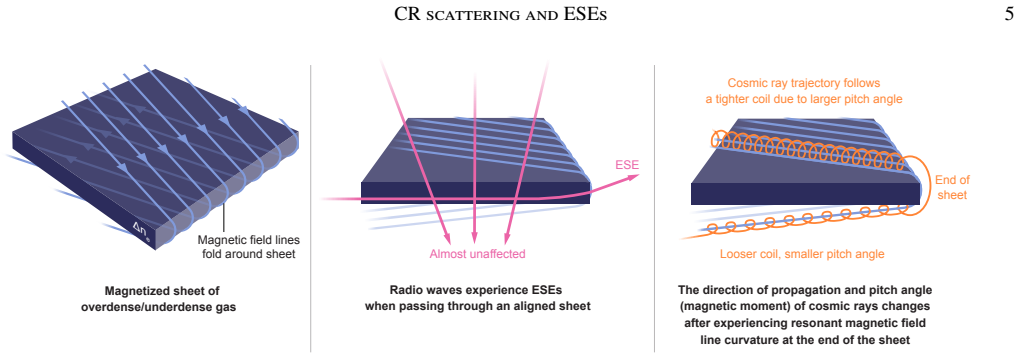
The central object is the magnetized density sheet: a current sheet of thickness $s\sim 1$ AU, length $\ell\sim 10^4$ AU, and density contrast $\Delta n_e \sim 0.03$ cm$^{-3}$, held in pressure balance by a magnetic field that reverses across the sheet. The load-bearing identities are the cosmic-ray mean free path $\lambda_{\rm CR}\sim \ell/f_V$, the radio-wave alignment probability $P_{\rm align}\sim s/\ell$, and the plasma-lens convergence $\kappa = \Omega_{\rm focal}/\Omega_{\rm lens}$, which converts the occurrence of aligned sheets $W_{\rm lens}\sim L f_V s/\ell^2$ into the observed ESE occurrence fraction $W_{\rm src} = \kappa W_{\rm lens}$. Equation (17) combines these so that $f_V$ and $\ell$ enter only through their ratio, making the predicted $\lambda_{\rm CR}$ independent of the sheet length as long as the sheets are straight enough to focus radio waves.
What would settle it
A decisive test is to measure the ESE occurrence fraction as a function of frequency toward pulsars and fast radio bursts: the model's $W_{\rm src}\propto \nu^{-2}$ scaling predicts roughly an order of magnitude more lensed images and echoes at a few hundred MHz than at 3 GHz, so a survey that sees no such increase would falsify the unified sheet model.
Extended reading notes
Core claim
On its own terms, the paper establishes that the same magnetized sheets—thin, almost perfectly straight plasma lenses with thickness $s \sim 1$ AU, length $\ell \sim 10^4$ AU, and density contrast $\Delta n_e \sim 0.03$ cm$^{-3}$—can account for both the observed rate of quasar extreme scattering events and the measured mean free path of GeV cosmic rays. The central quantitative identity is Eq. (17): $\lambda_{\rm CR} \simeq \ell/f_V \simeq 10\,{\rm pc}\,(W_{\rm src}/0.01)^{-1}(\nu/3\,{\rm GHz})^{-2}(L D_{\rm lens}/{\rm kpc}^2)(\Delta n_e/0.03\,{\rm cm}^{-3})(s/{\rm AU})^{-1}$. Because the ratio $\ell/f_V$ enters both the cosmic-ray mean free path and the ESE occurrence fraction, the model predicts the cosmic-ray mean free path from radio observations without free parameters. The paper argues that these sheets are pressure-balanced current sheets with reversing magnetic fields: the field reversal both confines the density perturbation that lenses radio waves and provides the sharp bends that scatter GeV particles when their local gyroradius matches the fold scale.
Load-bearing premise
The argument rests on the assumption that an order-unity fraction of the strong current sheets inferred from quasar ESE observations are magnetic folds whose sharp field-line bends can scatter GeV cosmic rays; if most sheets are not such folds, the predicted equality between the ESE rate and the cosmic-ray mean free path breaks down.
Editorial extensions
If this is right
- If the model is correct, the GeV cosmic-ray mean free path in the Galaxy is set by the same AU-scale sheets that produce quasar ESEs, replacing volume-filling turbulence as the dominant scatterer.
- The predicted sheet parameters imply observable signatures: VLBI-resolvable image offsets of order 10 mas at 1 GHz, lensed-image time delays of order 0.7 ms, and an ESE occurrence fraction that grows as $\nu^{-2}$.
- Pulsars and fast radio bursts offer a cleaner test than quasars because lensing appears as faint echoes separated by tens of milliseconds, stable over days and evolving on month timescales.
- Statistical surveys of ESEs with upcoming wide-field radio instruments can directly measure the sheet geometry and volume filling fraction, turning radio observations into a probe of cosmic-ray propagation.
Reading between the lines
- Beyond the paper's claims, the same ratio $\ell/f_V$ implies that statistical maps of ESE occurrence across the sky could serve as an indirect map of Galactic cosmic-ray scattering, including regions where CR data are sparse.
- A natural extension is to search for the predicted step-like jumps in pulsar DM structure functions on month timescales; this would test the sheet population without relying on lensing models.
- The model's main assumption could be turned into a measured quantity by computing, from MHD turbulence simulations, the fraction of strong current sheets whose fold curvature matches the GeV proton gyroradius.
Editorial analysis
A structured set of objections, weighed in public.
Referee Report
Summary. This paper proposes that the same population of very straight, large-aspect-ratio magnetized density/current sheets can produce both extreme scattering events (ESEs) of radio waves and strong scattering of GeV cosmic rays (CRs). The authors combine two previously separate models: current sheets with AU-scale thickness producing quasar/pulsar ESEs (Goldreich & Sridhar 2006; Jow et al. 2024) and intermittent magnetic folds scattering CRs (Lemoine 2023; Kempski et al. 2023). The central quantitative claim is Eq. (17): using the observed ESE occurrence fraction W_src ~ 0.01, the sheet thickness s ~ 1 AU, and the relation λ_CR ~ ℓ/f_V (Eq. 3), they infer a CR mean free path λ_pred_CR ~ 10 pc, consistent with CR observations. The paper then solves for sheet parameters ($s$, $\ell$, $f_V$, $\Delta n_e$) from four observables (λ_CR, ESE focal and demagnification timescales, and W_src), and proposes several observational tests: pulsar and FRB echoes, synchronized ESEs in Einstein-ring images, DM structure-function signatures, and long-duration ESE statistics. The derivations are internally consistent and the order-of-magnitude agreement is real for the adopted fiducial values. I do not see a circularity problem: W_src and λ_CR are independent inputs, and Eq. (17) is a derived relation between them.
Significance. If the proposed unification is correct, it is conceptually important: it connects two independent sets of interstellar-medium observations and provides a new, radio-based window onto the structures that regulate GeV CR propagation. The paper's falsifiable predictions—echos in pulsars/FRBs, correlated ESEs on Einstein rings, DM structure-function signals, and the predicted population of long-duration ESEs—are concrete and timely given upcoming facilities like CHORD and DSA-2000. The authors are also transparent about the two most demanding assumptions (sheet straightness and extrapolation of sheet statistics from the inner disk to the broader CR propagation volume), and Appendix A provides a useful lensing calculation that grounds Eq. (16). The analysis is reproducible in the sense that every step is an explicit order-of-magnitude derivation with stated parameter values. The main weakness is that the central numerical coincidence depends on the order-unity fraction of strong sheets being CR-resonant folds, a quantity that is asserted rather than measured or bounded.
major comments (3)
- [Section 3, Eqs. (3) and (17)] The paper explicitly assumes that 'at least an order unity fraction of strong current sheets ... are due to folded field lines' (Section 3, paragraph beginning 'While not all current sheets'). This assumption is the load-bearing link between the ESE-derived sheet population and the cosmic-ray mean free path: Eq. (3), λ_CR ~ ℓ/f_V, applies only if the sheets that produce the strong column-density gradients for ESEs also contain CR-resonant field reversals. If only a fraction f_fold of strong sheets are such folds, Eq. (3) becomes λ_CR ~ ℓ/(f_V f_fold), and the central prediction Eq. (17) is larger by 1/f_fold, so the apparent ~10 pc coincidence disappears for f_fold ≲ 0.1. The cited simulations (Figure 3; Kempski et al. 2023; Galishnikova et al. 2022) show qualitative coexistence of density sheets and magnetic-field reversals, but no quantitative joint statistics of 'ESE-capable sheets' and 'CR-resonant folds' are provided. I recommend introducing f_fold as an explicit parameter, discussing what observations or simulations could bound it, and qualifying the 'no free parameters' claim accordingly.
- [Section 6.2 and Eq. (17)] The prediction Eq. (17) also relies on the very straight-sheet condition r_c ≳ ℓ^2/s stated in Section 6.2. The paper correctly flags this as an assumption, but the consistency argument in Figure 5 and Eq. (17) implicitly assumes that the ESE-producing sheet population is dominated by sheets satisfying this condition. If most sheets instead have r_c ~ ℓ, the alignment probability and the maximum wave propagation length both change, and Appendix B shows that reproducing the ESE bending angles then requires either much larger density perturbations or much smaller volume filling fractions, breaking the CR-ESE match. The manuscript should quantify the fraction of sheets with r_c ≳ ℓ^2/s that is needed for Eq. (17), or state explicitly that the prediction applies only to that subpopulation of sheets.
- [Section 6.1 and abstract] The abstract states the assumption that the sheet statistics are similar throughout the Galactic volume, but Section 6.1 concedes that CRs spend much of their residence time in the inner CGM while ESEs are observed predominantly through the inner ~1 kpc of the warm ionized medium. The density contrast and field-reversal statistics are expected to differ between these phases, so the extrapolation from the local W_src to a global λ_CR in Eq. (17) carries an unquantified multiplicative uncertainty. I would like to see either a quantitative estimate of the expected ratio of sheet statistics between the disk and CGM, or a rephrasing of the prediction as a mean free path local to the disk midplane, followed by a discussion of how the global value could be recovered.
minor comments (4)
- [Table 1] The table header contains a typo: 'obervationally' should be 'observationally'.
- [Section 5.3] The units for dispersion measure are written as 'pc/cm3' in several places (e.g., Eqs. 33-34 and the surrounding text); the correct unit is pc cm^-3.
- [Figure 3] The colorbar labels in Figure 3 are placeholders ('colors') with no units; the caption should state that the plotted quantities are in arbitrary normalized units.
- [Eq. (29)] The expression for Ω_focal mixes angular sizes and physical lengths without clear parentheses and has a stray gap after '0.01′'; please rewrite it so the dimensional factors are unambiguous.
Circularity Check
No circularity: the ESE occurrence fraction and the GeV cosmic-ray mean free path are independent observables, and eq. (17) is an algebraic consequence of the model relations, not a fit.
full rationale
The derivation chain is self-contained. Eq. (3) defines the CR mean free path in the sheet model as λ_CR ~ ℓ/f_V; Eq. (16) gives the ESE occurrence fraction W_src ~ (L f_V s / ℓ^2) κ, with κ set by lensing geometry. Combining these two independently motivated relations eliminates ℓ and f_V and yields Eq. (17), λ_pred_CR as a function of the observed W_src, frequency, geometry, and Δn_e. The observed CR mean free path (Eq. 1) appears only as a comparison value, or as one of four constraints in the parameter inversion of Sec. 4.4, not as input to Eq. (17). No parameter is fitted to the quantity that is then called predicted. The load-bearing assumption that an order-unity fraction of strong current sheets are magnetic folds capable of CR scattering is explicitly stated in Sec. 3 and flagged for testing; it is a physical hypothesis, not a definitional reduction. Self-citations to Kempski et al. (2023) and Galishnikova et al. (2022) supply simulation motivation, while Eq. (3) is derived in the present paper and the radio-lensing side is anchored to external observations and prior work (Goldreich & Sridhar 2006; Fiedler et al. 1987). No equation reduces to its own input, and no fitted parameter is renamed as a prediction.
Assumptions & free parameters
free parameters (4)
- s (sheet short axis) =
~1 AU (fiducial)
- Δn_e (electron density variation across sheet) =
~0.03 cm^-3 (fiducial)
- D_lens (distance to lens) =
~1 kpc (fiducial)
- L (path length through sheet-populated ISM) =
~1 kpc (fiducial)
assumptions (6)
- domain assumption Pressure balance between thermal gas and magnetic field in current sheets, δρ/ρ ~ β_p^{-1} δB/B (eq. 2)
- ad hoc to paper At least an order-unity fraction of strong current sheets are magnetic folds that scatter CRs
- ad hoc to paper Sheets are extremely straight, with curvature radius r_c ≳ ℓ^2/s
- domain assumption Sheet statistics inferred from ESEs are representative of the entire Galactic volume probed by CRs
- domain assumption Random orientation of sheets over the path length L
- standard math Gaussian column density profile for the lens
Cite this review
Pith. "Pith review of A Unified Model of Cosmic Ray Propagation and Radio Extreme Scattering Events from Intermittent Interstellar Structures." pith.science (2026). https://pith.science/paper/F3FBV7BU
@misc{pith2026241203649,
  author       = {Pith},
  title        = {Pith review of: A Unified Model of Cosmic Ray Propagation and Radio Extreme Scattering Events from Intermittent Interstellar Structures},
  year         = {2026},
  howpublished = {\url{https://pith.science/paper/F3FBV7BU}},
  note         = {Machine review of arXiv:2412.03649}
}
abstract
Intermittent magnetic structures are a plausible candidate for explaining cosmic-ray (CR) diffusion rates derived from observed CR energy spectra. Independently, studies of extreme scattering events (ESEs) of radio quasars and pulsar scintillation have hinted that very straight, large-aspect-ratio, magnetic current sheets may be responsible for the localized large scattering of radio waves. The required shortest axis of the typical structures producing ESEs is of the same scale ($\sim$AU) as the gyroradii of $\sim$GeV CRs. In this paper, we propose that the same magnetic/density sheets can produce large scattering of both CRs and radio waves. We demonstrate that the geometry and volume filling factor of the sheets derived from quasar ESEs can explain the observed mean free path of GeV CRs without introducing free parameters. The model places constraints on the sheet geometry, such as straightness and large aspect ratio, and assumes the statistics of the sheets are similar throughout the Galactic volume. We, therefore, discuss observational tests of the sheet model, which includes observations of echoes in pulsars and fast radio bursts, gravitationally lensed quasars, the distribution of ESE durations, and spatial correlations between ESE events and rotation-measure fluctuations. Such tests will be enabled by upcoming wide-field radio instruments, including Canadian Hydrogen Observatory and Radio-transient Detector (CHORD) and Deep Synoptic Array 2000 Antennas (DSA-2000).
Figures


Figures from the paper (6 more)


Forward citations
Cited by 1 Pith paper
-
Cosmic ray and plasma coupling for isothermal supersonic turbulence in the magnetized interstellar medium
A two-moment cosmic ray MHD simulation suite shows that cosmic rays couple to isothermal supersonic turbulence only when both diffusion and streaming are slow relative to turbulent transport, imprints a mixed Pc ∝ ρ^(...
Reference graph
Works this paper leans on
-
[1]
Adriani, O., Barbarino, G. C., Bazilevskaya, G. A., et al. 2013, ApJ, 765, 91, doi: 10.1088/0004-637X/765/2/91
-
[2]
2015, PhRvL, 114, 171103, doi: 10.1103/PhysRevLett.114.171103
Aguilar, M., Aisa, D., Alpat, B., et al. 2015, PhRvL, 114, 171103, doi: 10.1103/PhysRevLett.114.171103
-
[3]
2016, PhRvL, 117, 231102, doi: 10.1103/PhysRevLett.117.231102
Aguilar, M., Ali Cavasonza, L., Ambrosi, G., et al. 2016, PhRvL, 117, 231102, doi: 10.1103/PhysRevLett.117.231102
-
[4]
2018, Advances in Space Research, 62, 2731, doi: 10.1016/j.asr.2017.04.019
Amato, E., & Blasi, P. 2018, Advances in Space Research, 62, 2731, doi: 10.1016/j.asr.2017.04.019
-
[5]
Bannister, K. W., Stevens, J., Tuntsov, A. V., et al. 2016, Science, 351, 354, doi: 10.1126/science.aac7673
-
[6]
Boldyrev, S., & Loureiro, N. F. 2017, ApJ, 844, 125, doi: 10.3847/1538-4357/aa7d02
-
[7]
Braginskii, S. I. 1965, Rev. Plasma Phys., 1, 205
1965
-
[8]
Brisken, W. F., Macquart, J. P., Gao, J. J., et al. 2010, ApJ, 708, 232, doi: 10.1088/0004-637X/708/1/232 20 Kempski, Li et al
Show all 76 references
-
[9]
S., Hopkins, P
Butsky, I. S., Hopkins, P. F., Kempski, P., et al. 2024, MNRAS, 528, 4245, doi: 10.1093/mnras/stae276
2024 doi
-
[10]
S., & Quinn, T
Butsky, I. S., & Quinn, T. R. 2018, ApJ, 868, 108, doi: 10.3847/1538-4357/aaeac2
2018 doi
-
[11]
Chandran, B. D. G. 2000, Phys. Rev. Lett., 85, 4656, doi: 10.1103/PhysRevLett.85.4656 Cimò, G., Beckert, T., Krichbaum, T. P., et al. 2002, PASA, 19, 10, doi: 10.1071/AS01097
2000 doi
-
[12]
W., Fey, A
Clegg, A. W., Fey, A. L., & Fiedler, R. L. 1996, ApJL, 457, L23, doi: 10.1086/309884
1996 doi
-
[13]
W., Fey, A
Clegg, A. W., Fey, A. L., & Lazio, T. J. W. 1998, ApJ, 496, 253, doi: 10.1086/305344
1998 doi
-
[14]
1993, Nature, 366, 320, doi: 10.1038/366320a0
Cognard, I., Bourgois, G., Lestrade, J.-F., et al. 1993, Nature, 366, 320, doi: 10.1038/366320a0
1993 doi
-
[15]
A., Kerr, M., Shannon, R
Coles, W. A., Kerr, M., Shannon, R. M., et al. 2015, ApJ, 808, 113, doi: 10.1088/0004-637X/808/2/113
2015 doi
-
[16]
M., Rickett, B
Cordes, J. M., Rickett, B. J., Stinebring, D. R., & Coles, W. A. 2006, ApJ, 637, 346, doi: 10.1086/498332
2006 doi
-
[17]
2006, Proceedings of the National Academy of Science, 103, 12269, doi: 10.1073/pnas.0602117103 De La Torre Luque, P., Mazziotta, M
Dalgarno, A. 2006, Proceedings of the National Academy of Science, 103, 12269, doi: 10.1073/pnas.0602117103 De La Torre Luque, P., Mazziotta, M. N., Loparco, F., Gargano, F., & Serini, D. 2021, JCAP, 2021, 099, doi: 10.1088/1475-7516/2021/03/099
2006 doi
-
[18]
2020, PhRvD, 101, 023013, doi: 10.1103/PhysRevD.101.023013
Evoli, C., Morlino, G., Blasi, P., & Aloisio, R. 2020, PhRvD, 101, 023013, doi: 10.1103/PhysRevD.101.023013
2020 doi
-
[19]
Simon, R. S. 1994, ApJ, 430, 581, doi: 10.1086/174432
1994 doi
-
[20]
L., Dennison, B., Johnston, K
Fiedler, R. L., Dennison, B., Johnston, K. J., & Hewish, A. 1987, Nature, 326, 675, doi: 10.1038/326675a0
1987 doi
-
[21]
B., Ripperda, B., & Philippov, A
Fielding, D. B., Ripperda, B., & Philippov, A. A. 2023, ApJL, 949, L5, doi: 10.3847/2041-8213/accf1f
2023 doi
-
[22]
K., Kunz, M
Galishnikova, A. K., Kunz, M. W., & Schekochihin, A. A. 2022, Physical Review X, 12, 041027, doi: 10.1103/PhysRevX.12.041027
2022 doi
-
[23]
2006, ApJL, 640, L159, doi: 10.1086/503668
Goldreich, P., & Sridhar, S. 2006, ApJL, 640, L159, doi: 10.1086/503668
2006 doi
-
[24]
Guo, F., & Oh, S. P. 2008, MNRAS, 384, 251, doi: 10.1111/j.1365-2966.2007.12692.x
2008
-
[25]
2015, in Astrophysics and Space Science Library, Vol
Haverkorn, M. 2015, in Astrophysics and Space Science Library, Vol. 407, Magnetic Fields in Diffuse Media, ed. A. Lazarian, E. M. de Gouveia Dal Pino, & C. Melioli, 483, doi: 10.1007/978-3-662-44625-6_17
2015 doi
-
[26]
F., Chan, T
Hopkins, P. F., Chan, T. K., Ji, S., et al. 2021, MNRAS, 501, 3640, doi: 10.1093/mnras/staa3690
2021 doi
-
[27]
F., Squire, J., Butsky, I
Hopkins, P. F., Squire, J., Butsky, I. S., & Ji, S. 2022, MNRAS, 517, 5413, doi: 10.1093/mnras/stac2909
2022 doi
-
[28]
S., Betti, S., et al
Hutschenreuter, S., Anderson, C. S., Betti, S., et al. 2022, A&A, 657, A43, doi: 10.1051/0004-6361/202140486
2022 doi
-
[29]
Ipavich, F. M. 1975, ApJ, 196, 107, doi: 10.1086/153397
1975 doi
-
[30]
2017a, MNRAS, 467, 1449, doi: 10.1093/mnras/stx131 —
Jacob, S., & Pfrommer, C. 2017a, MNRAS, 467, 1449, doi: 10.1093/mnras/stx131 —. 2017b, MNRAS, 467, 1478, doi: 10.1093/mnras/stx132
-
[31]
L., Pen, U.-L., & Baker, D
Jow, D. L., Pen, U.-L., & Baker, D. 2024, MNRAS, 528, 6292, doi: 10.1093/mnras/stae300
2024 doi
-
[32]
B., Quataert, E., et al
Kempski, P., Fielding, D. B., Quataert, E., et al. 2023, MNRAS, 525, 4985, doi: 10.1093/mnras/stad2609
2023 doi
-
[33]
2022, MNRAS, 514, 657, doi: 10.1093/mnras/stac1240
Kempski, P., & Quataert, E. 2022, MNRAS, 514, 657, doi: 10.1093/mnras/stac1240
2022 doi
-
[34]
A., Ward, C
Kerr, M., Coles, W. A., Ward, C. A., et al. 2018, MNRAS, 474, 4637, doi: 10.1093/mnras/stx3101
2018 doi
-
[35]
A., Pushkarev, A
Koryukova, T. A., Pushkarev, A. B., Kiehlmann, S., & Readhead, A.C.S.2023,MNRAS,526,5932,doi:10.1093/mnras/stad3052
2023 doi
- [36]
-
[37]
Kulsrud, R., & Pearce, W. P. 1969, ApJ, 156, 445, doi: 10.1086/149981
1969 doi
-
[38]
2021, ApJ, 923, 53, doi: 10.3847/1538-4357/ac2de9
Lazarian, A., & Xu, S. 2021, ApJ, 923, 53, doi: 10.3847/1538-4357/ac2de9
2021 doi
-
[39]
Lazio, T. J. W., Gaume, R. A., Claussen, M. J., et al. 2001, ApJ, 546, 267, doi: 10.1086/318262 Lazio,T.J.W.,Fey,A.L.,Dennison,B.,etal.2000,ApJ,534,706, doi: 10.1086/308779
2001 doi
-
[40]
2023, Journal of Plasma Physics, 89, 175890501, doi: 10.1017/S0022377823000946
Lemoine, M. 2023, Journal of Plasma Physics, 89, 175890501, doi: 10.1017/S0022377823000946
2023 doi
-
[41]
F., Rickett, B
Lestrade, J. F., Rickett, B. J., & Cognard, I. 1998, A&A, 334, 1068
1998
-
[42]
F., & Cognard, I
Maitia, V., Lestrade, J. F., & Cognard, I. 2003, ApJ, 582, 972, doi: 10.1086/344816
2003 doi
- [43]
-
[44]
A., & Chandran, B
Mallet, A., Schekochihin, A. A., & Chandran, B. D. G. 2017, Journal of Plasma Physics, 83, 905830609, doi: 10.1017/S0022377817000812
2017 doi
-
[45]
2012, MNRAS, 421, L132, doi: 10.1111/j.1745-3933.2012.01223.x
Pen, U.-L., & King, L. 2012, MNRAS, 421, L132, doi: 10.1111/j.1745-3933.2012.01223.x
2012
-
[46]
2014, MNRAS, 442, 3338, doi: 10.1093/mnras/stu1020
Pen, U.-L., & Levin, Y. 2014, MNRAS, 442, 3338, doi: 10.1093/mnras/stu1020
2014 doi
-
[47]
B., Kovalev, Y
Pushkarev, A. B., Kovalev, Y. Y., Lister, M. L., et al. 2013, A&A, 555, A80, doi: 10.1051/0004-6361/201321484
2013 doi
-
[48]
Quataert, E., Jiang, F., & Thompson, T. A. 2022a, MNRAS, 510, 920, doi: 10.1093/mnras/stab3274
-
[49]
A., & Jiang, Y.-F
Quataert, E., Thompson, T. A., & Jiang, Y.-F. 2022b, MNRAS, 510, 1184, doi: 10.1093/mnras/stab3273
-
[50]
2019, Journal of Plasma Physics, 85, 205850401, doi: 10.1017/S0022377819000539
Rincon, F. 2019, Journal of Plasma Physics, 85, 205850401, doi: 10.1017/S0022377819000539
2019 doi
-
[51]
W., Blandford, R
Romani, R. W., Blandford, R. D., & Cordes, J. M. 1987, Nature, 328, 324, doi: 10.1038/328324a0
1987 doi
-
[52]
Ruszkowski, M., Yang, H. Y. K., & Zweibel, E. 2017, ApJ, 834, 208, doi: 10.3847/1538-4357/834/2/208 CR scattering and ESEs 21
2017 doi
-
[53]
Schekochihin, A. A. 2022, Journal of Plasma Physics, 88, 155880501, doi: 10.1017/S0022377822000721
2022 doi
-
[54]
McWilliams, J. C. 2004, ApJ, 612, 276, doi: 10.1086/422547
2004 doi
-
[55]
E., Ellingsen, S
Senkbeil, C. E., Ellingsen, S. P., Lovell, J. E. J., et al. 2008, ApJL, 672, L95, doi: 10.1086/527300
2008 doi
-
[56]
2018, MNRAS, 478, 983, doi: 10.1093/mnras/sty1140
Simard, D., & Pen, U.-L. 2018, MNRAS, 478, 983, doi: 10.1093/mnras/sty1140
2018 doi
-
[57]
1971, ApJ, 170, 265, doi: 10.1086/151210
Skilling, J. 1971, ApJ, 170, 265, doi: 10.1086/151210
1971 doi
-
[58]
P., Auger, M
Spingola, C., McKean, J. P., Auger, M. W., et al. 2018, MNRAS, 478, 4816, doi: 10.1093/mnras/sty1326
2018 doi
-
[59]
W., Arzamasskiy, L., et al
Squire, J., Kunz, M. W., Arzamasskiy, L., et al. 2023, JPP, 89, 905890417, doi: 10.1017/S0022377823000727
2023 doi
-
[60]
A., Quataert, E., & Kunz, M
Squire, J., Schekochihin, A. A., Quataert, E., & Kunz, M. W. 2019, Journal of Plasma Physics, 85, 905850114, doi: 10.1017/S0022377819000114 Stanimirović, S., & Zweibel, E. G. 2018, ARA&A, 56, 489, doi: 10.1146/annurev-astro-081817-051810
2019 doi
-
[61]
R., McLaughlin, M
Stinebring, D. R., McLaughlin, M. A., Cordes, J. M., et al. 2001, ApJL, 549, L97, doi: 10.1086/319133
2001 doi
-
[62]
C., Cummings, A
Stone, E. C., Cummings, A. C., McDonald, F. B., et al. 2013, Science, 341, 150, doi: 10.1126/science.1236408
2013 doi
- [63]
- [64]
-
[65]
K., & Phinney, E
Vedantham, H. K., & Phinney, E. S. 2019, MNRAS, 483, 971, doi: 10.1093/mnras/sty2948
2019 doi
-
[66]
J., Thrane, E., & Smith, R
Walker, K., Reardon, D. J., Thrane, E., & Smith, R. 2022, ApJ, 933, 16, doi: 10.3847/1538-4357/ac69c6
2022 doi
-
[67]
A., Melrose, D
Walker, M. A., Melrose, D. B., Stinebring, D. R., & Zhang, C. M. 2004,MNRAS,354,43,doi:10.1111/j.1365-2966.2004.08159.x
2004
-
[68]
Wiener, J., Pfrommer, C., & Oh, S. P. 2017, MNRAS, 467, 906, doi: 10.1093/mnras/stx127
2017 doi
-
[69]
2021, ApJ, 922, 264, doi: 10.3847/1538-4357/ac2d8f
Xu, S. 2021, ApJ, 922, 264, doi: 10.3847/1538-4357/ac2d8f
2021 doi
-
[70]
2004, ApJ, 614, 757, doi: 10.1086/423733 —
Yan, H., & Lazarian, A. 2004, ApJ, 614, 757, doi: 10.1086/423733 —. 2008, ApJ, 673, 942, doi: 10.1086/524771
2004 doi
-
[71]
H., & Lazarian, A
Yuen, K. H., & Lazarian, A. 2020, ApJ, 898, 66, doi: 10.3847/1538-4357/ab9360
2020 doi
-
[72]
2023, ApJL, 959, L8, doi: 10.3847/2041-8213/ad0fe5
Zhang, C., & Xu, S. 2023, ApJL, 959, L8, doi: 10.3847/2041-8213/ad0fe5
2023 doi
-
[73]
A., Perez, J
Zhdankin, V., Uzdensky, D. A., Perez, J. C., & Boldyrev, S. 2013, ApJ, 771, 124, doi: 10.1088/0004-637X/771/2/124
2013 doi
-
[74]
R., & van Kerkwijk, M
Zhu, H., Baker, D., Pen, U.-L., Stinebring, D. R., & van Kerkwijk, M. H. 2023, ApJ, 950, 109, doi: 10.3847/1538-4357/accde0
2023 doi
-
[75]
Zweibel, E. G. 2013, Physics of Plasmas, 20, 055501, doi: 10.1063/1.4807033
2013 doi
-
[76]
Zweibel, E. G. 2017, Physics of Plasmas, 24, 055402, doi: 10.1063/1.4984017
2017 doi
Reviewed August 11, 2026 · model on record in the stance chip above.
Discussion (0). Continue with ORCID to comment.