REVIEW 4 major objections 4 minor 78 references
Overcoming Statistical Bias in Action-Controllable World Models
T0 review · 4 major / 4 minor · reviewed 2026-08-06 · deepseek-v4-flash
Pith's one-line read Adding counterfactual consistency to action-conditioned world models makes different actions produce observably different futures, suppresses drift under zero action, and lifts visual-planning success to 73.1% average.
desk verdict Useful framework and honest writing, but the new metrics partly measure the training objective and the VP2 gain is slim, so 'overcoming' bias is not established. read the letter →
The pith
A machine-rendered reading of the paper's core claim, the machinery that carries it, and where it could break.
The reading
What carries the argument
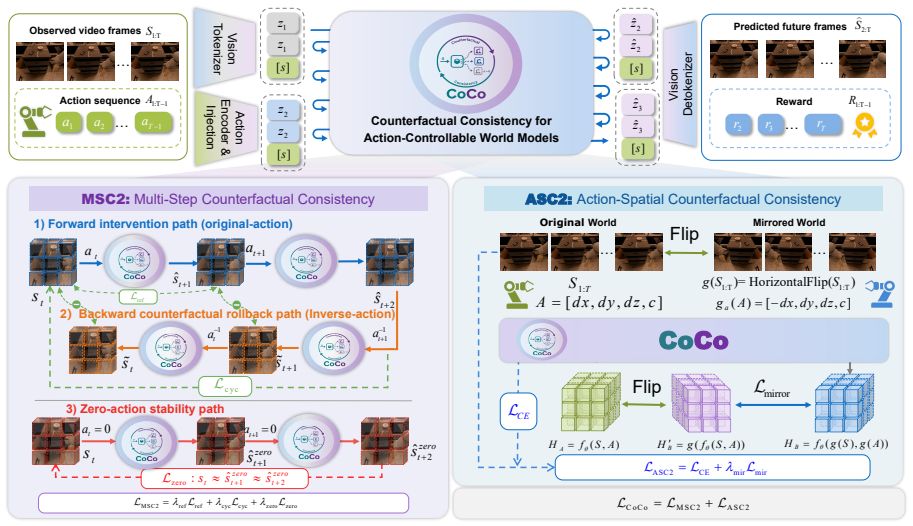
The load-bearing object is the counterfactual consistency loss imposed on the world model's conditional mapping $f_\theta$. MSC2 (Multi-Step Counterfactual Consistency) evaluates three rollouts from the same state: a reference rollout under the given actions, a rollback under the inverse action sequence starting from the predicted endpoint, and a zero-action rollout; the component losses $\mathcal{L}_{\text{ref}}$, $\mathcal{L}_{\text{cyc}}$, and $\mathcal{L}_{\text{zero}}$ respectively align predicted motion with real dynamics, enforce reversibility, and suppress drift. ASC2 (Action-Spatial Counterfactual Consistency) adds the spatial equivariance requirement $g(f_\theta(S_{\le t}, A_{t:t+K-1})) \approx f_\theta(g(S_{\le t}), g_a(A_{t:t+K-1}))$ for horizontal mirroring, aligned on continuous hidden representations rather than discrete tokens. Together these constraints force the model to encode directional action effects, action-magnitude sensitivity, and zero-action stability, which standard factual losses leave free.
What would settle it
A concrete falsifier: on a same-state multi-action dataset of an irreversible manipulation task, such as pushing a block so it slides and settles, train with the CoCo objective and measure whether the inverse-cycle endpoint error $d(\tilde{S}_t, S_t)$ can be reduced below a physically meaningful threshold without suppressing real object motion. If the model lowers the cycle loss mainly by freezing the object rather than by learning inverse dynamics, the MSC2 constraint has failed for exactly the contact-rich cases the paper flags as ill-defined.
Extended reading notes
Core claim
The central claim, stated on the paper's own terms, is that observational maximum-likelihood training is insufficient for action controllability because a model can match factual futures using statistical shortcuts. The proposed remedy is to add counterfactual consistency constraints to the training objective. In the temporal dimension, MSC2 requires that the reference rollout under an action sequence match real dynamics, that an inverse-action rollout from the predicted endpoint approximately recover the original state via $\tilde{S}_t = f_\theta(\hat{S}^{\text{ref}}_{t+K}, I(A_{t:t+K-1}))$, and that a zero-action rollout stay close to the initial state. In the spatial dimension, ASC2 requires the equivariance $g(f_\theta(S_{\le t}, A_{t:t+K-1})) \approx f_\theta(g(S_{\le t}), g_a(A_{t:t+K-1}))$ for horizontal mirroring. The reported consequence is that the resulting model scores higher on ARC-inv and ARC-ref, lowers drift energy, and converts simulated futures into better planning decisions, with the strongest evidence being 73.1% average success on VP2, competitive video quality on BAIR and RoboNet, and faster learning on several MetaWorld tasks.
Load-bearing premise
The load-bearing premise is that every action has a well-defined inverse and that a zero action leaves the world unchanged, which fails for contact-rich or momentum-driven tasks such as pushing and sliding; the paper itself concedes this limitation at the end.
Editorial extensions
If this is right
- A planner can now distinguish alternative action sequences by their predicted futures, because counterfactual consistency forces different actions from the same state to produce different, action-appropriate outcomes.
- Zero-action stability prevents rollouts from drifting on their own, so long-horizon simulation stays anchored to the actual state instead of wandering under visual inertia.
- The proposed ARC and DE metrics give a direct way to audit whether a world model is action-controlled, something reconstruction metrics like FVD or PSNR cannot reveal.
- Adding the counterfactual losses to an existing autoregressive video-prediction backbone improves planning success (73.1% average on VP2) without hurting video quality on BAIR or RoboNet.
- The same constraints transfer to model-based reinforcement learning, where the corrected world model learns faster and reaches higher success on several MetaWorld tasks.
Reading between the lines
- A natural extension not tested here: on irreversible contact tasks, the inverse-action cycle loss may need to be replaced by a learned invertibility constraint, since the paper itself notes that predefined inverses are ill-defined for contacts and complex semantic actions.
- The mirror-equivariance constraint is only an approximate regularizer on datasets without exact horizontal symmetry; its benefit should scale with how often mirrored states and mirrored action branches appear in training, which could be tested by ablating on left-right asymmetric scenes.
- The proposed ARC and DE metrics measure whether action effects and zero-action drift are present, but not whether the model's action-to-future mapping is continuous or reachability-aware; a planning-focused extension would measure whether distance in action space corresponds to distance between predicted futures.
Editorial analysis
A structured set of objections, weighed in public.
Referee Report
Summary. This paper proposes CoCo, a counterfactual consistency framework for action-conditioned world models. It augments a token-based video world model with two auxiliary losses: MSC2, which enforces consistency among reference, inverse-action, and zero-action rollouts (Eqs. 2-4), and ASC2, which enforces horizontal-mirror equivariance between hidden future representations (Eqs. 5-7). The authors also introduce two metrics, ARC and DE, and a MiniGrid-derived dataset Mini-SSMB for same-state, multi-action counterfactual evaluation. Experiments report improved ARC/DE on Mini-SSMB, BAIR, and RoboNet, improved average success on VP2 visual planning (73.1% vs 72.2% for SAMPO), and improved MBPO learning curves on several MetaWorld tasks. The central claim is that these counterfactual constraints reduce the model's reliance on statistical shortcuts and make actions causally control generated futures.
Significance. The idea of using counterfactual consistency to combat statistical bias in world models is timely, and the paper makes a useful conceptual contribution by separating action controllability from frame-level prediction quality. The proposed Mini-SSMB dataset and the ARC/DE metrics, if made independent of the training losses, could provide a valuable evaluation protocol for the community. However, as presented, the primary evidence for the central claim is weakened by circularity: the headline controllability metrics measure almost exactly the quantities minimized by the proposed losses. The most downstream result, VP2 visual planning, shows only a 0.9-point average success gap over a strong baseline, with no aggregate confidence interval and worse per-task performance on two of seven tasks. The physical premise of the inverse-action and zero-action constraints is also questionable for the contact-rich benchmarks used. These are correctable weaknesses, but they need to be addressed before the paper can support its general claim.
major comments (4)
- [Section 4.1 and Section 5.1 (Eq. (4), Eqs. (2)-(3))] The action-controllability evaluation is largely circular. ARC_inv is computed by applying the inverse action from the predicted reference endpoint and measuring agreement with the initial state, which is the same quantity minimized by L_cyc in Eq. (2)/(4). DE is computed as state drift under zero action, which is exactly the quantity minimized by L_zero in Eq. (3). Therefore the large DE reductions in Fig. 4 and Table 1 partly reflect that the training objective already includes the reported metric. The paper should either evaluate on held-out counterfactual branches from an environment simulator and report the actual branch accuracies, or make the downstream task success the primary evidence. As written, the controllability gains do not independently establish that statistical bias is overcome.
- [Section 4.1, Eq. (2) and Eq. (3)] The inverse-action and zero-action constraints rely on physical semantics that are not valid for contact-rich manipulation benchmarks. On BAIR, RoboNet, VP2, and MetaWorld, actions are continuous end-effector commands, and an inverse command does not reverse the post-contact object state; a zero command does not freeze a scene with settling or momentum-driven objects. Enforcing L_cyc and L_zero can therefore penalize legitimate dynamics and reward artificially static or reversible futures, which is precisely the kind of bias the paper claims to remove. The conclusion acknowledges that "predefined inverse actions and spatial transformations may be ill-defined for irreversible contacts or complex semantic actions." This limitation should be treated as central, and the paper should include a control experiment or a comparison with learned inverse actions to show that the constraints do not merely suppress legitimate motion.
- [Table 2 and Section 5.4 (VP2 visual planning)] The VP2 result does not establish a significant downstream benefit. CoCo achieves an average success of 73.1% versus 72.2% for SAMPO, a 0.9-point difference. Per-task, CoCo is worse than SAMPO on Open Drawer (32.5 vs 40.3) and Red Button (89.8 vs 94.7). The table caption states that the average is taken over four random seeds and that standard deviations are provided, but the average column shows no error bars or confidence interval. Without a significance test or aggregate confidence intervals, the claim of the "highest average success rate" is not supported by the reported numbers.
- [Table 1 and Fig. 4] The reported differences are often small, but the paper does not provide the reader with the means to assess variance. Table 1's caption says each metric is the mean and standard deviation over three runs, yet no standard deviations appear in the table. Fig. 4 shows training curves without error bars or seed information. Given that the Mini-SSMB improvements in the abstract are small (ARC_inv 0.406 to 0.412, ARC_ref 0.478 to 0.483), seed noise could determine whether these improvements are real. Please report per-run numbers, error bars, or significance tests for all head-to-head claims.
minor comments (4)
- [Abstract and Fig. 4] The abstract reports that the full model reduces DE by 17.07% relative to baseline, while Fig. 4's caption reports "46.4% lower vs. Baseline" for Ours-ASC2 and the text says Ours-ASC2 lowers DE to 4.19 (46.4%). Please clarify which model each percentage refers to and align the reporting.
- [Eq. (1) and Eq. (6)] The symbol H is used both for the video prediction horizon in Eq. (1) and for hidden future representations in Eq. (6). Consider using a different symbol for one of these quantities to avoid confusion.
- [Section 5.1 (Action Controllability Metrics)] The text says detailed definitions of ARC and DE are in Appendix A, but the appendix is not included in the submitted manuscript. Please include it so the metrics are fully specified.
- [Section 5.5 (Model-based Reinforcement Learning)] Fig. 6 shows overlapping confidence intervals on Hammer and Door Lock, and the aggregate curve is normalized but not quantified in the text. Please report the final aggregate success rate and task-level final success rates in a table, with the number of seeds used.
Circularity Check
ARC/DE gains reduce by construction: the reported controllability metrics are the same zero-action and inverse-action rollouts that L_zero and L_cyc train, so the headline Mini-SSMB/BAIR/RoboNet gains are the optimized loss; VP2 planning remains independent support.
-
fitted input called prediction
[Method, Multi-Step Counterfactual Consistency (Eqs. 2-4); Experiment, Action Controllability Metrics]
"In addition, MSC2 introduces a zero-action branch Ŝzero_{t+1:t+K} = f_θ(S_t, 0_{1:K}), which penalizes state drift when zero action is applied L_zero = Σ_{k=1}^K d(Ŝzero_{t+k}, S_t). ... ARC measures whether generated motion follows the action, whereas DE measures whether the model remains stable in the zero action."
DE is the zero-action drift penalized by L_zero, and ARC_inv is the inverse-action recovery penalized by L_cyc (while ARC_ref tracks L_ref against the factual branch). The model is trained to minimize L_cyc and L_zero, and the paper then reports reduced DE and increased ARC_inv on the same inverse/zero rollouts as evidence of overcoming statistical bias. For example, BAIR DE drops from 0.176 to 0.018 and Mini-SSMB DE falls 17.07% because L_zero is directly minimized; ARC_inv rises from 0.074 to 0.100 because L_cyc is directly minimized. This is optimizing the metric rather than independently measuring action controllability.
full rationale
The circularity is partial. The VP2 planning benchmark (Table 2) and standard video-quality metrics (FVD/LPIPS/PSNR/SSIM) are external and not optimized by ARC/DE; the VP2 result (73.1 vs 72.2 over SAMPO, 70.1 for iVideoGPT) is legitimate independent evidence. However, the paper's headline action-controllability claims rest on ARC/DE on Mini-SSMB and BAIR/RoboNet, which are the same objectives as L_cyc/L_zero; those specific gains reduce by construction. The conclusion also concedes that 'predefined inverse actions and spatial transformations may be ill-defined for irreversible contacts or complex semantic actions,' which undermines the physical validity of Eqs. (2)-(3) on contact-rich benchmarks but is a correctness concern, not circularity. No load-bearing self-citation or imported uniqueness theorem is present. Score 6 reflects partial circularity: the central claimed evidence for controllability reduces to the training losses, while an independent benchmark remains.
Assumptions & free parameters
free parameters (5)
- lambda_ref
- lambda_cyc
- lambda_zero
- lambda_mir
- rollout_horizon_K =
not stated; two-frame training clips imply K=1
assumptions (4)
- ad hoc to paper For every action sequence A there is an inverse sequence I(A) that reverses its effect on the state.
- domain assumption A zero action is an identity intervention: it should leave the state unchanged.
- ad hoc to paper For a horizontal mirror g there exists an action transform g_a such that g(f(S,A)) = f(g(S), g_a(A)).
- domain assumption Future token hidden states can be reshaped into spatial grids and flipped in a geometrically meaningful way.
Cite this review
Pith. "Pith review of Overcoming Statistical Bias in Action-Controllable World Models." pith.science (2026). https://pith.science/paper/F4FJU3SB
@misc{pith2026260804653,
  author       = {Pith},
  title        = {Pith review of: Overcoming Statistical Bias in Action-Controllable World Models},
  year         = {2026},
  howpublished = {\url{https://pith.science/paper/F4FJU3SB}},
  note         = {Machine review of arXiv:2608.04653}
}
read the original abstract
Action-conditioned world models aim to predict how visual environments evolve under an agent's actions. Yet future frames are often highly predictable from visual inertia and recurring motion patterns alone. This creates a shortcut: models can fit the data by exploiting statistical biases without making their visible dynamics meaningfully depend on the action. As a result, different actions may produce similar futures, while motion may persist even under zero action. The key question is how to reduce reliance on statistical shortcuts from dominating action-conditioned prediction. We argue that action control requires more than injecting action features; it requires enforcing consistency under counterfactual changes to actions and observations. Based on this insight, we introduce CoCo, a Counterfactual Consistency framework to enhance action controllability through two complementary constraints. Multi-step counterfactual consistency constrains reference, inverse-action, and zero-action rollouts, while action-spatial counterfactual consistency enforces consistent predictions under mirrored scenes and transformed actions. Together, they reduce reliance on statistical shortcuts from substituting for action-dependent dynamics. We further introduce Action Response Consistency (ARC) and Drift Energy (DE) to assess action controllability, together with Mini-SSMB for same-state, multi-action counterfactual evaluation. On Mini-SSMB, our full model achieved ARC_inv of 0.412 and ARC_ref of 0.483, while reducing DE by 17.07% relative to the baseline. On VP2 visual planning, it achieves the highest average success rate among SOTA models, at 73.1%. Experiments on BAIR and RoboNet further show that these gains preserve video prediction quality and transfer across model settings.
Figures


Figures from the paper (3 more)


Reference graph
Works this paper leans on
-
[1]
Blackboard Systems , year =
- [2]
- [3]
-
[4]
, title =
Robinson, Arthur L. , title =. 1980 , doi =. https://science.sciencemag.org/content/208/4447/1019.full.pdf , journal =
1980
-
[5]
Hasling, Diane Warner and Clancey, William J. and Rennels, Glenn R. , title =. International Journal of Man-Machine Studies , volume =. 1984 , issn =. doi:10.1016/S0020-7373(84)80003-6 , url =
-
[6]
Poligon: A System for Parallel Problem Solving , type =
Rice, James , year =. Poligon: A System for Parallel Problem Solving , type =
- [7]
- [8]
Show all 78 references
-
[9]
and Kaiser,
Vaswani, Ashish and Shazeer, Noam and Parmar, Niki and Uszkoreit, Jakob and Jones, Llion and Gomez, Aidan N. and Kaiser,. Attention Is All You Need , booktitle =. 2017 , url =
2017
-
[10]
Pluto: The 'Other' Red Planet , year =
-
[11]
Transformers Are Sample-Efficient World Models , booktitle =
Micheli, Vincent and Alonso, Eloi and Fleuret, Fran. Transformers Are Sample-Efficient World Models , booktitle =. 2023 , url =
2023
-
[12]
International Conference on Learning Representations , year =
Yang, Sherry and Du, Yilun and Ghasemipour, Kamyar and Tompson, Jonathan and Kaelbling, Leslie Pack and Schuurmans, Dale and Abbeel, Pieter , title =. International Conference on Learning Representations , year =
-
[13]
Bruce, Jake and Dennis, Michael D. and Edwards, Ashley and Parker-Holder, Jack and Shi, Yuge and Hughes, Edward and Lai, Matthew and Mavalankar, Aditi and Steigerwald, Richie and Apps, Chris and Aytar, Yusuf and Bechtle, Sarah Maria Elisabeth and Behbahani, Feryal and Chan, St...
2024
-
[14]
, title =
Chevalier-Boisvert, Maxime and Dai, Bolun and Towers, Mark and Perez-Vicente, Rodrigo and Willems, Lucas and Lahlou, Salem and Pal, Suman and Castro, Pablo Samuel and Terry, Jordan K. , title =. Advances in Neural Information Processing Systems , volume =. 2023 , address =
2023
-
[15]
Advances in Neural Information Processing Systems , volume=
How to Fine-tune the Model: Unified Model Shift and Model Bias Policy Optimization , author=. Advances in Neural Information Processing Systems , volume=. 2023 , address =
2023
-
[16]
Advances in Neural Information Processing Systems , volume =
BECAUSE: Bilinear Causal Representation for Generalizable Offline Model-based Reinforcement Learning , author=. Advances in Neural Information Processing Systems , volume =. 2024 , address =. doi:10.52202/079017-3637 , url=
2024 doi
-
[17]
Advances in Neural Information Processing Systems , volume=
Policy-shaped Prediction: Avoiding Distractions in Model-based Reinforcement Learning , author=. Advances in Neural Information Processing Systems , volume=. 2024 , doi=
2024
-
[18]
Advances in Neural Information Processing Systems , volume=
The Edge-of-Reach Problem in Offline Model-Based Reinforcement Learning , author=. Advances in Neural Information Processing Systems , volume=. 2024 , doi=
2024
-
[19]
Proceedings of the 41st International Conference on Machine Learning , volume=
Do Transformer World Models Give Better Policy Gradients? , author=. Proceedings of the 41st International Conference on Machine Learning , volume=. 2024 , publisher=
2024
-
[20]
Advances in Neural Information Processing Systems , volume=
Improving Model-Based Reinforcement Learning by Converging to Flatter Minima , author=. Advances in Neural Information Processing Systems , volume=. 2025 , publisher =
2025
-
[21]
Advances in Neural Information Processing Systems , pages =
Adversarial Counterfactual Environment Model Learning , author=. Advances in Neural Information Processing Systems , pages =. 2023 , address =
2023
-
[22]
Advances in Neural Information Processing Systems , volume=
Dynamics-Aligned Latent Imagination in Contextual World Models for Zero-Shot Generalization , author=. Advances in Neural Information Processing Systems , volume=. 2025 , publisher =
2025
-
[23]
Proceedings of the IEEE/CVF Conference on Computer Vision and Pattern Recognition , pages =
GEM: A Generalizable Ego-Vision Multimodal World Model for Fine-Grained Ego-Motion, Object Dynamics, and Scene Composition Control , author=. Proceedings of the IEEE/CVF Conference on Computer Vision and Pattern Recognition , pages =. 2025 , address =
2025
-
[24]
Proceedings of the IEEE/CVF Conference on Computer Vision and Pattern Recognition , pages =
Neural Motion Simulator Pushing the Limit of World Models in Reinforcement Learning , author=. Proceedings of the IEEE/CVF Conference on Computer Vision and Pattern Recognition , pages =. 2025 , address =
2025
-
[25]
Proceedings of the IEEE/CVF Conference on Computer Vision and Pattern Recognition (CVPR) , pages =
Bar, Amir and Zhou, Gaoyue and Tran, Danny and Darrell, Trevor and LeCun, Yann , title =. Proceedings of the IEEE/CVF Conference on Computer Vision and Pattern Recognition (CVPR) , pages =. 2025 , month =
2025
- [26]
-
[27]
2025 , eprint=
Counterfactual World Models via Digital Twin-conditioned Video Diffusion , author=. 2025 , eprint=. doi:10.48550/arXiv.2511.17481 , url=
2025 doi
-
[28]
Proceedings of the 42nd International Conference on Machine Learning , volume=
What Has a Foundation Model Found? Using Inductive Bias to Probe for World Models , author=. Proceedings of the 42nd International Conference on Machine Learning , volume=. 2025 , publisher=
2025
-
[29]
International Conference on Learning Representations , year=
A Control-Centric Benchmark for Video Prediction , author=. International Conference on Learning Representations , year=
-
[30]
and Levine, Sergey , title =
Ebert, Frederik and Finn, Chelsea and Lee, Alex X. and Levine, Sergey , title =. Proceedings of the 1st Annual Conference on Robot Learning , volume =. 2017 , publisher =
2017
-
[31]
Proceedings of the Conference on Robot Learning , volume =
Dasari, Sudeep and Ebert, Frederik and Tian, Stephen and Nair, Suraj and Bucher, Bernadette and Schmeckpeper, Karl and Singh, Siddharth and Levine, Sergey and Finn, Chelsea , title =. Proceedings of the Conference on Robot Learning , volume =. 2020 , publisher =
2020
-
[32]
and Kaiser,
Vaswani, Ashish and Shazeer, Noam and Parmar, Niki and Uszkoreit, Jakob and Jones, Llion and Gomez, Aidan N. and Kaiser,. Attention Is All You Need , booktitle =. 2017 , publisher =
2017
-
[33]
Advances in Neural Information Processing Systems , volume =
Wu, Jialong and Yin, Shaofeng and Feng, Ningya and He, Xu and Li, Dong and Hao, Jianye and Long, Mingsheng , title =. Advances in Neural Information Processing Systems , volume =. 2024 , publisher =. doi:10.52202/079017-2173 , url =
2024 doi
-
[34]
Advances in Neural Information Processing Systems , volume =
Voleti, Vikram and Jolicoeur-Martineau, Alexia and Pal, Chris , title =. Advances in Neural Information Processing Systems , volume =. 2022 , doi =
2022
-
[35]
Diffusion for World Modeling: Visual Details Matter in Atari , booktitle =
Alonso, Eloi and Jelley, Adam and Micheli, Vincent and Kanervisto, Anssi and Storkey, Amos and Pearce, Tim and Fleuret, Fran. Diffusion for World Modeling: Visual Details Matter in Atari , booktitle =. 2024 , volume =
2024
-
[36]
International Conference on Learning Representations , year =
Richens, Jonathan and Everitt, Tom , title =. International Conference on Learning Representations , year =
-
[37]
Advances in Neural Information Processing Systems , volume =
Wang, Sen and Tian, Jingyi and Wang, Le and Liao, Zhimin and Li, Jiayi and Dong, Huaiyi and Xia, Kun and Zhou, Sanping and Tang, Wei and Gang, Hua , title =. Advances in Neural Information Processing Systems , volume =. 2025 , publisher =
2025
- [38]
-
[39]
MaskViT: Masked Visual Pre-Training for Video Prediction , booktitle =
Gupta, Agrim and Tian, Stephen and Zhang, Yunzhi and Wu, Jiajun and Mart. MaskViT: Masked Visual Pre-Training for Video Prediction , booktitle =. 2023 , publisher =
2023
- [40]
-
[41]
Proceedings of the AAAI Conference on Artificial Intelligence , volume=
FiLM: Visual Reasoning with a General Conditioning Layer , author=. Proceedings of the AAAI Conference on Artificial Intelligence , volume=. 2018 , publisher =. doi:10.1609/aaai.v32i1.11671 , url=
2018 doi
-
[42]
Advances in Neural Information Processing Systems , volume=
Flamingo: A Visual Language Model for Few-Shot Learning , author=. Advances in Neural Information Processing Systems , volume=. 2022 , url=
2022
-
[43]
Proceedings of the IEEE Conference on Computer Vision and Pattern Recognition , pages=
Deep Residual Learning for Image Recognition , author=. Proceedings of the IEEE Conference on Computer Vision and Pattern Recognition , pages=. 2016 , doi=
2016
-
[44]
Proceedings of the IEEE/CVF International Conference on Computer Vision , pages=
Adding Conditional Control to Text-to-Image Diffusion Models , author=. Proceedings of the IEEE/CVF International Conference on Computer Vision , pages=. 2023 , publisher =
2023
-
[45]
Advances in Neural Information Processing Systems , volume=
Generating Code World Models with Large Language Models Guided by Monte Carlo Tree Search , author=. Advances in Neural Information Processing Systems , volume=. 2024 , url=
2024
-
[46]
Advances in Neural Information Processing Systems , volume=
Meta-DT: Offline Meta-RL as Conditional Sequence Modeling with World Model Disentanglement , author=. Advances in Neural Information Processing Systems , volume=. 2024 , publisher =
2024
-
[47]
Advances in Neural Information Processing Systems , volume=
Learning 3D Persistent Embodied World Models , author=. Advances in Neural Information Processing Systems , volume=. 2025 , publisher =
2025
-
[48]
Advances in Neural Information Processing Systems , volume=
Revisiting Multi-Agent World Modeling from a Diffusion-Inspired Perspective , author=. Advances in Neural Information Processing Systems , volume=. 2025 , publisher =
2025
-
[49]
Advances in Neural Information Processing Systems , volume=
RLVR-World: Training World Models with Reinforcement Learning , author=. Advances in Neural Information Processing Systems , volume=. 2025 , publisher =
2025
-
[50]
Proceedings of the IEEE/CVF Conference on Computer Vision and Pattern Recognition , year=
Motus: A Unified Latent Action World Model , author=. Proceedings of the IEEE/CVF Conference on Computer Vision and Pattern Recognition , year=
-
[51]
International Conference on Learning Representations , year =
Scaling Offline Model-Based RL via Jointly-Optimized World-Action Model Pretraining , author =. International Conference on Learning Representations , year =
-
[52]
International Conference on Learning Representations , year =
Open-World Reinforcement Learning over Long Short-Term Imagination , author =. International Conference on Learning Representations , year =
-
[53]
Proceedings of Robotics: Science and Systems , year =
Mendonca, Russell and Bahl, Shikhar and Pathak, Deepak , title =. Proceedings of Robotics: Science and Systems , year =
-
[54]
Proceedings of Robotics: Science and Systems , year =
Gu, Xinyang and Wang, Yen-Jen and Zhu, Xiang and Shi, Chengming and Guo, Yanjiang and Liu, Yichen and Chen, Jianyu , title =. Proceedings of Robotics: Science and Systems , year =
-
[55]
Proceedings of Robotics: Science and Systems , year =
Li, Wenxuan and Zhao, Hang and Yu, Zhiyuan and Du, Yu and Zou, Qin and Hu, Ruizhen and Xu, Kai , title =. Proceedings of Robotics: Science and Systems , year =
-
[56]
Proceedings of The 7th Conference on Robot Learning , pages =
Finetuning Offline World Models in the Real World , author =. Proceedings of The 7th Conference on Robot Learning , pages =. 2023 , editor =
2023
-
[57]
Proceedings of The 8th Conference on Robot Learning , pages =
RoboEXP: Action-Conditioned Scene Graph via Interactive Exploration for Robotic Manipulation , author =. Proceedings of The 8th Conference on Robot Learning , pages =. 2025 , editor =
2025
-
[58]
Proceedings of The 8th Conference on Robot Learning , pages =
Multi-Task Interactive Robot Fleet Learning with Visual World Models , author =. Proceedings of The 8th Conference on Robot Learning , pages =. 2025 , editor =
2025
-
[60]
ICLR 2019 Workshop on Deep Generative Models for Highly Structured Data , year =
FVD: A New Metric for Video Generation , author =. ICLR 2019 Workshop on Deep Generative Models for Highly Structured Data , year =
2019
-
[61]
IEEE Transactions on Image Processing , volume =
Image Quality Assessment: From Error Visibility to Structural Similarity , author =. IEEE Transactions on Image Processing , volume =. 2004 , publisher =
2004
-
[62]
2021 Picture Coding Symposium , pages =
On the Computation of PSNR for a Set of Images or Video , author =. 2021 Picture Coding Symposium , pages =. 2021 , organization =
2021
-
[63]
On the Content Bias in Fr
Ge, Songwei and Mahapatra, Aniruddha and Parmar, Gaurav and Zhu, Jun-Yan and Huang, Jia-Bin , booktitle =. On the Content Bias in Fr. 2024 , address =
2024
-
[64]
Proceedings of the IEEE/CVF Conference on Computer Vision and Pattern Recognition , pages =
The Unreasonable Effectiveness of Deep Features as a Perceptual Metric , author =. Proceedings of the IEEE/CVF Conference on Computer Vision and Pattern Recognition , pages =. 2018 , publisher =
2018
-
[65]
International Conference on Learning Representations , year =
Mastering Visual Continuous Control: Improved Data-Augmented Reinforcement Learning , author =. International Conference on Learning Representations , year =
-
[66]
2024 IEEE International Conference on Robotics and Automation , pages =
TWIST: Teacher-Student World Model Distillation for Efficient Sim-to-Real Transfer , author =. 2024 IEEE International Conference on Robotics and Automation , pages =. 2024 , publisher =. doi:10.1109/ICRA57147.2024.10610450 , url =
2024
-
[67]
2025 IEEE International Conference on Robotics and Automation , pages =
Learning Multiple Probabilistic Decisions from Latent World Model in Autonomous Driving , author =. 2025 IEEE International Conference on Robotics and Automation , pages =. 2025 , publisher =. doi:10.1109/ICRA55743.2025.11127996 , url =
2025
-
[68]
International Conference on Learning Representations , year =
Language Agents Meet Causality -- Bridging LLMs and Causal World Models , author =. International Conference on Learning Representations , year =
-
[69]
Proceedings of Robotics: Science and Systems , year =
Zhang, Arthur and Sikchi, Harshit and Biswas, Joydeep and Zhang, Amy , title =. Proceedings of Robotics: Science and Systems , year =. doi:10.15607/RSS.2025.XXI.136 , url =
2025 doi
-
[70]
Proceedings of the 40th International Conference on Machine Learning , volume =
High Fidelity Image Counterfactuals with Probabilistic Causal Models , author =. Proceedings of the 40th International Conference on Machine Learning , volume =. 2023 , publisher =
2023
-
[71]
Proceedings of the 40th International Conference on Machine Learning , volume =
Counterfactual Analysis in Dynamic Latent State Models , author =. Proceedings of the 40th International Conference on Machine Learning , volume =. 2023 , publisher =
2023
-
[72]
Proceedings of The 7th Conference on Robot Learning , volume =
TraCo: Learning Virtual Traffic Coordinator for Cooperation with Multi-Agent Reinforcement Learning , author =. Proceedings of The 7th Conference on Robot Learning , volume =. 2023 , publisher =
2023
-
[73]
Proceedings of Robotics: Science and Systems , year =
Autonomous Justification for Enabling Explainable Decision Support in Human-Robot Teaming , author =. Proceedings of Robotics: Science and Systems , year =. doi:10.15607/RSS.2023.XIX.002 , url =
2023 doi
-
[74]
Proceedings of the 41st International Conference on Machine Learning , volume =
Counterfactual Image Editing , author =. Proceedings of the 41st International Conference on Machine Learning , volume =. 2024 , publisher =
2024
-
[75]
International Conference on Learning Representations , year =
Gumbel Counterfactual Generation From Language Models , author =. International Conference on Learning Representations , year =
-
[76]
Proceedings of the 42nd International Conference on Machine Learning , volume =
Diffusion Counterfactual Generation with Semantic Abduction , author =. Proceedings of the 42nd International Conference on Machine Learning , volume =. 2025 , publisher =
2025
-
[77]
Proceedings of the 40th International Conference on Machine Learning , volume =
Trustworthy Policy Learning under the Counterfactual No-Harm Criterion , author =. Proceedings of the 40th International Conference on Machine Learning , volume =. 2023 , publisher =
2023
-
[78]
Proceedings of Robotics: Science and Systems , year =
Imitation Bootstrapped Reinforcement Learning , author =. Proceedings of Robotics: Science and Systems , year =. doi:10.15607/RSS.2024.XX.056 , publisher =
2024 doi
-
[79]
Proceedings of the 42nd International Conference on Machine Learning , volume =
Counterfactual Contrastive Learning with Normalizing Flows for Robust Treatment Effect Estimation , author =. Proceedings of the 42nd International Conference on Machine Learning , volume =. 2025 , publisher =
2025
Reviewed August 6, 2026 · model on record in the stance chip above.
Discussion (0). Continue with ORCID to comment.