Surface brightness-color relations for red giant branch stars: Observational constraints on metallicity effects using the ARD method
Pith reviewed 2026-06-26 07:40 UTC · model grok-4.3
The pith
The surface brightness-color relation for red giant branch stars changes predicted angular diameters by less than 1 percent for a full dex shift in metallicity.
A machine-rendered reading of the paper's core claim, the machinery that carries it, and where it could break.
Core claim
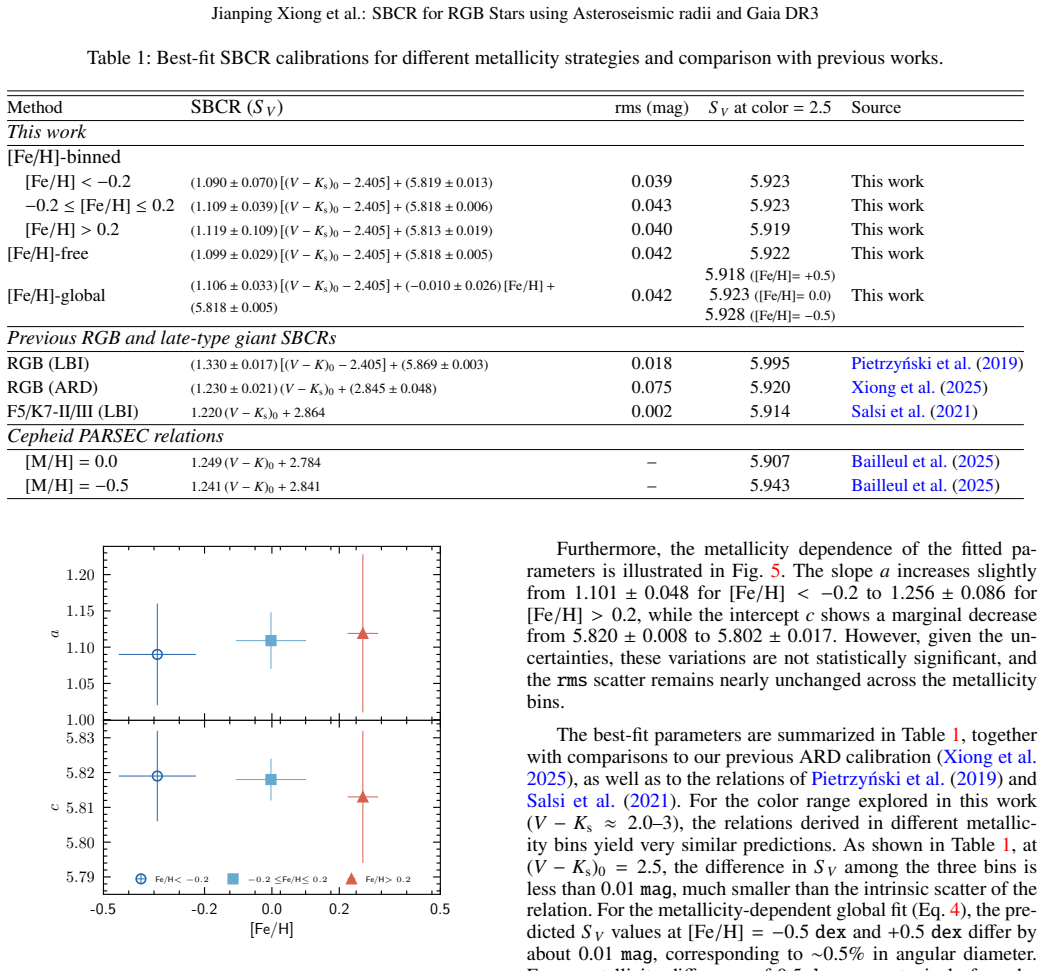
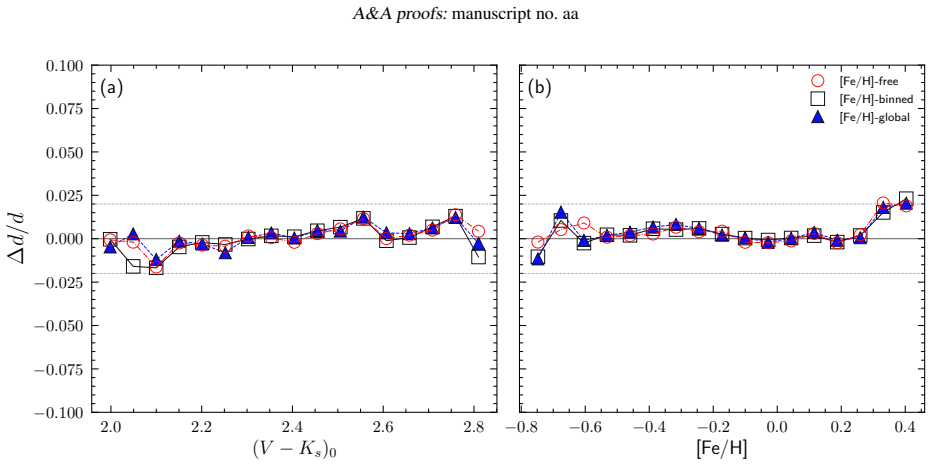
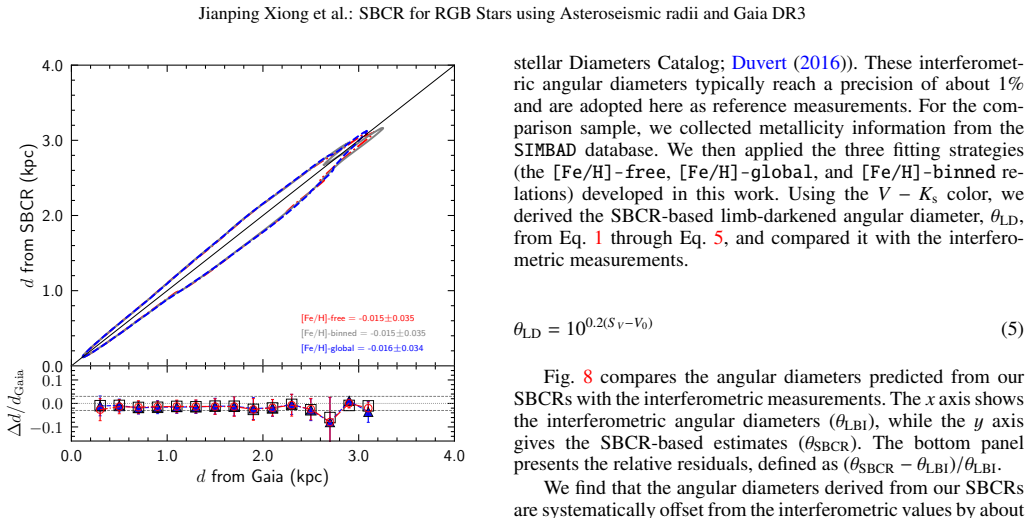
Over the range V-K_s=2-3, the SBCR shows only a weak metallicity dependence. A change of 1 dex in [Fe/H] modifies the predicted angular diameter by less than 1%, well below the intrinsic scatter of the calibration (~0.05 mag). This result is consistent with theoretical expectations. Comparison with the interferometric sample reveals a systematic offset of ~1.5% toward smaller angular diameters in our SBCR predictions, with a mild color dependence.
What carries the argument
The ARD method, which combines asteroseismic radii with Gaia distances to produce angular diameters that calibrate and test the SBCR through metallicity-free, binned, and global metallicity-dependent fits.
If this is right
- The metallicity effect stays small enough to neglect for most distance work in the explored color range.
- Large samples combining asteroseismic radii and Gaia distances supply a practical route to SBCR calibration.
- The metallicity term matters only when distance precision reaches the sub-percent level.
- The same ARD approach can extend the calibration to cooler and redder giants once input data coverage improves.
Where Pith is reading between the lines
- If the weak dependence holds, distance estimates for RGB stars across the Milky Way could use simpler relations that omit metallicity corrections in this color interval.
- Resolving the 1.5 percent ARD-interferometry offset with new observations would clarify whether any subtle metallicity trend appears at higher precision.
- Applying ARD calibration to other evolutionary stages could test whether the small metallicity sensitivity is unique to RGB stars or appears more broadly.
Load-bearing premise
The angular diameters obtained from asteroseismic radii and Gaia distances contain no systematics at the 1 percent level that would mask or imitate a metallicity dependence.
What would settle it
Interferometric angular-diameter measurements on a subset of the same APOKASC-3 RGB stars that either confirm or remove the reported 1.5 percent offset while preserving or eliminating the sub-1-percent metallicity dependence.
Figures




read the original abstract
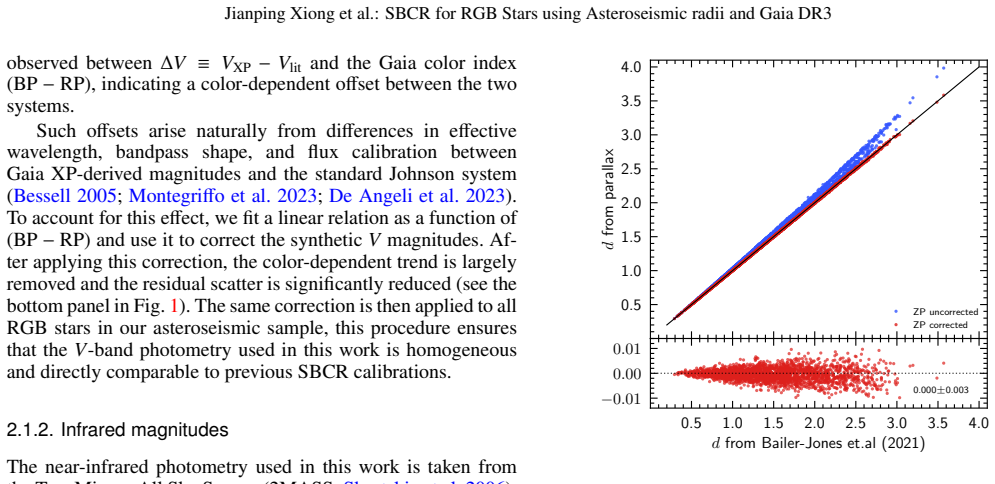
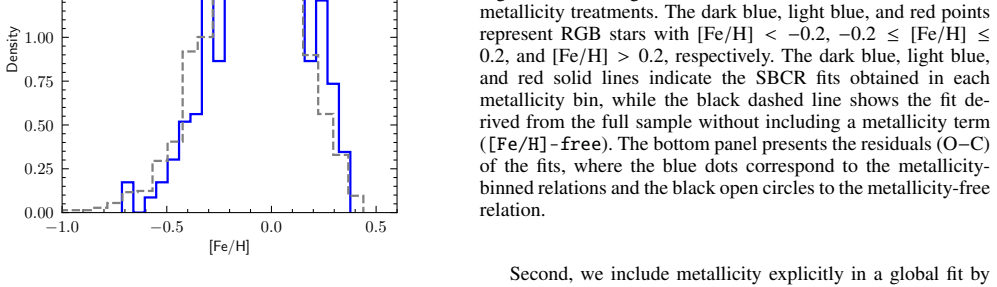
Aims: We aim to quantify the metallicity dependence of the SBCR for red giant branch (RGB) stars and to test the robustness of the relation using asteroseismic radii, Gaia distances, and atmospheric parameters from APOGEE. Methods: We selected more than 2,000 RGB stars from APOKASC-3 to calibrate and validate the SBCR. Johnson V magnitudes were synthesized from Gaia XP spectra and homogenized to widely used SBCR photometric systems, while K_s photometry was taken from 2MASS. Angular diameters derived from asteroseismic radii and Gaia distances (ARD) were used to construct the SBCR. We explored three fitting strategies: metallicity-free, metallicity-binned, and global metallicity-dependent relations. Results: Over the range V-K_s=2-3, the SBCR shows only a weak metallicity dependence. A change of 1 dex in [Fe/H] modifies the predicted angular diameter by less than 1%, well below the intrinsic scatter of the calibration (~0.05 mag). This result is consistent with theoretical expectations. Comparison with the interferometric sample reveals a systematic offset of ~1.5% toward smaller angular diameters in our SBCR predictions, with a mild color dependence. Conclusions: The metallicity effect on the SBCR is small in the color range explored here, but it becomes relevant for sub-percent distance measurements. Our results show that large RGB samples with asteroseismic radii and Gaia distances provide a powerful observational route for SBCR calibration, with clear potential for extension to cooler and redder giants as the precision and parameter coverage of the input data improve.
Editorial analysis
A structured set of objections, weighed in public.
Referee Report
Summary. The manuscript calibrates the surface brightness-color relation (SBCR) for red giant branch stars using >2000 APOKASC-3 stars, deriving angular diameters via the ARD method (asteroseismic radii + Gaia distances) and APOGEE parameters. Johnson V magnitudes are synthesized from Gaia XP spectra and combined with 2MASS K_s photometry. Three fitting strategies (metallicity-free, binned, and global metallicity-dependent) are applied over V-K_s=2-3, yielding a weak metallicity dependence: a 1 dex change in [Fe/H] alters predicted angular diameter by <1%, below the ~0.05 mag intrinsic scatter. A ~1.5% systematic offset (with mild color dependence) is reported versus interferometric samples. The conclusion is that metallicity effects are small but relevant for sub-percent distances, and that large ARD samples offer a robust calibration route.
Significance. If the ARD reference diameters are free of [Fe/H]-correlated systematics at the ~1% level, the result supplies a large-sample observational bound on metallicity dependence in the SBCR that aligns with theoretical expectations and supports use of the relation for RGB distance work. The scale of the sample (>2000 stars) and the explicit comparison of three fitting strategies are strengths; the public catalogs underlying the ARD values also aid reproducibility.
major comments (3)
- [Abstract / Results] Abstract and Results: the central claim that metallicity modifies predicted angular diameter by <1% per dex rests on treating ARD values as the reference calibration set, yet the text notes a 1.5% systematic offset versus interferometry (with mild color dependence) without a quantitative demonstration that any residual [Fe/H]-correlated bias in asteroseismic scaling relations, Gaia parallax corrections, or APOGEE parameters is smaller than this 1% threshold.
- [Methods / Results] Methods / Results: no explicit propagation of radius or distance uncertainties (including possible [Fe/H] covariances) into the SBCR fit coefficients or the quoted <1% metallicity effect is described; the intrinsic scatter of ~0.05 mag is given without the associated covariance matrix or error budget on the metallicity slope.
- [Comparison with interferometry] Comparison with interferometry: the 1.5% offset is reported but the paper does not test whether this offset itself varies with [Fe/H] at a level that could mask or mimic the claimed weak dependence; this test is load-bearing for adopting ARD as the primary reference.
minor comments (2)
- [Methods] Clarify the exact definition and any color-dependent terms in the three fitting strategies (metallicity-free, binned, global) so that the global fit coefficients can be directly compared to prior SBCR calibrations.
- [Abstract] The abstract states the result is 'consistent with theoretical expectations' but does not cite the specific models or predictions being compared.
Simulated Author's Rebuttal
We thank the referee for the constructive and detailed comments. We respond point-by-point to the major comments below, clarifying our approach and indicating revisions where the manuscript can be strengthened.
read point-by-point responses
-
Referee: [Abstract / Results] Abstract and Results: the central claim that metallicity modifies predicted angular diameter by <1% per dex rests on treating ARD values as the reference calibration set, yet the text notes a 1.5% systematic offset versus interferometry (with mild color dependence) without a quantitative demonstration that any residual [Fe/H]-correlated bias in asteroseismic scaling relations, Gaia parallax corrections, or APOGEE parameters is smaller than this 1% threshold.
Authors: The ARD diameters are adopted as the primary reference because of the sample size (>2000 stars) and the extensive validation of APOKASC-3 asteroseismic scaling relations in the literature. The 1.5% offset versus interferometry is reported explicitly. While a full sub-1% bound on every possible [Fe/H]-correlated residual is not quantified in the current text, the weak observed dependence is consistent with theory. In revision we will expand the discussion to include literature-based bounds on the dominant systematics. revision: partial
-
Referee: [Methods / Results] Methods / Results: no explicit propagation of radius or distance uncertainties (including possible [Fe/H] covariances) into the SBCR fit coefficients or the quoted <1% metallicity effect is described; the intrinsic scatter of ~0.05 mag is given without the associated covariance matrix or error budget on the metallicity slope.
Authors: We agree that the uncertainty treatment can be made more explicit. The revised Methods and Results sections will incorporate propagation of radius, distance, and parameter uncertainties (including [Fe/H] covariances) into the fit coefficients, provide the covariance matrix, and include an error budget for the metallicity slope. revision: yes
-
Referee: [Comparison with interferometry] Comparison with interferometry: the 1.5% offset is reported but the paper does not test whether this offset itself varies with [Fe/H] at a level that could mask or mimic the claimed weak dependence; this test is load-bearing for adopting ARD as the primary reference.
Authors: We acknowledge the value of this test. Although not performed in the submitted version, the APOGEE [Fe/H] values are available for the comparison stars. We will add the requested test of [Fe/H] dependence in the offset in the revised manuscript. revision: yes
Circularity Check
No significant circularity; empirical calibration grounded in external data
full rationale
The paper calibrates the SBCR by fitting relations to ARD angular diameters computed from independent APOKASC-3 asteroseismic radii and Gaia distances, then compares three explicit fitting strategies (metallicity-free, binned, global) on the observed sample. The reported weak metallicity dependence emerges directly from the data fit over V-Ks=2-3 and is not obtained by redefining inputs, renaming a prior result, or invoking a self-citation chain as the uniqueness constraint. The 1.5% offset versus interferometry is noted as an external consistency check rather than an internal definitional step. No load-bearing step reduces to a fitted parameter being relabeled as a prediction or to an ansatz smuggled via prior work by the same authors.
Axiom & Free-Parameter Ledger
free parameters (1)
- metallicity slope coefficient
axioms (2)
- domain assumption Asteroseismic radii from APOKASC-3 are accurate to the precision needed to detect 1% metallicity effects.
- domain assumption Gaia distances have negligible systematic error relative to the 0.05 mag scatter.
Reference graph
Works this paper leans on
-
[1]
2018, A&A, 616, A17
Arenou, F., Luri, X., Babusiaux, C., et al. 2018, A&A, 616, A17
2018
-
[2]
Bailer-Jones, C. A. L., Rybizki, J., Fouesneau, M., Demleitner, M., & Andrae, R. 2021, AJ, 161, 147
2021
-
[3]
C., Nardetto, N., Hocdé, V ., et al
Bailleul, M. C., Nardetto, N., Hocdé, V ., et al. 2025, A&A, 698, A46
2025
-
[4]
Barnes, T. G. & Evans, D. S. 1976, MNRAS, 174, 489
1976
-
[5]
G., Evans, D
Barnes, T. G., Evans, D. S., & Parsons, S. B. 1976, MNRAS, 174, 503
1976
-
[6]
Bessell, M. S. 2005, ARA&A, 43, 293 De Angeli, F., Weiler, M., Montegriffo, P., et al. 2023, A&A, 674, A2 Di Benedetto, G. P. 2005, MNRAS, 357, 174
2005
-
[7]
2016, VizieR Online Data Catalog: JMDC : JMMC Measured Stellar Diameters Catalogue (Duvert, 2016), VizieR On-line Data Catalog: II/345
Duvert, G. 2016, VizieR Online Data Catalog: JMDC : JMMC Measured Stellar Diameters Catalogue (Duvert, 2016), VizieR On-line Data Catalog: II/345. Originally published in: JMMC center (2016)
2016
-
[8]
& Gieren, W
Fouque, P. & Gieren, W. P. 1997, A&A, 320, 799 Gaia Collaboration, Montegriffo, P., Bellazzini, M., et al. 2023a, A&A, 674, A33 Gaia Collaboration, Vallenari, A., Brown, A. G. A., et al. 2023b, A&A, 674, A1
1997
-
[9]
2021, A&A, 649, A109
Graczyk, D., Pietrzy´nski, G., Galan, C., et al. 2021, A&A, 649, A109
2021
-
[10]
B., et al
Graczyk, D., Pietrzy´nski, G., Thompson, I. B., et al. 2014, ApJ, 780, 59
2014
-
[11]
B., et al
Graczyk, D., Pietrzy´nski, G., Thompson, I. B., et al. 2020, ApJ, 904, 13
2020
-
[12]
Kharchenko, N. V . & Roeser, S. 2009, VizieR Online Data Catalog: All-Sky Compiled Catalogue of 2.5 million stars (Kharchenko+2009), VizieR On- line Data Catalog: I/280B. Originally published in: 2001KFNT...17e.409K Article number, page 8 of 9 Jianping Xiong et al.: SBCR for RGB Stars using Asteroseismic radii and Gaia DR3
2009
-
[13]
2022, ApJ, 927, 167
Li, T., Li, Y ., Bi, S., et al. 2022, ApJ, 927, 167
2022
-
[14]
2023, A&A, 674, A3
Montegriffo, P., De Angeli, F., Andrae, R., et al. 2023, A&A, 674, A3
2023
-
[15]
2013, A&A, 550, A126 Pietrzy´nski, G., Graczyk, D., Gallenne, A., et al
Mosser, B., Michel, E., Belkacem, K., et al. 2013, A&A, 550, A126 Pietrzy´nski, G., Graczyk, D., Gallenne, A., et al. 2019, Nature, 567, 200 Pietrzy´nski, G., Graczyk, D., Gieren, W., et al. 2013, Nature, 495, 76
2013
-
[16]
H., Elsworth, Y
Pinsonneault, M. H., Elsworth, Y . P., Tayar, J., et al. 2018, ApJS, 239, 32
2018
-
[17]
H., Zinn, J
Pinsonneault, M. H., Zinn, J. C., Tayar, J., et al. 2025, ApJS, 276, 69
2025
-
[18]
G., Casertano, S., Yuan, W., Macri, L
Riess, A. G., Casertano, S., Yuan, W., Macri, L. M., & Scolnic, D. 2019, ApJ, 876, 85
2019
-
[19]
G., Yuan, W., Macri, L
Riess, A. G., Yuan, W., Macri, L. M., et al. 2022, ApJ, 934, L7
2022
-
[20]
2020, A&A, 640, A2
Salsi, A., Nardetto, N., Mourard, D., et al. 2020, A&A, 640, A2
2020
-
[21]
2021, A&A, 652, A26
Salsi, A., Nardetto, N., Mourard, D., et al. 2021, A&A, 652, A26
2021
-
[22]
2022, A&A, 662, A120
Salsi, A., Nardetto, N., Plez, B., & Mourard, D. 2022, A&A, 662, A120
2022
-
[23]
C., Stassun, K
Schonhut-Stasik, J., Zinn, J. C., Stassun, K. G., et al. 2024, AJ, 167, 50
2024
-
[24]
Sharma, S., Stello, D., Bland-Hawthorn, J., Huber, D., & Bedding, T. R. 2016, ApJ, 822, 15
2016
-
[25]
F., Cutri, R
Skrutskie, M. F., Cutri, R. M., Stiening, R., et al. 2006, AJ, 131, 1163
2006
-
[26]
2011, A&A, 534, A94
Storm, J., Gieren, W., Fouqué, P., et al. 2011, A&A, 534, A94
2011
-
[27]
G., & Degl’Innocenti, S
Valle, G., Dell’Omodarme, M., Prada Moroni, P. G., & Degl’Innocenti, S. 2024, A&A, 690, A327
2024
-
[28]
& Chen, X
Wang, S. & Chen, X. 2019, ApJ, 877, 116
2019
-
[29]
2025, ApJS, 280, 15
Wang, T., Yuan, H., Chen, B., et al. 2025, ApJS, 280, 15
2025
-
[30]
R., & Li, Y
Wang, Y ., Li, T., Bi, S., Bedding, T. R., & Li, Y . 2023, ApJ, 953, 182
2023
-
[31]
Wesselink, A. J. 1969, MNRAS, 144, 297
1969
-
[32]
2025, A&A, 697, A37
Xiong, J., Cheng, Q., Chen, X., et al. 2025, A&A, 697, A37
2025
-
[33]
2024, A&A, 690, A295 Article number, page 9 of 9
Zgirski, B., Gieren, W., Pietrzy´nski, G., et al. 2024, A&A, 690, A295 Article number, page 9 of 9
2024
discussion (0)
Sign in with ORCID, Apple, or X to comment. Anyone can read and Pith papers without signing in.