Expressibility, Noise, and Error Mitigation in VQE Ansatz Selection
Pith reviewed 2026-06-28 05:51 UTC · model grok-4.3
The pith
Error mitigation does not restore expressibility as a reliable predictor of VQE performance under noise.
A machine-rendered reading of the paper's core claim, the machinery that carries it, and where it could break.
Core claim
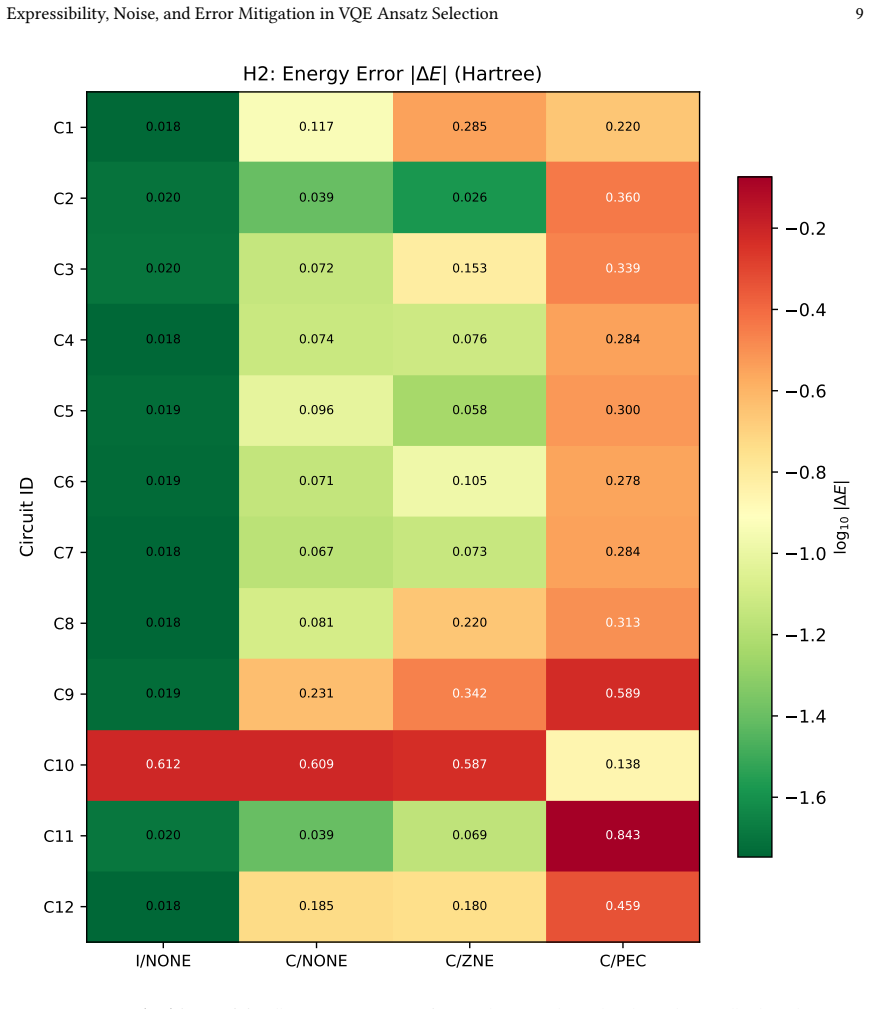
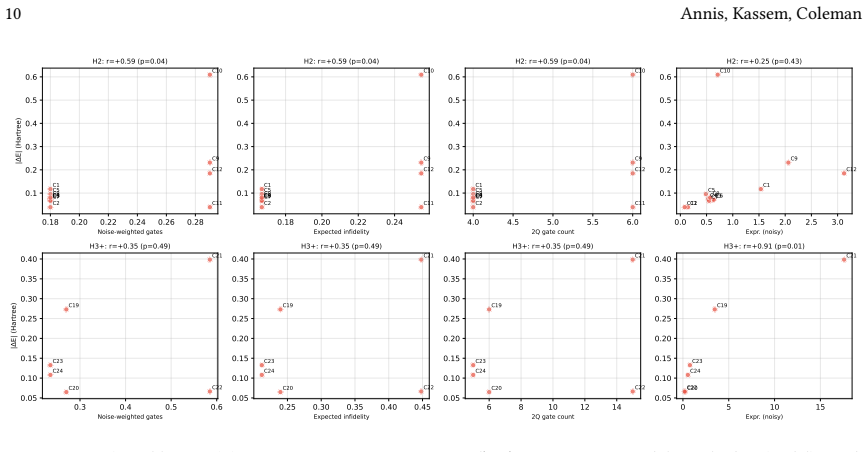
Expressibility loses predictive power for VQE error once noise is included. Zero-noise extrapolation reduces error in only 4 of 12 H2 circuits and 4 of 6 H3+ circuits, while probabilistic error cancellation increases error in 11 of 12 H2 circuits and all 6 H3+ circuits. Ideal-to-noisy circuit rankings scramble, ZNE largely keeps the noisy ordering, and PEC reorders it. Noisy expressibility correlates with unmitigated performance for H3+, yet two-qubit gate count predicts PEC degradation at least as well.
What carries the argument
Correlation between ideal and noisy expressibility values and VQE energy errors measured across ideal, noisy, ZNE, and PEC execution scenarios for fixed sets of H2 and H3+ ansatz circuits.
Load-bearing premise
The twelve H2 circuits, six H3+ circuits, and density-matrix noise model used in simulation stand in for the behavior of real hardware and a broader range of ansatze.
What would settle it
An experiment on real hardware showing that ZNE or PEC restores strong correlation between expressibility and VQE error across a representative set of circuits would falsify the central claim.
Figures


read the original abstract
The variational quantum eigensolver (VQE) is a promising algorithm for near-term quantum chemistry applications, but selecting optimal ansatz circuits remains challenging. Expressibility, a metric quantifying a circuit's ability to explore the Hilbert space, has been proposed as a guide for ansatz selection, but recent work showed it inconsistently predicts VQE performance under realistic noise for $H_2$. We extend this investigation to cover both $H_2$ and $H_3^+$ under four execution scenarios: ideal, noisy, and noisy with zero-noise extrapolation (ZNE) or probabilistic error cancellation (PEC). We find that error mitigation does not reliably restore expressibility's predictive power. ZNE reduces error for only 4 of 12 $H_2$ circuits and 4 of 6 $H_3^+$ circuits, while PEC actually increases error in 11 of 12 $H_2$ circuits and all 6 $H_3^+$ circuits. We reproduce and extend Saib et al.'s key finding that circuit rankings scramble under noise (Spearman $\rho \approx -0.1$ between ideal and noisy rankings), and identify a new result: ZNE largely preserves noisy rankings ($\rho = +0.80$ for $H_2$) while PEC actively reorders them ($\rho = -0.22$). Noisy expressibility, computed from density matrix simulations, strongly predicts unmitigated performance for $H_3^+$ (Pearson $r = +0.91$, $p = 0.01$), but this metric is computationally intractable at scale. We demonstrate that zero-cost circuit topology metrics such as two-qubit gate count provide comparable or superior predictive power for PEC degradation ($r = +0.96$ for $H_3^+$), while standard expressibility best predicts noisy and ZNE performance for $H_2$ ($r = +0.74$ and $r = +0.77$).
Editorial analysis
A structured set of objections, weighed in public.
Referee Report
Summary. The manuscript reports density-matrix simulations of 12 H2 and 6 H3+ VQE ansatze under ideal, noisy, ZNE-mitigated, and PEC-mitigated conditions. It finds that expressibility loses predictive power under noise (Spearman ρ ≈ −0.1 between ideal and noisy rankings), that ZNE reduces error in only 4/12 H2 and 4/6 H3+ cases while PEC increases error in 11/12 H2 and all 6 H3+ cases, that noisy expressibility correlates with unmitigated performance only for H3+ (Pearson r = +0.91), and that zero-cost topology metrics such as two-qubit gate count can match or exceed expressibility for predicting PEC degradation (r = +0.96 for H3+).
Significance. If the reported correlations and mitigation outcomes hold beyond the tested instances, the work supplies concrete, actionable guidance for ansatz selection on small noisy devices and identifies simple topology proxies that avoid the cost of expressibility calculations. The reproduction of ranking scrambling and the explicit comparison of ZNE versus PEC effects on ranking stability are useful benchmarks for the VQE community.
major comments (3)
- [Abstract] Abstract and Results: the headline claim that 'error mitigation does not reliably restore expressibility's predictive power' is based on only 12 H2 and 6 H3+ circuits. With such a small sample, the observed fractions (4/12, 11/12, etc.) and the reported Spearman/Pearson coefficients could be sensitive to the particular choice of ansatze; the manuscript does not report bootstrap confidence intervals or a power analysis that would show the results are robust to modest changes in the circuit set.
- [Abstract] Abstract: the noise model and gate-error correlations used in the density-matrix simulations are not specified. Because the central observation is that rankings scramble under noise (ρ ≈ −0.1) and that ZNE/PEC reorder them differently, the absence of a description of the noise channel (e.g., whether it includes correlated two-qubit errors or readout noise) leaves open whether the reported reordering is an artifact of the chosen model rather than a general feature of VQE on hardware.
- [Abstract] Abstract: no error bars, standard deviations across random initializations, or raw data tables are referenced for the error-reduction counts or the correlation values. For the claim that noisy expressibility 'strongly predicts' unmitigated performance (r = +0.91, p = 0.01) on only six H3+ points, the lack of uncertainty quantification makes it impossible to judge whether the correlation is statistically distinguishable from weaker values.
minor comments (2)
- [Methods] The manuscript should clarify in the Methods section whether the 12/6 circuits were selected before or after seeing the noisy results; post-hoc selection would introduce bias into the reported predictive-power comparisons.
- [Results] Figure captions or the main text should state the precise definition of 'error' used for the 'reduces error' counts (energy error relative to ideal, or something else) and whether the same metric is used for both molecules.
Simulated Author's Rebuttal
We thank the referee for the constructive feedback. We address each major comment below and have revised the manuscript accordingly to improve clarity and statistical rigor.
read point-by-point responses
-
Referee: [Abstract] Abstract and Results: the headline claim that 'error mitigation does not reliably restore expressibility's predictive power' is based on only 12 H2 and 6 H3+ circuits. With such a small sample, the observed fractions (4/12, 11/12, etc.) and the reported Spearman/Pearson coefficients could be sensitive to the particular choice of ansatze; the manuscript does not report bootstrap confidence intervals or a power analysis that would show the results are robust to modest changes in the circuit set.
Authors: We agree the sample is limited, reflecting our focus on density-matrix simulations feasible only for these small molecules. In revision we added bootstrap confidence intervals (1000 resamples) for all Spearman and Pearson coefficients to quantify sensitivity to circuit choice. A formal power analysis is not added, as the work is positioned as an exploratory benchmark on representative small instances rather than a general statistical claim; this limitation is now explicitly noted in the discussion. revision: partial
-
Referee: [Abstract] Abstract: the noise model and gate-error correlations used in the density-matrix simulations are not specified. Because the central observation is that rankings scramble under noise (ρ ≈ −0.1) and that ZNE/PEC reorder them differently, the absence of a description of the noise channel (e.g., whether it includes correlated two-qubit errors or readout noise) leaves open whether the reported reordering is an artifact of the chosen model rather than a general feature of VQE on hardware.
Authors: The referee correctly identifies an omission. We have expanded the abstract and added a dedicated Methods subsection specifying the noise model: independent local depolarizing channels after each gate with rates taken from IBM Qiskit calibration data (no correlated two-qubit errors or readout noise included). This makes the simulation assumptions explicit and allows readers to assess generality. revision: yes
-
Referee: [Abstract] Abstract: no error bars, standard deviations across random initializations, or raw data tables are referenced for the error-reduction counts or the correlation values. For the claim that noisy expressibility 'strongly predicts' unmitigated performance (r = +0.91, p = 0.01) on only six H3+ points, the lack of uncertainty quantification makes it impossible to judge whether the correlation is statistically distinguishable from weaker values.
Authors: We accept this criticism. The revised manuscript now reports standard deviations over 20 random initializations for all VQE energies and error-reduction counts, with error bars on the relevant figures. Raw data tables have been moved to the supplementary information. For the H3+ correlation we retain the p-value but have added an explicit caveat on the small n=6 sample size in both abstract and text. revision: yes
Circularity Check
No circularity: empirical simulation results with independent numerical benchmarks
full rationale
The paper reports direct outcomes from density-matrix simulations on 12 H2 and 6 H3+ circuits under ideal, noisy, ZNE, and PEC scenarios. All headline statistics (e.g., ZNE success on 4/12 and 4/6 circuits, PEC worsening on 11/12 and 6/6, Spearman ρ values, Pearson r = +0.91 for noisy expressibility on H3+, topology metric r = +0.96) are computed from the simulation outputs themselves. No equations, fitted parameters, or self-citations are used to derive the central claims; the work reproduces an external result from Saib et al. and adds new numerical comparisons. The derivation chain consists solely of independent numerical benchmarks and is therefore self-contained.
Axiom & Free-Parameter Ledger
axioms (1)
- standard math Standard quantum mechanics and Markovian noise models hold for the density matrix simulations of VQE circuits.
Reference graph
Works this paper leans on
-
[1]
Filippo Brozzi, Gloria Turati, Maurizio Ferrari Dacrema, Filippo Caruso, and Paolo Cremonesi. 2025. Hamiltonian Expressibility for Ansatz Selection in Variational Quantum Algorithms.arXiv preprint arXiv:2507.22550(2025)
arXiv 2025
-
[2]
Zhenyu Cai, Ryan Babbush, Simon C Benjamin, Suguru Endo, William J Huggins, Ying Li, Jarrod R McClean, and Thomas E O’Brien. 2023. Quantum error mitigation.Reviews of Modern Physics95, 4 (2023), 045005
2023
-
[3]
Marco Cerezo, Akira Sone, Tyler Volkoff, Lukasz Cincio, and Patrick J Coles. 2021. Cost function dependent barren plateaus in shallow parametrized quantum circuits.Nature Communications12 (2021), 1791. doi:10.1038/s41467-021-21728-w arXiv:2001.00550
-
[4]
Kieran Dalton, Christopher K Long, Yordan S Mansour, David Sherrington, Sandra Sherrington, Charles Sherrington, Joseph Sherrington, Benjamin Sherrington, and Alexander Sherrington. 2024. Quantifying the effect of gate errors on variational quantum eigensolvers for quantum chemistry. npj Quantum Information10 (2024), 18. doi:10.1038/s41534-024-00808-x arX...
-
[5]
Yuxuan Du, Zhuozhuo Tu, Xiao Yuan, and Dacheng Tao. 2022. Efficient measure for the expressivity of variational quantum algorithms.Physical Review Letters128, 8 (2022), 080506. doi:10.1103/PhysRevLett.128.080506 arXiv:2104.09961. Manuscript submitted to ACM 14 Annis, Kassem, Coleman
-
[6]
Enrico Fontana, Nathan Fitzpatrick, David Muñoz Ramo, Ross Duncan, and Ivan Rungger. 2021. Evaluating the noise resilience of variational quantum algorithms.Physical Review A104, 2 (2021), 022403. doi:10.1103/PhysRevA.104.022403 arXiv:2011.01125
-
[7]
Tudor Giurgica-Tiron, Yousef Hindy, Ryan LaRose, Andrea Mari, and William J Zeng. 2020. Digital zero noise extrapolation for quantum error mitigation. In2020 IEEE International Conference on Quantum Computing and Engineering (QCE). IEEE, 306–316
2020
-
[8]
Harper R Grimsley, George S Barron, Edwin Barnes, Sophia E Economou, and Nicholas J Mayhall. 2023. Adaptive, problem-tailored variational quantum eigensolver mitigates rough parameter landscapes and barren plateaus.npj Quantum Information9 (2023), 19. doi:10.1038/s41534-023- 00681-0 arXiv:2204.07179
-
[9]
Tobias Haug, Kishor Bharti, and M S Kim. 2021. Capacity and quantum geometry of parametrized quantum circuits.PRX Quantum2, 4 (2021), 040309. doi:10.1103/PRXQuantum.2.040309 arXiv:2102.01659
-
[10]
Zoë Holmes, Kunal Sharma, M Cerezo, and Patrick J Coles. 2022. Connecting ansatz expressibility to gradient magnitudes and barren plateaus.PRX Quantum3, 1 (2022), 010313. doi:10.1103/PRXQuantum.3.010313 arXiv:2101.02138
-
[11]
Ali Javadi-Abhari, Matthew Treinish, Kevin Krsulich, Christopher J Wood, Jake Lishman, Julien Gacon, Simon Martiel, Paul D Nation, Lev S Bishop, Andrew W Cross, et al. 2024. Quantum computing with Qiskit.arXiv preprint arXiv:2405.08810(2024)
Pith/arXiv arXiv 2024
-
[12]
Abhinav Kandala, Antonio Mezzacapo, Kristan Temme, Maika Takita, Markus Brink, Jerry M Chow, and Jay M Gambetta. 2017. Hardware-efficient variational quantum eigensolver for small molecules and quantum magnets.nature549, 7671 (2017), 242–246
2017
-
[13]
Youngseok Kim, Andrew Eddins, Sajant Anand, Ken Xuan Wei, Ewout van den Berg, Sami Rosenblatt, Hasan Nayfeh, Yantao Wu, Michael Zaletel, Kristan Temme, and Abhinav Kandala. 2023. Evidence for the utility of quantum computing before fault tolerance.Nature618, 7965 (2023), 500–505. doi:10.1038/s41586-023-06096-3
-
[14]
Martin Larocca, Supanut Thanasilp, Samson Wang, Kunal Sharma, Jacob Biamonte, Patrick J Coles, Lukasz Cincio, Jarrod R McClean, Zoë Holmes, and M Cerezo. 2025. A review of barren plateaus in variational quantum computing.Nature Reviews Physics7 (2025), 174–187. doi:10.1038/s42254- 024-00781-6 arXiv:2405.00781
-
[15]
Ryan LaRose, Andrea Mari, Sarah Kaiser, Peter J Karalekas, Andre A Alves, Piotr Czarnik, Mohamed El Mandouh, Max H Gordon, Yousef Hindy, Aaron Robertson, et al. 2022. Mitiq: A software package for error mitigation on noisy quantum computers.Quantum6 (2022), 774
2022
-
[16]
Jarrod R McClean, Sergio Boixo, Vadim N Smelyanskiy, Ryan Babbush, and Hartmut Neven. 2018. Barren plateaus in quantum neural network training landscapes.Nature Communications9 (2018), 4812. doi:10.1038/s41467-018-07090-4
-
[17]
Jarrod R McClean, Jonathan Romero, Ryan Babbush, and Alán Aspuru-Guzik. 2016. The theory of variational hybrid quantum-classical algorithms. New Journal of Physics18, 2 (2016), 023023
2016
-
[18]
Alberto Peruzzo, Jarrod McClean, Peter Shadbolt, Man-Hong Yung, Xiao-Qi Zhou, Peter J Love, Alán Aspuru-Guzik, and Jeremy L O’brien. 2014. A variational eigenvalue solver on a photonic quantum processor.Nature communications5, 1 (2014), 4213
2014
-
[19]
Jonathan Romero, Ryan Babbush, Jarrod R McClean, Cornelius Hempel, Peter J Love, and Alán Aspuru-Guzik. 2018. Strategies for quantum computing molecular energies using the unitary coupled cluster ansatz.Quantum Science and Technology4, 1 (2018), 014008
2018
-
[20]
Waheeda Saib, Petros Wallden, and Ismail Akhalwaya. 2021. The effect of noise on the performance of variational algorithms for quantum chemistry. In2021 IEEE International Conference on Quantum Computing and Engineering (QCE). IEEE, 42–53
2021
-
[21]
Sukin Sim, Peter D Johnson, and Alán Aspuru-Guzik. 2019. Expressibility and entangling capability of parameterized quantum circuits for hybrid quantum-classical algorithms.Advanced Quantum Technologies2, 12 (2019), 1900070
2019
-
[22]
Phattharaporn Singkanipa and Daniel A Lidar. 2025. Beyond unital noise in variational quantum algorithms: noise-induced barren plateaus and limit sets.Quantum9 (2025), 1617. doi:10.22331/q-2025-01-30-1617 arXiv:2402.08721
-
[23]
James C Spall. 1998. An overview of the simultaneous perturbation method for efficient optimization.Johns Hopkins apl technical digest19, 4 (1998), 482–492
1998
-
[24]
Qiming Sun, Timothy C Berkelbach, Nick S Blunt, George H Booth, Sheng Guo, Zhendong Li, Junzi Liu, James D McClain, Elvira R Sayfutyarova, Sandeep Sharma, et al. 2018. PySCF: the Python-based simulations of chemistry framework.Wiley Interdisciplinary Reviews: Computational Molecular Science8, 1 (2018), e1340
2018
-
[25]
Ho Lun Tang, V O Shkolnikov, George S Barron, Harper R Grimsley, Nicholas J Mayhall, Edwin Barnes, and Sophia E Economou. 2021. qubit- ADAPT-VQE: An adaptive algorithm for constructing hardware-efficient ansätze on a quantum processor.PRX Quantum2, 2 (2021), 020310. doi:10.1103/PRXQuantum.2.020310
-
[26]
Kristan Temme, Sergey Bravyi, and Jay M Gambetta. 2017. Error mitigation for short-depth quantum circuits.Physical review letters119, 18 (2017), 180509
2017
-
[27]
Ewout Van Den Berg, Zlatko K Minev, Abhinav Kandala, and Kristan Temme. 2023. Probabilistic error cancellation with sparse Pauli–Lindblad models on noisy quantum processors.Nature physics19, 8 (2023), 1116–1121
2023
-
[28]
Samson Wang, Enrico Fontana, M Cerezo, Kunal Sharma, Akira Sone, Lukasz Cincio, and Patrick J Coles. 2021. Noise-induced barren plateaus in variational quantum algorithms.Nature Communications12 (2021), 6961. doi:10.1038/s41467-021-27045-6 arXiv:2007.14384
-
[29]
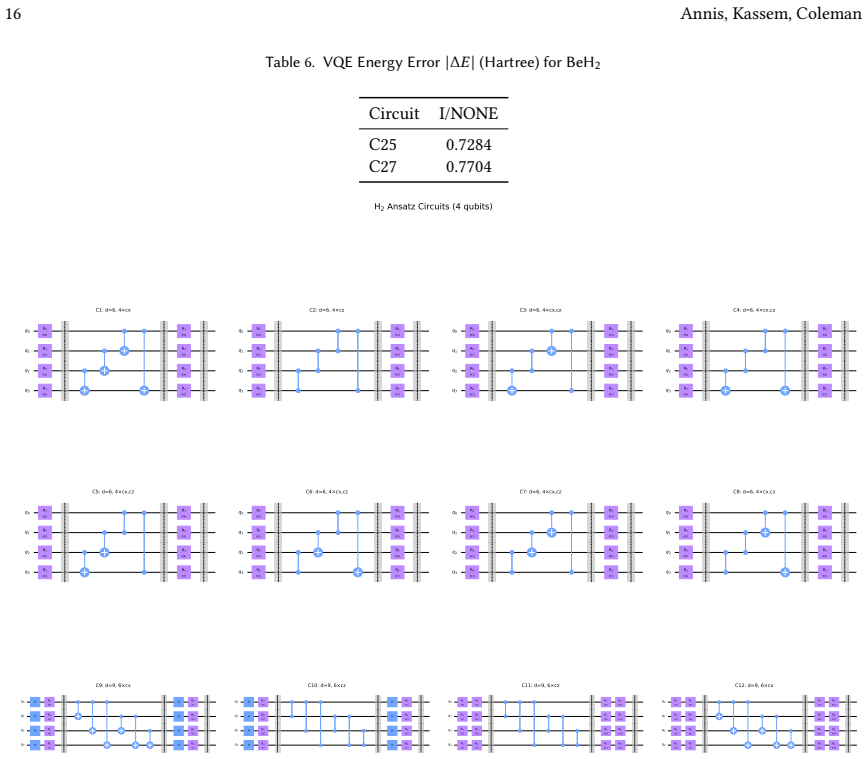
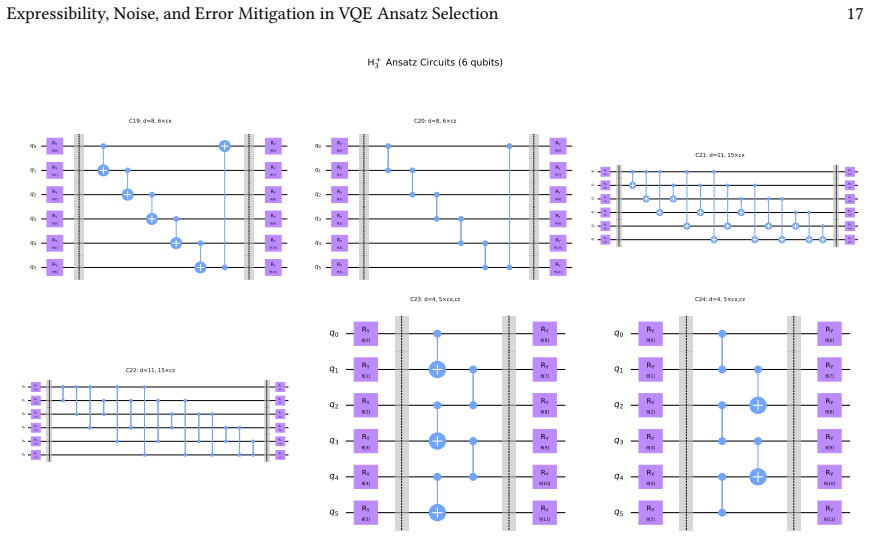
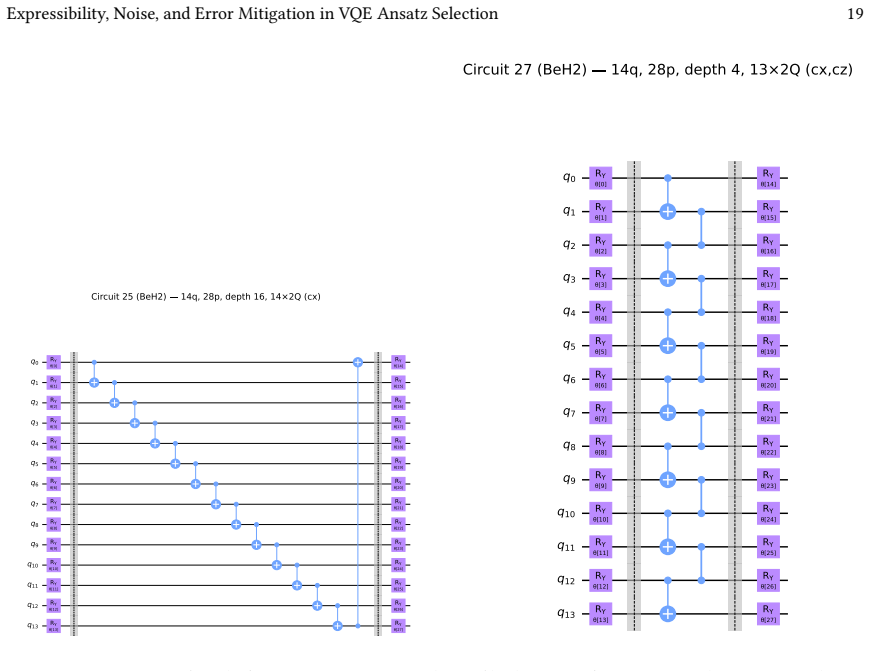
Jinfeng Zeng, Zipeng Wu, Chenfeng Cao, Chao Zhang, Shi-Yao Hou, Pengxiang Xu, and Bei Zeng. 2021. Simulating noisy variational quantum eigensolver with local noise models.Quantum Engineering3, 4 (2021), e77. Manuscript submitted to ACM Expressibility, Noise, and Error Mitigation in VQE Ansatz Selection 15 A Circuit Diagrams Figures 4 and 5 show all ansatz...
2021
discussion (0)
Sign in with ORCID, Apple, or X to comment. Anyone can read and Pith papers without signing in.