Bricker to BRACE: A Bracket Exposure RAW Dataset and Restoration Model for Flicker-Banding
Pith reviewed 2026-06-30 06:47 UTC · model grok-4.3
The pith
Flicker-banding artifacts vary across exposures, so bracketed multi-frame RAW restoration is required to separate them from genuine texture.
A machine-rendered reading of the paper's core claim, the machinery that carries it, and where it could break.
Core claim
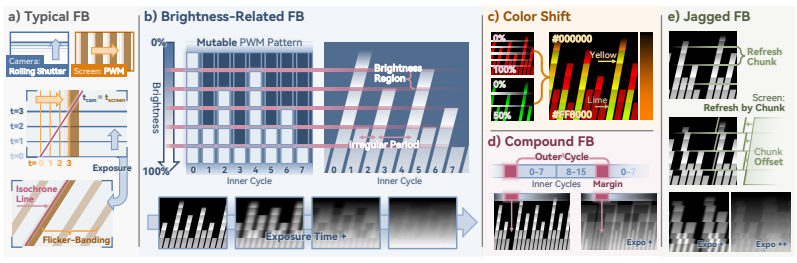
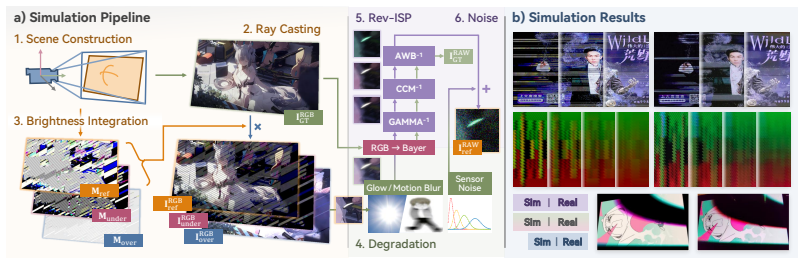
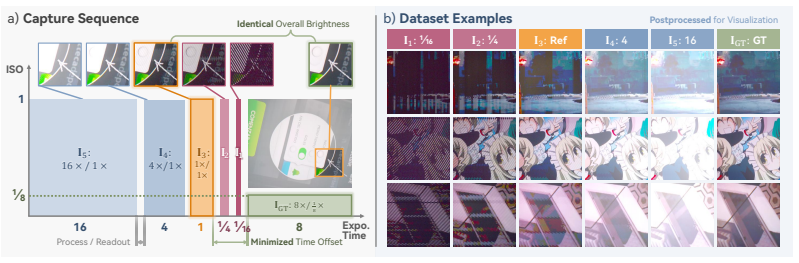
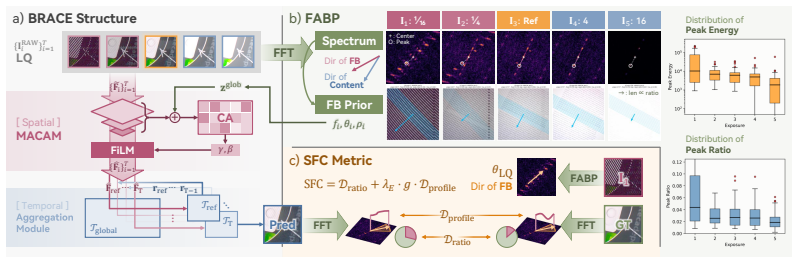
Flicker-banding arises from temporal aliasing between rolling shutter and display modulation, producing color shifts and jagged patterns that vary with exposure. Existing single-frame parametric models cannot reliably separate these from texture, so a multi-frame bracketed RAW restoration paradigm is needed. The Bricker dataset is built via ray-tracing simulation and automated capture, and the BRACE model applies frequency-aware banding prior and MSCAM for cross-exposure fusion.
What carries the argument
BRACE model that utilizes frequency-aware banding prior and multi-scale spatial cross-attention modulator (MSCAM) for cross-exposure spatial fusion in bracketed RAW images
If this is right
- Restoration quality on screen-captured images will improve when multiple bracketed exposures are available instead of single frames.
- The Stripe Frequency Consistency metric will provide a better way to evaluate banding removal than previous measures.
- Screen photography applications will benefit from models trained on the Bricker dataset for handling real-world flicker-banding.
- Multi-frame fusion techniques will become standard for artifacts that change with camera settings.
Where Pith is reading between the lines
- Camera systems could incorporate automatic bracket capture for screen photos to enable better post-processing.
- This paradigm might extend to other rolling shutter artifacts or temporal aliasing issues in imaging.
- Real-time applications may need faster approximations if bracket capture is not feasible.
- Dataset creation via simulation could be applied to other image degradation problems.
Load-bearing premise
Complex FB morphologies vary significantly across exposure settings in a way that single-frame methods fundamentally cannot handle, requiring bracketed multi-frame input.
What would settle it
Demonstration of a single-frame method that matches or exceeds BRACE performance on the Bricker benchmarks without using multiple frames or exposure variation.
Figures





read the original abstract
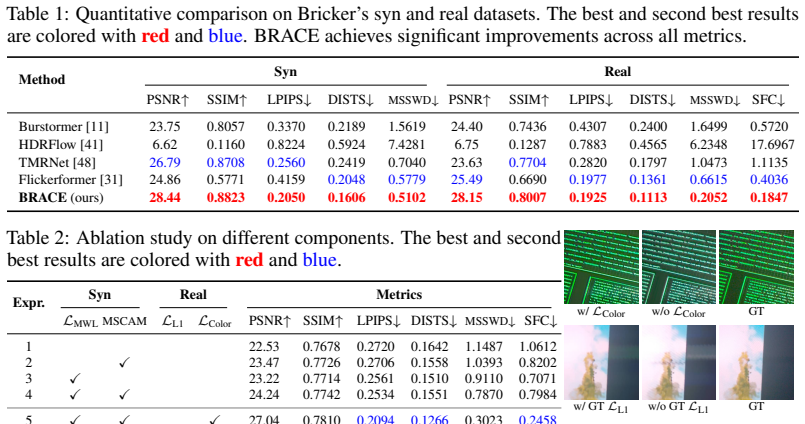
Flicker-banding (FB), arises from temporal aliasing between a camera's rolling shutter and a display's brightness modulation, degrading screen-captured image readability with color shifts and jagged patterns. Existing single-frame methods with simplified parametric stripe models cannot reliably distinguish these artifacts from genuine texture. To address this, we conduct a systematic analysis of complex FB morphologies and reveal their significant variation across exposure settings, motivating a multi-frame bracketed RAW restoration paradigm. We construct Bricker, a synthetic-real bracketed RAW dataset built via ray-tracing-based physical simulation and automated multi-exposure capture tool. We further propose BRACE: Bracketed RAW Flicker-Banding Removal, a multi-frame restoration model that utilizes frequency-aware banding prior and a multi-scale spatial cross-attention modulator (MSCAM) for cross-exposure spatial fusion. We also introduce the Stripe Frequency Consistency (SFC) metric to evaluate banding removal. Experiments demonstrate state-of-the-art performance on both synthetic and real benchmarks. Our dataset and code are available at: https://github.com/ZZH-qwq/BRACE.
Editorial analysis
A structured set of objections, weighed in public.
Referee Report
Summary. The manuscript introduces Bricker, a synthetic-real bracketed RAW dataset for flicker-banding (FB) artifacts in screen captures, generated via ray-tracing simulation and an automated multi-exposure capture tool. It proposes BRACE, a multi-frame restoration network that incorporates a frequency-aware banding prior and a multi-scale spatial cross-attention modulator (MSCAM) to fuse information across bracketed exposures. The work also defines the Stripe Frequency Consistency (SFC) metric and reports state-of-the-art FB removal performance on both synthetic and real benchmarks, with the dataset and code released publicly.
Significance. If the central claims hold, the Bricker dataset and accompanying code release constitute a concrete resource for the screen-capture restoration community. The systematic analysis of FB morphology variation across exposures and the multi-frame paradigm could provide a practical route to handling complex banding patterns that current single-frame parametric approaches struggle with. The SFC metric offers a new evaluation axis focused on stripe frequency preservation.
major comments (2)
- [§1] §1 (Introduction) and the motivation paragraph: The claim that 'existing single-frame methods with simplified parametric stripe models cannot reliably distinguish these artifacts from genuine texture' is used to motivate the bracketed multi-frame paradigm. However, the manuscript does not report an experiment training a non-parametric single-frame baseline (e.g., a standard convolutional or transformer network) directly on the Bricker dataset to test whether exposure-specific cues remain unlearnable in the single-frame setting. This comparison is load-bearing for the assertion that bracketed input is required rather than merely beneficial.
- [§4, §5] §4 (Method) and §5 (Experiments): The frequency-aware banding prior and MSCAM are presented as enabling cross-exposure fusion, yet the ablation study does not isolate whether the performance gain stems from the multi-frame input itself versus the architectural additions when compared against a single-frame counterpart trained on the same data. Without this control, the necessity of the bracketed paradigm remains incompletely demonstrated.
minor comments (3)
- [Abstract, §5] Abstract and §5: The SOTA claim is stated without accompanying error bars, number of runs, or statistical tests; adding these would strengthen the experimental reporting.
- [Dataset section] Dataset construction section: The ray-tracing simulation parameters and the automated capture tool's exposure settings should be tabulated for reproducibility.
- [Figures] Figure captions: Several figures showing FB morphologies would benefit from explicit annotation of exposure values and frequency content to aid reader interpretation.
Simulated Author's Rebuttal
We thank the referee for the constructive comments on our manuscript. We address each major comment below and agree to strengthen the paper with additional experiments.
read point-by-point responses
-
Referee: [§1] §1 (Introduction) and the motivation paragraph: The claim that 'existing single-frame methods with simplified parametric stripe models cannot reliably distinguish these artifacts from genuine texture' is used to motivate the bracketed multi-frame paradigm. However, the manuscript does not report an experiment training a non-parametric single-frame baseline (e.g., a standard convolutional or transformer network) directly on the Bricker dataset to test whether exposure-specific cues remain unlearnable in the single-frame setting. This comparison is load-bearing for the assertion that bracketed input is required rather than merely beneficial.
Authors: We thank the referee for this observation. Our motivation is grounded in the systematic analysis (Section 3) showing substantial FB morphology variation across exposures, which parametric single-frame models cannot capture. While this supports the multi-frame paradigm, we agree an explicit non-parametric single-frame baseline on Bricker would further validate the claim. We will train and evaluate such a baseline (e.g., a standard transformer) on the dataset and include the results in the revision. revision: yes
-
Referee: [§4, §5] §4 (Method) and §5 (Experiments): The frequency-aware banding prior and MSCAM are presented as enabling cross-exposure fusion, yet the ablation study does not isolate whether the performance gain stems from the multi-frame input itself versus the architectural additions when compared against a single-frame counterpart trained on the same data. Without this control, the necessity of the bracketed paradigm remains incompletely demonstrated.
Authors: We acknowledge the point. Current ablations demonstrate the value of the frequency prior and MSCAM in the multi-frame setting. To isolate the bracketed input's contribution, we will add controls comparing single-frame counterparts (with/without the proposed modules) trained on individual Bricker exposures. These results will be added to the revised manuscript. revision: yes
Circularity Check
No significant circularity; paper is dataset+model construction without load-bearing derivations or self-citation chains.
full rationale
The manuscript introduces a synthetic-real bracketed RAW dataset (Bricker) via ray-tracing simulation and an automated capture tool, then proposes the BRACE multi-frame restoration network using frequency-aware priors and MSCAM. No equations, parameter fits, or predictions are described that reduce to their own inputs by construction. The motivation for bracketed input rests on empirical observation of FB morphology variation across exposures rather than any uniqueness theorem or self-cited ansatz. No self-citations appear load-bearing; the work is self-contained as an engineering contribution with external benchmarks (synthetic and real data) and a new SFC metric. This matches the default expectation of non-circularity for dataset/model papers.
Axiom & Free-Parameter Ledger
Reference graph
Works this paper leans on
-
[1]
Imperceptible color vibration for screen-camera communication via 2d binary pattern.ITE Transactions on Media Technology and Applications, 2020
Satoshi Abe, Takefumi Hiraki, Shogo Fukushima, and Takeshi Naemura. Imperceptible color vibration for screen-camera communication via 2d binary pattern.ITE Transactions on Media Technology and Applications, 2020
2020
-
[2]
Digital negative (dng) specification version 1.7.1.0
Adobe. Digital negative (dng) specification version 1.7.1.0. https://helpx.adobe.com/camera-raw/ digital-negative.html, 2023
2023
-
[3]
Camera2 api
Android Developers. Camera2 api. https://developer.android.com/reference/android/ hardware/camera2/package-summary, 2025
2025
-
[4]
Deep burst super-resolution
Goutam Bhat, Martin Danelljan, Luc Van Gool, and Radu Timofte. Deep burst super-resolution. InCVPR, 2021
2021
-
[5]
Low-light image restoration with short- and long- exposure raw pairs.TMM, 2021
Meng Chang, Huajun Feng, Zhihai Xu, and Qi Li. Low-light image restoration with short- and long- exposure raw pairs.TMM, 2021
2021
-
[6]
Learning to see in the dark
Chen Chen, Qifeng Chen, Jia Xu, and Vladlen Koltun. Learning to see in the dark. InCVPR, 2018
2018
-
[7]
Led flicker: Root cause, impact and measurement for automotive imaging applications
Brian Deegan. Led flicker: Root cause, impact and measurement for automotive imaging applications. Electronic Imaging, 2018
2018
-
[8]
Rico: A mobile app dataset for building data-driven design applications
Biplab Deka, Zifeng Huang, Chad Franzen, Joshua Hibschman, Daniel Afergan, Yang Li, Jeffrey Nichols, and Ranjitha Kumar. Rico: A mobile app dataset for building data-driven design applications. InUIST, 2017
2017
-
[9]
Simoncelli
Keyan Ding, Kede Ma, Shiqi Wang, and Eero P. Simoncelli. Image quality assessment: Unifying structure and texture similarity.TPAMI, 2022
2022
-
[10]
Burst image restoration and enhancement
Akshay Dudhane, Syed Waqas Zamir, Salman Khan, Fahad Shahbaz Khan, and Ming-Hsuan Yang. Burst image restoration and enhancement. InCVPR, 2022
2022
-
[11]
Burstormer: Burst image restoration and enhancement transformer
Akshay Dudhane, Syed Waqas Zamir, Salman Khan, Fahad Shahbaz Khan, and Ming-Hsuan Yang. Burstormer: Burst image restoration and enhancement transformer. InCVPR, 2023
2023
-
[12]
Rise Up Games. Proshot. https://www.riseupgames.com/proshot, 2025. Professional camera application for mobile devices
2025
-
[13]
Organic light-emitting diode (oled) technology: materials, devices and display technologies.Polymer International, 2006
Bernard Geffroy, Philippe Le Roy, and Christophe Prat. Organic light-emitting diode (oled) technology: materials, devices and display technologies.Polymer International, 2006
2006
-
[14]
Human body restoration with one-step diffusion model and a new benchmark
Jue Gong, Jingkai Wang, Zheng Chen, Xing Liu, Hong Gu, Yulun Zhang, and Xiaokang Yang. Human body restoration with one-step diffusion model and a new benchmark. InICML, 2025
2025
-
[15]
Open camera
Mark Harman. Open camera. https://opencamera.org.uk/, 2025. Android open-source camera application
2025
-
[16]
Burst photography for high dynamic range and low-light imaging on mobile cameras.TOG, 2016
Samuel W Hasinoff, Dillon Sharlet, Ryan Geiss, Andrew Adams, Jonathan T Barron, Florian Kainz, Jiawen Chen, and Marc Levoy. Burst photography for high dynamic range and low-light imaging on mobile cameras.TOG, 2016
2016
-
[17]
Multiscale sliced wasserstein distances as perceptual color difference measures
Jiaqi He, Zhihua Wang, Leon Wang, Tsein-I Liu, Yuming Fang, Qilin Sun, and Kede Ma. Multiscale sliced wasserstein distances as perceptual color difference measures. InECCV, 2024
2024
-
[18]
Ieee p2020 automotive imaging white paper
IEEE P2020 Working Group. Ieee p2020 automotive imaging white paper. Technical report, IEEE Standards Association, 2018
2018
-
[19]
Adam: A Method for Stochastic Optimization
Diederik P Kingma and Jimmy Ba. Adam: A method for stochastic optimization.arXiv preprint arXiv:1412.6980, 2014
work page internal anchor Pith review Pith/arXiv arXiv 2014
-
[20]
Ntire 2025 challenge on efficient burst hdr and restoration: Datasets, methods, and results
Sangmin Lee, Eunpil Park, Angel Canelo, Hyunhee Park, Youngjo Kim, Hyungju Chun, Xin Jin, Chongyi Li, Chun-Le Guo, Radu Timofte, et al. Ntire 2025 challenge on efficient burst hdr and restoration: Datasets, methods, and results. InCVPR, 2025
2025
-
[21]
Docbank: A benchmark dataset for document layout analysis.arXiv preprint arXiv:2006.01038, 2020
Minghao Li, Yiheng Xu, Lei Cui, Shaohan Huang, Furu Wei, Zhoujun Li, and Ming Zhou. Docbank: A benchmark dataset for document layout analysis.arXiv preprint arXiv:2006.01038, 2020
-
[22]
Lsdir: A large scale dataset for image restoration
Yawei Li, Kai Zhang, Jingyun Liang, Jiezhang Cao, Ce Liu, Rui Gong, Yulun Zhang, Hao Tang, Yun Liu, Denis Demandolx, Rakesh Ranjan, Radu Timofte, and Luc Van Gool. Lsdir: A large scale dataset for image restoration. InCVPRW, 2023. 10
2023
-
[23]
Swinir: Image restoration using swin transformer
Jingyun Liang, Jiezhang Cao, Guolei Sun, Kai Zhang, Luc Van Gool, and Radu Timofte. Swinir: Image restoration using swin transformer. InICCV, 2021
2021
-
[24]
Wenjie Lin, Zhen Liu, Chengzhi Jiang, Mingyan Han, Ting Jiang, and Shuaicheng Liu. Improving bracket image restoration and enhancement with flow-guided alignment and enhanced feature aggregation.arXiv preprint arXiv:2404.10358, 2024
-
[25]
Deflickercyclegan: Learning to detect and remove flickers in a single image.TIP, 2023
Xiaodan Lin, Yangfu Li, Jianqing Zhu, and Huanqiang Zeng. Deflickercyclegan: Learning to detect and remove flickers in a single image.TIP, 2023
2023
-
[26]
Active-matrix micro-led display driven by metal oxide tfts using digital pwm method.IEEE Transactions on Electron Devices, 2021
Yi-Zhen Lin, Chun Liu, Jin-Hui Zhang, Yi-Kai Yuan, Wei Cai, Lei Zhou, Miao Xu, Lei Wang, Wei-Jing Wu, and Jun-Biao Peng. Active-matrix micro-led display driven by metal oxide tfts using digital pwm method.IEEE Transactions on Electron Devices, 2021
2021
-
[27]
Learning raw image denoising with bayer pattern unification and bayer preserving augmentation
Jiaming Liu, Chi-Hao Wu, Yuzhi Wang, Qin Xu, Yuqian Zhou, Haibin Huang, Chuan Wang, Shaofan Cai, Yifan Ding, Haoqiang Fan, et al. Learning raw image denoising with bayer pattern unification and bayer preserving augmentation. InCVPRW, 2019
2019
-
[28]
Burst denoising with kernel prediction networks
Ben Mildenhall, Jonathan T Barron, Jiawen Chen, Dillon Sharlet, Ren Ng, and Robert Carroll. Burst denoising with kernel prediction networks. InCVPR, 2018
2018
-
[29]
Film: Visual reasoning with a general conditioning layer
Ethan Perez, Florian Strub, Harm De Vries, Vincent Dumoulin, and Aaron Courville. Film: Visual reasoning with a general conditioning layer. InAAAI, 2018
2018
-
[30]
Burstdeflicker: A benchmark dataset for flicker removal in dynamic scenes
Lishen Qu, Zhihao Liu, Shihao Zhou, Yaqi Luo, Jie Liang, Hui Zeng, Lei Zhang, and Jufeng Yang. Burstdeflicker: A benchmark dataset for flicker removal in dynamic scenes. InNeurIPS Datasets and Benchmarks Track, 2025
2025
-
[31]
It takes two: A duet of periodicity and directionality for burst flicker removal
Lishen Qu, Shihao Zhou, Jie Liang, Hui Zeng, Lei Zhang, and Jufeng Yang. It takes two: A duet of periodicity and directionality for burst flicker removal. InCVPR, 2026
2026
-
[32]
Screen content video dataset and benchmark
Nikolai Safonov, Mikhail Rakhmanov, and Dmitriy Vatolin. Screen content video dataset and benchmark. InACM MM, 2025
2025
-
[33]
Robert C. Sumner. Describing and sampling the led flicker signal, 2020
2020
-
[34]
Pixel-level and semantic-level adjustable super-resolution: A dual-lora approach
Lingchen Sun, Rongyuan Wu, Zhiyuan Ma, Shuaizheng Liu, Qiaosi Yi, and Lei Zhang. Pixel-level and semantic-level adjustable super-resolution: A dual-lora approach. InCVPR, 2025
2025
-
[35]
Videogamebunny: Towards vision assistants for video games.arXiv preprint arXiv:2407.15295, 2024
Mohammad Reza Taesiri and Cor-Paul Bezemer. Videogamebunny: Towards vision assistants for video games.arXiv preprint arXiv:2407.15295, 2024
-
[36]
Dscvc: Deep screen content video compression
Feifeng Wang, Liquan Shen, Zhaoyi Tian, Shiwei Wang, Qi Teng, Yao Zhu, and Chengtao Zhou. Dscvc: Deep screen content video compression. InTCSVT, 2025
2025
-
[37]
Benchmark dataset and effective inter-frame alignment for real-world video super-resolution
Ruohao Wang, Xiaohui Liu, Zhilu Zhang, Xiaohe Wu, Chun-Mei Feng, Lei Zhang, and Wangmeng Zuo. Benchmark dataset and effective inter-frame alignment for real-world video super-resolution. InCVPR, 2023
2023
-
[38]
Bovik, Hamid R
Zhou Wang, Alan C. Bovik, Hamid R. Sheikh, and Eero P. Simoncelli. Image quality assessment: From error visibility to structural similarity.IEEE Transactions on Image Processing, 2004
2004
-
[39]
Rbsr: Efficient and flexible recurrent network for burst super-resolution
Renlong Wu, Zhilu Zhang, Shuohao Zhang, Hongzhi Zhang, and Wangmeng Zuo. Rbsr: Efficient and flexible recurrent network for burst super-resolution. InPRCV, 2023
2023
-
[40]
High quality reference feature for two stage bracketing image restoration and enhancement
Xiaoxia Xing, Hyunhee Park, Fan Wang, Ying Zhang, Sejun Song, Changho Kim, and Xiangyu Kong. High quality reference feature for two stage bracketing image restoration and enhancement. InCVPRW, 2024
2024
-
[41]
Hdrflow: Real-time hdr video reconstruction with large motions
Gangwei Xu, Yujin Wang, Jinwei Gu, Tianfan Xue, and Xin Yang. Hdrflow: Real-time hdr video reconstruction with large motions. InCVPR, 2024
2024
-
[42]
Image demoiréing in raw and srgb domains
Shuning Xu, Binbin Song, Xiangyu Chen, Xina Liu, and Jiantao Zhou. Image demoiréing in raw and srgb domains. InECCV, 2024
2024
-
[43]
Screenid: Enhancing qrcode security by utilizing screen dimming feature.IEEE/ACM Transactions on Networking, 31(2):862–876, 2023
Guangtao Xue, Yijie Li, Hao Pan, Lanqing Yang, Yi-Chao Chen, Xiaoyu Ji, and Jiadi Yu. Screenid: Enhancing qrcode security by utilizing screen dimming feature.IEEE/ACM Transactions on Networking, 31(2):862–876, 2023. 11
2023
-
[44]
CRNet: A detail-preserving network for unified image restoration and enhancement task
Kangzhen Yang, Tao Hu, Kexin Dai, Genggeng Chen, Yu Cao, Wei Dong, Peng Wu, Yanning Zhang, and Qingsen Yan. CRNet: A detail-preserving network for unified image restoration and enhancement task. In CVPRW, 2024
2024
-
[45]
Efficient hdr reconstruction from real-world raw images.TPAMI, 2026
Qirui Yang, Yihao Liu, Qihua Cheng, Huanjing Yue, Kun Li, and Jingyu Yang. Efficient hdr reconstruction from real-world raw images.TPAMI, 2026
2026
-
[46]
Efros, Eli Shechtman, and Oliver Wang
Richard Zhang, Phillip Isola, Alexei A. Efros, Eli Shechtman, and Oliver Wang. The unreasonable effectiveness of deep features as a perceptual metric. InCVPR, 2018
2018
-
[47]
Self-supervised image restoration with blurry and noisy pairs.NeurIPS, 2022
Zhilu Zhang, RongJian Xu, Ming Liu, Zifei Yan, and Wangmeng Zuo. Self-supervised image restoration with blurry and noisy pairs.NeurIPS, 2022
2022
-
[48]
Exposure bracketing is all you need for a high-quality image
Zhilu Zhang, Shuohao Zhang, Renlong Wu, Zifei Yan, and Wangmeng Zuo. Exposure bracketing is all you need for a high-quality image. InICLR, 2025
2025
-
[49]
NTIRE 2024 challenge on bracketing image restoration and enhancement: Datasets, methods and results
Zhilu Zhang, Shuohao Zhang, Renlong Wu, Wangmeng Zuo, Radu Timofte, et al. NTIRE 2024 challenge on bracketing image restoration and enhancement: Datasets, methods and results. InCVPRW, 2024
2024
-
[50]
Publaynet: largest dataset ever for document layout analysis
Xu Zhong, Jianbin Tang, and Antonio Jimeno Yepes. Publaynet: largest dataset ever for document layout analysis. InICDAR, 2019
2019
-
[51]
Libo Zhu, Zihan Zhou, Xiaoyang Liu, Weihang Zhang, Keyu Shi, Yifan Fu, and Yulun Zhang. RIFLE: Removal of image flicker-banding via latent diffusion enhancement.arXiv preprint arXiv:2509.24644, 2025
-
[52]
Libo Zhu, Zihan Zhou, Zhiyi Zhou, Yiyang Qu, Weihang Zhang, Keyu Shi, Yifan Fu, and Yulun Zhang. Combined flicker-banding and moiré removal for screen-captured images.arXiv preprint arXiv:2602.01559, 2026. 12 A Detail causes of complex FB degradations Figure 8: Examples of complex FB degradations.Left:Jagged FB with color shift.Right:Jagged FB with compou...
discussion (0)
Sign in with ORCID, Apple, or X to comment. Anyone can read and Pith papers without signing in.