REVIEW 2 major objections 5 minor 45 references
Data mining the functional architecture of the brain's circuitry
T0 review · 2 major / 5 minor · reviewed 2026-08-10 · deepseek-v4-flash
Pith's one-line read New brain-wide recordings finally make the functional architecture of the brain discoverable.
desk verdict A coherent perspective that sells a brain-wide functional-architecture agenda, but the central promise is asserted rather than demonstrated, and the paper's own identifiability concession is never squared with that promise. read the letter →
The pith
A machine-rendered reading of the paper's core claim, the machinery that carries it, and where it could break.
The reading
What carries the argument
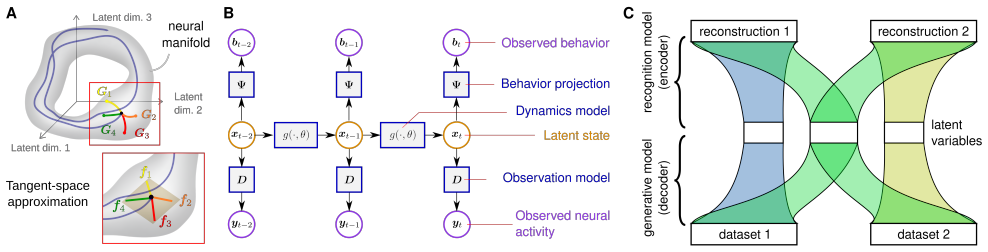
The load-bearing machinery is the latent-variable modeling framework for multi-dataset neural data. In this view, observable activity $x(t)$ is generated from low-dimensional latents $z(t)$ through a (possibly nonlinear) readout $x(t)=\Phi(z(t))$, and the goal is to decompose the latent space into modular operators and into shared versus private components across views. One concrete instance, decomposed linear dynamical systems (dLDS), represents dynamics as paths on a manifold whose tangent spaces are spanned by a sparse set of linear operators $\{G_k\}$, each operator corresponding to a distinct interaction module. The same shared/private separation underlies multi-modal fusion, where the latent state splits as $z \to \{z_s, z_1, z_2\}$. The paper uses this framework to state both the promise and the challenge: modularity must be built into the model, and without it, nonlinear latent dynamics are unidentifiable up to invertible transformations.
What would settle it
Collect a large-scale dataset that combines calcium or voltage imaging across several brain areas with detailed behavior in the same animals across multiple distinct tasks, then fit a shared/private latent-dynamics model; if the inferred modules do not stabilize across task sets or cannot be aligned across animals, the central premise that the functional architecture is discoverable from current observational data fails.
Extended reading notes
Core claim
The paper's central claim is that the brain's functional architecture can be discovered from data that now exist. While anatomically defined regions provide a hardware map, functional architecture refers to where and how information spreads and transforms across widely distributed circuits; the paper cites evidence that activity is 'everywhere' and that no strict anatomical boundary predicts function. To find that architecture, the author argues, models must explicitly learn modular dynamics rather than treating all recorded units as one shared state space, and must separate shared from private information when fusing data from different tasks, animals, and modalities. The paper also flags the central mathematical obstacle, in Section 4: when latent dynamics are nonlinear, models are unidentifiable up to an arbitrary invertible transformation, so interpretable discovery requires additional structure or constraints.
Load-bearing premise
The program depends on the assumption that functional modules leave stable, separable signatures across the tasks, animals, and recording modalities available today, even though the paper itself concedes that nonlinear latent dynamics can be transformed arbitrarily without changing the data it produces.
Editorial extensions
If this is right
- Brain-wide recordings across multiple tasks will reveal functional modules that are invisible in single-task studies, because distinct systems are recruited together in one task and separately in another.
- Models that explicitly separate shared and private information across modalities will prevent erroneous scientific conclusions about shared brain function caused by information leakage.
- Data geometry—curvature and tangent-space structure of neural manifolds—will become a primary language for linking dynamics, behavior, and brain-wide recordings.
- Interpretable models, rather than black-box ANN predictors, are required because scientific discovery needs extrapolation beyond the training domain, not just accurate interpolation.
- If the program succeeds, disorders such as neurodegeneration and psychiatric disease can be understood as changes in the functional architecture, not just as localized region-specific activity changes.
Reading between the lines
- The paper's own unidentifiability caveat suggests a testable criterion: if a functional architecture is real, the modules recovered under different inductive biases (sparsity, independence, geometry) should converge; if they diverge, the data alone do not pin down the architecture.
- A next step the paper leaves implicit is causal validation: inferred modules from observational recordings could be tested with targeted perturbations (e.g., optogenetics or lesions) to see whether they are functionally necessary.
- If the multi-task RNN results generalize, training recurrent networks on the same task battery as animals should produce internal modules whose structure parallels the brain's, providing a fast testbed for model interpretability before invasive experiments.
- The 'everything is everywhere' evidence implies that a functional atlas based on latent dynamics might generalize across individuals better than an anatomical atlas, which would be a direct test when comparing healthy and diseased populations.
Editorial analysis
A structured set of objections, weighed in public.
Referee Report
Summary. This manuscript is a perspective/position paper arguing that advances in large-scale neural recording, behavioral monitoring, and multi-modal imaging have created an opportunity to move from 'local' systems neuroscience to a 'global' account of the brain's functional architecture. The author proposes that by synthesizing data across brain areas, tasks, and modalities, and by using interpretable mathematical models with explicit modular or latent-state structure, the field can discover the distributed subsystems of brain computation and their interactions. The paper surveys relevant modeling approaches (e.g., dLDS, manifold methods, shared/private latent-variable models, multi-view fusion) and lists challenges: data alignment, task diversity, interpretability versus expressivity, and the non-identifiability of nonlinear latent dynamics. It concludes with a call for interpretable AI, data geometry, sparsity, and independent representations as guiding themes.
Significance. If the central claim is correct, the paper identifies a timely and practically important research direction: moving from anatomy-centric descriptions to data-driven maps of functional circuits. The manuscript has the merit of naming concrete technical hurdles—cross-session and cross-animal alignment, shared-versus-private latent structure, and the expressivity/interpretability trade-off—and of pointing to a set of recent methods as initial steps. It is also candid in explicitly acknowledging the non-identifiability of nonlinear latent dynamics, which many similar programmatic papers omit. However, the paper is an opinion piece without new data, derivations, or simulations, and its central assertion that current or imminent datasets will allow discovery of the functional architecture is not backed by a formal argument. The significance therefore rests on whether the identified obstacles can be resolved, especially the identifiability problem, which the manuscript does not address beyond listing it as a challenge.
major comments (2)
- [Section 4] The paper's central claim that new multi-area, multi-task, multi-modal data will allow discovery of the brain's functional architecture is not reconciled with the non-identifiability result stated in Section 4. There, the author correctly notes that for nonlinear latent dynamics z_t = g(z_{t-1}) and nonlinear emissions x_t = Φ(z_t), any invertible h yields an equally valid solution (Φ∘h, h^{-1}∘g∘h, h^{-1}(z_t)). Since the proposed 'functional architecture' is defined on latent states, the number of modules, their boundaries, and their interaction graph are all invariant under this reparameterization. The paper acknowledges that 'theoretical advances are needed' but does not explain what those advances would be; the concluding appeal to sparsity, independence, and geometry is not connected to any identifiability theorem. Without either restricting the model class (e.g., identifiable nonlinear ICA with auxiliary variables), invoking interventions or perturbations, or explicitly reframing the goal as discovering an equivalence class of architectures, the abstract's claim that the data are 'needed to find' the architecture overstates what observational recordings alone can deliver.
- [Section 3] The argument that synthesizing data across tasks will differentiate between co-active systems is presented only through an intuitive example (reaction task versus decision task). The manuscript does not state what conditions on the task set, behavioral coverage, or neural-population overlap would make such differentiation possible, nor does it show that any existing or planned dataset satisfies those conditions. As written, the claim that multi-task data will reveal shared versus private systems is an assertion, not a demonstrated research conclusion. The authors should either temper the claim or provide concrete criteria—for example, the number and type of tasks needed to decorrelate system engagement—so that the opportunity statement is falsifiable.
minor comments (5)
- [Abstract] Typographical errors: 'moleclular' should be 'molecular', and 'inmodality' should be 'in modality'.
- [Section 4] The notation for the transformed latent variable is confusing: 'gz(t) = h^{-1}(z(t))' should be written as a new latent variable, e.g., \tilde z(t) = h^{-1}(z(t)), with corresponding definitions \tilde Φ = Φ∘h and \tilde g = h^{-1}∘g∘h. As printed, 'gz(t)' looks like another dynamical map rather than the transformed state.
- [Section 5] In the sentence defining multi-modal readouts, 'x2 = f2(x2)' should read 'x2 = f2(z)'.
- [Section 5] 'Sythesizing' should be 'Synthesizing'.
- [General] The paper uses 'functional architecture' as a central term but never defines it operationally. Even a working definition—e.g., a partition of latent variables into modules with specified interactions—would help the reader understand what kind of evidence would confirm or refute a proposed architecture.
Circularity Check
No significant circularity: the paper is a perspective with no fitted prediction or derived quantity; self-citations are illustrative, and the identifiability concession in Section 4 is a stated limitation rather than a circular step.
full rationale
This is a perspective/roadmap paper, not a derivation. Its central claim is an opportunity statement: improvements in recording technology and behavioral monitoring now make it plausible to discover the brain's functional architecture from large-scale, multi-area, multi-task, multi-modal data. No quantity is fitted and then renamed as a prediction, no theorem is proved from assumptions that include the conclusion, and no equation is defined in terms of its own target. The author cites several prior works in which they were involved (dLDS, GRAFT, SIBBLINGS, CREIMBO, SVAE, butterfly architectures, and others), but these citations serve as examples of existing modeling approaches that motivate the research agenda; the agenda does not stand or fall on the correctness of any single cited method, and none of the cited works is invoked as an external uniqueness theorem that forbids alternatives. Section 4 does explicitly concede that nonlinear latent dynamics with nonlinear emissions are identifiable only up to an invertible transformation h, writing that one can define Phi-tilde, g-tilde, and z-tilde that describe the data equally well. This is an honest statement of a key limitation of the proposed program, and it undercuts the strength of the central optimism, but it is not circular: it does not assume what it sets out to show, and it does not dress an input as an output. Therefore, under the rule that self-citation is not circularity unless load-bearing, the appropriate finding is no significant circularity.
Assumptions & free parameters
assumptions (4)
- domain assumption Current neural recording and behavioral monitoring data are approaching sufficiency for discovering the brain's functional architecture.
- domain assumption Distinct functional modules exist and can be recovered from task variation as shared and private latent factors.
- domain assumption Geometric methods such as tangent-space decompositions (dLDS) provide a valid description of modular neural dynamics.
- domain assumption The unidentifiability of nonlinear latent models can be overcome by geometry, sparsity, or independence constraints.
Cite this review
Pith. "Pith review of Data mining the functional architecture of the brain's circuitry." pith.science (2026). https://pith.science/paper/FGMWXFOH
@misc{pith2026250109684,
  author       = {Pith},
  title        = {Pith review of: Data mining the functional architecture of the brain's circuitry},
  year         = {2026},
  howpublished = {\url{https://pith.science/paper/FGMWXFOH}},
  note         = {Machine review of arXiv:2501.09684}
}
read the original abstract
The brain is a highly complex organ consisting of a myriad of subsystems that flexibly interact and adapt over time and context to enable perception, cognition, and behavior. Understanding the multi-scale nature of the brain, i.e., how circuit- and moleclular-level interactions build up the fundamental components of brain function, holds incredible potential for developing interventions for neurodegenerative and psychiatric diseases, as well as open new understanding into our very nature. Historically technological limitations have forced systems neuroscience to be local in anatomy (localized, small neural populations in single brain areas), in behavior (studying single tasks), in time (focusing on specific stages of learning or development), and in modality (focusing on imaging single biological quantities). New developments in neural recording technology and behavioral monitoring now provide the data needed to break free of local neuroscience to global neuroscience: i.e., understanding how the brain's many subsystem interact, adapt, and change across the multitude of behaviors animals and humans must perform to thrive. Specifically, while we have much knowledge of the anatomical architecture of the brain (i.e., the hardware), we finally are approaching the data needed to find the functional architecture and discover the fundamental properties of the software that runs on the hardware. We must take this opportunity to bridge between the vast amounts of data to discover this functional architecture which will face numerous challenges from low-level data alignment up to high level questions of interpretable mathematical models of behavior that can synthesize the myriad of datasets together.
Figures

Reference graph
Works this paper leans on
-
[1]
Relating represen- tational geometry to cortical geometry in the visual cortex
Francisco Acosta, Colin Conwell, Sophia Sanborn, David Klindt, and Nina Miolane. Relating represen- tational geometry to cortical geometry in the visual cortex. NeurIPS Workshop on Unifying Representa- tions, 2023
work page 2023
-
[2]
Deep canonical correlation analysis
Galen Andrew, Raman Arora, Jeff Bilmes, and Karen Livescu. Deep canonical correlation analysis. In International conference on machine learning , pages 1247–1255. PMLR, 2013
work page 2013
-
[3]
Lan- guage processing in the occipital cortex of congenitally blind adults
Marina Bedny, Alvaro Pascual-Leone, David Dodell- Feder, Evelina Fedorenko, and Rebecca Saxe. Lan- guage processing in the occipital cortex of congenitally blind adults. Proceedings of the National Academy of Sciences, 108(11):4429–4434, 2011
work page 2011
-
[4]
Review of data processing of func- tional optical microscopy for neuroscience
Hadas Benisty, Alexander Song, Gal Mishne, and Adam S Charles. Review of data processing of func- tional optical microscopy for neuroscience. Neuropho- tonics, 9(4):041402–041402, 2022
work page 2022
-
[5]
Sufficient and Necessary Explanations (and What Lies in Between)
Beepul Bharti, Paul Yi, and Jeremias Sulam. Sufficient and necessary explanations (and what lies in between). arXiv preprint arXiv:2409.20427 , 2024
work page Pith review arXiv 2024
-
[6]
Coordinated cross- brain activity during accumulation of sensory evidence and decision commitment
Adrian G Bondy, Julie A Charlton, Thomas Zhihao Luo, Charles D Kopec, Wynne M Stagnaro, Sarah Jo C Venditto, Laura Lynch, Sanjeev Janarthanan, Stefan N Oline, Timothy D Harris, et al. Coordinated cross- brain activity during accumulation of sensory evidence and decision commitment. bioRxiv, pages 2024–08, 2024
work page 2024
-
[7]
Understanding disentangling in β-vae
Christopher P Burgess, Irina Higgins, Arka Pal, Loic Matthey, Nick Watters, Guillaume Desjardins, and Alexander Lerchner. Understanding disentangling in β-vae. arXiv preprint arXiv:1804.03599 , 2018
arXiv 2018
-
[8]
Graft: Graph filtered temporal dictionary learning for functional neural imaging
Adam S Charles, Nathan Cermak, Rifqi O Affan, Benjamin B Scott, Jackie Schiller, and Gal Mishne. Graft: Graph filtered temporal dictionary learning for functional neural imaging. IEEE Transactions on Image Processing, 31:3509–3524, 2022
work page 2022
Show all 45 references
-
[9]
Toward community-driven big open brain sci- ence: open big data and tools for structure, function, and genetics
Adam S Charles, Benjamin Falk, Nicholas Turner, et al. Toward community-driven big open brain sci- ence: open big data and tools for structure, function, and genetics. Annual review of neuroscience , 43:441– 464, 2020
2020
-
[10]
Brain-wide neural activity underlying memory-guided movement
Susu Chen, Yi Liu, Ziyue Aiden Wang, Jennifer Colonell, Liu D Liu, Han Hou, Nai-Wen Tien, Tim Wang, Timothy Harris, Shaul Druckmann, et al. Brain-wide neural activity underlying memory-guided movement. Cell, 187(3):676–691, 2024
2024
-
[11]
Neural population dy- namics during reaching
Mark M Churchland, John P Cunningham, Matthew T Kaufman, Justin D Foster, Paul Nuyujukian, Stephen I Ryu, and Krishna V Shenoy. Neural population dy- namics during reaching. Nature, 487(7405):51–56, 2012
2012
-
[12]
High-speed, cortex-wide volumetric recording of neuroactivity at cellular resolution using light beads microscopy
Jeffery Demas, Jason Manley, Frank Tejera, Hyewon Kim, Francisca Martinez Traub, Brandon Chen, and Alipasha Vaziri. High-speed, cortex-wide volumetric recording of neuroactivity at cellular resolution using light beads microscopy. bioRxiv, 2021
2021
-
[13]
Flexible multitask computation in recurrent networks utilizes shared dynamical motifs
Laura N Driscoll, Krishna Shenoy, and David Sussillo. Flexible multitask computation in recurrent networks utilizes shared dynamical motifs. Nature Neuroscience, 27(7):1349–1363, 2024
2024
-
[14]
Explainable ai (xai): Core ideas, techniques, and solutions
Rudresh Dwivedi, Devam Dave, Het Naik, Smiti Sing- hal, Rana Omer, Pankesh Patel, Bin Qian, Zhenyu Wen, Tejal Shah, Graham Morgan, et al. Explainable ai (xai): Core ideas, techniques, and solutions. ACM Computing Surveys , 55(9):1–33, 2023
2023
-
[15]
Chronic brain functional ultrasound imaging in freely moving rodents performing cognitive tasks
Ahmed El Hady, Daniel Takahashi, Ruolan Sun, Oluwateniola Akinwale, Tyler Boyd-Meredith, Yisi Zhang, Adam S Charles, and Carlos D Brody. Chronic brain functional ultrasound imaging in freely moving rodents performing cognitive tasks. Journal of neuro- science methods, 403:110033, 2024
2024
-
[16]
Sparse- coding variational autoencoders
Victor Geadah, Gabriel Barello, Daniel Greenidge, Adam S Charles, and Jonathan W Pillow. Sparse- coding variational autoencoders. Neural Computation, pages 1–31, 2024
2024
-
[17]
Multi-modal gaussian process variational autoencoders for neural and behavioral data
Rabia Gondur, Usama Bin Sikandar, Evan Schaf- fer, Mikio Christian Aoi, and Stephen L Keeley. Multi-modal gaussian process variational autoencoders for neural and behavioral data. arXiv preprint arXiv:2310.03111, 2023
2023
-
[18]
Canonical correlation analysis: An overview with application to learning methods
David R Hardoon, Sandor Szedmak, and John Shawe- Taylor. Canonical correlation analysis: An overview with application to learning methods. Neural compu- tation, 16(12):2639–2664, 2004
2004
-
[19]
Fully integrated silicon probes for high-density recording of neural activity
James J Jun, Nicholas A Steinmetz, Joshua H Siegle, et al. Fully integrated silicon probes for high-density recording of neural activity. Nature, 551(7679):232, 2017
2017
-
[20]
Dissociated functional signifi- cance of decision-related activity in the primate dorsal stream
Leor N Katz, Jacob L Yates, Jonathan W Pillow, and Alexander C Huk. Dissociated functional signifi- cance of decision-related activity in the primate dorsal stream. Nature, 535(7611):285–288, 2016
2016
-
[21]
Sequential and ef- ficient neural-population coding of complex task infor- mation
Sue Ann Koay, Adam S Charles, Stephan Y Thiberge, Carlos Brody, and David W Tank. Sequential and ef- ficient neural-population coding of complex task infor- mation. bioRxiv, page 801654, 2021
2021
-
[22]
Unsupervised discovery of the shared and private geometry in multi-view data
Sai Koukuntla, Joshua B Julian, Jesse C Kaminsky, Manuel Schottdorf, David W Tank, Carlos D Brody, and Adam S Charles. Unsupervised discovery of the shared and private geometry in multi-view data. arXiv preprint arXiv:2408.12091, 2024
2024
-
[23]
Learning the ge- ometry of common latent variables using alternating- diffusion
Roy R Lederman and Ronen Talmon. Learning the ge- ometry of common latent variables using alternating- diffusion. Applied and Computational Harmonic Anal- ysis, 44(3):509–536, 2018
2018
-
[24]
Bayesian learning and inference in recurrent switching linear dy- namical systems
Scott Linderman, Matthew Johnson, Andrew Miller, Ryan Adams, David Blei, and Liam Paninski. Bayesian learning and inference in recurrent switching linear dy- namical systems. In Artificial intelligence and statis- tics, pages 914–922. PMLR, 2017
2017
-
[25]
Decomposed lin- ear dynamical systems (dlds) for learning the latent components of neural dynamics
Noga Mudrik, Yenho Chen, Eva Yezerets, Christo- pher J Rozell, and Adam S Charles. Decomposed lin- ear dynamical systems (dlds) for learning the latent components of neural dynamics. Journal of Machine Learning Research, 25(59):1–44, 2024
2024
-
[26]
Creimbo: Cross ensemble interactions in multi-view brain observations
Noga Mudrik, Ryan Ly, Oliver Ruebel, and Adam S Charles. Creimbo: Cross ensemble interactions in multi-view brain observations. arXiv preprint arXiv:2405.17395, 2024
2024 arXiv
-
[27]
Sibblings: Similarity-driven building-block inference using graphs across states
Noga Mudrik, Gal Mishne, and Adam S Charles. Sibblings: Similarity-driven building-block inference using graphs across states. International Conference on Machine Learning (ICML) , 2024
2024
-
[28]
Using deeplabcut for 3d markerless pose esti- mation across species and behaviors
Tanmay Nath, Alexander Mathis, An Chi Chen, Amir Patel, Matthias Bethge, and Mackenzie Weygandt Mathis. Using deeplabcut for 3d markerless pose esti- mation across species and behaviors. Nature protocols, 14(7):2152–2176, 2019
2019
-
[29]
Sleap: Multi- animal pose tracking
Talmo D Pereira, Nathaniel Tabris, Junyu Li, Shruthi Ravindranath, Eleni S Papadoyannis, Z Yan Wang, David M Turner, Grace McKenzie-Smith, Sarah D Kocher, Annegret L Falkner, et al. Sleap: Multi- animal pose tracking. BioRxiv, pages 2020–08, 2020
2020
-
[30]
Rethinking brain-wide interactions through multi-region ‘network of networks’ models
Matthew G Perich and Kanaka Rajan. Rethinking brain-wide interactions through multi-region ‘network of networks’ models. Current opinion in neurobiology , 65:146–151, 2020
2020
-
[31]
Spatio-temporal correlations and visual signalling in a complete neuronal population
Jonathan W Pillow, Jonathon Shlens, Liam Paninski, Alexander Sher, Alan M Litke, EJ Chichilnisky, and Eero P Simoncelli. Spatio-temporal correlations and visual signalling in a complete neuronal population. Nature, 454(7207):995–999, 2008
2008
-
[32]
Neural signal propagation atlas of caenorhabditis elegans
Francesco Randi, Anuj K Sharma, Sophie Dvali, and Andrew M Leifer. Neural signal propagation atlas of caenorhabditis elegans. Nature, 623(7986):406–414, 2023
2023
-
[33]
A general framework for parallel distributed processing
David E Rumelhart, Geoffrey E Hinton, James L McClelland, et al. A general framework for parallel distributed processing. Parallel distributed processing: Explorations in the microstructure of cognition , 1(45- 76):26, 1986
1986
-
[34]
Mod- eling behaviorally relevant neural dynamics enabled by preferential subspace identification
Omid G Sani, Hamidreza Abbaspourazad, Yan T Wong, Bijan Pesaran, and Maryam M Shanechi. Mod- eling behaviorally relevant neural dynamics enabled by preferential subspace identification. Nature Neu- roscience, 24(1):140–149, 2021
2021
-
[35]
A. Song, A. S. Charles, S. A. Koay, J. L. Gauthier, S. Y. Thiberge, J. W. Pillow, and D. W. Tank. Volumet- ric two-photon imaging of neurons using stereoscopy (vTwINS). Nature methods, 14(4):420, 2017
2017
-
[36]
Distributed cod- ing of choice, action and engagement across the mouse brain
Nicholas A Steinmetz, Peter Zatka-Haas, Matteo Carandini, and Kenneth D Harris. Distributed cod- ing of choice, action and engagement across the mouse brain. Nature, 576(7786):266–273, 2019
2019
-
[37]
How advances in neural recording affect data analysis
Ian H Stevenson and Konrad P Kording. How advances in neural recording affect data analysis. Nature neuro- science, 14(2):139–142, 2011
2011
-
[38]
Building compositional tasks with shared neural sub- spaces
Sina Tafazoli, Flora M Bouchacourt, Adel Ardalan, Nikola T Markov, Motoaki Uchimura, Marcelo G Mat- tar, Nathaniel D Daw, and Timothy J Buschman. Building compositional tasks with shared neural sub- spaces. bioRxiv, 2024
2024
-
[39]
Fast hierarchical games for image explanations
Jacopo Teneggi, Alexandre Luster, and Jeremias Su- lam. Fast hierarchical games for image explanations. IEEE Transactions on Pattern Analysis and Machine Intelligence, 45(4):4494–4503, 2022
2022
-
[40]
Disentangling representations in rnns through multi- task learning
Pantelis Vafidis, Aman Bhargava, and Antonio Rangel. Disentangling representations in rnns through multi- task learning. arXiv preprint arXiv:2407.11249 , 2024
2024 arXiv
-
[41]
Real-time volumetric mi- croscopy of in vivo dynamics and large-scale samples with scape 2.0
Venkatakaushik Voleti, Kripa B Patel, Wenze Li, Cit- lali Perez Campos, Srinidhi Bharadwaj, Hang Yu, Caitlin Ford, Malte J Casper, Richard Wenwei Yan, Wenxuan Liang, et al. Real-time volumetric mi- croscopy of in vivo dynamics and large-scale samples with scape 2.0. Nature met...
2019
-
[42]
Deep graph pose: a semi-supervised deep graphical model for improved animal pose track- ing
Anqi Wu, Estefany Kelly Buchanan, Matthew White- way, Michael Schartner, Guido Meijer, Jean-Paul Noel, Erica Rodriguez, Claire Everett, Amy Norovich, Evan Schaffer, et al. Deep graph pose: a semi-supervised deep graphical model for improved animal pose track- ing. Advances in ...
2020
-
[43]
De- composed linear dynamical systems (dlds) models re- veal context-dependent dynamic connectivity in c
Eva Yezerets, Noga Mudrik, and Adam Charles. De- composed linear dynamical systems (dlds) models re- veal context-dependent dynamic connectivity in c. ele- gans. bioRxiv, pages 2024–05, 2024
2024
-
[44]
Extracting dynamical structure embedded in neural ac- tivity
Byron M Yu, Afsheen Afshar, Gopal Santhanam, Stephen Ryu, Krishna V Shenoy, and Maneesh Sahani. Extracting dynamical structure embedded in neural ac- tivity. Advances in neural information processing sys- tems, 18, 2005
2005
-
[45]
Large-scale two-photon calcium imaging in freely moving mice
Weijian Zong, Horst A Obenhaus, Emilie R Skytøen, Hanna Eneqvist, Nienke L de Jong, Ruben Vale, Marina R Jorge, May-Britt Moser, and Edvard I Moser. Large-scale two-photon calcium imaging in freely moving mice. Cell, 185(7):1240–1256, 2022
2022
Reviewed August 10, 2026 · model on record in the stance chip above.
Discussion (0). Continue with ORCID to comment.