Using graph neural networks to predict many-body interactions in amorphous materials
Pith reviewed 2026-06-28 20:22 UTC · model grok-4.3
The pith
Graph neural network trained only on high-energy configurations reproduces DFT energies and recovers experimental equilibrium structures in polymer-grafted nanoparticle glasses.
A machine-rendered reading of the paper's core claim, the machinery that carries it, and where it could break.
Core claim
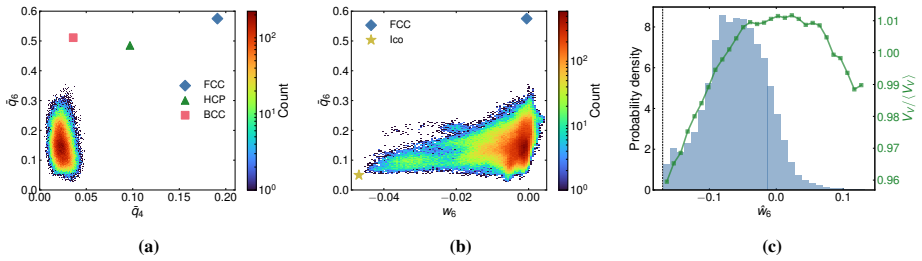
NequIP, an equivariant message-passing graph neural network, learns the high-dimensional, rugged potential energy landscape of solvent-free polymer-grafted nanoparticles and reproduces classical DFT energies across a range of PGN design parameters at four orders of magnitude lower cost. GNN-driven Monte Carlo simulations reveal locally favored icosahedral-like structures at equilibrium and recover equilibrium structures in agreement with experiments, despite the network being trained only on high-energy, out-of-equilibrium configurations.
What carries the argument
NequIP, an equivariant message-passing graph neural network that maps atomic configurations to many-body interaction energies.
If this is right
- The network reproduces DFT energies across a range of PGN design parameters at four orders of magnitude lower cost.
- Systematic hyperparameter analysis yields physical insights into the range, anisotropy, and effective body order of the interactions.
- GNN-driven Monte Carlo simulations recover equilibrium structures containing locally favored icosahedral-like arrangements.
- These simulated equilibrium structures agree with experimental observations.
Where Pith is reading between the lines
- If the approach holds, similar networks could be trained on limited high-energy data to explore equilibrium properties in other solvent-free or crowded soft-matter systems where direct equilibrium sampling is expensive.
- The learned effective interactions might be inspected to test whether they recover known angular forms predicted by polymer physics for chain-mediated forces.
- One could check whether the same network architecture, without retraining, transfers to related amorphous systems such as metallic glasses mentioned in the introduction.
Load-bearing premise
A graph neural network trained exclusively on high-energy out-of-equilibrium configurations will generalize to predict the lower-energy equilibrium structures and dynamics that match experiments.
What would settle it
If Monte Carlo simulations driven by the trained network produced pair-correlation functions or coordination statistics that differed measurably from experimental data on the same polymer-grafted nanoparticle systems, the generalization claim would be falsified.
Figures

read the original abstract
Many-body interactions govern the complex behavior of many amorphous materials, from metallic glasses to biological tissues, yet are often replaced by pairwise additive frameworks for computational efficiency. Here, we use classical density functional theory (DFT) to study a model soft glass of solvent-free polymer-grafted nanoparticles (PGNs), where the absence of solvent forces grafted chains to uniformly fill the interstitial space, generating strong angular-dependent many-body interactions between the cores. We show that NequIP, an equivariant message-passing graph neural network (GNN), learns the high-dimensional, rugged potential energy landscape of the system and reproduces classical DFT energies across a range of PGN design parameters at four orders of magnitude lower cost. Systematic analysis of GNN hyperparameters offers physical insights into the range, anisotropy, and effective body order of interactions. GNN-driven Monte Carlo simulations reveal locally favored icosahedral-like structures at equilibrium, and strikingly, recover equilibrium structures in agreement with experiments, despite the network being trained only on high-energy, out-of-equilibrium configurations.
Editorial analysis
A structured set of objections, weighed in public.
Referee Report
Summary. The manuscript claims that an equivariant message-passing graph neural network (NequIP) trained on classical DFT calculations of high-energy, out-of-equilibrium configurations of solvent-free polymer-grafted nanoparticles (PGNs) can accurately reproduce the many-body potential energy landscape. This enables four-orders-of-magnitude faster energy evaluations across PGN design parameters, yields physical insights from hyperparameter analysis into interaction range and body order, and allows GNN-driven Monte Carlo simulations to recover equilibrium structures (including locally favored icosahedral motifs) that agree with experiments despite the training data being restricted to high-energy states.
Significance. If the central generalization result holds, the work would demonstrate a practical route to surrogate modeling of rugged many-body landscapes in amorphous materials, enabling larger-scale simulations that were previously limited by DFT cost. The systematic hyperparameter study and the reported success of extrapolation from out-of-equilibrium training data would be notable strengths for the field of machine-learned interatomic potentials in disordered systems.
major comments (2)
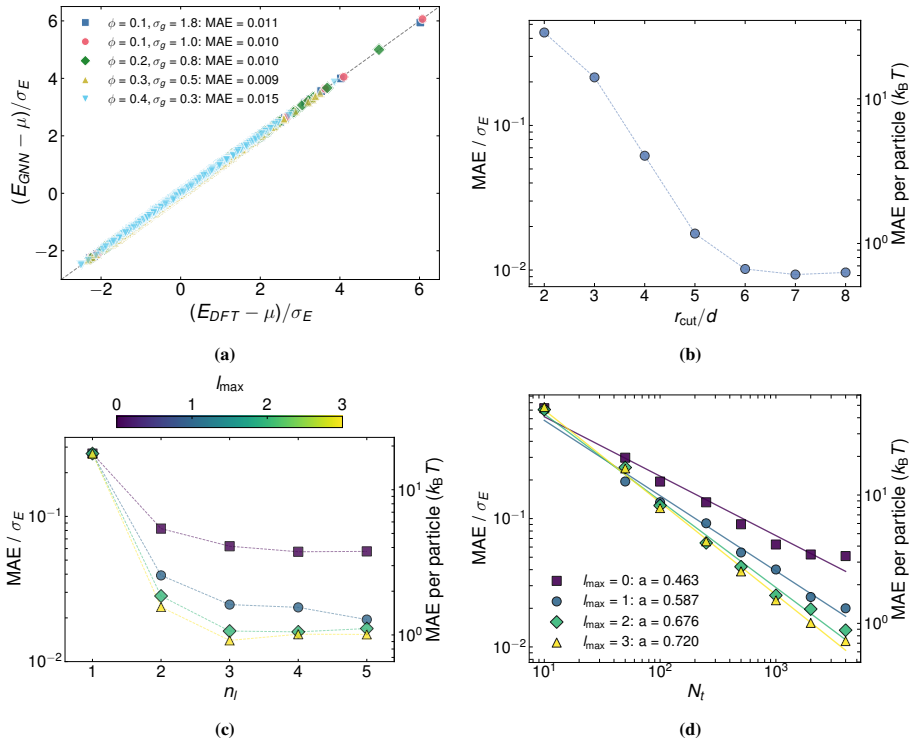
- [Abstract] Abstract: The claim that the GNN 'reproduces classical DFT energies' is presented without any quantitative error metrics (MAE, RMSE, or correlation coefficients), test-set details, or validation protocol. This information is load-bearing for the accuracy assertion and for the downstream claim that the learned potential supports reliable Monte Carlo sampling.
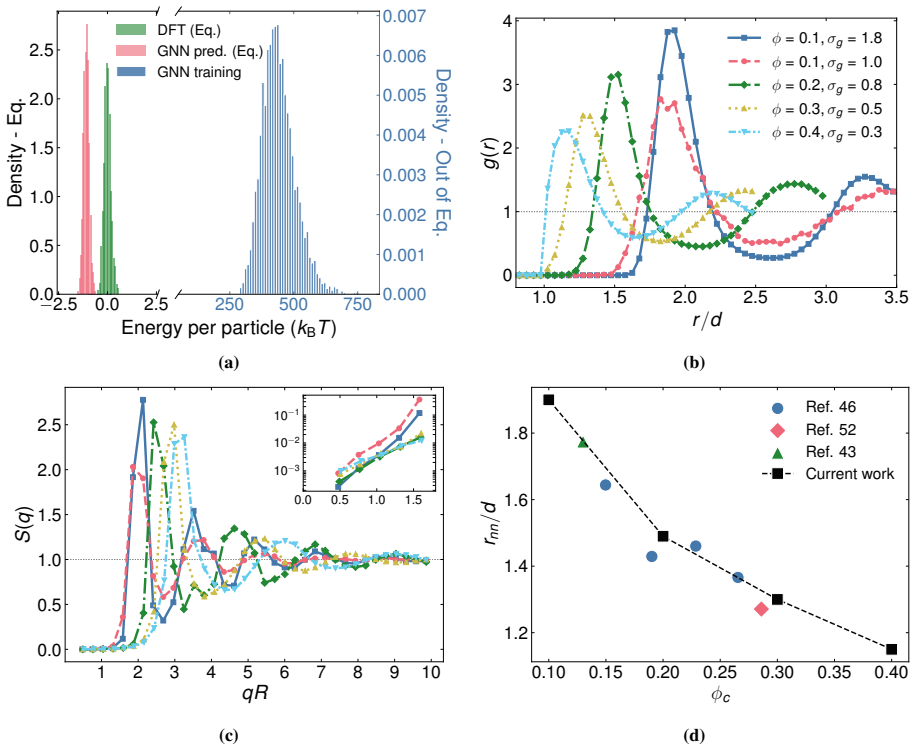
- [Abstract] Abstract (final sentence): The assertion that GNN-driven Monte Carlo recovers experimental equilibrium structures 'despite the network being trained only on high-energy, out-of-equilibrium configurations' is the central extrapolation result, yet the abstract supplies no hold-out comparison of GNN versus DFT energies on low-energy or equilibrated configurations, nor any structural metrics (e.g., g(r), structure factor) quantifying agreement with experiment. This gap directly affects the weakest assumption identified in the stress test.
minor comments (1)
- [Abstract] The abstract refers to 'systematic analysis of GNN hyperparameters' but does not indicate where in the manuscript the corresponding figures or tables appear; a forward reference would improve readability.
Simulated Author's Rebuttal
We thank the referee for their careful reading of the manuscript and for highlighting the need for quantitative support in the abstract. We address each comment below and will revise the abstract to incorporate the requested details from the main text.
read point-by-point responses
-
Referee: [Abstract] Abstract: The claim that the GNN 'reproduces classical DFT energies' is presented without any quantitative error metrics (MAE, RMSE, or correlation coefficients), test-set details, or validation protocol. This information is load-bearing for the accuracy assertion and for the downstream claim that the learned potential supports reliable Monte Carlo sampling.
Authors: We agree that the abstract would benefit from explicit quantitative metrics. The manuscript reports MAE, RMSE, and correlation coefficients on held-out test sets, together with the validation protocol, in the Results and Methods sections. We will revise the abstract to include a concise statement of these metrics and the test-set size. revision: yes
-
Referee: [Abstract] Abstract (final sentence): The assertion that GNN-driven Monte Carlo recovers experimental equilibrium structures 'despite the network being trained only on high-energy, out-of-equilibrium configurations' is the central extrapolation result, yet the abstract supplies no hold-out comparison of GNN versus DFT energies on low-energy or equilibrated configurations, nor any structural metrics (e.g., g(r), structure factor) quantifying agreement with experiment. This gap directly affects the weakest assumption identified in the stress test.
Authors: The main text presents GNN versus DFT energy comparisons across configurations and reports structural metrics (g(r) and structure factor) from the GNN-driven Monte Carlo runs that match experimental data. The structural agreement after equilibration provides indirect validation of the extrapolation to low-energy states. We will revise the abstract to reference these quantitative structural metrics and the reported energy accuracy on test sets. revision: yes
Circularity Check
No significant circularity; derivation relies on external DFT and experiments
full rationale
The paper trains NequIP on classical DFT energies (external ground truth) and validates GNN-driven MC structures against independent experiments. No equations, fitted parameters, or self-citations are shown that reduce the reported reproduction of DFT energies or experimental agreement to a tautology or input by construction. The generalization from high-energy training data to equilibrium is presented as an empirical result, not a definitional or self-referential step. This is self-contained against external benchmarks.
Axiom & Free-Parameter Ledger
axioms (2)
- domain assumption Equivariant message-passing graph neural networks can faithfully represent the potential energy surface of systems with angular many-body interactions.
- domain assumption Classical density functional theory provides a reliable reference for the many-body energies in solvent-free PGNs.
Reference graph
Works this paper leans on
-
[1]
The physics of higher-order interactions in complex systems.Nature physics, 17(10):1093–1098, 2021
Federico Battiston, Enrico Amico, Alain Barrat, Ginestra Bianconi, Guilherme Ferraz de Arruda, Benedetta Franceschiello, Iacopo Iacopini, Sonia Kéfi, Vito Latora, Yamir Moreno, et al. The physics of higher-order interactions in complex systems.Nature physics, 17(10):1093–1098, 2021
2021
-
[2]
Simplicial models of social contagion.Nature communications, 10(1):2485, 2019
Iacopo Iacopini, Giovanni Petri, Alain Barrat, and Vito Latora. Simplicial models of social contagion.Nature communications, 10(1):2485, 2019
2019
-
[3]
Higher-order interactions stabilize dynamics in competitive network models.Nature, 548(7666):210–213, 2017
Jacopo Grilli, György Barabás, Matthew J Michalska-Smith, and Stefano Allesina. Higher-order interactions stabilize dynamics in competitive network models.Nature, 548(7666):210–213, 2017
2017
-
[4]
Beyond pairwise mechanisms of species coexistence in complex communities.Nature, 546(7656):56–64, 2017
Jonathan M Levine, Jordi Bascompte, Peter B Adler, and Stefano Allesina. Beyond pairwise mechanisms of species coexistence in complex communities.Nature, 546(7656):56–64, 2017
2017
-
[5]
Many-bodyelectrostaticforcesbetweencolloidalparticles at vanishing ionic strength.Phys
JasonW.Merrill,SunilK.Sainis,andEricR.Dufresne. Many-bodyelectrostaticforcesbetweencolloidalparticles at vanishing ionic strength.Phys. Rev. Lett., 103:138301, Sep 2009
2009
-
[6]
Many-body effects in nanocrystal superlattices: departure from sphere packing explains stability of binary phases.Journal of the American Chemical Society, 137(13):4494–4502, 2015
Michael A Boles and Dmitri V Talapin. Many-body effects in nanocrystal superlattices: departure from sphere packing explains stability of binary phases.Journal of the American Chemical Society, 137(13):4494–4502, 2015
2015
-
[7]
Free-standing nanoparticle superlattice sheets controlled by dna.Nature materials, 8(6):519–525, 2009
Wenlong Cheng, Michael J Campolongo, Judy J Cha, Shawn J Tan, Christopher C Umbach, David A Muller, and Dan Luo. Free-standing nanoparticle superlattice sheets controlled by dna.Nature materials, 8(6):519–525, 2009
2009
-
[8]
Atomic level structure in multicomponent bulk metallic glass.Physical review letters, 102(24):245501, 2009
YQ Cheng, E Ma, and HW Sheng. Atomic level structure in multicomponent bulk metallic glass.Physical review letters, 102(24):245501, 2009
2009
-
[9]
Many-body interactions in soft jammed materials.Soft matter, 13(7):1371–1383, 2017
Reinhard Höhler and Sylvie Cohen-Addad. Many-body interactions in soft jammed materials.Soft matter, 13(7):1371–1383, 2017
2017
-
[10]
A density-independent rigidity transition in biological tissues.Nature Physics, 11(12):1074–1079, 2015
Dapeng Bi, JH Lopez, Jennifer M Schwarz, and M Lisa Manning. A density-independent rigidity transition in biological tissues.Nature Physics, 11(12):1074–1079, 2015
2015
-
[11]
Relation between the dynamics of glassy clusters and characteristic features of their energy landscape.Physical Review Letters, 112(8):083401, 2014
Sandip De, Bastian Schaefer, Ali Sadeghi, Michael Sicher, DG Kanhere, and Stefan Goedecker. Relation between the dynamics of glassy clusters and characteristic features of their energy landscape.Physical Review Letters, 112(8):083401, 2014
2014
-
[12]
Revealing key structural features hidden in liquids and glasses.Nature Reviews Physics, 1(5):333–348, 2019
Hajime Tanaka, Hua Tong, Rui Shi, and John Russo. Revealing key structural features hidden in liquids and glasses.Nature Reviews Physics, 1(5):333–348, 2019
2019
-
[13]
Infinitely rugged intra-cage potential energy landscape in metallic glasses caused by many-body interaction.Materials Today Physics, 49:101582, 2024
Haoyu Li, Hongyi Xiao, Takeshi Egami, and Yue Fan. Infinitely rugged intra-cage potential energy landscape in metallic glasses caused by many-body interaction.Materials Today Physics, 49:101582, 2024
2024
-
[14]
Generalized neural-network representation of high-dimensional potential- energy surfaces.Physical review letters, 98(14):146401, 2007
Jörg Behler and Michele Parrinello. Generalized neural-network representation of high-dimensional potential- energy surfaces.Physical review letters, 98(14):146401, 2007
2007
-
[15]
On representing chemical environments.Physical Review B—Condensed Matter and Materials Physics, 87(18):184115, 2013
Albert P Bartók, Risi Kondor, and Gábor Csányi. On representing chemical environments.Physical Review B—Condensed Matter and Materials Physics, 87(18):184115, 2013
2013
-
[16]
Atomic cluster expansion for accurate and transferable interatomic potentials.Physical Review B, 99(1):014104, 2019
Ralf Drautz. Atomic cluster expansion for accurate and transferable interatomic potentials.Physical Review B, 99(1):014104, 2019. 21
2019
-
[17]
Physics- inspired structural representations for molecules and materials.Chemical Reviews, 121(16):9759–9815, 2021
Felix Musil, Andrea Grisafi, Albert P Bartók, Christoph Ortner, Gábor Csányi, and Michele Ceriotti. Physics- inspired structural representations for molecules and materials.Chemical Reviews, 121(16):9759–9815, 2021
2021
-
[18]
Schnet–a deep learning architecture for molecules and materials.The Journal of chemical physics, 148(24), 2018
Kristof T Schütt, Huziel E Sauceda, P-J Kindermans, Alexandre Tkatchenko, and K-R Müller. Schnet–a deep learning architecture for molecules and materials.The Journal of chemical physics, 148(24), 2018
2018
-
[19]
Mace: Higherorderequivariant message passing neural networks for fast and accurate force fields.Advances in neural information processing systems, 35:11423–11436, 2022
IlyesBatatia,DavidPKovacs,GregorSimm,ChristophOrtner,andGáborCsányi. Mace: Higherorderequivariant message passing neural networks for fast and accurate force fields.Advances in neural information processing systems, 35:11423–11436, 2022
2022
-
[20]
E (3)-equivariant graph neural networks for data-efficient and accurate interatomic potentials.Nature communications, 13(1):2453, 2022
Simon Batzner, Albert Musaelian, Lixin Sun, Mario Geiger, Jonathan P Mailoa, Mordechai Kornbluth, Nicola Molinari, Tess E Smidt, and Boris Kozinsky. E (3)-equivariant graph neural networks for data-efficient and accurate interatomic potentials.Nature communications, 13(1):2453, 2022
2022
-
[21]
Learning local equivariant representations for large-scale atomistic dynamics.Nature Communications, 14(1):579, 2023
Albert Musaelian, Simon Batzner, Anders Johansson, Lixin Sun, Cameron J Owen, Mordechai Kornbluth, and Boris Kozinsky. Learning local equivariant representations for large-scale atomistic dynamics.Nature Communications, 14(1):579, 2023
2023
-
[22]
Viscous liquids and the glass transition: a potential energy barrier picture.The Journal of Chemical Physics, 51(9):3728–3739, 1969
Martin Goldstein. Viscous liquids and the glass transition: a potential energy barrier picture.The Journal of Chemical Physics, 51(9):3728–3739, 1969
1969
-
[23]
What does the potential energy landscape tell us about the dynamics<? format?> of supercooled liquids and glasses?Physical review letters, 91(23):235501, 2003
Burkhard Doliwa and Andreas Heuer. What does the potential energy landscape tell us about the dynamics<? format?> of supercooled liquids and glasses?Physical review letters, 91(23):235501, 2003
2003
-
[24]
Supercooled liquids and the glass transition.Nature, 410(6825):259– 267, 2001
Pablo G Debenedetti and Frank H Stillinger. Supercooled liquids and the glass transition.Nature, 410(6825):259– 267, 2001
2001
-
[25]
Relaxationdynamics in the energy landscape of glass-forming liquids.Physical Review X, 12(2):021001, 2022
YoshihikoNishikawa,MisakiOzawa,AtsushiIkeda,PinakiChaudhuri,andLudovicBerthier. Relaxationdynamics in the energy landscape of glass-forming liquids.Physical Review X, 12(2):021001, 2022
2022
-
[26]
Modern computational studies of the glass transition.Nature Reviews Physics, 5(2):102–116, 2023
Ludovic Berthier and David R Reichman. Modern computational studies of the glass transition.Nature Reviews Physics, 5(2):102–116, 2023
2023
-
[27]
Local vs
Massimo Pica Ciamarra, Wencheng Ji, and Matthieu Wyart. Local vs. cooperative: Unraveling glass transition mechanisms with seer.Proceedings of the National Academy of Sciences, 121(22):e2400611121, 2024
2024
-
[28]
How thermally activated deformation starts in metallic glass
Yue Fan, Takuya Iwashita, and Takeshi Egami. How thermally activated deformation starts in metallic glass. Nature communications, 5(1):5083, 2014
2014
-
[29]
KumpeiShiraishi,HideyukiMizuno,andAtsushiIkeda.Johari–goldstein 𝛽relaxationinglassydynamicsoriginates from two-scale energy landscape.Proceedings of the National Academy of Sciences, 120(14):e2215153120, 2023
2023
-
[30]
Theroleofexcitationsinsupercooledliquids: Density, geometry, and relaxation dynamics.Proceedings of the National Academy of Sciences, 122(11):e2416800122, 2025
WenchengJi,MassimoPicaCiamarra,andMatthieuWyart. Theroleofexcitationsinsupercooledliquids: Density, geometry, and relaxation dynamics.Proceedings of the National Academy of Sciences, 122(11):e2416800122, 2025
2025
-
[31]
Development of a neuroevolution machine learning potential of pd-cu-ni-p alloys.Materials & Design, 231:112012, 2023
Rui Zhao, Shucheng Wang, Zhuangzhuang Kong, Yunlei Xu, Kuan Fu, Ping Peng, and Cuilan Wu. Development of a neuroevolution machine learning potential of pd-cu-ni-p alloys.Materials & Design, 231:112012, 2023. 22
2023
-
[32]
Recent advances in metallic glasses.arXiv preprint arXiv:2512.16590, 2025
Silvia Bonfanti, Ralf Busch, Jesper Byggmästar, Jeppe C Dyre, Jürgen Eckert, Spencer Fajardo, Michael L Falk, Isabella Gallino, Jamie J Kruzic, Jiayin Lu, et al. Recent advances in metallic glasses.arXiv preprint arXiv:2512.16590, 2025
-
[33]
Anisotropic self-assembly of spherical polymer-grafted nanoparticles.Nature materials, 8(4):354–359, 2009
Pinar Akcora, Hongjun Liu, Sanat K Kumar, Joseph Moll, Yu Li, Brian C Benicewicz, Linda S Schadler, Devrim Acehan, Athanassios Z Panagiotopoulos, Victor Pryamitsyn, et al. Anisotropic self-assembly of spherical polymer-grafted nanoparticles.Nature materials, 8(4):354–359, 2009
2009
-
[34]
Nanocomposites with polymer grafted nanoparticles.Macromolecules, 46(9):3199–3214, 2013
Sanat K Kumar, Nicolas Jouault, Brian Benicewicz, and Tony Neely. Nanocomposites with polymer grafted nanoparticles.Macromolecules, 46(9):3199–3214, 2013
2013
-
[35]
A generalized machine- learning framework for developing alchemical many-body interaction models for polymer-grafted nanoparticles
Melody Yiyuan Zhang, Shih-Kuang Alex Lee, Sharon C Glotzer, and Rebecca K Lindsey. A generalized machine- learning framework for developing alchemical many-body interaction models for polymer-grafted nanoparticles. Journal of Chemical Theory and Computation, 21(19):9853–9867, 2025
2025
-
[36]
Modeling theanisotropicself-assemblyofsphericalpolymer-graftednanoparticles.TheJournalofchemicalphysics,131(22), 2009
VictorPryamtisyn, VenkatGanesan, AthanassiosZPanagiotopoulos, HongjunLiu, andSanatKKumar. Modeling theanisotropicself-assemblyofsphericalpolymer-graftednanoparticles.TheJournalofchemicalphysics,131(22), 2009
2009
-
[37]
Anisotropic three-particle interactions between spherical polymer-grafted nanoparticles in a polymer matrix.Macromolecules, 50(3):1167–1183, 2017
Tsung-Yeh Tang and Gaurav Arya. Anisotropic three-particle interactions between spherical polymer-grafted nanoparticles in a polymer matrix.Macromolecules, 50(3):1167–1183, 2017
2017
-
[38]
Many-bodypotentialfor simulating the self-assembly of polymer-grafted nanoparticles in a polymer matrix.npj Computational Materials, 9(1):224, 2023
YilongZhou,SigbjørnLølandBore,AndreaRTao,FrancescoPaesani,andGauravArya. Many-bodypotentialfor simulating the self-assembly of polymer-grafted nanoparticles in a polymer matrix.npj Computational Materials, 9(1):224, 2023
2023
-
[39]
Structural transitions of solvent-free oligomer-grafted nanoparticles.Physical review letters, 107(10):105503, 2011
Alexandros Chremos and Athanassios Z Panagiotopoulos. Structural transitions of solvent-free oligomer-grafted nanoparticles.Physical review letters, 107(10):105503, 2011
2011
-
[40]
Self-assembly of polymer-grafted nanoparticles in solvent-free conditions.Soft Matter, 12(47):9527–9537, 2016
Alexandros Chremos and Jack F Douglas. Self-assembly of polymer-grafted nanoparticles in solvent-free conditions.Soft Matter, 12(47):9527–9537, 2016
2016
-
[41]
Linking the rheology of thermal amorphous materials to molecular-scale physics.Journal of Fluid Mechanics, 1027:A32, 2026
Mehryar Jannesari Ghomsheh, Anubhab Roy, Donald L Koch, and Sarah Hormozi. Linking the rheology of thermal amorphous materials to molecular-scale physics.Journal of Fluid Mechanics, 1027:A32, 2026
2026
-
[42]
Strain-accelerated dynamics of soft colloidal glasses.Physical Review E—Statistical, Nonlinear, and Soft Matter Physics, 83(4):041402, 2011
Praveen Agarwal and Lynden A Archer. Strain-accelerated dynamics of soft colloidal glasses.Physical Review E—Statistical, Nonlinear, and Soft Matter Physics, 83(4):041402, 2011
2011
-
[43]
Microscopic origins of caging and equilibration of self-suspended hairy nanoparticles.Macromolecules, 52(21):8187–8196, 2019
Xiaotun Liu, Brooks A Abel, Qing Zhao, Shuke Li, Snehashis Choudhury, Jingxu Zheng, and Lynden A Archer. Microscopic origins of caging and equilibration of self-suspended hairy nanoparticles.Macromolecules, 52(21):8187–8196, 2019
2019
-
[44]
The ages in a self-suspended nanoparticle liquid.Nano letters, 10(1):111–115, 2010
Praveen Agarwal, Haibo Qi, and Lynden A Archer. The ages in a self-suspended nanoparticle liquid.Nano letters, 10(1):111–115, 2010
2010
-
[45]
Crowded, confined, and frustrated: dynamics of molecules tethered to nanoparticles.Physical review letters, 109(25):258301, 2012
Praveen Agarwal, Sung A Kim, and Lynden A Archer. Crowded, confined, and frustrated: dynamics of molecules tethered to nanoparticles.Physical review letters, 109(25):258301, 2012
2012
-
[46]
Self-suspended suspensions of covalently grafted hairy nanoparticles.Langmuir, 31(10):3222–3231, 2015
Snehashis Choudhury, Akanksha Agrawal, Sung A Kim, and Lynden A Archer. Self-suspended suspensions of covalently grafted hairy nanoparticles.Langmuir, 31(10):3222–3231, 2015. 23
2015
-
[47]
Hyperdiffusive dynamics in newtonian nanoparticle fluids.ACS Macro Letters, 4(10):1149–1153, 2015
SamanvayaSrivastava,PraveenAgarwal,RahulMangal,DonaldLKoch,SureshNarayanan,andLyndenAArcher. Hyperdiffusive dynamics in newtonian nanoparticle fluids.ACS Macro Letters, 4(10):1149–1153, 2015
2015
-
[48]
Dynamics and rheology of soft colloidal glasses.ACS Macro Letters, 4(1):119–123, 2015
Yu Ho Wen, Jennifer L Schaefer, and Lynden A Archer. Dynamics and rheology of soft colloidal glasses.ACS Macro Letters, 4(1):119–123, 2015
2015
-
[49]
Universal polymeric-to-colloidal transition in melts of hairy nanoparticles.ACS nano, 15(10):16697–16708, 2021
Daniele Parisi, Eileen Buenning, Nikolaos Kalafatakis, Leo Gury, Brian C Benicewicz, Mario Gauthier, Michel Cloitre, Michael Rubinstein, Sanat K Kumar, and Dimitris Vlassopoulos. Universal polymeric-to-colloidal transition in melts of hairy nanoparticles.ACS nano, 15(10):16697–16708, 2021
2021
-
[50]
Structure of solvent-free nanoparticle- organic hybrid materials.Langmuir, 26(22):16801–16811, 2010
Hsiu-Yu Yu and Donald L Koch. Structure of solvent-free nanoparticle- organic hybrid materials.Langmuir, 26(22):16801–16811, 2010
2010
-
[51]
Structurefactorofblendsofsolvent-free nanoparticle–organic hybrid materials: density-functional theory and small angle x-ray scattering.Soft Matter, 10(45):9120–9135, 2014
Hsiu-YuYu,SamanvayaSrivastava,LyndenAArcher,andDonaldLKoch. Structurefactorofblendsofsolvent-free nanoparticle–organic hybrid materials: density-functional theory and small angle x-ray scattering.Soft Matter, 10(45):9120–9135, 2014
2014
-
[52]
Self-suspended polymer grafted nanoparticles.Current opinion in chemical engineering, 16:92–101, 2017
Samanvaya Srivastava, Snehashis Choudhury, Akanksha Agrawal, and Lynden A Archer. Self-suspended polymer grafted nanoparticles.Current opinion in chemical engineering, 16:92–101, 2017
2017
-
[53]
Structure of solvent-free grafted nanoparticles: Molecular dynamics and density-functional theory.The Journal of chemical physics, 135(11), 2011
Alexandros Chremos, Athanassios Z Panagiotopoulos, Hsiu-Yu Yu, and Donald L Koch. Structure of solvent-free grafted nanoparticles: Molecular dynamics and density-functional theory.The Journal of chemical physics, 135(11), 2011
2011
-
[54]
Cambridge university press, 2020
Richard M Martin.Electronic structure: basic theory and practical methods. Cambridge university press, 2020
2020
-
[55]
The design space of e (3)-equivariant atom-centred interatomic potentials.Nature Machine Intelligence, 7(1):56–67, 2025
Ilyes Batatia, Simon Batzner, Dávid Péter Kovács, Albert Musaelian, Gregor NC Simm, Ralf Drautz, Christoph Ortner, Boris Kozinsky, and Gábor Csányi. The design space of e (3)-equivariant atom-centred interatomic potentials.Nature Machine Intelligence, 7(1):56–67, 2025
2025
-
[56]
Particlelocalizationandhyperuniformityofpolymer-graftednanoparticle materials.Annalen der Physik, 529(5):1600342, 2017
AlexandrosChremosandJackFDouglas. Particlelocalizationandhyperuniformityofpolymer-graftednanoparticle materials.Annalen der Physik, 529(5):1600342, 2017
2017
-
[57]
Bond-orientational order inliquids andglasses.Physical Review B, 28(2):784, 1983
PaulJ Steinhardt, David RNelson, and MarcoRonchetti. Bond-orientational order inliquids andglasses.Physical Review B, 28(2):784, 1983
1983
-
[58]
Accurate determination of crystal structures based on averaged local bond order parameters.The Journal of chemical physics, 129(11), 2008
Wolfgang Lechner and Christoph Dellago. Accurate determination of crystal structures based on averaged local bond order parameters.The Journal of chemical physics, 129(11), 2008
2008
-
[59]
Real-space structure of colloidal hard-sphere glasses.Science, 270(5239):1177–1179, 1995
Alfons Van Blaaderen and Pierre Wiltzius. Real-space structure of colloidal hard-sphere glasses.Science, 270(5239):1177–1179, 1995
1995
-
[60]
Roles of icosahedral and crystal-like order in the hard spheres glass transition.Nature communications, 3(1):974, 2012
Mathieu Leocmach and Hajime Tanaka. Roles of icosahedral and crystal-like order in the hard spheres glass transition.Nature communications, 3(1):974, 2012
2012
-
[61]
Emergence and persistence of flow inhomogeneities in the yielding and fluidization of dense soft solids.Physical Review E, 102(1):010604, 2020
Vishwas Venkatesh Vasisht, Gabrielle Roberts, and Emanuela Del Gado. Emergence and persistence of flow inhomogeneities in the yielding and fluidization of dense soft solids.Physical Review E, 102(1):010604, 2020
2020
-
[62]
Memory of shear flow in soft jammed materials.PNAS nexus, 3(10):pgae441, 2024
HA Vinutha, Manon Marchand, Marco Caggioni, Vishwas V Vasisht, Emanuela Del Gado, and Veronique Trappe. Memory of shear flow in soft jammed materials.PNAS nexus, 3(10):pgae441, 2024. 24
2024
-
[63]
Observation of five-fold local symmetry in liquid lead.Nature, 408(6814):839–841, 2000
H Reichert, O Klein, H Dosch, M Denk, V Honkimäki, T Lippmann, and G Reiter. Observation of five-fold local symmetry in liquid lead.Nature, 408(6814):839–841, 2000
2000
-
[64]
Is there icosahedral ordering in liquid and undercooled metals?Physical review letters, 91(13):135505, 2003
Andrea Di Cicco, Angela Trapananti, Silena Faggioni, and Adriano Filipponi. Is there icosahedral ordering in liquid and undercooled metals?Physical review letters, 91(13):135505, 2003
2003
-
[65]
Supercooling of liquids.Proceedings of the Royal Society of London
Frederick Charles Frank. Supercooling of liquids.Proceedings of the Royal Society of London. Series A. Mathematical and Physical Sciences, 215(1120):43–46, 1952
1952
-
[66]
Five-fold symmetry in liquids.Nature, 408(6814):781–782, 2000
Frans Spaepen. Five-fold symmetry in liquids.Nature, 408(6814):781–782, 2000
2000
-
[67]
Entropy-driven formation of large icosahedral colloidal clusters by spherical confinement.Nature materials, 14(1):56–60, 2015
Bart De Nijs, Simone Dussi, Frank Smallenburg, Johannes D Meeldijk, Dirk J Groenendijk, Laura Filion, Arnout Imhof, Alfons Van Blaaderen, and Marjolein Dijkstra. Entropy-driven formation of large icosahedral colloidal clusters by spherical confinement.Nature materials, 14(1):56–60, 2015
2015
-
[68]
Clustersofpolyhedra in spherical confinement.Proceedings of the National Academy of Sciences, 113(6):E669–E678, 2016
ErinGTeich,GregVanAnders,DaphneKlotsa,JuliaDshemuchadse,andSharonCGlotzer. Clustersofpolyhedra in spherical confinement.Proceedings of the National Academy of Sciences, 113(6):E669–E678, 2016
2016
-
[69]
Dynamics and yielding of binary self-suspended nanoparticle fluids.Soft Matter, 11(26):5224–5234, 2015
Akanksha Agrawal, Hsiu-Yu Yu, Samanvaya Srivastava, Snehashis Choudhury, Suresh Narayanan, and Lynden A Archer. Dynamics and yielding of binary self-suspended nanoparticle fluids.Soft Matter, 11(26):5224–5234, 2015
2015
-
[70]
Unveiling the predictive power of static structure in glassy systems.Nature physics, 16(4):448–454, 2020
Victor Bapst, Thomas Keck, A Grabska-Barwińska, Craig Donner, Ekin Dogus Cubuk, Samuel S Schoenholz, Annette Obika, Alexander WR Nelson, Trevor Back, Demis Hassabis, et al. Unveiling the predictive power of static structure in glassy systems.Nature physics, 16(4):448–454, 2020
2020
-
[71]
Roadmap on machine learning glassy dynamics.Nature Reviews Physics, 7(2):91–104, 2025
Gerhard Jung, Rinske M Alkemade, Victor Bapst, Daniele Coslovich, Laura Filion, François P Landes, Andrea J Liu, Francesco Saverio Pezzicoli, Hayato Shiba, Giovanni Volpe, et al. Roadmap on machine learning glassy dynamics.Nature Reviews Physics, 7(2):91–104, 2025
2025
-
[72]
Machine learning many-body potentials for colloidal systems.The Journal of Chemical Physics, 155(17), 2021
Gerardo Campos-Villalobos, Emanuele Boattini, Laura Filion, and Marjolein Dijkstra. Machine learning many-body potentials for colloidal systems.The Journal of Chemical Physics, 155(17), 2021
2021
-
[73]
Coarse-grained many-body potentials of ligand-stabilized nanoparticles from machine-learned mean forces.ACS nano, 17(23):23391–23404, 2023
Giuliana Giunta, Gerardo Campos-Villalobos, and Marjolein Dijkstra. Coarse-grained many-body potentials of ligand-stabilized nanoparticles from machine-learned mean forces.ACS nano, 17(23):23391–23404, 2023
2023
-
[74]
Machine-learned coarse- grained potentials for particles with anisotropic shapes and interactions.npj Computational Materials, 10(1):228, 2024
Gerardo Campos-Villalobos, Rodolfo Subert, Giuliana Giunta, and Marjolein Dijkstra. Machine-learned coarse- grained potentials for particles with anisotropic shapes and interactions.npj Computational Materials, 10(1):228, 2024
2024
-
[75]
Machine learning short-ranged many-body interactions in colloidal systems using descriptors based on voronoi cells.The Journal of chemical physics, 162(23), 2025
Rinske M Alkemade, Rastko Sknepnek, Frank Smallenburg, and Laura Filion. Machine learning short-ranged many-body interactions in colloidal systems using descriptors based on voronoi cells.The Journal of chemical physics, 162(23), 2025
2025
-
[76]
From predictive modelling to machine learning and reverse engineering of colloidal self-assembly.Nature materials, 20(6):762–773, 2021
Marjolein Dijkstra and Erik Luijten. From predictive modelling to machine learning and reverse engineering of colloidal self-assembly.Nature materials, 20(6):762–773, 2021
2021
-
[77]
Equation of state for the lennard–jones fluid based on the perturbation theory.Fluid phase equilibria, 264(1-2):174–183, 2008
FF Betancourt-Cárdenas, LA Galicia-Luna, and SI Sandler. Equation of state for the lennard–jones fluid based on the perturbation theory.Fluid phase equilibria, 264(1-2):174–183, 2008. 25
2008
-
[78]
Adsorption of chain molecules with a polar head a scaling description.Journal De Physique, 38(8):983–987, 1977
S Alexander. Adsorption of chain molecules with a polar head a scaling description.Journal De Physique, 38(8):983–987, 1977
1977
-
[79]
Conformations of polymers attached to an interface.Macromolecules, 13(5):1069–1075, 1980
PrG de Gennes. Conformations of polymers attached to an interface.Macromolecules, 13(5):1069–1075, 1980
1980
-
[80]
Courier Corporation, 2003
Thomas JR Hughes.The finite element method: linear static and dynamic finite element analysis. Courier Corporation, 2003
2003
discussion (0)
Sign in with ORCID, Apple, or X to comment. Anyone can read and Pith papers without signing in.