REVIEW 3 major objections 3 minor 79 references
Alien Type Ia supernovae from the Milky Way merger history and one possible candidate: Kepler's supernova
T0 review · 3 major / 3 minor · reviewed 2026-08-15 · deepseek-v4-flash
Pith's one-line read This paper argues that Kepler's supernova had an extragalactic progenitor, and that 'alien' Type Ia supernovae from Milky Way mergers occur at a detectable rate of 1.5e-5 to 5e-5 per year.
desk verdict Solid, honest rate estimate for 'alien' SNe Ia from known mergers; the Kepler candidate is suggestive but the proper-motion systematics keep it from being more than a candidate. read the letter →
The pith
A machine-rendered reading of the paper's core claim, the machinery that carries it, and where it could break.
The reading
What carries the argument
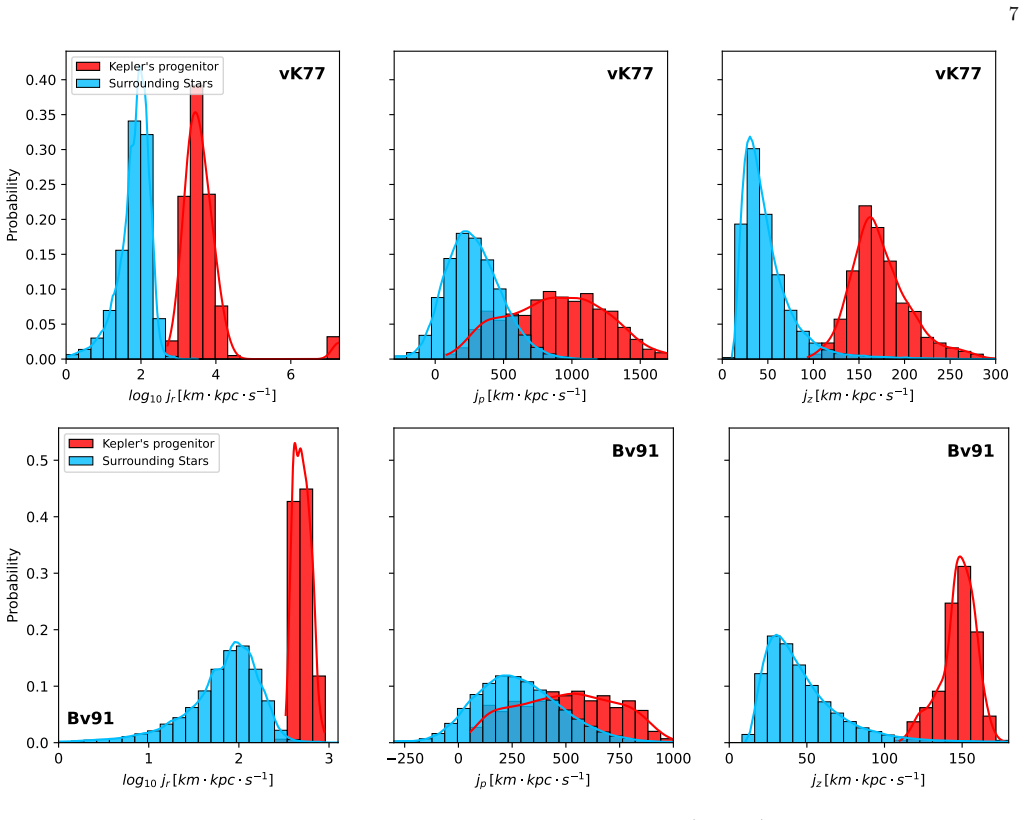
The analysis runs on two pieces of machinery. First, orbit integration in the Galpy package, using two Milky Way potentials (MWPotential2014 and McMillan17), converts the position and velocity of Kepler's progenitor and of 3,507 nearby Gaia DR3 stars into integrals of motion: total energy $E$, angular momentum $L_z$, and actions $(j_r,j_p,j_z)$. Comparing these against the $(E,L_z)$ boxes that Malhan et al. (2022) assign to in-situ and accreted substructures is what produces the 'alien' kinematic signature. Second, the rate estimate combines the accretion time $z_{\rm acc}$ and stellar mass $M_{\rm acc}$ of each of the seven satellites with the delay-time distribution (DTD) of SNe Ia: method I uses the GalCEM one-zone chemical evolution code with two DTDs (Greggio 2005; Maoz & Graur 2017), while method II, introduced in this paper, is the delta-function approximation, which replaces the unknown star-formation history with a single 'harmonic' delay time $\Delta t_{\rm har}$ and a constant stellar mass loss of 40%, yielding $N \approx (M_{\rm acc}/0.6)\,{\rm DTD}(\Delta t_{\rm har})\,t_{\rm SNR}$. This machinery lets the authors estimate the alien SN Ia rate using only the mass and accretion time of each merger.
What would settle it
Measure the proper motion of Kepler's optical knots with sub-milliarcsecond precision using astrometric monitoring over a decade; if the resulting space motion places the progenitor inside the (E, Lz) region that Malhan et al. (2022) assign to in-situ disk or bulge populations, the claim that Kepler is an alien SN Ia would be falsified. Detecting a surviving companion star with velocity consistent with in-situ populations would likewise contradict the accreted-origin scenario.
Extended reading notes
Core claim
The paper's central claim is that Kepler's supernova progenitor is kinematically and dynamically distinct from the in-situ Milky Way stellar population: in $(E,L_z)$ space it lies far from the disk and bulge regions identified by Malhan et al. (2022), and in action space it has larger radial and vertical actions than its surrounding stars. The authors interpret this as evidence that the progenitor was accreted into the Milky Way from a disrupted satellite galaxy, making SN 1604 a candidate 'alien' Type Ia supernova. They further claim that alien SNe Ia from seven known accreted galaxies (Kraken, Gaia-Enceladus-Sausage, the Helmi streams, Sequoia, Sagittarius, Wukong/LMS-1, and Cetus) should occur at a present-day rate of $1.5\times 10^{-5}$ to $5.0\times 10^{-5}$ yr$^{-1}$ by galactic chemical evolution modeling, or $3.1^{+1.8}_{-1.1}\times 10^{-5}$ yr$^{-1}$ by a new delta-function approximation, corresponding to 0.9 to 3.0 events over the last 60 kyr. These are lower bounds because the models assume dry mergers with no post-merger star formation.
Load-bearing premise
The load-bearing premise is that the dense, nitrogen-rich optical knots in Kepler's remnant trace the motion of the progenitor star itself—not shocked ejecta or circumstellar material—and the two published proper-motion measurements of those knots disagree, so the 'alien' kinematic signature is fragile.
Editorial extensions
If this is right
- Roughly one to three of the supernova remnants visible today should be 'alien' within the canonical 60 kyr SNR lifetime, so remnant surveys can expect to find a few kinematic outliers like Kepler.
- Kepler's unusual high-velocity, plane-escaping motion and its asymmetric shell are naturally explained if its progenitor was accreted, without invoking special binary evolution.
- The delta-function approximation gives a quick estimate of recent SN Ia rates for any accreted galaxy from just its stellar mass and accretion time, usable beyond the Milky Way.
- Because the estimates assume dry mergers with no post-merger star formation, the true alien SN Ia rate is likely higher, strengthening the case that a detectable fraction of SNe Ia are extragalactic in origin.
- The Milky Way's merger history should leave observable traces not only in stars but also in the remnants of thermonuclear supernovae.
Reading between the lines
- A direct test of the paper's logic would be to apply the same $(E,L_z)$ and action-space comparison to other historical Type Ia remnants, such as Tycho's SNR, whose in-situ association is usually assumed; an unexpected outlier there would suggest that alien progenitors are common enough to be found among the small set of historical supernovae.
- If Kepler were ever confirmed as alien (for example, through the kinematics of a surviving companion star), its known age and the host merger's accretion time would pin down a single delay time for one SN Ia, providing an individual anchor for the delay-time distribution of accreted stellar populations.
- The delta-function approximation could be turned into a forecasting tool for other galaxies: given a measured merger history from stellar halos, one could predict the present-day fraction of 'alien' SNe Ia in external galaxies and compare with resolved stellar-population studies.
- A chemical follow-up prediction follows from the paper's own logic: an alien SNR should show nucleosynthetic or circumstellar abundance patterns reflecting the lower metallicity of its dwarf-galaxy origin, distinguishing it from in-situ remnants of similar age.
Signed reviews
Editorial analysis
A structured set of objections, weighed in public.
Referee Report
Summary. The paper introduces the notion of 'alien SNe Ia' produced by stars that were accreted into the Milky Way through dry mergers, and it presents two main results. First, using Gaia DR3 data for stars around Kepler's supernova remnant, the authors compare the progenitor's kinematics and dynamics in (E, Lz) and action space with nearby stars and with known substructures, concluding that the progenitor is kinematically and dynamically anomalous and may not belong to the in-situ Milky Way population, thus proposing it as a possible alien SN Ia candidate. Second, the paper estimates the recent rate of alien SNe Ia from seven known merger remnants (Kraken, Gaia-Enceladus-Sausage, Helmi streams, Sequoia, Sagittarius, Wukong/LMS-1, and Cetus) using two methods: a galactic chemical evolution calculation with GalCEM, and a newly introduced delta-function approximation (DFA). The GalCEM method gives 1.5e-5 to 5.0e-5 yr^-1 (0.9 to 3.0 events in the past 60 kyr), while the DFA gives 3.1e-5 yr^-1 with 1.84 events; both are honestly labeled lower bounds under the assumption of no post-merger star formation.
Significance. If the Kepler association were secure, this would be the first identified candidate for a supernova progenitor of extragalactic origin in the Milky Way, and the paper would open a new observational window on accreted stellar populations. The rate calculation is a transparent forward estimate that uses literature values for Macc and zacc, a plausible DTD family, and public, reproducible code; the lower-bound character is clearly stated. The new DFA method is clearly derived and its approximations are enumerated, which is useful even if the method is approximate. However, the Kepler candidate claim rests on the assumption that optical knots trace the progenitor's space motion, and the two available proper-motion catalogs are mutually inconsistent at about 3.3 sigma, flipping the substructure association. The rate methods are also not fully independent because they share the same satellite masses, accretion times, and DTD inputs, so their consistency should not be overinterpreted as independent validation.
major comments (3)
- [Section 2.1 and Section 3.2] The kinematic case for Kepler's progenitor being an alien SN Ia depends entirely on the assumption that the optical knots' proper motions trace the progenitor's space motion. The two published measurements disagree strongly: van den Bergh & Kamper (1977) give pmDE = 10.9 +/- 1.8 mas/yr while Bandiera & van den Bergh (1991) give pmDE = 4.84 +/- 0.49 mas/yr, a difference of roughly 3.3 sigma. As the paper itself shows in Section 3.2, adopting the vK77 values places Kepler's progenitor in or near several accretion-event boxes (Sagittarius, Cetus, G-E, L/W, Helmi), whereas adopting the Bv91 values places it in none of the accretion boxes. Since the knots could in principle be shocked ejecta or circumstellar material rather than unshocked progenitor material, the conclusion that the progenitor is not in-situ is not secured. The paper should either provide independent evidence for the knot-progenitor connection or explicitly frame the entire Kepler analysis as conditional on a still-unresolved systematic choice, with the abstract and title adjusted accordingly.
- [Section 3.2 and Figure 1] The claim that Kepler's progenitor is 'not in situ' is weakened by the lack of a statistical control sample of halo stars. Showing that the progenitor lies outside the Malhan et al. (2022) in-situ boxes is not by itself evidence for an accreted origin, because an ordinary high-energy halo star with a large vertical excursion would also fall outside those boxes. The nearby-star comparison in Figure 1 is dominated by disk stars, so a clean separation from them is expected for any halo-like orbit. To make the 'alien' classification load-bearing, the authors should quantify how often field halo stars occupy the same (E, Lz) region, for example by drawing a matched control sample from Gaia and computing the probability that an in-situ star would appear as anomalous as Kepler's progenitor under the same selection and orbit-integration pipeline.
- [Section 4.2] The statement that 'Methods I and II are relatively independent, so we consider our results to be reliable' is not justified. Method II uses the same Macc and zacc values for the same seven satellites and adopts the same power-law DTD family from Maoz & Graur (2017) that is used in one branch of Method I; both methods also assume dry mergers with no post-merger star formation. Given these shared inputs, the consistency of the two rate estimates is largely a check on the algebraic approximations of the DFA, not an independent confirmation of the astrophysical result. The paper should soften this claim and present the two methods as complementary estimates sharing common systematic uncertainties, with the dominant uncertainty being the satellite masses and DTD normalization.
minor comments (3)
- [Throughout] There are several typographical and formatting issues, including 'Kranken' in the discussion of Malhan et al. (2022) (should be 'Kraken'), the inline notation 'd4.5' in the Introduction, and inconsistent use of 'top/bottom panels' in the Figure 3 caption when the figure appears to be arranged in rows; these should be cleaned up before publication.
- [Section 4.1.2 and Appendix B] In the DFA derivation, the choice of the harmonic mean for DTD(Delta t_har) is reasonable, but the associated error budget in Appendix B would benefit from being stated more concretely; for instance, the claim that the '1 sigma dynamic range of Macc is about 5' should be reconciled with the quoted 0.3 dex systematic uncertainty, which corresponds to a factor of about 2, so that the reader can verify the relative sizes of the systematic terms.
- [Section 5] The discussion correctly acknowledges that the substructure association is inconclusive, but this caveat appears only after the abstract and Section 3.2 have already stated the 'alien' hypothesis in stronger terms; the authors should ensure the abstract matches the level of certainty expressed in the conclusions.
Circularity Check
No significant circularity: the alien-SN rate is a forward convolution of external Macc/zacc/DTD inputs, and the Kepler candidacy is an observationally hedged comparison, not a fitted prediction.
full rationale
Neither rate estimate contains a fitted parameter that is later relabeled as a prediction. Method I (Sec. 4.1.1) computes the SNe Ia rate as a convolution of SFH and DTD using Macc and zacc taken from Kruijssen et al. (2020) and Naidu et al. (2022), with DTDs from Greggio (2005) and Maoz & Graur (2017); no term is calibrated to any observed 'alien' SNe Ia population. Method II (Sec. 4.1.2) derives N_DFA ≈ Macc × DTD(Δthar) × tSNR / 0.6 directly from the definition of Macc and a power-law DTD (Eqs. 3-8), so the quoted rate is a transparent function of the external inputs, not an inverse fit. The two methods share Macc, zacc, and the DTD family, so their agreement is not an independent validation; the paper's statement that the methods are 'relatively independent' (Sec. 4.2) overstates the situation, but sharing inputs is not circular. For Kepler, the 'not in situ' claim is a classification against the Malhan et al. (2022) E-Lz boxes, and the paper explicitly concedes that association with specific accreted substructures is inconclusive and notes the disagreement between the two published proper-motion sets (Secs. 3.2 and 5); this is an observational systematic, not a construction. The only self-citation entering the calculation is GalCEM (Gjergo et al. 2023), a public code used as a tool with externally sourced DTDs; it is not load-bearing in a circular sense. Because no prediction reduces by definition to its input, the score is 2 rather than 0 only to acknowledge that minor self-citation and the partially shared inputs of the two methods.
Assumptions & free parameters
free parameters (5)
- DTD normalization R =
0.21e-12 M_sun^-1 yr^-1 (Maoz & Graur 2017)
- DTD power-law slope alpha =
-1.07 (Maoz & Graur 2017)
- Stellar mass loss fraction Loss(t) =
0.4
- GalCEM gas infall timescale =
7 Gyr
- Kennicutt-Schmidt star formation exponent =
1.4
assumptions (7)
- domain assumption Optical knots of Kepler's SNR trace the progenitor's space velocity
- domain assumption Mergers considered were dry, with no post-merger star formation
- domain assumption A power-law SNe Ia DTD with alpha about -1 and normalization R applies to accreted populations
- domain assumption Typical SNR radio lifetime is 60 kyr and is treated as a uniform visibility window
- standard math Standard galactic dynamics background for orbits and actions
- domain assumption Closed-box evolution of satellites before tacc, with no stellar mass inflow or outflow
- ad hoc to paper Adopted uncertainty widths for Wukong/LMS-1 and Cetus logM and zacc
Cite this review
Pith. "Pith review of Alien Type Ia supernovae from the Milky Way merger history and one possible candidate: Kepler's supernova." pith.science (2026). https://pith.science/paper/FMHNTPTN
@misc{pith2026250503085,
  author       = {Pith},
  title        = {Pith review of: Alien Type Ia supernovae from the Milky Way merger history and one possible candidate: Kepler's supernova},
  year         = {2026},
  howpublished = {\url{https://pith.science/paper/FMHNTPTN}},
  note         = {Machine review of arXiv:2505.03085}
}
abstract
The Milky Way is a dynamic and evolving system shaped by numerous merger events throughout its history. These mergers bring stars with kinematic and dynamic properties differing from the main stellar population. However, it remains uncertain whether any of the Galactic supernova remnants can be attributed to such a merger origin. In this work, we compare the progenitor of Kepler's supernova to its nearby stars, ``alien'' stars, and in-situ Milky Way stellar populations. We uncover the abnormal kinematics and dynamics of Kepler's supernova and propose that its progenitor may have an extragalactic origin. We call the Type Ia supernovae (SNe Ia) produced by stars accreted into the Milky Way through merger events ``alien SNe Ia'' since they are cosmic immigrants. We estimate the rate of alien SNe Ia exploded recently using two methods: through galactic chemical evolution, and through a method without considering exact star formation history, introduced for the first time in this paper. We consider the past accretion of a few major satellite galaxies -- Kraken, Gaia-Enceladus-Sausage, the Helmi streams, Sequoia, Sagittarius, Wukong/LMS-1, and Cetus -- assuming these were dry mergers. The first method yields $1.5\times 10^{-5} - 5.0\times10^{-5}\rm\,yr^{-1}$, while the second method yields a comparable ${3.1}^{+1.8}_{-{1.1}}\times10^{-5}\rm\,yr^{-1}$ as the rate estimates for recent alien SNe Ia. These estimates represent lower bounds because we assumed no postmerger star formation.
Figures


Figures from the paper (2 more)


Reference graph
Works this paper leans on
-
[1]
2017, MNRAS, 470, 4698, doi: 10.1093/mnras/stx1517
Angl´ es-Alc´ azar, D., Faucher-Gigu` ere, C.-A., Kereˇ s, D., et al. 2017, MNRAS, 470, 4698, doi: 10.1093/mnras/stx1517
-
[2]
2024, MNRAS, 527, 2426, doi: 10.1093/mnras/stad3244
Annem, B., & Khoperskov, S. 2024, MNRAS, 527, 2426, doi: 10.1093/mnras/stad3244
-
[3]
2021, AJ, 161, 147, doi: 10.3847/1538-3881/abd806
Demleitner, M., & Andrae, R. 2021, AJ, 161, 147, doi: 10.3847/1538-3881/abd806
-
[4]
1987, ApJ, 319, 885, doi: 10.1086/165505
Bandiera, R. 1987, ApJ, 319, 885, doi: 10.1086/165505
-
[5]
1991, ApJ, 374, 186, doi: 10.1086/170108
Bandiera, R., & van den Bergh, S. 1991, ApJ, 374, 186, doi: 10.1086/170108
-
[6]
Deason, A. J. 2018, MNRAS, 478, 611, doi: 10.1093/mnras/sty982
-
[8]
2008, Galactic Dynamics: Second Edition (Princeton University Press)
Binney, J., & Tremaine, S. 2008, Galactic Dynamics: Second Edition (Princeton University Press)
2008
-
[9]
Blair, W. P., Long, K. S., & Vancura, O. 1991, ApJ, 366, 484, doi: 10.1086/169583
doi:10.1086/169583 1991
Show all 79 references
-
[10]
P., Conroy, C., et al
Bonaca, A., Naidu, R. P., Conroy, C., et al. 2021, ApJL, 909, L26, doi: 10.3847/2041-8213/abeaa9
2021 doi
-
[11]
2015, ApJS, 216, 29, doi: 10.1088/0067-0049/216/2/29
Bovy, J. 2015, ApJS, 216, 29, doi: 10.1088/0067-0049/216/2/29
2015 doi
-
[12]
2003, MNRAS, 344, 1000, doi: 10.1046/j.1365-8711.2003.06897.x
Bruzual, G., & Charlot, S. 2003, MNRAS, 344, 1000, doi: 10.1046/j.1365-8711.2003.06897.x
2003
-
[13]
2003, PASP, 115, 763, doi: 10.1086/376392
Chabrier, G. 2003, PASP, 115, 763, doi: 10.1086/376392
2003 doi
-
[14]
M., & Vink, J
Chiotellis, A., Schure, K. M., & Vink, J. 2012, A&A, 537, A139, doi: 10.1051/0004-6361/201014754
2012 doi
-
[15]
2019, ApJ, 883, 107, doi: 10.3847/1538-4357/ab38b8 14 Dynamic range is the ratio between the largest and smallest val- ues that a certain quantity can assume
Conroy, C., Bonaca, A., Cargile, P., et al. 2019, ApJ, 883, 107, doi: 10.3847/1538-4357/ab38b8 14 Dynamic range is the ratio between the largest and smallest val- ues that a certain quantity can assume
2019 doi
-
[16]
2012, Research in Astronomy and Astrophysics, 12, 1197, doi: 10.1088/1674-4527/12/9/003 De Silva, G
Cui, X.-Q., Zhao, Y.-H., Chu, Y.-Q., et al. 2012, Research in Astronomy and Astrophysics, 12, 1197, doi: 10.1088/1674-4527/12/9/003 De Silva, G. M., Freeman, K. C., Bland-Hawthorn, J., et al. 2015, MNRAS, 449, 2604, doi: 10.1093/mnras/stv327 Di Matteo, P., Combes, F., Melchior...
2012 doi
-
[17]
J., Stanway, E
Eldridge, J. J., Stanway, E. R., Xiao, L., et al. 2017, PASA, 34, e058, doi: 10.1017/pasa.2017.51
2017 doi
-
[18]
2021, A&A, 649, A5, doi: 10.1051/0004-6361/202039834
Fabricius, C., Luri, X., Arenou, F., et al. 2021, A&A, 649, A5, doi: 10.1051/0004-6361/202039834
2021 doi
-
[19]
2012, Advances in Space Research, 49, 1313, doi: 10.1016/j.asr.2012.02.004
Ferrand, G., & Safi-Harb, S. 2012, Advances in Space Research, 49, 1313, doi: 10.1016/j.asr.2012.02.004
2012 doi
-
[20]
A., Goss, W
Frail, D. A., Goss, W. M., & Whiteoak, J. B. Z. 1994, ApJ, 437, 781, doi: 10.1086/175038
1994 doi
-
[21]
2021, MNRAS, 502, 5882, doi: 10.1093/mnras/stab493
Freundlich, J., & Maoz, D. 2021, MNRAS, 502, 5882, doi: 10.1093/mnras/stab493
2021 doi
-
[22]
2022, A&A, 668, A4, doi: 10.1051/0004-6361/202243590 Gaia Collaboration, Prusti, T., de Bruijne, J
Fu, X., Bragaglia, A., Liu, C., et al. 2022, A&A, 668, A4, doi: 10.1051/0004-6361/202243590 Gaia Collaboration, Prusti, T., de Bruijne, J. H. J., et al. 2016, A&A, 595, A1, doi: 10.1051/0004-6361/201629272 Gaia Collaboration, Vallenari, A., Brown, A. G. A., et al. 2023, A&A, 6...
2022 doi
-
[23]
C., et al
Gilmore, G., Randich, S., Worley, C. C., et al. 2022, A&A, 666, A120, doi: 10.1051/0004-6361/202243134
2022 doi
-
[24]
G., Ruth, A., et al
Gjergo, E., Sorokin, A. G., Ruth, A., et al. 2023, ApJS, 264, 44, doi: 10.3847/1538-4365/aca7c7
2023 doi
-
[25]
Green, D. A. 2019, Journal of Astrophysics and Astronomy, 40, 36, doi: 10.1007/s12036-019-9601-6
2019 doi
-
[26]
2005, A&A, 441, 1055, doi: 10.1051/0004-6361:20052926
Greggio, L. 2005, A&A, 441, 1055, doi: 10.1051/0004-6361:20052926
2005 doi
-
[27]
R., Millman, K
Harris, C. R., Millman, K. J., van der Walt, S. J., et al. 2020, Nature, 585, 357, doi: 10.1038/s41586-020-2649-2
2020 doi
-
[28]
D., et al
Haywood, M., Di Matteo, P., Lehnert, M. D., et al. 2018, ApJ, 863, 113, doi: 10.3847/1538-4357/aad235 15
2018 doi
-
[29]
H., et al
Helmi, A., Babusiaux, C., Koppelman, H. H., et al. 2018, Nature, 563, 85, doi: 10.1038/s41586-018-0625-x
2018 doi
-
[30]
Helmi, A., & de Zeeuw, P. T. 2000, MNRAS, 319, 657, doi: 10.1046/j.1365-8711.2000.03895.x
2000
-
[31]
Helmi, A., White, S. D. M., de Zeeuw, P. T., & Zhao, H. 1999, Nature, 402, 53, doi: 10.1038/46980
1999 doi
-
[32]
Hunter, J. D. 2007, Computing in Science and Engineering, 9, 90, doi: 10.1109/MCSE.2007.55
2007 doi
-
[33]
A., Gilmore, G., & Irwin, M
Ibata, R. A., Gilmore, G., & Irwin, M. J. 1994, Nature, 370, 194, doi: 10.1038/370194a0
1994 doi
-
[34]
Iben, Jr., I., & Tutukov, A. V. 1984, ApJS, 54, 335, doi: 10.1086/190932
1984 doi
-
[35]
2011, MNRAS, 417, 1466, doi: 10.1111/j.1365-2966.2011.19361.x
Kashi, A., & Soker, N. 2011, MNRAS, 417, 1466, doi: 10.1111/j.1365-2966.2011.19361.x
2011
-
[36]
2023, A&A, 674, A5, doi: 10.1051/0004-6361/202244220
Katz, D., Sartoretti, P., Guerrier, A., et al. 2023, A&A, 674, A5, doi: 10.1051/0004-6361/202244220
2023 doi
-
[37]
1998, ARA&A, 36, 189, doi: 10.1146/annurev.astro.36.1.189
Kennicutt, Robert C., J. 1998, ARA&A, 36, 189, doi: 10.1146/annurev.astro.36.1.189
1998 doi
-
[38]
2019, A&A, 625, A5, doi: 10.1051/0004-6361/201834769
Bastian, U. 2019, A&A, 625, A5, doi: 10.1051/0004-6361/201834769
2019 doi
-
[39]
2001, MNRAS, 322, 231, doi: 10.1046/j.1365-8711.2001.04022.x
Kroupa, P. 2001, MNRAS, 322, 231, doi: 10.1046/j.1365-8711.2001.04022.x
2001
-
[40]
Kruijssen, J. M. D., Pfeffer, J. L., Chevance, M., et al. 2020, MNRAS, 498, 2472, doi: 10.1093/mnras/staa2452
2020 doi
-
[41]
A., & Matteucci, F
Lanfranchi, G. A., & Matteucci, F. 2004, MNRAS, 351, 1338, doi: 10.1111/j.1365-2966.2004.07877.x —. 2007, A&A, 468, 927, doi: 10.1051/0004-6361:20066576
2004
-
[42]
Livio, M., & Riess, A. G. 2003, ApJL, 594, L93, doi: 10.1086/378765
2003 doi
-
[43]
R., Schiavon, R
Majewski, S. R., Schiavon, R. P., Frinchaboy, P. M., et al. 2017, AJ, 154, 94, doi: 10.3847/1538-3881/aa784d
2017 doi
-
[44]
A., Sharma, S., et al
Malhan, K., Ibata, R. A., Sharma, S., et al. 2022, ApJ, 926, 107, doi: 10.3847/1538-4357/ac4d2a
2022 doi
-
[45]
2017, ApJ, 848, 25, doi: 10.3847/1538-4357/aa8b6e
Maoz, D., & Graur, O. 2017, ApJ, 848, 25, doi: 10.3847/1538-4357/aa8b6e
2017 doi
-
[46]
H., & Helmi, A
Massari, D., Koppelman, H. H., & Helmi, A. 2019, A&A, 630, L4, doi: 10.1051/0004-6361/201936135
2019 doi
-
[47]
2012, Chemical Evolution of Galaxies (Springer-Verlag Berlin Heidelberg), doi: 10.1007/978-3-642-22491-1
Matteucci, F. 2012, Chemical Evolution of Galaxies (Springer-Verlag Berlin Heidelberg), doi: 10.1007/978-3-642-22491-1
2012 doi
-
[48]
1986, A&A, 154, 279
Matteucci, F., & Greggio, L. 1986, A&A, 154, 279
1986
-
[49]
McMillan, P. J. 2017, MNRAS, 465, 76, doi: 10.1093/mnras/stw2759
2017 doi
-
[50]
2019, MNRAS, 482, 5651, doi: 10.1093/mnras/sty3092
Meng, X., & Li, J. 2019, MNRAS, 482, 5651, doi: 10.1093/mnras/sty3092
2019 doi
-
[51]
2021, MNRAS, 507, 4603, doi: 10.1093/mnras/stab2369
Meng, X.-C., & Luo, Y.-P. 2021, MNRAS, 507, 4603, doi: 10.1093/mnras/stab2369
2021 doi
- [52]
-
[53]
J., Bhalerao, J., Park, S., et al
Millard, M. J., Bhalerao, J., Park, S., et al. 2020, ApJ, 893, 98, doi: 10.3847/1538-4357/ab7db1
2020 doi
-
[54]
P., Naab, T., & White, S
Moster, B. P., Naab, T., & White, S. D. M. 2013, MNRAS, 428, 3121, doi: 10.1093/mnras/sts261
2013 doi
-
[55]
C., Evans, N
Myeong, G. C., Evans, N. W., Belokurov, V., Sanders, J. L., & Koposov, S. E. 2018, ApJL, 863, L28, doi: 10.3847/2041-8213/aad7f7
2018 doi
-
[56]
2019, MNRAS, 488, 1235, doi: 10.1093/mnras/stz1770
Belokurov, V. 2019, MNRAS, 488, 1235, doi: 10.1093/mnras/stz1770
2019 doi
- [57]
-
[58]
J., Yanny, B., & Willett, B
Newberg, H. J., Yanny, B., & Willett, B. A. 2009, ApJL, 700, L61, doi: 10.1088/0004-637X/700/2/L61
2009 doi
-
[59]
Niederste-Ostholt, M., Belokurov, V., & Evans, N. W. 2012, MNRAS, 422, 207, doi: 10.1111/j.1365-2966.2012.20602.x
2012
-
[60]
1982, ApJ, 257, 780, doi: 10.1086/160031
Nomoto, K. 1982, ApJ, 257, 780, doi: 10.1086/160031
1982 doi
-
[61]
2014, A&A, 562, A91, doi: 10.1051/0004-6361/201322531 Planck Collaboration, Ade, P
Piffl, T., Scannapieco, C., Binney, J., et al. 2014, A&A, 562, A91, doi: 10.1051/0004-6361/201322531 Planck Collaboration, Ade, P. A. R., Aghanim, N., et al. 2014, A&A, 571, A16, doi: 10.1051/0004-6361/201321591
2014 doi
- [62]
-
[63]
2022, A&A, 666, A121, doi: 10.1051/0004-6361/202243141
Randich, S., Gilmore, G., Magrini, L., et al. 2022, A&A, 666, A121, doi: 10.1051/0004-6361/202243141
2022 doi
-
[64]
2015, MNRAS, 446, 4220, doi: 10.1093/mnras/stu2427
Romano, D., Bellazzini, M., Starkenburg, E., & Leaman, R. 2015, MNRAS, 446, 4220, doi: 10.1093/mnras/stu2427
2015 doi
-
[65]
2018, ApJ, 862, 124, doi: 10.3847/1538-4357/aac9c4
Ruiz-Lapuente, P., Damiani, F., Bedin, L., et al. 2018, ApJ, 862, 124, doi: 10.3847/1538-4357/aac9c4
2018 doi
-
[66]
C., Blair, W
Sankrit, R., Raymond, J. C., Blair, W. P., et al. 2016, ApJ, 817, 36, doi: 10.3847/0004-637X/817/1/36 Sch¨ onrich, R., Binney, J., & Dehnen, W. 2010, MNRAS, 403, 1829, doi: 10.1111/j.1365-2966.2010.16253.x
2016
-
[67]
Sollerman, J., Ghavamian, P., Lundqvist, P., & Smith, R. C. 2003, A&A, 407, 249, doi: 10.1051/0004-6361:20030839
2003 doi
-
[68]
2019, ApJ, 872, 45, doi: 10.3847/1538-4357/aafb73
Sun, L., & Chen, Y. 2019, ApJ, 872, 45, doi: 10.3847/1538-4357/aafb73
2019 doi
-
[69]
A., Loeffler, W., & Schroeder, A
Tammann, G. A., Loeffler, W., & Schroeder, A. 1994, ApJS, 92, 487, doi: 10.1086/192002 van den Bergh, S., & Kamper, K. W. 1977, ApJ, 218, 617, doi: 10.1086/155719
1994 doi
-
[70]
Vincenzo, F., Matteucci, F., Vattakunnel, S., & Lanfranchi, G. A. 2014, MNRAS, 441, 2815, doi: 10.1093/mnras/stu710
2014 doi
-
[71]
2019, MNRAS, 487, L47, doi: 10.1093/mnrasl/slz070
Vincenzo, F., Spitoni, E., Calura, F., et al. 2019, MNRAS, 487, L47, doi: 10.1093/mnrasl/slz070
2019 doi
-
[72]
2008, ApJ, 689, 231, doi: 10.1086/592375 16
Vink, J. 2008, ApJ, 689, 231, doi: 10.1086/592375 16
2008 doi
-
[73]
E., et al
Virtanen, P., Gommers, R., Oliphant, T. E., et al. 2020, Nature Methods, 17, 261, doi: 10.1038/s41592-019-0686-2
2020 doi
-
[74]
Webbink, R. F. 1984, ApJ, 277, 355, doi: 10.1086/161701
1984 doi
-
[75]
1973, ApJ, 186, 1007, doi: 10.1086/152565
Whelan, J., & Iben, Jr., I. 1973, ApJ, 186, 1007, doi: 10.1086/152565
1973 doi
-
[76]
Wiersma, R. P. C., Schaye, J., Theuns, T., Dalla Vecchia, C., & Tornatore, L. 2009, MNRAS, 399, 574, doi: 10.1111/j.1365-2966.2009.15331.x
2009
-
[77]
2021, MNRAS, 506, 3330, doi: 10.1093/mnras/stab1943
Wiseman, P., Sullivan, M., Smith, M., et al. 2021, MNRAS, 506, 3330, doi: 10.1093/mnras/stab1943
2021 doi
-
[78]
2024, MNRAS, 527, 9892, doi: 10.1093/mnras/stad3860
Ye, D., Du, C., Shi, J., & Ma, J. 2024, MNRAS, 527, 9892, doi: 10.1093/mnras/stad3860
2024 doi
-
[79]
C., & Huang, Y
Yuan, Z., Chang, J., Beers, T. C., & Huang, Y. 2020, ApJL, 898, L37, doi: 10.3847/2041-8213/aba49f
2020 doi
-
[80]
E., Izzard, R
Zapartas, E., de Mink, S. E., Izzard, R. G., et al. 2017, A&A, 601, A29, doi: 10.1051/0004-6361/201629685
2017 doi
Reviewed August 15, 2026 · model on record in the stance chip above.
Discussion (0). Continue with ORCID to comment.