The CARMENES search for exoplanets around M dwarfs -- Photospheric parameters of target stars from high-resolution spectroscopy. II. Simultaneous multiwavelength range modeling of activity insensitive lines
Pith reviewed 2026-05-25 11:27 UTC · model grok-4.3
The pith
Parameters from visible spectra of M dwarfs agree better with literature than near-infrared spectra alone.
A machine-rendered reading of the paper's core claim, the machinery that carries it, and where it could break.
Core claim
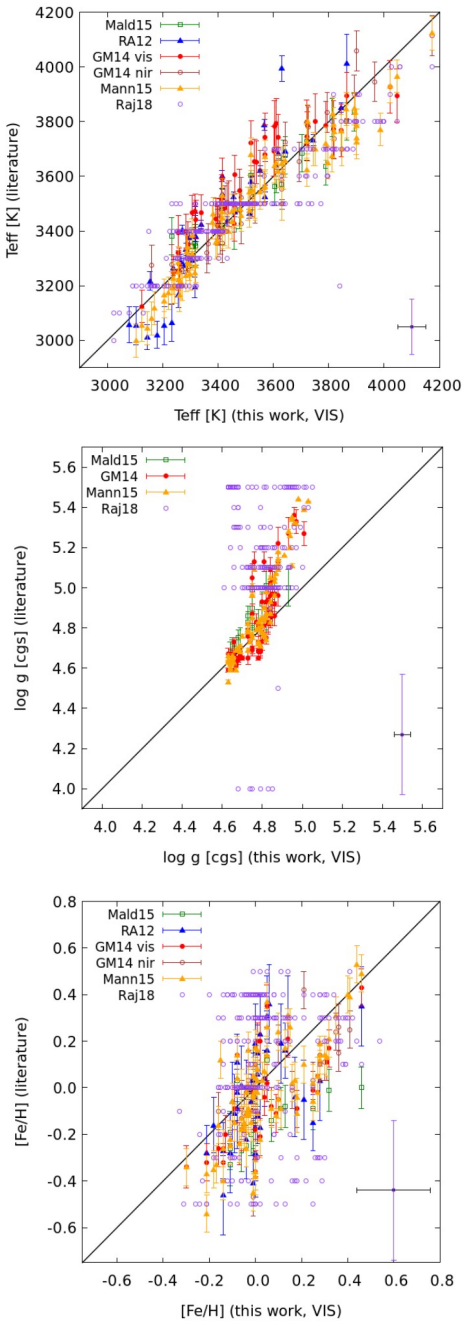
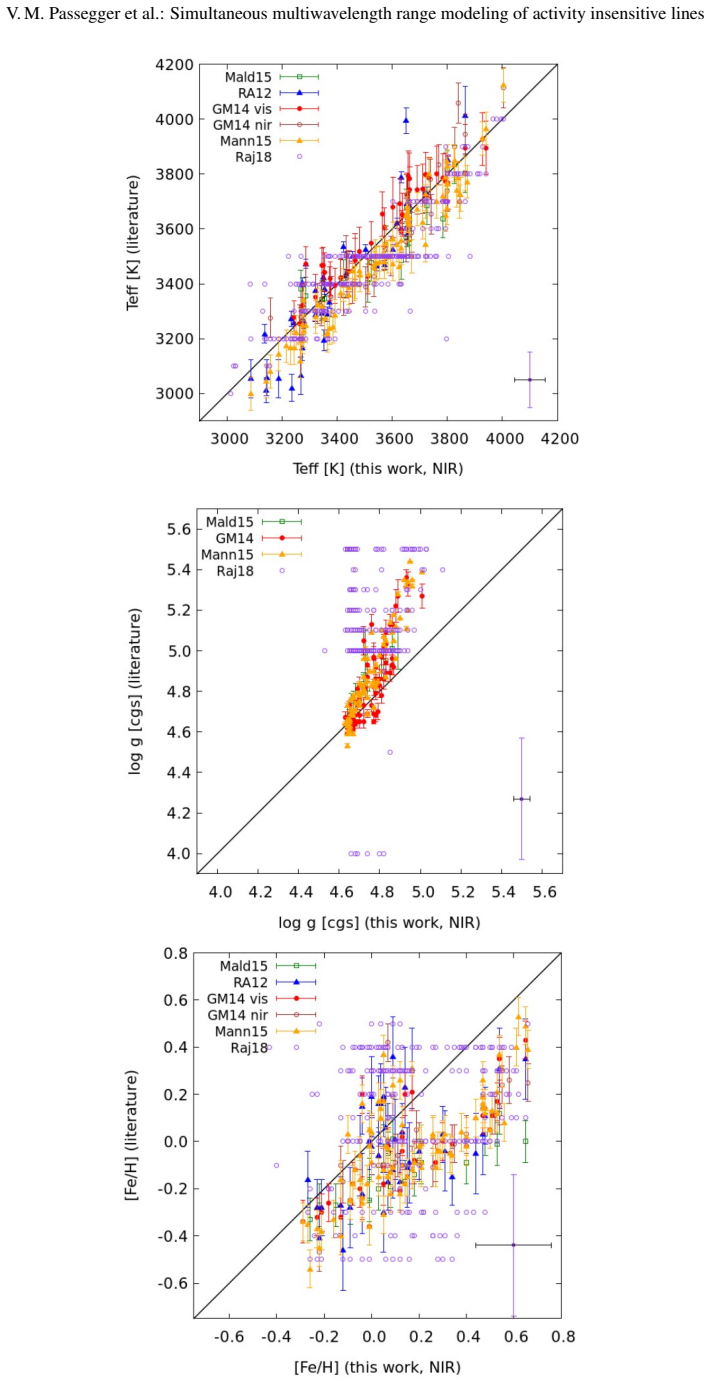
Fundamental parameters derived from visible spectra and visible plus near-infrared spectra combined are in better agreement with literature values than those derived from near-infrared spectra alone, when fitting to magnetically insensitive lines.
What carries the argument
χ² minimization fitting of updated PHOENIX stellar atmosphere models to selected activity-insensitive spectral lines across visible and near-infrared ranges.
If this is right
- Improved stellar parameters lead to better constraints on the properties of any orbiting exoplanets.
- Multiwavelength modeling reduces systematic errors in metallicity and temperature estimates for cool stars.
- Future observations can prioritize visible spectroscopy for more reliable results on M dwarfs.
Where Pith is reading between the lines
- The discrepancy in near-infrared fits may point to incomplete modeling of molecular features or activity effects in that range.
- Simultaneous multiwavelength data could become standard for reducing uncertainties in stellar characterization.
Load-bearing premise
Magnetically insensitive lines can be selected reliably so that stellar activity does not influence the fitted line profiles.
What would settle it
A direct comparison showing that near-infrared derived parameters match literature values as closely as visible ones would challenge the central finding.
Figures




read the original abstract
We present precise photospheric parameters of 282 M dwarfs determined from fitting the most recent version of PHOENIX models to high-resolution CARMENES spectra in the visible (0.52 - 0.96 $\mu$m) and near-infrared wavelength range (0.96 - 1.71 $\mu$m). With its aim to search for habitable planets around M dwarfs, several planets of different masses have been detected. The characterization of the target sample is important for the ability to derive and constrain the physical properties of any planetary systems that are detected. As a continuation of previous work in this context, we derived the fundamental stellar parameters effective temperature, surface gravity, and metallicity of the CARMENES M-dwarf targets from PHOENIX model fits using a $\chi^2$ method. We calculated updated PHOENIX stellar atmosphere models that include a new equation of state to especially account for spectral features of low-temperature stellar atmospheres as well as new atomic and molecular line lists. We show the importance of selecting magnetically insensitive lines for fitting to avoid effects of stellar activity in the line profiles. For the first time, we directly compare stellar parameters derived from multiwavelength range spectra, simultaneously observed for the same star. In comparison with literature values we show that fundamental parameters derived from visible spectra and visible and near-infrared spectra combined are in better agreement than those derived from the same spectra in the near-infrared alone.
Editorial analysis
A structured set of objections, weighed in public.
Referee Report
Summary. The paper derives effective temperature, surface gravity, and metallicity for 282 M dwarfs by χ²-fitting the latest PHOENIX models (with updated EOS and line lists) to simultaneous CARMENES high-resolution spectra. It stresses the selection of magnetically insensitive lines to mitigate stellar activity effects on line profiles and performs the first direct comparison of parameters obtained from the visible range (0.52–0.96 μm), near-infrared range (0.96–1.71 μm), and their combination, reporting that VIS and VIS+NIR results agree better with literature values than NIR-only results.
Significance. If the empirical comparison holds, the work supplies a large homogeneous parameter catalog useful for CARMENES exoplanet host characterization. The simultaneous multi-range observations and explicit use of activity-insensitive lines constitute a clear methodological advance over single-band analyses; the updated PHOENIX models are also a positive contribution.
major comments (1)
- [Methods / line selection] The central claim rests on the assertion that magnetically insensitive lines can be selected so that activity does not bias the χ² fits. The manuscript states the importance of this selection but does not specify the quantitative criteria, line list, or validation tests used; without these details the robustness of the VIS vs. NIR agreement comparison cannot be assessed.
minor comments (1)
- The abstract gives wavelength ranges but does not report the number of lines retained after selection or the typical χ² values per degree of freedom for the three fitting regimes.
Simulated Author's Rebuttal
We thank the referee for their constructive review and positive assessment of the work's significance. We address the single major comment below and will revise the manuscript to incorporate the requested details.
read point-by-point responses
-
Referee: [Methods / line selection] The central claim rests on the assertion that magnetically insensitive lines can be selected so that activity does not bias the χ² fits. The manuscript states the importance of this selection but does not specify the quantitative criteria, line list, or validation tests used; without these details the robustness of the VIS vs. NIR agreement comparison cannot be assessed.
Authors: We agree that additional explicit documentation is needed. In the revised manuscript we will add a dedicated subsection (in Section 3) that (i) states the quantitative criteria used to identify magnetically insensitive lines (primarily the lack of detectable Zeeman broadening in the PHOENIX synthetic spectra and cross-references to published magnetic-sensitivity indices), (ii) provides the resulting line list (or a machine-readable table of the selected features), and (iii) reports validation tests, including fits performed with and without the activity-sensitive lines and comparisons against independent activity indicators. These additions will directly support the robustness of the VIS–NIR comparison. revision: yes
Circularity Check
No significant circularity detected
full rationale
The derivation consists of direct χ² fitting of updated external PHOENIX atmosphere models (with new EOS and line lists) to observed CARMENES spectra across VIS, NIR, and combined ranges, followed by empirical comparison of the resulting Teff, log g, and [Fe/H] values against independent literature compilations. No equations reduce outputs to inputs by construction, no fitted parameters are relabeled as predictions, and no load-bearing self-citations or uniqueness theorems imported from prior author work are invoked to force the central agreement claim. The method is self-contained against external benchmarks.
Axiom & Free-Parameter Ledger
free parameters (3)
- effective temperature
- surface gravity
- metallicity
axioms (2)
- domain assumption Updated PHOENIX models with new equation of state and atomic/molecular line lists accurately represent M-dwarf photospheres at low temperatures
- domain assumption Magnetically insensitive lines exist and can be selected to eliminate activity effects from the line profiles
Reference graph
Works this paper leans on
-
[1]
Allard, F., Hauschildt, P. H., Alexander, D. R., Tamanai, A., & Schweitzer, A. 2001, ApJ, 556, 357
work page 2001
-
[2]
2011, in Astronomical Society of the Pa- cific Conference Series, V ol
Allard, F., Homeier, D., & Freytag, B. 2011, in Astronomical Society of the Pa- cific Conference Series, V ol. 448, 16th Cambridge Workshop on Cool Stars, Stellar Systems, and the Sun, ed. C. Johns-Krull, M. K. Browning, & A. A. West, 91
work page 2011
-
[3]
2012, Philosophical Transactions of the Royal Society of London Series A, 370, 2765
Allard, F., Homeier, D., & Freytag, B. 2012, Philosophical Transactions of the Royal Society of London Series A, 370, 2765
work page 2012
-
[4]
2013, Memorie della Societa Astro- nomica Italiana Supplementi, 24, 128
Allard, F., Homeier, D., Freytag, B., et al. 2013, Memorie della Societa Astro- nomica Italiana Supplementi, 24, 128
work page 2013
-
[5]
Asplund, M., Grevesse, N., Sauval, A. J., & Scott, P. 2009, ARA&A, 47, 481 Baraffe, I., Chabrier, G., Allard, F., & Hauschildt, P. H. 1998, A&A, 337, 403 Baraffe, I., Homeier, D., Allard, F., & Chabrier, G. 2015, A&A, 577, A42
work page 2009
-
[6]
Baroch, D., Morales, J. C., Ribas, I., et al. 2018, A&A, 619, A32
work page 2018
-
[7]
F., Zechmeister, M., & Reiners, A
Bauer, F. F., Zechmeister, M., & Reiners, A. 2015, A&A, 581, A117
work page 2015
-
[8]
Berdyugina, S. V . & Solanki, S. K. 2002, A&A, 385, 701
work page 2002
-
[9]
Birky, J. L., Aganze, C., Burgasser, A. J., et al. 2017, in American Astronomical Society Meeting Abstracts, V ol. 229, American Astronomical Society Meet- ing Abstracts #229, 240.18
work page 2017
-
[10]
S., von Braun, K., van Belle, G., et al
Boyajian, T. S., von Braun, K., van Belle, G., et al. 2012, ApJ, 757, 112
work page 2012
-
[11]
Bressan, A., Marigo, P., Girardi, L., et al. 2012, MNRAS, 427, 127
work page 2012
-
[12]
A., Guàrdia, J., López del Fresno, M., et al
Caballero, J. A., Guàrdia, J., López del Fresno, M., et al. 2016b, in Proc. SPIE, V ol. 9910, Observatory Operations: Strategies, Processes, and Systems VI, 99100E Caffau, E., Ludwig, H.-G., Ste ffen, M., Freytag, B., & Bonifacio, P. 2011, Sol. Phys., 268, 255
work page 2011
-
[13]
Chen, Y ., Bressan, A., Girardi, L., et al. 2015, MNRAS, 452, 1068
work page 2015
-
[14]
Chen, Y ., Girardi, L., Bressan, A., et al. 2014, MNRAS, 444, 2525
work page 2014
-
[15]
Claret, A., Hauschildt, P. H., & Witte, S. 2012, A&A, 546, A14 Cortés-Contreras, M. 2016, PhD thesis, Universidad Complutense de Madrid, Spain
work page 2012
-
[16]
2000, A&A, 364, 217 Gaia Collaboration, Brown, A
Delfosse, X., Forveille, T., Ségransan, D., et al. 2000, A&A, 364, 217 Gaia Collaboration, Brown, A. G. A., Vallenari, A., et al. 2018, A&A, 616, A1 Gaia Collaboration, Prusti, T., de Bruijne, J. H. J., et al. 2016, A&A, 595, A1
work page 2000
- [17]
-
[18]
Gordon, I. E., Rothman, L. S., Hill, C., et al. 2017, J. Quant. Spec. Ra- diat. Transf., 203, 3
work page 2017
-
[19]
D., Bayliss, D., Brahm, R., et al
Hartman, J. D., Bayliss, D., Brahm, R., et al. 2015, AJ, 149, 166
work page 2015
-
[20]
Hauschildt, P. H. 1992, J. Quant. Spec. Radiat. Transf., 47, 433
work page 1992
-
[21]
Hauschildt, P. H. 1993, J. Quant. Spec. Radiat. Transf., 50, 301
work page 1993
-
[22]
Hauschildt, P. H., Allard, F., & Baron, E. 1999, ApJ, 512, 377
work page 1999
-
[23]
Hauschildt, P. H. & Baron, E. 1999, Journal of Computational and Applied Math- ematics, 109, 41
work page 1999
-
[24]
Hauschildt, P. H., Baron, E., & Allard, F. 1997, ApJ, 483, 390
work page 1997
-
[25]
Husser, T.-O., Wende-von Berg, S., Dreizler, S., et al. 2013, A&A, 553, A6
work page 2013
- [26]
-
[27]
2014, in Astronomical Society of the Pacific Conference Series, V ol
Kausch, W., Noll, S., Smette, A., et al. 2014, in Astronomical Society of the Pacific Conference Series, V ol. 485, Astronomical Data Analysis Software and Systems XXIII, ed. N. Manset & P. Forshay, 403 Landi Degl’Innocenti, E. & Landolfi, M., eds. 2004, Astrophysics and Space Science Library, V ol. 307, Polarization in Spectral Lines
work page 2014
- [28]
- [29]
-
[30]
Maldonado, J., Affer, L., Micela, G., et al. 2015, A&A, 577, A132
work page 2015
-
[31]
Mann, A. W., Brewer, J. M., Gaidos, E., Lépine, S., & Hilton, E. J. 2013, AJ, 145, 52
work page 2013
- [32]
-
[33]
Mann, A. W., Dupuy, T., Kraus, A. L., et al. 2019, ApJ, 871, 63
work page 2019
-
[34]
Mann, A. W., Feiden, G. A., Gaidos, E., Boyajian, T., & von Braun, K. 2015, ApJ, 804, 64 Martínez-Rodríguez, H. 2014, Master thesis, Universidad Complutense de
work page 2015
-
[35]
2017, PhD thesis, Universität Hamburg, Germany
Meyer, M. 2017, PhD thesis, Universität Hamburg, Germany
work page 2017
-
[36]
Montes, D., López-Santiago, J., Fernández-Figueroa, M. J., & Gálvez, M. C. 2001, A&A, 379, 976
work page 2001
-
[37]
Nagel, E., Czesla, S., Schmitt, J. H. M. M., et al. 2019, A&A, 622, A153
work page 2019
-
[38]
R., Charbonneau, D., Irwin, J., et al
Newton, E. R., Charbonneau, D., Irwin, J., et al. 2014, AJ, 147, 20
work page 2014
-
[39]
2002, Physics of star formation in galaxies
Palla, F., Zinnecker, H., Maeder, A., & Meynet, G., eds. 2002, Physics of star formation in galaxies
work page 2002
-
[40]
Passegger, V . M. 2017, PhD thesis, Georg-August-Universität Göttingen, Ger- many
work page 2017
-
[41]
Passegger, V . M., Reiners, A., Jeffers, S. V ., et al. 2018, A&A, 615, A6
work page 2018
-
[42]
M., Wende-von Berg, S., & Reiners, A
Passegger, V . M., Wende-von Berg, S., & Reiners, A. 2016, A&A, 587, A19
work page 2016
-
[43]
Piskunov, N. E. & Valenti, J. A. 2002, A&A, 385, 1095
work page 2002
-
[44]
Quirrenbach, A., Amado, P. J., Ribas, I., et al. 2018, in Society of Photo- Optical Instrumentation Engineers (SPIE) Conference Series, V ol. 10702, So- ciety of Photo-Optical Instrumentation Engineers (SPIE) Conference Series, 107020W
work page 2018
-
[45]
S., Allard, F., Rajpurohit, S., et al
Rajpurohit, A. S., Allard, F., Rajpurohit, S., et al. 2018, A&A, 620, A180
work page 2018
- [46]
-
[47]
2018, Nature, 563, 365 Rodríguez Martínez, R., Ballard, S., Mayo, A., et al
Ribas, I., Tuomi, M., Reiners, A., et al. 2018, Nature, 563, 365 Rodríguez Martínez, R., Ballard, S., Mayo, A., et al. 2018, arXiv e-prints, arXiv:1808.03652
-
[48]
Rojas-Ayala, B., Covey, K. R., Muirhead, P. S., & Lloyd, J. P. 2012, ApJ, 748, 93
work page 2012
- [49]
-
[50]
2018, AJ, 155, 257 Schäfer, S., Guenther, E
Sarkis, P., Henning, T., Kürster, M., et al. 2018, AJ, 155, 257 Schäfer, S., Guenther, E. W., Reiners, A., et al. 2018, in Society of Photo-Optical Instrumentation Engineers (SPIE) Conference Series, V ol. 10702, Ground- based and Airborne Instrumentation for Astronomy VII, 1070276 Schöfer, P., Jeffers, S. V ., Reiners, A., et al. 2019, A&A, 623, A44
work page 2018
-
[51]
Schweitzer, A., Passegger, V . M., Cifuentes, C., et al. 2019, A&A, 625, A68
work page 2019
-
[52]
2017, Nature Astronomy, 1, 0184
Shulyak, D., Reiners, A., Engeln, A., et al. 2017, Nature Astronomy, 1, 0184
work page 2017
-
[53]
Shulyak, D., Reiners, A., Seemann, U., Kochukhov, O., & Piskunov, N. 2014, A&A, 563, A35
work page 2014
- [54]
- [55]
-
[56]
2012, MOOG: LTE line analysis and spectrum synthesis, Astrophysics Source Code Library
Sneden, C., Bean, J., Ivans, I., Lucatello, S., & Sobeck, J. 2012, MOOG: LTE line analysis and spectrum synthesis, Astrophysics Source Code Library
work page 2012
- [57]
- [58]
-
[59]
Tang, J., Bressan, A., Rosenfield, P., et al. 2014, MNRAS, 445, 4287
work page 2014
-
[60]
Trifonov, T., Kürster, M., Zechmeister, M., et al. 2018, A&A, 609, A117
work page 2018
-
[61]
Valenti, J. A. & Piskunov, N. 2012, SME: Spectroscopy Made Easy, Astro- physics Source Code Library
work page 2012
-
[62]
Veyette, M. J. & Muirhead, P. S. 2018, ApJ, 863, 166
work page 2018
-
[63]
Veyette, M. J., Muirhead, P. S., Mann, A. W., et al. 2017, ApJ, 851, 26 von Braun, K., Boyajian, T. S., van Belle, G. T., et al. 2014, MNRAS, 438, 2413
work page 2017
-
[64]
Wright, J. T. & Eastman, J. D. 2014, PASP, 126, 838
work page 2014
-
[65]
Zechmeister, M., Anglada-Escudé, G., & Reiners, A. 2014, A&A, 561, A59
work page 2014
-
[66]
Zechmeister, M., Dreizler, S., Ribas, I., Reiners, A., & Caballero, J. A. 2019, A&A, in press
work page 2019
- [67]
-
[68]
Zechmeister, M., Reiners, A., Amado, P. J., et al. 2018, A&A, 609, A12 Article number, page 16 of 30 V . M. Passegger et al.: Simultaneous multiwavelength range modeling of activity insensitive lines Appendix A: Additional plots Figure A.1 presents the same comparison plots as in Fig. 4, in- cluding values for the combined wavelength ranges VIS +NIR. The ...
work page 2018
discussion (0)
Sign in with ORCID, Apple, or X to comment. Anyone can read and Pith papers without signing in.