Neural Radiated-Noise Fields for Unmanned Underwater Vehicle Noise Spectrum Prediction in Three-Dimensional Scenes
Pith reviewed 2026-06-28 21:14 UTC · model grok-4.3
The pith
Neural radiated-noise fields model UUV sound spectra continuously across three-dimensional space using only measurement data.
A machine-rendered reading of the paper's core claim, the machinery that carries it, and where it could break.
Core claim
The NRNF represents the UUV radiated-noise spectrum as a continuous function of the three-dimensional UUV position, the three-dimensional hydrophone position, the UUV yaw angle, and the frequency. It employs sinusoidal encoding and a learnable three-dimensional scene feature grid to represent environmental structure and propagation effects, achieving an average prediction error of 3.5 dB in the 50 to 5000 Hz band on lake trial data under horizontal extrapolation, depth extrapolation, and cross-run generalization settings.
What carries the argument
The neural radiated-noise field (NRNF), a neural network that maps position, yaw, and frequency inputs to noise spectrum via sinusoidal encodings and a learnable 3D scene feature grid.
If this is right
- Horizontal extrapolation is the easiest generalization task among the tested settings.
- Depth extrapolation is the most challenging for the model.
- Cross-run generalization has intermediate difficulty.
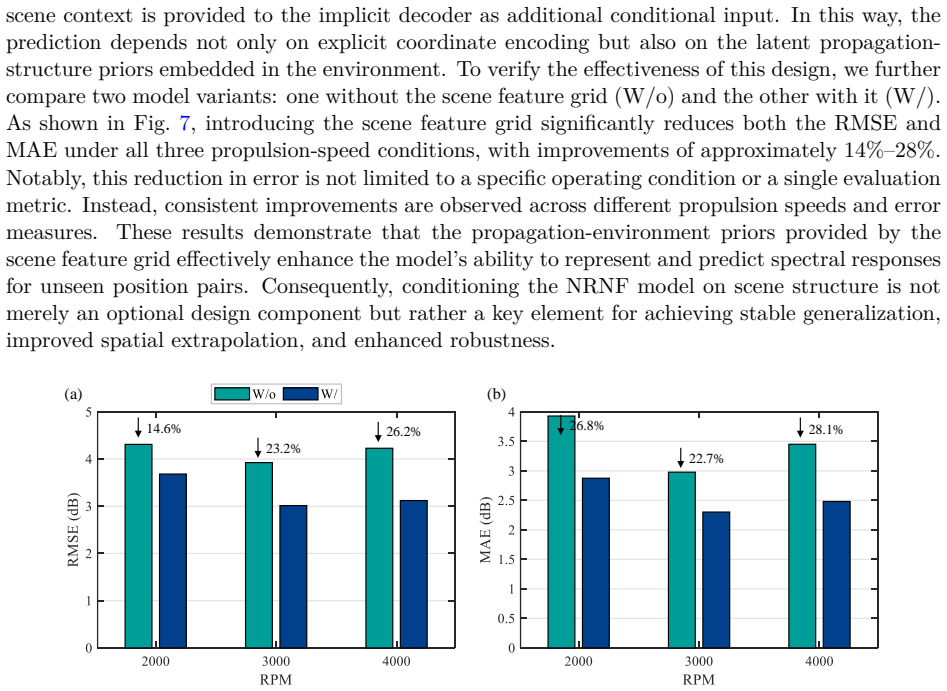
- The learnable scene feature grid improves prediction stability and spatial generalization.
Where Pith is reading between the lines
- NRNF methods might be adapted to predict noise in other media or for different sensor types.
- Future work could test if the model scales to real ocean environments with more variable conditions.
- Combining NRNF with physics-informed constraints could enhance accuracy in data-scarce regions.
Load-bearing premise
The lake trial dataset sufficiently represents the range of environmental propagation effects and vehicle configurations needed for the claimed generalization to arbitrary 3D scenes without structural information.
What would settle it
A test on data from a different body of water or a different UUV where the average prediction error substantially exceeds 3.5 dB would falsify the generalization claim.
Figures



read the original abstract
Radiated noise in unmanned underwater vehicles (UUVs) is an important indicator for characterizing acoustic signatures and evaluating platform performance. To address the strong dependence of traditional physics-based modeling and numerical simulation methods on target structural information and environmental boundary conditions, and their inability to achieve continuous spatial spectrum-response modeling in three-dimensional scenes, this paper proposes a neural radiated-noise field (NRNF). An NRNF represents the UUV radiated-noise spectrum as a continuous function of the three-dimensional UUV position, the three-dimensional hydrophone position, the UUV yaw angle, and the frequency, enabling query-based prediction at arbitrary spatial locations. The proposed method employs sinusoidal encoding for position and frequency, and introduces a learnable three-dimensional scene feature grid to explicitly represent environmental structure and propagation effects. A spectrum-prediction dataset is constructed from lake trials, and the proposed model is evaluated under three settings: horizontal extrapolation, depth extrapolation, and cross-run generalization. Results show that the NRNF achieves an average prediction error of 3.5 dB in the 50 to 5000 Hz band. Horizontal extrapolation is easiest, depth extrapolation is the most challenging, and cross-run generalization is of intermediate difficulty. Further ablation results demonstrate that the scene feature grid significantly improves the prediction stability and spatial generalization of the model.
Editorial analysis
A structured set of objections, weighed in public.
Referee Report
Summary. The paper proposes Neural Radiated-Noise Fields (NRNF), a neural representation that models UUV radiated-noise spectrum as a continuous function of 3D UUV position, 3D hydrophone position, yaw angle, and frequency. It uses sinusoidal encodings and a learnable 3D scene feature grid to capture environmental structure and propagation effects without requiring target structural information. A dataset is built from lake trials, and the model is tested on three splits (horizontal extrapolation, depth extrapolation, cross-run generalization), achieving 3.5 dB average error in the 50-5000 Hz band, with ablation showing the scene grid improves stability.
Significance. If the central result holds under stronger validation, NRNF would provide a data-driven, query-based alternative to physics-based acoustic modeling that avoids dependence on detailed structural or boundary data, enabling continuous 3D spectrum prediction for UUV signature analysis. The approach of embedding a learnable scene grid inside a neural field is a concrete technical contribution that could extend to other underwater acoustic tasks.
major comments (3)
- [Abstract] Abstract and evaluation settings: All quantitative results (3.5 dB average error and relative difficulty of the three splits) are obtained from train/test partitions of a single lake-trial dataset. This design only measures interpolation or mild extrapolation inside one environment and does not test the headline claim of applicability to arbitrary 3D scenes with unseen propagation physics (different bottom impedance, sound-speed profiles, or surface conditions).
- [Method] Method description: The learnable three-dimensional scene feature grid is optimized on the same lake-trial data used for evaluation; without an independent test environment or held-out physics, it is unclear whether the grid encodes general propagation effects or simply fits the training distribution, directly affecting the generalization statements.
- [Results] Results section: No information is supplied on network architecture, optimizer, learning-rate schedule, number of parameters in the scene grid, training/validation split ratios, error bars, or data-exclusion criteria, so the reported 3.5 dB figure and ablation conclusions cannot be independently verified.
minor comments (2)
- The abstract states that sinusoidal encoding is used for position and frequency but does not give the exact functional form, number of frequencies, or scaling factors.
- Figure captions and axis labels should explicitly state the frequency range and dB reference (e.g., re 1 µPa) for all spectrum plots.
Simulated Author's Rebuttal
We thank the referee for the constructive comments. We agree that the evaluation is confined to a single lake-trial dataset and that several implementation details were omitted. We will revise the manuscript to clarify the scope of the claims, add the missing experimental details, and temper statements about generalization to arbitrary environments.
read point-by-point responses
-
Referee: [Abstract] Abstract and evaluation settings: All quantitative results (3.5 dB average error and relative difficulty of the three splits) are obtained from train/test partitions of a single lake-trial dataset. This design only measures interpolation or mild extrapolation inside one environment and does not test the headline claim of applicability to arbitrary 3D scenes with unseen propagation physics (different bottom impedance, sound-speed profiles, or surface conditions).
Authors: We agree that the reported results demonstrate performance only within the measured lake environment and do not constitute validation across environments with different propagation physics. The abstract and introduction will be revised to state that the method enables continuous 3D spectrum prediction from data collected in a given scene, without claiming cross-environment generalization. The three splits test different forms of spatial generalization inside the same lake, which we will describe more precisely. revision: yes
-
Referee: [Method] Method description: The learnable three-dimensional scene feature grid is optimized on the same lake-trial data used for evaluation; without an independent test environment or held-out physics, it is unclear whether the grid encodes general propagation effects or simply fits the training distribution, directly affecting the generalization statements.
Authors: The scene feature grid is learned from the same measurements and therefore encodes the propagation characteristics present in that particular lake trial. We will add explicit discussion in the method section clarifying that the grid captures scene-specific effects rather than universal physics, and we will adjust the generalization claims accordingly. revision: yes
-
Referee: [Results] Results section: No information is supplied on network architecture, optimizer, learning-rate schedule, number of parameters in the scene grid, training/validation split ratios, error bars, or data-exclusion criteria, so the reported 3.5 dB figure and ablation conclusions cannot be independently verified.
Authors: We acknowledge the omission. A new appendix will be added containing the network architecture, optimizer settings, learning-rate schedule, scene-grid dimensions, split ratios, error bars across runs, and data-exclusion criteria. This will allow the 3.5 dB result and ablations to be reproduced. revision: yes
Circularity Check
No significant circularity; evaluation uses held-out splits within one dataset
full rationale
The paper constructs a dataset from lake trials, trains the NRNF neural model on it, and reports average error on three distinct train/test partition settings (horizontal extrapolation, depth extrapolation, cross-run generalization). This is standard supervised learning evaluation and does not reduce any claimed prediction to its inputs by construction. No equations, self-citations, or ansatzes are shown that would make the 3.5 dB figure equivalent to the training data. The central claim of applicability to arbitrary scenes is an empirical generalization statement whose strength can be debated on external grounds, but the derivation chain itself contains no self-definitional or fitted-input reductions.
Axiom & Free-Parameter Ledger
free parameters (1)
- learnable three-dimensional scene feature grid
axioms (1)
- domain assumption Sinusoidal encoding suffices to represent continuous position and frequency inputs for the network
invented entities (1)
-
Neural Radiated-Noise Field (NRNF)
no independent evidence
Reference graph
Works this paper leans on
-
[1]
Passiveacoustictrackingofanunmanned underwater vehicle using bearing-doppler-speed measurements,
K.R.Kita, S.Randeni, D.DiBiaso, andH.Schmidt, “Passiveacoustictrackingofanunmanned underwater vehicle using bearing-doppler-speed measurements,” The Journal of the Acoustical Society of America151(2), 1311–1324 (2022)
2022
-
[2]
Multi-frequency noise reduction method for underwater radiated noise of autonomous underwater vehicles,
B. Mao, H. Yang, W. Li, X. Zhu, and Y. Zheng, “Multi-frequency noise reduction method for underwater radiated noise of autonomous underwater vehicles,” Journal of Marine Science and Engineering12(5), 705 (2024)
2024
-
[3]
Experimental study and numerical simulation of radiated noise from unmanned underwater vehicle,
C. Zhang, Q. Xu, H. Yang, Z. Peng, J. Li, and J. Zhou, “Experimental study and numerical simulation of radiated noise from unmanned underwater vehicle,” Polish Maritime Research (2024). 20
2024
-
[4]
An acoustic remote sensing method for high-precision propeller rotation and speed estimation of unmanned underwater vehicles,
K. Railey, D. DiBiaso, and H. Schmidt, “An acoustic remote sensing method for high-precision propeller rotation and speed estimation of unmanned underwater vehicles,” The Journal of the Acoustical Society of America148(6), 3942–3950 (2020)
2020
-
[5]
F. B. Jensen, W. A. Kuperman, M. B. Porter, H. Schmidt, and A. Tolstoy,Computational ocean acoustics, Vol. 2011 (Springer, 2011)
2011
-
[6]
Development of coupled fe/be models to investigate the structural and acoustic responses of a submerged vessel,
S.Merz, S.Oberst, P.G.Dylejko, N.J.Kessissoglou, Y.K.Tso, andS.Marburg, “Development of coupled fe/be models to investigate the structural and acoustic responses of a submerged vessel,” Journal of Computational Acoustics15(01), 23–47 (2007)
2007
-
[7]
The boundary element method in acoustics: A survey,
S. Kirkup, “The boundary element method in acoustics: A survey,” Applied Sciences9(8), 1642 (2019)
2019
-
[8]
Predicting underwater radiated noise from ship propellers,
J. P. Tomy, “Predicting underwater radiated noise from ship propellers,” Ph.D. dissertation, Technical University of Denmark, Lyngby, Denmark, 2024
2024
-
[9]
Three-dimensional boundary fitted parabolic-equation model of underwater sound propagation,
Y.-T. Lin, “Three-dimensional boundary fitted parabolic-equation model of underwater sound propagation,” The Journal of the Acoustical Society of America146(3), 2058–2067 (2019)
2058
-
[10]
A normal mode model for acousto-elastic ocean environments,
E. K. Westwood, C. T. Tindle, and N. R. Chapman, “A normal mode model for acousto-elastic ocean environments,” The Journal of the Acoustical Society of America100(6), 3631–3645 (1996)
1996
-
[11]
Bidimensional ray tracing model for the underwater noise propagation prediction,
E. D’Andrea, M. Arena, M. Viscardi, and T. Coppola, “Bidimensional ray tracing model for the underwater noise propagation prediction,” Fluids6(1), 19 (2021)
2021
-
[12]
Marine propeller underwater radiated noise prediction with the fwh acoustic analogy part 3: Assessment of full-scale propeller hydroacoustic performance versus sea trial data,
S. Sezen and M. Atlar, “Marine propeller underwater radiated noise prediction with the fwh acoustic analogy part 3: Assessment of full-scale propeller hydroacoustic performance versus sea trial data,” Ocean Engineering266, 112712 (2022)
2022
-
[13]
Underwaterradiated noise prediction for a submarine propeller in different flow conditions,
M.C.Özden, A.Y.Gürkan, Y.A.Özden, T.G.Canyurt, andE.Korkut, “Underwaterradiated noise prediction for a submarine propeller in different flow conditions,” Ocean Engineering126, 488–500 (2016)
2016
-
[14]
Statistical energy analysis for complicated coupled system and its application in engineering,
M. Sheng, M. Wang, J. Sun, and B. Qian, “Statistical energy analysis for complicated coupled system and its application in engineering,” Journal of sound and vibration274(3-5), 877–891 (2004)
2004
-
[15]
Nerf: Representing scenes as neural radiance fields for view synthesis,
B. Mildenhall, P. P. Srinivasan, M. Tancik, J. T. Barron, R. Ramamoorthi, and R. Ng, “Nerf: Representing scenes as neural radiance fields for view synthesis,” Communications of the ACM 65(1), 99–106 (2021)
2021
-
[16]
Differentiable volumetric rendering: Learning implicit 3d representations without 3d supervision,
M. Niemeyer, L. Mescheder, M. Oechsle, and A. Geiger, “Differentiable volumetric rendering: Learning implicit 3d representations without 3d supervision,” inProceedings of the IEEE/CVF conference on computer vision and pattern recognition(2020), pp. 3504–3515
2020
-
[17]
Implicit neural represen- tations with periodic activation functions,
V. Sitzmann, J. Martel, A. Bergman, D. Lindell, and G. Wetzstein, “Implicit neural represen- tations with periodic activation functions,” Advances in neural information processing systems 33, 7462–7473 (2020)
2020
-
[18]
Physics-informed neural networks: A deep learning framework for solving forward and inverse problems involving nonlinear partial dif- ferential equations,
M. Raissi, P. Perdikaris, and G. E. Karniadakis, “Physics-informed neural networks: A deep learning framework for solving forward and inverse problems involving nonlinear partial dif- ferential equations,” Journal of Computational physics378, 686–707 (2019). 21
2019
-
[19]
Predicting ocean pressure field with a physics- informed neural network,
S. Yoon, Y. Park, P. Gerstoft, and W. Seong, “Predicting ocean pressure field with a physics- informed neural network,” The Journal of the Acoustical Society of America155(3), 2037–2049 (2024)
2037
-
[20]
Physics-informed neural network with pretraining optimization for ocean acoustic field prediction,
J. Tang and H. Niu, “Physics-informed neural network with pretraining optimization for ocean acoustic field prediction,” The Journal of the Acoustical Society of America158(5), 3846–3860 (2025)
2025
-
[21]
Learning nonlinear operators via deeponet based on the universal approximation theorem of operators,
L. Lu, P. Jin, G. Pang, Z. Zhang, and G. E. Karniadakis, “Learning nonlinear operators via deeponet based on the universal approximation theorem of operators,” Nature machine intelligence3(3), 218–229 (2021)
2021
-
[22]
Training a deep operator network as a surrogate solver for two-dimensional parabolic-equation models,
L. Xu, H. Zhang, and M. Zhang, “Training a deep operator network as a surrogate solver for two-dimensional parabolic-equation models,” The Journal of the Acoustical Society of America 154(5), 3276–3284 (2023)
2023
-
[23]
O. S. Vengurlekar, A. Pediredla, and S. Jayasuriya, “Sh-sas: An implicit neural representa- tion for complex spherical-harmonic scattering fields for 3d synthetic aperture sonar,” arXiv preprint arXiv:2509.11087 (2025)
-
[24]
Neural implicit surface reconstruction using imaging sonar,
M. Qadri, M. Kaess, and I. Gkioulekas, “Neural implicit surface reconstruction using imaging sonar,” arXiv preprint arXiv:2209.08221 (2022)
-
[25]
Mesh2ir: Neural acoustic impulse response generator for complex 3d scenes,
A. Ratnarajah, Z. Tang, R. Aralikatti, and D. Manocha, “Mesh2ir: Neural acoustic impulse response generator for complex 3d scenes,” inProceedings of the 30th ACM International Conference on Multimedia(2022), pp. 924–933
2022
-
[26]
Inras: Implicit neural representation for audio scenes,
K. Su, M. Chen, and E. Shlizerman, “Inras: Implicit neural representation for audio scenes,” Advances in Neural Information Processing Systems35, 8144–8158 (2022)
2022
-
[27]
1967, IEEE Transactions on Audio and Electroacoustics, 15, 70, doi: 10.1109/TAU.1967.1161901
P. D. Welch, “The use of fast fourier transform for the estimation of power spectra: A method based on time averaging over short, modified periodograms,” IEEE Transactions on Audio and Electroacoustics15(2), 70–73 (1967) doi:10.1109/TAU.1967.1161901
-
[28]
Learning neural acoustic fields,
A. Luo, Y. Du, M. Tarr, J. Tenenbaum, A. Torralba, and C. Gan, “Learning neural acoustic fields,” Advances in Neural Information Processing Systems35, 3165–3177 (2022)
2022
-
[29]
Adam: A Method for Stochastic Optimization
D. P. Kingma and J. Ba, “Adam: A method for stochastic optimization,” arXiv preprint arXiv:1412.6980 (2014). 22
work page internal anchor Pith review Pith/arXiv arXiv 2014
discussion (0)
Sign in with ORCID, Apple, or X to comment. Anyone can read and Pith papers without signing in.