Spectral properties of the Schreier graphs of the basilica group
Pith reviewed 2026-06-27 20:23 UTC · model grok-4.3
The pith
A recursive framework for characteristic polynomials of basilica Schreier graph Laplacians reveals an underlying dynamical system and approximates the KNS spectral measure.
A machine-rendered reading of the paper's core claim, the machinery that carries it, and where it could break.
Core claim
By building a new recursive framework for the characteristic polynomials of the Laplacians on the Schreier graphs Γ_n of the basilica group, the analysis shows that these polynomials are generated by iteration of a simple dynamical system; this framework in turn establishes approximation results for the Kesten-von Neumann-Serre spectral measure of the limiting infinite graph.
What carries the argument
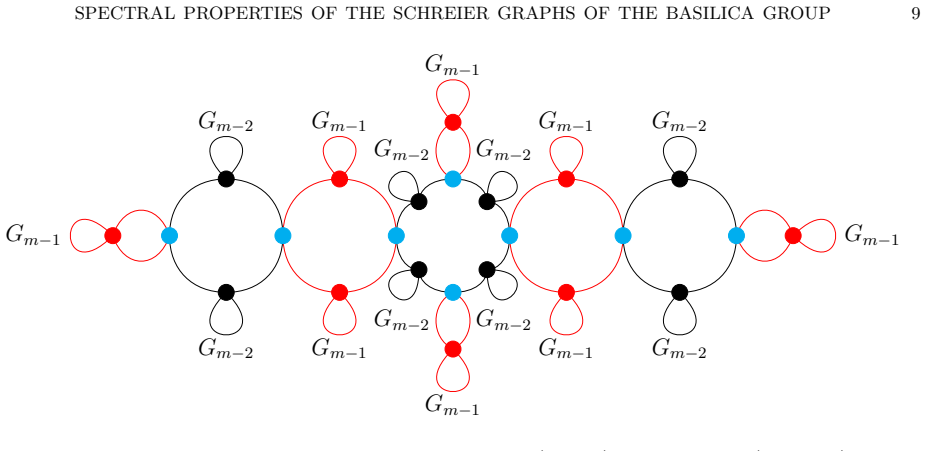
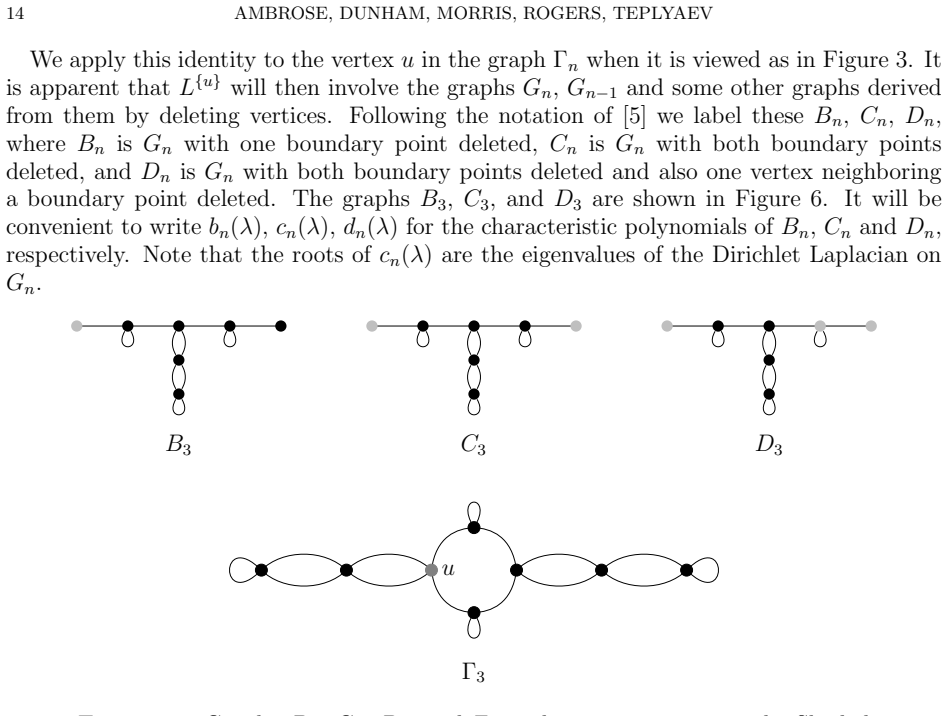
The recursive framework for characteristic polynomials, obtained by extending subgraph decompositions of the basilica graphs.
If this is right
- The eigenvalues of the Laplacian on Γ_n become computable for arbitrary n by iterating the recursion from a small number of base cases.
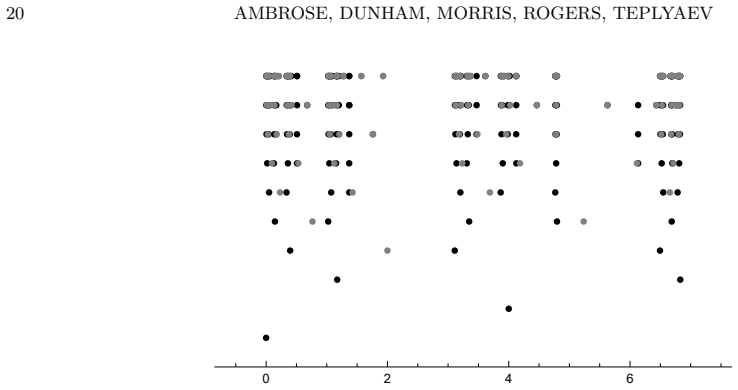
- The distribution of eigenvalues converges to the KNS measure at a rate controlled by the dynamical system.
- Spectral properties such as the density of states on the infinite Schreier graph can be read off from the attractor of the dynamical system.
- The same recursion supplies a concrete algorithm for approximating the integrated density of states for finite-level graphs.
Where Pith is reading between the lines
- The same style of recursion may exist for Schreier graphs of other iterated monodromy groups of quadratic polynomials.
- Numerical iteration of the dynamical system could produce high-resolution plots of the KNS measure without diagonalizing large matrices.
- The dynamical system may admit an invariant measure whose support describes the spectrum exactly rather than approximately.
Load-bearing premise
The recursive relations for the characteristic polynomials can be written down at every level by direct use of the known subgraph results, with no new obstructions appearing.
What would settle it
Explicit computation of the characteristic polynomial for Γ_4 or Γ_5 by another method and direct comparison against the polynomial produced by applying the claimed recursion to the polynomial for Γ_3.
Figures




read the original abstract
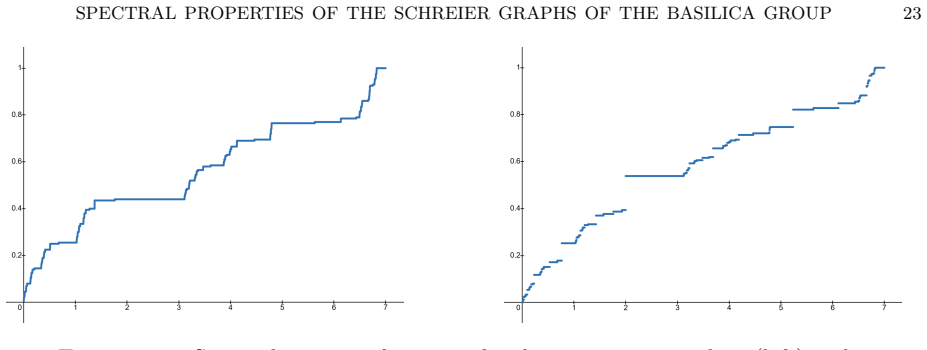
We study the spectral properties of Laplacians on the Schreier graphs $\Gamma_n$ of the basilica group, the iterated monodromy group of the polynomial $z^2 - 1$, which is an important example in the theory of self-similar, amenable but not elementarily amenable, automaton groups. Building heavily on results by Brzoska, Jarvis, George, Rogers and Teplyaev about certain subgraphs of the basilica graphs, we develop a new recursive framework for computing the characteristic polynomials of these Laplacians. Our analysis reveals a simple underlying dynamical system and proves approximation results for the Kesten-von Neumann-Serre (KNS) spectral measure.
Editorial analysis
A structured set of objections, weighed in public.
Referee Report
Summary. The manuscript studies spectral properties of Laplacians on the Schreier graphs Γ_n of the basilica group (iterated monodromy group of z²-1). Building on subgraph results of Brzoska, Jarvis, George, Rogers and Teplyaev, it develops a recursive framework for the characteristic polynomials, identifies an underlying dynamical system, and proves approximation results for the Kesten-von Neumann-Serre spectral measure.
Significance. If the recursive construction succeeds without new obstructions, the work would supply an explicit dynamical system whose iterates approximate the KNS measure for this canonical example of a self-similar amenable but not elementarily amenable group, extending prior subgraph analyses to the full Schreier graphs.
major comments (2)
- [Abstract and §3] Abstract and §3 (recursive framework): the central claim that the recursive framework for characteristic polynomials of Laplacians on Γ_n extends the subgraph results without additional obstructions at each iteration is load-bearing for the approximation theorems, yet the abstract supplies neither the explicit recursion formula, base cases, nor inductive step; verification that the iterated monodromy action preserves the necessary algebraic relations therefore cannot be checked from the given text.
- [§4] §4 (dynamical system and KNS approximation): the identification of the 'simple underlying dynamical system' and the proof of approximation results for the KNS measure rest on the recursion being obstruction-free; without the explicit construction, it remains open whether the extension from subgraphs to full graphs at successive n introduces new relations that would invalidate the claimed convergence.
minor comments (1)
- [§2] Notation for the graphs Γ_n and the precise definition of the KNS measure should be stated once in §2 before being used in later sections.
Simulated Author's Rebuttal
We thank the referee for the careful reading and constructive comments on our manuscript. We address the two major comments point by point below, agreeing that greater explicitness will strengthen the presentation.
read point-by-point responses
-
Referee: [Abstract and §3] Abstract and §3 (recursive framework): the central claim that the recursive framework for characteristic polynomials of Laplacians on Γ_n extends the subgraph results without additional obstructions at each iteration is load-bearing for the approximation theorems, yet the abstract supplies neither the explicit recursion formula, base cases, nor inductive step; verification that the iterated monodromy action preserves the necessary algebraic relations therefore cannot be checked from the given text.
Authors: Section 3 presents the recursive framework, including base cases for small n derived from the subgraph results and the inductive step using the self-similar structure of the basilica group. We agree, however, that the abstract is too brief and does not display the recursion formula or confirm the absence of new obstructions. In the revision we will add a concise statement of the recursion to the abstract and insert an explicit lemma in §3 verifying that the iterated monodromy action preserves the required algebraic relations at each step. revision: yes
-
Referee: [§4] §4 (dynamical system and KNS approximation): the identification of the 'simple underlying dynamical system' and the proof of approximation results for the KNS measure rest on the recursion being obstruction-free; without the explicit construction, it remains open whether the extension from subgraphs to full graphs at successive n introduces new relations that would invalidate the claimed convergence.
Authors: The dynamical system and KNS approximation theorems in §4 are obtained directly by iterating the recursion constructed in §3. To make the obstruction-free extension explicit, the revised manuscript will include a dedicated paragraph or short lemma showing that the passage from the Brzoska–Jarvis–George–Rogers–Teplyaev subgraphs to the full Schreier graphs Γ_n introduces no new relations that alter the spectral convergence. This will render the argument self-contained. revision: yes
Circularity Check
No circularity; new recursive framework is independent of cited subgraph results
full rationale
The paper cites prior subgraph results from Brzoska et al. (including overlapping authors Rogers and Teplyaev) as a foundation for extending to full Schreier graphs Γ_n, but explicitly develops a new recursive framework for characteristic polynomials, identifies a dynamical system, and proves KNS approximation results as original contributions. No equation or claim reduces by construction to the cited inputs, no fitted parameters are renamed as predictions, and no uniqueness theorem or ansatz is smuggled via self-citation. The derivation chain remains self-contained against external benchmarks once the subgraph base is granted; self-citation here is ordinary supporting context rather than load-bearing reduction. This matches the most common honest non-finding.
Axiom & Free-Parameter Ledger
Reference graph
Works this paper leans on
-
[1]
Anne Bannon, Jeanette Patel, Shivani Regan, Luke G Rogers, and Alexander Teplyaev,Spectral dy- namics for Schreier graphs of the basilica group, 2026
2026
-
[2]
Grigorchuk,On the spectrum of Hecke type operators related to some fractal groups, Tr
Laurent Bartholdi and Rostislav I. Grigorchuk,On the spectrum of Hecke type operators related to some fractal groups, Tr. Mat. Inst. Steklova231(2000), no. Din. Sist., Avtom. i Beskon. Gruppy, 5–45. MR 1841750
2000
-
[3]
,Spectra of non-commutative dynamical systems and graphs related to fractal groups, C. R. Acad. Sci. Paris S´ er. I Math.331(2000), no. 6, 429–434. MR 1792481
2000
-
[4]
J.130(2005), no
Laurent Bartholdi and B´ alint Vir´ ag,Amenability via random walks, Duke Math. J.130(2005), no. 1, 39–56. MR 2176547
2005
-
[5]
5, rnag037
Antoni Brzoska, Courtney George, Samantha Jarvis, Luke G Rogers, and Alexander Teplyaev,Spectral properties of graphs associated to the basilica group, International Mathematics Research Notices2026 (2026), no. 5, rnag037
2026
-
[6]
Fan R. K. Chung,Spectral graph theory, CBMS Regional Conference Series in Mathematics, vol. 92, Published for the Conference Board of the Mathematical Sciences, Washington, DC; by the American Mathematical Society, Providence, RI, 1997. MR 1421568
1997
-
[7]
N.-B. Dang, R. Grigorchuk, and M. Lyubich,Self-similar groups and holomorphic dynamics: renormal- ization, integrability, and spectrum, Arnold Math. J.9(2023), no. 4, 505–597
2023
-
[8]
Daniele D’Angeli, Alfredo Donno, Michel Matter, and Tatiana Nagnibeda,Schreier graphs of the Basilica group, J. Mod. Dyn.4(2010), no. 1, 167–205. MR 2643891
2010
-
[9]
2, Paper No
Rostislav Grigorchuk and Supun Samarakoon,Integrable and chaotic systems associated with fractal groups, Entropy23(2021), no. 2, Paper No. 237, 43. 26 AMBROSE, DUNHAM, MORRIS, ROGERS, TEPLYAEV
2021
-
[10]
Rostislav I. Grigorchuk, Daniel Lenz, and Tatiana Nagnibeda,Schreier graphs of Grigorchuk’s group and a subshift associated to a nonprimitive substitution, Groups, graphs and random walks, London Math. Soc. Lecture Note Ser., vol. 436, Cambridge Univ. Press, Cambridge, 2017, pp. 250–299. MR 3644012
2017
-
[11]
Ann.370(2018), no
,Spectra of Schreier graphs of Grigorchuk’s group and Schroedinger operators with aperiodic order, Math. Ann.370(2018), no. 3-4, 1607–1637. MR 3770175
2018
-
[12]
Grigorchuk, Volodymyr Nekrashevych, and Zoran ˇSuni´ c,From self-similar groups to self-similar sets and spectra, Fractal geometry and stochastics V, Progr
Rostislav I. Grigorchuk, Volodymyr Nekrashevych, and Zoran ˇSuni´ c,From self-similar groups to self-similar sets and spectra, Fractal geometry and stochastics V, Progr. Probab., vol. 70, Birkh¨ auser/Springer, Cham, 2015, pp. 175–207. MR 3558157
2015
-
[13]
Grigorchuk and Andrzej ˙Zuk,On a torsion-free weakly branch group defined by a three state automaton, Internat
Rostislav I. Grigorchuk and Andrzej ˙Zuk,On a torsion-free weakly branch group defined by a three state automaton, Internat. J. Algebra Comput.12(2002), no. 1-2, 223–246, International Conference on Geometric and Combinatorial Methods in Group Theory and Semigroup Theory (Lincoln, NE, 2000). MR 1902367
2002
-
[14]
Math., vol
,Spectral properties of a torsion-free weakly branch group defined by a three state automaton, Computational and statistical group theory (Las Vegas, NV/Hoboken, NJ, 2001), Contemp. Math., vol. 298, Amer. Math. Soc., Providence, RI, 2002, pp. 57–82. MR 1929716
2001
-
[15]
,The Ihara zeta function of infinite graphs, the KNS spectral measure and integrable maps, Random walks and geometry, Walter de Gruyter, Berlin, 2004, pp. 141–180. MR 2087782
2004
-
[16]
Kaimanovich,Random walks on Sierpi´ nski graphs: hyperbolicity and stochastic homogeniza- tion, Fractals in Graz 2001, Trends Math., Birkh¨ auser, Basel, 2003, pp
Vadim A. Kaimanovich,Random walks on Sierpi´ nski graphs: hyperbolicity and stochastic homogeniza- tion, Fractals in Graz 2001, Trends Math., Birkh¨ auser, Basel, 2003, pp. 145–183. MR 2091703
2001
-
[17]
M¨ unchhausen trick
,“M¨ unchhausen trick” and amenability of self-similar groups, Internat. J. Algebra Comput.15 (2005), no. 5-6, 907–937. MR 2197814
2005
-
[18]
Probab., vol
,Self-similarity and random walks, Fractal geometry and stochastics IV, Progr. Probab., vol. 61, Birkh¨ auser Verlag, Basel, 2009, pp. 45–70. MR 2762673
2009
-
[19]
117, Amer- ican Mathematical Society, Providence, RI, 2005
Volodymyr Nekrashevych,Self-similar groups, Mathematical Surveys and Monographs, vol. 117, Amer- ican Mathematical Society, Providence, RI, 2005. MR 2162164
2005
-
[20]
Volodymyr Nekrashevych and Alexander Teplyaev,Groups and analysis on fractals, Analysis on graphs and its applications, Proc. Sympos. Pure Math., vol. 77, Amer. Math. Soc., Providence, RI, 2008, pp. 143–180. MR 2459868
2008
discussion (0)
Sign in with ORCID, Apple, or X to comment. Anyone can read and Pith papers without signing in.