Does Normalization Choice Matter for Causal Large Time-Series Models?
Pith reviewed 2026-06-27 17:24 UTC · model grok-4.3
The pith
Normalization choice significantly influences training convergence and forecasting performance in causal large time-series models.
A machine-rendered reading of the paper's core claim, the machinery that carries it, and where it could break.
Core claim
In evaluations of transformer-based large time-series models trained with patching and efficient causal strategy, normalization choice significantly influences both training convergence and forecasting performance. Recent alternatives, including causal normalization and statistics computed from initial observations, have been proposed to address potential information leakage, but their practical implications remain insufficiently understood.
What carries the argument
Normalization strategies (standard, causal, and initial-observation variants) applied within causal autoregressive transformer training that uses patching on heterogeneous time-series.
If this is right
- Selecting an appropriate normalization method can measurably speed up training convergence.
- Forecast accuracy varies with the normalization approach even when the underlying model architecture stays the same.
- Causal normalization and initial-observation statistics provide viable alternatives that reduce future leakage while still affecting performance.
- Normalization must be treated as an explicit hyper-parameter when training on non-stationary heterogeneous signals.
Where Pith is reading between the lines
- Development workflows for these models should include systematic normalization ablations rather than defaulting to a single scheme.
- The same sensitivity may appear in other causal sequential architectures that process non-stationary data.
- Design of new causal training procedures could incorporate normalization as a tunable component rather than a fixed preprocessing step.
Load-bearing premise
Observed differences in convergence and performance are driven primarily by the normalization method rather than by interactions with the specific patching or causal training implementation.
What would settle it
A controlled comparison that keeps patching and causal training details fixed while swapping only the normalization method and finds no measurable change in convergence speed or forecast accuracy would falsify the central claim.
Figures




read the original abstract
Large models for time-series forecasting have been emerged as a promising paradigm for training models on heterogeneous collections of signals. These models typically rely on causal autoregressive architectures, where each observation is sequentially predicted from past. In practice, real-world time-series exhibit non-stationarities, which significantly influence predictive performance. To mitigate this, normalization is commonly employed. However, in efficient causal settings it might induce information leakage from future observations during training. Recent alternatives, including causal normalization and statistics computed from initial observations, have been proposed to address this issue, but their practical implications remain insufficiently understood. In this work, we evaluate normalization strategies for transformer-based large time-series models trained with patching and efficient causal strategy. We showcase that normalization choice significantly influences both training convergence and forecasting performance.
Editorial analysis
A structured set of objections, weighed in public.
Referee Report
Summary. The paper evaluates normalization strategies (including causal normalization and initial-observation statistics) for transformer-based large time-series forecasting models that employ patching and efficient causal autoregressive training. It claims that normalization choice significantly influences both training convergence and forecasting performance in the presence of non-stationarities and potential information leakage.
Significance. If the empirical results hold after proper controls, the work would highlight a practical design choice that affects reliability in large causal time-series models, offering guidance for avoiding leakage while maintaining performance on heterogeneous signals.
major comments (1)
- [Abstract] Abstract: the central empirical claim that normalization choice 'significantly influences' convergence and performance is stated without any reference to datasets, number of runs, statistical tests, or ablations that isolate normalization from interactions with the patching mechanism and causal mask (e.g., per-patch statistics under the mask or initial-observation boundaries). This directly undermines assessment of whether normalization is the primary driver.
minor comments (1)
- [Abstract] The abstract would be clearer if it briefly enumerated the specific normalization variants compared and the evaluation metrics used for convergence and forecasting.
Simulated Author's Rebuttal
We thank the referee for their review and the opportunity to clarify the presentation of our empirical claims. We address the single major comment below.
read point-by-point responses
-
Referee: [Abstract] Abstract: the central empirical claim that normalization choice 'significantly influences' convergence and performance is stated without any reference to datasets, number of runs, statistical tests, or ablations that isolate normalization from interactions with the patching mechanism and causal mask (e.g., per-patch statistics under the mask or initial-observation boundaries). This directly undermines assessment of whether normalization is the primary driver.
Authors: The abstract is a high-level summary of results that are fully detailed in the body of the paper. Sections 4 and 5 report experiments on multiple heterogeneous time-series datasets, with performance metrics averaged over 5 random seeds per configuration and accompanied by standard-error bars. We include direct ablations that vary only the normalization strategy while holding the patching mechanism, causal mask, and autoregressive training fixed; these appear in Figures 3–5 and Tables 2–4, with per-patch and initial-observation variants explicitly compared. Nevertheless, we agree that the abstract would benefit from greater specificity. We will revise it to state the number of datasets, the number of runs, and the existence of the isolation ablations, thereby making the empirical basis clearer without lengthening the abstract substantially. revision: yes
Circularity Check
Empirical evaluation with no derivations or self-referential predictions
full rationale
The paper reports an empirical study comparing normalization strategies for transformer-based time-series models under patching and causal training. No equations, derivations, fitted parameters, or predictions are present that could reduce to inputs by construction. The central claim is a direct statement of observed differences in convergence and performance from experiments, with no load-bearing self-citations or ansatzes. The analysis is self-contained against external benchmarks.
Axiom & Free-Parameter Ledger
Reference graph
Works this paper leans on
-
[1]
URL https://arxiv.org/abs/2410.10393. Abdul Fatir Ansari, Lorenzo Stella, Caner Turkmen, Xiyuan Zhang, Pedro Mercado, Huibin Shen, Oleksandr Shchur, Syama Sundar Rangapuram, Sebastian Pineda Arango, Shubham Kapoor, Jasper Zschiegner, Danielle C. Maddix, Hao Wang, Michael W. Mahoney, Kari Torkkola, An- drew Gordon Wilson, Michael Bohlke-Schneider, and Yuya...
-
[2]
URL https://arxiv.org/abs/2403.07815. Abdul Fatir Ansari, Oleksandr Shchur, Jaris K ¨uken, Andreas Auer, Boran Han, Pedro Mercado, Syama Sundar Rangapuram, Huibin Shen, Lorenzo Stella, Xiyuan Zhang, Mononito Goswami, Shubham Kapoor, Danielle C. Maddix, Pablo Guerron, Tony Hu, Junming Yin, Nick Erick- son, Prateek Mutalik Desai, Hao Wang, Huzefa Rangwala, ...
-
[3]
URL https://arxiv.org/abs/2510.15821. Andreas Auer, Patrick Podest, Daniel Klotz, Sebastian B¨ock, G¨unter Klambauer, and Sepp Hochre- iter. Tirex: Zero-shot forecasting across long and short horizons with enhanced in-context learn- ing,
-
[4]
URL https://arxiv.org/abs/2505.23719. Ben Cohen, Emaad Khwaja, Youssef Doubli, Salahidine Lemaachi, Chris Lettieri, Charles Mas- son, Hugo Miccinilli, Elise Ram´e, Qiqi Ren, Afshin Rostamizadeh, Jean Ogier du Terrail, Anna- Monica Toon, Kan Wang, Stephan Xie, Zongzhe Xu, Viktoriya Zhukova, David Asker, Ameet Talwalkar, and Othmane Abou-Amal. This time is ...
-
[5]
Abhimanyu Das, Weihao Kong, Rajat Sen, and Yichen Zhou
URL https://arxiv.org/abs/2505.14766. Abhimanyu Das, Weihao Kong, Rajat Sen, and Yichen Zhou. A decoder-only foundation model for time-series forecasting,
-
[6]
URL https://arxiv.org/abs/2310.10688. Janez Demˇsar. Statistical comparisons of classifiers over multiple data sets.The Journal of Machine learning research, 7(1):1–30,
-
[7]
Association for Computing Machinery. ISBN 9798400704369. doi: 10.1145/3627673.3679931. URL https://doi.org/10.1145/3627673.3679931. Wei Gao, Xinyu Zhou, Peng Sun, Tianwei Zhang, and Yonggang Wen. Rethinking key-value cache compression techniques for large language model serving,
-
[8]
Lars Graf, Thomas Ortner, Stanisław Wo ´zniak, and Angeliki Pantazi
URLhttps://arxiv.org/ abs/2503.24000. Lars Graf, Thomas Ortner, Stanisław Wo ´zniak, and Angeliki Pantazi. Flowstate: Sampling rate invariant time series forecasting,
-
[9]
URL https://arxiv.org/abs/2508.05287. 5 ICLR 2026 Workshop on Time Series in the Age of Large Models (TSALM) Aaron Grattafiori, Abhimanyu Dubey, Abhinav Jauhri, and Abhinav Pandey et al. The llama 3 herd of models,
arXiv 2026
-
[10]
Taesung Kim, Jinhee Kim, Yunwon Tae, Cheonbok Park, Jang-Ho Choi, and Jaegul Choo
URL https://arxiv.org/abs/2407.21783. Taesung Kim, Jinhee Kim, Yunwon Tae, Cheonbok Park, Jang-Ho Choi, and Jaegul Choo. Re- versible instance normalization for accurate time-series forecasting against distribution shift. In International Conference on Learning Representations,
-
[11]
Yong Liu, Haoran Zhang, Chenyu Li, Xiangdong Huang, Jianmin Wang, and Mingsheng Long
URL http://arxiv.org/abs/2511.11698. Yong Liu, Haoran Zhang, Chenyu Li, Xiangdong Huang, Jianmin Wang, and Mingsheng Long. Timer: Generative pre-trained transformers are large time series models,
-
[12]
Yuqi Nie, Nam H Nguyen, Phanwadee Sinthong, and Jayant Kalagnanam
URL https: //arxiv.org/abs/2402.02368. Yuqi Nie, Nam H Nguyen, Phanwadee Sinthong, and Jayant Kalagnanam. A time series is worth 64 words: Long-term forecasting with transformers. In The Eleventh International Confer- ence on Learning Representations ,
-
[13]
URL https://arxiv.org/abs/2508.10925. Noam Shazeer. Glu variants improve transformer,
-
[14]
URL https://arxiv.org/abs/ 2002.05202. Oleksandr Shchur, Abdul Fatir Ansari, Caner Turkmen, Lorenzo Stella, Nick Erickson, Pablo Guer- ron, Michael Bohlke-Schneider, and Yuyang Wang. fev-bench: A realistic benchmark for time series forecasting,
Pith/arXiv arXiv 2002
-
[15]
Xiaoming Shi, Shiyu Wang, Yuqi Nie, Dianqi Li, Zhou Ye, Qingsong Wen, and Ming Jin
URL https://arxiv.org/abs/2509.26468. Xiaoming Shi, Shiyu Wang, Yuqi Nie, Dianqi Li, Zhou Ye, Qingsong Wen, and Ming Jin. Time- moe: Billion-scale time series foundation models with mixture of experts,
-
[16]
Jianlin Su, Yu Lu, Shengfeng Pan, Ahmed Murtadha, Bo Wen, and Yunfeng Liu
URL https: //arxiv.org/abs/2409.16040. Jianlin Su, Yu Lu, Shengfeng Pan, Ahmed Murtadha, Bo Wen, and Yunfeng Liu. Roformer: En- hanced transformer with rotary position embedding,
-
[17]
Bartosz Uniejewski and Rafał Weron
URLhttps://arxiv.org/abs/ 2104.09864. Bartosz Uniejewski and Rafał Weron. Efficient forecasting of electricity spot prices with expert and lasso models. Energies, 11:2039, 08
Pith/arXiv arXiv 2039
-
[18]
doi: 10.3390/en11082039. Ashish Vaswani, Noam Shazeer, Niki Parmar, Jakob Uszkoreit, Llion Jones, Aidan N. Gomez, Łukasz Kaiser, and Illia Polosukhin. Attention is all you need. In Proceedings of the 31st In- ternational Conference on Neural Information Processing Systems , NIPS’17, Red Hook, NY , USA,
-
[19]
A A PPENDIX The code is available at https://github.com/vilhess/normalizer
URL https: //arxiv.org/abs/2402.02592. A A PPENDIX The code is available at https://github.com/vilhess/normalizer. A.1 F ORMALIZATION OF THE PROBLEM SETTING We consider the task of univariate time-series forecasting using patch-based representations. Let a time-series be partitioned into a sequence of patches x = (xP1 , xP2 , . . . ,xPN ), (6) 6 ICLR 2026...
arXiv 2026
-
[20]
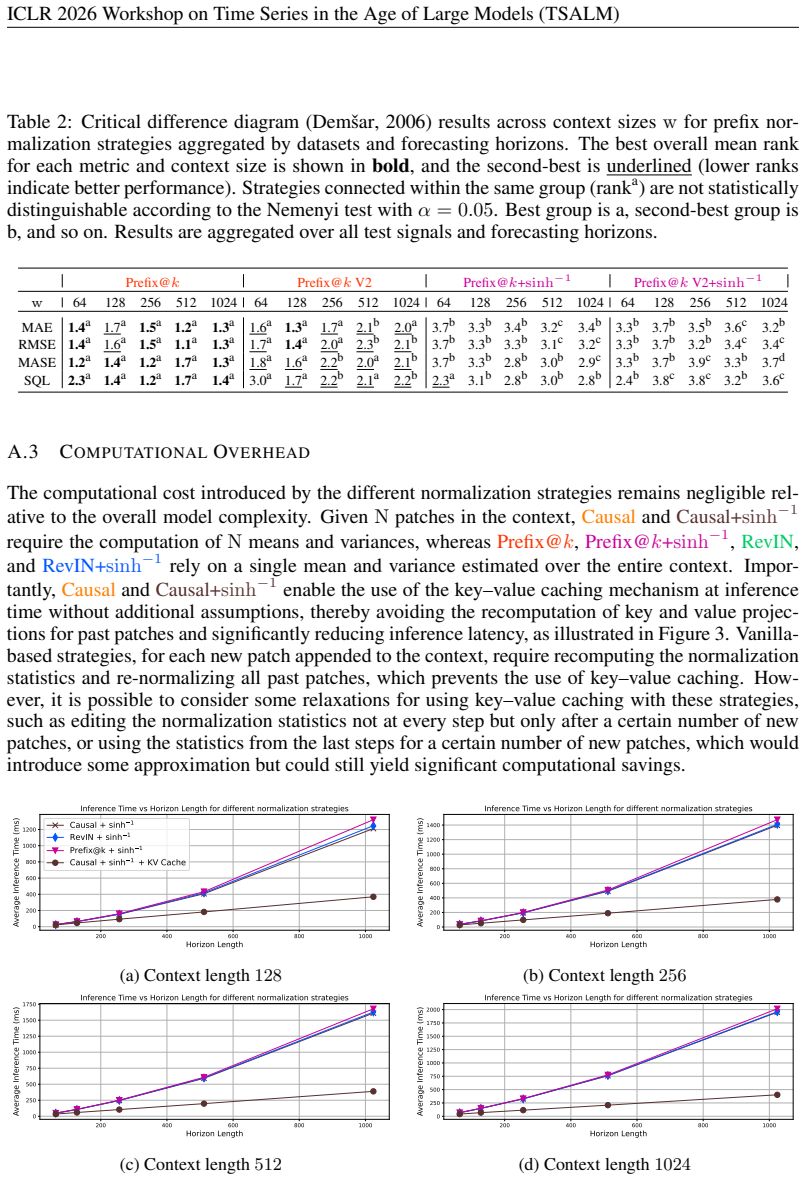
8 ICLR 2026 Workshop on Time Series in the Age of Large Models (TSALM) Table 2: Critical difference diagram (Dem ˇsar,
2026
-
[21]
Vanilla- based strategies, for each new patch appended to the context, require recomputing the normalization statistics and re-normalizing all past patches, which prevents the use of key–value caching. How- ever, it is possible to consider some relaxations for using key–value caching with these strategies, such as editing the normalization statistics not ...
2026
-
[22]
Standard residual connections are used throughout the stack, and temporal causality is strictly enforced via a triangular attention mask
to inject relative temporal information into the at- tention mechanism. Standard residual connections are used throughout the stack, and temporal causality is strictly enforced via a triangular attention mask. Table 3: Model configuration Component Value Patch size L 32 observations Max context N 32 patch (1024 observations) Forecast horizon 1 patch (32 o...
2048
-
[23]
In addition, we adopt the KernelSynth strategy from Ansari et al
to increase pattern diversity. In addition, we adopt the KernelSynth strategy from Ansari et al. (2024) to sample Gaussian-process signals with mixtures of kernels (e.g., RBF, periodic, linear), sweeping hyperparameters (amplitudes, frequencies/periods, length scales, noise) to cover a broad range of dynamics. Real-World Dataset. For real-world signals, w...
2024
-
[24]
The implementation uses PyTorch Lightning with Distributed Data Parallel
(23) A.5.3 S ETUP Training was performed on 4 NVIDIA V100 GPUs. The implementation uses PyTorch Lightning with Distributed Data Parallel. We have a global batch size of 1024 and train for 225k steps in total. We use the AdamW optimizer, a learning rate starting at10−5 with a linear warm-up over 10k steps until 5.10−4, followed by cosine decay to 10−5 unti...
2025
-
[25]
Thus, SkillScore(s, r) quantifies the average relative error reduction achieved by strategy s compared to the reference strategy r across datasets
The skill score takes values in (−∞, 1]: a score of 1 corresponds to perfect performance (i.e., zero error), a score of 0 indicates performance equivalent to the reference strategy, and negative values indicate worse performance than the reference. Thus, SkillScore(s, r) quantifies the average relative error reduction achieved by strategy s compared to th...
2026
-
[26]
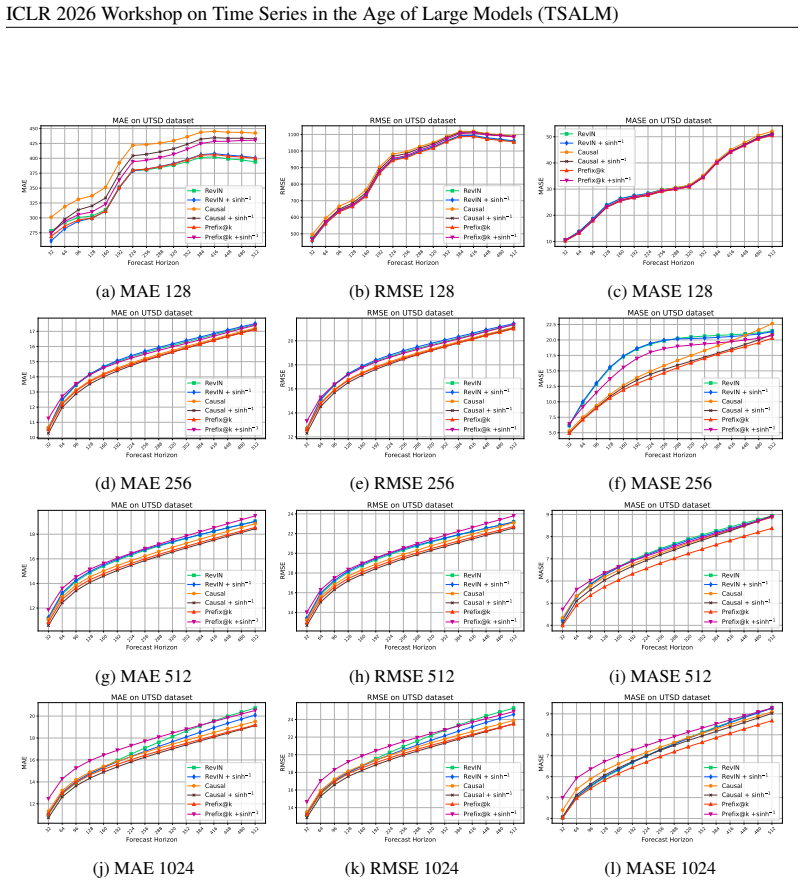
The performance of Causal+ sinh−1 improves as the context length increases, eventually surpassing both RevIN+ sinh−1 and RevIN at a context length 14 ICLR 2026 Workshop on Time Series in the Age of Large Models (TSALM) 32 64 96 128 160 192 224 256 288 320 352 384 416 448 480 512 Forecast Horizon 0 2000 4000 6000 8000 10000 12000 14000MAE MAE on Artificial...
2026
-
[27]
For a context length of 1024, the models again perform similarly on average across horizons, with the exception of Prefix@k+sinh−1, which shows consistently degraded performance across all horizons. 15 ICLR 2026 Workshop on Time Series in the Age of Large Models (TSALM) 32 64 96 128 160 192 224 256 288 320 352 384 416 448 480 512 Forecast Horizon 275 300 ...
2026
-
[28]
Our analysis is restricted to mean—variance-based normalization strategies, which remain the dominant choice in current large-scale time-series models
trained under comparable conditions. Our analysis is restricted to mean—variance-based normalization strategies, which remain the dominant choice in current large-scale time-series models. Alternative normaliza- tion families are therefore not considered in this work. 19 ICLR 2026 Workshop on Time Series in the Age of Large Models (TSALM) ACKNOWLEDGMENTS ...
2026
discussion (0)
Sign in with ORCID, Apple, or X to comment. Anyone can read and Pith papers without signing in.