Infrared Echoes of Precessing Tidal Disruption Events
Pith reviewed 2026-06-27 21:15 UTC · model grok-4.3
The pith
Precessing tidal disruption event disks create highly variable infrared echoes from surrounding dust.
A machine-rendered reading of the paper's core claim, the machinery that carries it, and where it could break.
Core claim
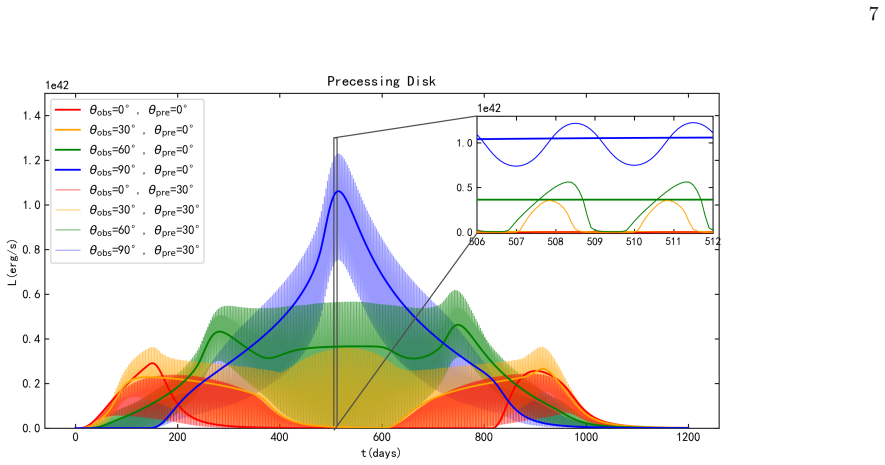
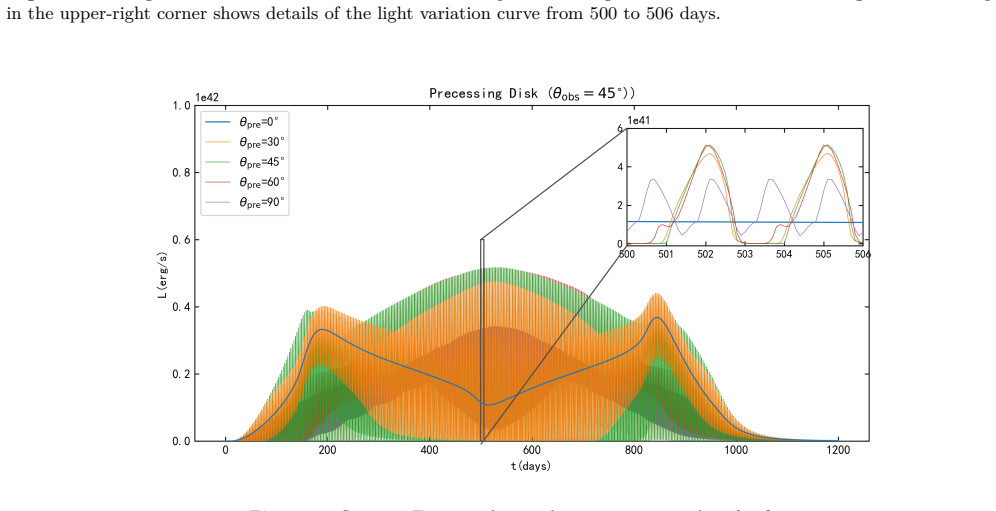
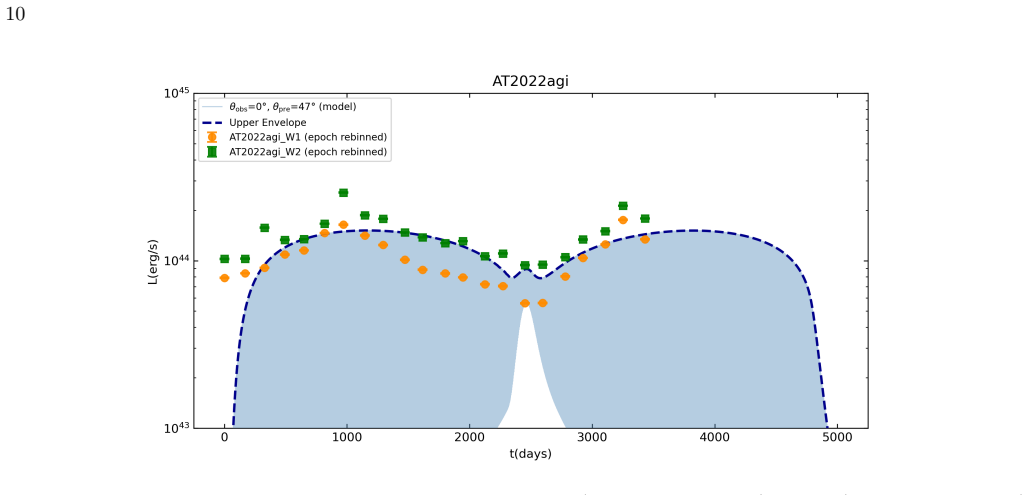
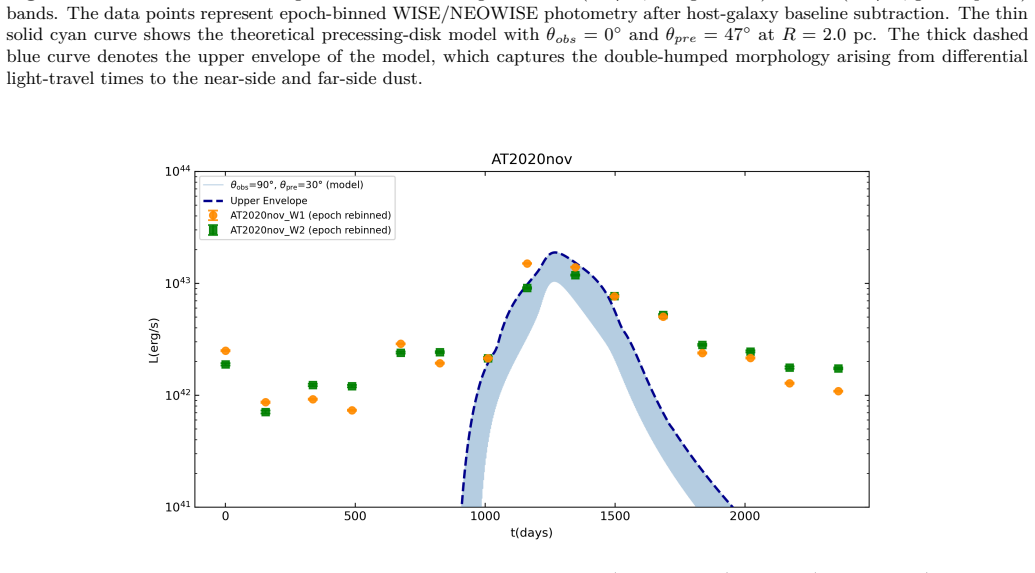
The precession will lead to highly variable infrared light curves, which can be revealed by high-cadence observations. The overall profile of the infrared light curves shows double-peaked to single-peaked pattern transitions as a result of the changes in the viewing angle or precession angle. The results indicate that infrared echoes are dynamic tracers of the evolving lighting patterns of the central engine.
What carries the argument
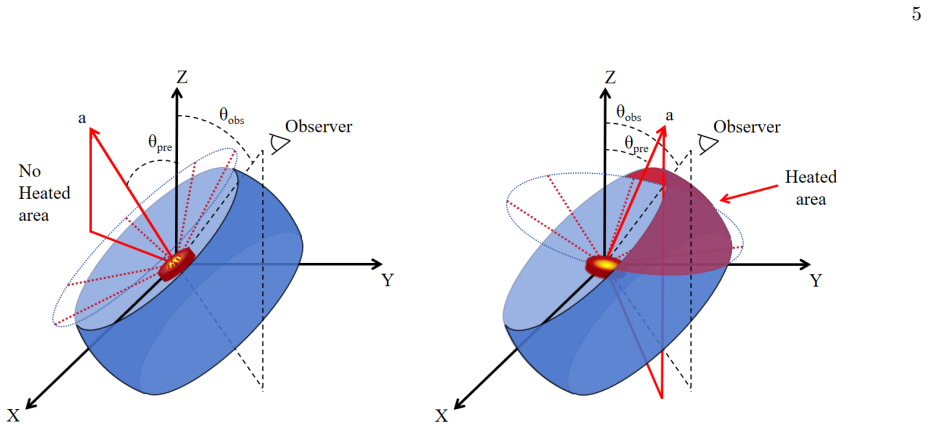
A theoretical framework for infrared dust echoes from a precessing TDE disk, which models how precession modulates the illumination pattern on parsec-scale dust.
If this is right
- High-cadence infrared observations can detect the high variability in the light curves.
- The light curve profiles transition from double-peaked to single-peaked with changes in viewing angle or precession angle.
- Infrared echoes serve as dynamic tracers of the central engine's lighting patterns.
- These echoes provide calorimetric probes that account for the evolving geometry due to precession.
Where Pith is reading between the lines
- If the model holds, repeated infrared monitoring of known TDEs could measure precession periods and misalignment angles directly from the echo variability.
- Such signatures might appear in multi-wavelength data if precession also affects the emitted radiation reaching the dust.
- Future infrared surveys could use the double-to-single peak transitions to flag precessing systems among other transients.
Load-bearing premise
The accretion disk in a tidal disruption event is misaligned and undergoes relativistic precession instead of remaining static and axisymmetric.
What would settle it
A high-cadence infrared monitoring campaign of a tidal disruption event showing constant light curve shapes with no variability or peak pattern transitions over years would falsify the central claim.
Figures

read the original abstract
A tidal disruption event (TDE) occurs when a star is torn apart by a supermassive black hole. The resulting UV/optical flare irradiates parsec-scale dust, producing delayed mid-infrared echoes that persist for years. These echoes provide unique calorimetric probes of the total radiated energy and dust geometry.Existing models usually assume static axisymmetric illumination patterns. However, the TDE accretion disk is likely misaligned and undergoes relativistic precession.In this work, we present a theoretical framework for infrared dust echoes from a precessing TDE disk. The precession will lead to highly variable infrared light curves, which can be revealed by high-cadence observations. The overall profile of the infrared light curves shows double-peaked to single-peaked pattern transitions as a result of the changes in the viewing angle or precession angle.The results indicate that infrared echoes are dynamic tracers of the evolving lighting patterns of the central engine.
Editorial analysis
A structured set of objections, weighed in public.
Referee Report
Summary. The manuscript develops a theoretical framework for mid-infrared dust echoes produced by a precessing, misaligned TDE accretion disk. It claims that relativistic precession generates highly variable IR light curves whose overall profile transitions between double-peaked and single-peaked shapes as a function of viewing angle or precession angle; these echoes are presented as dynamic tracers of the evolving illumination pattern of the central engine, observable with high-cadence monitoring.
Significance. If the central claim holds after proper treatment of light-travel effects, the work would extend static axisymmetric echo models to include precession and thereby offer a new route to constrain TDE disk misalignment and precession parameters from IR observations.
major comments (2)
- [theoretical framework] The central claim that precession produces observable highly variable IR light curves with double-to-single peaked transitions is load-bearing on whether the model computes the echo as the source light curve convolved with the parsec-scale dust delay distribution. The abstract and framework description give no indication that this convolution is performed or that the regime precession period ≳ dust light-crossing time (~years) is explored; if the precession timescale is shorter, the convolution will average over multiple phases and can suppress both amplitude and the reported peak-structure transitions.
- [theoretical framework] §3 (or equivalent model section): the forward model is described as driven by precession geometry, yet no explicit statement is given on how the dust response is integrated over the radial and angular extent of the torus; without this, it is impossible to verify whether the claimed light-curve transitions survive the delay spread.
minor comments (2)
- [Abstract] The abstract states that 'the TDE accretion disk is likely misaligned' without a supporting reference or brief justification; a short sentence citing the relevant TDE misalignment literature would improve clarity.
- Notation for viewing angle and precession angle should be defined at first use and kept consistent between text and any figures showing light-curve profiles.
Simulated Author's Rebuttal
We thank the referee for their constructive comments, which highlight important aspects of the light-travel time treatment in our theoretical framework. We address each major comment below.
read point-by-point responses
-
Referee: [theoretical framework] The central claim that precession produces observable highly variable IR light curves with double-to-single peaked transitions is load-bearing on whether the model computes the echo as the source light curve convolved with the parsec-scale dust delay distribution. The abstract and framework description give no indication that this convolution is performed or that the regime precession period ≳ dust light-crossing time (~years) is explored; if the precession timescale is shorter, the convolution will average over multiple phases and can suppress both amplitude and the reported peak-structure transitions.
Authors: We agree that the convolution with the dust delay distribution is central to validating the variability and peak-structure transitions. Our forward model does perform this convolution between the time-dependent illumination from the precessing disk and the delay distribution of the parsec-scale torus, and we restrict the presented results to the regime where the precession period is comparable to or longer than the light-crossing time so that phase-dependent features are not averaged away. We acknowledge that neither the abstract nor the initial framework description made this explicit. We will revise the manuscript to state the convolution procedure and the explored timescale regime clearly. revision: yes
-
Referee: [theoretical framework] §3 (or equivalent model section): the forward model is described as driven by precession geometry, yet no explicit statement is given on how the dust response is integrated over the radial and angular extent of the torus; without this, it is impossible to verify whether the claimed light-curve transitions survive the delay spread.
Authors: We will add an explicit subsection in the model description (revised §3) that details the integration of the dust response over the radial and angular coordinates of the torus. This will include the mathematical expression for summing the delayed contributions from each dust element, confirming that the full delay spread is incorporated when generating the light curves. revision: yes
Circularity Check
Forward physical model of precessing TDE IR echoes shows no circularity
full rationale
The provided abstract and context describe a theoretical framework deriving IR light-curve variability and double-to-single peaked transitions directly from precession geometry, viewing angle, and dust illumination. No equations or steps are shown that reduce predictions to fitted parameters, self-definitions, or load-bearing self-citations. The derivation is presented as a forward model from relativistic precession assumptions, remaining self-contained without the specific reductions required for circularity flags.
Axiom & Free-Parameter Ledger
axioms (1)
- domain assumption The TDE accretion disk is likely misaligned and undergoes relativistic precession
Reference graph
Works this paper leans on
-
[1]
Alexander, K. D., van Velzen, S., Horesh, A., & Zauderer, B. A. 2020, SSRv, 216, 81, doi: 10.1007/s11214-020-00702-w
-
[2]
2026, arXiv e-prints, arXiv:2603.07161, doi: 10.48550/arXiv.2603.07161
An, T., Wang, A., Zhang, Y., et al. 2026, arXiv e-prints, arXiv:2603.07161, doi: 10.48550/arXiv.2603.07161
-
[3]
Arcodia, R., Merloni, A., Nandra, K., et al. 2021, Nature, 592, 704, doi: 10.1038/s41586-021-03394-6
-
[4]
Arcodia, R., Liu, Z., Merloni, A., et al. 2024, A&A, 684, A64, doi: 10.1051/0004-6361/202348881
-
[5]
Bu, D.-F., Chen, L., Mou, G., Qiao, E., & Yang, X.-H. 2023, MNRAS, 521, 4180, doi: 10.1093/mnras/stad804
-
[6]
arXiv , author =:2110.10786 , journal =
Chakraborty, J., Kara, E., Masterson, M., et al. 2021, ApJL, 921, L40, doi: 10.3847/2041-8213/ac313b
-
[7]
Chen, J.-H., Dai, L., Kan, C. K., Kwan, T. M., & Zhang, Z. 2026, ApJ, 1000, 9, doi: 10.3847/1538-4357/ae434e
-
[8]
Committee, R. O. T. A., & Committees, C. C. S. D. 2025, Roman Observations Time Allocation Committee: Final Report and Recommendations, https://arxiv.org/abs/2505.10574
arXiv 2025
-
[9]
DeCoursey, C., Egami, E., Sun, F., et al. 2025, The First Photometric Evidence of a Transient/Variable Source at z >5 with JWST, https://arxiv.org/abs/2504.17007
arXiv 2025
-
[10]
2017, The Astrophysical Journal Letters, 841, L8, doi: 10.3847/2041-8213/aa7130
Dou, L., Wang, T., Yan, L., et al. 2017, The Astrophysical Journal Letters, 841, L8, doi: 10.3847/2041-8213/aa7130
-
[11]
2016, The Astrophysical Journal, 832, 188, doi: 10.3847/0004-637x/832/2/188
Dou, L., Wang, T.-g., Jiang, N., et al. 2016, The Astrophysical Journal, 832, 188, doi: 10.3847/0004-637x/832/2/188
-
[12]
1983, ApJ, 274, 175, doi: 10.1086/161435
Dwek, E. 1983, ApJ, 274, 175, doi: 10.1086/161435
-
[13]
1985, ApJ, 297, 719, doi: 10.1086/163571
Dwek, E. 1985, ApJ, 297, 719, doi: 10.1086/163571
-
[14]
E., Glaccum, W., et al
Dwek, E., Felten, J. E., Glaccum, W., et al. 1989, in Bulletin of the American Astronomical Society, Vol. 21, 1215
1989
-
[15]
J., Willott, C., Alberts, S., et al
Eisenstein, D. J., Willott, C., Alberts, S., et al. 2025, Overview of the JWST Advanced Deep Extragalactic Survey (JADES), https://arxiv.org/abs/2306.02465 ESA. 2026, Euclid„ ESA Earth Observation Portal https://www.eoportal.org/satellite-missions/euclid
Pith/arXiv arXiv 2025
-
[16]
Felten, J. E., & Dwek, E. 1989, Nature, 339, 123, doi: 10.1038/339123a0
-
[17]
Fragile, P. C., Blaes, O. M., Anninos, P., & Salmonson, J. D. 2007, ApJ, 668, 417, doi: 10.1086/521092
-
[18]
Y., He, L
Fu, S. Y., He, L. B., Zhu, A. D., et al. 2025, GRB Coordinates Network, 42990, 1
2025
-
[19]
Gerardy, C. L., Fesen, R. A., Nomoto, K., et al. 2002, The Astrophysical Journal, 575, 1007–1017, doi: 10.1086/341430
-
[20]
Gezari, S. 2021, Annual Review of Astronomy and Astrophysics, 59, 21–58, doi: 10.1146/annurev-astro-111720-030029
-
[21]
Giustini, M., Miniutti, G., & Saxton, R. D. 2020, A&A, 636, L2, doi: 10.1051/0004-6361/202037610
-
[22]
Guolo, M., Gezari, S., Yao, Y., et al. 2024, A systematic analysis of the X-ray emission in optically selected tidal disruption events: observational evidence for the unification of the optically and X-ray selected populations, https://arxiv.org/abs/2308.13019
arXiv 2024
-
[23]
Hammerstein, E., Gezari, S., van Velzen, S., et al. 2021, The Astrophysical Journal Letters, 908, L20, doi: 10.3847/2041-8213/abdcb4 14
-
[24]
Hammerstein, E., Cenko, S. B., Gezari, S., et al. 2023, Integral Field Spectroscopy of 13 Tidal Disruption Event Hosts from the ZTF Survey, https://arxiv.org/abs/2307.15705 Hern´ andez-Garc´ ıa, L., Chakraborty, J., S´ anchez-S´ aez, P., et al. 2025, Nature Astronomy, doi: 10.1038/s41550-025-02523-9
-
[25]
The Astrophysical Journal , author =
Jiang, N., Wang, T., Hu, X., et al. 2021, The Astrophysical Journal, 911, 31, doi: 10.3847/1538-4357/abe772
-
[26]
2017, The Astrophysical Journal, 850, 63, doi: 10.3847/1538-4357/aa93f5
Jiang, N., Wang, T., Yan, L., et al. 2017, The Astrophysical Journal, 850, 63, doi: 10.3847/1538-4357/aa93f5
-
[27]
Langis, D. A., Liodakis, I., Koljonen, K. I. I., et al. 2026, Astronomy & Astrophysics, 707, A171, doi: 10.1051/0004-6361/202554882
-
[28]
2013, ApJ, 762, 98, doi: 10.1088/0004-637X/762/2/98
Lei, W.-H., Zhang, B., & Gao, H. 2013, ApJ, 762, 98, doi: 10.1088/0004-637X/762/2/98
-
[29]
Lei, X., Wu, Q., Li, H., et al. 2024, ApJ, 977, 63, doi: 10.3847/1538-4357/ad8ba5
-
[30]
1918, Physikalische Zeitschrift, 19, 156
Lense, J., & Thirring, H. 1918, Physikalische Zeitschrift, 19, 156
1918
-
[31]
2025, arXiv e-prints, arXiv:2506.04196, doi: 10.48550/arXiv.2506.04196
Li, Y.-Z., Xu, W.-L., Chen, Y.-G., & Lei, W.-H. 2025, arXiv e-prints, arXiv:2506.04196, doi: 10.48550/arXiv.2506.04196
-
[32]
Lin, Z., Jiang, N., Wang, T., et al. 2024, The Astrophysical Journal Letters, 971, L26, doi: 10.3847/2041-8213/ad638e
-
[33]
Liu, C., & Miller, A. A. 2026, Publications of the Astronomical Society of the Pacific, 138, 024503, doi: 10.1088/1538-3873/ae3cc1
-
[34]
Lu, W., Kumar, P., & Evans, N. J. 2016, Monthly Notices of the Royal Astronomical Society, 458, 575–581, doi: 10.1093/mnras/stw307
-
[35]
Lu, W., Matsumoto, T., & Matzner, C. D. 2024, MNRAS, 533, 979, doi: 10.1093/mnras/stae1770
-
[36]
Maeda, K., Nozawa, T., Nagao, T., & Motohara, K. 2015, Constraining the Amount of Circumstellar Matter and Dust around Type Ia Supernovae through Near-Infrared Echoes, https://arxiv.org/abs/1411.3778
Pith/arXiv arXiv 2015
-
[37]
Masterson, M., De, K., Panagiotou, C., et al. 2024, A New Population of Mid-Infrared-Selected Tidal Disruption Events: Implications for Tidal Disruption Event Rates and Host Galaxy Properties, https://arxiv.org/abs/2401.01403
arXiv 2024
-
[39]
Miniutti, G., Saxton, R. D., Giustini, M., et al. 2019b, Nature, 573, 381, doi: 10.1038/s41586-019-1556-x
-
[40]
Mou, G., Wang, T., Wang, W., & Yang, J. 2022, MNRAS, 510, 3650, doi: 10.1093/mnras/stab3742
-
[41]
2025, Astronomy & Astrophysics, 695, A228, doi: 10.1051/0004-6361/202451340
Necker, J., Graikou, E., Kowalski, M., et al. 2025, Astronomy & Astrophysics, 695, A228, doi: 10.1051/0004-6361/202451340
-
[42]
Nicholl, M., Pasham, D. R., Mummery, A., et al. 2024, Nature, 634, 804, doi: 10.1038/s41586-024-08023-6
-
[43]
R., Coughlin, E., van Velzen, S., & Hinkle, J
Pasham, D. R., Coughlin, E., van Velzen, S., & Hinkle, J. 2025, Using Infrared Dust Echoes to Identify Bright Quasi-periodic Eruption Sources, https://arxiv.org/abs/2502.12078
arXiv 2025
-
[44]
Phinney, E. S. 1989, in IAU Symposium, Vol. 136, The Center of the Galaxy, ed. M. Morris, 543
1989
-
[45]
Rees, M. J. 1988, Nature, 333, 523, doi: 10.1038/333523a0
-
[46]
M., Mattila, S., Efstathiou, A., et al
Reynolds, T. M., Mattila, S., Efstathiou, A., et al. 2022, Astronomy & Astrophysics, 664, A158, doi: 10.1051/0004-6361/202243289
-
[47]
Rieke, G. H. 1978, ApJ, 226, 550, doi: 10.1086/156639
-
[48]
Shu, X. W., Wang, S. S., Dou, L. M., et al. 2018, ApJL, 857, L16, doi: 10.3847/2041-8213/aaba17
-
[49]
Stern, D., Assef, R. J., Benford, D. J., et al. 2012, The Astrophysical Journal, 753, 30, doi: 10.1088/0004-637x/753/1/30
work page internal anchor Pith review doi:10.1088/0004-637x/753/1/30 2012
-
[50]
2012, PhRvL, 108, 061302, doi: 10.1103/PhysRevLett.108.061302 STScI
Stone, N., & Loeb, A. 2012, PhRvL, 108, 061302, doi: 10.1103/PhysRevLett.108.061302 STScI. 2025, NIRCam Time-Series Imaging„ JWST User Documentation https://jwst-docs.stsci.edu/jwst-near- infrared-camera/nircam-observing-modes/nircam-time- series-observations/nircam-time-series-imaging
-
[51]
2013, ApJ, 768, 167, doi: 10.1088/0004-637X/768/2/167
Sun, L., Shu, X., & Wang, T. 2013, ApJ, 768, 167, doi: 10.1088/0004-637X/768/2/167
-
[52]
Sun, L., Jiang, N., Dou, L., et al. 2024, Astronomy & Astrophysics, 692, A262, doi: 10.1051/0004-6361/202452380
-
[53]
Crowther, P. 2017, A tidal disruption event in the nearby ultra-luminous infrared galaxy F01004-2237, https://arxiv.org/abs/1702.02573
Pith/arXiv arXiv 2017
-
[54]
Teboul, O., & Metzger, B. D. 2023, ApJL, 957, L9, doi: 10.3847/2041-8213/ad0037 van Velzen, S., Mendez, A. J., Krolik, J. H., & Gorjian, V. 2016, The Astrophysical Journal, 829, 19, doi: 10.3847/0004-637x/829/1/19 van Velzen, S., Pasham, D. R., Komossa, S., Yan, L., &
-
[55]
Kara, E. A. 2021, Space Science Reviews, 217, doi: 10.1007/s11214-021-00835-6
-
[56]
2018, Monthly Notices of the Royal Astronomical Society, 477, 2943–2965, doi: 10.1093/mnras/sty465
Wang, T., Yan, L., Dou, L., et al. 2018, Monthly Notices of the Royal Astronomical Society, 477, 2943–2965, doi: 10.1093/mnras/sty465
-
[57]
Wang, Y., Lin, Z., Wu, L., et al. 2025, Science Advances, 11, 25.9068, doi: 10.1126/sciadv.ady9068 15
-
[58]
2023, The Astrophysical Journal, 948, 42, doi: 10.3847/1538-4357/acbe9e
Winter, W., & Lunardini, C. 2023, The Astrophysical Journal, 948, 42, doi: 10.3847/1538-4357/acbe9e
-
[59]
2025, The Astrophysical Journal Letters, 988, L77, doi: 10.3847/2041-8213/adf229
Wu, M., Jiang, N., Zhu, J., et al. 2025, The Astrophysical Journal Letters, 988, L77, doi: 10.3847/2041-8213/adf229
-
[60]
Yao, Y., Ye, J., Sun, L., et al. 2025, Distinguishing Tidal Disruption Events and Changing-look Active Galactic Nuclei via Variation of Mid-infrared Color, https://arxiv.org/abs/2503.10053
arXiv 2025
-
[61]
Yuan, H.-Y., Wu, H.-Z., & Lei, W.-H. 2026, ApJ, 996, 42, doi: 10.3847/1538-4357/ae1eed
-
[62]
Zhou, C., Lei, W.-H., Lei, X., et al. 2026, arXiv e-prints, arXiv:2603.06056, doi: 10.48550/arXiv.2603.06056
-
[63]
Zhuang, J., Shen, R.-F., Mou, G., & Lu, W. 2025, ApJ, 979, 109, doi: 10.3847/1538-4357/ad9b98
discussion (0)
Sign in with ORCID, Apple, or X to comment. Anyone can read and Pith papers without signing in.