REVIEW 2 major objections 4 minor 66 references
The Phase Transition in Online PCA Depends on $n/d\log(d)$, not $n/d$
T0 review · 2 major / 4 minor · reviewed 2026-07-31 · deepseek-v4-flash
Pith's one-line read For Oja's streaming PCA, positive recovery of the top eigenvector from a random start requires n/(d log d) to exceed an explicit constant γ*, with an exact critical distribution; below it the overlap vanishes.
desk verdict This paper has the right answer and likely the right proof strategy, but a centering error in Lemma 3.2 makes the proof as written technically false; the fix should be routine. read the letter →
The pith
A machine-rendered reading of the paper's core claim, the machinery that carries it, and where it could break.
The reading
What carries the argument
The central object is the scalar overlap recursion for ρ_k = ⟨v̂_k, v0⟩, reduced in Lemma 3.2 to ρ_k = (1 + α/d)ρ_{k−1} − βρ_{k−1}³/d + M_k/d + R_k/d², with α = δ(θ² − δ/2) and β = δθ²(1 + δ/2). The proof then uses two simplifications: in the subcritical regime the martingale noise M_k is asymptotically equivalent to iid products δ A_k C_k, and once the overlap has risen above the O(d^{−1/2}) floor, the discrete recursion is approximated by the logistic ODE ρ′ = ρ(α − βρ²). The linear factor (1 + α/d)^{n−k} ≈ exp(α(n−k)/d), accumulated over n ≈ γ* d log d steps, carries the signal across the transition, while the cubic term parks the limit at ρ* = sqrt(α/β).
What would settle it
Run Oja at d = 10^4 with θ = 2, δ = 1 (γ* ≈ 0.14, ρ* ≈ 0.76) over many independent random starts: if the median |overlap| leaves 0 substantially before n = γ* d log d, or if it saturates at a value measurably different from ρ* for n much larger than γ* d log d, the predicted threshold or plateau fails. Also test the δ > 2θ² prediction (e.g., θ = 1, δ = 2.5): if overlap recovers for very large n instead of tending to 0, Theorem 3.3 is wrong.
Extended reading notes
Core claim
Let X_k be iid N(0, Σ) with Σ = θ² v0 v0ᵀ + I, and run Oja's update ṽ_k = v̂_{k−1} + (δ/d)⟨X_k, v̂_{k−1}⟩X_k, v̂_k = ṽ_k/‖ṽ_k‖, starting from v̂_0 uniform on the sphere. The paper proves that as n,d → ∞ with n/(d log d) → γ ∈ (0,∞), the absolute overlap |⟨v̂_n, v0⟩| converges in probability to 0 if γ < γ*, and to ρ* if γ > γ*, where γ* = 1/(δ(2θ² − δ)) and ρ* = sqrt((θ² − δ/2)/(θ²(1 + δ/2))). At n = [γ* d log d + η d], the absolute overlap converges weakly to ρ* |G| exp(η/2γ*) / sqrt(ρ*⁴ + G² exp(η/γ*)) with G ∼ N(0,1). If δ > 2θ², the linear gain is negative and the overlap tends to 0 for every n,d. The paper also proves that the same threshold, plateau, and critical law hold for a spher
Load-bearing premise
The proof rests on the approximation that the true martingale noise in the overlap recursion can be replaced by iid Gaussian products and the discrete dynamics by a logistic ODE, with errors that stay negligible after being amplified by exp(α(n−k)/d) over roughly γ* d log d steps; if those neglected terms are not negligible, the exact constants γ* and ρ* would change.
Editorial extensions
If this is right
- Positive overlap from a random start is impossible when n is merely linear in d; the sample complexity of Oja from random initialization is Θ(d log d), with explicit prefactor γ*.
- Above the threshold, more samples do not improve the estimator: the overlap saturates at ρ* < 1, and the only way to push ρ* closer to 1 is to shrink δ, which increases γ* and lengthens the search phase.
- At δ* = θ², the threshold γ* equals 1/θ⁴, the same functional form as the classical offline PCA transition; the two transitions coincide positionally even though their time scales differ by log d.
- At criticality the limiting overlap is random with a closed-form law, so the transition occupies a Θ(d) window in n and individual runs near the threshold are not reproducible in value.
- The same γ*, ρ*, and critical distribution hold for the spherical-gradient variant of Oja, so the result is insensitive to the choice of normalization in the update.
Reading between the lines
- If the d log d law extends beyond Gaussian data, then any single-pass stochastic-gradient estimator initialized near uniform on the sphere should need a log d factor more samples than its offline counterpart; testing with sub-Gaussian or heavy-tailed distributions would reveal whether the constants shift with higher moments.
- The random critical law suggests that the first escape from the noise floor is a random event; a testable prediction is that individual trajectories at n = n* are concentrated near 0 or near ρ*, while the averaged law follows the Gaussian formula.
- The tradeoff between γ* and ρ* offers a practical rule for choosing δ: δ = θ² minimizes the sample threshold but gives a plateau that decreases with θ, while smaller δ buys accuracy only at the cost of more samples before the search phase ends.
- The finite-d experiments in the paper already show the transition sharpening with d; a sharper falsifiable test would estimate γ* from the crossing of median overlap curves across several (θ, δ, d) and compare the fitted values with the formula γ*(θ, δ).
Editorial analysis
A structured set of objections, weighed in public.
Referee Report
Summary. The paper analyzes Oja's online PCA algorithm on the Gaussian spiked covariance model with random initialization and step size δ/d. It claims a sharp phase transition in the scaling n/(d log d): below γ_* the overlap with the signal vanishes, above γ_* it converges to ρ_*, and in an O(d) window around criticality the overlap has an explicit Gaussian-mixture limit. The proof is based on an approximate one-dimensional recursion for the signed overlap, a martingale approximation that replaces the noise by i.i.d. products, and a comparison with the logistic ODE after a search phase of length γ_* d log d. The same constants and critical law are claimed for a spherical-gradient variant. Numerical experiments and QQ plots are provided in support.
Significance. If the results are correct, they establish that random-initialized Oja requires Θ(d log d) samples for any nonvanishing overlap, in contrast to offline PCA's Θ(d) scaling, and they give exact constants and a non-Gaussian critical distribution. This is a substantial contribution to the high-dimensional theory of online PCA and stochastic gradient descent. The paper is commendably concrete: the constants γ_* and ρ_* are explicit closed-form expressions, the critical law is stated exactly, the logistic-ODE solution is used rather than a qualitative approximation, and the simulations validate the predicted thresholds, plateaus, and Gaussian QQ behavior. The derivation is not circular: the constants come from the recursion, not from the data.
major comments (2)
- [Lemma 3.2, Eq. (16)] The claimed martingale property of M_k is false as stated. In the last term of Eq. (16), the centering constant is θ^2ρ_{k-1}^2+1, but E[B_k^2 ||D_k||^2/d | F_{k-1}] = (θ^2ρ_{k-1}^2+1)(d-2)/d. Consequently E[M_k|F_{k-1}] = δ^2 ρ_{k-1}(θ^2ρ_{k-1}^2+1)/d ≠ 0. This is a lower-order O(ρ/d^2) contribution to the recursion after division by d, so the main constants and conclusions are probably unaffected. However, Lemma 6.2 explicitly treats S_k = M_k − δ A_k C_k as a martingale difference, so the proof of the central approximation is not valid as written. The fix is to center the last term using the correct conditional mean and absorb the difference into R_k, or to carry the nonzero mean through Lemma 6.2. Given that this lemma underlies Theorems 3.4–3.6, the proof needs correction before publication.
- [Lemmas 6.2 and 6.3] The L^2 bounds that justify replacing M_k by δ A_k C_k omit the squared-mean contribution that appears once S_k is not a true martingale difference. With E[S_k|F_{k-1}] = O(ρ_{k-1}/d), the omitted term is of order n^2 e^{2α n/d}/d^5, which tends to zero at the relevant scalings, so the lemma is salvageable; but the proof should state and estimate this term. In addition, Lemma 6.3's displayed variance computation drops a factor of d: ∑_{k=0}^n c_d^{2k} ∼ d(e^{2α n/d}−1)/(2α), so the second equality should contain an extra 1/d. Without that factor, the expression diverges; restoring it gives the stated limit γ_*δ^2(θ^2+1). These are proof errors in exactly the estimates that feed the critical law, and they should be fixed explicitly.
minor comments (4)
- [Lemma 6.1] In the proof, for α<0 the intermediate term C/(2α d) exp(2αk/d) is negative; the α<0 case should be bounded separately. The final bound E|ρ_k|^3 ≤ C exp(3αk/d)/d^{3/2} remains true, but the displayed derivation is not valid as written.
- [Tables 7 and 8] The table headers list δ=0.2 for both tables, but the reported γ_* and ρ_* values correspond to δ=0.6 and δ=1, respectively (compare Figure 6). The labels should be corrected.
- [Abstract and Eq. (10)] The formula for γ_* is ambiguous as typeset: it should read γ_* = 1/[2δ(θ^2 − δ/2)_+] or equivalently 1/[δ(2θ^2 − δ)_+], not '1/2δ(θ^2−δ/2)_+'.
- [Lemma 6.6] The Gronwall argument is applied with a right-hand side that depends on k (through √k and k). The argument works because the bound is monotone in k, but this should be stated explicitly.
Circularity Check
No significant circularity: the phase-transition constants are derived from the Oja recursion itself, not fitted to data or imported from self-citations.
full rationale
The central derivation is self-contained. Lemma 3.2 (Eq. 8) obtains the recursion ρ_k = (1+α/d)ρ_{k-1} - βρ_{k-1}^3/d + M_k/d + R_k/d^2 by a Taylor expansion of the Oja update (7); the constants α=δ(θ²-δ/2), β=δθ²(1+δ/2), and hence γ*=1/(2α), ρ*=sqrt(α/β), are algebraic consequences of this expansion, not fit parameters. Theorems 3.4-3.6 then follow by propagating these recursions via Lemmas 6.1-6.6, with explicit error bounds (e.g., Lemma 6.2 bounds the replacement M_k≈δA_kC_k by a vanishing L2 bound; Lemma 6.6 bounds the discrete-to-ODE approximation). The BBP identity γ*(θ,δ*)=1/θ^4 is presented as an observed 'curious connection' after the theorems and plays no role in the derivations, so it is not a renamed input. There are no self-citation chains: the cited Gronwall inequality (Ben Arous et al. 2021) is proved in the paper (Lemma 6.4), and the author is not an author of that cited work. The only caveat noted by the reviewer is technical, not circular: the proof of Lemma 3.2 claims E[M_k|F_{k-1}]=0 but the term involving B_k^2||D_k||^2/d is centered with (θ²ρ²+1) rather than its exact conditional mean (θ²ρ²+1)(d-2)/d, leaving a small O(ρ/d²) bias. This is a correctness/approximation concern for the proof as written, but it is not a reduction of the prediction to its inputs, and the claimed constants are not defined in terms of the target overlap. Hence circularity score 0.
Assumptions & free parameters
assumptions (4)
- domain assumption X_k iid N(0,Σ), Σ=θ²v0v0^T+I (Johnstone spiked covariance)
- domain assumption Initialization v̂0 ~ Unif(S^{d−1}) independent of the data
- domain assumption Constant step-size scaling δ/d with δ>0 fixed, and α=δ(θ²−δ/2)>0 for Theorems 3.4–3.6
- standard math Standard martingale CLT, Slutsky's lemma, continuous mapping, and discrete Gronwall lemma
Cite this review
Pith. "Pith review of The Phase Transition in Online PCA Depends on $n/d\log(d)$, not $n/d$." pith.science (2026). https://pith.science/paper/G4Y62YTJ
@misc{pith2026260723914,
  author       = {Pith},
  title        = {Pith review of: The Phase Transition in Online PCA Depends on $n/d\log(d)$, not $n/d$},
  year         = {2026},
  howpublished = {\url{https://pith.science/paper/G4Y62YTJ}},
  note         = {Machine review of arXiv:2607.23914}
}
abstract
High dimensional statistical theory has established the importance of constant aspect ratio, when the number of dimensions ($d$) and samples ($n$) satisfy $n,d\to\infty$ with $n/d\to \gamma\in(0,\infty)$, in understanding the limits of canonical estimation problems. In particular, for estimating the top eigenvector of a $d\times d$ population covariance matrix from $n$ iid samples, the BBP phase transition gives a precise threshold -- a simple functional of the aspect ratio -- such that the top sample principal component attains nonzero asymptotic correlation with the truth only when the leading population eigenvalue exceeds it. In this paper, we show that for online / streaming algorithms the story is very different, and constant aspect ratio is insufficient for nonzero overlap. We study Oja's algorithm, the most popular method for online PCA. Let $\Sigma=\theta^2 v_0v_0^\top+I\in\mathbb{R}^{d\times d}$, and run Oja's algorithm with step size $\delta/d$ on $n$ iid samples $X_k\sim\mathcal{N}(0,\Sigma)$, with output $\hat v_n$. Then, as $n,d\to\infty$ with $n/d\log d\to\gamma\in(0,\infty)$, we establish a phase transition: $|\langle\hat v_n,v_0\rangle|\to 0$ when $\gamma<\gamma_*$, and $\to\rho_*$ when $\gamma>\gamma_*$. Here $\rho_*=\rho_*(\theta,\delta)=\sqrt{(\theta^2-\delta/2)_+/\theta^2(1+\delta/2)}$ and $\gamma_*=\gamma_*(\theta,\delta)=1/2\delta(\theta^2-\delta/2)_+$. Further, at criticality, when $n=[\gamma_*d\log d+\eta d]$ and $d\to\infty$, $\eta\in\mathbb{R}$, the correlation is random: $|\langle\hat v_n,v_0\rangle|\stackrel{w}{\to}\rho_*|G|\exp(\eta/2\gamma_*)/\sqrt{\rho_*^4+G^2\exp(\eta/\gamma_*)}$ where $G\sim\mathcal{N}(0,1)$. This is in stark contrast to ordinary high dimensional PCA, where nonzero overlap is possible at constant $n/d$ and improves as $n/d$ increases.
Figures
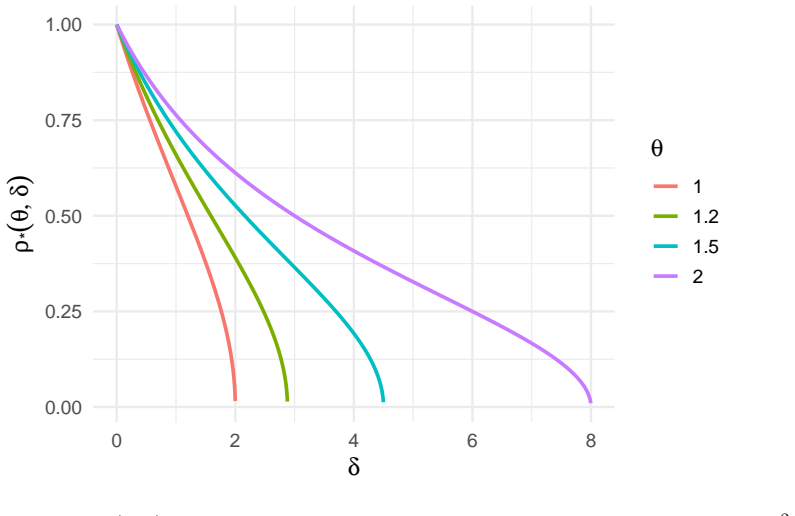


Figures from the paper (9 more)


Reference graph
Works this paper leans on
-
[1]
High-dimensional analysis of semidefinite relaxations for sparse principal components
Arash A Amini and Martin J Wainwright. High-dimensional analysis of semidefinite relaxations for sparse principal components. In 2008 IEEE international symposium on information theory, pp.\ 2454--2458. IEEE, 2008
2008
-
[2]
Phase transition of the largest eigenvalue for nonnull complex sample covariance matrices
Jinho Baik, G \'e rard Ben Arous, and Sandrine P \'e ch \'e . Phase transition of the largest eigenvalue for nonnull complex sample covariance matrices . The Annals of Probability, 33 0 (5): 0 1643 -- 1697, 2005. doi:10.1214/009117905000000233. URL https://doi.org/10.1214/009117905000000233
-
[3]
Online stochastic gradient descent on non-convex losses from high-dimensional inference
Gerard Ben Arous, Reza Gheissari, and Aukosh Jagannath. Online stochastic gradient descent on non-convex losses from high-dimensional inference. Journal of Machine Learning Research, 22 0 (106): 0 1--51, 2021
2021
-
[4]
High-dimensional limit theorems for sgd: Effective dynamics and critical scaling
Gerard Ben Arous, Reza Gheissari, and Aukosh Jagannath. High-dimensional limit theorems for sgd: Effective dynamics and critical scaling. Advances in neural information processing systems, 35: 0 25349--25362, 2022
2022
-
[5]
The eigenvalues and eigenvectors of finite, low rank perturbations of large random matrices
Florent Benaych-Georges and Raj Rao Nadakuditi. The eigenvalues and eigenvectors of finite, low rank perturbations of large random matrices. Advances in Mathematics, 227 0 (1): 0 494--521, 2011
2011
-
[6]
The singular values and vectors of low rank perturbations of large rectangular random matrices
Florent Benaych-Georges and Raj Rao Nadakuditi. The singular values and vectors of low rank perturbations of large rectangular random matrices. Journal of Multivariate Analysis, 111: 0 120--135, 2012
2012
-
[7]
Probability and measure
Patrick Billingsley. Probability and measure. John Wiley & Sons, 2017
2017
-
[8]
Online principal components analysis
Christos Boutsidis, Dan Garber, Zohar Karnin, and Edo Liberty. Online principal components analysis. In Proceedings of the twenty-sixth annual ACM-SIAM symposium on Discrete algorithms, pp.\ 887--901. SIAM, 2014
2014
Show all 66 references
-
[9]
Online principal component analysis in high dimension: Which algorithm to choose? International Statistical Review, 86 0 (1): 0 29--50, 2018
Herv \'e Cardot and David Degras. Online principal component analysis in high dimension: Which algorithm to choose? International Statistical Review, 86 0 (1): 0 29--50, 2018
2018
-
[10]
Information-theoretically optimal sparse pca
Yash Deshpande and Andrea Montanari. Information-theoretically optimal sparse pca. In 2014 IEEE International Symposium on Information Theory, pp.\ 2197--2201. IEEE, 2014
2014
-
[11]
Sparse pca via covariance thresholding
Yash Deshpande and Andrea Montanari. Sparse pca via covariance thresholding. Journal of Machine Learning Research, 17 0 (141): 0 1--41, 2016
2016
-
[12]
Observed universality of phase transitions in high-dimensional geometry, with implications for modern data analysis and signal processing
David Donoho and Jared Tanner. Observed universality of phase transitions in high-dimensional geometry, with implications for modern data analysis and signal processing. Philosophical Transactions of the Royal Society A: Mathematical, Physical and Engineering Sciences, 367 0 (...
1906
-
[15]
Streaming pca: Matching matrix bernstein and near-optimal finite sample guarantees for oja’s algorithm
Prateek Jain, Chi Jin, Sham M Kakade, Praneeth Netrapalli, and Aaron Sidford. Streaming pca: Matching matrix bernstein and near-optimal finite sample guarantees for oja’s algorithm. In Conference on learning theory, pp.\ 1147--1164. PMLR, 2016
2016
-
[16]
On the distribution of the largest eigenvalue in principal components analysis
Iain M Johnstone. On the distribution of the largest eigenvalue in principal components analysis. The Annals of statistics, 29 0 (2): 0 295--327, 2001
2001
-
[17]
On consistency and sparsity for principal components analysis in high dimensions
Iain M Johnstone and Arthur Yu Lu. On consistency and sparsity for principal components analysis in high dimensions. Journal of the American Statistical Association, 104 0 (486): 0 682--693, 2009
2009
-
[18]
Pca in high dimensions: An orientation
Iain M Johnstone and Debashis Paul. Pca in high dimensions: An orientation. Proceedings of the IEEE, 106 0 (8): 0 1277--1292, 2018
2018
-
[19]
Method of stochastic approximation in the determination of the largest eigenvalue of the mathematical expectation of random matrices
T Krasulina. Method of stochastic approximation in the determination of the largest eigenvalue of the mathematical expectation of random matrices. Automatation and remote control, 2: 0 50--56, 1970
1970
-
[20]
Streaming pca for markovian data
Syamantak Kumar and Purnamrita Sarkar. Streaming pca for markovian data. Advances in Neural Information Processing Systems, 36: 0 64650--64662, 2023
2023
-
[22]
Diffusion approximations for online principal component estimation and global convergence
Chris Junchi Li, Mengdi Wang, Han Liu, and Tong Zhang. Diffusion approximations for online principal component estimation and global convergence. Advances in Neural Information Processing Systems, 30, 2017
2017
-
[24]
Bootstrapping the error of oja's algorithm
Robert Lunde, Purnamrita Sarkar, and Rachel Ward. Bootstrapping the error of oja's algorithm. Advances in neural information processing systems, 34: 0 6240--6252, 2021
2021
-
[25]
Multivariate analysis
Kanti V Mardia, John T Kent, and Charles C Taylor. Multivariate analysis. John Wiley & Sons, 2024
2024
-
[26]
Estimation of low-rank matrices via approximate message passing
Andrea Montanari and Ramji Venkataramanan. Estimation of low-rank matrices via approximate message passing . The Annals of Statistics, 49 0 (1): 0 321 -- 345, 2021. doi:10.1214/20-AOS1958. URL https://doi.org/10.1214/20-AOS1958
2021 doi
-
[27]
Online pca with optimal regret
Jiazhong Nie, Wojciech Kotlowski, and Manfred K Warmuth. Online pca with optimal regret. Journal of Machine Learning Research, 17 0 (173): 0 1--49, 2016
2016
-
[28]
Simplified neuron model as a principal component analyzer
Erkki Oja. Simplified neuron model as a principal component analyzer. Journal of mathematical biology, 15 0 (3): 0 267--273, 1982
1982
-
[29]
On stochastic approximation of the eigenvectors and eigenvalues of the expectation of a random matrix
Erkki Oja and Juha Karhunen. On stochastic approximation of the eigenvectors and eigenvalues of the expectation of a random matrix. Journal of mathematical analysis and applications, 106 0 (1): 0 69--84, 1985
1985
-
[30]
Optimality and sub-optimality of pca i: Spiked random matrix models
Amelia Perry, Alexander S Wein, Afonso S Bandeira, and Ankur Moitra. Optimality and sub-optimality of pca i: Spiked random matrix models. The Annals of Statistics, 46 0 (5): 0 2416--2451, 2018
2018
-
[32]
An introduction to ordinary differential equations
James C Robinson. An introduction to ordinary differential equations. Cambridge University Press, 2004
2004
-
[33]
Online learning for sparse pca in high dimensions: Exact dynamics and phase transitions
Chuang Wang and Yue M Lu. Online learning for sparse pca in high dimensions: Exact dynamics and phase transitions. In 2016 IEEE Information Theory Workshop (ITW), pp.\ 186--190. IEEE, 2016
2016
-
[35]
Randomized online pca algorithms with regret bounds that are logarithmic in the dimension
Manfred K Warmuth and Dima Kuzmin. Randomized online pca algorithms with regret bounds that are logarithmic in the dimension. Journal of Machine Learning Research, 9 0 (10): 0 2287--2320, 2008
2008
-
[36]
The Annals of statistics , volume=
On the distribution of the largest eigenvalue in principal components analysis , author=. The Annals of statistics , volume=. 2001 , publisher=
2001
-
[37]
The Annals of Probability , number =
Jinho Baik and G. The Annals of Probability , number =. 2005 , doi =
2005
-
[38]
Advances in Mathematics , volume=
The eigenvalues and eigenvectors of finite, low rank perturbations of large random matrices , author=. Advances in Mathematics , volume=. 2011 , publisher=
2011
-
[39]
Proceedings of the IEEE , volume=
PCA in high dimensions: An orientation , author=. Proceedings of the IEEE , volume=. 2018 , publisher=
2018
-
[40]
Journal of mathematical biology , volume=
Simplified neuron model as a principal component analyzer , author=. Journal of mathematical biology , volume=. 1982 , publisher=
1982
-
[41]
Journal of mathematical analysis and applications , volume=
On stochastic approximation of the eigenvectors and eigenvalues of the expectation of a random matrix , author=. Journal of mathematical analysis and applications , volume=. 1985 , publisher=
1985
-
[42]
2014 , publisher=
Martingale limit theory and its application , author=. 2014 , publisher=
2014
-
[43]
Lecture notes, University of Chicago Department of Statistics , year=
The Martingale Central Limit Theorem , author=. Lecture notes, University of Chicago Department of Statistics , year=
-
[44]
2004 , publisher=
An introduction to ordinary differential equations , author=. 2004 , publisher=
2004
-
[45]
2024 , publisher=
Multivariate analysis , author=. 2024 , publisher=
2024
-
[46]
Journal of Machine Learning Research , volume=
Online stochastic gradient descent on non-convex losses from high-dimensional inference , author=. Journal of Machine Learning Research , volume=
-
[47]
Journal of Multivariate Analysis , volume=
The singular values and vectors of low rank perturbations of large rectangular random matrices , author=. Journal of Multivariate Analysis , volume=. 2012 , publisher=
2012
-
[48]
The Annals of Statistics , volume=
Optimality and sub-optimality of PCA I: Spiked random matrix models , author=. The Annals of Statistics , volume=. 2018 , publisher=
2018
-
[49]
2016 IEEE Information Theory Workshop (ITW) , pages=
Online learning for sparse PCA in high dimensions: Exact dynamics and phase transitions , author=. 2016 IEEE Information Theory Workshop (ITW) , pages=. 2016 , organization=
2016
-
[50]
arXiv preprint arXiv:1712.04332 , year=
Scaling limit: Exact and tractable analysis of online learning algorithms with applications to regularized regression and PCA , author=. arXiv preprint arXiv:1712.04332 , year=
-
[51]
Journal of the American Statistical Association , volume=
On consistency and sparsity for principal components analysis in high dimensions , author=. Journal of the American Statistical Association , volume=. 2009 , publisher=
2009
-
[52]
Journal of Machine Learning Research , volume=
Sparse PCA via covariance thresholding , author=. Journal of Machine Learning Research , volume=
-
[53]
2014 IEEE International Symposium on Information Theory , pages=
Information-theoretically optimal sparse PCA , author=. 2014 IEEE International Symposium on Information Theory , pages=. 2014 , organization=
2014
-
[54]
2008 IEEE international symposium on information theory , pages=
High-dimensional analysis of semidefinite relaxations for sparse principal components , author=. 2008 IEEE international symposium on information theory , pages=. 2008 , organization=
2008
-
[55]
The Annals of Statistics , number =
Andrea Montanari and Ramji Venkataramanan , title =. The Annals of Statistics , number =. 2021 , doi =
2021
-
[56]
Proceedings of the National Academy of Sciences , volume =
Gen Li and Wei Fan and Yuting Wei , title =. Proceedings of the National Academy of Sciences , volume =. 2023 , doi =. https://www.pnas.org/doi/pdf/10.1073/pnas.2302930120 , abstract =
2023 doi
-
[57]
Automatation and remote control , volume=
Method of stochastic approximation in the determination of the largest eigenvalue of the mathematical expectation of random matrices , author=. Automatation and remote control , volume=
-
[58]
Journal of Machine Learning Research , volume=
Randomized online PCA algorithms with regret bounds that are logarithmic in the dimension , author=. Journal of Machine Learning Research , volume=. 2008 , publisher=
2008
-
[59]
Proceedings of the twenty-sixth annual ACM-SIAM symposium on Discrete algorithms , pages=
Online principal components analysis , author=. Proceedings of the twenty-sixth annual ACM-SIAM symposium on Discrete algorithms , pages=. 2014 , organization=
2014
-
[60]
Conference on learning theory , pages=
Streaming pca: Matching matrix bernstein and near-optimal finite sample guarantees for oja’s algorithm , author=. Conference on learning theory , pages=. 2016 , organization=
2016
-
[61]
Journal of Machine Learning Research , volume=
Online PCA with optimal regret , author=. Journal of Machine Learning Research , volume=
-
[62]
arXiv preprint arXiv:1905.12115 , year=
AdaOja: Adaptive learning rates for streaming PCA , author=. arXiv preprint arXiv:1905.12115 , year=
1905 arXiv
-
[63]
Advances in neural information processing systems , volume=
Bootstrapping the error of Oja's algorithm , author=. Advances in neural information processing systems , volume=
-
[64]
International Statistical Review , volume=
Online principal component analysis in high dimension: Which algorithm to choose? , author=. International Statistical Review , volume=. 2018 , publisher=
2018
-
[65]
Advances in Neural Information Processing Systems , volume=
Streaming pca for markovian data , author=. Advances in Neural Information Processing Systems , volume=
-
[66]
arXiv preprint arXiv:2506.12655 , year=
Beyond Sin-Squared Error: Linear-Time Entrywise Uncertainty Quantification for Streaming PCA , author=. arXiv preprint arXiv:2506.12655 , year=
-
[67]
arXiv preprint arXiv:2511.18273 , year=
Time-uniform concentration bounds for iterative algorithms , author=. arXiv preprint arXiv:2511.18273 , year=
-
[68]
Advances in neural information processing systems , volume=
High-dimensional limit theorems for sgd: Effective dynamics and critical scaling , author=. Advances in neural information processing systems , volume=
-
[69]
arXiv preprint arXiv:2512.13634 , year=
Universality of high-dimensional scaling limits of stochastic gradient descent , author=. arXiv preprint arXiv:2512.13634 , year=
-
[70]
Advances in Neural Information Processing Systems , volume=
Diffusion approximations for online principal component estimation and global convergence , author=. Advances in Neural Information Processing Systems , volume=
-
[71]
2017 , publisher=
Probability and measure , author=. 2017 , publisher=
2017
-
[72]
Philosophical Transactions of the Royal Society A: Mathematical, Physical and Engineering Sciences , volume=
Observed universality of phase transitions in high-dimensional geometry, with implications for modern data analysis and signal processing , author=. Philosophical Transactions of the Royal Society A: Mathematical, Physical and Engineering Sciences , volume=. 2009 , publisher=
2009
Reviewed July 31, 2026 · model on record in the stance chip above.
Discussion (0). Continue with ORCID to comment.